LAST UPDATED: November 23, 2026

How's the skincare market doing? Get the full picture here

TikTok made shoppers into chemists, now skincare follows. Shoppers now read ingredient lists like nutrition labels, and sunscreen is turning into a daily habit. Big groups are still paying billions for brands that dermatologists recommend. This report gets you up to date on the whole skincare market.

  • 190+ pages
  • 12 sections
  • verified data only
How's the skincare market doing? Get the full picture here market report cover

What’s inside the report?

12 sections to help founders and investors understand the skincare market with clarity

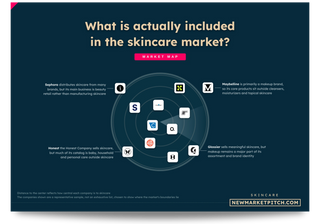
Radar map of the skincare market showing which companies count as part of it, which sit on its edge and which stay outside: What is actually included in the skincare market? (Skincare Market, NewMarketPitch)
Market Definition

What is this market about?

Skincare figures online often lump in makeup, hair products and treatments done in a clinic, so we start by saying exactly what we count.

A cleanser, a vitamin C serum or a daily sunscreen is in. So is an acne patch sold at the pharmacy. A foundation with SPF sold as makeup is out, and so are prescription creams, injections and laser sessions.

That way, the market size, the categories and the brands we compare all describe the same thing.

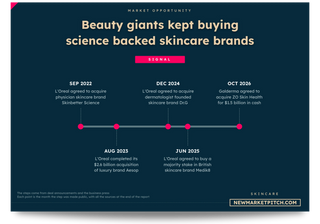
Timeline of the dated steps showing how the skincare market is moving, with one key signal: Beauty giants kept buying science backed skincare brands (Skincare Market, NewMarketPitch)
Market Opportunity

Why this market now?

Skincare is hot, and the money is moving toward products that promise proven results, from dermatologist brands to better sun protection.

We've found a lot of interesting signals. For example, in November 2025, Kimberly-Clark, the maker of Huggies and Kleenex, agreed to buy Kenvue, the owner of Neutrogena and Aveeno, in a deal worth about $48.7B. And in June 2026, the FDA added bemotrizinol to its list of approved sunscreen ingredients, the first new one in more than 20 years. Big buyers want trusted skincare brands, and the rules are finally catching up with what shoppers want from sunscreen.

In this section, we look at why science-backed skincare is pulling ahead, what a new sunscreen filter changes for brands selling in the US, and what these big moves mean for smaller players.

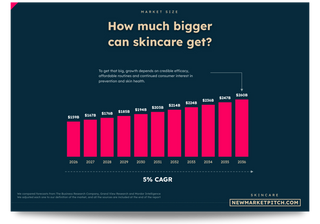
Bar chart of the skincare market size year by year to 2036, with its growth rate: How much bigger can skincare get? (Skincare Market, NewMarketPitch)
Market Size

How big could this market get?

Skincare market sizes online rarely agree. Some count makeup with SPF, others add body care, prescription products or salon treatments.

We use first principles. We build our own estimate from what brands actually sell, compare it with outside sources, and spell out each assumption, so you can follow how we reached our number.

We also show how the number changes in a cautious and an optimistic scenario, for example if shoppers keep trading down to cheaper brands or keep paying more for active ingredients.

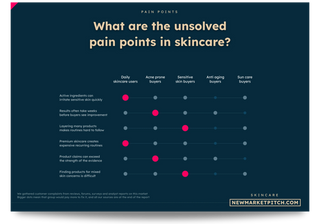
Matrix of the problems skincare customers still face, rated for each type of buyer: What are the unsolved pain points in skincare? (Skincare Market, NewMarketPitch)
Pain Points

What are the pain points, and for whom?

Shoppers have never had more skincare choice. That's exactly the problem: most of them don't know what works for their skin.

We compare six kinds of skincare companies, from mass and pharmacy brands to prestige labels, sun care specialists and the labs that make products for others. Then we rank what hurts them most, like copycat formulas that land within months, claims that need costly testing, and retailers that drop slow sellers fast.

This shows which problems a skincare company can turn into a reason to buy, and which ones every brand simply has to live with.

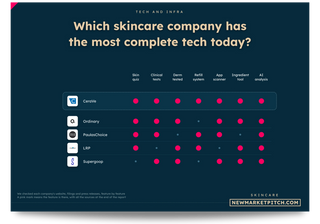
Comparison table of the tech offered by leading skincare companies: Which skincare company has the most complete tech today? (Skincare Market, NewMarketPitch)
Tech & Infra

What is the latest tech and infrastructure?

A great serum starts in the lab, but it lives or dies on proof. Brands need stable formulas, clinical tests and claims that regulators will accept.

We go through what sits behind a modern skincare product: new actives like peptides and gentler retinoids, newer sunscreen filters, contract manufacturers, clinical testing labs, and the AI tools that analyze skin photos or suggest a routine. We also show where things get stuck, like slow sunscreen approvals in the US, ingredients that are hard to keep stable, and new safety rules that add paperwork.

You'll see which technologies already change what shoppers buy today, and which are still mostly marketing.

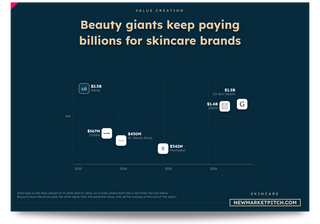
Chart of the main skincare deals placed by date and value, each shown with the logo of the buyer: Beauty giants keep paying billions for skincare brands (Skincare Market, NewMarketPitch)
Value Creation

How is value created and monetized exactly?

Pharmacy and supermarket sales, beauty retailers, a brand's own website, Amazon, dermatologist offices and, for many founders, the sale of the brand itself: skincare companies make money in several ways.

We compare where the margin goes. The jar itself costs little, but marketing, retailer fees and clinical tests eat most of the price. Mass brands live on volume and shelf space. Prestige brands charge more but spend heavily to stay visible. Selling online keeps more of each sale, until ad costs rise. And brands recommended by dermatologists spend years building trust that is hard to copy.

You'll see which models still make money when ad prices climb and shoppers trade down, and which ones only work while a product is trending.

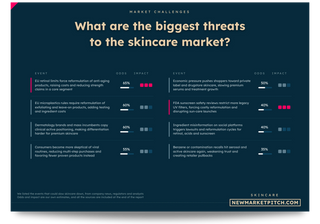
Table of the events that could slow the skincare market, with their odds and impact: What are the biggest threats to the skincare market? (Skincare Market, NewMarketPitch)
Market Challenges

What could slow this market down?

Some brakes are easy to see: crowded shelves, shoppers who jump to the next trend, and cheaper copies of every hit product.

Others are easier to miss. New US safety rules mean more testing and record keeping. Tariffs raise the cost of packaging and ingredients. Retailers push back on margins. And when a brand's claims go too far, regulators, lawyers and social media can turn on it quickly.

We take each risk in turn, rate how likely it is, and show which kinds of skincare brands would feel it most.

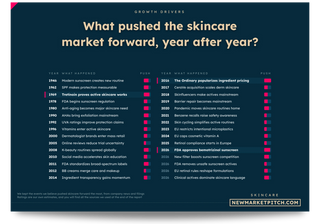
Timeline of the events that pushed the skincare market forward, with their impact: What pushed the skincare market forward, year after year? (Skincare Market, NewMarketPitch)
Growth Drivers

What are the growth drivers in this market?

Skincare keeps growing for reasons that run deeper than the latest viral routine, so we go through them one by one.

Some drivers are easy to see: aging populations, more people wearing sunscreen every day, and younger shoppers starting skincare earlier. Others feed each other. Shoppers who learn about ingredients become willing to pay for proven ones. Dermatologists who trust a brand recommend it, which builds the reviews that sell it. And every brand that sells for a high price convinces investors to fund the next one.

Before building or investing, you should know what makes a shopper buy a second bottle, and what makes them stay with one brand instead of chasing the next launch.

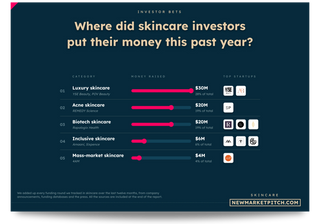
Bar chart of where investors put their money in skincare, by category: Where did skincare investors put their money this past year? (Skincare Market, NewMarketPitch)
Investor Bets

What are investors betting on now?

Investors still love skincare, but they want brands that make money, not just brands that trend.

We compare recent rounds and deals across dermatologist brands, sun care, acne care and prestige skincare. We also look at whether big groups prefer to buy whole brands or take smaller stakes first, and which newer bets, like skin testing at home and products for sensitive skin, are getting funded.

You'll see which skincare brands investors trust today, based on recent deals from Kimberly-Clark's offer for Kenvue to smaller rounds. We also look at what a younger brand needs to show before it can raise.

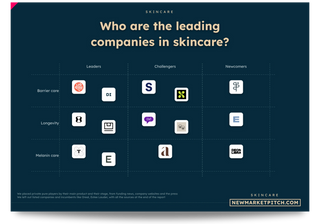
Market grid of the top skincare startups and companies by segment: Who are the leading companies in skincare? (Skincare Market, NewMarketPitch)
Top Players

Who are the top startups and companies?

CeraVe and The Ordinary come up first when people talk about affordable skincare that works, but they're only one part of this market.

Many interesting companies grow quietly. Some only make products for acne or very sensitive skin. Others develop new sunscreen filters, test claims for the big brands, or make the formulas that dozens of better-known labels sell under their own names.

They're hard to compare because two serums can look the same on the shelf and work very differently. Many sell mostly in pharmacies or abroad, and most are private, so their real sales stay hidden.

Below, you'll find the market grids and ecosystem maps we've built to show who makes what, who sells where, and where newer brands are getting in.

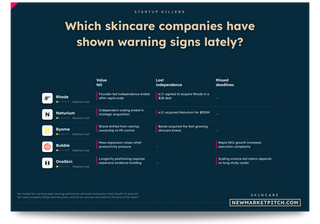
Table of the warning signs shown by leading skincare companies: Which skincare companies have shown warning signs lately? (Skincare Market, NewMarketPitch)
Startup Killers

What could kill a startup in this market?

Anyone can launch a serum. Few can get shoppers to finish the bottle and buy another.

So we studied why skincare startups fail or stall. Some made claims they couldn't back up and lost shoppers' trust. Others bet everything on one hero product that copycats matched at half the price. And some spent so much on ads that every new customer lost them money.

If you're building, you'll see why proof, repeat buyers and controlled ad spend matter more than one viral launch. If you're investing, you'll know what to check about claims, copycat risk and the real cost of each new customer.

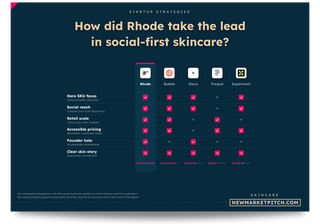
Scorecard showing what sets the leading skincare company apart: How did Rhode take the lead in social-first skincare? (Skincare Market, NewMarketPitch)
Startup Strategies

How do you win in this market?

Rhode, Paula's Choice, Supergoop!… a few skincare brands have turned a clear promise into a business someone was willing to pay for, or that keeps growing.

Rhode kept its range small, built it around Hailey Bieber's own routine, and sold to e.l.f. Beauty in a deal worth up to $1B. Paula's Choice won shoppers by explaining ingredients in plain words, then sold to Unilever. Supergoop! built its whole brand around wearing sunscreen every day. Their paths are very different, and none of them is a formula others can copy.

We'll look at how these teams picked one clear promise, earned shoppers' trust with it, and grew from there.

Questions?

Who is this market report actually for?+

It's for founders, investors, beauty and consumer health groups, retailers, ingredient suppliers, manufacturers and strategists who want a clear view of skincare.

Use it to choose a category to launch in, to weigh pharmacy, prestige and online channels, to judge what proof your claims need, to decide when a brand is ready to raise or sell, or to understand demand, technology, funding, competitors and risks across the whole market.

How many pages are in the report?+

It has 190+ pages. It is designed to be comprehensive enough to support serious market evaluation, while still being fast to read and easy to use.

We prioritize signal, structure, and visual clarity over unnecessary length.

What do you include in the skincare market?+

We define the skincare market as companies whose main business is developing, branding and selling topical products or digitally delivered regimens designed to cleanse, protect, hydrate, repair or improve the appearance and health of human skin.

We include facial and body skincare, anti-acne and dermatology-led cosmetic regimens, sunscreen-led brands, topical skin-longevity and microbiome products, barrier care, brands built for skin of color, and hybrid skincare plus consultation models where products and regimens are core.

We exclude color cosmetics, fragrance, haircare, general personal care, supplements without topical skincare, beauty retail, spas and clinics selling services, dermatology therapeutics, beauty-tech software, and contract manufacturers or ingredient suppliers without their own skincare brand.

Do you list your sources clearly?+

Yes. All key data points and assumptions are explained and sourced in the document.

All sources are tier-1: company filings, funding databases, public datasets, expert interviews, industry reports, etc.

Is the data up to date?+

Yes. The report was last updated on November 23, 2026 with the latest market signals.

Is this a one-time payment?+

Yes. This is a one-time purchase. There is no subscription required to access the document.

I want to buy several market reports, can I get a discount code?+

Yes. You can use NEWMARKET for 20% off when purchasing two reports, or NEWMARKETMAX for 30% off when purchasing five or more.

I’m interested in a market but I can’t find it here+

If a market you care about is not currently on the list, email us at team@newmarketpitch.com and we may be able to cover it.

I have more questions for you+

No problem. You can reach out directly and we respond within 24 hours.

LAST UPDATED: November 23, 2026

Before you build or invest in the skincare market, read this

A serum can sell out after one viral video and still lose money on every jar once the ads stop working. This report covers the whole skincare market, from size and shoppers to ingredients, channels, business models, funding, key brands, risks and the openings that remain.

PRO
$49
One-time payment
  • ✓ Market Definition
  • ✓ Market Opportunity
  • ✓ Market Size
  • ✓ Pain Points
  • ✓ Tech & Infra
  • ✓ Value Creation
  • ✓ Market Challenges
  • ✓ Growth Drivers
  • ✓ Investor Bets
  • ✓ Top Players
  • ✓ Startup Killers
  • ✓ Startup Strategies
PRO+
$79
One-time payment
  • ✓ Market Definition
  • ✓ Market Opportunity
  • ✓ Market Size
  • ✓ Pain Points
  • ✓ Tech & Infra
  • ✓ Value Creation
  • ✓ Market Challenges
  • ✓ Growth Drivers
  • ✓ Investor Bets
  • ✓ Top Players
  • ✓ Startup Killers
  • ✓ Startup Strategies
PRO++
$99
One-time payment
  • ✓ Market Definition
  • ✓ Market Opportunity
  • ✓ Market Size
  • ✓ Pain Points
  • ✓ Tech & Infra
  • ✓ Value Creation
  • ✓ Market Challenges
  • ✓ Growth Drivers
  • ✓ Investor Bets
  • ✓ Top Players
  • ✓ Startup Killers
  • ✓ Startup Strategies
Use code MARKETPITCH for 10% off your order