LAST UPDATED: November 24, 2026

Make smarter decisions on the sustainable packaging market

Sustainable packaging was marketing, now it's regulation. Packaging is turning from a brand promise into a line on the invoice, as producer fees and recyclability rules spread. Brands now have to cut material and switch formats without raising costs or shortening shelf life. This report brings you up to date on the whole sustainable packaging market.

  • 190+ pages
  • 12 sections
  • verified data only
Make smarter decisions on the sustainable packaging market market report cover

What’s inside the report?

12 sections to help founders and investors understand the sustainable packaging market with clarity

Radar map of the sustainable packaging market showing which companies count as part of it, which sit on its edge and which stay outside: Which companies really belong in sustainable packaging? (Sustainable Packaging Market, NewMarketPitch)
Market Definition

What is this market, exactly?

"Sustainable" is printed on almost every pack, so we start by being strict about what counts.

A single-material pouch that recycling plants can actually sort, a molded fiber tray that replaces foam, or a reusable cup system is in. So are coatings that let paper do a job plastic used to do. A regular plastic bottle with a green label is out, and so is a waste collection or recycling service.

That keeps the market size and our company comparisons consistent.

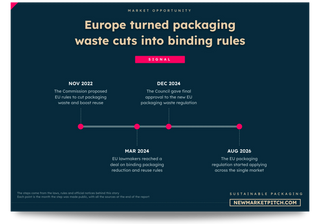
Timeline of the dated steps showing how the sustainable packaging market is moving, with one key signal: Europe turned packaging waste cuts into binding rules (Sustainable Packaging Market, NewMarketPitch)
Market Opportunity

Why this market now?

Sustainable packaging has stopped being a pledge. For more and more brands, it's now a bill.

We've found a lot of interesting signals. For example, in October 2025, UK companies received their first bills under the new packaging producer responsibility scheme, with fees for the first year estimated at close to £1.5 billion. And in May 2026, the permanent rules for California's SB 54 packaging law took effect, ahead of a 2032 deadline for all covered packaging sold in the state to be recyclable or compostable. Brands are starting to pay for the waste their packaging creates, and the surest way to pay less is to redesign the pack.

In this section, we look at how these fees change the cost of each material, which redesigns brands are making first, and what this means for suppliers of fiber, recyclable plastics, compostable materials and reuse systems.

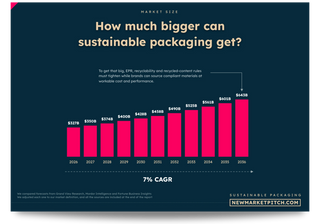
Bar chart of the sustainable packaging market size year by year to 2036, with its growth rate: How much bigger can sustainable packaging get? (Sustainable Packaging Market, NewMarketPitch)
Market Size

How big could this market get?

Sustainable packaging sizes online are all over the map. Some count every paper box ever made, others only bioplastics, and many never say what makes a pack sustainable.

We take a first-principles approach: we build our own estimate, check it against other sources, and spell out every assumption, including which formats count as a real improvement.

We also show how the number changes in a cautious and an optimistic scenario, for example if fees rise faster or if recycled material stays expensive.

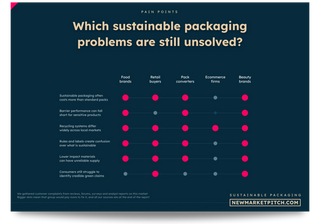
Matrix of the problems sustainable packaging customers still face, rated for each type of buyer: Which sustainable packaging problems are still unsolved? (Sustainable Packaging Market, NewMarketPitch)
Pain Points

What are the pain points, and for whom?

Brands are caught between new rules, retailer demands and shoppers who won't pay more. Every material switch has a cost somewhere.

We compare six kinds of sustainable packaging companies, from fiber and molded pulp to recyclable plastics, compostable materials, reuse systems and barrier coatings. Their buyers range from food and beauty brands to retailers, online sellers and restaurant chains. Then we rank what hurts most, like higher material prices, paper that can't keep food fresh as long, and packing lines that must be rebuilt for new formats.

This shows which switches brands will pay for now, and which ones they keep putting off.

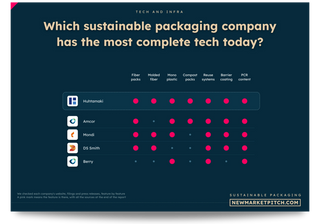
Comparison table of the tech offered by leading sustainable packaging companies: Which sustainable packaging company has the most complete tech today? (Sustainable Packaging Market, NewMarketPitch)
Tech & Infra

What is the latest tech and infrastructure?

Replacing plastic sounds simple. Then the new pack has to block oxygen and grease, run on the same machines and still get recycled.

We go through the stack, from fiber, recycled plastics and bio-based materials to coatings, inks, adhesives and the machines that form and fill packs. We also cover what's new, like dry molded fiber, paper bottles, and digital watermarks that help sorting plants. And we show where things get stuck: coatings that make paper hard to recycle, compostable packs with nowhere to be composted, and a short supply of recycled plastic approved for food.

You'll see which materials already run at scale today, and which still need better barriers or more recycling capacity.

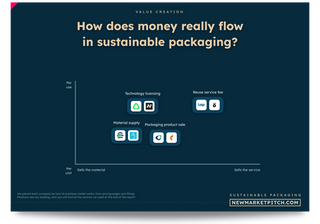
Map of sustainable packaging business models with company logos: How does money really flow in sustainable packaging? (Sustainable Packaging Market, NewMarketPitch)
Value Creation

How is value created and monetized exactly?

Selling packaging by the tonne or by the unit, licensing a material or a process, renting out reusable containers, and charging brands for redesign work: sustainable packaging companies make money in many ways.

We look at who pays and who keeps the margin. A material maker pays for new lines and long trials with each brand before volumes arrive. Licensors earn royalties but depend on converters to build the plants. Reuse systems pay for washing, transport and lost containers, so they need most containers to come back. And producer fees can shift the bill from one material to another overnight.

You'll see which models still make money once brands stop paying extra for a green pack, and which ones depend on rules that keep changing.

Table of the events that could slow the sustainable packaging market, with their odds and impact: What are the biggest threats to the sustainable packaging market? (Sustainable Packaging Market, NewMarketPitch)
Market Challenges

What could slow this market down?

Some brakes are easy to see: higher costs than conventional plastic, brands quietly scaling back their pledges, and shoppers who won't pay extra.

Others are easier to miss. Rules differ from one country or US state to the next, so a pack can comply in one market and not in another. Cheap virgin plastic makes recycled material hard to sell. Paper packs can fail recycling tests because of their coatings. And a single case of misleading green claims can make a brand drop a supplier.

We go through these risks one by one, rate how likely each is, and show which materials and business models are most exposed.

Timeline of the events that pushed the sustainable packaging market forward, with their impact: What pushed the sustainable packaging market forward, year after year? (Sustainable Packaging Market, NewMarketPitch)
Growth Drivers

What are the growth drivers in this market?

Rules explain much of the growth, but not all of it, so we look at each force separately.

Some drivers are easy to see: producer fees, recycled content targets, and retailers asking suppliers to use less packaging. Others feed each other. Higher fees on hard-to-recycle packs make cleaner designs cheaper by comparison. More sorting and recycling capacity makes recyclable formats worth more. And once one big brand switches a format, its suppliers can offer the same pack to rivals at a lower cost.

Before building or investing, you should know what makes a brand switch a pack across its whole range, not just on one product for a press release.

Bar chart of where investors put their money in sustainable packaging, by category: Where did sustainable packaging investors put their money this past year? (Sustainable Packaging Market, NewMarketPitch)
Investor Bets

Where are investors placing their bets today?

Investors still back new packaging materials, but they now want to see factories, customers and volumes.

We compare recent rounds and deals across fiber packaging, recyclable plastics, compostable materials and reuse systems. We also look at whether investors prefer companies that build their own plants or those that license technology to converters, and which newer bets, like coatings that let paper replace plastic, are getting funded.

You'll see which packaging startups are raising money today, as producer fees push brands to redesign. We also look at what a younger company needs to show, like a signed brand and a line running at full speed, before it can raise.

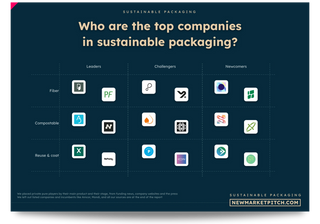
Market grid of the top sustainable packaging startups and companies by segment: Who are the top companies in sustainable packaging? (Sustainable Packaging Market, NewMarketPitch)
Top Players

Who are the top startups and companies?

Notpla and PulPac get much of the attention in sustainable packaging, but most of the market is built by companies few people have heard of.

Many interesting players work out of sight. Some develop coatings that let paper hold liquids and grease. Others turn plastic pouches into a single recyclable material, run washing centers for reusable cups, or design boxes that fit online orders with less empty space.

They're hard to compare because the same claim, recyclable or compostable, means different things in different countries. Many also sell through converters or brands, so their name never appears on the pack.

Below, you'll find the market grids and ecosystem maps we've built to show who makes which materials, who turns them into packs, and where new players are getting in.

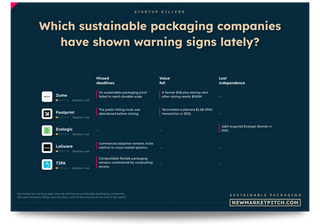
Table of the warning signs shown by leading sustainable packaging companies: Which sustainable packaging companies have shown warning signs lately? (Sustainable Packaging Market, NewMarketPitch)
Startup Killers

What could kill a startup in this market?

Brands love a greener pack until it costs more or slows down the line.

So we studied why sustainable packaging startups fail or stall. Some built a new material before finding a converter able to make it at scale. Others won pilots with famous brands that never turned into large orders. And some bet on compostable packs in places where no one collects compost.

If you're building, you'll see why cost, line speed and a real route to recycling or composting matter more than a striking material. If you're investing, you'll know what to check about signed volumes, converter partners and how much demand depends on a single rule.

Scorecard showing what sets the leading sustainable packaging company apart: How did Tetra Pak take the lead in aseptic beverage cartons? (Sustainable Packaging Market, NewMarketPitch)
Startup Strategies

How do you win in this market?

Ranpak, Huhtamaki, Vytal… a few companies have turned lower-impact packaging into a steady business, each with its own model.

Ranpak sells paper-based protective packaging to shippers and places its machines in their warehouses. Huhtamaki makes fiber cups, plates and egg cartons for food brands and restaurant chains. Vytal runs reusable takeaway containers in Germany without asking customers for a deposit. Their models are very different, and reuse in particular has yet to prove it can work in every city.

We'll look at how these companies made the greener option easy for customers to adopt, and kept it affordable enough to replace what was there before.

Questions?

Who is this market report actually for?+

It's for founders, investors, packaging makers and converters, consumer brands, retailers and strategists who want a clear view of sustainable packaging.

Use it to choose between fiber, recyclable plastics, compostable materials and reuse, to plan for producer fees and recyclability rules, to judge which materials can scale, or to understand demand, technology, funding, competitors and risks across the whole market.

How many pages are in the report?+

It has 190+ pages. It is designed to be comprehensive enough to support serious market evaluation, while still being fast to read and easy to use.

We prioritize signal, structure, and visual clarity over unnecessary length.

What do you include in the sustainable packaging market?+

We define the sustainable packaging market as companies whose core products or platforms demonstrably reduce the environmental footprint of packaging across its material, design, manufacture, use, reuse and end-of-life.

We include packaging-first renewable and recycled substrates, plastic-free and compostable formats, functional coatings, resource-efficient forming and right-sizing technologies, reusable and refillable packaging systems, and packaging-specific design, measurement, traceability and compliance software.

We exclude general materials and chemical recycling without a packaging focus, routine packaging from undifferentiated incumbents, waste management without a packaging offer, generic ESG tools, and consumer brands merely using greener packaging.

Do you list your sources clearly?+

Yes. All key data points and assumptions are explained and sourced in the document.

All sources are tier-1: company filings, funding databases, public datasets, expert interviews, industry reports, etc.

Is the data up to date?+

Yes. The report was last updated on November 24, 2026 with the latest market signals.

Is this a one-time payment?+

Yes. This is a one-time purchase. There is no subscription required to access the document.

I want to buy several market reports, can I get a discount code?+

Yes. You can use NEWMARKET for 20% off when purchasing two reports, or NEWMARKETMAX for 30% off when purchasing five or more.

I’m interested in a market but I can’t find it here+

If a market you care about is not currently on the list, email us at team@newmarketpitch.com and we may be able to cover it.

I have more questions for you+

No problem. You can reach out directly and we respond within 24 hours.

LAST UPDATED: November 24, 2026

Get the sustainable packaging market report

A greener pack can win over a brand's sustainability team and still lose to procurement on price. This report covers the whole sustainable packaging market: its size, buyers, materials and technology, business models, funding, key players, risks and the openings that remain.

PRO
$49
One-time payment
  • ✓ Market Definition
  • ✓ Market Opportunity
  • ✓ Market Size
  • ✓ Pain Points
  • ✓ Tech & Infra
  • ✓ Value Creation
  • ✓ Market Challenges
  • ✓ Growth Drivers
  • ✓ Investor Bets
  • ✓ Top Players
  • ✓ Startup Killers
  • ✓ Startup Strategies
PRO+
$79
One-time payment
  • ✓ Market Definition
  • ✓ Market Opportunity
  • ✓ Market Size
  • ✓ Pain Points
  • ✓ Tech & Infra
  • ✓ Value Creation
  • ✓ Market Challenges
  • ✓ Growth Drivers
  • ✓ Investor Bets
  • ✓ Top Players
  • ✓ Startup Killers
  • ✓ Startup Strategies
PRO++
$99
One-time payment
  • ✓ Market Definition
  • ✓ Market Opportunity
  • ✓ Market Size
  • ✓ Pain Points
  • ✓ Tech & Infra
  • ✓ Value Creation
  • ✓ Market Challenges
  • ✓ Growth Drivers
  • ✓ Investor Bets
  • ✓ Top Players
  • ✓ Startup Killers
  • ✓ Startup Strategies
Use code MARKETPITCH for 10% off your order