LAST UPDATED: November 21, 2026

Make better decisions on the virtual power plant market

Your home battery was a backup, now it helps the grid. Home batteries, thermostats and EVs now answer the grid's call by the hundreds of thousands. The hard part is getting paid for it year after year, while rules and budgets keep moving. This report walks you through the whole virtual power plant market.

  • 190+ pages
  • 12 sections
  • verified data only
Make better decisions on the virtual power plant market market report cover

What’s inside the report?

12 sections to help founders and investors understand the virtual power plant market with clarity

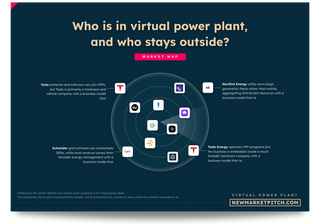
Radar map of the virtual power plant market showing which companies count as part of it, which sit on its edge and which stay outside: Who is in virtual power plant, and who stays outside? (Virtual Power Plant Market, NewMarketPitch)
Market Definition

What does this market really cover?

Virtual power plants get confused with home batteries, smart thermostats and old-style demand response, so we start by saying exactly what we count.

Software that tells 100,000 home batteries when to discharge into the evening peak is in. So is a platform that bundles factory loads, EV chargers and rooftop solar and bids them into a power market. A battery sold on its own is out, and so is an app that shows a home's energy use but never dispatches anything.

That way, the market size, the business models and every company we compare refer to the same thing.

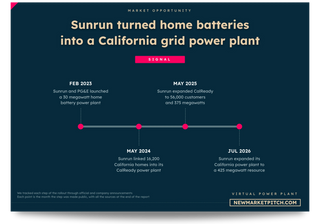
Timeline of the dated steps showing how the virtual power plant market is moving, with one key signal: Sunrun turned home batteries into a California grid power plant (Virtual Power Plant Market, NewMarketPitch)
Market Opportunity

Why this market now?

Virtual power plants now deliver power at the scale of a real plant, but much of their income still depends on programs that politicians can cut.

We've found a lot of interesting signals. For example, in September 2026, Sunrun and Tesla sent more than 580 MW from home batteries into California's grid during a heatwave, the largest dispatch of its kind on record. Yet a few weeks earlier, California's final budget gave the state program behind many of those payments no money for 2027. And in October 2026, Voltus raised $225M, partly to help data centers pay for flexible capacity in the communities around them. The fleets work and new buyers are showing up, but the business still rests on rules that can change in one budget vote.

In this section, we look at why grid operators now count on these fleets, which programs and markets actually pay them, and what new buyers like data centers could change for VPP companies.

Bar chart of the virtual power plant market size year by year to 2036, with its growth rate: How much bigger can virtual power plant get? (Virtual Power Plant Market, NewMarketPitch)
Market Size

How big could this market get?

VPP market sizes online swing wildly, because some count every home battery and solar panel sold, and others only the software that runs them.

We use first principles. We build our own estimate from the ground up, compare it with outside sources, and show each assumption so you can check how we got there.

We also show how the number moves in a cautious and an optimistic case, since it depends on how many grid markets open to these fleets and how much they pay.

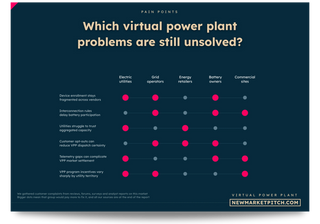
Matrix of the problems virtual power plant customers still face, rated for each type of buyer: Which virtual power plant problems are still unsolved? (Virtual Power Plant Market, NewMarketPitch)
Pain Points

What are the pain points, and for whom?

Utilities need more power at the evening peak, and a new gas plant takes years to build. Meanwhile, millions of batteries and thermostats sit in homes and buildings doing nothing for the grid.

We compare six kinds of VPP companies, from software sold to utilities to installers that run their own customers' batteries and platforms that bid factory loads into power markets. Their buyers are utilities, grid operators, energy retailers and large power users. Then we rank what hurts most, like peaks that are hard to cover, slow grid connections and customers who drop out of programs.

This shows who will pay for flexibility, and who still sees it as a nice extra.

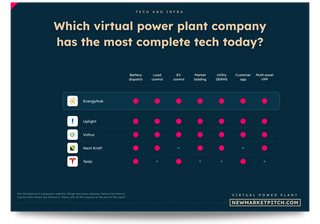
Comparison table of the tech offered by leading virtual power plant companies: Which virtual power plant company has the most complete tech today? (Virtual Power Plant Market, NewMarketPitch)
Tech & Infra

What is the latest tech and infrastructure?

A VPP is only as good as its weakest link. The software has to reach thousands of devices from different brands, predict what each one can give, and deliver on time when the grid calls.

We map the stack layer by layer, from the devices and their makers' clouds to forecasting, dispatch software and the link to utilities and power markets. We also show where things get stuck, like devices that don't speak the same language, meters too slow to prove what a home delivered, and utility systems that can't see what happens behind the meter.

You'll see which grid services a fleet of small devices can already deliver reliably today, and which ones still need a real power plant.

Map of virtual power plant business models with company logos: How does money really flow in virtual power plant? (Virtual Power Plant Market, NewMarketPitch)
Value Creation

How is value created and monetized exactly?

Utility program fees, payments from capacity and energy markets, savings shared with homeowners, software licenses and battery leases: there are many ways to earn money from a virtual power plant.

We compare who pays and who keeps what. A software vendor selling to utilities earns steady license fees but never touches market revenue. An aggregator earns from the grid, then shares much of it with device owners to keep them enrolled. A company that owns or leases the batteries keeps more of each dispatch, but has to finance the hardware. And every model pays to sign up customers, which is rarely cheap.

You'll see which models still make money when a program loses its funding, and which ones depend on a single market's prices.

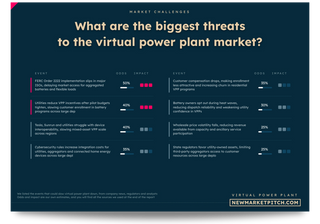
Table of the events that could slow the virtual power plant market, with their odds and impact: What are the biggest threats to the virtual power plant market? (Virtual Power Plant Market, NewMarketPitch)
Market Challenges

What could slow this market down?

Some brakes are easy to see: programs that depend on yearly budgets, grid markets that are slow to let small devices in, and utilities that would rather own their own assets.

Others are easier to miss. Device makers may keep control of their own fleets. Homeowners leave programs when a dispatch drains the battery they bought for blackouts. Meters and baselines make it hard to prove what a fleet really delivered. And the end of some US tax credits for home solar and batteries could slow the growth of devices to coordinate.

We go through these risks one by one, rate how likely each is, and explain which kinds of VPP companies would be hit hardest.

Timeline of the events that pushed the virtual power plant market forward, with their impact: What pushed the virtual power plant market forward, year after year? (Virtual Power Plant Market, NewMarketPitch)
Growth Drivers

What are the growth drivers in this market?

A VPP doesn't grow just because more batteries get installed. A few things have to line up, and we go through each of them.

Some drivers are easy to see: power demand rising with data centers and electrification, sharper evening peaks, and more batteries, EVs and heat pumps in homes. Others reinforce each other. Each successful dispatch gives grid operators more reason to count on these fleets. That opens new markets and better payments. And better payments make it easier to sign up the next thousand homes.

Before building or investing, you should know what makes a utility trust a fleet of homes as much as a power plant, and what keeps those homes enrolled.

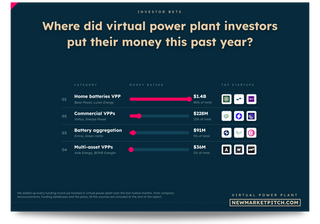
Bar chart of where investors put their money in virtual power plant, by category: Where did virtual power plant investors put their money this past year? (Virtual Power Plant Market, NewMarketPitch)
Investor Bets

What are investors betting on now?

VPP funding used to go mostly to software. Now some of the biggest checks go to companies that also own or lease the batteries in people's homes.

We compare recent rounds across utility software, market aggregators, home battery companies and platforms for commercial buildings. We also look at why investors are backing VPPs tied to data centers, and what they expect from companies outside the US, where power markets open to small devices at very different speeds.

You'll see which VPP models investors trust today, based on recent rounds like Voltus's, and how much proven capacity a younger company needs to show before it can raise.

Market grid of the top virtual power plant startups and companies by segment: Who are the top players in virtual power plant today? (Virtual Power Plant Market, NewMarketPitch)
Top Players

Who are the top startups and companies?

Next Kraftwerke and Kraken, the software company spun out of Octopus Energy, come up first when people talk about VPPs in Europe, but they're only a small part of the market.

The lesser-known VPP companies are often the most interesting. Some only manage water heaters or pool pumps. Others turn electric school buses into grid batteries, help utilities forecast what a neighborhood of devices can give, or work behind the scenes for the thermostat brand on the wall.

They're hard to compare because each one counts capacity its own way. One company quotes every device it could reach, another only the megawatts it actually delivered. And many sell under a utility's program name, so customers never hear of them.

Below, you'll find the market grids and ecosystem maps we've built to show who controls which devices, who sells to whom, and where newcomers are getting in.

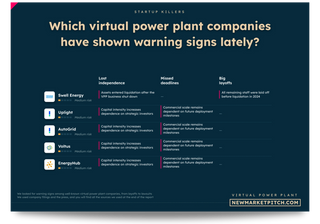
Table of the warning signs shown by leading virtual power plant companies: Which virtual power plant companies have shown warning signs lately? (Virtual Power Plant Market, NewMarketPitch)
Startup Killers

What could kill a startup in this market?

A VPP can lose its income in one budget vote. And its devices belong to someone else, who can opt out at any time.

So we studied why VPP startups fail or stall. Some built their business on one state program that later lost its funding. Others spent so much to sign up each home that it never paid back. And some depended on a single device maker that later launched its own VPP.

If you're building, you'll see why several sources of revenue, cheap enrollment and your own access to devices matter more than clever dispatch software. If you're investing, you'll know what to check about program risk, cost per home and who really controls the fleet.

Scorecard showing what sets the leading virtual power plant company apart: Why might Voltus be winning the DER aggregation market? (Virtual Power Plant Market, NewMarketPitch)
Startup Strategies

How do you win in this market?

EnergyHub, Leap, Base Power… a few VPP companies already earn real money from the grid, each in a different way.

EnergyHub sells VPP software to more than 120 utilities. Leap bids devices from dozens of partners into power markets and shares the income. Base Power leases batteries to homes in Texas and runs them as one fleet. None has proven its model in every market, but each found a payer that keeps coming back.

We'll look at how these teams chose who pays them first, kept device owners enrolled, and grew without betting everything on one program.

Questions?

Who is this market report actually for?+

It's for founders, investors, utilities, grid operators, energy retailers, device makers and strategists who want a clear view of virtual power plants.

It helps you choose between selling software to utilities and earning from power markets, decide which devices to aggregate first, and weigh program payments against market revenue. It also gives you the full picture: demand, technology, rules, funding, competitors and risks.

How many pages are in the report?+

It has 190+ pages. It is designed to be comprehensive enough to support serious market evaluation, while still being fast to read and easy to use.

We prioritize signal, structure, and visual clarity over unnecessary length.

What do you include in the virtual power plant market?+

We define the virtual power plant (VPP) market as software-coordinated aggregations of distributed electricity generation, storage or flexible-demand assets that are monitored, controlled or dispatched together to provide grid, wholesale-market or utility value.

We include independent VPP aggregators and operators, platforms that orchestrate third-party distributed energy resources, demand-response firms aggregating commercial, industrial or household loads, home battery and EV flexibility networks, renewable and storage fleet aggregators, and market access or connectivity built for dispatchable VPP capacity.

We exclude pure battery makers and EPCs, standalone grid-scale batteries, EV chargers without coordinated grid services, energy retailers focused on commodity supply, solar installers with incidental VPP pilots, generic home or building energy management, and one-off flexibility procurement tools.

Do you list your sources clearly?+

Yes. All key data points and assumptions are explained and sourced in the document.

All sources are tier-1: company filings, funding databases, public datasets, expert interviews, industry reports, etc.

Is the data up to date?+

Yes. The report was last updated on November 21, 2026 with the latest market signals.

Is this a one-time payment?+

Yes. This is a one-time purchase. There is no subscription required to access the document.

I want to buy several market reports, can I get a discount code?+

Yes. You can use NEWMARKET for 20% off when purchasing two reports, or NEWMARKETMAX for 30% off when purchasing five or more.

I’m interested in a market but I can’t find it here+

If a market you care about is not currently on the list, email us at team@newmarketpitch.com and we may be able to cover it.

I have more questions for you+

No problem. You can reach out directly and we respond within 24 hours.

LAST UPDATED: November 21, 2026

It's time to really understand the virtual power plant market

A fleet of home batteries can match a gas plant at the evening peak and still lose its main source of income in a budget vote. This report covers the whole virtual power plant market, from size and buyers to technology, business models, funding, competitors, risks and the openings that remain.

PRO
$49
One-time payment
  • ✓ Market Definition
  • ✓ Market Opportunity
  • ✓ Market Size
  • ✓ Pain Points
  • ✓ Tech & Infra
  • ✓ Value Creation
  • ✓ Market Challenges
  • ✓ Growth Drivers
  • ✓ Investor Bets
  • ✓ Top Players
  • ✓ Startup Killers
  • ✓ Startup Strategies
PRO+
$79
One-time payment
  • ✓ Market Definition
  • ✓ Market Opportunity
  • ✓ Market Size
  • ✓ Pain Points
  • ✓ Tech & Infra
  • ✓ Value Creation
  • ✓ Market Challenges
  • ✓ Growth Drivers
  • ✓ Investor Bets
  • ✓ Top Players
  • ✓ Startup Killers
  • ✓ Startup Strategies
PRO++
$99
One-time payment
  • ✓ Market Definition
  • ✓ Market Opportunity
  • ✓ Market Size
  • ✓ Pain Points
  • ✓ Tech & Infra
  • ✓ Value Creation
  • ✓ Market Challenges
  • ✓ Growth Drivers
  • ✓ Investor Bets
  • ✓ Top Players
  • ✓ Startup Killers
  • ✓ Startup Strategies
Use code MARKETPITCH for 10% off your order