LAST UPDATED: November 20, 2026

Make better decisions on the web3 infrastructure market

Web3 lost the hype, the infrastructure kept growing. Brokers, exchanges and big brands now launch blockchains of their own, and every crypto app still leans on nodes, data and tools it doesn't run itself. The hard part is staying reliable while prices for basic access keep falling. This report covers the whole web3 infrastructure market, from nodes and APIs to rollups and monitoring.

  • 190+ pages
  • 12 sections
  • verified data only
Make better decisions on the web3 infrastructure market market report cover

What’s inside the report?

12 sections to help founders and investors understand the web3 infrastructure market with clarity

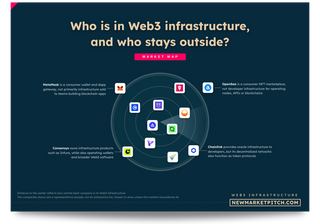
Radar map of the Web3 infrastructure market showing which companies count as part of it, which sit on its edge and which stay outside: Who is in Web3 infrastructure, and who stays outside? (Web3 Infrastructure Market, NewMarketPitch)
Market Definition

Where does this market start and stop?

Web3 infrastructure is easy to confuse with the blockchains themselves, or with the apps built on top. We start by separating the tools from the projects.

A service that runs nodes and answers an app's requests to a blockchain is in. So are indexing services, blockchain APIs, developer tools, rollup platforms and the dashboards teams use to watch their contracts. A consumer crypto app is out, and so are exchanges and tokens that come with no infrastructure product.

This keeps the market size and every company comparison tied to the same definition.

Timeline of the dated steps showing how the Web3 infrastructure market is moving, with one key signal: Ethereum keeps upgrading to scale its core network (Web3 Infrastructure Market, NewMarketPitch)
Market Opportunity

Why this market now?

Web3 infrastructure is winning bigger customers, but much of it still depends on a handful of providers, and that weakness is hard to ignore.

We've found a lot of interesting signals. For example, in October 2025, an Amazon Web Services outage disrupted Infura, one of the main services apps use to read blockchain data, and some wallets that rely on it showed users a zero balance. And in February 2026, Robinhood opened a public testnet for Robinhood Chain, its own blockchain built on Arbitrum. Large companies now want chains of their own, and they need infrastructure that keeps running when one cloud goes down.

In this section, we look at why more companies are launching their own chains, which parts of the infrastructure they rent rather than build, and what outages like this one mean for the providers behind them.

Bar chart of the Web3 infrastructure market size year by year to 2036, with its growth rate: How much bigger can Web3 infrastructure get? (Web3 Infrastructure Market, NewMarketPitch)
Market Size

How big could this market get?

Web3 infrastructure is hard to size. Figures online often mix in token values, mining or the whole blockchain market.

We build our own estimate from what developers and companies actually pay for nodes, APIs, data and tools. Then we check it against other sources and spell out each assumption.

We also show a cautious case and an optimistic one, so you can see how much the estimate depends on crypto activity.

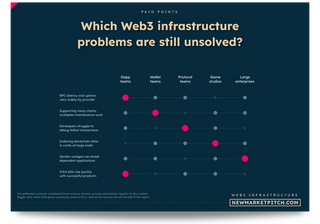
Matrix of the problems Web3 infrastructure customers still face, rated for each type of buyer: Which Web3 infrastructure problems are still unsolved? (Web3 Infrastructure Market, NewMarketPitch)
Pain Points

What are the pain points, and for whom?

Running a blockchain app means dealing with nodes that fall behind, data that is slow to query and contracts that can't be patched once they're live.

We split the market into six types of companies, from node and API providers to indexing services, developer tools, rollup platforms and monitoring tools. Then we rank the problems their buyers care about most: uptime, fast and accurate data, support for many chains and an early warning when something goes wrong.

This shows which problems teams will pay an outside provider to solve, and which ones they would rather handle in-house.

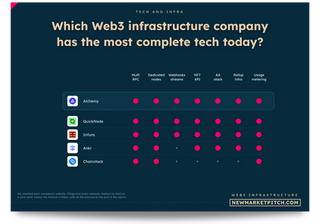
Comparison table of the tech offered by leading Web3 infrastructure companies: Which Web3 infrastructure company has the most complete tech today? (Web3 Infrastructure Market, NewMarketPitch)
Tech & Infra

What is the latest tech and infrastructure?

Every crypto app relies on parts most users never see: nodes that read the chain, indexers that turn raw blocks into usable data, and tools that catch bugs before they cost money.

We map the stack layer by layer, from the node and the RPC endpoint to indexing, rollup frameworks, account abstraction and monitoring. We also show where things get stuck, like providers hosted on the same few clouds, data that looks different from one chain to the next, and rollups that still rely on a single sequencer.

You'll see which parts are reliable enough for brokers and banks today, and which still fail under heavy load.

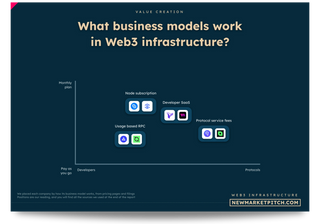
Map of Web3 infrastructure business models with company logos: What business models work in Web3 infrastructure? (Web3 Infrastructure Market, NewMarketPitch)
Value Creation

How is value created and monetized exactly?

Pay-as-you-go API calls, monthly plans, enterprise contracts, fees per rollup and a share of a chain's revenue: web3 infrastructure companies charge in many ways.

Node providers, rollup platforms and data tools aren't paid by the same people, and they don't carry the same costs. A node provider pays for servers and bandwidth, while rivals keep cutting prices. A rollup platform earns setup and hosting fees, sometimes plus part of the chain's revenue, but loses out if the chain never finds users. Data and monitoring tools can charge more because they save engineers time. And many providers still depend on grants from blockchain foundations.

You'll see which models keep their margins when basic node access gets cheaper every year and crypto activity slows.

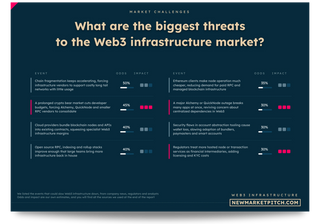
Table of the events that could slow the Web3 infrastructure market, with their odds and impact: What are the biggest threats to the Web3 infrastructure market? (Web3 Infrastructure Market, NewMarketPitch)
Market Challenges

What could slow this market down?

Some risks are easy to see: crypto downturns that cut usage, free tiers that never turn into paying plans, and blockchains that offer their own public endpoints.

Others are easier to miss. Many providers sit on the same few clouds. A large customer can bring its infrastructure in-house. A foundation can stop paying for support on its chain. And a chain that loses its users takes its infrastructure revenue with it.

We rank these risks by how likely they are, and explain which providers would lose the most if they happen.

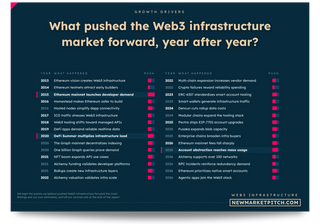
Timeline of the events that pushed the Web3 infrastructure market forward, with their impact: What pushed the Web3 infrastructure market forward, year after year? (Web3 Infrastructure Market, NewMarketPitch)
Growth Drivers

What are the growth drivers in this market?

Growth numbers mean little on their own. So we explain the forces that would push this market up.

Some drivers are clear: brokers, banks and brands launching their own chains, stablecoins used for real payments, and cheaper data on Ethereum after its recent upgrades. Others feed each other. Each new chain needs nodes, indexers and monitoring from day one. Better tools let smaller teams ship apps, which bring more traffic. And once a company runs on one provider's stack, it tends to add more services from the same provider.

Before building or investing, you should know what makes a company rent its blockchain infrastructure instead of building it, and what keeps it from switching providers.

Bar chart of where investors put their money in Web3 infrastructure, by category: Where did Web3 infrastructure investors put their money this past year? (Web3 Infrastructure Market, NewMarketPitch)
Investor Bets

What are investors backing right now?

In web3 infrastructure, investors now look past developer sign-ups to who actually pays.

We go through recent rounds and deals across node providers, data platforms, rollup services and developer tools. We compare companies that sell to crypto teams with those that sell to banks and brokers. We also flag newer bets, like infrastructure for AI agents that hold wallets or for chains launched by large companies.

We'll use the latest rounds and acquisitions to show which infrastructure businesses investors trust today, as more large companies build chains of their own.

Market grid of the top Web3 infrastructure startups and companies by segment: Who are the top companies in Web3 infrastructure? (Web3 Infrastructure Market, NewMarketPitch)
Top Players

Who are the top startups and companies?

Alchemy and QuickNode are the names most developers meet first, but they cover only one layer of web3 infrastructure.

Many interesting players work out of sight. Some index a single chain better than anyone else. Others simulate transactions before they go live, run the sequencer for someone else's rollup, or watch contracts and pause them when an attack starts.

They're hard to spot because their customers are other companies, not users. A wallet or an exchange shows its own name while a small provider serves the data underneath. And a free tier with thousands of sign-ups can hide how few customers really pay.

Below, you'll find our market grids and ecosystem maps, layer by layer, from raw nodes to the tools teams use to run their own chains.

Table of Web3 infrastructure startups that shut down or struggled, and why: What broke these Web3 infrastructure startups, and how did they end? (Web3 Infrastructure Market, NewMarketPitch)
Startup Killers

What could kill a startup in this market?

Infrastructure only gets noticed when it fails. And in web3, a customer can switch providers by changing one line of code.

We studied infrastructure startups that stalled or shut down. Some bet on a chain that lost its users. Others lived on grants from a foundation and struggled when the money stopped. And some sold node access at a loss, then couldn't raise prices once bigger rivals cut theirs.

If you're building, you'll see why reliability, the right chains and paying customers count for more than a big free tier. If you're investing, you'll know what to check about grant revenue, churn and dependence on a single chain.

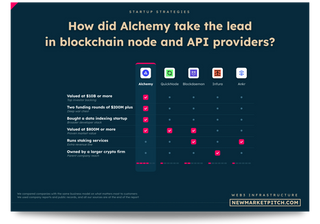
Scorecard showing what sets the leading Web3 infrastructure company apart: How did Alchemy take the lead in blockchain node and API providers? (Web3 Infrastructure Market, NewMarketPitch)
Startup Strategies

How do you win in this market?

Conduit, Tenderly, Dune… a few infrastructure companies have built products that teams pay for, each at a different layer.

Conduit launches and runs rollups for companies that want their own chain. Tenderly gives developers tools to simulate, debug and monitor transactions. Dune lets analysts query blockchain data with SQL and sells data access to companies. Each picked one job and did it well, though no single model has proven it works across every chain.

We'll look at how these teams found customers who pay, held on to them through downturns, and added services from there.

Questions?

Who is this market report actually for?+

It's for founders, investors, developers, crypto teams, banks and brokers exploring blockchains, cloud providers and strategists who want a clear view of web3 infrastructure.

Use it to decide whether to run infrastructure in-house or rent it, to choose between node, data and rollup businesses, to compare usage-based and enterprise pricing, or to understand demand, technology, funding, competitors and risks across the whole market.

How many pages are in the report?+

It has 190+ pages. It is designed to be comprehensive enough to support serious market evaluation, while still being fast to read and easy to use.

We prioritize signal, structure, and visual clarity over unnecessary length.

What do you include in the web3 infrastructure market?+

We define the web3 infrastructure market as companies mainly building reusable blockchain networks, technical primitives and developer or operator systems that let decentralized applications and protocols execute, interoperate, secure, verify, store, retrieve or access onchain activity.

We include core L1 and L2 execution networks, rollup launch, modular data availability and shared sequencing, nodes, RPC, validators and staking infrastructure, indexing, SDKs and blockchain data pipelines, messaging and bridges, ZK proving, oracles, smart-contract security, and blockchain-native decentralized physical or cloud infrastructure.

We exclude standalone wallets, consumer onboarding apps, exchanges, lending and asset-management protocols, RWA tokenization platforms, NFT, gaming and social apps, centralized cloud software, pure hardware makers, undifferentiated mining farms, and token-only ventures without an operating company.

Do you list your sources clearly?+

Yes. All key data points and assumptions are explained and sourced in the document.

All sources are tier-1: company filings, funding databases, public datasets, expert interviews, industry reports, etc.

Is the data up to date?+

Yes. The report was last updated on November 20, 2026 with the latest market signals.

Is this a one-time payment?+

Yes. This is a one-time purchase. There is no subscription required to access the document.

I want to buy several market reports, can I get a discount code?+

Yes. You can use NEWMARKET for 20% off when purchasing two reports, or NEWMARKETMAX for 30% off when purchasing five or more.

I’m interested in a market but I can’t find it here+

If a market you care about is not currently on the list, email us at team@newmarketpitch.com and we may be able to cover it.

I have more questions for you+

No problem. You can reach out directly and we respond within 24 hours.

LAST UPDATED: November 20, 2026

It's time to really understand the web3 infrastructure market

Node access gets cheaper every year, yet customers expect it never to go down. This report covers the whole web3 infrastructure market, from size and buyers to technology, business models, funding, key players, risks and openings.

PRO
$49
One-time payment
  • ✓ Market Definition
  • ✓ Market Opportunity
  • ✓ Market Size
  • ✓ Pain Points
  • ✓ Tech & Infra
  • ✓ Value Creation
  • ✓ Market Challenges
  • ✓ Growth Drivers
  • ✓ Investor Bets
  • ✓ Top Players
  • ✓ Startup Killers
  • ✓ Startup Strategies
PRO+
$79
One-time payment
  • ✓ Market Definition
  • ✓ Market Opportunity
  • ✓ Market Size
  • ✓ Pain Points
  • ✓ Tech & Infra
  • ✓ Value Creation
  • ✓ Market Challenges
  • ✓ Growth Drivers
  • ✓ Investor Bets
  • ✓ Top Players
  • ✓ Startup Killers
  • ✓ Startup Strategies
PRO++
$99
One-time payment
  • ✓ Market Definition
  • ✓ Market Opportunity
  • ✓ Market Size
  • ✓ Pain Points
  • ✓ Tech & Infra
  • ✓ Value Creation
  • ✓ Market Challenges
  • ✓ Growth Drivers
  • ✓ Investor Bets
  • ✓ Top Players
  • ✓ Startup Killers
  • ✓ Startup Strategies
Use code MARKETPITCH for 10% off your order