LAST UPDATED: November 20, 2026

It's time to better understand the workforce management software market

Scheduling an hourly team used to be a manager's spreadsheet problem. Now a late shift change can lead to fines, and overtime has to be tracked to the dollar. This report covers the whole market as it stands today.

  • 190+ pages
  • 12 sections
  • verified data only
It's time to better understand the workforce management software market market report cover

What’s inside the report?

12 sections to help founders and investors understand the workforce management software market with clarity

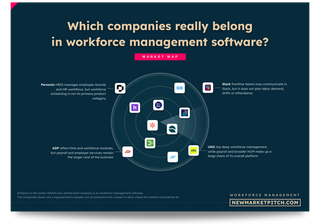
Radar map of the workforce management software market showing which companies count as part of it, which sit on its edge and which stay outside: Which companies really belong in workforce management software? (Workforce Management Software Market, NewMarketPitch)
Market Definition

Where does this market start and stop?

Workforce management gets confused with HR systems, payroll and even project tools, so we begin with a clear definition.

A tool that builds shift schedules for a store, tracks when nurses clock in, forecasts how many agents a call center needs, or checks that breaks follow local law is in. A payroll system that only pays the hours, a recruiting tool or a basic HR database is out.

That way, the numbers and every company we compare describe the same market.

Timeline of the dated steps showing how the workforce management software market is moving, with one key signal: UKG took its workforce AI from advice to real action (Workforce Management Software Market, NewMarketPitch)
Market Opportunity

Why this market now?

Workforce management is an old market, but scheduling and time tracking have become a legal and tax issue, and employers can't treat them as paperwork anymore.

We've found a lot of interesting signals. For example, in December 2025, Starbucks agreed to pay $38.9M to settle New York City claims that it broke the Fair Workweek law, the largest worker protection settlement in the city's history. And starting with the 2026 tax year, US employers must report qualified overtime pay separately on W-2 forms under the “no tax on overtime” law, with updated IRS guidance in August 2026. Getting hours and schedules wrong now has a clear cost, so accurate records are no longer optional.

In this section, we look at why scheduling and overtime rules keep spreading, which employers feel the pressure first, and where software vendors are finding new buyers.

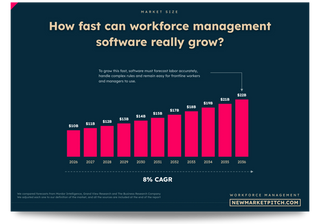
Bar chart of the workforce management software market size year by year to 2036, with its growth rate: How fast can workforce management software really grow? (Workforce Management Software Market, NewMarketPitch)
Market Size

How big could this market get?

Workforce management market sizes online often bundle in payroll, full HR suites or call center software, so the figures rarely agree.

We build our own estimate, compare it with published figures and explain each assumption, so you can see how we got there and judge it for yourself.

We also run a low and a high case, so you can see how much the answer depends on each assumption.

Matrix of the problems workforce management software customers still face, rated for each type of buyer: What are the unsolved pain points in workforce management software? (Workforce Management Software Market, NewMarketPitch)
Pain Points

What are the pain points, and for whom?

Labor is often the biggest cost a store, hospital or warehouse can control, and it's still planned week by week with too little information.

We compare six kinds of workforce management companies, from scheduling apps for small shops to enterprise suites for hospitals, retailers and factories. Then we rank what their buyers struggle with most: shifts left empty at the last minute, overtime that blows the budget, workers who quit over bad schedules, and labor rules that change from one city to the next.

This shows which problems a manager will pay to fix, and which ones still get solved in a group chat.

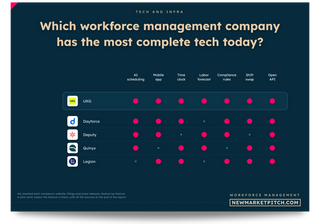
Comparison table of the tech offered by leading workforce management software companies: Which workforce management company has the most complete tech today? (Workforce Management Software Market, NewMarketPitch)
Tech & Infra

What is the latest tech and infrastructure?

A schedule is only as good as the forecast behind it. The software has to predict demand, match it with who's available, and follow the rules.

We go through the stack piece by piece: demand forecasting, scheduling engines, time clocks and mobile apps, libraries of labor rules, and links to payroll and HR systems. We also show where things break, like forecasts built on poor sales data, rule changes vendors must code city by city, workers clocking in for each other, and frontline staff who won't use a clunky app.

You'll see what AI scheduling already does well today, and where managers still overrule it.

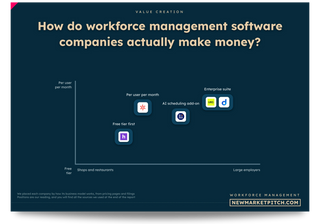
Map of workforce management software business models with company logos: How do workforce management software companies actually make money? (Workforce Management Software Market, NewMarketPitch)
Value Creation

How is value created and monetized exactly?

Per-employee subscriptions, per-location plans for small businesses, time clock hardware, enterprise licenses and paid compliance modules: workforce management vendors charge in several ways.

We compare who pays and what each type of customer costs to support. Small-business apps sell cheap monthly plans but lose many customers each year, as small shops close or switch. Enterprise suites sign long contracts, but need months of setup and custom rules. Some vendors also earn money from earned wage access or hiring tools sold to the same managers. And every new labor law means engineering work before it brings in any revenue.

You'll see which models still pay off when customers are small and short-lived, and which ones need big enterprise deals to work.

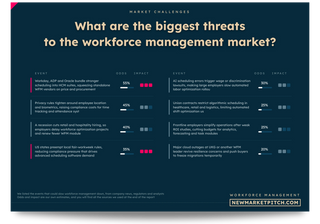
Table of the events that could slow the workforce management software market, with their odds and impact: What are the biggest threats to the workforce management market? (Workforce Management Software Market, NewMarketPitch)
Market Challenges

What could slow this market down?

Some brakes are obvious: thin margins in retail and restaurants, managers who trust their own spreadsheet, and long rollouts at large employers.

Others are easier to miss. Payroll and HR suites throw scheduling into a bundle. Unions may push back on schedules set by algorithms. Fingerprint and face scan time clocks invite privacy lawsuits, such as those under Illinois' biometric privacy law. And when hourly hiring slows, there are fewer people to schedule.

Each risk gets a rating for how likely it is, along with who would feel it first.

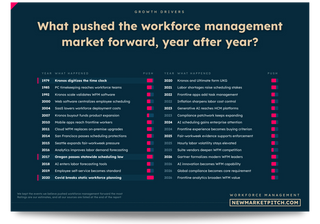
Timeline of the events that pushed the workforce management software market forward, with their impact: What pushed the workforce management market forward, year after year? (Workforce Management Software Market, NewMarketPitch)
Growth Drivers

What are the growth drivers in this market?

Workforce software grows when labor gets more expensive or harder to manage. We look at each force behind that.

Some are easy to see: higher minimum wages, staff shortages in healthcare and retail, and more fair scheduling rules. Others feed each other. Better forecasts make schedules more stable, so fewer workers quit. Shift swapping on a phone fills the last-minute gaps managers used to cover with overtime. And once time data is clean, payroll, compliance and labor planning tools are easier to sell on top.

Before building or investing, you should know what makes a manager trust the software's schedule, and what keeps hourly workers opening the app every week.

Bar chart of where investors put their money in workforce management software, by category: Where did workforce management software investors put their money this past year? (Workforce Management Software Market, NewMarketPitch)
Investor Bets

Where are investors placing their bets today?

Workforce management rarely makes funding headlines. Much of the money arrives through acquisitions by payroll and HR companies, alongside a few larger rounds for AI scheduling.

We compare recent rounds and deals across small-business scheduling apps, enterprise suites and tools built for one industry, like hospitals or warehouses. We also look at whether investors favor standalone vendors or those that bundle payroll and pay, and which newer bets, like AI that builds schedules on its own, are getting funded.

You'll see where money is going now that scheduling rules are tighter, and how many locations and active workers a younger company needs to show before it can raise.

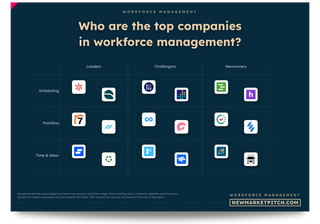
Market grid of the top workforce management software startups and companies by segment: Who are the top companies in workforce management? (Workforce Management Software Market, NewMarketPitch)
Top Players

Who are the top startups and companies?

UKG and Deputy are the names managers bring up first, one for large employers, the other for small and midsize teams, but the market goes well beyond them.

Plenty of interesting players work far from the headlines. Some only schedule nurses or airport ground crews. Others forecast call center volume, run time clocks with face recognition, or keep a library of local labor rules that other software plugs into.

They're hard to compare because scheduling is often sold inside a payroll or HR bundle, so it's unclear who really built it. And each industry runs shifts differently, so a tool that works in retail may fail in a hospital.

Below, you'll find the market grids and ecosystem maps we've built to show who serves which industry and company size, and where newer players are finding room.

Table of the warning signs shown by leading workforce management software companies: Which workforce management companies have shown warning signs lately? (Workforce Management Software Market, NewMarketPitch)
Startup Killers

What could kill a startup in this market?

Hourly workers don't read manuals. If the app is slow or the schedule is wrong, they stop using it, and so does the manager.

So we studied why workforce management startups fail or stall. Some sold cheap plans to small businesses that left within a year. Others promised AI schedules but spent months adapting to each customer's rules. And some lost deals once payroll providers started including scheduling for free.

If you're building, you'll see why worker adoption, rule coverage and links to payroll matter more than a smarter algorithm. If you're investing, you'll know what to check about churn, setup time, and how easily a bundled rival could replace the product.

Scorecard showing what sets the leading workforce management software company apart: Why might Legion be winning the AI scheduling market? (Workforce Management Software Market, NewMarketPitch)
Startup Strategies

How do you win in this market?

Legion, Quinyx, Connecteam… a few workforce management companies have won steady customers by focusing on frontline teams.

Legion sells AI scheduling to large hourly employers like retail and restaurant chains. Quinyx built its business on scheduling for retail and hospitality in Europe. Connecteam offers one low-cost app for deskless teams, with time tracking, schedules and chat. Each found a clear customer, but none has yet matched the reach of the big suites.

We'll look at how these teams earned frontline workers' trust, what they automated first, and how they kept managers using the product long after rollout.

Questions?

Who is this market report actually for?+

It's for founders, investors, operations and HR leaders, payroll and software companies, and strategists who want a clear view of workforce management software.

Use it to choose between small-business apps and enterprise suites, to decide which industries and labor rules to cover first, to compare per-employee pricing with per-location plans, or to understand demand, technology, funding, competitors and risks across the whole market.

How many pages are in the report?+

It has 190+ pages. It is designed to be comprehensive enough to support serious market evaluation, while still being fast to read and easy to use.

We prioritize signal, structure, and visual clarity over unnecessary length.

What do you include in the workforce management software market?+

We define the workforce management software market as software whose main product is the operational planning, scheduling, deployment, measurement and optimization of employees or recurring contingent labor across shifts, locations, tasks and labor-demand constraints.

We include time and attendance, work-hour and leave tracking used in deployment, shift planning and swaps, employee self-service, labor-demand forecasting and optimization, compliance and labor-cost controls, healthcare, retail, hospitality, field-service and contact-center rostering, and frontline suites where operational scheduling is a central purchase reason.

We exclude applicant tracking alone, general HRIS, benefits and payroll where scheduling is secondary, earned-wage access, gig marketplaces and staffing agencies without employer-facing scheduling software, project time billing, and standalone strategic headcount planning.

Do you list your sources clearly?+

Yes. All key data points and assumptions are explained and sourced in the document.

All sources are tier-1: company filings, funding databases, public datasets, expert interviews, industry reports, etc.

Is the data up to date?+

Yes. The report was last updated on November 20, 2026 with the latest market signals.

Is this a one-time payment?+

Yes. This is a one-time purchase. There is no subscription required to access the document.

I want to buy several market reports, can I get a discount code?+

Yes. You can use NEWMARKET for 20% off when purchasing two reports, or NEWMARKETMAX for 30% off when purchasing five or more.

I’m interested in a market but I can’t find it here+

If a market you care about is not currently on the list, email us at team@newmarketpitch.com and we may be able to cover it.

I have more questions for you+

No problem. You can reach out directly and we respond within 24 hours.

LAST UPDATED: November 20, 2026

Get the full picture of the workforce management software market

A schedule that looks perfect on Monday can turn into empty shifts, overtime and a fine by Friday. This report lays out the whole workforce management market: size, buyers, technology, business models, funding, key players, risks and the room left for newcomers.

PRO
$49
One-time payment
  • ✓ Market Definition
  • ✓ Market Opportunity
  • ✓ Market Size
  • ✓ Pain Points
  • ✓ Tech & Infra
  • ✓ Value Creation
  • ✓ Market Challenges
  • ✓ Growth Drivers
  • ✓ Investor Bets
  • ✓ Top Players
  • ✓ Startup Killers
  • ✓ Startup Strategies
PRO+
$79
One-time payment
  • ✓ Market Definition
  • ✓ Market Opportunity
  • ✓ Market Size
  • ✓ Pain Points
  • ✓ Tech & Infra
  • ✓ Value Creation
  • ✓ Market Challenges
  • ✓ Growth Drivers
  • ✓ Investor Bets
  • ✓ Top Players
  • ✓ Startup Killers
  • ✓ Startup Strategies
PRO++
$99
One-time payment
  • ✓ Market Definition
  • ✓ Market Opportunity
  • ✓ Market Size
  • ✓ Pain Points
  • ✓ Tech & Infra
  • ✓ Value Creation
  • ✓ Market Challenges
  • ✓ Growth Drivers
  • ✓ Investor Bets
  • ✓ Top Players
  • ✓ Startup Killers
  • ✓ Startup Strategies
Use code MARKETPITCH for 10% off your order