Who are the top investors in AI agent infrastructure?
Whether you're building or investing in the AI agent infrastructure market, our report covers everything you need to know: the players, the money, and what's coming next.
Summary
Andreessen Horowitz is the most active investor in AI agent infrastructure, with 12 rounds joined. Sequoia Capital follows with 10, while Accel and Lightspeed Venture Partners are tied at 9.
Andreessen Horowitz is also the busiest of these investors this year, with 6 rounds, so its lead is current rather than built on older deals.
The field is much wider than the top names suggest. We found 297 different named investors across 208 rounds with at least one named investor.
Look at who actually leads rounds and the picture gets sharper. Andreessen Horowitz, Accel and Sequoia Capital usually take the lead rather than simply joining large syndicates.
The stage split is also clear. Coinbase Ventures is the busiest seed investor, while Sequoia Capital and Accel are tied at Series A.
Far fewer companies make it to the later rounds. Redpoint Ventures is busiest at Series C, and Lightspeed Venture Partners is busiest at Series D+.
Corporate investors show up often without behaving like traditional lead VCs. Datadog Ventures joined 7 rounds and led none, while Okta Ventures joined 5 and also led none.
Coinbase Ventures is the unusual name near the top. Its activity is concentrated early and around agent payments, commerce and transaction infrastructure.
Co-investing is still pretty fragmented. Accel and Section 32 are the most frequent pair, while Andreessen Horowitz and Sequoia Capital also appear together on major infrastructure companies.
So there is one clear overall activity leader, but no single investor owns every part of AI agent infrastructure. Sequoia Capital, Accel, Lightspeed Venture Partners, Coinbase Ventures and several specialist or corporate investors are strongest in different parts of the market.

Written by the New Market Pitch teamWe track new markets so founders and investors can move faster. About us

In our report covering the AI agent infrastructure market, you will always find fresh funding data, taken straight from our own verified funding database.
Which VCs invest the most in AI agent infrastructure right now?
Andreessen Horowitz is the most active AI agent infrastructure investor right now, with 12 rounds joined and 11 led.
Sequoia Capital follows with 10 rounds, while Accel and Lightspeed Venture Partners are tied at 9. Andreessen Horowitz keeps taking lead positions rather than just adding its name to syndicates. Its portfolio here includes Temporal, OpenRouter, Exa, Braintrust and Neo Security. The firm's Machine Age Fund, announced in August, puts the hardware underneath AI near the center of its strategy, and its Temporal investment makes the same point from another angle: agents need reliable systems once they start changing records, deploying code or initiating payments.
The table below ranks the 20 most active AI agent infrastructure investors by the number of equity rounds they joined, with the rounds they led, their main stages, the startups they backed and the biggest round they joined.
If you want to go more into detail and get more data to understand what investors are betting on now, please check our AI agent infrastructure report.
| # | Investor | Rounds | Led | Main stages | AI agent infrastructure startups backed | Biggest round joined | Latest round |
|---|---|---|---|---|---|---|---|
| 1 | Andreessen Horowitz ▲ | 12 | 11Usually leads (92% of its rounds) |
Seed 4Series A 4 | Temporal, OpenRouter, Exa, Braintrust, Neo Security + 4 more | $300MTemporal · 2026 | Nov 2026 |
| 2 | Sequoia Capital ▲ | 10 | 7Usually leads (70% of its rounds) |
Series A 5Series B 3 | Temporal, OpenRouter, n8n, Parallel Web Systems, LangChain + 4 more | $300MTemporal · 2026 | May 2026 |
| 3 | Accel ▲ | 9 | 8Usually leads (89% of its rounds) |
Series A 5Seed 1 | Modal, n8n, Kernel, Oasis Security, Ema + 2 more | $750MModal · 2026 | Oct 2026 |
| 4 | Lightspeed Venture Partners ▲ | 9 | 6Usually leads (67% of its rounds) |
Series A 4Seed 2 | Temporal, Exa, Straiker, Judgment Labs, Composio + 2 more | $550MTemporal · 2026 | Sep 2026 |
| 5 | Datadog Ventures ▲ | 7 | 0Never led | Series A 3Series B 3 | LangChain, Daytona, Arize AI, Braintrust, Patronus AI + 1 more | $125MLangChain · 2025 | Jun 2026 |
| 6 | Coinbase Ventures ▼ | 7 | 0Never led (lead known for 4 of 7 rounds) |
Seed 6Series A 1 | Sapiom, Catena Labs, Circuit & Chisel, Skyfire, Payman AI | $30MCatena Labs · 2026 | May 2026 |
| 7 | General Catalyst ▲ | 6 | 4Usually leads (67% of its rounds) |
Seed 3Series A 2 | Modal, Geordie AI, Catena Labs, Coval, Kite + 1 more | $355MModal · 2026 | May 2026 |
| 8 | Redpoint Ventures ▲ | 6 | 3Leads half its rounds | Series A 2Series C 2 | Modal, n8n, LiveKit, Restate | $355MModal · 2026 | Sep 2026 |
| 9 | Y Combinator ▼ | 6 | 0Never led (lead known for 2 of 6 rounds) |
Seed 4Series A 1 | Gumloop, Coval, Retell AI, Hamming AI, Athina AI + 1 more | $17MGumloop · 2025 | Aug 2025 |
| 10 | Index Ventures | 5 | 5Named as lead in every round found | Seed 3Series A 1 | Parallel Web Systems, LiveKit, //dev/agents, Thread AI | $100MLiveKit · 2026 | Jan 2026 |
| 11 | First Round Capital ▼ | 5 | 4Usually leads (80% of its rounds) |
Seed 3Series A 2 | Parallel Web Systems, Phonic, Gumloop, Blaxel | $30MParallel Web Systems · 2024 | Oct 2026 |
| 12 | Felicis ▼ | 5 | 4Usually leads (80% of its rounds) |
Seed 3Series A 1 | n8n, Runlayer, Browser Use, Letta | $60Mn8n · 2025 | Jun 2026 |
| 13 | Kleiner Perkins ▼ | 5 | 3Usually leads (60% of its rounds) |
Series A 2Seed 1 | Modal, Parallel Web Systems, Browserbase | $750MModal · 2026 | Oct 2026 |
| 14 | Okta Ventures | 5 | 0Never led | Series A 4Seed 1 | Browserbase, Sapiom, Aembit, Prompt Security | $35MSapiom · 2026 | Aug 2026 |
| 15 | Glilot Capital Partners ▲ | 4 | 4Named as lead in every round found | Seed 2Series A 2 | Noma Security, Rein Security, CopilotKit | $27MCopilotKit · 2026 | Oct 2026 |
| 16 | Gradient ▲ | 4 | 4Named as lead in every round found | Seed 4 | Vijil, Nango, Respan, Photon | $7.5MNango · 2026 | Oct 2026 |
| 17 | Bessemer Venture Partners ▲ | 4 | 4Named as lead in every round found | Series A 2Series B 2 | Onyx Security, Neo Security, Vapi, Relevance AI | $113MOnyx Security · 2026 | Jul 2026 |
| 18 | Notable Capital ▼ | 4 | 4Named as lead in every round found | Series A 3Series B 1 | Patronus AI, Browserbase, Inngest, Token Security | $40MBrowserbase · 2025 | Sep 2025 |
| 19 | ICONIQ Growth ▼ | 4 | 3Usually leads (75% of its rounds) |
Series A 2Series B 2 | Braintrust, UnifyApps, TinyFish | $80MBraintrust · 2026 | Feb 2026 |
| 20 | Menlo Ventures ▲ | 4 | 2Leads half its rounds | Series B 2Series A 1 | Modal, OpenRouter, Astrix Security | $750MModal · 2026 | Oct 2026 |
No investors match this search.
Data from January 2024 through 12 November 2026, which is enough to show who is active today and who has been for years. Rounds: equity rounds in which the investor is named. Led: rounds it led or co-led. ▲ more rounds in 2026 so far than its 2025 pace, ▼ fewer.

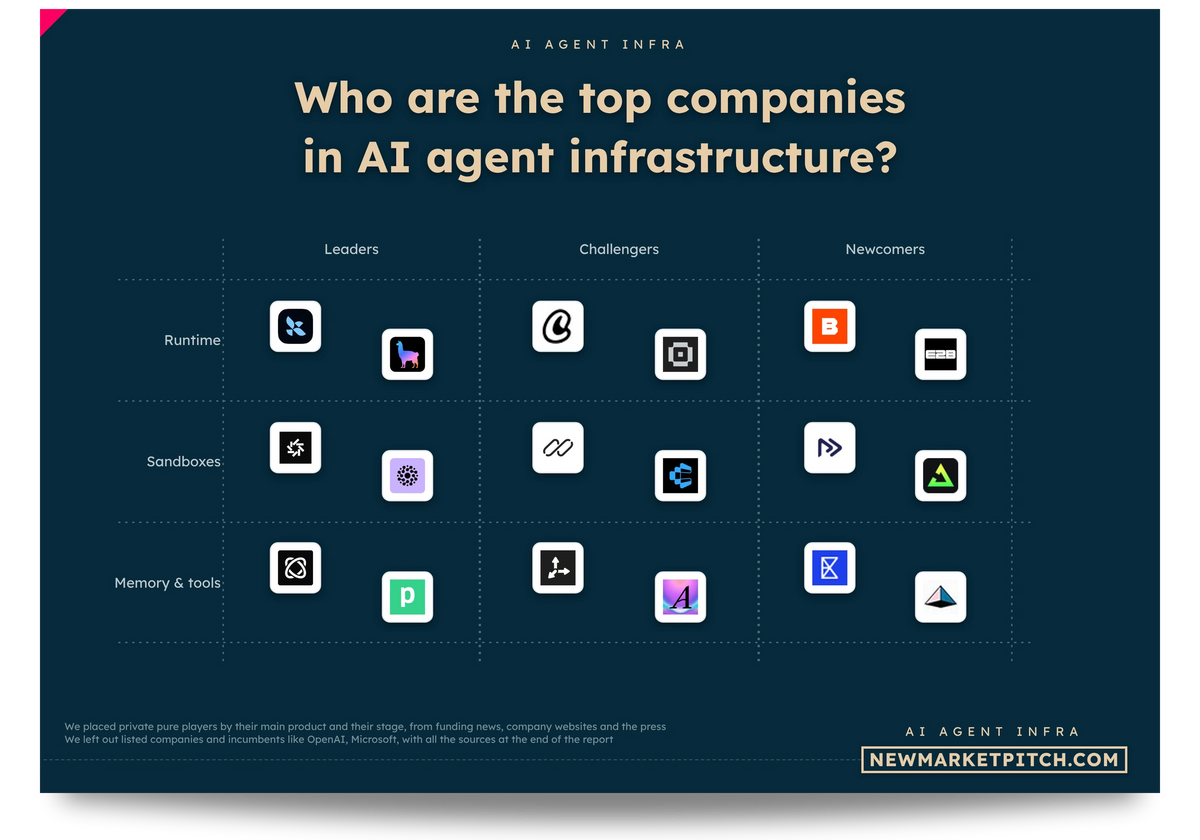
In our research about AI agent infrastructure startups, we turn what is vague and complex into simple, useful visuals. Market maps like this one show you at a glance where every startup stands.
Is Andreessen Horowitz really leading AI agent infrastructure rounds, or just showing up?
Andreessen Horowitz clearly leads most of the AI agent infrastructure rounds it joins.
Andreessen Horowitz's 92% lead rate is among the highest of the busiest investors. Accel led 8 of 9 rounds and Sequoia Capital led 7 of 10, so the busiest firms are often the ones setting the deal rather than following it. Andreessen Horowitz's Temporal thesis helps explain the conviction. Once agents can change real systems, reliable execution becomes a core infrastructure problem, not a nice extra.
Is Sequoia or Accel more active in AI agent infrastructure?
Sequoia Capital has joined slightly more AI agent infrastructure rounds than Accel, 10 against 9, but neither has caught up with Andreessen Horowitz.
Sequoia Capital led 7 of its rounds, while Accel led 8. Sequoia Capital has been particularly active at Series A, where it is tied with Accel at 5 rounds. Its recent writing argues that long-running agents need a new layer of runtime and inference infrastructure. Accel has made a similar infrastructure bet through Modal, which it describes as a developer platform for inference, fine-tuning and agent code execution. Both firms are serious challengers, but neither has matched Andreessen Horowitz's overall pace.

In our market report about AI agent infrastructure startups, we always try to gather several sources and make estimates that make sense, so you can work with solid numbers.
Which AI agent infrastructure investors are still investing this year?
Andreessen Horowitz is the busiest AI agent infrastructure investor this year with 6 rounds, ahead of every other investor.
Among the 20 most active investors, 18 have joined at least 1 round this year and 2 have not. Andreessen Horowitz joined 3 rounds last year, so its pace has picked up. The wider market is still busy too, with 69 rounds with a named investor this year versus 68 last year. Sequoia Capital called this the year of agents at its AI Ascent event in April, while Lightspeed has focused on the practical problems that show up once agents leave demos and enter production, especially execution, retrieval and security.
The table below shows, year by year, how many rounds 12 of the most active AI agent infrastructure investors joined, so it is easy to see who is still investing and who has slowed down.
If you want to go more into detail and see which investors are still writing checks and which have slowed down, please check our AI agent infrastructure report.
| Investor | 2024 | 2025 | 2026* | Total |
|---|---|---|---|---|
| Andreessen Horowitz | 3 | 3 | 6 | 12 |
| Sequoia Capital | 4 | 2 | 4 | 10 |
| Lightspeed Venture Partners | 1 | 4 | 4 | 9 |
| Accel | 3 | 3 | 3 | 9 |
| Datadog Ventures | 2 | 2 | 3 | 7 |
| General Catalyst | 3 | 3 | 6 | |
| Glilot Capital Partners | 1 | 3 | 4 | |
| Gradient | 1 | 3 | 4 | |
| Coinbase Ventures | 2 | 3 | 2 | 7 |
| Redpoint Ventures | 2 | 2 | 2 | 6 |
| Okta Ventures | 3 | 2 | 5 | |
| Bessemer Venture Partners | 1 | 1 | 2 | 4 |
* 2026: January to 12 November. Darker cells mean more rounds that year. Data from January 2024 through 12 November 2026.
Has Y Combinator gone quiet in AI agent infrastructure?
Y Combinator has not been named in any AI agent infrastructure round this year, after 3 last year and 3 the year before.
Accelerator checks are often left out of round announcements, so part of this drop may simply go unreported. Y Combinator is still connected to relevant companies, including Gumloop, Coval, Retell AI, Hamming AI and Athina AI. Y Combinator's earlier activity was heavily seed-focused, with 4 of its 6 tracked rounds at seed. What has changed is where the later checks come from. Once these companies show production traction, larger multi-stage funds and specialists tend to take over the next rounds.
Are corporate investors becoming serious players in AI agent infrastructure?
Yes, corporate investors are now serious players in AI agent infrastructure, although they usually join rounds instead of leading them.
Datadog Ventures joined 7 rounds and led none, while Okta Ventures joined 5 rounds and also led none. Their portfolios are very close to their core businesses. Datadog Ventures has backed LangChain, Daytona, Arize AI, Braintrust and Patronus AI, all tied to developer tooling, observability or production AI workflows. Okta Ventures has backed Browserbase, Sapiom, Aembit and Prompt Security, where identity and access control are central. These investors can bring distribution and technical partnerships even when another fund leads the round.

Our document detailing everything you need to know about AI agent infrastructure gets updated several times a month, so you always get the latest view of where things stand.
Is Coinbase Ventures now a real AI agent infrastructure investor?
Coinbase Ventures has become a meaningful early-stage AI agent infrastructure investor, with 7 rounds joined and 6 of them at seed.
The portfolio is unusually focused. Sapiom, Catena Labs, Circuit & Chisel, Skyfire and Payman AI all sit close to payments, financial infrastructure or agent commerce. Coinbase Ventures has also written about an onchain AI economy where autonomous agents can transact, and its portfolio page describes Skyfire as payments and monetization for AI agents. That makes Coinbase Ventures less broad than the big generalists but very clear about the problem it wants to own.
Which AI agent infrastructure investors back seed rounds, and which back growth rounds?
Seed is the busiest stage in AI agent infrastructure, with 92 of the 203 rounds with a known stage.
Coinbase Ventures is the most active seed investor with 6 rounds, while Sequoia Capital and Accel are tied at Series A with 5 rounds each. Later-stage activity is much thinner, with 13 rounds at Series C or later. Redpoint Ventures is the most active at Series C with 2 rounds, and Lightspeed Venture Partners is the most active at Series D+ with 2. Many companies are still proving new categories, while a smaller group such as Temporal and Modal has reached the point where much larger expansion rounds make sense.
The table below shows, for 12 of the most active AI agent infrastructure investors, how many rounds they joined at each stage, from seed to growth.
If you want to go more into detail and see where each investor places its bets, from seed to growth, please check our AI agent infrastructure report.
| Investor | Seed | Series A | Series B | Series C | Series D+ | Growth |
|---|---|---|---|---|---|---|
| Andreessen Horowitz | 4 | 4 | 2 | 1 | 1 | · |
| Sequoia Capital | 1 | 5 | 3 | · | 1 | · |
| Accel | 1 | 5 | 1 | 1 | 1 | · |
| Lightspeed Venture Partners | 2 | 4 | 1 | · | 2 | · |
| Datadog Ventures | · | 3 | 3 | 1 | · | · |
| Coinbase Ventures | 6 | 1 | · | · | · | · |
| General Catalyst | 3 | 2 | · | 1 | · | · |
| Redpoint Ventures | 1 | 2 | 1 | 2 | · | · |
| Y Combinator | 4 | 1 | · | · | · | · |
| Index Ventures | 3 | 1 | · | 1 | · | · |
| First Round Capital | 3 | 2 | · | · | · | · |
| Felicis | 3 | 1 | 1 | · | · | · |
Most active at each stage, among all AI agent infrastructure investors: Seed, Coinbase Ventures · Series A, Sequoia Capital and Accel · Series B, Sequoia Capital, Datadog Ventures and ServiceNow Ventures · Series C, Redpoint Ventures · Series D+, Lightspeed Venture Partners · Growth, no investor joined more than one round. Bigger dots mean more rounds. Data from January 2024 through 12 November 2026.
Who backs AI agent infrastructure startups at seed?
Coinbase Ventures is the busiest seed backer among the most active AI agent infrastructure investors, with 6 seed rounds, while Andreessen Horowitz, Gradient and Y Combinator each have 4.
Those investors offer very different kinds of help. Coinbase Ventures is concentrated around crypto, payments and agent commerce. Gradient has repeatedly backed the plumbing agents need, including Nango for integrations, Respan for control and Photon for messaging. Y Combinator brings an accelerator network and company-formation pipeline rather than acting like a conventional lead VC. The right seed backer depends heavily on what layer of the stack a startup is building.
Which investors actually lead the AI agent infrastructure rounds they join?
Index Ventures, Glilot Capital Partners, Gradient, Bessemer Venture Partners and Notable Capital were each named as lead in every AI agent infrastructure round we found for them.
Index Ventures was named as lead in all 5 of its rounds, and Glilot Capital Partners, Gradient, Bessemer Venture Partners and Notable Capital in all 4 of theirs. These firms are less active overall than the biggest generalists, but they are decisive when they do invest. Bessemer, for example, led Onyx Security's $113M Series B in July and described agent security as a new cybersecurity control layer. A smaller specialist can therefore matter more than a larger fund when its thesis lines up exactly with the startup.

In our report covering the AI agent infrastructure market, we look at what the winners do differently, so you can learn from the best instead of guessing.
Is AI agent security getting its own group of investors?
Yes, AI agent security is now attracting its own group of investors focused on identity, permissions and runtime control.
Bessemer Venture Partners has backed Onyx Security and describes agent security as a defining cybersecurity problem. Glilot Capital Partners has backed Noma Security and Rein Security, while Okta Ventures appears in Browserbase, Sapiom, Aembit and Prompt Security. Lightspeed's recent CISO survey also points to agent identity and access governance as a major issue once agents move into production. Investors now treat agent security as a market of its own, not just a feature of general AI tools.
Are all the biggest AI agent infrastructure backers still generalist VCs?
No, AI agent infrastructure also has major corporate, accelerator and specialist backers alongside the generalist VCs at the top.
Datadog Ventures has 7 rounds, Coinbase Ventures also has 7, and Y Combinator has 6. Their roles are very different from Andreessen Horowitz, Sequoia Capital or Accel. Datadog Ventures never led a tracked round, Coinbase Ventures is heavily seed-focused, and Y Combinator acts mainly as an accelerator. That mix fits a market spread across runtimes, integrations, security, identity, payments, observability and communications.
Which AI agent infrastructure investors most often invest together?
Accel and Section 32 are the most frequent AI agent infrastructure co-investing pair, with 3 rounds together, all in Ema.
Andreessen Horowitz and Sequoia Capital follow with 2 shared rounds across Temporal and OpenRouter. Other pairs also recur at 2 rounds, including Andreessen Horowitz with Databricks Ventures, Andreessen Horowitz with Menlo Ventures, Databricks Ventures with ServiceNow Ventures, and Lightspeed Venture Partners with NVIDIA. Even so, no single club controls the market. Agent infrastructure companies often need investors who understand different parts of cloud, models, security, workflows and enterprise distribution.
The table below lists the pairs of AI agent infrastructure investors named together in at least two equity rounds, with the startups they backed together.
If you want to go more into detail and see which investor networks back the same startups, please check our AI agent infrastructure report.
| Investor pair | Rounds together | Startups backed together |
|---|---|---|
| Accel + Section 32Ema | 3 | Ema |
| Andreessen Horowitz + Sequoia CapitalTemporal, OpenRouter | 2 | Temporal, OpenRouter |
| Andreessen Horowitz + Databricks VenturesOpenRouter, Braintrust | 2 | OpenRouter, Braintrust |
| Alumni Ventures + Samsung NEXTFirmly, Kite | 2 | Firmly, Kite |
| Databricks Ventures + ServiceNow VenturesOpenRouter, Galileo | 2 | OpenRouter, Galileo |
| Andreessen Horowitz + Menlo VenturesOpenRouter | 2 | OpenRouter |
| Andreessen Horowitz + Merlin VenturesNeo Security | 2 | Neo Security |
| Lightspeed Venture Partners + NVIDIAExa | 2 | Exa |
Pairs of investors named in the same equity round. Data from January 2024 through 12 November 2026.

Learning from others' mistakes is the cheapest lesson there is. In our research about AI agent infrastructure startups, we look at what broke startups before you, so you don't repeat it.
Do Andreessen Horowitz and Sequoia Capital actually invest together in AI agent infrastructure?
Yes, Andreessen Horowitz and Sequoia Capital do invest together in AI agent infrastructure, with 2 shared rounds across Temporal and OpenRouter.
The firms compete for many of the same companies, but they will share a round when the startup looks like a core infrastructure layer. Temporal handles durable execution for long-running workflows, while OpenRouter routes traffic across model providers. Both can sit deep inside how agents run, which makes shared ownership easier to understand even for firms that compete elsewhere.
Why are so many major VCs backing Temporal?
Temporal attracts major AI agent infrastructure investors because durable execution becomes critical when agents run longer jobs and take real actions.
Andreessen Horowitz, Sequoia Capital and Lightspeed Venture Partners all appear among Temporal's backers in our tracked activity. Lightspeed's thesis is simple: agents make mistakes, while production workflows still have to finish correctly. Temporal coordinates processes that survive retries, failures and state changes, so it sits between classic distributed systems and the new agent stack. That is a problem several infrastructure investors can independently decide is worth backing.
Why are so many big VCs backing Modal?
Big AI agent infrastructure investors keep backing Modal because it sits directly in the execution path for AI workloads, including code and sandboxes run on an agent's behalf.
Accel, General Catalyst, Kleiner Perkins and Menlo Ventures all appear among Modal's tracked investors. Accel describes Modal as a developer-first way to hide GPU, storage and scaling complexity, while General Catalyst highlights inference, training, batch work and agent-generated code. Modal can sell into many AI workloads rather than relying on one end-user agent category, which helps explain why several large funds want exposure to the same company.

If you build or invest in the AI agent infrastructure market, you need to know which business models pay off now and which ones are fading. That's why our report covering it has a whole section on it.
Is AI agent infrastructure already controlled by a few VCs?
No, AI agent infrastructure is still too broad to be controlled by a few VCs, with 297 different named investors across 208 rounds with at least one named investor.
The top firms keep coming back, yet repeated syndicates are still limited. That leaves room for specialists in agent identity, runtime security, payments, integrations and browser infrastructure. There is no single VC playbook for this market today; the best investor still depends heavily on the startup's technical layer and stage.
So, who are the biggest investors in AI agent infrastructure today?
Andreessen Horowitz is the clearest overall leader in AI agent infrastructure today.
Sequoia Capital is the closest challenger, while Accel and Lightspeed Venture Partners form the next tier. The answer changes once you look at specific stages. Coinbase Ventures is strongest at seed by activity, Redpoint Ventures is the busiest at Series C, Lightspeed Venture Partners at Series D+, and specialist or corporate investors are important in security, identity, observability and payments. One firm leads overall, but several others own meaningful parts of the market.
The table below shows what we found.
| Question | Answer |
|---|---|
| Who leads overall activity today? | Andreessen Horowitz leads with 12 rounds joined. It also leads most of the rounds it enters. That makes its overall position the strongest. |
| Is Sequoia far behind? | No, Sequoia Capital has joined 10 rounds. It remains the closest challenger by activity. Its strength is especially clear at Series A. |
| Does Accel mostly follow? | No, Accel led 8 of 9 rounds. Accel is happy to set the terms of a deal. Its big bet on Modal shows it clearly. |
| Is seed dominated by generalists? | Not entirely, Coinbase Ventures is the busiest seed investor with 6 rounds. Its portfolio leans toward agent commerce. That gives it a distinct early-stage niche. |
| Who controls Series A? | Sequoia Capital and Accel are tied at 5. Neither controls the stage alone. Competition gets intense once startups show early traction. |
| Is late-stage funding deep? | No, only 13 known-stage rounds were Series C or later. Redpoint is the busiest at Series C with 2. The mature company pool is still narrow. |
| Do corporate investors lead deals? | Usually not, Datadog Ventures led no tracked rounds. Okta Ventures also led none. They tend to add strategic value instead. |
| Are security specialists emerging? | Yes, Bessemer and Glilot back agent-security control layers. Identity and permissions are becoming standalone problems. Focused investors now have room to specialize. |
| Do top VCs invest together? | Yes, but repeated pairings remain limited. Accel and Section 32 share 3 rounds. The market is not controlled by one club. |
| Is the field still open? | Yes, 297 named investors appear across the market. The leader is active, but the field stays broad. New specialists can still build meaningful positions. |

In our document detailing everything you need to know about AI agent infrastructure, we like to show you the big picture. We know your time is precious, so we make every page quick to read and packed with as much learning as possible per minute.
Our methodology
Our data runs through November 12, 2026. We systematically track equity rounds in AI agent infrastructure since January 2024, a window long enough to show who is active today. We define AI agent infrastructure as developer-facing and enterprise control-plane technology used to build, integrate, run, contextualize, observe, secure or transact through autonomous or supervised agents, and we include borderline companies rather than excluding them when agent infrastructure is a primary product. Every company counted is a startup under our fixed definition.
We count each equity round an investor joined and separately record whether it led that round. Announcements name lead investors more reliably than smaller participants, so rounds that an investor joined without leading are undercounted and lead rates are an upper bound. We do not estimate the amount an investor itself committed, because individual checks are rarely disclosed. IPOs and post-listing offerings are excluded. Investor names come from company announcements and reputable press, duplicate names are merged, vague labels such as “existing investors” are not counted, and duplicate reports of the same round are merged. The current-year column starts in March, once 3 months of data exist.
Rounds confirmed by a company announcement, a press article or a regulatory filing are counted in full. Where no article exists, a round is counted only when at least two recognised databases agree on its date (within one month) and amount (within 5%), and it is marked as low confidence; a round found in a single database stays in the company's history but is left out of totals. For companies that have raised more than $100M, every round counted is backed by an article.
We never rely on investor lists from commercial databases alone because those lists can add firms that were not in a specific round or mix equity with debt and grants. Of 213 equity rounds, 208 have at least one named investor, equal to 98%, so every investor count should still be read as a floor rather than a perfect record of every participant.
Investor-round counts do not match the deal counts in our funding tracker because the unit is different. One financing round counts once in the funding tracker, but it counts once for every named investor that joined it here; rounds with no named investor remain part of the funding history but cannot appear in investor tables.
Counting rounds rather than capital committed is deliberate. Check sizes are usually private and would force unsupported estimates, while participation and lead status are verifiable. This can place a prolific generalist above a specialist that announced a large dedicated fund, but it answers the question we can measure consistently: who repeatedly shows up in completed AI agent infrastructure equity rounds and who takes responsibility for leading them.
Key sources include Andreessen Horowitz thesis on durable execution for agents, Andreessen Horowitz Machine Age infrastructure strategy, Accel investment thesis and Modal infrastructure positioning, General Catalyst investment thesis for Modal, Lightspeed thesis on Temporal and production agents, Lightspeed thesis on Exa and agent search, Coinbase Ventures strategy and onchain AI focus, Coinbase Ventures portfolio including Skyfire, Gradient thesis on Nango and agent integrations, Gradient 2026 investments in agent infrastructure, Bessemer investment in Onyx Security, Sequoia thesis on runtime infrastructure for long-running agents, Sequoia view of agents as a major current AI theme, Menlo portfolio and enterprise AI infrastructure context, and Lightspeed CISO survey on agent security and identity.

When you build or invest in the AI agent infrastructure market, you need clarity, not confusion. In our report covering the AI agent infrastructure market, we always try to put numbers on and quantify whatever is usually vague and confusing.
Written by the New Market Pitch teamWe track new markets so founders and investors can move faster. About us