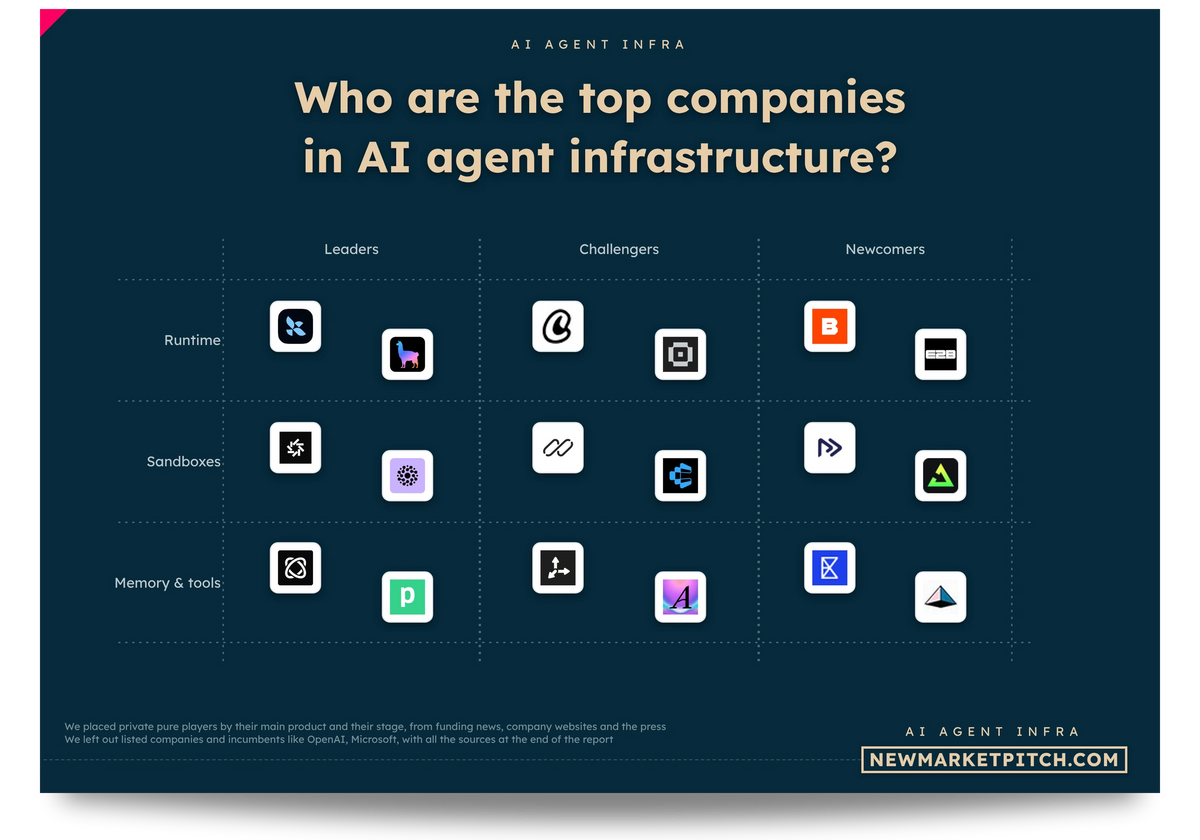
Which AI agent infrastructure startups raised the most?
Whether you're building or investing in the AI agent infrastructure market, our report covers everything you need to know: the players, the money, and what's coming next.
Summary
Modal has raised the most equity among the AI agent infrastructure startups we track, with $1.2B, level with Temporal, which has also raised $1.2B. LangChain is third at $460M, while Exa follows at $357M. After the top few, the totals drop off fast.
Modal reached that total with 5 equity rounds and a $750M Series D+ in October, the largest single round in the market. Temporal reached its $1.2B through 7 rounds, the most of any company, capped by a $550M Series D+ round in September.
Modal and Temporal got there in very different ways. Modal jumped with one giant late-stage round, while Temporal climbed across more financings. Both now show the same total.
Below them, the scale falls quickly. LangChain has raised $460M, Exa $357M and n8n at least $254M. Parallel Web Systems follows at $230M, then Zenity at $184M and LiveKit at $181M.
Only 18 of the 133 companies have raised at least $100M, while 115 remain below $100M. The median is at least $25M, which shows that most companies in this market are still being built with venture totals far below the leaders.
The United States dominates by company count, with 97 of 133 startups, or 73%. Israel has 9, Germany and the United Kingdom each have 7, while the remaining countries are represented by smaller groups.
Their sales help explain why the largest rounds have gone to infrastructure layers rather than finished agent applications. Modal said it had crossed $1B in annualized run rate, while Temporal reported annualized revenue run rate above $250M and more than 4,300 paying customers.
Funding is also reaching specialized categories. Zenity has raised $184M around AI agent security, LiveKit $181M around real-time voice infrastructure, Braintrust $124M around evaluation and observability, and Daytona $91M around agent execution environments.
A large portion of the market is still very early. We count 51 companies with only one equity round, and 54 companies had their most recent round in 2026. So the market has a few mature leaders and a steady stream of newcomers.
The clearest pattern is that investors keep paying for infrastructure that many agents can reuse. Compute, durable execution, search, orchestration, security, voice, evaluation and tool access all appear high in the funding ranking because these layers can serve many agent applications at once.

Written by the New Market Pitch teamWe track new markets so founders and investors can move faster. About us

In our report covering the AI agent infrastructure market, you will always find fresh funding data, taken straight from our own verified funding database.
Top startups in the AI agent infrastructure market ranked by total funding raised
Here is the current ranking of the AI agent infrastructure startups that raised the most, with the total each one has raised and our confidence level.
If you want to go deeper into the AI agent infrastructure startup landscape, check our report covering the AI agent infrastructure market.
| # | Startup | Total raised | Last round | Status | Confidence |
|---|---|---|---|---|---|
| $1B and above | |||||
| 1 | ModalProvides serverless AI compute infrastructure | $1.2B | Oct 2026$750M · Series D | Active | Full |
| 2 | TemporalDurable execution platform for reliable agent workflows | $1.2B | Sep 2026$550M · Series D+ | Active | Full |
| $100M to $500M | |||||
| 3 | LangChainFramework and infrastructure for AI agents | $460M | Sep 2026$300M · Series C, filing-reported | Active | Partial |
| 4 | ExaWeb search and research tools for agents | $357M | May 2026$250M · Series C | Active | Full |
| 5 | n8nVisual AI agent orchestration and execution workflows | $254M+ | May 2026Undisclosed · Other | Active | Full |
| 6 | Parallel Web SystemsWeb search and research APIs for agents | $230M | Apr 2026$100M · Series B | Active | Full |
| 7 | ZenitySecures and governs autonomous AI agents | $184M | Aug 2026$125M · Series C | Active | Full |
| 8 | LiveKitReal-time infrastructure for voice AI | $181M | Jan 2026$100M · Series C | Active | Full |
| 9 | Oasis SecurityAccess controls for machine and agent identities | $160M | Mar 2026$120M · Series B | Acquired | Full |
| 10 | CognigyConversational AI agents for customer service | $159M+ | Jun 2024$100M · Series C | Acquired | Full |
| 11 | Onyx SecurityAI agent governance and control | $153M | Jul 2026$113M · Series B | Active | Full |
| 12 | OpenRouterProvides unified AI model routing marketplace | $141M | May 2026$113M · Series B | Active | Full |
| 13 | EmaUniversal AI employees for enterprises | $138M+ | Sep 2026$77M · Series B | Active | Full |
| 14 | Noma SecurityEnterprise AI security and monitoring | $132M+ | Jul 2025$100M · Series B | Active | Full |
| 15 | Arize AIAI model evaluation and failure monitoring | $131M | Feb 2025$70M · Series C | Acquired | Full |
| 16 | BraintrustAI evaluation and observability platform | $124M | Feb 2026$80M · Series B | Active | Full |
| 17 | Protect AISecurity testing and protection for AI systems | $108M | Aug 2024$60M · Series B | Acquired | Full |
| 18 | Neo SecuritySecurity controls for enterprise AI agents | $100M+ | Jul 2026$75M+ · Series A | Active | Full |
| Below $100M | |||||
| 19 | Emergence AIAutonomous agents for enterprise workflows | $97M | Jun 2024$97M · Growth equity | Active | Full |
| 20 | DaytonaIsolated cloud computers for AI agents | $91M | Oct 2026$60M · Series B | Active | Full |
| 21 | Astrix SecurityCloud and SaaS non-human identity security | $85M | Dec 2024$45M · Series B | Acquired | Full |
| 22 | StraikerProtects enterprise AI agents from attacks | $85M | Jun 2026$64M · Series A | Active | Full |
| 23 | UnifyAppsEnterprise AI agent integration platform | $81M | Oct 2025$50M · Series B | Active | Full |
| 24 | Arcade.devSecure agent authentication and action execution | $72M+ | Sep 2026Undisclosed · Series A extension | Active | Full |
| 25 | GumloopNo-code AI workflow automation | $70M | Mar 2026$50M · Series B | Active | Full |
| 26 | Patronus AISimulation and evaluation environments for AI agents | $70M | Jun 2026$50M · Series B | Active | Full |
| 27 | VapiVoice AI agent infrastructure | $70M | May 2026$50M · Series B | Active | Full |
| 28 | BrowserbaseCloud browsers and automation runtime for agents | $68M | Jun 2025$40M · Series B | Active | Full |
| 29 | GalileoAI evaluation and observability infrastructure | $68M | Oct 2024$45M · Series B | Acquired | Full |
| 30 | MintlifyDeveloper documentation made consumable by AI agents | $66M | Apr 2026$45M · Series B | Active | Partial |
| 31 | DustEnterprise AI agents and workflows | $61M | May 2026$40M · Series B | Active | Full |
| 32 | //dev/agentsOperating system for AI agents | $56M | Nov 2024$56M · Seed | Active | Full |
| 33 | Sema4.aiEnterprise AI agent building and management platform | $56M | Jun 2025$25M · Series A | Active | Full |
| 34 | SapiomPayment and tool access infrastructure for agents | $51M | Aug 2026$35M · Series A | Active | Full |
| 35 | AIR SecuritySecurity controls for AI agent integrations | $50M | Aug 2026$40M · Seed | Active | Strong |
| 36 | Catena LabsFinancial infrastructure for autonomous AI agents | $48M | May 2026$30M · Series A | Active | Full |
| 37 | TinyFishAutonomous enterprise web workflow agents | $47M | Aug 2025$47M · Series A | Active | Full |
| 38 | AembitSecretless workload identity access to cloud services | $43M+ | Sep 2024$25M · Series A | Active | Partial |
| 39 | SGNLContinuous access governance for machine identities and agents | $42M | Feb 2025$30M · Series A | Acquired | Full |
| 40 | RunlayerEnterprise AI agent security and governance | $41M | Jun 2026$30M · Series A | Active | Full |
| 41 | BotpressAI agent development platform | $40M+ | Jun 2025$25M · Series B | Active | Full |
| 42 | NaturalPayments stack for agents and automated commerce | $40M | Jul 2026$30M · Series A | Active | Full |
| 43 | KilnTooling for agent prototyping testing and evaluation | $39M | Jan 2024$17M · Other | Active | Strong |
| 44 | KeycardRuntime agent identity and access control | $38M | Oct 2025$30M · Series A | Active | Full |
| 45 | Relevance AINo-code AI agent workforce platform | $37M+ | May 2025$24M · Series B | Active | Full |
| 46 | Geordie AIAutonomous AI agent security | $36M | May 2026$30M · Series A | Active | Full |
| 47 | E2BSecure cloud sandboxes for executing agent tasks | $35M | Jul 2025$21M · Series A | Active | Full |
| 48 | MastraProvides TypeScript framework for building AI agents | $35M | Apr 2026$22M · Series A | Active | Full |
| 49 | Obot AIAI agent governance and MCP gateway | $35M | Sep 2025$35M · Seed | Active | Full |
| 50 | Rein SecurityRuntime safeguards for autonomous AI agents | $33M | Oct 2026$25M · Series A | Active | Full |
| 51 | Judgment LabsEvaluations and observability for deployed agents | $32M | May 2026$32M · Seed + Series A (announced together) | Active | Full |
| 52 | PhonicEnd-to-end speech-to-speech AI voice models | $32M | Oct 2026$28M · Series A | Active | Full |
| 53 | CovalVoice AI testing and evaluation platform | $31M | Jun 2026$28M · Series A | Active | Full |
| 54 | DifyOpen-source development platform for agentic AI applications | $30M+ | Mar 2026$30M · Seed | Active | Partial |
| 55 | InngestDurable functions and workflows for production agents | $30M | Sep 2025$21M · Series A | Active | Full |
| 56 | LakeraRuntime security and guardrails for AI agents | $30M | Jul 2024$20M · Series A | Acquired | Full |
| 57 | WordwareIntegrated development environment for AI agent applications | $30M | Nov 2024$30M · Seed | Active | Full |
| 58 | ComposioIntegrates agent tools actions and app authentication | $29M | Jul 2025$25M · Series A | Active | Full |
| 59 | Synthflow AIVoice agents answering and routing customer calls | $29M | Jun 2025$20M · Series A | Active | Full |
| 60 | Aim SecuritySecurity governance for enterprise AI and agents | $28M | Jun 2024$18M · Series A | Acquired | Full |
| 61 | LlamaIndexBuilds data-connected agents and workflow development frameworks | $28M | Mar 2025$19M · Series A | Active | Full |
| 62 | CopilotKitEmbeds interactive agents into application interfaces | $27M+ | May 2026$27M · Series A | Active | Partial |
| 63 | LinqMessaging and voice communication APIs | $27M | Feb 2026$20M · Series A | Active | Full |
| 64 | RestateDurable execution infrastructure for agentic applications | $27M | Sep 2026$20M · Series A | Active | Full |
| 65 | Token SecurityMachine identities and SaaS token attack protection | $27M | Jan 2025$20M · Series A | Active | Full |
| 66 | Thread AIEnterprise AI workflow and agent orchestration platform | $26M | Jun 2025$20M · Series A | Active | Full |
| 67 | VellumVisual platform for creating testing deploying agents | $25M | Jul 2025$20M · Series A | Active | Full |
| 68 | StackOneUnified APIs connecting agents to enterprise applications | $24M | May 2025$20M · Series A | Active | Full |
| 69 | EunoEnterprise data context for AI agents | $23M | Sep 2026$23M · Series A | Active | Full |
| 70 | Prompt SecurityRuntime guardrails for enterprise AI agent usage | $23M | Nov 2024$18M · Series A | Acquired | Full |
| 71 | VijilTesting monitoring and protecting AI agents | $23M | Nov 2025$17M · Series A | Active | Full |
| 72 | KernelCloud browsers for generative AI agents | $22M | Oct 2025$22M · Series A | Active | Full |
| 73 | LyzrEnterprise platform to build govern deploy agents | $22M | Mar 2026$14M · Series A | Active | Full |
| 74 | PaidBilling and monetization infrastructure for AI agents | $22M | Sep 2025$22M · Seed | Active | Full |
| 75 | Pillar SecurityAI application security and testing | $22M+ | May 2026$13M · Seed | Active | Full |
| 76 | CrewAIBuilds collaborative multi-agent orchestration and deployment platform | $20M | Oct 2024$12M · Series A | Active | Full |
| 77 | Mem0Memory layer for personalizing persistent AI agents | $20M | Oct 2025$20M · Series A | Active | Full |
| 78 | Circuit & ChiselAI lab building low-cost blended model Pareto | $19M | Sep 2025$19M · Seed | Active | Full |
| 79 | Trigger.devBackground job and task execution for agents | $19M | Dec 2025$16M · Series A | Active | Full |
| 80 | KitePayments infrastructure for autonomous AI agents | $18M+ | Sep 2025$18M · Series A | Active | Full |
| 81 | PortkeyAI gateway routing observability and access control | $18M | Feb 2026$15M · Series A | Active | Full |
| 82 | Browser UseOpen-source browser automation framework for AI agents | $17M | Mar 2025$17M · Seed | Active | Full |
| 83 | PydanticProvides typed Python framework for agent applications | $17M | Oct 2024$12M · Series A | Active | Partial |
| 84 | OuterlimitDecentralized AI agent authorization security | $16M | Sep 2026$16M · Pre-Seed | Active | Full |
| 85 | Stack AIProvides enterprise visual agent-building and deployment software | $16M | May 2025$16M · Series A | Active | Full |
| 86 | AnonAuthentication infrastructure to connect agents with apps | $15M | Nov 2024$8.3M · Seed | Active | Low |
| 87 | Barndoor AISecurity controls for enterprise AI agents | $14M | May 2025$14M · Seed | Active | Full |
| 88 | FirecrawlExtracts and crawls websites for agent workflows | $14M | Aug 2025$14M · Series A | Active | Full |
| 89 | LettaStateful agents with persistent editable long-term memory | $10M | Sep 2024$10M · Seed | Active | Full |
| 90 | Tektonic AIAI agents for enterprise revenue workflows | $10M | Jun 2024$10M · Seed | Active | Full |
| 91 | SkyfireAgent identity and machine-to-machine payments rails | $9.5M | Oct 2024$1M · Seed | Active | Full |
| 92 | MartianIntelligent LLM routing and selection for applications | $9M | Nov 2023$9M · Seed | Active | Full |
| 93 | SplxAIRed teaming and security testing for agents | $9M | Mar 2025$7M · Seed | Acquired | Full |
| 94 | CogneeKnowledge graphs and semantic memory for agents | $7.5M | Feb 2026$7.5M · Seed | Active | Full |
| 95 | NangoUnified APIs and OAuth for agent integrations | $7.5M | Apr 2026$7.5M · Seed | Active | Full |
| 96 | xpanderEnterprise platform for building AI agents | $7.5M | Aug 2026$7.5M · Seed | Active | Full |
| 97 | HoneyHiveAgent observability evaluation and debugging platform | $7.4M | Apr 2025$5.5M · Seed | Active | Full |
| 98 | BlaxelServerless runtime infrastructure for AI agents | $7.3M | Dec 2025$7.3M · Seed | Acquired | Full |
| 99 | NeverminedPayments and monetization infrastructure for AI agents | $7.3M+ | Jan 2025$4M+ · Seed | Active | Full |
| 100 | RunloopCode execution environments and evaluations for agents | $7M | Jul 2025$7M · Seed | Active | Full |
| 101 | aiXplainOperating system and tools for AI agents | $6.5M | Jul 2024$6.5M | Active | Full |
| 102 | ChainMLAI agent infrastructure for developers | $6.2M | May 2024$6.2M · Seed | Active | Full |
| 103 | AgentMailEmail infrastructure API for AI agents | $6M | Mar 2026$6M · Seed | Active | Full |
| 104 | AlpicHosting platform for MCP servers and ChatGPT apps | $6M | Sep 2025$6M · Seed | Active | Full |
| 105 | Naptha AIInfrastructure for multi-agent AI systems | $6M | Oct 2024$6M · Seed | Active | Full |
| 106 | Asymptote LabsAI agent monitoring and governance software | $5.5M | Oct 2026$5.5M · Seed | Active | Full |
| 107 | ScalekitAuthentication and integrations for AI agents | $5.5M | Sep 2025$5.5M · Seed | Active | Full |
| 108 | VoiceRunDevelopment platform for enterprise voice agents | $5.5M | Jan 2026$5.5M · Seed | Active | Full |
| 109 | AgnoOffers open-source agent and multi-agent framework | $5.4M+ | Aug 2024$5.4M · Seed | Active | Partial |
| 110 | NekudaAgentic commerce tools for websites | $5M | May 2025$5M · Seed | Active | Full |
| 111 | RespanOpen-source AI gateway with observability | $5M | Mar 2026$5M · Seed | Active | Full |
| 112 | Retell AIVoice agent builder for enterprise calls | $4.7M+ | Aug 2024$4.6M · Seed | Active | Full |
| 113 | PhotonConnects AI agents to messaging apps | $4.5M | Oct 2026$4.5M · Seed | Active | Full |
| 114 | AMESAIndustrial AI agent platform | $4.2M | May 2024$4.2M · Seed | Active | Full |
| 115 | KontextRuntime authorization and monitoring for AI agents | $4M | Sep 2026$4M · Seed | Active | Full |
| 116 | LangfuseOpen-source LLM and agent observability | $4M | Nov 2023$4M · Seed | Acquired | Full |
| 117 | OneTrust layer that lets AI agents connect to and act in business apps | $4M | Jul 2026$4M · Seed | Active | Full |
| 118 | Hamming AIAutomated testing and monitoring for voice agents | $3.9M | Dec 2024$3.8M · Seed | Active | Full |
| 119 | Payman AIAgent payments and human contractor transaction workflows | $3.8M | Feb 2025$800K · Seed | Active | Partial |
| 120 | BeamServerless cloud for AI applications | $3.5M | May 2022$3.5M · Seed | Active | Low |
| 121 | Athina AIProduction agent evaluation and LLM monitoring | $3M | Nov 2024$3M · Seed | Active | Full |
| 122 | Maxim AISimulation testing and observability for AI agents | $3M | Jun 2024$3M · Seed | Active | Full |
| 123 | SupermemoryLong-term memory API for AI agents | $3M | Oct 2025$3M · Pre-Seed | Active | Full |
| 124 | HumanloopEvaluation and prompt management for enterprise agents | $2.7M | Jul 2022$2.6M · Seed | Acquired | Low |
| 125 | SkyvernBrowser automation infrastructure driven by visual agents | $2.7M | Dec 2025$2.7M · Seed | Active | Full |
| 126 | AgentOpsMonitoring tracing and benchmarking AI agent runs | $2.6M | Aug 2024$2.6M · Pre-Seed | Active | Full |
| 127 | ZepTemporal knowledge graph and memory for agents | $2.3M | Feb 2024$500K · Seed | Active | Low |
| 128 | Confident AIEvaluation testing platform for production AI agents | $2.2M | Aug 2025$2.2M · Seed | Active | Full |
| 129 | HeliconeLLM gateway observability and agent analytics | $1.5M | Apr 2023$1.5M · Pre-Seed | Acquired | Low |
| 130 | LangWatchAgent evaluation monitoring and prompt optimization | $1.1M | Feb 2025$1.1M · Pre-Seed | Active | Full |
| 131 | VobizTelephony infrastructure for AI voice agents | $1M | May 2026$1M · Seed | Active | Full |
| 132 | Vaani AI ResearchMultilingual voice AI agent infrastructure | $400K | Sep 2025$400K · Seed | Active | Full |
| Undisclosed | |||||
| 133 | AIsaAgent payment infrastructure and transaction authorization | Undisclosed | Jul 2026Undisclosed · Seed | Active | Low |
No startups match this search.

In our research about AI agent infrastructure startups, we turn what is vague and complex into simple, useful visuals. Market maps like this one show you at a glance where every startup stands.
Why have investors put so much money into Modal?
Modal reached the top of AI agent infrastructure fundraising by growing fast enough to support much larger late-stage rounds.
Modal has raised $1.2B across 5 rounds. Modal's October Series D+ was $750M, the largest single round in the market. The company said at the time that it had crossed $1B in annualized run rate after growing more than 15x year over year, and that its Sandboxes product alone had reached a $300M run rate. Those operating figures make the round look like money for expansion, not a bet on a pre-revenue idea.
Modal also sells a lot more than one narrow product. Modal provides AI compute, inference, reinforcement-learning infrastructure, batch jobs and sandboxed execution used by coding agents and other AI-native applications. That means investors are funding a platform that can capture several kinds of workload rather than one agent category. Modal is raising for two reasons at once: infrastructure is expensive, and one cloud layer can serve many fast-growing AI products.
How did Temporal raise so much for AI agent infrastructure?
Temporal built up $1.2B in AI agent infrastructure funding step by step, across 7 rounds, instead of relying on one giant financing.
Temporal has completed 7 equity rounds, the highest count in the market, and its September Series D+ round was $550M. The company reported annualized revenue run rate above $250M, more than 4,300 paying customers and 1.9 trillion billable actions in August. Temporal also said OpenAI's use of Temporal had grown 60-fold in under a year.
That is why Temporal's fundraising looks so different from Modal's. Durable execution started as a general distributed-systems problem and became more valuable as AI agents began running longer, stateful workflows. Temporal had time to build adoption before the agent boom intensified. Temporal now raises like a core cloud company, but its 7 rounds show a business built in stages, not one born in the current AI wave.

In our market report about AI agent infrastructure startups, we always try to gather several sources and make estimates that make sense, so you can work with solid numbers.
Is the funding gap after Modal and Temporal really that large?
Yes. AI agent infrastructure funding falls sharply after Modal and Temporal, the two $1.2B leaders.
LangChain is third with $460M, Exa fourth with $357M, n8n fifth with at least $254M and Parallel Web Systems sixth with $230M. Zenity follows at $184M, LiveKit at $181M, Oasis Security at $160M before Cyera agreed to buy it in July 2026, and Cognigy at least $159M before NiCE bought it in September 2025. That puts the top two in a completely different funding tier from the rest of the market.
Part of the gap comes from company age and business model. Modal and Temporal are building infrastructure layers with large engineering, cloud and enterprise-sales requirements. Search, orchestration and security companies can also raise large rounds, but many can build with less capital. Lower funding does not make them less important; different parts of the agent stack simply need very different amounts of money.
The table below shows the top funded companies and their equity totals.
| Company | Total raised | Rounds |
|---|---|---|
| Modal | $1.2B | 5 |
| Temporal | $1.2B | 7 |
| LangChain | $460M | 4 |
| Exa | $357M | 4 |
| n8n | $254M+ | 5 |
| Parallel Web Systems | $230M | 3 |
| Zenity | $184M | 4 |
| LiveKit | $181M | 5 |
| Oasis Security | $160M | 3 |
| Cognigy | $159M+ | 4 |
Did Modal get to the top mostly through one giant round?
Largely. Modal got to the top of AI agent infrastructure fundraising mainly because of its $750M Series D+ in October.
Modal had already raised substantial capital before that financing, but the $750M round is the largest single round in the whole AI agent infrastructure market. The $750M round also dwarfs the largest rounds from earlier years: Temporal's $75M round was the largest in 2023, Cognigy, bought by NiCE in September 2025, led 2024 with a $100M round, and n8n's $180M round led 2025.
The size jump fits Modal's recent growth, with close to 3 billion sandboxes spun up on its platform by October. Investors were funding a company already operating at major infrastructure scale. AI-native compute also gets expensive quickly when demand accelerates. Modal needs to support large volumes of GPU, CPU and sandbox workloads, so a very large round can be deployed into capacity and product development in ways that a lighter software company could not justify.
Is it unusual for an AI agent infrastructure startup to raise many rounds?
Yes, very. Temporal has raised through 7 equity rounds, more than any other AI agent infrastructure startup.
Temporal's 7 rounds stand out in a market where many companies are far younger. We count 51 startups with only one equity round. Temporal's history is much more mature: multiple rounds across several years, culminating in a $550M Series D+ financing.
That longer history also matters. Temporal was founded before the current agent boom and originally solved durable execution for distributed systems broadly. As AI agents became more common, the same infrastructure became useful for long-running autonomous workflows. Instead of having to invent a new product category from scratch, Temporal could fund expansion from an existing technical base and customer network. That helps explain why it has accumulated as much equity financing as Modal even though its most recent round is smaller than Modal's $750M Series D+.

Our document detailing everything you need to know about AI agent infrastructure gets updated several times a month, so you always get the latest view of where things stand.
Are $100M funding totals common in AI agent infrastructure?
No. A $100M funding total is still unusual in AI agent infrastructure.
Only 18 of the 133 companies in our ranking have raised at least $100M. We count 16 companies in the $100M to $500M bracket, 2 at $1B or above, and 115 below $100M. The median is at least $25M.
That distribution is important because headlines can make the market look more capital-heavy than it is. The giant rounds go to a small set of leaders, while most startups are still operating with much smaller totals. Many are building software layers such as memory, integrations, observability or permissions that can reach product-market fit without billion-dollar capital bases. The market has a big split: a few infrastructure platforms are raising at cloud-scale levels, while a large early-stage ecosystem is still testing which agent primitives will become durable categories.
Who raised the biggest single rounds in AI agent infrastructure?
Modal raised the biggest single AI agent infrastructure round, with Temporal and LangChain next among the current leaders.
Modal's October Series D+ was $750M. Temporal's September Series D+ round was $550M. LangChain's September Series C was $300M, Exa's May Series C was $250M, and several other companies have crossed the $100M line in a single financing, including Zenity and Onyx Security.
The biggest rounds go to companies that many other AI products could end up building on. Modal sells AI compute, Temporal durable execution, LangChain agent development infrastructure and Exa agent-oriented search. These are reusable services that can serve many downstream products. That is different from funding one finished vertical agent, where the addressable market may be narrower. Investors write very large checks when they think lots of agent products will end up relying on one company.
The table below shows selected large rounds from the funded leaders.
| Company | Last round | Stage |
|---|---|---|
| Modal | $750M | Series D+ |
| Temporal | $550M | Series D+ |
| LangChain | $300M | Series C |
| Exa | $250M | Series C |
| Zenity | $125M | Series C |
| Onyx Security | $113M | Series B |
| OpenRouter | $113M | Series B |
| Parallel Web Systems | $100M | Series B |
| LiveKit | $100M | Series C |
| Noma Security | $100M | Series B |

In our report covering the AI agent infrastructure market, we look at what the winners do differently, so you can learn from the best instead of guessing.
Why has LangChain raised so much compared with most agent frameworks?
LangChain has raised $460M because investors are backing it as a broad agent platform, not just an open-source framework.
The company now spans LangChain, LangGraph and LangSmith, covering application development, agent orchestration, evaluation, observability and deployment. In October 2025, it named Replit, Clay, Harvey, Rippling, Cloudflare, Workday and Cisco among the companies using its products. That breadth increases the amount of product, enterprise infrastructure and go-to-market investment required.
LangChain's September Series C was $300M, making it one of the largest single rounds in the market. The financing gives LangChain the resources to stay independent across models and cloud providers. The opportunity is large if enterprises want to avoid locking agent development into one model vendor. The risk is equally clear: OpenAI, Anthropic, Microsoft, Google and cloud platforms are all expanding their own agent tooling. LangChain's large funding total gives it room to compete across that stack, but it also means the business now has to grow into that spending.
Why did Exa raise $357M for search infrastructure?
Exa raised $357M because search for AI agents now needs serious crawling, indexing and model infrastructure behind it.
Exa's May Series C was $250M. In May 2026, the company said it powered search for Cursor, Cognition, HubSpot, OpenRouter, Monday.com and more than 400,000 developers. It is building its own search and retrieval infrastructure for AI systems, which requires model training, indexing, serving capacity and enterprise distribution.
That cost structure helps explain the large funding total. Search engines are difficult to build because they need to crawl, index and rank enormous amounts of information with low latency. Agents raise the bar further because they may search repeatedly inside one task and require fresh, structured outputs. Exa is effectively trying to become a machine-first search layer for agents, which requires more capital than a conventional SaaS tool but can also support a much larger infrastructure outcome if it becomes a standard dependency.

Learning from others' mistakes is the cheapest lesson there is. In our research about AI agent infrastructure startups, we look at what broke startups before you, so you don't repeat it.
Is agent security attracting more capital than other specialist layers?
Yes. AI agent security is already one of the most heavily funded specialist parts of the market.
Zenity has raised $184M, Oasis Security $160M, Onyx Security $153M, Noma Security at least $132M, Protect AI $108M and Neo Security at least $100M. Two of them are no longer independent: Cyera agreed to buy Oasis Security in July 2026, and Palo Alto Networks bought Protect AI in July 2025, so security is attracting both venture money and buyers.
The commercial logic is straightforward. Agents can access credentials, data and business systems, so enterprises need controls over identity, permissions, behavior and runtime actions. Onyx said in July that its revenue had quadrupled in four months and that it was securing more than 1.1 million agents. Zenity raised its $125M Series C in August to secure and govern AI agents across enterprise platforms. Security spending usually follows new computing layers into the enterprise. Once agents touch sensitive systems, companies start paying for a separate layer of controls.
Is voice AI infrastructure getting serious venture funding?
Clearly. Voice AI infrastructure is already attracting nine-figure funding totals.
LiveKit has raised $181M and Vapi $70M. LiveKit provides the real-time communications layer underneath voice and video AI, while Vapi offers a platform for building and deploying configurable voice agents. TechCrunch reported in January 2026 that LiveKit powers ChatGPT voice mode and serves customers including xAI, Salesforce and Tesla. Vapi said in May 2026 that Amazon Ring now handles all of its inbound calls on Vapi.
These companies solve different parts of the stack, which is why both can attract capital. LiveKit focuses on low-latency real-time infrastructure, while Vapi packages telephony, models and orchestration for application developers. Voice agents also carry real production requirements: interruptions, latency, streaming, call routing, reliability and compliance all matter at once. The funding shows that investors think those production demands are big enough to support dedicated voice-infrastructure companies.
Are the best-funded AI agent infrastructure startups all American?
No. The United States leads AI agent infrastructure fundraising with Modal, Temporal and LangChain, but Germany's n8n and Israel's Zenity also sit in the top 10.
The United States is home to 97 of the 133 companies, or 73%. Israel has 9, Germany and the United Kingdom each have 7, France and India have 3 each, Canada and Switzerland have 2 each, and Australia, the Netherlands and Singapore have 1 each.
The geography makes sense: the United States still has the biggest concentration of AI developers, venture investors and cloud companies. However, several non-American companies have still built large funding positions. Germany has n8n and Cognigy, Israel has Zenity and multiple security companies, France has Dust, and the United Kingdom has companies across integrations, billing and agent infrastructure.
The table below shows the company-count distribution by country.
| Country | Companies | Share |
|---|---|---|
| United States | 97 | 73% |
| Israel | 9 | 7% |
| Germany | 7 | 5% |
| United Kingdom | 7 | 5% |
| France | 3 | 2% |
| India | 3 | 2% |
| Canada | 2 | 2% |
| Switzerland | 2 | 2% |
| Australia | 1 | 1% |
| Netherlands | 1 | 1% |
| Singapore | 1 | 1% |

If you build or invest in the AI agent infrastructure market, you need to know which business models pay off now and which ones are fading. That's why our report covering it has a whole section on it.
Why did acquired AI agent infrastructure startups raise so much?
Several acquired AI agent infrastructure startups still raised huge amounts before being bought, which shows how much money it took to build them.
Oasis Security has raised $160M, Cognigy at least $159M, Arize AI $131M and Protect AI $108M, all before being bought. NiCE completed its purchase of Cognigy in September 2025, Palo Alto Networks bought Protect AI in July 2025, Cyera agreed to buy Oasis Security in July 2026 and Dynatrace agreed to buy Arize AI in August 2026.
The acquisitions also show which parts of the agent stack larger platforms want to own. NiCE wanted Cognigy for enterprise customer-service AI, Cyera wanted Oasis Security for identity and data security, and Dynatrace wanted Arize AI for AI observability. A bought startup still matters: its product, and the money that built it, usually live on inside a bigger platform.
Are most AI agent infrastructure startups still early-stage?
Yes. Most AI agent infrastructure startups are still far earlier than Modal and Temporal.
We count 51 companies with only one equity round, and 115 of 133 companies have raised less than $100M. The median total is at least $25M. Those figures show a market where a very small number of companies have reached late-stage financing while a large majority are still proving whether their layer deserves to exist independently.
The early-stage group spans memory, sandboxes, evaluation, integrations, security, payments and tool access. Some of those categories will consolidate, while others may become large standalone markets. The amount of capital required will also differ. A memory API may not need the same financing as a compute platform, and a governance startup may scale with enterprise software economics rather than infrastructure-heavy spending. Funding totals only make sense next to the kind of product being built. They are not a score of product quality.

In our document detailing everything you need to know about AI agent infrastructure, we like to show you the big picture. We know your time is precious, so we make every page quick to read and packed with as much learning as possible per minute.
Are AI agent infrastructure startups still raising fresh money, or living on old rounds?
Most leading AI agent infrastructure companies are still raising fresh money today rather than living on old rounds.
We count 54 companies whose most recent round is in 2026, compared with 45 in 2025 and 29 in 2024. Only 3 have a most recent round in 2023 and 2 before 2023. That shows a market with active financing across both the leaders and the early-stage base.
Look at the current leaders. Modal, Temporal, LangChain, Exa, Parallel Web Systems, Zenity, OpenRouter, Onyx Security and Daytona all raised again in 2026. Investors are still putting fresh money into product expansion as agent workloads move into production.
The table below shows when AI agent infrastructure startups last raised equity.
| Last round | Companies |
|---|---|
| 2026 | 54 |
| 2025 | 45 |
| 2024 | 29 |
| 2023 | 3 |
| Before 2023 | 2 |
Does a huge funding total mean an AI agent infrastructure startup is wasting money?
No. A high AI agent infrastructure funding total can simply mean the product is expensive to build or the company is trying to scale very fast.
Modal and Temporal each have $1.2B in equity funding, but both report substantial operating scale. Modal said it had crossed $1B in annualized run rate, while Temporal reported annualized revenue run rate above $250M and more than 4,300 paying customers. Their capital supports compute, reliability, enterprise sales and global infrastructure.
Other companies need far less money because they sell lighter software layers. OpenRouter has raised $141M while running a model-routing marketplace that, by its own count in May 2026, serves more than 8 million developers. Vapi has raised $70M while building a voice-agent platform used in production by large enterprises. Comparing those totals without considering the underlying cost structure would be misleading. The real question is whether each company's market is big enough to justify the money it has raised.

When you build or invest in the AI agent infrastructure market, you need clarity, not confusion. In our report covering the AI agent infrastructure market, we always try to put numbers on and quantify whatever is usually vague and confusing.
Why are web-search companies raising so much for agent infrastructure?
Web-search startups are raising heavily because AI agents can generate far more search activity than a human using a search box.
Exa has raised $357M and Parallel Web Systems $230M. Exa said in May 2026 that it served more than 400,000 developers, while Parallel reported in April 2026 more than 100,000 developers and customers including Clay, Harvey, Notion and Opendoor. Both are building search and research interfaces designed for automated systems rather than human search-result pages.
Agents can issue many searches inside one task, retrieve large amounts of information and require fresh, structured outputs with low latency. That creates infrastructure costs in crawling, indexing, retrieval and model serving. It also creates a large potential market if every agent becomes a recurring search customer. Those funding totals are a bet that machine search becomes its own infrastructure layer instead of a small feature bought from traditional search engines.
Can AI agent testing become a major funded category?
Yes. AI agent testing and observability are already drawing serious funding, even if they need less capital than compute or durable execution.
Braintrust has raised $124M, Patronus AI $70M, Galileo $68M before Cisco bought it in 2026, Judgment Labs $32M, Coval $31M and several smaller companies have raised additional seed and Series A rounds. Braintrust's February Series B was $80M and was explicitly framed around building observability infrastructure for production AI.
AI agents cannot be judged only by the final answer they produce. Companies need to inspect traces, tool calls, trajectories, regressions and live production behavior. That creates recurring demand for testing and monitoring even when models improve. These companies need less money than Modal or Temporal because they are mostly software businesses. Still, the number of funded specialists shows that investors expect testing and observability to remain a real layer of the stack.
Are agent-native payments still too early for large rounds?
Mostly yes. Agent-native payments are getting funded, but the totals are still much smaller than for execution and orchestration leaders.
Sapiom has raised $51M, Catena Labs $48M, Natural $40M, Kite at least $18M and Nevermined at least $7.3M. These companies are building payment, billing and transaction-authorization systems for agents that need to buy data, tools or services without a human manually approving every step.
The opportunity is large if autonomous commerce grows, but ownership of the layer is not settled. Existing payment processors, model gateways, cloud providers and specialist startups can all compete to handle machine transactions. For now, these rounds look more like money to build the category than money to scale a proven giant. Investors are financing experiments in how agents should hold permissions, budgets and payment credentials, but the market has not yet produced a payment-infrastructure company funded at the level of Modal, Temporal or LangChain.

A good product starts with a real problem. In our research about AI agent infrastructure startups, we show you the ones customers still live with.
Can a startup build serious agent infrastructure with one round?
Yes. Many AI agent infrastructure startups are still building after one equity round, although the biggest platforms usually raise several times.
We count 51 one-round companies. Examples include Emergence AI with $97M, //dev/agents with $56M, TinyFish with $47M, Obot AI with $35M, Judgment Labs with $32M, Wordware with $30M and several younger companies in the $5M to $20M range.
One-round startups can move quickly when founders raise a large seed or Series A and target a software-heavy layer. The model becomes harder for capital-intensive compute or late-stage enterprise infrastructure, where product breadth, compliance, sales and global availability require repeated investment. The one-round group shows both opportunity and uncertainty. New entrants can still reach meaningful scale quickly, but only a small fraction will ultimately need or justify the billion-dollar funding totals seen at the top.
So, which AI agent infrastructure startups raised the most?
Modal and Temporal lead AI agent infrastructure fundraising with $1.2B each, and Modal ranks first.
LangChain is third at $460M, followed by Exa at $357M, n8n at least $254M and Parallel Web Systems at $230M. Zenity has raised $184M, LiveKit $181M, Oasis Security $160M before Cyera agreed to buy it in July 2026, and Cognigy at least $159M before NiCE bought it in September 2025. Only 18 of the 133 companies have raised at least $100M, so the leaders are a small minority of the market.
The totals tell different stories once you look at how each company raised them. Modal's position was accelerated by a $750M Series D+, while Temporal accumulated its total across 7 rounds. LangChain and Exa are funding broad agent-engineering and search platforms, while security, voice and evaluation companies require smaller but still substantial capital bases. There is no single financing path in AI agent infrastructure. The amount of money depends heavily on what the company is building and how fast demand is growing.
The table below shows what we found.
| Question | Answer |
|---|---|
| Who has raised the most? | Modal ranks first in AI agent infrastructure with $1.2B raised. Temporal shows the same $1.2B total, built across 7 rounds. Both sit far above LangChain, third with $460M. |
| Did Modal rely on one giant round? | Largely, since its October Series D+ alone brought in $750M. That is the largest single round in the whole market. Modal's $1B annualized run rate made that check easier to justify. |
| Did Temporal take a different path? | Yes, Temporal built its total step by step across 7 rounds. Temporal's latest round brought in $550M in September. Its durable execution business grew long before the agent boom. |
| How far behind is LangChain? | LangChain sits third with $460M, well behind the two leaders. LangChain's September Series C alone brought in $300M. Investors back it as a broad agent platform, not one framework. |
| Is search for agents expensive to build? | Yes, Exa has already raised $357M for machine-first search. Parallel Web Systems follows with $230M for web research APIs. Crawling, indexing and fast retrieval need serious infrastructure money. |
| Is agent security attracting major capital? | Yes, Zenity alone has raised $184M to secure AI agents. Onyx Security follows with $153M after quadrupling its revenue. Enterprises now budget for controls once agents touch sensitive systems. |
| Is voice infrastructure well funded? | Yes, LiveKit has raised $181M for real-time voice AI infrastructure. Vapi has raised $70M for its voice-agent building platform. Production voice needs low latency, streaming and reliable call routing. |
| Are $100M funding totals normal here? | No, only 18 of the 133 companies have raised at least $100M. The other 115 remain below that line, with a median of at least $25M. Most of the market is still early and lightly funded. |
| Are the best-funded companies all American? | No, Germany's n8n ranks fifth with at least $254M raised. Israel's Zenity is seventh with $184M for agent security. The United States still leads, with Modal, Temporal and LangChain on top. |
| Are fresh rounds still happening? | Yes, 54 companies in this market last raised in 2026. Another 45 companies made their most recent raise during 2025. Leaders like Modal, Temporal and LangChain all raised again in 2026. |
| Can one round be enough? | Sometimes, since 51 companies have raised only one equity round. Emergence AI took $97M in that single round. Capital-heavy compute platforms usually need many more rounds than that. |

In our market report about AI agent infrastructure startups, we try to remove everything that could confuse you, especially if you're investing or building in this market.
Our methodology
Our data runs through November 12, 2026. We define AI agent infrastructure as developer-facing and enterprise control-plane technology used to build, integrate, run, provide context to, observe, secure or transact through autonomous or supervised agents. Companies on the border of the definition are included rather than left out when agent workflows are a primary use case. Every company in the ranking is a startup under our definition; companies that have since gone public, been acquired or shut down keep their place with their status shown, and their total stops at the IPO or acquisition.
A total counts equity raised since founding, including every sourced private equity round and the primary proceeds of an IPO. We exclude debt, venture debt, grants, unconverted convertibles and SAFEs, post-IPO offerings and secondary share sales, and we merge duplicate reports of the same round. A "+" total is a minimum because at least one round has no public amount.
Rounds confirmed by a company announcement, a press article or a regulatory filing are counted in full. Where no article exists, a round is counted only when at least two recognised databases agree on its date (within one month) and amount (within 5%), and it is marked as low confidence; a round found in a single database stays in the company's history but is left out of totals. For companies that have raised more than $100M, every round counted is backed by an article.
Totals and valuations published by commercial databases such as Crunchbase, PitchBook and similar websites are never used as our figure because they often mix debt, grants, unpaid commitments or estimates. Databases are never the only source of a figure we count in full, and a round found only in two agreeing databases is counted with low confidence. When a company or the press announces a different total, we keep our own sum of the equity rounds we can source, and the confidence rating shows how much of each total rests on confirmed rounds.
A total can differ from a figure announced by a company or reported in the press because we count only the equity rounds we can source under these rules. Acquired companies remain in this ranking because the article measures how much equity was required to build each startup over its whole history, including companies that are no longer independent. The ranking covers each company's full funding history rather than only recent market activity.
Key sources include Modal $750M round, revenue run rate, Sandboxes run rate and infrastructure scale, Modal earlier financing and product scope, Temporal $550M round and revenue run rate, Temporal customers, actions and AI workload growth, LangChain product breadth and enterprise customers, Exa $250M round, customers and developer adoption, n8n $180M round and orchestration strategy, n8n company financing milestones, Parallel funding, customers and developer adoption, Zenity $125M round and security focus, LiveKit financing and customer context, Onyx $113M round and revenue growth, OpenRouter $113M round and usage scale, Daytona $60M round and agent execution strategy, Daytona commercial growth, Vapi $50M round and enterprise voice-agent positioning, Braintrust $80M round and observability strategy, Dynatrace agreement to acquire Arize AI, August 2026, Cisco acquisition of Galileo, April 2026, Palo Alto Networks completes acquisition of Protect AI, July 2025, Oasis acquisition context and agent identity focus, and Cognigy acquisition context.

Your time is limited. In our document detailing everything you need to know about AI agent infrastructure, we put numbers on each part of the market, so you can see where it makes sense to focus.
Written by the New Market Pitch teamWe track new markets so founders and investors can move faster. About us