Which AI agent infrastructure startups are worth the most?
Whether you're building or investing in the AI agent infrastructure market, our report covers everything you need to know: the players, the money, and what's coming next.
Summary
Modal is the most valuable AI agent infrastructure startup we track, valued at $15.75B. Temporal follows at $12.55B, while OpenRouter, which Stripe agreed to buy in August 2026, sits third at $7.5B–$8.5B. The top of this market has already moved well beyond experimental developer tooling.
The gap between Modal and Temporal is real but not overwhelming: the ratio between the first two valuations is 1.3x. They are solving different infrastructure problems, yet both have become core building blocks for developers running AI workloads and long-lived agent workflows.
The drop after those two is much steeper. OpenRouter is third, n8n is fourth at $5.2B, and Exa is fifth at $2.2B. That tells us investors are rewarding several different layers at once, from compute and durable execution to orchestration, model routing and web access.
Unicorn status is still rare across the full market. We count 9 startups whose whole valuation is at least $1B, while 107 of the 117 companies sit below $1B. So AI agent infrastructure has a very valuable top tier above a much broader early-stage base.
The strongest valuations are also the most transparent. All 10 companies at the top of the ranking rest on a valuation stated by a source or following directly from a round, which makes the upper end easier to compare than the long tail.
Modal's position is also backed by operating scale. The company said in October that it had crossed $1B in annualized run rate, while its Sandboxes product alone had reached a $300M run rate and close to 3 billion sandboxes spun up.
Temporal also looks more and more like core plumbing, not a bet on the AI hype. In September, Temporal reported annualized revenue run rate above $250M, more than 4,300 paying customers and 1.9 trillion billable actions in August, while OpenAI's use of Temporal had grown 60-fold in under a year.
Below the leaders, specialization is producing billion-dollar outcomes too. Daytona reached $1.0B around an agent-specific execution cloud, LiveKit reached $1.0B around real-time voice infrastructure, and Zenity sits at $833M–$1.6B around AI agent security and governance.
Valuation and capital raised do not move in lockstep. OpenRouter has the highest valuation-to-funding multiple at 56.7x, while LangChain has the lowest at 2.7x. A high valuation can come from distribution, usage or a strong place in the stack just as much as from raising lots of money.
The market is spreading across several layers. The leaders cover compute, orchestration, search, routing, security, evaluation and voice. The companies that become hard-to-replace parts of other agents may end up being more valuable than the ones selling a single finished agent.

Written by the New Market Pitch teamWe track new markets so founders and investors can move faster. About us

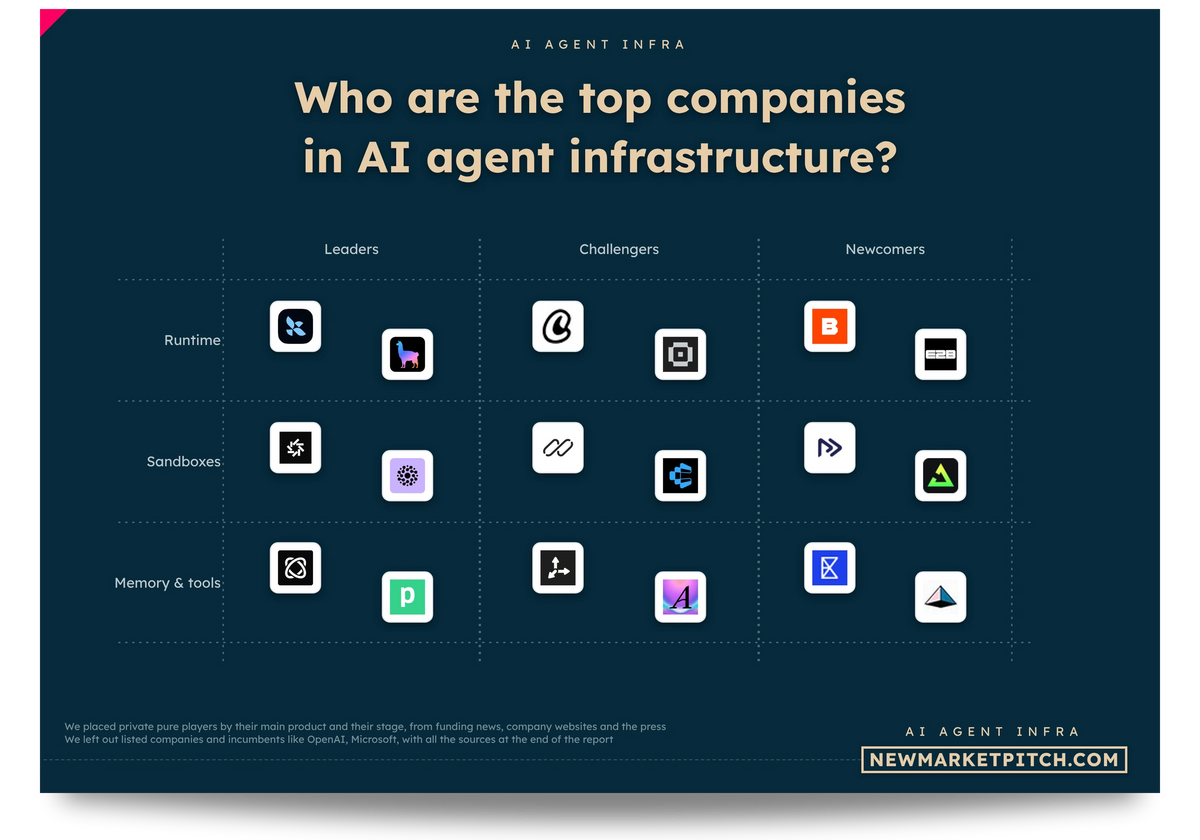
In our report covering the AI agent infrastructure market, we turn what is vague and complex into simple, useful visuals. Market maps like this one show you at a glance where every startup stands.
Top startups in the AI agent infrastructure market ranked by valuation
Here is the current ranking of the most valuable AI agent infrastructure startups. For each one you will also find our confidence level and the valuation basis we used.
If you want to go deeper into the AI agent infrastructure startup landscape, check our report covering the AI agent infrastructure market.
| # | Startup | Valuation | Confidence | Valuation basis | Last round | Total funding |
|---|---|---|---|---|---|---|
| Private startups | ||||||
| 1 | ModalProvides serverless AI compute infrastructure | $15.75Bas of Oct 2026 | Full | Announced private round valuation | $750MSeries D · Oct 2026 | $1.2Bvalued at 13.0× this |
| 2 | TemporalDurable execution platform for reliable agent workflows | $12.55Bas of Sep 2026 | Full | Announced private round valuation | $550MSeries D+ · Sep 2026 | $1.2Bvalued at 10.5× this |
| 3 | OpenRouterProvides unified AI model routing marketplace | $7.5B–$8.5Bas of Aug 2026 | Full | Acquisition value | $113MSeries B · May 2026 | $141Mvalued at 56.7× this |
| 4 | n8nVisual AI agent orchestration and execution workflows | $5.2Bas of May 2026 | Strong | Reported private round valuation | UndisclosedOther · May 2026 | $254M+valued at 20.5× this |
| 5 | ExaWeb search and research tools for agents | $2.2Bas of May 2026 | Full | Announced private round valuation | $250MSeries C · May 2026 | $357Mvalued at 6.2× this |
| 6 | Parallel Web SystemsWeb search and research APIs for agents | $2.0Bas of Apr 2026 | Full | Announced private round valuation | $100MSeries B · Apr 2026 | $230Mvalued at 8.7× this |
| 7 | LangChainFramework and infrastructure for AI agents | $1.25Bas of Oct 2025 | Full | Announced private round valuation | $300MSeries C, filing-reported · Sep 2026 | $460Mvalued at 2.7× this |
| 8 | ZenitySecures and governs autonomous AI agents | $833M–$1.6Bas of Aug 2026 | Strong | Implied valuation from raise | $125MSeries C · Aug 2026 | $184Mvalued at 6.5× this |
| 9 | DaytonaIsolated cloud computers for AI agents | $1.0Bas of Oct 2026 | Full | Announced private round valuation | $60MSeries B · Oct 2026 | $91Mvalued at 11.0× this |
| 10 | LiveKitReal-time infrastructure for voice AI | $1.0Bas of Jan 2026 | Full | Announced private round valuation | $100MSeries C · Jan 2026 | $181Mvalued at 5.5× this |
| 11 | Emergence AIAutonomous agents for enterprise workflows | $648M–$1.2Bas of Jun 2024 | Low | Estimated from last round | $97MGrowth equity · Jun 2024 | $97Mvalued at 9.6× this |
| 12 | BraintrustAI evaluation and observability platform | $800M | Full | Announced private round valuation | $80MSeries B · Feb 2026 | $124Mvalued at 6.4× this |
| 13 | EmaUniversal AI employees for enterprises | $513M–$962Mas of Sep 2026 | Low | Estimated from last round | $77MSeries B · Sep 2026 | $138M+valued at 5.3× this |
| 14 | Onyx SecurityAI agent governance and control | $640Mas of Jul 2026 | Strong | Reported private round valuation | $113MSeries B · Jul 2026 | $153Mvalued at 4.2× this |
| 15 | Neo SecuritySecurity controls for enterprise AI agents | $400M–$800Mas of Oct 2026 | Partial | Comparables-based estimate | $75M+Series A · Jul 2026 | $100M+valued at 6.0× this |
| 16 | //dev/agentsOperating system for AI agents | $500Mas of Nov 2024 | Strong | Reported private round valuation | $56MSeed · Nov 2024 | $56Mvalued at 8.9× this |
| 17 | VapiVoice AI agent infrastructure | $500Mas of May 2026 | Strong | Reported private round valuation | $50MSeries B · May 2026 | $70Mvalued at 7.1× this |
| 18 | GumloopNo-code AI workflow automation | $333M–$625Mas of Mar 2026 | Low | Estimated from last round | $50MSeries B · Mar 2026 | $70Mvalued at 6.8× this |
| 19 | Patronus AISimulation and evaluation environments for AI agents | $333M–$625Mas of Jun 2026 | Low | Estimated from last round | $50MSeries B · Jun 2026 | $70Mvalued at 6.8× this |
| 20 | MintlifyDeveloper documentation made consumable by AI agents | $300M–$562Mas of Apr 2026 | Low | Estimated from last round | $45MSeries B · Apr 2026 | $66Mvalued at 6.5× this |
| 21 | StraikerProtects enterprise AI agents from attacks | $320M–$533Mas of Jun 2026 | Strong | Implied valuation from raise | $64MSeries A · Jun 2026 | $85Mvalued at 5.0× this |
| 22 | Arcade.devSecure agent authentication and action execution | $300M–$500Mas of Jun 2026 | Low | Estimated from last round | UndisclosedSeries A extension · Sep 2026 | $72M+valued at 5.6× this |
| 23 | Noma SecurityEnterprise AI security and monitoring | $400Mas of Jul 2025 | Strong | Reported private round valuation | $100MSeries B · Jul 2025 | $132M+valued at 3.0× this |
| 24 | BrowserbaseCloud browsers and automation runtime for agents | $267M–$500Mas of Jun 2025 | Low | Estimated from last round | $40MSeries B · Jun 2025 | $68Mvalued at 5.7× this |
| 25 | DustEnterprise AI agents and workflows | $267M–$500Mas of May 2026 | Low | Estimated from last round | $40MSeries B · May 2026 | $61Mvalued at 6.2× this |
| 26 | TinyFishAutonomous enterprise web workflow agents | $235M–$392Mas of Aug 2025 | Low | Estimated from last round | $47MSeries A · Aug 2025 | $47Mvalued at 6.7× this |
| 27 | AIR SecuritySecurity controls for AI agent integrations | $200M–$330Mas of Oct 2026 | Partial | Comparables-based estimate | $40MSeed · Aug 2026 | $50Mvalued at 5.3× this |
| 28 | UnifyAppsEnterprise AI agent integration platform | $250Mas of Oct 2025 | Strong | Reported private round valuation | $50MSeries B · Oct 2025 | $81Mvalued at 3.1× this |
| 29 | BotpressAI agent development platform | $167M–$312Mas of Jun 2025 | Low | Estimated from last round | $25MSeries B · Jun 2025 | $40M+valued at 6.0× this |
| 30 | SapiomPayment and tool access infrastructure for agents | $175M–$292Mas of Aug 2026 | Low | Estimated from last round | $35MSeries A · Aug 2026 | $51Mvalued at 4.6× this |
| 31 | Relevance AINo-code AI agent workforce platform | $160M–$300Mas of May 2025 | Low | Estimated from last round | $24MSeries B · May 2025 | $37M+valued at 6.2× this |
| 32 | Catena LabsFinancial infrastructure for autonomous AI agents | $150M–$250Mas of May 2026 | Low | Estimated from last round | $30MSeries A · May 2026 | $48Mvalued at 4.2× this |
| 33 | NaturalPayments stack for agents and automated commerce | $150M–$250Mas of Jul 2026 | Low | Estimated from last round | $30MSeries A · Jul 2026 | $40Mvalued at 5.0× this |
| 34 | RunlayerEnterprise AI agent security and governance | $150M–$250Mas of Jun 2026 | Low | Estimated from last round | $30MSeries A · Jun 2026 | $41Mvalued at 4.9× this |
| 35 | CovalVoice AI testing and evaluation platform | $140M–$233Mas of Jun 2026 | Low | Estimated from last round | $28MSeries A · Jun 2026 | $31Mvalued at 6.0× this |
| 36 | Obot AIAI agent governance and MCP gateway | $140M–$233Mas of Sep 2025 | Low | Estimated from last round | $35MSeed · Sep 2025 | $35Mvalued at 5.3× this |
| 37 | CopilotKitEmbeds interactive agents into application interfaces | $135M–$225Mas of May 2026 | Low | Estimated from last round | $27MSeries A · May 2026 | $27M+valued at 6.6× this |
| 38 | DifyOpen-source development platform for agentic AI applications | $180Mas of Mar 2026 | Full | Announced private round valuation | $30MSeed · Mar 2026 | $30M+valued at 6.0× this |
| 39 | Geordie AIAutonomous AI agent security | $180Mas of May 2026 | Full | Announced private round valuation | $30MSeries A · May 2026 | $36Mvalued at 4.9× this |
| 40 | Judgment LabsEvaluations and observability for deployed agents | $175Mas of May 2026 | Strong | Reported private round valuation | $32MSeed + Series A (announced together) · May 2026 | $32Mvalued at 5.5× this |
| 41 | KernelCloud browsers for generative AI agents | $100M–$240M | Partial | Comparables-based estimate | $22MSeries A · Oct 2025 | $22Mvalued at 7.7× this |
| 42 | AembitSecretless workload identity access to cloud services | $125M–$208Mas of Sep 2024 | Low | Estimated from last round | $25MSeries A · Sep 2024 | $43M+valued at 3.9× this |
| 43 | ComposioIntegrates agent tools actions and app authentication | $125M–$208Mas of Jul 2025 | Low | Estimated from last round | $25MSeries A · Jul 2025 | $29Mvalued at 5.7× this |
| 44 | Rein SecurityRuntime safeguards for autonomous AI agents | $125M–$208Mas of Oct 2026 | Low | Estimated from last round | $25MSeries A · Oct 2026 | $33Mvalued at 5.1× this |
| 45 | Sema4.aiEnterprise AI agent building and management platform | $125M–$208Mas of Jun 2025 | Low | Estimated from last round | $25MSeries A · Jun 2025 | $56Mvalued at 3.0× this |
| 46 | KeycardRuntime agent identity and access control | $115M–$205Mas of Oct 2026 | Partial | Comparables-based estimate | $30MSeries A · Oct 2025 | $38Mvalued at 4.2× this |
| 47 | WordwareIntegrated development environment for AI agent applications | $120M–$200Mas of Nov 2024 | Low | Estimated from last round | $30MSeed · Nov 2024 | $30Mvalued at 5.3× this |
| 48 | EunoEnterprise data context for AI agents | $115M–$192Mas of Sep 2026 | Low | Estimated from last round | $23MSeries A · Sep 2026 | $23Mvalued at 6.7× this |
| 49 | MastraProvides TypeScript framework for building AI agents | $110M–$183Mas of Apr 2026 | Low | Estimated from last round | $22MSeries A · Apr 2026 | $35Mvalued at 4.2× this |
| 50 | E2BSecure cloud sandboxes for executing agent tasks | $105M–$175Mas of Jul 2025 | Low | Estimated from last round | $21MSeries A · Jul 2025 | $35Mvalued at 4.0× this |
| 51 | InngestDurable functions and workflows for production agents | $105M–$175Mas of Sep 2025 | Low | Estimated from last round | $21MSeries A · Sep 2025 | $30Mvalued at 4.7× this |
| 52 | LinqMessaging and voice communication APIs | $100M–$167Mas of Feb 2026 | Low | Estimated from last round | $20MSeries A · Feb 2026 | $27Mvalued at 5.0× this |
| 53 | Mem0Memory layer for personalizing persistent AI agents | $100M–$167Mas of Oct 2025 | Low | Estimated from last round | $20MSeries A · Oct 2025 | $20Mvalued at 6.7× this |
| 54 | RestateDurable execution infrastructure for agentic applications | $100M–$167Mas of Sep 2026 | Low | Estimated from last round | $20MSeries A · Sep 2026 | $27Mvalued at 4.9× this |
| 55 | StackOneUnified APIs connecting agents to enterprise applications | $100M–$167Mas of May 2025 | Low | Estimated from last round | $20MSeries A · May 2025 | $24Mvalued at 5.6× this |
| 56 | Synthflow AIVoice agents answering and routing customer calls | $100M–$167Mas of Jun 2025 | Low | Estimated from last round | $20MSeries A · Jun 2025 | $29Mvalued at 4.6× this |
| 57 | Thread AIEnterprise AI workflow and agent orchestration platform | $100M–$167Mas of Jun 2025 | Low | Estimated from last round | $20MSeries A · Jun 2025 | $26Mvalued at 5.1× this |
| 58 | Token SecurityMachine identities and SaaS token attack protection | $100M–$167Mas of Jan 2025 | Low | Estimated from last round | $20MSeries A · Jan 2025 | $27Mvalued at 4.9× this |
| 59 | VellumVisual platform for creating testing deploying agents | $100M–$167Mas of Jul 2025 | Low | Estimated from last round | $20MSeries A · Jul 2025 | $25Mvalued at 5.3× this |
| 60 | LlamaIndexBuilds data-connected agents and workflow development frameworks | $95M–$158Mas of Mar 2025 | Low | Estimated from last round | $19MSeries A · Mar 2025 | $28Mvalued at 4.6× this |
| 61 | KitePayments infrastructure for autonomous AI agents | $90M–$150Mas of Sep 2025 | Low | Estimated from last round | $18MSeries A · Sep 2025 | $18M+valued at 6.7× this |
| 62 | KilnTooling for agent prototyping testing and evaluation | $68M–$170Mas of Jan 2024 | Low | Estimated from last round | $17MOther · Jan 2024 | $39Mvalued at 3.1× this |
| 63 | PaidBilling and monetization infrastructure for AI agents | $86M–$144Mas of Sep 2025 | Low | Estimated from last round | $22MSeed · Sep 2025 | $22Mvalued at 5.3× this |
| 64 | VijilTesting monitoring and protecting AI agents | $85M–$142Mas of Nov 2025 | Low | Estimated from last round | $17MSeries A · Nov 2025 | $23Mvalued at 4.9× this |
| 65 | Stack AIProvides enterprise visual agent-building and deployment software | $80M–$133Mas of May 2025 | Low | Estimated from last round | $16MSeries A · May 2025 | $16Mvalued at 6.7× this |
| 66 | Trigger.devBackground job and task execution for agents | $80M–$133Mas of Dec 2025 | Low | Estimated from last round | $16MSeries A · Dec 2025 | $19Mvalued at 5.6× this |
| 67 | Circuit & ChiselAI lab building low-cost blended model Pareto | $77M–$128Mas of Sep 2025 | Low | Estimated from last round | $19MSeed · Sep 2025 | $19Mvalued at 5.3× this |
| 68 | PortkeyAI gateway routing observability and access control | $75M–$125Mas of Feb 2026 | Low | Estimated from last round | $15MSeries A · Feb 2026 | $18Mvalued at 5.6× this |
| 69 | FirecrawlExtracts and crawls websites for agent workflows | $72M–$121Mas of Aug 2025 | Low | Estimated from last round | $14MSeries A · Aug 2025 | $14Mvalued at 6.7× this |
| 70 | LyzrEnterprise platform to build govern deploy agents | $72M–$121Mas of Mar 2026 | Low | Estimated from last round | $14MSeries A · Mar 2026 | $22Mvalued at 4.3× this |
| 71 | Browser UseOpen-source browser automation framework for AI agents | $68M–$113Mas of Mar 2025 | Low | Estimated from last round | $17MSeed · Mar 2025 | $17Mvalued at 5.3× this |
| 72 | OuterlimitDecentralized AI agent authorization security | $64M–$107M | Strong | Implied valuation from raise | $16MPre-Seed · Sep 2026 | $16Mvalued at 5.3× this |
| 73 | PydanticProvides typed Python framework for agent applications | $62M–$104Mas of Oct 2024 | Low | Estimated from last round | $12MSeries A · Oct 2024 | $17Mvalued at 4.8× this |
| 74 | CrewAIBuilds collaborative multi-agent orchestration and deployment platform | $60M–$100Mas of Oct 2024 | Low | Estimated from last round | $12MSeries A · Oct 2024 | $20Mvalued at 4.0× this |
| 75 | Barndoor AISecurity controls for enterprise AI agents | $54M–$91Mas of May 2025 | Low | Estimated from last round | $14MSeed · May 2025 | $14Mvalued at 5.3× this |
| 76 | LettaStateful agents with persistent editable long-term memory | $40M–$67Mas of Sep 2024 | Low | Estimated from last round | $10MSeed · Sep 2024 | $10Mvalued at 5.3× this |
| 77 | Tektonic AIAI agents for enterprise revenue workflows | $40M–$67Mas of Jun 2024 | Low | Estimated from last round | $10MSeed · Jun 2024 | $10Mvalued at 5.3× this |
| 78 | Pillar SecurityAI application security and testing | $25M–$75Mas of Oct 2026 | Partial | Comparables-based estimate | $13MSeed · May 2026 | $22M+valued at 2.3× this |
| 79 | MartianIntelligent LLM routing and selection for applications | $36M–$60Mas of Nov 2023 | Low | Estimated from last round | $9MSeed · Nov 2023 | $9Mvalued at 5.3× this |
| 80 | aiXplainOperating system and tools for AI agents | $26M–$65Mas of Jul 2024 | Low | Estimated from last round | $6.5MJul 2024 | $6.5Mvalued at 7.0× this |
| 81 | AnonAuthentication infrastructure to connect agents with apps | $33M–$55Mas of Nov 2024 | Low | Estimated from last round | $8.3MSeed · Nov 2024 | $15Mvalued at 3.0× this |
| 82 | CogneeKnowledge graphs and semantic memory for agents | $30M–$50Mas of Feb 2026 | Low | Estimated from last round | $7.5MSeed · Feb 2026 | $7.5Mvalued at 5.3× this |
| 83 | NangoUnified APIs and OAuth for agent integrations | $30M–$50Mas of Apr 2026 | Low | Estimated from last round | $7.5MSeed · Apr 2026 | $7.5Mvalued at 5.3× this |
| 84 | xpanderEnterprise platform for building AI agents | $30M–$50Mas of Aug 2026 | Low | Estimated from last round | $7.5MSeed · Aug 2026 | $7.5Mvalued at 5.3× this |
| 85 | RunloopCode execution environments and evaluations for agents | $28M–$47Mas of Jul 2025 | Low | Estimated from last round | $7MSeed · Jul 2025 | $7Mvalued at 5.3× this |
| 86 | ChainMLAI agent infrastructure for developers | $25M–$41Mas of May 2024 | Low | Estimated from last round | $6.2MSeed · May 2024 | $6.2Mvalued at 5.3× this |
| 87 | AgentMailEmail infrastructure API for AI agents | $24M–$40Mas of Mar 2026 | Low | Estimated from last round | $6MSeed · Mar 2026 | $6Mvalued at 5.3× this |
| 88 | AlpicHosting platform for MCP servers and ChatGPT apps | $24M–$40Mas of Sep 2025 | Low | Estimated from last round | $6MSeed · Sep 2025 | $6Mvalued at 5.3× this |
| 89 | Naptha AIInfrastructure for multi-agent AI systems | $24M–$40Mas of Oct 2024 | Low | Estimated from last round | $6MSeed · Oct 2024 | $6Mvalued at 5.3× this |
| 90 | Asymptote LabsAI agent monitoring and governance software | $22M–$37Mas of Oct 2026 | Low | Estimated from last round | $5.5MSeed · Oct 2026 | $5.5Mvalued at 5.3× this |
| 91 | HoneyHiveAgent observability evaluation and debugging platform | $22M–$37Mas of Apr 2025 | Low | Estimated from last round | $5.5MSeed · Apr 2025 | $7.4Mvalued at 4.0× this |
| 92 | ScalekitAuthentication and integrations for AI agents | $22M–$37Mas of Sep 2025 | Low | Estimated from last round | $5.5MSeed · Sep 2025 | $5.5Mvalued at 5.3× this |
| 93 | VoiceRunDevelopment platform for enterprise voice agents | $22M–$37Mas of Jan 2026 | Low | Estimated from last round | $5.5MSeed · Jan 2026 | $5.5Mvalued at 5.3× this |
| 94 | AgnoOffers open-source agent and multi-agent framework | $22M–$36Mas of Aug 2024 | Low | Estimated from last round | $5.4MSeed · Aug 2024 | $5.4M+valued at 5.3× this |
| 95 | NekudaAgentic commerce tools for websites | $20M–$33Mas of May 2025 | Low | Estimated from last round | $5MSeed · May 2025 | $5Mvalued at 5.3× this |
| 96 | RespanOpen-source AI gateway with observability | $20M–$33Mas of Mar 2026 | Low | Estimated from last round | $5MSeed · Mar 2026 | $5Mvalued at 5.3× this |
| 97 | Retell AIVoice agent builder for enterprise calls | $18M–$31Mas of Aug 2024 | Low | Estimated from last round | $4.6MSeed · Aug 2024 | $4.7M+valued at 5.2× this |
| 98 | PhotonConnects AI agents to messaging apps | $18M–$30Mas of Oct 2026 | Low | Estimated from last round | $4.5MSeed · Oct 2026 | $4.5Mvalued at 5.3× this |
| 99 | PhonicEnd-to-end speech-to-speech AI voice models | $17M–$30M | Partial | Comparables-based estimate | $28MSeries A · Oct 2026 | $32Mvalued at 0.7× this |
| 100 | AMESAIndustrial AI agent platform | $17M–$28Mas of May 2024 | Low | Estimated from last round | $4.2MSeed · May 2024 | $4.2Mvalued at 5.3× this |
| 101 | KontextRuntime authorization and monitoring for AI agents | $16M–$27Mas of Sep 2026 | Low | Estimated from last round | $4MSeed · Sep 2026 | $4Mvalued at 5.3× this |
| 102 | NeverminedPayments and monetization infrastructure for AI agents | $16M–$27Mas of Jan 2025 | Low | Estimated from last round | $4M+Seed · Jan 2025 | $7.3M+valued at 2.9× this |
| 103 | OneTrust layer that lets AI agents connect to and act in business apps | $16M–$27Mas of Jul 2026 | Low | Estimated from last round | $4MSeed · Jul 2026 | $4Mvalued at 5.3× this |
| 104 | Hamming AIAutomated testing and monitoring for voice agents | $15M–$25Mas of Dec 2024 | Low | Estimated from last round | $3.8MSeed · Dec 2024 | $3.9Mvalued at 5.2× this |
| 105 | BeamServerless cloud for AI applications | $14M–$23Mas of May 2022 | Low | Estimated from last round | $3.5MSeed · May 2022 | $3.5Mvalued at 5.3× this |
| 106 | Athina AIProduction agent evaluation and LLM monitoring | $12M–$20Mas of Nov 2024 | Low | Estimated from last round | $3MSeed · Nov 2024 | $3Mvalued at 5.3× this |
| 107 | Maxim AISimulation testing and observability for AI agents | $12M–$20Mas of Jun 2024 | Low | Estimated from last round | $3MSeed · Jun 2024 | $3Mvalued at 5.3× this |
| 108 | SupermemoryLong-term memory API for AI agents | $12M–$20Mas of Oct 2025 | Low | Estimated from last round | $3MPre-Seed · Oct 2025 | $3Mvalued at 5.3× this |
| 109 | SkyvernBrowser automation infrastructure driven by visual agents | $11M–$18Mas of Dec 2025 | Low | Estimated from last round | $2.7MSeed · Dec 2025 | $2.7Mvalued at 5.3× this |
| 110 | AgentOpsMonitoring tracing and benchmarking AI agent runs | $10M–$17Mas of Aug 2024 | Low | Estimated from last round | $2.6MPre-Seed · Aug 2024 | $2.6Mvalued at 5.3× this |
| 111 | Confident AIEvaluation testing platform for production AI agents | $8.8M–$15Mas of Aug 2025 | Low | Estimated from last round | $2.2MSeed · Aug 2025 | $2.2Mvalued at 5.3× this |
| 112 | LangWatchAgent evaluation monitoring and prompt optimization | $4.4M–$7.3Mas of Feb 2025 | Low | Estimated from last round | $1.1MPre-Seed · Feb 2025 | $1.1Mvalued at 5.3× this |
| 113 | SkyfireAgent identity and machine-to-machine payments rails | $4M–$6.7Mas of Oct 2024 | Low | Estimated from last round | $1MSeed · Oct 2024 | $9.5Mvalued at 0.6× this |
| 114 | VobizTelephony infrastructure for AI voice agents | $4M–$6.7Mas of May 2026 | Low | Estimated from last round | $1MSeed · May 2026 | $1Mvalued at 5.3× this |
| 115 | Payman AIAgent payments and human contractor transaction workflows | $3.2M–$5.3Mas of Feb 2025 | Low | Estimated from last round | $800KSeed · Feb 2025 | $3.8Mvalued at 1.1× this |
| 116 | ZepTemporal knowledge graph and memory for agents | $2M–$3.3Mas of Feb 2024 | Low | Estimated from last round | $500KSeed · Feb 2024 | $2.3Mvalued at 1.2× this |
| 117 | Vaani AI ResearchMultilingual voice AI agent infrastructure | $1.6M–$2.7Mas of Sep 2025 | Low | Estimated from last round | $400KSeed · Sep 2025 | $400Kvalued at 5.3× this |
| Listed in the last 5 years or acquired in the last 3 years · not ranked | ||||||
| CognigyConversational AI agents for customer service | $955Mas of Jul 2025 | Full | Acquisition value | $100MSeries C · Jun 2024 | $159M+valued at 6.0× this | |
| Arize AIAI model evaluation and failure monitoring | $915Mas of Aug 2026 | Full | Acquisition value | $70MSeries C · Feb 2025 | $131Mvalued at 7.0× this | |
| Astrix SecurityCloud and SaaS non-human identity security | $400Mas of May 2026 | Full | Acquisition value | $45MSeries B · Dec 2024 | $85Mvalued at 4.7× this | |
| LakeraRuntime security and guardrails for AI agents | $202Mas of Oct 2025 | Full | Acquisition value | $20MSeries A · Jul 2024 | $30Mvalued at 6.7× this | |
No startups match this search.

Our research about AI agent infrastructure startups gets updated several times a month, so you always get the latest view of where things stand.
Why is Modal worth more than every other AI agent infrastructure startup?
Modal is the most valuable AI agent infrastructure startup because investors are pricing a broad, high-usage compute layer rather than a narrow agent tool.
Modal is valued at $15.75B, first in the market, and its operating numbers make that price easier to understand. In October, Modal said it had crossed $1B in annualized run rate after growing more than 15x year over year. Its Sandboxes product alone had reached a $300M run rate, with close to 3 billion sandboxes spun up, and the company said those environments can scale to a million concurrent sandboxes. Agent workloads need that execution capacity, not just prompts and orchestration.
Modal is also expanding beyond one workload. It supports inference, reinforcement learning, batch jobs, training and sandboxed code execution, while customers use it for coding agents, model serving, simulations and computational workloads. That breadth helps explain the valuation. Investors are betting that Modal can become a general-purpose cloud layer for AI-native software, not just a tool for one workload.
Can Temporal actually overtake Modal?
Temporal can realistically overtake Modal in AI agent infrastructure, but Modal is still ahead today.
Temporal is valued at $12.55B versus Modal at $15.75B, and the ratio between them is 1.3x. Temporal's case is unusually strong because its durable execution layer is already deeply embedded in production systems. In September, the company reported annualized revenue run rate above $250M, more than 4,300 paying customers and 1.9 trillion billable actions in August. It also said OpenAI's use had increased 60-fold in under a year and named Snap and NVIDIA among customers.
That usage profile is relevant to agents because long-running autonomous workflows fail differently from normal web requests. Temporal keeps state and resumes work across failures, which becomes more valuable as agents run for hours, days or longer. Modal is ahead on valuation for now, but Temporal is big enough, and deep enough in production systems, that the gap could close.

In our market report about AI agent infrastructure startups, we look at what the winners do differently, so you can learn from the best instead of guessing.
Why is OpenRouter worth so much despite raising far less money?
OpenRouter, which Stripe agreed to buy in August 2026, is worth so much because it has become a busy routing layer in AI agent infrastructure, sitting between developers and hundreds of AI models.
OpenRouter is valued at $7.5B–$8.5B in the Stripe deal and has raised $141M. That value is 56.7x the money it raised, the highest valuation-to-funding multiple in this market. The operating evidence explains part of that gap. In August, OpenRouter said it was processing 10+ trillion tokens per day across 400+ AI models for more than 10 million developers and companies.
A routing marketplace can sit between many models, providers and applications without paying to train the models itself. Stripe's August 2026 agreement to buy OpenRouter shows why that position is valuable: routing, spend control and payments start to meet in the same place when agents choose models and make purchases programmatically. OpenRouter's valuation is tied to that usage and network position, not to how much money it spent getting there.
Is n8n still one of the most valuable AI agent infrastructure startups?
Yes. n8n remains one of the most valuable AI agent infrastructure startups, with a $5.2B reported valuation and a clear enterprise orchestration role.
n8n is fourth in our ranking. Its product sits between traditional workflow automation and agent orchestration, allowing companies to connect models, business systems and deterministic logic. That hybrid model is important because enterprises rarely want fully autonomous behavior everywhere. They want agents inside controlled workflows where approvals, data access and fallback logic remain visible.
The company has also attracted money from investors that can help with distribution. n8n's own press materials say SAP invested in May at a $5.2B valuation and that n8n would be embedded in SAP Joule Studio. Earlier, its $180M Series C in October 2025 was framed around moving AI from experimentation into reliable business execution. That enterprise distribution makes the valuation easier to understand: n8n is not competing only as an agent builder, but as an orchestration layer connecting AI to the software stack companies already use.

In our document detailing everything you need to know about AI agent infrastructure, you will always find fresh funding data, taken straight from our own verified funding database.
Do AI agents really need their own search infrastructure?
Yes, because AI agents need live web data, and search has become one of the most valuable layers of AI agent infrastructure.
Exa is valued at $2.2B and Parallel Web Systems at $2.0B, placing them fifth and sixth. Both sell web search and research capabilities designed for machines rather than human search pages. Exa said in May that it served more than 400,000 developers and powered search for companies including Cursor, Cognition, HubSpot, OpenRouter and Monday.com. Parallel has said its customers include Clay, Harvey, Notion and Opendoor, and TechCrunch reported more than 100,000 developers using its products.
Those examples show why search is becoming infrastructure rather than a feature. Agents need fresh, structured and machine-readable information at scale, often inside longer workflows. A coding agent, sales agent or research agent that cannot retrieve reliable external information becomes much less useful. Investors are valuing web access as infrastructure that many kinds of agents can reuse, rather than as another consumer search engine.
The table below shows the most valuable AI agent search, routing and web-access startups.
| Company | Valuation | What it does |
|---|---|---|
| OpenRouter | $7.5B–$8.5B | Model routing |
| Exa | $2.2B | Agent search |
| Parallel Web Systems | $2.0B | Agent search |
| Mintlify | $300M–$562M | Agent docs |
| Browserbase | $267M–$500M | Cloud browsers |
| TinyFish | $235M–$392M | Web workflows |
| Firecrawl | $72M–$121M | Web extraction |
Is AI agent security already a billion-dollar category?
AI agent security is already reaching billion-dollar territory, although no single security startup has pulled far away from the rest.
Zenity is valued at $833M–$1.6B, Onyx Security at $640M and Neo Security at $400M–$800M. Straiker follows at $320M–$533M, while Noma Security is reportedly valued at $400M. The cluster matters because security is appearing across several control points: agent identity, action permissions, runtime policy, monitoring and governance.
Commercial traction is starting to match that investor interest. Onyx said in July that revenue had quadrupled in four months after launch and that it was securing more than 1.1 million AI agents while inspecting more than 66 million AI sessions. Zenity's 2026 releases have focused on runtime protection, agent governance and integrations across major enterprise AI platforms. As agents gain access to business systems, the security problem shifts from protecting prompts to controlling what autonomous software can actually do. That makes agent security a plausible standalone infrastructure layer rather than an add-on to conventional cybersecurity.
Why did Daytona reach a $1B valuation so quickly?
Daytona reached a $1.0B valuation because AI agents need safe places to run code and complete tasks, and that need is becoming its own infrastructure market.
Daytona's core idea is that an agent needs its own computer-like environment to write code, use tools, browse, preserve state and execute tasks safely. In October, the company raised a $60M Series B and said revenue had grown approximately 25× since January. In early November, Daytona said its run rate had gone from $1M to $100M in four quarters.
The product is also broader than a basic code sandbox. Daytona offers isolated Linux, Windows, macOS and GPU environments, with persistent state and rapid startup. Customers named by the company include Meta, Cohere, Writer, Clay, n8n, Postman and Mintlify. That combination of rapid commercial growth and a clearly agent-specific workload explains why investors were willing to price it alongside much older infrastructure companies. The market is effectively betting that execution will become as fundamental to agents as cloud instances became to web applications.

Learning from others' mistakes is the cheapest lesson there is. In our report covering the AI agent infrastructure market, we look at what broke startups before you, so you don't repeat it.
Does LiveKit prove voice agents need their own infrastructure layer?
Yes. LiveKit's $1.0B valuation shows that real-time voice has become a real infrastructure layer for AI agents.
LiveKit provides low-latency audio, video and real-time communications infrastructure used by developers building voice agents. TechCrunch reported in January that the company powered ChatGPT voice mode and counted xAI, Salesforce and Tesla among customers. That breadth matters because the same real-time layer can serve many applications rather than one finished voice agent.
Voice systems have demanding infrastructure requirements: interruption handling, streaming audio, latency, telephony, model handoffs and reliability all need to work continuously during a conversation. The economics look closer to developer infrastructure than to a single vertical application. Vapi, valued at $500M, shows the same split from another angle. It provides a configurable platform for deploying voice agents and said its enterprise customers include Amazon Ring, Intuit and New York Life. Together, LiveKit and Vapi show a growing split between the real-time rails and the agent-building layer above them.
Is LangChain still central to the AI agent infrastructure market?
LangChain is still central to AI agent infrastructure, but it is no longer one of the market's biggest companies by valuation.
LangChain is seventh among AI agent infrastructure startups by valuation, at $1.25B. Its importance comes from distribution among developers and from moving beyond the original open-source library into LangGraph and LangSmith, which cover orchestration, evaluation, observability and deployment. The company has named Replit, Clay, Harvey, Rippling, Cloudflare, Workday and Cisco among users of its products.
LangChain's valuation is only 2.7x the money it has raised, the lowest multiple in this market. That low multiple says little about the business itself. The $1.25B valuation dates from October 2025, and LangChain has raised more since, with a Series C in September 2026 whose valuation has not been reported. Compared with leaner routing or security companies, LangChain is being financed more like a broad platform build. The challenge for LangChain is to turn its popularity with developers into something big companies run their agents on, before model providers and cloud platforms build the same features themselves.

In our research about AI agent infrastructure startups, we always try to gather several sources and make estimates that make sense, so you can work with solid numbers.
Are the most valuable AI agent infrastructure startups all American?
Mostly, but not all: 8 of the 10 most valuable AI agent infrastructure startups are American, while Germany's n8n and Israel's Zenity make the top 10.
The United States accounts for 88 of the 117 AI agent infrastructure startups we track. Israel and the United Kingdom each have 6, Germany has 5, France and India have 3 each, Canada has 2, and Australia, the Netherlands, Singapore and Switzerland each have 1.
The non-American companies are also present near the top. Germany's n8n is fourth at $5.2B. Israel's Zenity is eighth at $833M–$1.6B, and several Israeli security startups sit in the next tier. France's Dust and Canada's Gumloop appear in the mid-market group, while the United Kingdom has several companies spanning security, billing, integrations and infrastructure.
The table below shows how many of these startups each country has.
| Country | Companies |
|---|---|
| United States | 88 |
| Israel | 6 |
| United Kingdom | 6 |
| Germany | 5 |
| France | 3 |
| India | 3 |
| Canada | 2 |
| Australia | 1 |
| Netherlands | 1 |
| Singapore | 1 |
| Switzerland | 1 |
How many AI agent infrastructure startups are actually unicorns?
Only 9 AI agent infrastructure startups are clear unicorns today, so a $1B valuation is still unusual in this market.
We count a startup as a unicorn here only when its entire valuation is at least $1B. That avoids treating a range that merely touches $1B at the top as a confirmed unicorn. The clear group includes Modal, Temporal, OpenRouter, n8n, Exa, Parallel Web Systems, LangChain, Daytona and LiveKit.
The broader distribution is much less glamorous. We count 2 companies above $10B, 2 in the $5B to $10B bracket, 6 in the $1B to $5B bracket, and 107 below $1B. The apparent mismatch between 9 clear unicorns and 10 companies in the billion-dollar brackets comes from Zenity's $833M–$1.6B range, which crosses the threshold without sitting fully above it. Most AI agent infrastructure startups are still building toward scale rather than already sitting at huge valuations.

If you build or invest in the AI agent infrastructure market, you need to know which business models pay off now and which ones are fading. That's why our report covering it has a whole section on it.
Are AI agent infrastructure valuations becoming detached from funding?
Sometimes. AI agent infrastructure valuations can run far ahead of funding when a startup sits in a part of the stack that many other products depend on.
OpenRouter is the clearest example. Stripe agreed in August 2026 to buy it at a value 56.7x the money it had raised, the highest valuation-to-funding multiple in this market. Temporal is at 10.5x, Daytona at 11.0x, Parallel Web Systems at 8.7x and //dev/agents at 8.9x. At the other end, LangChain is at 2.7x and UnifyApps at 3.1x.
Those gaps come from very different business models. A marketplace or routing layer can scale transaction volume without owning the costliest underlying infrastructure. A security or orchestration company may also sell high-margin software after a relatively modest amount of capital. By contrast, a broad platform can raise more heavily to build enterprise sales, cloud infrastructure and multiple products.
The table below shows the highest valuation-to-funding multiples in this market, plus the lowest one.
| Company | Multiple | Valuation |
|---|---|---|
| OpenRouter | 56.7x | $7.5B–$8.5B |
| Modal | 13.0x | $15.75B |
| Daytona | 11.0x | $1.0B |
| Temporal | 10.5x | $12.55B |
| //dev/agents | 8.9x | $500M |
| Parallel Web Systems | 8.7x | $2.0B |
| Vapi | 7.1x | $500M |
| Zenity | 6.5x | $833M–$1.6B |
| Braintrust | 6.4x | $800M |
| LangChain | 2.7x | $1.25B |
Can AI agent testing become a big standalone business?
Yes. AI agent testing and observability can stand on their own because production agents need constant tracing, evaluation and debugging.
Braintrust is valued at $800M, Patronus AI at $333M–$625M and Judgment Labs at $175M, while a longer tail includes Coval, Kiln, Vellum, HoneyHive, Athina AI, Maxim AI and AgentOps. The number of independent companies matters because evaluation is not a single pre-deployment test. Agents can make different decisions on each run, use external tools and fail in ways that normal deterministic software does not.
Braintrust's February financing was explicitly framed around becoming an observability layer for production AI. Its founder has described the problem as one he encountered while building internal evaluation tooling at both Impira and Figma. As more companies put agents into production, the need shifts from testing a prompt to measuring entire trajectories, tool calls and outcomes. That creates room for specialist infrastructure even if cloud platforms and model vendors also add their own evaluation features.

In our document detailing everything you need to know about AI agent infrastructure, we like to show you the big picture. We know your time is precious, so we make every page quick to read and packed with as much learning as possible per minute.
Is AI agent identity becoming its own market?
Increasingly, yes. Identity is becoming its own slice of AI agent infrastructure as agents gain permission to act inside real business systems.
Arcade.dev is valued at $300M–$500M, Aembit at $125M–$208M, Keycard at $115M–$205M, Composio at $125M–$208M and Anon at $33M–$55M. These companies attack related problems from different angles: authenticating agents, issuing credentials, limiting tool access, connecting SaaS applications and enforcing action-level rules.
Arcade.dev's 2026 product direction is a good example of why the category is expanding. The company has focused on governance at the moment an agent takes an action, going beyond basic user authentication. It has also published scans of large MCP tool ecosystems and built controls around tool execution and approvals. As agents move from answering questions to sending emails, modifying records, buying services or touching production systems, conventional human identity controls leave gaps. Companies then need a new security layer around machine actors.
Why aren't AI agent payment startups worth more yet?
AI agent payment startups are still worth much less than the AI agent infrastructure leaders because agents paying on their own is still new and unproven.
Sapiom is valued at $175M–$292M, Catena Labs and Natural at $150M–$250M, Kite at $90M–$150M, Paid at $86M–$144M and Nevermined at $16M–$27M. Those figures are meaningful for young companies, but they sit well below orchestration, compute and durable execution leaders.
Payments still matter. Autonomous agents need ways to pay for APIs, data, services and other machine actions while respecting budgets and permissions. The uncertainty is where that functionality will ultimately live. Payment processors, cloud providers, model gateways and specialist agent-payment startups can all compete for the same transaction layer. Until agents buying from other agents becomes routine, investors can't really tell which independent company will end up collecting the fees. For now, payments look like an emerging infrastructure layer rather than a settled one.
Will one company end up owning the AI agent infrastructure stack?
Probably not. AI agent infrastructure is currently breaking into several valuable layers instead of collapsing around one dominant platform.
Modal leads compute and execution at $15.75B, Temporal leads durable workflows at $12.55B, OpenRouter is a major routing layer at $7.5B–$8.5B, n8n is a large orchestration platform at $5.2B, and Exa and Parallel Web Systems lead specialist web search. Security, voice, evaluation and authentication then form additional layers below them.
That structure resembles other infrastructure markets where developers combine multiple services. An agent may run in a Modal or Daytona environment, use Temporal for durable execution, call Exa for search, route models through OpenRouter, connect tools through Composio or Arcade.dev, and be monitored by Braintrust or another evaluation layer. Cloud and model providers will try to bundle these functions, but the current valuations show that investors still believe independent specialists can own important parts of the stack.

When you build or invest in the AI agent infrastructure market, you need clarity, not confusion. In our report covering the AI agent infrastructure market, we always try to put numbers on and quantify whatever is usually vague and confusing.
Are the biggest AI agent infrastructure valuations backed by real usage?
Mostly yes. The biggest AI agent infrastructure companies now have real usage and customers behind their valuations.
Modal has reported $1B in annualized run rate and large-scale sandbox usage. Temporal has reported more than 4,300 paying customers, annualized revenue run rate above $250M and 1.9 trillion billable actions in one month. OpenRouter has reported more than 10 million developers and companies with 10+ trillion tokens processed per day. Exa says more than 400,000 developers use its search infrastructure, while Parallel has reported more than 100,000 developers.
These are different metrics and should not be compared as if they were the same thing. Revenue, customers, developer accounts, requests and tokens measure different kinds of adoption. The common pattern is that the top valuations increasingly correspond to infrastructure already handling production-scale workloads. That is a stronger foundation than the earlier phase of agent investing, when many companies were valued mainly on technical promise and founder reputation.
Could security startups become more valuable than agent builders?
Yes. AI agent security could become more valuable than some builders because companies need protection no matter which agent framework they use.
Zenity's $833M–$1.6B range already overlaps the unicorn threshold, while Onyx Security is reportedly valued at $640M and Neo Security at $400M–$800M. The underlying demand is also becoming more concrete. Onyx said it was securing more than 1.1 million agents and 66 million AI sessions by July, while Zenity has expanded runtime controls across major agent platforms and enterprise environments.
That position can be hard to dislodge. Companies may switch between OpenAI, Anthropic, internal models and different agent frameworks, but they still need one place to enforce policies and monitor actions. A security vendor that works across models and frameworks can stay useful while the rest of the stack changes. The risk is that incumbent cybersecurity platforms absorb the category quickly. Still, the current private valuations show that investors believe agent-specific controls are differentiated enough to support independent companies.

A good product starts with a real problem. In our research about AI agent infrastructure startups, we show you the ones customers still live with.
Are lower-valued AI agent infrastructure startups already too late?
No. A lower AI agent infrastructure valuation often says more about a startup's stage than about whether the product matters.
The market has 107 startups below $1B, including many companies building memory, sandboxes, observability, integrations, payments and identity. Mem0 is valued at $100M–$167M, E2B at $105M–$175M, LlamaIndex at $95M–$158M and CrewAI at $60M–$100M. These are categories that could become more valuable if agent workloads standardize around them.
The challenge is that many functions may be bundled by larger platforms. Memory can be absorbed into databases or frameworks, sandboxes into clouds, observability into developer platforms and integrations into orchestration products. Smaller startups need more than a useful feature. They need to become a control point, create strong developer distribution, or build enough enterprise depth that customers prefer an independent layer. The top of the ranking shows that this can happen quickly when usage accelerates, but it is not automatic.
So, which AI agent infrastructure startups are worth the most today?
Modal is the most valuable AI agent infrastructure startup today at $15.75B, followed by Temporal at $12.55B and OpenRouter, which Stripe agreed to buy in August 2026, at $7.5B–$8.5B.
The ranking shows a market with two very large infrastructure leaders, a second group spanning routing and orchestration, and then a long tail of specialist companies. n8n is valued at $5.2B, Exa at $2.2B, Parallel Web Systems at $2.0B and LangChain at $1.25B. Daytona and LiveKit are each valued at $1.0B, while Zenity's $833M–$1.6B range crosses the threshold without sitting fully above it.
The bigger lesson is that the money goes to the basic building blocks that many agents reuse. Compute, durable execution, model routing, search, orchestration, security and voice all appear near the top. The biggest winners may be the companies that other agents depend on to run, connect, search, act and stay reliable, even when those infrastructure brands are less visible to end users.
The table below shows what we found.
| Question | Answer |
|---|---|
| Is Modal clearly number one? | Yes, Modal is valued at $15.75B today. Temporal follows at $12.55B and remains close. The lead is meaningful but not permanent. |
| Is Temporal close behind Modal? | Yes, its $12.55B valuation keeps it within reach. It also reports more than 4,300 paying customers. Durable execution has become central to agents. |
| Is OpenRouter unusually capital-efficient? | Yes, its value is 56.7x the money it raised. Stripe agreed in August 2026 to buy it at $7.5B–$8.5B. Routing can scale without paying to train the models. |
| Is orchestration already a huge market? | Yes, n8n is reportedly valued at $5.2B. LangChain is valued at $1.25B. Enterprises are paying for control over agent workflows. |
| Is search becoming agent infrastructure? | Yes, Exa is valued at $2.2B today. Parallel Web Systems is valued at $2.0B. Agents need fresh external information to work. |
| Are agent clouds becoming real? | Yes, Daytona is valued at $1.0B. It provides isolated computers for production agents. Execution is becoming a distinct infrastructure layer. |
| Does voice support unicorn infrastructure? | Yes, LiveKit is valued at $1.0B. It powers real-time voice and video systems. Voice agents need specialized low-latency rails. |
| Is security close to unicorn scale? | Yes, Zenity is valued at $833M–$1.6B. Onyx Security is reportedly valued at $640M. Governance is becoming mandatory infrastructure. |
| Are most startups already unicorns? | No, only 9 startups are worth $1B or more. 107 companies remain below $1B. The market is broad but top-heavy. |
| Do valuations simply follow funding? | No, valuation-to-funding multiples vary widely. OpenRouter reaches 56.7x while LangChain is 2.7x. Where a company sits in the stack changes the economics. |
| Where do the top startups come from? | Yes, 88 of 117 startups are American. Germany and Israel still produce top-tier companies. Geography is concentrated but not exclusive. |

In our market report about AI agent infrastructure startups, we try to remove everything that could confuse you, especially if you're investing or building in this market.
Our methodology
Our data runs through November 12, 2026. We define AI agent infrastructure as developer-facing and enterprise control-plane technology used to build, integrate, run, provide context to, observe, secure or transact through autonomous or supervised agents. We include companies on the border of that definition rather than excluding them when agent workflows are a primary use case. Every company in the main ranking is an independent startup under our definition; acquired or listed companies are shown apart.
Every startup in this ranking has raised equity funding, and each valuation comes with a confidence level that shows how it was obtained. A Full rating means the company announced the valuation itself, or several independent sources report the same figure. A Strong rating means a credible press report gives the valuation, or it follows directly from the terms of a funding round, such as the amount raised and the stake sold.
When no valuation has been disclosed, it is estimated. A Partial rating means the startup was compared with similar companies at the same stage, using indicators such as revenue, deal terms or recent transactions in the sector. A Low rating means the only reliable data point is the last equity round: the valuation is then derived from the amount raised and the share of the company that startups usually give up at that stage, which is why it is shown as a range and dated to that round.
Several safeguards keep these figures honest. Valuations that appear only in commercial databases, with no article or company statement behind them, are not used, and neither are share sales between existing shareholders, which often take place at a discount or a premium. Rounds older than five years are not used to estimate a valuation, debt and grants never count as equity, and companies whose claims are disputed are left out of the ranking. Startups that have since been acquired or have gone public are listed separately, valued at their acquisition price or market capitalization rather than at a past private round.
Companies are ordered by the midpoint of their range. Total funding counts equity only, with debt, grants and post-IPO offerings excluded, and a "+" total is a minimum. A round enters the total only when a company announcement, filing or press article confirms it, or, without an article, when two recognized databases agree on its date and amount; those database-only rounds are low confidence and never support a company above $100M raised. Valuations come from company announcements, filings and reliable press, never from a database figure alone.
A range estimated from the last round can rank above a smaller stated valuation because the ranking orders every company by the midpoint of its range. A Low estimate reflects what startups usually give up at that stage for a round of that size and is dated to that round, while the confidence rating lets readers weigh that estimate against a valuation stated by a source. The ranking covers each company's whole history under our startup definition rather than only recent funding activity.
Key sources include Modal annualized run rate, sandbox scale and Series D context, Modal customer use cases and agent workloads, Temporal funding, valuation and revenue run rate, Temporal customers, actions and AI workload growth, OpenRouter acquisition and usage scale, OpenRouter developer and model-routing scale, n8n orchestration positioning and Series C context, n8n SAP investment and company milestones, Exa developer adoption and search customers, Parallel customers and developer adoption, Daytona agent cloud, growth and customer context, Daytona run-rate growth, LiveKit customers and voice infrastructure role, Vapi voice-agent platform and financing context, LangChain products and enterprise customers, Onyx revenue growth, customers and AI control-plane positioning, Zenity security and governance positioning, Arcade.dev agent governance and action-control positioning, Arcade.dev MCP, tool and governance product context, and Braintrust evaluation and observability positioning.

Your time is limited. In our document detailing everything you need to know about AI agent infrastructure, we put numbers on each part of the market, so you can see where it makes sense to focus.
Written by the New Market Pitch teamWe track new markets so founders and investors can move faster. About us