
What are the most valuable AI customer support startups?
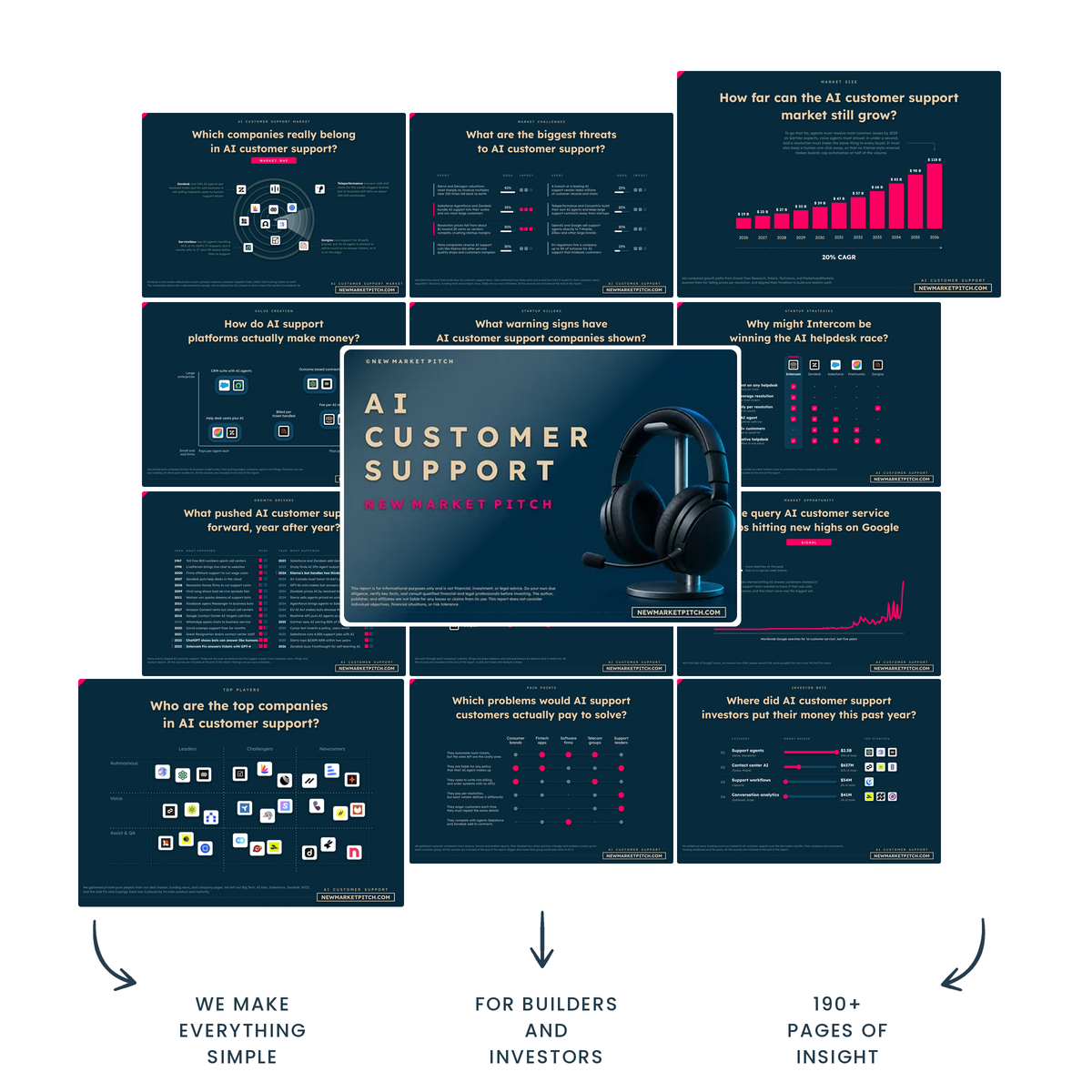
Whether you're building or investing in the AI customer support market, our report covers everything you need to know: the players, the money, and what's coming next.
Summary
AI customer support startups are suddenly worth billions because enterprises are shifting substantial budgets toward AI agents that can resolve customer problems, and investors believe the leading platforms could capture a meaningful share of the customer service market.
The spending shift is already measurable. Gartner found that AI spending among customer service leaders rose 38% while overall support budgets increased just 2%. Yet only 24% of surveyed leaders could demonstrate positive financial returns across their AI use cases. Adoption is racing ahead of proven profitability.
The valuation concentration is remarkable. Sierra leads with an estimated $15.7 billion midpoint, approximately 3.4 times Decagon's $4.6 billion and more than five times Parloa's $3.05 billion. Together, those three companies represent roughly $23.4 billion in estimated value, with Sierra accounting for about two-thirds.
Sierra's premium comes with unusually rapid commercial growth. The company surpassed $150 million in ARR within roughly two years of launching, while its later $200 million ARR reference implies a valuation multiple near 79 times revenue. Even with that growth, investors are paying for a much larger future business.
Parloa offers another revealing benchmark. Its valuation tripled from $1 billion to $3 billion in approximately eight months, supported by more than $50 million in annual recurring revenue and 150% net revenue retention. At roughly 60 times ARR, the valuation assumes that its strong customer expansion will continue.
The market is also splitting into two generations. AI-native startups such as Sierra and Decagon are receiving enormous growth premiums, while Talkdesk's modeled $4.25 billion valuation midpoint is substantially below its last disclosed $10 billion-plus financing valuation from 2021. Newer companies are being priced for automating customer service work, not just providing the software used by support teams.
Strategic acquisitions are reinforcing that opportunity. Salesforce's approximately $3.6 billion acquisition of Fin and NICE's $955 million acquisition of Cognigy represent roughly $4.56 billion in combined transaction value. Established software companies are willing to pay heavily for specialized AI capabilities and the enterprise relationships that come with them.
Voice AI is attracting serious investment, but it does not automatically command the highest valuations. Parloa, Uniphore, and PolyAI collectively represent about $6.3 billion in estimated value, less than half Sierra's valuation alone. Investors appear to favor platforms capable of completing a wider range of customer transactions across channels.
Eight of the 20 companies analyzed have valuation midpoints above $1 billion, although that includes an acquired company and several modeled estimates. The distinction matters: a recently announced billion-dollar financing is stronger evidence of unicorn status than a comparable-company valuation range crossing the same threshold.
The next test is economic rather than technological. AI support products already charge approximately $0.90 to $2 per qualifying outcome, resolution, or conversation, depending on the provider. Competition could push customer prices down, while integration expenses, difficult cases, and inference costs remain significant.
Our conclusion is that AI customer support has produced real billion-dollar businesses, but the valuations are not equally defensible. Sierra has the strongest combination of disclosed commercial scale and valuation leadership, Decagon is emerging as its closest AI-native challenger, and Parloa is establishing a serious position in enterprise voice automation. The winners will be the companies that turn high automation rates into consistently profitable customer resolutions.

Written by the New Market Pitch teamWe track new markets so founders and investors can move faster. About us

In our report covering the AI customer support market, we turn what is vague and complex into simple, useful visuals. Market maps like this one show you at a glance where every startup stands.
Top startups in the AI customer support market ranked by valuation
Here is an updated table that ranks the top startups in the AI customer support market based on their latest reported or estimated valuations as of October 15, 2026.
If you need to dig deeper and get more detailed data, please check our report covering the AI customer support market.
| # | Startup Name | What They Do | Current Valuation ($) | Valuation Confidence Level | Valuation Type | Evidence Status | Total Funding ($) | Funding Confidence Level |
|---|---|---|---|---|---|---|---|---|
| 1 | Sierra | Autonomous enterprise customer support agents | $15.2B–$16.2B | Strong Confidence | Announced Private Round Valuation | Observed | ~$1.6B | Not provided |
| 2 | Decagon | AI agents automating customer interactions | $4.3B–$4.9B | Strong Confidence | Announced Private Round Valuation | Observed | $400M+ | Not provided |
| 3 | Talkdesk | AI-powered cloud contact center software | $3.0B–$5.5B | Low Confidence | Comparables-Based Estimate | Estimated | ~$500M equity | Not provided |
| 4 | Intercom (Fin) | AI customer support and messaging | $3.6B | Full Confidence | Acquisition Value | Observed | ~$241M equity | Not provided |
| 5 | Parloa | Enterprise conversational AI voice agents | $2.9B–$3.2B | Strong Confidence | Announced Private Round Valuation | Observed | ~$562M | Not provided |
| 6 | Uniphore | Enterprise conversational AI automation platform | $2.0B–$2.8B | Partial Confidence | Announced Private Round Valuation | Implied | ~$980M | Not provided |
| 7 | Kore.ai | Enterprise AI agents and orchestration | $850M–$1.5B | Partial Confidence | Comparables-Based Estimate | Estimated | ~$300M–$365M | Not provided |
| 8 | Cresta | AI contact center coaching automation | $900M–$1.2B | Partial Confidence | Comparables-Based Estimate | Estimated | ~$276M | Not provided |
| 9 | Cognigy | Enterprise conversational AI agent platform | $955M | Full Confidence | Acquisition Value | Observed | ~$160M | Not provided |
| 10 | Ada | Automated AI customer support agents | $650M–$1.2B | Low Confidence | Comparables-Based Estimate | Estimated | ~$200M | Not provided |
| 11 | Glia | AI customer engagement for banking | $650M–$1.1B | Low Confidence | Comparables-Based Estimate | Estimated | ~$152M–$181M | Not provided |
| 12 | PolyAI | Enterprise conversational voice AI agents | $750M–$900M | Strong Confidence | Announced Private Round Valuation | Implied | ~$205M | Not provided |
| 13 | ASAPP | Generative AI contact center automation | $500M–$1.1B | Low Confidence | Comparables-Based Estimate | Estimated | ~$399M including debt | Not provided |
| 14 | Gorgias | AI customer support for ecommerce | $550M–$850M | Partial Confidence | Revenue or ARR Multiple Estimate | Estimated | ~$102M | Not provided |
| 15 | Observe.AI | Contact center intelligence and automation | $450M–$900M | Low Confidence | Comparables-Based Estimate | Estimated | ~$213M | Not provided |
| 16 | Yellow.ai | Enterprise multilingual customer service automation | $450M–$650M | Partial Confidence | IPO or Listing Range Valuation | Implied | ~$103M | Not provided |
| 17 | Forethought | Self-improving AI customer support agents | $250M–$600M | Low Confidence | Proxy-Based Estimate | Estimated | ~$117M | Not provided |
| 18 | Gladly | AI-powered personalized customer service | $300M–$500M | Partial Confidence | Comparables-Based Estimate | Estimated | ~$208M–$235M | Not provided |
| 19 | Kustomer | AI-powered conversational CRM platform | $300M–$450M | Partial Confidence | Implied Valuation from Raise | Implied | ~$264M | Not provided |
| 20 | Dixa | AI omnichannel customer service platform | $220M–$500M | Low Confidence | Comparables-Based Estimate | Estimated | ~$158M | Not provided |

Our research about AI customer support tools gets updated several times a month, so you always get the latest view of where things stand.
Why are AI customer support startups suddenly worth billions?
AI customer support startups are attracting billions of dollars because businesses are finally spending serious money on AI agents that can handle customer requests, and investors believe the biggest providers could take over a large part of customer service spending.
The change is visible in corporate budgets. Gartner surveyed 199 customer service leaders in April and May 2026 and found that spending on AI had increased 38%, while overall customer service budgets had grown only 2%. Companies are shifting money toward automation rather than simply increasing their support budgets.
The money flowing into startups tells a similar story. Sierra raised $950 million at a valuation exceeding $15 billion, Decagon raised $250 million at $4.5 billion, and Parloa secured $350 million at $3 billion. All three financings were announced within the first five months of 2026.
There is a commercial reason behind the excitement. These companies are building agents that can process returns, change reservations, resolve account problems, and complete other tasks that previously required human support teams. Their potential market goes well beyond traditional chatbot subscriptions.
Still, Gartner found that only 24% of surveyed service and support leaders could demonstrate positive financial returns across their AI use cases. Companies are spending heavily before the economics have been fully proven.
That is the tension at the center of today's valuations. The demand is real, the funding is enormous, and the financial returns remain surprisingly difficult to demonstrate.
Which AI customer support startups are worth the most today?
Sierra is currently the most valuable specialist AI customer support startup in our dataset, with an estimated valuation of $15.2 billion to $16.2 billion, comfortably ahead of Decagon, Talkdesk, and Parloa.
At the midpoint of our valuation ranges, Sierra is worth approximately $15.7 billion, against $4.6 billion for Decagon, $4.25 billion for Talkdesk, and $3.05 billion for Parloa. Sierra alone is worth roughly $3.8 billion more than those three companies combined.
The gap is particularly striking because the leading companies are quite different. Sierra and Decagon are relatively young AI-native businesses focused on automating customer interactions. Talkdesk has a longer history in cloud contact-center software, while Parloa has built its business around enterprise conversational AI, particularly voice.
We also include acquired companies where transaction prices provide useful valuation benchmarks. Salesforce acquired Fin, formerly Intercom, for approximately $3.6 billion, while NICE acquired Cognigy for approximately $955 million. Those figures represent acquisition values rather than the current independent valuations of operating startups.
The table below ranks the nine highest-valued businesses in our dataset using valuation midpoints. Where a valuation is estimated rather than directly disclosed, the evidence category makes that distinction clear.
| Company | Estimated valuation | Evidence |
|---|---|---|
| Sierra | $15.2B–$16.2B | Announced financing |
| Decagon | $4.3B–$4.9B | Announced financing |
| Talkdesk | $3.0B–$5.5B | Comparables-based estimate |
| Fin (formerly Intercom) | $3.6B | Completed acquisition |
| Parloa | $2.9B–$3.2B | Announced financing |
| Uniphore | $2.0B–$2.8B | Financing-based estimate |
| Kore.ai | $850M–$1.5B | Comparables-based estimate |
| Cresta | $900M–$1.2B | Comparables-based estimate |
| Cognigy | $955M | Completed acquisition |

In our market report about AI customer support tools, we look at what the winners do differently, so you can learn from the best instead of guessing.
How many AI customer support startups are unicorns?
Our analysis finds six AI customer support businesses whose valuation ranges are entirely above $1 billion, rising to eight when companies with valuation midpoints above $1 billion are included.
The six are Sierra, Decagon, Talkdesk, Fin, Parloa, and Uniphore. Kore.ai and Cresta also qualify under our midpoint approach, although their estimated valuation ranges extend below the billion-dollar threshold.
This means eight of the 20 companies analyzed, or 40%, have midpoint valuations above $1 billion. That percentage describes the selected market leaders and should not be confused with the proportion of all AI customer support startups that have achieved unicorn status.
There is another distinction worth making. Fin has been acquired by Salesforce, while Cognigy is now part of NICE. Acquired businesses may have transaction values above or near $1 billion, but they no longer count as independent private unicorns.
Among the remaining businesses, some billion-dollar valuations are based on recent funding rounds, while others are estimates informed by older financings and comparable companies. The evidence is especially strong for Sierra, Decagon, and Parloa because their valuations are tied to announced transactions.
So the sector already has several confirmed billion-dollar winners. But calling every company with a modeled valuation above $1 billion a confirmed unicorn would be stretching the evidence.
Why is Sierra worth so much more than other AI customer support startups?
Sierra commands the highest AI customer support valuation because its revenue has grown exceptionally fast and the company has already secured large enterprise customers across several industries.
Sierra reported reaching $100 million in annual recurring revenue just seven quarters after launching in February 2024. In its February 2026 business update, the company said it had subsequently achieved its first $50 million quarter and entered its third year with more than $150 million in ARR.
That growth helps explain the premium, although the revenue multiple is still extraordinary. At a $15.7 billion valuation midpoint, Sierra would trade at approximately 105 times its $150 million ARR milestone. Using the later $200 million ARR figure in our market data, the multiple falls to roughly 79 times. Both are reference multiples rather than a verified current trading multiple.
The company has also reported impressive customer reach. During its May 2026 fundraising announcement, Sierra said it served more than 40% of Fortune 50 companies, with agents handling billions of interactions. Its customers span banking, healthcare, retail, insurance, and entertainment.
Few young enterprise software companies can point to that combination of nine-figure recurring revenue, rapid growth, and relationships with some of the world's largest businesses. Sierra has accomplished a lot in a very short period.
But investors are demanding even more. A valuation above $15 billion requires several additional years of exceptional growth, and probably a much larger role for Sierra within enterprise software. Its existing revenue explains why the company is taken seriously; its expected future revenue explains the price.

In our document detailing everything you need to know about AI customer support, you will always find fresh funding data, taken straight from our own verified funding database.
Is Decagon catching up with Sierra?
Decagon is growing fast enough to become a serious challenger to Sierra, but Sierra currently remains far ahead in disclosed revenue scale and valuation.
Decagon announced a $250 million Series D in January 2026, raising its valuation to $4.5 billion. According to the company's announcement, its valuation tripled in less than six months, following a fiscal year in which more than 100 new enterprise customers joined the platform.
Those customers included Avis Budget Group, Block, and Deutsche Telekom. The diversity of that group is encouraging: Decagon is selling across travel, financial technology, and telecommunications rather than relying on a single customer service niche.
One of the latest developments adds another dimension. Business Insider reported in October 2026 that Decagon had hired an investment banker to explore potential acquisition interest and held preliminary discussions involving ServiceNow. Those talks were reportedly no longer active, and no transaction had been announced.
At approximately $4.5 billion, Decagon is valued at less than one-third of Sierra's estimated $15.7 billion midpoint. Closing that gap would require a substantial increase in revenue, a higher valuation multiple, or both.
Decagon has already shown that enterprise demand can translate into rapid customer growth. But without directly comparable current revenue figures, we cannot say that its business is catching Sierra as quickly as its valuation history might suggest.
Why did Parloa's valuation triple in less than a year?
Parloa's valuation tripled because its enterprise voice AI business grew quickly enough to attract a second major funding round about eight months after the previous one.
In May 2025, Parloa reached a valuation of approximately $1 billion after raising $120 million. In January 2026, it announced a $350 million Series D led by General Catalyst at a $3 billion valuation. Total funding exceeded $560 million.
The company also disclosed more than $50 million in annual recurring revenue for 2025, alongside 150% net revenue retention. That retention figure is particularly interesting: it indicates that existing customers, collectively, were increasing their spending substantially even after accounting for contraction and churn.
Parloa's customer base includes Booking.com, Allianz, and Swiss Life. These companies handle large volumes of customer interactions, often across multiple countries, languages, and channels. They also have complicated systems that AI agents must connect to before resolving customer requests.
At $3 billion, Parloa was valued at roughly 60 times its reported 2025 ARR. That is an expensive multiple, even for a rapidly growing enterprise software company, but the combination of strong retention, recurring revenue, and major enterprise customers helps explain why investors paid it.
Parloa's 150% net revenue retention may ultimately prove more important than the headline valuation increase. If existing accounts continue expanding at anything close to that rate, the company has a powerful source of growth without having to find an entirely new set of customers every year.

Learning from others' mistakes is the cheapest lesson there is. In our report covering the AI customer support market, we look at what broke startups before you, so you don't repeat it.
Are voice AI customer support startups worth more than chatbot companies?
Voice AI customer support startups are attracting billion-dollar valuations, but the largest valuations still belong to platforms that can handle several types of customer interactions.
Parloa is valued at approximately $3 billion, PolyAI has an estimated valuation of $750 million to $900 million, and Uniphore has a midpoint valuation of around $2.4 billion. Together, these three companies represent approximately $6.3 billion in estimated value.
Sierra alone is worth more than twice that amount. Decagon is also more valuable than Parloa, despite offering customer automation across multiple workflows and communication channels rather than concentrating on voice.
Voice AI does have a particularly demanding technical problem to solve. Telephone conversations require low latency, accurate speech recognition, natural interruptions, and the ability to complete transactions while someone is speaking.
PolyAI provides a useful example of how far voice automation has progressed. When it announced an $86 million Series D in December 2025, the company reported more than 2,000 live deployments across 45 languages and over 25 countries, serving more than 100 enterprise customers.
That deployment footprint suggests voice automation is moving well beyond isolated pilot projects. One customer can roll out the technology across multiple locations, languages, or business units, creating substantial expansion opportunities for a provider that gets the initial deployment right.
For now, voice AI looks like a valuable specialization within the broader customer support market. The highest valuations favor businesses that can automate more of the customer journey, regardless of whether an interaction starts with a phone call, email, or chat message.
Which AI customer support startups have raised the most money?
Sierra leads our AI customer support funding dataset with approximately $1.6 billion raised, followed by Uniphore with around $980 million and Parloa with roughly $562 million.
But the timing of these investments reveals something that total funding figures alone miss.
Uniphore announced a $400 million Series E in February 2022, at a valuation of $2.5 billion. Talkdesk had already raised approximately $498 million by August 2021, when its Series D valued the business above $10 billion.
These companies attracted major venture investment before generative AI agents became a central part of the enterprise software market.
The newer generation raised comparable amounts much faster. Sierra secured $950 million in a single announced financing in May 2026, while Decagon and Parloa raised $250 million and $350 million, respectively, during January 2026.
Parloa's latest round accounted for approximately 62% of its reported cumulative funding, while Decagon's $250 million round represented more than half of the minimum $400 million total in our dataset. Sierra's $950 million financing represented about 60% of its reported lifetime funding.
Those are huge concentrations of capital in individual rounds. Investors are effectively making massive bets on a small set of businesses that have reached commercial scale very quickly.
Lifetime funding comparisons also need some care. Older businesses have had more time to accumulate financing, and reported totals can mix equity with other forms of capital. We identify that distinction where it affects the numbers.
| Company | Total funding in dataset | Valuation midpoint |
|---|---|---|
| Sierra | ~$1.6B | $15.7B |
| Uniphore | ~$980M | $2.4B |
| Parloa | ~$562M | $3.05B |
| Talkdesk | ~$500M equity | $4.25B |
| Decagon | $400M+ | $4.6B |
| ASAPP | ~$399M including debt | $800M |
| Kore.ai | ~$300M–$365M | $1.18B |
| Cresta | ~$276M | $1.05B |
| Kustomer | ~$264M | $375M |

In our research about AI customer support tools, we always try to gather several sources and make estimates that make sense, so you can work with solid numbers.
Is Talkdesk really worth less than half its previous $10 billion valuation?
Talkdesk could now be worth substantially less than its 2021 valuation, but the exact decline remains unconfirmed because its current $3 billion to $5.5 billion range is an estimate rather than a recently disclosed transaction price.
In August 2021, Talkdesk announced a $230 million Series D at a valuation exceeding $10 billion. The company had raised approximately $498 million in total and was among the highest-valued private enterprise software businesses at the time.
Our current estimate gives Talkdesk a midpoint of $4.25 billion. Compared with its historical valuation floor of $10 billion, that would imply a decline of at least 57.5%.
The broader software market has changed enormously since 2021. Investors once paid premium valuations for fast-growing cloud contact-center platforms. More recently, some of the largest financing rounds have gone to AI-native businesses promising to automate the work performed within those platforms.
Talkdesk has continued developing AI capabilities, so its business should not be judged only by its older cloud contact-center model. However, without a recent disclosed valuation or detailed comparable financial data, the estimated decline remains uncertain.
The historical $10 billion-plus financing is a confirmed transaction reference. The current $4.25 billion midpoint is our modeled assessment. It would be premature to treat the difference as a realized loss of value.
Are AI customer support startup valuations rising too quickly?
Some AI customer support startup valuations have climbed remarkably fast, and the strongest evidence of overheating comes from how much investors are paying relative to disclosed revenue.
Parloa reached a $3 billion valuation against more than $50 million in reported annual recurring revenue, producing a multiple near 60 times ARR. Sierra's $15.7 billion midpoint compared with its earlier disclosed $150 million ARR milestone produces an even higher reference multiple, around 105 times. Using Sierra's later $200 million revenue reference brings that figure closer to 79 times.
These ratios are difficult to compare perfectly because the revenue disclosures and valuations are not always from exactly the same date. Still, both show that investors expect very large future businesses.
Consider a company valued at $15 billion that eventually trades at 15 times ARR. It would need approximately $1 billion in annual recurring revenue to sustain that valuation at the lower multiple. That is an illustrative scenario, not a forecast of Sierra's revenue or future market multiple.
Meanwhile, the market contains a counterexample in Talkdesk. Its previously announced valuation above $10 billion contrasts sharply with the much lower present estimate in our dataset.
The divide is pretty stark. Recently funded AI-native specialists are receiving enormous growth premiums, while some established software businesses face much more conservative estimates.
The valuations are aggressive, particularly when revenue multiples reach several dozen times ARR. Their long-term success depends on companies growing into those prices before competitive pressure or changing market conditions bring the multiples down.

If you build or invest in the AI customer support market, you need to know which business models pay off now and which ones are fading. That's why our report covering it has a whole section on it.
Why did Salesforce and NICE spend billions acquiring AI customer support companies?
Salesforce and NICE bought specialist AI customer support companies to strengthen their existing platforms quickly, rather than spending years building every conversational AI capability themselves.
Salesforce announced its agreement to acquire Fin, formerly Intercom, for approximately $3.6 billion in June 2026 and completed the transaction in September. Fin brought an established customer agent platform, proprietary AI technology, and relationships with more than 30,000 companies.
NICE completed its acquisition of Cognigy in September 2025 after agreeing to a transaction worth approximately $955 million. The acquisition gave NICE additional conversational AI capabilities that could be distributed through its CXone platform and existing customer relationships.
The combined acquisition value was approximately $4.56 billion. Salesforce's Fin transaction represented nearly 79% of that amount.
There was also a commercial difference between the deals. Fin had already established a recognizable AI customer service product that could operate across several support channels. Cognigy specialized in enterprise conversational automation, including demanding multilingual and voice use cases.
NICE said Cognigy was expected to deliver approximately 80% ARR growth in 2026 when it announced the acquisition. That helps explain why a business valued below $1 billion could still be highly attractive to a large software buyer.
The acquisitions have also changed the competitive landscape. Salesforce and NICE now own specialist technology that independent startups have spent years developing, and they can distribute it through much larger existing customer networks.
For startup investors, the deals establish another potential route to a substantial return. A company does not necessarily have to become the dominant independent customer support platform to create billions of dollars in value.
Can Sierra and Decagon really compete with Salesforce and Zendesk?
Sierra and Decagon can compete with Salesforce and Zendesk today because many businesses want better customer service automation without replacing their entire CRM or helpdesk system.
Salesforce has a major advantage in enterprise relationships, customer data, and distribution. Zendesk has a large installed base of support teams and offers AI-powered automated resolutions directly inside its platform.
For a startup, convincing a company to replace either system would be difficult. But selling an AI agent that connects to existing systems is a much easier proposition.
Fin demonstrated this approach before Salesforce acquired it. Its AI agent could operate on top of Zendesk, Freshdesk, and other helpdesk platforms. That allowed customers to adopt Fin's automation capabilities while keeping their existing support infrastructure.
Sierra and Decagon also emphasize integrations and task completion. Their products are designed to work with enterprise data and business processes, rather than requiring every customer to rebuild its support operations around a new interface.
The competitive pressure is becoming stronger, though. Salesforce's acquisition of Fin gives it a specialist AI agent product backed by a much larger sales organization. Zendesk also offers its own automated-resolution pricing and AI features.
Independent startups still have room to win when they resolve more problems, deploy faster, or perform better on complicated workflows. A company offering little more than a chatbot interface will have a considerably harder time competing with established platforms.

In our document detailing everything you need to know about AI customer support, we don't want to repeat what boring consulting reports say. Instead, we show you the real and latest market signals that matter.
Do AI customer support agents actually save companies money?
AI customer support agents can deliver substantial savings, but most companies still struggle to prove that their AI spending produces a positive financial return.
The clearest evidence comes from the difference between deployment activity and measured results. Gartner's 2026 research found that customer service organizations were among the most aggressive adopters of AI, yet only 24% of surveyed service and support leaders could demonstrate positive financial returns across their AI use cases.
Some customer examples are more encouraging. Fin reports that Peddle saved approximately $163,000 annually by reducing support volume, while other customers have used the technology to shorten response times and handle routine requests without human intervention.
PolyAI also cited a commissioned Forrester Total Economic Impact study showing a 391% return on investment and an average of $10.3 million in savings for the modeled customer organizations. Those figures are useful, although a vendor-sponsored study should not be mistaken for independent evidence that every deployment will achieve similar results.
Cost per interaction provides another way to assess the economics. Fin currently charges approximately $0.99 per qualifying outcome, while Salesforce offers an Agentforce model at $2 per conversation. A business processing hundreds of thousands of customer requests each month could potentially save significant amounts if a large share can be resolved without human involvement.
But companies also pay for integrations, software commitments, monitoring, and the human teams that handle unsuccessful cases.
The savings become convincing when an AI agent completes work that would otherwise consume meaningful employee time. A high chatbot engagement rate, by itself, proves very little. What counts is how many customer problems get resolved without someone having to finish the job manually.
Could cheaper AI customer support pricing hurt startup valuations?
Cheaper AI customer support pricing could put pressure on startup valuations, especially for companies that depend on charging relatively high fees for each automated interaction.
The competition is already visible in public pricing. Fin charges $0.99 per qualifying outcome, Gorgias says most of its AI Agent plans cost approximately $0.90 per resolved interaction, and Zendesk offers automated resolutions at $1.50 with commitments or $2 on a pay-as-you-go basis.
These products do not bill for exactly the same thing. Fin's definition of an outcome can include certain successful procedure handoffs, while Zendesk measures automated resolutions and Salesforce also offers conversation-based billing. Comparisons therefore need to account for what customers actually receive.
But enterprise buyers can increasingly negotiate around the cost of each completed interaction rather than simply paying a fixed subscription for chatbot software.
There is also a possible surprise ahead. Gartner predicted in January 2026 that the cost per generative AI customer service resolution could exceed $3 by 2030, citing factors such as data center expenses, more complicated use cases, and the cost of supporting increasingly sophisticated automation.
If that forecast proves accurate, some AI providers may find themselves squeezed between falling customer prices and higher-than-expected operating costs.
That makes unit economics critical. Can a startup automate increasingly valuable customer tasks while maintaining a healthy margin on every resolution? Companies that mainly provide cheap answers to simple questions could face a particularly difficult pricing environment.

In our report covering the AI customer support market, we like to show you the big picture. We know your time is precious, so we make every page quick to read and packed with as much learning as possible per minute.
Will AI customer support startups replace human support agents?
AI customer support startups are taking over more routine work, but the latest surveys suggest that businesses still expect humans to handle complicated and sensitive customer problems.
In an April 2026 announcement, Gartner reported that 85% of surveyed service and support leaders were expanding human agent responsibilities as AI reduced some contact volumes and changed the work remaining for employees.
Only 31% had implemented or were planning AI-driven frontline layoffs through the first quarter of 2027.
Customer preferences reinforce this. Another Gartner survey covering 3,566 customers found that 87% considered access to a human agent essential when companies use generative AI for customer service. At the same time, 50% said generative AI made their customer service interactions easier.
Customers seem perfectly willing to use automation when it solves their problem. They are much less willing to lose access to a person when things go wrong.
There is also a difference between answering a question and handling an unusual case. AI agents can already check order status, update account information, and guide customers through standard processes. Disputed payments, unusual insurance claims, and sensitive complaints can involve judgment, exceptions, and legal responsibilities that make full automation harder.
Human customer service jobs will almost certainly change as more interactions are automated. The evidence currently points toward less routine work and more demanding human responsibilities, rather than the disappearance of support teams. Some companies will reduce headcount, but the transition is unlikely to look the same across every industry.
Why are customers using ChatGPT instead of company support chatbots?
Customers are increasingly turning to ChatGPT and other general-purpose AI assistants because those tools often provide a more useful starting point than the chatbot on a company's own website.
Gartner surveyed 3,566 customers in early 2026 and found that people were approximately three times more likely to use third-party generative AI tools than company-provided chatbots during customer service interactions.
The change is especially interesting when viewed over time. According to Gartner, third-party generative AI usage during support interactions had nearly doubled over the preceding year, while usage of company-provided chatbots had remained statistically unchanged since 2022.
Customers are also asking AI tools to do more than explain things. Among respondents who had used generative AI, 58% had used it to complete a task, increasing to 74% among B2B customers.
This creates a real challenge for specialist customer support vendors. A customer might ask ChatGPT how to cancel a subscription or compare refund policies before ever opening the company's helpdesk.
However, completing an account-specific transaction still requires access to the company's internal systems and permission to perform the action.
That is where specialist providers retain an advantage. Their agents can connect to order management systems, CRMs, billing platforms, and authenticated customer records. General-purpose assistants may increasingly become the first interface people use, but someone still needs to execute the requested actions reliably.
Companies such as Sierra, Decagon, and Fin are positioning themselves for exactly that kind of work. The long-term opportunity may be less about owning the conversation and more about owning the machinery that actually resolves it.

When you build or invest in the AI customer support market, you need clarity, not confusion. In our research about AI customer support tools, we always try to put numbers on and quantify whatever is usually vague and confusing.
Which smaller AI customer support startups could become the next unicorns?
PolyAI, Ada, Glia, and Gorgias are among the smaller AI customer support companies worth watching, although none has a confirmed new billion-dollar valuation in the evidence we reviewed.
PolyAI looks particularly interesting because of its demonstrated enterprise deployment scale. Its December 2025 Series D brought total funding above $200 million, and the company reported more than 100 enterprise customers with deployments across dozens of countries.
Our dataset estimates PolyAI's valuation at $750 million to $900 million, putting it relatively close to the unicorn threshold.
Ada has an estimated valuation range of $650 million to $1.2 billion, while Glia, which specializes in customer engagement for financial services, falls between $650 million and $1.1 billion. Both could already be worth more than $1 billion under the upper end of our estimates, although a recent financing would provide stronger confirmation.
Gorgias offers another interesting approach. It focuses on ecommerce support, where customer questions often involve orders, deliveries, returns, and subscriptions. Its narrower specialization may make deployments more repeatable than those of broad enterprise platforms.
Cresta and Kore.ai have already crossed $1 billion by valuation midpoint in our dataset, but their estimated ranges also dip below that threshold. We therefore treat their unicorn status as less certain than that of companies with recently disclosed billion-dollar financings.
Among the smaller businesses, we would watch PolyAI's ability to turn international deployments into higher recurring revenue, Ada's enterprise customer expansion, and Gorgias's performance in ecommerce automation. All three have identifiable ways to expand, although their valuation paths could look very different.
| Company | Estimated valuation | Position relative to $1B |
|---|---|---|
| Kore.ai | $850M–$1.5B | Midpoint above |
| Cresta | $900M–$1.2B | Midpoint above |
| Ada | $650M–$1.2B | Range crosses |
| Glia | $650M–$1.1B | Range crosses |
| PolyAI | $750M–$900M | Below |
| ASAPP | $500M–$1.1B | Range crosses |
| Gorgias | $550M–$850M | Below |
| Observe.AI | $450M–$900M | Below |
| Yellow.ai | $450M–$650M | Below |
Are AI customer support startup valuations actually justified today?
The largest AI customer support valuations are supported by genuine commercial growth, but several companies are priced for exceptionally strong future performance that still needs to be delivered.
Sierra has already shown that a specialist AI customer support business can reach nine-figure ARR within a very short operating history. Decagon has demonstrated rapid enterprise customer acquisition, and Parloa has reported strong customer expansion through 150% net revenue retention.
These are meaningful operating achievements. They explain why investors are willing to fund the category at valuations that would have seemed extraordinary for young enterprise software companies only a few years ago.
Yet there are several reasons to be selective.
First, the biggest valuation multiples leave little room for growth to slow. A company valued at 60 or 100 times annual recurring revenue must either expand revenue substantially or continue attracting investors willing to pay similarly high multiples.
Second, the competition is getting stronger. Salesforce and NICE have already spent billions acquiring AI customer service capabilities, while Zendesk continues developing automation within its existing support software.
Third, customer service buyers are increasingly focused on measurable outcomes. Businesses may accept expensive deployments while experimenting with AI, but long-term contracts will be harder to defend if the cost per successful resolution remains high.
Finally, not every valuation in our ranking is equally well supported. Recent financing rounds and completed acquisitions provide firm transaction references, while several other companies depend on estimates based on older funding, comparable businesses, and operating information.
Our overall judgment is positive on the market and more selective on individual valuations. AI customer support is already producing substantial enterprise software businesses with real recurring revenue. Sierra currently leads the specialist valuation rankings, Decagon is a serious challenger, and Parloa has established a strong position in enterprise conversational AI.
The biggest winners will be the companies that consistently solve customer problems at an attractive cost while maintaining strong margins and customer retention. Several startups have made impressive progress toward that goal. Their current valuations assume that progress will continue for years, which is a high bar even for the best companies.

A good product starts with a real problem. In our market report about AI customer support tools, we show you the ones customers still live with.
Our methodology
This analysis examines why valuations have accelerated across the AI customer support market and whether those valuations are supported by actual financial and commercial performance. We analyzed startups ranked 1–20 in our 100-company market dataset, using October 15, 2026 as the valuation reference date and USD as the reporting currency.
We built the valuation comparison around several dimensions: completed financing rounds, acquisition transactions, reported revenue and ARR, customer adoption, retention, funding histories, competitor valuations, and enterprise customer service spending. For each dimension, we gathered recent evidence, compared companies on a consistent basis, and combined those observations to assess the strength of each valuation.
Recent announced financing valuations provide the principal references for Sierra, Decagon, and Parloa. We distinguish those transaction-based benchmarks from broader estimates for companies such as Talkdesk, Kore.ai, Cresta, and Ada, where older financing evidence, operating information, and comparable businesses play a larger role. We also treat the approximately $3.6 billion Fin acquisition and $955 million Cognigy acquisition as completed transaction values rather than valuations of independent private companies.
Where a current valuation could not be established from a recent transaction, we examined the company's commercial position, historical funding, business model, and relevant valuation benchmarks. We used revenue multiples, financing-based inferences, and comparable transactions where appropriate to the available evidence. Valuation ranges reflect differences in evidence quality and uncertainty; ranking positions are determined by their midpoints rather than automatically favoring the highest possible estimate.
Our financial comparisons use reported ARR milestones and financing dates rather than assuming that every revenue figure represents the same reporting period. This is particularly important for Sierra and Parloa, where rapid growth and large new financing rounds can produce very different valuation multiples depending on the revenue reference used. We also distinguish total reported funding from equity-only capital where financing histories include debt or other instruments.
The unicorn analysis uses a $1 billion valuation threshold but separates companies with recent confirmed financing references from those whose modeled ranges cross that threshold. Acquired businesses are included as valuation benchmarks without being classified as independent private unicorns. The 20-company sample represents selected market participants, so its valuation distribution should not be interpreted as representative of every startup operating in customer support AI.
To assess the broader market, we compared Gartner's 2026 customer service spending, adoption, ROI, workforce, and consumer preference surveys with company-reported enterprise customer growth and deployment figures. We also reviewed published outcome-based pricing from major providers and distinguished vendor-reported savings and commissioned ROI studies from independently established market-wide results.
Key sources for financing and operating performance include Sierra's financing announcement, Sierra's operating update, Decagon's Series D announcement, Parloa's Series D announcement, Talkdesk's historical Series D, Uniphore's financing announcement, and PolyAI's Series D and deployment figures.
For acquisition benchmarks, we used Salesforce's Fin acquisition announcement, Salesforce's acquisition completion disclosure, and NICE's Cognigy transaction announcement. We also considered Bloomberg's reporting on Decagon and Business Insider's reporting on potential acquisition discussions, while keeping exploratory discussions separate from completed transactions.
For market adoption and economics, our principal references include Gartner's AI customer service spending research, Gartner's research on third-party AI adoption, Gartner's human-support preference survey, Gartner's workforce research, and Gartner's forecast for AI resolution costs. Pricing comparisons draw on Fin, Gorgias, Zendesk, and Salesforce Agentforce.
Our central valuation test combines recent financial evidence with observed operating performance and the economics of customer service automation. We give greater weight to completed transactions and disclosed commercial results than to older valuation headlines or speculative estimates, while keeping the distinction between current transaction references and modeled values visible throughout the analysis.

In our document detailing everything you need to know about AI customer support, we try to remove everything that could confuse you, especially if you're investing or building in this market.
Written by the New Market Pitch teamWe track new markets so founders and investors can move faster. About us