
AI customer support funding tracker (122 deals)
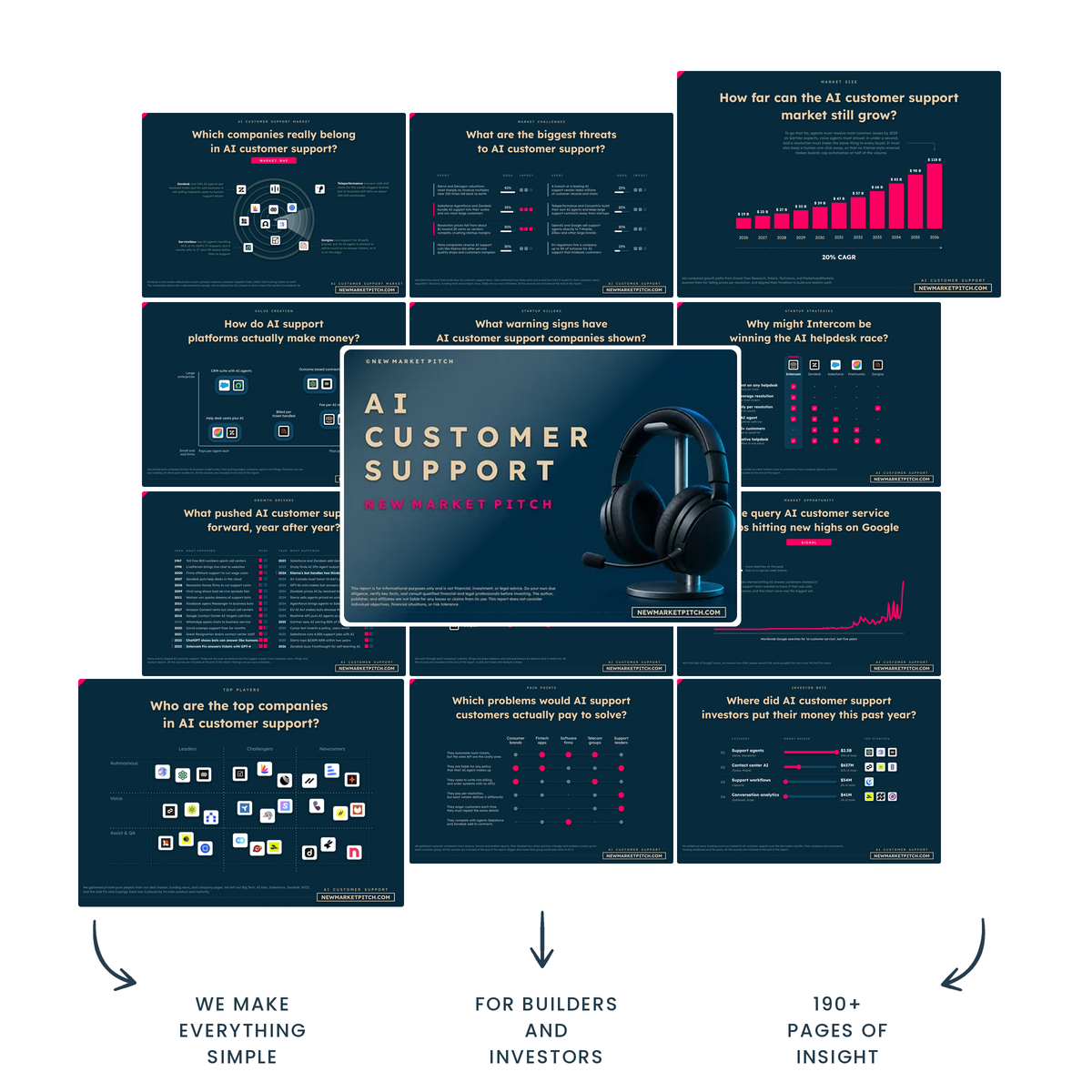
Whether you're building or investing in the AI customer support market, our report covers everything you need to know: the players, the money, and what's coming next.
Summary
The AI customer support funding tracker (122 deals) shows a $3.53 billion market where most of the money goes to a handful of enterprise AI companies. Sierra, Parloa and Decagon alone captured $1.65 billion, nearly 47% of all recorded funding, leaving a very different fundraising reality for the other 95 businesses.
The typical round is much smaller than the headline suggests. Across 122 financings involving 98 companies, the median was $6.52 million against an average of $28.94 million. Just 11 rounds of at least $100 million absorbed 54.4% of all capital.
Funding concentration is also visible at the company level. Only 18 businesses raised more than once during the period, yet they received 65.5% of the money. Most companies appeared in the dataset just once.
Autonomous Support Agents attracted $1.89 billion across 62 deals, making them the largest product category. But their median financing was just $5 million. Sierra and Decagon account for roughly $1.12 billion of that category's total, highlighting how much of its apparent financial strength comes from two companies.
Contact Center Automation has a different funding profile. Its $1.28 billion came from just 30 transactions, with a $16.5 million median round, 3.3 times the autonomous-agent median. These companies were also older at financing, suggesting investors are financing more established enterprise platforms.
Fundraising remains heavily weighted toward the earliest stages by deal count. We identified 59 Seed rounds and 22 Series A rounds, but only 11 Series B rounds. That is a clear financing gap, although the relatively young age of many startups means it cannot yet be interpreted as a failure rate.
Big rounds are closely associated with company maturity, but there are exceptions. Businesses raising more than $50 million had a median age of six years, while companies raising under $5 million had a median age of one year. Sierra and Decagon show how AI-native businesses can compress that timeline dramatically.
The market raises money in waves rather than following a smooth growth curve. September 2025 produced $515.2 million, while January 2026 reached $656.6 million. Both months were dominated by a small number of exceptional rounds, rather than a broad surge in companies raising capital.
Geographically, North America captured approximately $2.26 billion, or 63.9% of funding. Germany stands out in Europe with $643.4 million, largely because of Parloa and Cognigy. Africa and Latin America together accounted for only about $13.5 million in the recorded transactions.
The less-funded categories reveal another divide. Agent Assist Copilots received just $13.1 million, while Ticket Triage and Routing attracted $6.1 million. Some of these capabilities are already embedded in larger enterprise platforms, which may reduce the need for separately funded specialist companies.
The market's next meaningful milestone is the development of a larger middle tier. AI customer support already has companies capable of raising hundreds of millions, and dozens of startups can attract initial financing. What remains unproven is how many can progress into repeatable $30 million to $100 million growth rounds.

Written by the New Market Pitch teamWe track new markets so founders and investors can move faster. About us

In our report covering the AI customer support market, you will always find fresh funding data, taken straight from our own verified funding database.
Our funding tracker covering the AI customer support market
Below is the table listing all the deals. You may find our methodology at the end of this page.
And, if you want to gain a deeper understanding of the market and its current dynamics, get our report covering the AI customer support market.
| Company | Category | Date | Stage | Deal size | What they do | Region | Lead investors |
|---|---|---|---|---|---|---|---|
| Decimal AI | Autonomous Support Agents | September 2026 | Seed | $4M | Provides AI support engineers that investigate technical customer issues using application context, logs and code to accelerate resolution. | North America | Khosla Ventures; Kearny Jackson |
| HeyDiga | Autonomous Support Agents | September 2026 | Seed | ≈$6,400,000 | Provides AI voice receptionists that answer customer questions, manage bookings and route incoming calls for service businesses. | Europe | 6 Degrees Capital |
| Wonderful | Autonomous Support Agents | September 2026 | Series C | $550M | Provides customer service and wider enterprise AI agents across IT HR and operations. | Middle East | Insight Partners |
| Capacity | Support Workflow Orchestration | September 2026 | Series D+ | >$54,000,000 | Unifies AI customer-support agents, agent assistance, knowledge management, quality assurance and support workflow automation. | North America | Kathy Ireland |
| Wilmo AI | Autonomous Support Agents | August 2026 | Seed | ≈$1,300,000 | Automates e-commerce customer support with AI agents that answer shoppers' questions and resolve post-purchase requests. | Europe | Ugly Duckling Ventures |
| Omilia | Contact Center Automation | August 2026 | Series B | $67M | Provides enterprise voice AI that automates contact-center customer conversations and assists human agents. | Europe | Expedition Growth Capital |
| Walaw | Autonomous Support Agents | July 2026 | Seed | ≈$1,100,000 | Provides an AI receptionist that answers patient inquiries, schedules appointments and automates clinic front-desk communications. | North America | Telegraph Ventures |
| Cue | Autonomous Support Agents | July 2026 | Unknown | $5M | Provides autonomous AI customer-service agents across messaging, email, webchat and voice, with escalation to human support teams. | Africa | Knife Capital; FAM Investments |
| Hostie AI, Inc. | Autonomous Support Agents | July 2026 | Series A | $12M | Provides AI agents that handle restaurant guest inquiries, reservations, takeout orders and other incoming communications. | North America | Obvious Ventures |
| Chaty AI | Contact Center Automation | June 2026 | Seed | $1.2M | Provides AI receptionists and website assistants that answer tourism customer enquiries and process bookings. | Asia-Pacific | Not disclosed |
| Mimir | Autonomous Support Agents | June 2026 | Seed | ≈$600,000 | Provides an AI-native e-commerce helpdesk that resolves customer enquiries about orders, deliveries, products and returns. | Europe | Sondo Capital |
| Enera | Autonomous Support Agents | June 2026 | Seed | $2M | Operates AI support agents that troubleshoot failed EV-charging sessions and analyze driver-support interactions. | Europe | Lakehouse Ventures |
| fonio.ai | Contact Center Automation | June 2026 | Seed | $17M | Provides AI phone and messaging agents that handle customer enquiries, appointments and routine business calls. | Europe | 20VC |
| Sono (Closio Oy) | Contact Center Automation | June 2026 | Seed | $1.5M | Automates customer-service phone calls, including enquiries, appointment handling and call routing. | Europe | Maki.vc |
| Sierra | Autonomous Support Agents | May 2026 | Series D+ | $950M | Provides enterprise conversational AI customer-service agents. | North America | Tiger Global; GV |
| Netomi | Autonomous Support Agents | April 2026 | Series C | $110M | Deploys enterprise AI customer-service agents that resolve requests across chat, email and voice. | North America | Accenture Ventures |
| Solidroad | QA & Conversation Analytics | April 2026 | Series A | $25M | Automates quality assurance, conversation evaluation, coaching and training simulations for human and AI support agents. | North America | Hedosophia |
| GuruSup | Autonomous Support Agents | April 2026 | Seed | $1.5M | Provides autonomous AI agents that resolve customer-service requests across WhatsApp, chat, email and voice. | Europe | 4Founders Capital |
| Phonely | Contact Center Automation | April 2026 | Series A | $16M | Builds AI voice agents that answer customer calls, resolve enquiries, route callers and manage appointments. | North America | Base10 Partners |
| CiaoDott | Contact Center Automation | March 2026 | Seed | ≈$1,730,000 | Develops AI voice receptionists that answer patient calls and schedule appointments for medical practices. | Europe | The Techshop |
| Minimal AI | Autonomous Support Agents | March 2026 | Seed | $3.6M | Builds autonomous AI customer-support agents that handle and resolve e-commerce support tickets. | Europe | Not disclosed |
| Wonderful | Autonomous Support Agents | March 2026 | Series B | $150M | Provides multilingual AI customer service agents and enterprise integrations. | Middle East | Insight Partners |
| 14.ai | Autonomous Support Agents | March 2026 | Seed | $3M | Operates an AI-native customer-support service that uses proprietary agents to resolve support tickets across communication channels. | North America | Y Combinator |
| Slang AI | Contact Center Automation | February 2026 | Series B | $28M | Builds AI telephone agents that answer customer calls, address inquiries and manage restaurant reservations. | North America | U.S. Venture Partners |
| Scala | QA & Conversation Analytics | February 2026 | Seed | $8.5M | Provides AI-enabled operational intelligence and performance analytics for contact centers managing human and AI agents. | North America | Madrona; FUSE |
| Newo.ai | Contact Center Automation | February 2026 | Series A | $25M | Offers AI receptionists and voice agents that answer, route and resolve inbound customer calls and messages for businesses. | North America | Ratmir Timashev |
| Operata | QA & Conversation Analytics | February 2026 | Series A | ≈$7,800,000 | Provides AI-enabled observability and performance analytics for cloud contact centers and customer-service conversations. | North America | Tidal Ventures |
| Tactful AI | Autonomous Support Agents | February 2026 | Unknown | $1M | Provides AI-powered customer-experience agents and tools that automate support interactions across service channels. | Africa | Foras AI; M Empire |
| Linda AI | Contact Center Automation | February 2026 | Seed | ≈$3,070,000 | Provides AI dental receptionists that answer patient calls, handle inquiries and book appointments. | Europe | 6 Degrees Capital |
| Decagon | Autonomous Support Agents | January 2026 | Series D+ | $250M | Develops autonomous customer-support agents that resolve customer requests across chat, email and voice. | North America | Coatue Management; Index Ventures |
| Level3AI | Autonomous Support Agents | January 2026 | Seed | $13M | Creates AI customer-service agents that resolve multilingual support inquiries across conversational channels. | Asia-Pacific | Lightspeed India Partners |
| Open CX | Autonomous Support Agents | January 2026 | Unknown | $7M | Automates complex customer-support interactions across voice, email, chat and messaging channels using AI agents. | Middle East | Y Combinator; X by Unifonic |
| Elyos AI | Contact Center Automation | January 2026 | Series A | $13M | Provides AI voice agents that answer customer calls and arrange service bookings for trades and field-service companies. | Europe | Blackbird Ventures |
| Fini | Autonomous Support Agents | January 2026 | Seed | $3.6M | Builds AI customer-support agents that answer questions and resolve requests using company knowledge and connected systems. | Europe | Matrix Partners |
| Parloa | Contact Center Automation | January 2026 | Series D+ | $350M | Develops enterprise AI voice agents that autonomously handle customer-service conversations and requests. | Europe | General Catalyst |
| Flip | Contact Center Automation | January 2026 | Series A | $20M | Provides AI-powered telephone support agents that automatically handle and resolve inbound customer-service calls. | North America | Next Coast Ventures; Ridge Ventures |
| PolyAI | Contact Center Automation | December 2025 | Series D+ | $86M | Provides enterprise voice AI agents that resolve customer inquiries and execute multistep tasks within contact centers. | Europe | Georgian; Hedosophia; Khosla Ventures |
| fonio.ai | Contact Center Automation | December 2025 | Seed | ≈$3,490,000 | Provides AI telephone assistants that answer customer inquiries, process requests and automate business call handling. | Europe | Not disclosed |
| GetVocal | Autonomous Support Agents | November 2025 | Series A | $26M | Develops governed conversational AI agents that automate enterprise customer-service interactions alongside human support teams. | Europe | Creandum |
| Vida | Contact Center Automation | November 2025 | Series A | $4M | Provides an AI voice-agent operating system that automates inbound customer telephone interactions and related service workflows. | North America | Trammell Venture Partners |
| Wonderful | Autonomous Support Agents | November 2025 | Series A | $100M | Provides multilingual AI customer-service agents that independently handle requests through voice, chat and email. | Middle East | Index Ventures |
| Giga | Autonomous Support Agents | November 2025 | Series A | $61M | Develops autonomous voice AI agents that resolve complex enterprise customer-support requests in real time. | North America | Redpoint Ventures |
| Aunoa | Autonomous Support Agents | October 2025 | Unknown | ≈$1,740,000 | Builds conversational AI agents that automate enterprise customer inquiries and service processes across messaging and voice channels. | Europe | Eoniq; Faraday |
| Assort Health | Autonomous Support Agents | September 2025 | Series B | $76M | Automates healthcare patient calls and service workflows, including appointment changes, prescription requests and referrals. | North America | Lightspeed Venture Partners |
| Notch.cx | Autonomous Support Agents | September 2025 | Seed | $7M | Provides autonomous AI agents that resolve enterprise customer-support tickets and execute service workflows. | Middle East | Lightspeed Venture Partners |
| DOO | Autonomous Support Agents | September 2025 | Unknown | $1.7M | Provides Arabic-dialect AI agents that automate enterprise customer-support conversations across digital channels. | Middle East | Merak Capital |
| Vocca | Contact Center Automation | September 2025 | Seed | $5.5M | Provides healthcare-specific AI phone agents that answer patient calls, manage appointments and resolve routine patient enquiries. | Europe | Speedinvest; firstminute capital |
| Rulebase | QA & Conversation Analytics | September 2025 | Seed | $2.1M | Uses AI to review support conversations for quality and compliance and automate associated dispute-resolution follow-ups. | North America | Bowery Capital |
| Clarity (formerly Anecdote) | QA & Conversation Analytics | September 2025 | Series A | $12M | Combines AI-based customer-feedback analysis, support-conversation intelligence and automated customer-service workflows. | Europe | Prosus Ventures; STV AI Fund |
| Eloquent AI | Autonomous Support Agents | September 2025 | Seed | $7.4M | Develops AI operators that resolve financial-services customer requests and execute associated regulated support workflows. | North America | Foundation Capital |
| Parahelp | Autonomous Support Agents | September 2025 | Seed | $3.2M | Provides an autonomous AI support agent that resolves complex software-support tickets within existing help-desk platforms. | North America | Hidden Capital |
| Parahelp | Autonomous Support Agents | September 2025 | Series A | $18M | Provides an autonomous AI support agent that resolves complex software-support tickets within existing help-desk platforms. | North America | Alt Capital |
| Quack AI | Autonomous Support Agents | September 2025 | Seed | $7M | Builds proactive AI customer-support agents that identify and resolve software-user issues across service channels. | North America | Hanaco Ventures; Storytime Capital |
| Hello Patient | Contact Center Automation | September 2025 | Series A | $22.5M | Automates healthcare patient-support calls, appointment requests and follow-up conversations using conversational AI agents. | North America | Scale Venture Partners |
| Sierra | Autonomous Support Agents | September 2025 | Unknown | $350M | Provides enterprise AI agents that autonomously conduct customer-service conversations and perform related actions across business systems. | North America | Greenoaks |
| Rauda AI | Autonomous Support Agents | September 2025 | Seed | ≈$2,800,000 | Builds voice-native AI customer-support agents that handle conversations and resolve service requests across channels. | Europe | JME Ventures |
| Pylon | Support Workflow Orchestration | August 2025 | Series B | $31M | Provides an AI-powered B2B customer-support platform combining ticket management, agent assistance and post-sales support workflows. | North America | Andreessen Horowitz; Bain Capital Ventures |
| Cavalry AI | Autonomous Support Agents | August 2025 | Seed | $2.1M | Automates e-commerce customer-service interactions and resolves post-purchase support issues using AI agents. | North America | Not disclosed |
| Kustomer | Support Workflow Orchestration | August 2025 | Series B | $30M | Operates an AI-native customer-service platform combining support CRM, autonomous agents, agent assistance and omnichannel workflows. | North America | Norwest |
| Lorikeet | Autonomous Support Agents | August 2025 | Series A | $35M | Provides autonomous customer-service agents that resolve complex requests and execute actions across enterprise systems. | Asia-Pacific | QED Investors |
| Brainfish | Knowledge & Answer Engines | July 2025 | Unknown | $6.4M | Provides context-aware AI support agents that answer product questions and proactively guide users before they submit tickets. | Asia-Pacific | Prosus Ventures |
| Gradient Labs | Autonomous Support Agents | July 2025 | Series A | $13M | Builds autonomous AI customer-service agents for regulated financial institutions, including support resolution and related casework. | Europe | Redpoint Ventures |
| Wonderful | Autonomous Support Agents | July 2025 | Seed | $34M | Develops multilingual AI agents that autonomously handle customer-service conversations across voice, chat and email. | Middle East | Index Ventures |
| Waypoint AI | Ticket Triage & Routing | June 2025 | Seed | $3.1M | AI customer-support engineer that triages technical escalations, investigates product issues and prepares resolution workflows. | North America | 42CAP; Dreamcraft Ventures |
| Decagon | Autonomous Support Agents | June 2025 | Series C | $131M | Autonomous AI agents that resolve customer-support conversations and perform actions across voice, chat, email and SMS. | North America | Accel; Andreessen Horowitz |
| Maven AGI | Autonomous Support Agents | June 2025 | Series B | $50M | Enterprise AI agents that autonomously resolve support inquiries and execute customer-service workflows across communication channels. | North America | Dell Technologies Capital |
| Solidroad | QA & Conversation Analytics | June 2025 | Seed | $6.5M | AI quality-assurance platform that reviews customer conversations and generates coaching and training for human and AI support agents. | North America | First Round Capital |
| Voyc | QA & Conversation Analytics | May 2025 | Seed | $2M | AI conversation-quality monitoring that evaluates customer calls for service quality, compliance and agent performance. | Unknown | Not disclosed |
| Forethought | Autonomous Support Agents | May 2025 | Series D+ | $25M | AI agents that resolve customer-service requests and automate support interactions across chat, email, voice and SMS. | North America | Blue Cloud Ventures |
| Parloa | Contact Center Automation | May 2025 | Series C | $120M | AI agent management platform that builds and operates automated customer-service agents for enterprise contact centers. | Europe | Durable Capital Partners; Altimeter Capital; General Catalyst |
| Assort Health | Autonomous Support Agents | April 2025 | Series A | $22M | Specialty-specific AI voice agents that handle patient inquiries, appointment scheduling and administrative call workflows. | North America | First Round Capital; Chemistry |
| Rondah AI | Autonomous Support Agents | April 2025 | Seed | $1.8M | AI receptionists that answer patient calls, schedule appointments and handle front-desk requests for dental practices. | North America | 2048 Ventures; Twelve Below |
| Loopia Software Ltda | Autonomous Support Agents | March 2025 | Seed | ≈$650,000 | Automates e-commerce customer service conversations across marketplaces and messaging channels using AI agents. | Latin America | Funses I |
| Reddy Solutions, Inc. | Agent Assist Copilots | February 2025 | Unknown | $2M | Provides AI-powered contact center agent training, real-time assistance, quality assurance and performance coaching. | North America | DA Ventures |
| Plain | Support Workflow Orchestration | February 2025 | Series A | $15M | Provides an AI-powered B2B support platform consolidating customer requests and coordinating support workflows across channels. | Europe | Battery Ventures |
| ToumAI | Contact Center Automation | February 2025 | Seed | ≈$1,030,000 | Develops multilingual AI customer experience tools for voice interactions, automated contact handling and conversation analysis. | Africa | Launch Africa Ventures |
| Lorikeet | Autonomous Support Agents | February 2025 | Unknown | $9M | Automates complex customer support requests using AI agents connected to enterprise workflows and account systems. | Asia-Pacific | Blackbird |
| GetVocal | Autonomous Support Agents | January 2025 | Seed | ≈$2,830,000 | Provides governed conversational AI agents that handle customer service interactions across enterprise contact channels. | Europe | Speedinvest; Elaia |
| Intryc | QA & Conversation Analytics | January 2025 | Seed | $3.1M | Automates customer support quality assurance by analyzing conversations and identifying service-quality issues. | North America | General Catalyst |
| Applied Labs | Autonomous Support Agents | January 2025 | Seed | $4.2M | Builds AI customer support agents that execute complex resolution workflows using business knowledge and integrated systems. | North America | Abstract |
| Mojo-CX | QA & Conversation Analytics | January 2025 | Growth Equity | ≈$2,750,000 | Provides AI-powered contact center conversation analytics, agent assistance, quality monitoring and coaching. | Europe | NPIF II – Praetura Equity Finance |
| Open CX | Autonomous Support Agents | January 2025 | Seed | $1.5M | Develops AI agents that autonomously resolve complex customer support requests across communication channels. | North America | Not disclosed |
| Carecode | Autonomous Support Agents | December 2024 | Seed | $4.3M | Develops AI agents that manage patient messages, appointment scheduling and other healthcare front-desk interactions. | Latin America | Andreessen Horowitz; QED Investors |
| Confido Health | Autonomous Support Agents | December 2024 | Seed | $3M | Provides healthcare AI agents that handle patient phone calls, scheduling, verification requests and care-coordination communications. | North America | Together Fund |
| Yampa | Autonomous Support Agents | December 2024 | Seed | ≈$3,140,000 | Develops autonomous AI customer-service agents that answer inquiries and execute end-to-end support processes. | Europe | Partech |
| Hyro | Autonomous Support Agents | December 2024 | Series B | $15M | Develops conversational AI agents that handle healthcare patient-support calls, questions and scheduling requests. | North America | Healthier Capital |
| Scorebuddy | QA & Conversation Analytics | November 2024 | Growth Equity | ≈$5,230,000 | Provides AI-powered contact-center quality assurance, automated interaction scoring and conversation analytics. | Europe | Foresight Group |
| LearnWise AI | Knowledge & Answer Engines | November 2024 | Seed | ≈$2,100,000 | Builds AI support assistants that answer students' and staff members' questions using institutional knowledge. | Europe | Emerge |
| Cresta | Contact Center Automation | November 2024 | Series D+ | $125M | Provides AI-powered contact-center software combining agent assistance, conversation analytics and automated customer-service agents. | North America | World Innovation Lab (WiL); Qatar Investment Authority (QIA) |
| CommBox | Contact Center Automation | November 2024 | Growth Equity | $15M | Provides AI-enabled omnichannel customer-service automation and contact-center communication software. | Middle East | PSG Equity |
| Hello Patient | Contact Center Automation | October 2024 | Seed | $6.3M | Supplies AI phone agents that handle patient calls, appointment changes and other medical-practice front-desk requests. | North America | 8VC; Bling Capital; Max Ventures |
| Yuma AI | Autonomous Support Agents | October 2024 | Seed | $5M | Automates e-commerce customer-support inquiries and order-related resolutions using AI agents. | North America | Not disclosed |
| Sierra | Autonomous Support Agents | October 2024 | Series C | $175M | Builds autonomous conversational AI agents that resolve customer-service inquiries and take actions across enterprise systems. | North America | Greenoaks Capital |
| interface.ai | Autonomous Support Agents | October 2024 | Unknown | $20M | Automates banking customer-service conversations and account-related requests through AI voice and digital assistants. | North America | Avataar Venture Partners |
| Decagon | Autonomous Support Agents | October 2024 | Series B | $65M | Provides AI customer support agents that answer inquiries, retrieve account information and execute resolution actions. | North America | Bain Capital Ventures |
| Neuron7.ai | Knowledge & Answer Engines | October 2024 | Series B | $44M | Uses AI to retrieve service knowledge and guide support personnel and field technicians through complex issue resolution. | North America | Smith Point Capital |
| Parakeet Health | Autonomous Support Agents | October 2024 | Seed | $3M | Provides AI voice agents that answer patient calls and manage appointment scheduling and routine healthcare inquiries. | North America | Canvas Ventures |
| Kapa.ai | Knowledge & Answer Engines | October 2024 | Seed | $3.2M | Builds AI assistants that answer customers' technical questions using product documentation and support knowledge. | Europe | Initialized Capital |
| Lorikeet | Autonomous Support Agents | October 2024 | Seed | $5M | Develops autonomous AI customer support agents capable of resolving complex inquiries and completing customer-service workflows. | Asia-Pacific | Square Peg Capital |
| Numa | Support Workflow Orchestration | October 2024 | Series B | $32M | Provides AI-powered customer communication, service appointment scheduling and follow-up automation for automotive dealerships. | North America | Touring Capital; Mitsui & Co. |
| Engaige Technologies B.V. | Autonomous Support Agents | September 2024 | Seed | ≈$1,110,000 | Provides AI customer-support automation agents handling inquiries and service tasks across chat, WhatsApp and email. | Europe | Graduate Entrepreneur Fund |
| UJET, Inc. | Contact Center Automation | September 2024 | Series D+ | $76M | Provides an AI-powered cloud contact-center platform combining customer-service communications, agent assistance and service automation. | North America | Sapphire Ventures |
| Rauda AI | Autonomous Support Agents | September 2024 | Seed | ≈$575,000 | Develops autonomous AI customer-service agents that handle support conversations and execute complex customer-service workflows. | Europe | Not disclosed |
| Convin | QA & Conversation Analytics | August 2024 | Series A | $6.5M | Provides AI-powered contact-center conversation intelligence, automated quality assurance and real-time agent coaching. | Asia-Pacific | India Quotient |
| Gradient Labs | Autonomous Support Agents | August 2024 | Seed | ≈$3,600,000 | Develops autonomous AI customer-service agents that resolve complex support requests for financial-services and other regulated businesses. | Europe | LocalGlobe |
| Unthread | Ticket Triage & Routing | August 2024 | Seed | $3M | Provides AI-enhanced customer support ticketing, automated answers and issue-routing workflows integrated with Slack and other messaging channels. | North America | Not disclosed |
| Level AI | QA & Conversation Analytics | July 2024 | Series C | $39.4M | Provides AI-powered contact-center conversation analysis, automated quality assurance, agent coaching and service automation. | North America | Adams Street Partners |
| Synthflow AI | Contact Center Automation | June 2024 | Seed | $7.4M | Provides no-code AI voice agents that answer customer calls, respond to service inquiries and complete telephone-based tasks. | Europe | Singular |
| Decagon | Autonomous Support Agents | June 2024 | Seed | $5M | Develops autonomous AI customer-support agents that resolve complex inquiries and execute actions through enterprise systems. | North America | Andreessen Horowitz (a16z) |
| Decagon | Autonomous Support Agents | June 2024 | Series A | $30M | Develops autonomous AI customer-support agents that resolve complex inquiries and execute actions through enterprise systems. | North America | Accel |
| GreyLabs AI | QA & Conversation Analytics | June 2024 | Seed | >$1,500,000 | Analyzes financial-services contact-center calls and messages using AI to automate quality audits and surface agent-performance insights. | Asia-Pacific | Matrix Partners India |
| Cognigy | Contact Center Automation | June 2024 | Series C | $100M | Provides an enterprise AI platform for automating customer-service conversations and orchestrating voice and digital support agents. | Europe | Eurazeo Growth |
| Neople | Agent Assist Copilots | June 2024 | Seed | ≈$6,530,000 | Provides AI co-workers that use company knowledge to help e-commerce support teams answer customer inquiries. | Europe | Newion; Simon Capital |
| Thoughtly | Contact Center Automation | June 2024 | Seed | $3M | Provides configurable AI phone agents for handling inbound and outbound contact-center conversations. | North America | Not disclosed |
| Maven AGI | Autonomous Support Agents | May 2024 | Series A | $20M | Builds generative AI agents that resolve enterprise customer-support inquiries using connected knowledge and business systems. | North America | M13 |
| Ducky | Agent Assist Copilots | May 2024 | Seed | $2.7M | Provides AI assistance that retrieves knowledge and drafts context-aware answers for human customer-support agents. | North America | Penny Jar Capital |
| PolyAI | Contact Center Automation | May 2024 | Series C | $50M | Develops conversational voice assistants that automate inbound customer-service interactions for enterprise contact centers. | Europe | Not disclosed |
| Brainfish | Knowledge & Answer Engines | May 2024 | Seed | ≈$2,500,000 | Provides AI customer-support software that retrieves company knowledge and resolves online customer questions in real time. | Asia-Pacific | Peak XV Partners' Surge |
| Parloa | Contact Center Automation | April 2024 | Series B | $66M | Develops conversational voice AI agents that automate customer-service calls and transactions for enterprise contact centers. | Europe | Altimeter Capital |
| Klark | Agent Assist Copilots | March 2024 | Seed | ≈$1,850,000 | Uses generative AI to draft or automate customer-service responses from support knowledge and CRM context. | Europe | Not disclosed |
| Aimiable | Support Workflow Orchestration | March 2024 | Unknown | $3.1M | Provides AI-driven workforce management for customer-support teams, including demand forecasting, automated scheduling and operational reporting. | North America | Not disclosed |
| Cue | Autonomous Support Agents | February 2024 | Seed | $1.5M | Provides AI-powered customer-service software combining chatbots, live chat and support automation across WhatsApp and other digital channels. | Africa | Not disclosed |
| NLX | Contact Center Automation | February 2024 | Series A | $12M | Provides a conversational-AI platform for automated customer self-service across voice, chat and multimodal channels. | North America | Cercano |
| Rasa | Contact Center Automation | February 2024 | Series C | $30M | Provides an enterprise conversational-AI platform for building and running customer-facing chat and voice assistants that automate service interactions. | North America | StepStone Group; PayPal Ventures |
| Sierra | Autonomous Support Agents | February 2024 | Unknown | $110M | Builds autonomous AI agents that resolve customer requests and execute actions across enterprise systems. | North America | Sequoia Capital; Benchmark |

In our research about AI customer support tools, we turn what is vague and complex into simple, useful visuals. Market maps like this one show you at a glance where every startup stands.
Is AI customer support really a $3.5 billion funding market?
AI customer support is now a multibillion-dollar funding market, but the $3.53 billion raised in our study is heavily concentrated in a small group of companies.
Across January 2024 to mid-September 2026, we identified 122 financing deals involving 98 businesses. The average round reached $28.94 million, while the median was only $6.52 million. An average more than four times the median tells us how much the biggest deals are distorting the headline.
The clearest examples are Sierra, Parloa and Decagon, which collectively raised $1.65 billion during the period. Other major recipients, including PolyAI, Cresta and Cognigy, also secured substantial financing, but their totals are far below those of the three leaders.
Once we exclude individual rounds above $50 million, the market's recorded funding falls to approximately $1.06 billion. That still represents meaningful investment across a growing range of AI customer support businesses, although it gives a much better sense of the money available outside exceptional growth financings.
The sector has attracted serious capital. The catch is that relatively few companies have received most of it.
How many AI customer support companies are actually getting funded?
We identified 98 funded AI customer support companies, and more than 80% appeared only once in our financing records.
Of those businesses, 80 recorded one qualifying transaction, 14 recorded two, and only four raised three or more times during the period.
This gives us a more useful picture than the 122-deal headline. New companies are attracting investment, but repeated financing is limited to a relatively small group.
The 18 businesses that raised multiple times captured $2.31 billion, equivalent to 65.5% of all capital. Meanwhile, the 80 companies with one recorded financing shared approximately $1.22 billion.
There is an important timing distinction here. A company appearing once may have raised before our study began, or it may raise again afterward. We are measuring the frequency of financing within this window rather than a company's full history.
Even so, most companies secured one recorded investment, while repeat fundraisers accounted for nearly two-thirds of the money.

In our market report about AI customer support tools, we always try to gather several sources and make estimates that make sense, so you can work with solid numbers.
Who is getting most of the AI customer support funding?
Sierra, Parloa and Decagon are the three biggest funding recipients in AI customer support, with a sizeable gap between them and everyone else.
Sierra leads with $635 million across three recorded financings. Parloa follows with $536 million, while Decagon raised $481 million across five transactions.
After Decagon, cumulative funding drops sharply to PolyAI at $136 million and Wonderful at $134 million.
There is also considerable concentration beyond the top three. The five largest companies captured 54.4% of the market's capital, and the top ten accounted for 68.9%.
The amounts below represent financing raised during our study period, rather than lifetime funding.
| Company | Recorded deals | Funding raised |
|---|---|---|
| Sierra | 3 | $635M |
| Parloa | 3 | $536M |
| Decagon | 5 | $481M |
| PolyAI | 2 | $136M |
| Wonderful | 2 | $134M |
| Cresta | 1 | $125M |
| Netomi | 1 | $110M |
| Cognigy | 1 | $100M |
| Assort Health | 2 | $98M |
| UJET | 1 | $76M |
How much money does a typical AI customer support startup raise?
A typical AI customer support financing is around $6.5 million, and rounds below $20 million make up roughly two-thirds of the market's recorded deals.
We counted 50 financings smaller than $5 million and another 32 between $5 million and $20 million. Those 82 deals represented 67.2% of transactions but attracted only 11.9% of the capital.
At the other end, just 11 financings of at least $100 million collected $1.92 billion.
The company-level figures tell a similar story. Approximately 44% of funded businesses accumulated $5 million or less during the window, whereas 14.3% raised more than $50 million.
For a founder comparing fundraising prospects, the median round is considerably more informative than the average. A $3 million Seed financing or a $19 million Series A is much closer to the amounts frequently observed than the exceptional $250 million and $350 million rounds attracting headlines.
| Round size | Deals | Share of deals | Capital raised | Share of capital |
|---|---|---|---|---|
| Under $5M | 50 | 41.0% | $118.45M | 3.4% |
| $5M to under $20M | 32 | 26.2% | $301.46M | 8.5% |
| $20M to under $50M | 19 | 15.6% | $538.90M | 15.3% |
| $50M to under $100M | 10 | 8.2% | $651.00M | 18.4% |
| $100M or more | 11 | 9.0% | $1,921.00M | 54.4% |

Our document detailing everything you need to know about AI customer support gets updated several times a month, so you always get the latest view of where things stand.
Which part of the AI customer support market gets the most funding?
Autonomous Support Agents attract the most AI customer support funding overall, while Contact Center Automation gets the largest checks among the market's two dominant categories.
We recorded $1.89 billion across 62 autonomous-agent financings, involving 45 companies. Contact Center Automation received $1.28 billion from 30 deals involving 25 companies.
These two categories account for almost 90% of the market's financing.
There is a big difference in the size of their typical deals, however. The median autonomous-agent round was $5 million, while the contact-center median reached $16.5 million.
The remaining categories are much smaller. Support Workflow Orchestration received $165.1 million, QA and Conversation Analytics attracted $122.4 million, and Knowledge and Answer Engines collected $58.2 million.
Agent Assist Copilots and Ticket Triage and Routing barely appear in the large-round market, with $13.1 million and $6.1 million, respectively.
| Category | Companies | Deals | Capital raised | Median round |
|---|---|---|---|---|
| Autonomous Support Agents | 45 | 62 | $1,889.30M | $5.00M |
| Contact Center Automation | 25 | 30 | $1,276.67M | $16.50M |
| Support Workflow Orchestration | 6 | 6 | $165.09M | $30.50M |
| QA & Conversation Analytics | 12 | 13 | $122.38M | $6.50M |
| Knowledge & Answer Engines | 4 | 5 | $58.20M | $3.20M |
| Agent Assist Copilots | 4 | 4 | $13.08M | $2.35M |
| Ticket Triage & Routing | 2 | 2 | $6.10M | $3.05M |
Why do AI contact-center companies raise much bigger rounds?
AI contact-center companies generally raise larger rounds because many are established enterprise software businesses financing complex deployments, international expansion and broader product development.
The median contact-center financing is 3.3 times that of autonomous support agents. The companies receiving those investments are also considerably older, with a median age of five years at financing versus one year for autonomous agents.
Parloa illustrates what investors are financing. In May 2025, the company announced a $120 million Series C and reported that its revenue had quadrupled since its previous financing. Its January 2026 Series D brought in another $350 million to expand internationally and develop its AI Agent Management Platform.
Cresta's $125 million Series D in November 2024 provides another example. According to the company's announcement, the financing was intended to expand its product range, commercial operations and development of virtual agents.
Cognigy raised $100 million in June 2024 to support research, product development and international growth. Its enterprise platform serves businesses such as Lufthansa Group, Bosch and Toyota.
These companies operate in environments where software must work across customer communication channels, existing enterprise systems and complex operational requirements.
We do not have audited spending breakdowns for every company, so it would be excessive to attribute their larger rounds specifically to computing costs or integration expenses. Their funding announcements point primarily to product development, deployment capabilities and commercial expansion.

In our report covering the AI customer support market, we look at what the winners do differently, so you can learn from the best instead of guessing.
Are autonomous AI support agents mostly small startups?
Autonomous AI support agents currently have a huge number of early-stage businesses alongside a handful of companies raising extraordinary amounts of money.
The category includes 45 funded companies, yet its median financing was just $5 million. This is particularly striking given its nearly $1.9 billion funding total.
Sierra and Decagon explain much of the imbalance. Together, they attracted roughly $1.12 billion within the category, leaving approximately $773 million for the other recorded autonomous-agent financings.
The businesses are young, too. Their median age at financing was one year.
We are seeing relatively young companies secure initial funding to build and commercialize AI agents, while investors commit much larger sums to selected businesses that have already established relationships with major enterprise customers.
That difference is visible in what the biggest companies are selling. Sierra builds customer-facing AI agents for large organizations. Decagon offers an enterprise platform for AI-driven customer interactions, including more complex support workflows.
The financial gap between an early agent startup and an established enterprise deployment platform is now enormous, even though both may carry the same autonomous-agent category label.
Why are Sierra and Decagon raising so much money?
Sierra and Decagon are attracting unusually large investments because major venture firms are betting that a few AI-native companies could become central platforms for enterprise customer engagement.
Sierra announced a $350 million financing in September 2025 at a $10 billion valuation. The round was led by Greenoaks. In the company's announcement, founders Bret Taylor and Clay Bavor reported hundreds of customers across financial services, healthcare, telecommunications, retail and consumer services.
Decagon has followed a similarly aggressive trajectory. The company announced a $131 million Series C in June 2025 at a $1.5 billion valuation, followed by another $250 million in January 2026 at a $4.5 billion valuation.
The January announcement also reported more than 100 new global enterprise customers during the preceding fiscal year, including Avis Budget Group, Block and Deutsche Telekom.
Decagon's June 2025 announcement provides more concrete evidence of the commercial proposition. The company reported that some enterprise customers were automating more than 80% of support conversations, while ClassPass had reduced its support conversation costs by 95%.
Those figures are company-reported results, rather than independently audited performance across the whole market. They nevertheless help explain why investors see the opportunity as much bigger than selling a basic customer-service chatbot.
Sierra and Decagon are pursuing large enterprise software contracts with products that can handle increasingly complex customer interactions. Investors are clearly prepared to pay heavily for early evidence that this model can work at scale.

In our research about AI customer support tools, we don't want to repeat what boring consulting reports say. Instead, we show you the real and latest market signals that matter.
Is AI customer support funding growing steadily or coming in waves?
AI customer support funding has been highly uneven, with individual financing announcements regularly creating much larger spikes than the underlying deal activity.
During the 32 completed calendar months we analyzed, there were an average of 3.72 deals per month. The median was 3.5 deals, suggesting a fairly modest recurring flow of transactions.
Funding dollars were considerably more volatile. Average monthly capital reached $108.3 million, while the median was $67.15 million.
September 2025 recorded the most transactions, with 13 deals totaling $515.2 million. Sierra's $350 million financing accounted for approximately 68% of that month's money.
January 2026 was even bigger financially, reaching $656.6 million across seven deals. Parloa's $350 million Series D and Decagon's $250 million financing contributed $600 million together.
We also observed months with very little recorded activity, including January 2024 and May 2026, when our database contained no qualifying transactions.
Deal activity has been relatively consistent, but the funding totals jump whenever a market leader closes an exceptional round. There is no evidence here of a steady month-by-month acceleration in the number of companies raising money.
How far along are AI customer support startups when they raise funding?
Most AI customer support financing deals are still at Seed or Series A, but the largest share of money goes to companies that have moved beyond those stages.
Of the 110 rounds with identified stages, 59 were Seed financings and 22 were Series A.
Seed rounds had a median size of $3 million. At Series A, the median increased to $19 million, followed by $44 million at Series B and $105 million at Series C.
The money shifts dramatically as companies move up the ladder. Seed and Series A together received $765.5 million, compared with approximately $2.25 billion for Series B and later-stage categories combined.
The Series D+ category alone accounted for $966 million across seven transactions. Parloa's January 2026 financing and Cresta's November 2024 financing show the scale of capital available to established platforms.
Stage classification is missing for 12 transactions representing $516.9 million. Sierra's September 2025 financing is among the important rounds without a consistently reported series designation, so we have kept it outside the formal stage ladder.
| Funding stage | Deals | Capital raised | Median round |
|---|---|---|---|
| Seed | 59 | $249.71M | $3M |
| Series A | 22 | $515.80M | $19M |
| Series B | 11 | $504.00M | $44M |
| Series C | 8 | $755.40M | $105M |
| Series D+ | 7 | $966.00M | $86M |
| Growth Equity | 3 | $22.98M | $5.23M |
| Unknown | 12 | $516.93M | $5.70M |

Learning from others' mistakes is the cheapest lesson there is. In our market report about AI customer support tools, we look at what broke startups before you, so you don't repeat it.
Why do so few AI customer support startups make it to Series B?
Very few AI customer support companies have recorded Series B financings relative to the number raising Seed capital, making the transition into growth funding the most obvious gap in the market.
Our records contain 59 Seed rounds, 22 Series A rounds and only 11 Series B rounds.
There are several plausible explanations, beginning with the age of the companies. We identified 26 businesses founded in 2023, another 20 founded in 2024 and ten founded in 2025. Many simply have not had much time to progress through several financing stages.
Moving beyond an early AI demonstration also creates commercial challenges. A startup seeking growth capital generally needs to show that it can win customers repeatedly, retain them and operate its product reliably.
In customer support, those requirements can be demanding. Companies may need to integrate with existing CRM and ticketing systems, support live conversations, meet security expectations and demonstrate measurable results.
Decagon's June 2025 announcement gives a practical example of the evidence investors can evaluate: customer automation rates, satisfaction scores, lower support costs and recurring revenue growth.
We cannot calculate a genuine Seed-to-Series B success rate from these figures. Some companies completed earlier rounds outside our window, while others may raise after it.
For now, Series B and later-stage financing remains much less common than early-stage investment in the companies we tracked.
How old are AI customer support startups when investors write big checks?
AI customer support companies raising more than $50 million are typically around six years old, compared with just one year for businesses raising under $5 million.
The median company age across all qualifying financings was two years, with an average of 3.36 years.
The difference becomes especially visible at later stages. Series A recipients had a median age of two years, Series B recipients six years, Series C recipients seven and Series D+ recipients eight.
We also see two different company generations.
Cognigy, PolyAI and Cresta developed enterprise customer-service products over several years before securing some of their largest financings. Sierra and Decagon belong to a newer group of AI-native businesses that have attracted unusually large investments much earlier.
Parloa occupies an interesting position between those generations. Founded in 2018, it had several years of company history before the rapid expansion of its agentic AI platform and its major 2025–2026 fundraising activity.
The six-year median for rounds above $50 million is descriptive, not a minimum age requirement. Fast-growing AI-native companies have already shown that the usual fundraising timeline can be shortened considerably.

If you build or invest in the AI customer support market, you need to know which business models pay off now and which ones are fading. That's why our report covering it has a whole section on it.
Are investors putting more money into new AI startups or existing companies?
Previously funded AI customer support companies receive almost all the market's financing dollars, even though new businesses continue to attract initial investments.
We classified 43 transactions as first financings, worth $293.4 million combined. The other 79 were follow-on rounds totaling approximately $3.24 billion.
The median first financing was $3 million, compared with $16 million for follow-on transactions.
These figures are consistent with the wider funding ladder. Investors are willing to finance new AI support products with relatively modest initial rounds, while substantially larger commitments go to companies with previous fundraising histories.
PolyAI illustrates the follow-on model through its $50 million Series C in May 2024 and $86 million Series D in December 2025. Parloa's successive financing events show how quickly an established company can raise additional capital when investors support its expansion.
Most of the dollars are flowing through later financing events rather than the creation of new companies. That is a major reason why the sector's aggregate funding figure is so much larger than the amounts available to first-time fundraisers.
Which countries are funding AI customer support startups the most?
The United States dominates AI customer support financing, while Germany has become the clearest European center for exceptionally large investments.
North America accounted for 61 deals and approximately $2.26 billion, representing 63.9% of all capital.
Europe followed with 39 transactions worth $1.01 billion. Germany contributed approximately $643.4 million, largely through Parloa and Cognigy.
This leaves other European countries sharing a much smaller portion of the region's total, despite the presence of funded businesses across several markets.
Outside North America and Europe, the Middle East attracted $164.7 million across six transactions. Wonderful is an important contributor to that figure.
Asia-Pacific recorded nine transactions but only $80.1 million in capital. Africa and Latin America together accounted for six financings worth approximately $13.5 million.
The regional differences are even more noticeable when we compare typical round sizes. North America's median financing was $16 million, Europe's was $3.6 million, and Asia-Pacific's was $6.4 million.
Our financing universe focuses on qualifying businesses and disclosed transactions, so differences in local funding visibility and classification can affect regional totals. These figures should not be read as the complete global market for customer-service technology.
Within the companies we tracked, North America remains the main destination for large venture investments.

In our report covering the AI customer support market, we like to show you the big picture. We know your time is precious, so we make every page quick to read and packed with as much learning as possible per minute.
Which investors keep backing AI customer support startups?
Andreessen Horowitz is the most frequently recurring lead investor in our AI customer support financing records, while Greenoaks, General Catalyst and Index Ventures stand out for the size of the rounds they have led.
Andreessen Horowitz appeared as a lead or co-lead in four transactions. General Catalyst and Index Ventures each appeared in three.
Greenoaks appeared twice, but those two rounds were associated with $525 million of Sierra financing. General Catalyst's three transactions represented $473.1 million in combined round value, and Index Ventures' three were associated with $384 million.
Their involvement helps explain how a small number of companies secure repeated large investments.
Decagon's June 2025 Series C was co-led by Accel and Andreessen Horowitz. Its January 2026 Series D brought in Coatue and Index Ventures as leads, while earlier backers including Accel and Andreessen Horowitz continued participating.
Parloa's January 2026 Series D was led by General Catalyst, following an earlier Series C involving General Catalyst, Altimeter Capital and Durable Capital Partners.
Across the entire market, we identified 116 distinct disclosed lead-investor names after limited normalization. Most appeared in only one transaction.
The investor base is therefore quite broad at the early stages, although a smaller circle of venture firms keeps appearing around the biggest companies.
Combined round values refer to the full financing amounts associated with an investor's leadership, not the investor's individual contribution. We do not add them together because co-led rounds would be counted multiple times.
Are big technology companies investing in AI customer support?
Corporate investors are already backing AI customer support companies, but their involvement remains selective and is concentrated in larger enterprise-oriented financings.
We identified strategic-investor participation in 14 of the 122 deals.
The median financing with a corporate investor was $50 million, compared with $5.9 million for transactions without disclosed strategic participation.
Some of the clearest examples involve investors with direct interests in enterprise technology, computing infrastructure or customer-experience software.
PolyAI's May 2024 Series C included NVentures, NVIDIA's investment arm, and Zendesk. Its December 2025 Series D again included NVentures, alongside investors such as Georgian, Hedosophia and Khosla Ventures.
Cresta's November 2024 Series D included strategic participants such as Accenture, LG Technology Ventures, Qualcomm and Workday Ventures.
Across the broader dataset, Accenture Ventures, Comcast Ventures and NVentures appeared repeatedly.
Corporate participation can give these businesses access to industry expertise, distribution relationships and potential commercial partnerships. We cannot assume those benefits were realized in every financing.
The size difference is also partly explained by the stage of the companies involved. Corporate investors tend to appear more often in relatively mature businesses already capable of attracting large rounds.

When you build or invest in the AI customer support market, you need clarity, not confusion. In our research about AI customer support tools, we always try to put numbers on and quantify whatever is usually vague and confusing.
Which AI customer support products are investors barely funding?
AI agent-assist tools, ticket routing and several narrow customer-service applications are attracting very little large-scale venture financing compared with broader enterprise automation platforms.
Agent Assist Copilots received four financings totaling $13.1 million. Ticket Triage and Routing had only two, worth $6.1 million combined.
Neither category recorded a round above $50 million.
QA and Conversation Analytics has more activity, with 13 deals involving 12 companies, but its $122.4 million total remains small relative to the leading categories.
Knowledge and Answer Engines is another example. It received $58.2 million, although Neuron7.ai alone accounted for $44 million, or more than three-quarters of the category's funding.
These numbers do not necessarily indicate weak customer demand. Some agent-assist, routing and analytics capabilities are already part of larger enterprise platforms.
Cresta, for example, develops products for both human agents and automated customer interactions. Decagon and Parloa also incorporate capabilities that overlap with narrower support-software categories.
This creates a funding advantage for companies selling a broader platform. A customer may buy automated routing, conversation analysis or agent assistance as part of a larger product rather than through a separately funded specialist vendor.
For now, the strongest financing evidence sits with businesses that can address a substantial portion of customer-support operations.
What is still missing from the AI customer support funding market?
AI customer support still lacks a large, well-funded middle tier of companies between small venture-backed startups and the few businesses raising hundreds of millions.
As we saw earlier, the number of financing transactions falls sharply between Seed and Series B. The lack of later-stage activity is even more pronounced in smaller product categories.
Agent Assist Copilots had no recorded Series B-or-later financings. Ticket Triage and Routing also lacked later-stage transactions.
Geographically, we found no financings above $50 million in Africa or Latin America.
Corporate investment is another gap. Four of the seven categories had no disclosed strategic-investor participation during our study period.
Some of these absences may reflect genuine differences in market maturity. Others could result from small sample sizes, incomplete disclosures or the way companies are grouped into categories.
Most young businesses are attracting relatively small amounts, few appear repeatedly, and large growth rounds remain concentrated in a narrow group.
The next important test for this market is whether more companies can develop into businesses capable of raising $30 million, $50 million or $100 million, rather than whether another exceptionally financed leader can raise an additional $300 million.

A good product starts with a real problem. In our market report about AI customer support tools, we show you the ones customers still live with.
What should we actually take away from the AI customer support funding data?
AI customer support is currently a well-funded but highly unequal market, with plenty of new companies and a relatively small group already operating at major enterprise-software scale.
The $3.53 billion funding total is substantial, but we would not use it as a benchmark for what an ordinary startup can raise. The typical transaction remains in the single-digit millions, and large rounds account for a disproportionate share of capital.
Autonomous support agents have attracted the most funding and the largest number of young companies. Contact-center automation has a more mature company population and a much higher median financing. These categories are now attracting most of the serious capital.
The market's funding ladder remains narrow. Early-stage investments are common, but relatively few businesses have appeared in Series B and later financing. Several younger companies may eventually move into those stages, although their future progress is not yet visible.
The biggest financing events increasingly reflect enterprise ambitions. Sierra, Decagon, Parloa, Cresta and PolyAI are developing products intended to handle substantial portions of customer-service operations, with large customers, multiple communication channels and complex commercial requirements.
Venture firms are the main source of disclosed financing leadership, while corporate investors participate selectively in larger rounds. North America continues to dominate funding, with Germany standing out as Europe's biggest capital center in our records.
For founders, the crucial question is whether they can build beyond an initial AI support application into a product that customers adopt at scale and keep using. For investors, the key distinction is between backing a promising new company and backing a business that can become a large enterprise platform.
The market already has several examples of the latter. What remains much less established is how many of today's smaller AI customer support companies can eventually join them.
Our methodology
This analysis examines fundraising in the AI customer support market between January 1, 2024 and September 15, 2026, inclusive. Our dataset covers 122 qualifying financing transactions involving 98 companies, representing approximately $3.53 billion in disclosed capital. We analyzed the period as one continuous funding cohort, with amounts reported in US dollars or approximate USD equivalents.
We focused on private companies whose core business involves AI-powered customer support, contact-center automation or related customer-service workflows. Eligible businesses were assigned to seven product categories according to their primary positioning, even when their products overlapped multiple areas of customer support.
We included qualifying private-company equity financings and excluded identifiable debt components, loans, grants, public offerings and amounts that could not be reliably separated from non-equity financing. We also checked additional closes, extensions and separate tranches to avoid counting the same financing more than once. Previously disclosed lifetime funding was not added to newly announced rounds.
Transactions and companies were counted separately. We recorded financing dates, amounts, stages, lead investors, strategic investors, founding years and geographic regions when disclosed. We did not assign funding stages based solely on round size, treat every named investor as a lead or attribute an entire financing to a single participating investor.
Our final dataset contains stage information for 110 transactions, founding information for 117, disclosed lead-investor information for 108 and regional classification for 121. Monthly averages were calculated using completed calendar months, excluding the incomplete September 2026 month while retaining its qualifying transactions in the overall financing totals.
We calculated median and average financing amounts, deal-size distributions, company-level concentration, funding-stage comparisons, regional allocations, category-level differences, investor participation and company-age measures. Company-level totals refer to financing recorded within the study period, not necessarily lifetime capital raised. First financings were distinguished from follow-on transactions using the financing histories available in our records.
We cross-checked material financing details using original company announcements, investor disclosures, established financial and industry publications and transaction records. Particular attention was paid to duplicate reports, funding-stage consistency, debt-and-equity packages, separate financing announcements, currency conversions and distinctions between primary funding and secondary shareholder liquidity.
Our central data source is the AI customer support market financing database, specifically its funding records. Aggregate statistics presented in the analysis were calculated from this database rather than taken from third-party market estimates.
Key company sources include Sierra's September 2025 financing announcement, Decagon's June 2025 Series C announcement, Decagon's January 2026 Series D announcement, Decagon's employee tender offer disclosure, Parloa's May 2025 Series C announcement, Parloa's January 2026 Series D announcement, Parloa's enterprise deployment update, PolyAI's May 2024 Series C announcement, PolyAI's December 2025 Series D announcement, Cresta's November 2024 Series D announcement, Cresta's Series D closing disclosure, Cresta's international expansion update, Cognigy's June 2024 Series C announcement and Cognigy's corporate background. These sources were used to assess reported financing amounts, investor participation, enterprise customer adoption and stated use of proceeds.
The $3.53 billion total represents documented qualifying financing on a reported-capital basis. It is not an audited measure of cash proceeds or a comprehensive count of every undisclosed private financing worldwide. All market comparisons and conclusions refer to the qualifying transactions recorded within the stated period.

In our document detailing everything you need to know about AI customer support, we try to remove everything that could confuse you, especially if you're investing or building in this market.
Written by the New Market Pitch teamWe track new markets so founders and investors can move faster. About us