Here's what's in our AI in Drug Discovery market report
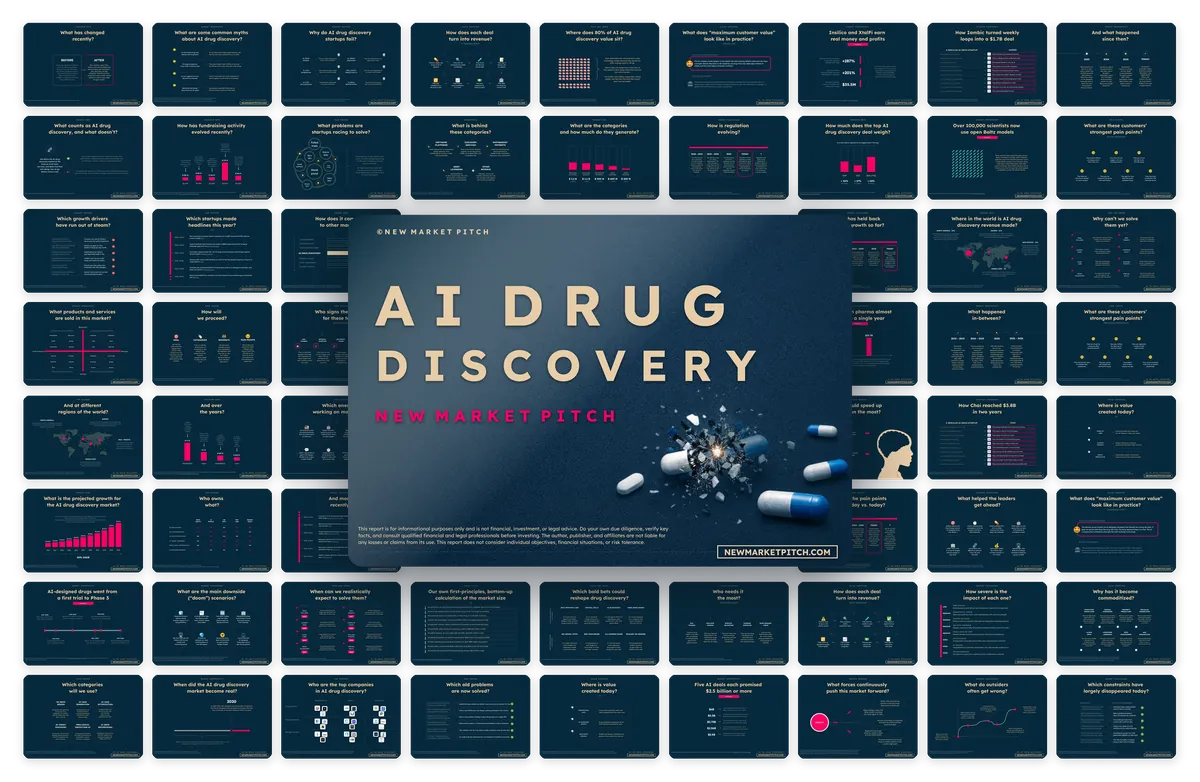
Whether you're building or investing in the AI in drug discovery market, our report covers everything you need to know: the players, the money, and what's coming next.
Summary
This report runs to around 210+ pages covering the market size, companies, funding, technology, buyers, business models, risks, investors, and the evidence behind the current AI drug discovery story.
The report keeps a fairly strict definition of the market. It focuses on AI used directly in preclinical drug discovery, including target identification, molecular design, lead optimization, drug repurposing, ADMET, and toxicity prediction, rather than counting every use of AI inside a pharmaceutical company.
That definition changes the market-size discussion quite a bit. Published estimates often disagree because some measure a relatively narrow discovery software market while others bundle in clinical operations, manufacturing, commercial analytics, and other pharmaceutical AI categories.
One of the biggest questions is still validation. Producing promising molecules or performing well on a benchmark is much easier than showing that AI consistently leads to better therapeutic candidates in wet-lab experiments and, eventually, in humans.
The competitive landscape is also more fragmented than the single label "AI drug discovery" suggests. Companies can compete through proprietary biological data, generative chemistry, disease-specific platforms, pharma partnerships, or by building their own drug pipelines.
Funding remains substantial, but headline deal values need to be read carefully. A large partnership can include years of conditional milestones, so the announced value of a deal can be very different from the cash a company receives in the near term.
Business models reflect the same uncertainty. Platform licensing can generate earlier revenue, while owning drug candidates creates far more upside if a molecule succeeds, but also exposes the company to longer timelines, higher capital requirements, and clinical failure risk.
The strongest companies therefore need more than impressive AI. Proprietary data, credible biological validation, pharma trust, useful wet-lab infrastructure, and a realistic path to monetization all become part of the moat.
Customer demand is driven by an expensive underlying problem: conventional drug discovery takes a long time, consumes huge amounts of laboratory work, and loses large numbers of candidates before they ever become medicines. Even modest improvements in candidate selection can therefore have meaningful economic value.
The report is built for founders, investors, pharma teams, operators, and strategists who want to pressure-test that opportunity. It combines market sizing with company landscapes, investor activity, technology maturity, business models, failure modes, and startup strategy rather than treating AI drug discovery as one homogeneous market.

Written by the New Market Pitch teamWe track new markets so founders and investors can move faster. About us

In our report covering the AI drug discovery market, we always try to gather several sources and make estimates that make sense, so you can work with solid numbers.
Is this AI in Drug Discovery market report actually up to date?
Yes. Our AI in Drug Discovery market report is built to reflect what is happening in the market now, with current company, funding, technology, partnership, and investor activity included throughout the research.
We regularly refresh the parts that move fastest, especially funding rounds, pharma partnerships, company activity, technology maturity, and clinical validation.
That makes the report useful if you are looking for recent AI in Drug Discovery market research rather than a static overview of how artificial intelligence can be used in pharmaceutical R&D.
What do you actually get in the AI in Drug Discovery market report?
The AI in Drug Discovery market report covers the main things a buyer would usually want to check before making a decision: market size, companies, technologies, funding, investors, business models, risks, and startup strategy.
The report is organized around 12 core areas: Market Definition, Market Opportunity, Market Size, Pain Points, Tech & Infrastructure, Value Creation, Market Challenges, Growth Drivers, Investor Bets, Top Players, Startup Killers, and Startup Strategies.
At around 210+ pages, it goes much further than a short market summary.
How exactly does the report define the AI in Drug Discovery market?
Our AI in Drug Discovery report focuses on AI-enabled software and services that directly help identify, design, optimize, or evaluate therapeutic candidates before human trials.
We keep the definition fairly strict because "AI in pharma" can mean almost anything, from manufacturing to commercial analytics. Including all of that can make market-size estimates look much bigger without really describing the same market.
The report mainly covers target identification, hit and lead generation, lead optimization, de novo molecular design, drug repurposing, ADMET prediction, toxicity prediction, and other preclinical discovery workflows.
| Included in the report's market definition | Generally outside the core market definition |
|---|---|
| Target identification and validation | Clinical trial operations |
| Hit and lead generation | Pharmaceutical manufacturing |
| Lead optimization | Pharmacovigilance |
| De novo molecular design | Commercial analytics |
| Drug repurposing | General enterprise AI |
| ADMET and toxicity prediction | Regulatory workflow software |
Does the report include AI in Drug Discovery market size and forecasts?
Yes. The AI in Drug Discovery market report includes market sizing, growth analysis, and the assumptions behind the numbers.
This part deserves some care because published AI drug discovery market estimates vary a lot. Some reports measure a narrow software market, while others mix in much broader pharmaceutical AI activity.
We build our own estimate from first principles and then compare it with external market data. The point is to show what the number actually represents instead of simply repeating a headline CAGR.
If you want more recent data on this point, please see our latest AI in drug discovery market report.

In our research about AI drug discovery, we don't want to repeat what boring consulting reports say. Instead, we show you the real and latest market signals that matter.
Does the report include AI drug discovery startups?
Yes. The AI in Drug Discovery market report includes emerging startups as well as larger and more established companies.
We look across several parts of the discovery pipeline, including target identification, molecular generation, lead optimization, ADMET prediction, computational biology, and disease-specific discovery platforms.
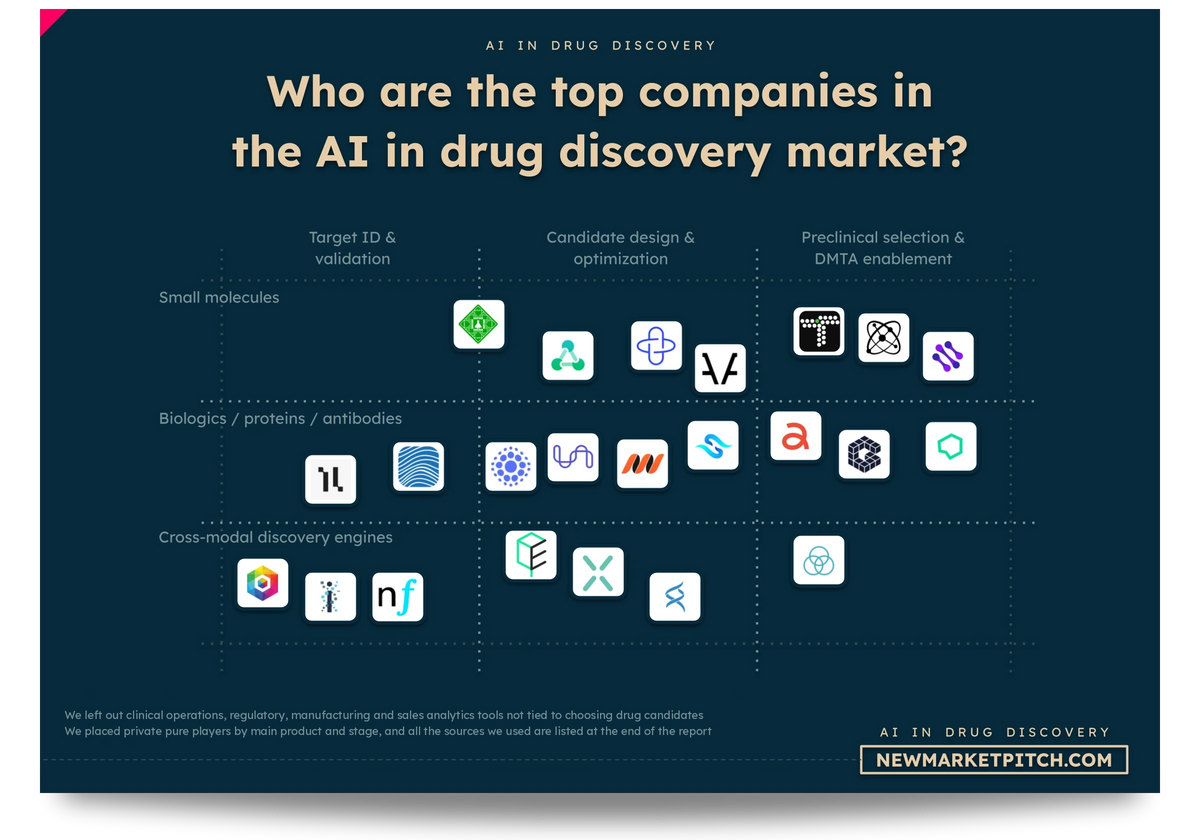
The report also uses company grids and ecosystem maps, so you can quickly see which companies are operating in which part of the market.
Does the report show who the main AI drug discovery competitors are?
Yes. The AI in Drug Discovery report looks at the main companies in the market and, more importantly, how their strategies differ.
We compare things such as proprietary datasets, therapeutic focus, validation strategy, pharma partnerships, pipeline ownership, and deal structures.
Companies including Recursion, Insilico Medicine, and Isomorphic Labs show how different the competitive models can become even when all three sit under the same broad "AI drug discovery" label.
Does the report cover recent AI drug discovery funding rounds and investors?
Yes. The AI in Drug Discovery market report tracks recent funding activity and looks at what investors are actually backing.
We look at the companies raising capital, the technologies behind them, and the business models attracting attention.
Some deals are already very large. Isomorphic Labs, for example, raised $600 million, while Takeda committed more than $1.7 billion to a partnership with Iambic.
Those headline numbers are useful, but they need context. A $1 billion-plus partnership can contain years of conditional milestones, so announced deal value and near-term revenue are often two very different things.
If you want more recent data on this point, please see our latest AI in drug discovery market report.
Does the report cover the actual AI drug discovery technology stack?
Yes. The AI in Drug Discovery report covers the main technologies being used across the discovery process and separates mature tools from more experimental ones.
We look at target identification, molecular design, predictive models, lead optimization, ADMET assessment, toxicity prediction, and the broader computational biology infrastructure behind them.
We also pay attention to how far each approach has really progressed. Some technologies are already used in pharmaceutical workflows. Others still need much stronger validation.
| Technology area | What the report looks at |
|---|---|
| Target identification | AI used to find and prioritize biological targets |
| Molecular design | Generative and predictive approaches for candidate design |
| Lead optimization | AI used to improve candidate characteristics |
| ADMET and toxicity | Prediction of safety and pharmacokinetic properties |
| Computational biology | Data and modeling infrastructure behind discovery |
| Validation maturity | Whether the technology is in production, validation, or still experimental |

In our market report about AI drug discovery, we like to show you the big picture. We know your time is precious, so we make every page quick to read and packed with as much learning as possible per minute.
Does the report look at whether AI-designed drugs actually work?
Yes. The AI in Drug Discovery report spends real time on validation, because a good model on a benchmark does not mean much if the biology fails.
We look at wet-lab validation, clinical evidence, generalization beyond training data, and how difficult it can be to prove that AI genuinely improved the outcome.
This is one of the hardest filters when comparing AI drug discovery companies. Plenty of platforms can generate promising outputs. Far fewer can show that those outputs lead to better therapeutic candidates.
If you want more recent data on this point, please see our latest AI in drug discovery market report.
Does the report explain how AI drug discovery companies make money?
Yes. The AI in Drug Discovery market report compares the main ways companies turn their technology into revenue.
We cover platform licensing, milestone-based pharma partnerships, co-development agreements, internally owned drug pipelines, and data-as-a-service models.
We also look at the economics behind those models, especially pipeline ownership, milestone timing, deal structure, and how much revenue can realistically arrive before a drug succeeds in the clinic.
Does the report explain who actually buys AI drug discovery technology?
Yes. The AI in Drug Discovery report looks at the main customer groups and the reasons they would pay for these tools.
Those buyers can include pharmaceutical companies, biotech startups, contract research organizations, and academic research groups.
The strongest buying pressures usually come from the cost and duration of traditional R&D, low success rates, expensive wet-lab cycles, and the need to prioritize better candidates earlier.
Does the report cover the main risks and reasons AI drug discovery startups fail?
Yes. The AI in Drug Discovery report looks closely at the problems that can kill a company even when the science sounds impressive.
We cover weak biological validation, models that overfit training data, long validation cycles, poor clinical endpoints, dependence on non-proprietary datasets, and partnerships where most of the headline value sits in milestones that may never be paid.
There is also a very practical problem: a pharma partnership can look fantastic in a press release while producing surprisingly little near-term revenue.
This section is designed for pressure-testing a company, not just understanding the technology behind it.
If you want more recent data on this point, please see our latest AI in drug discovery market report.
Does the report explain what could actually make the AI drug discovery market grow faster?
Yes. The AI in Drug Discovery market report looks at the specific conditions that could push adoption higher.
Lower discovery costs and faster candidate selection are obvious drivers, but they are only part of the story.
The market also needs better proprietary datasets, stronger clinical evidence from AI-discovered molecules, more confidence from pharma buyers, and business models that produce value before a compound reaches the end of a long development cycle.

In our document detailing everything you need to know about AI drug discovery, we turn what is vague and complex into simple, useful visuals. Market maps like this one show you at a glance where every startup stands.
Does the report cover the US, Europe, and other AI drug discovery markets?
Yes. The AI in Drug Discovery report looks at the global market, including company, funding, partnership, and technology activity across major regions.
The report is designed more as a global industry and competitive analysis than as a country-by-country statistical database.
So if you need to understand where important companies, investors, and partnerships are emerging, the report is useful. If you need a detailed standalone market-size table for every individual country, that is not the main focus.
Does the report cover regulation and trust around AI-designed drugs?
Yes. The AI in Drug Discovery report covers regulation where it affects adoption, validation, and confidence in AI-generated evidence.
The practical question is whether pharmaceutical companies and regulators will trust outputs generated or supported by AI models.
We therefore look at clinical validation, reproducibility, model reliability, and the difficulty of proving that an AI system made a meaningful contribution to a therapeutic outcome.
The report does not try to replace a dedicated regulatory handbook. It focuses on the regulatory issues that can actually change how quickly the market develops.
If you want more recent data on this point, please see our latest AI in drug discovery market report.
How is the AI in Drug Discovery market report researched?
We use a mix of first-principles analysis, company data, funding information, public datasets, industry research, and expert input to build the AI in Drug Discovery market report.
For market sizing, we calculate our own estimate and make the assumptions visible rather than relying on one outside forecast.
For company, funding, and technology analysis, we compare information from company disclosures, funding databases, public datasets, specialist research, and expert conversations.
We also define the market boundary before sizing it, which helps avoid mixing drug discovery with unrelated areas of pharmaceutical AI.
Can I see where the data in the AI in Drug Discovery report comes from?
Yes. The AI in Drug Discovery report is built around traceable data and clear assumptions.
Important datapoints are tied back to company disclosures, funding databases, public datasets, expert interviews, industry research, and other relevant sources.
The same applies to market-size assumptions. We want the reader to see how the estimate was built and where the underlying evidence comes from.
Who should buy the AI in Drug Discovery market report?
The AI in Drug Discovery report is mainly built for founders, investors, operators, and strategists who need to understand the market before making a business, investment, partnership, or positioning decision.
Founders can use the report to understand customer pain points, competitors, monetization models, and common startup mistakes.
Investors can use it to compare market size, capital flows, technology maturity, leading companies, and downside risks.
Corporate and pharma teams can use it to understand where the market is moving and which technologies or companies deserve a closer look.

Our report covering the AI drug discovery market gets updated several times a month, so you always get the latest view of where things stand.
How long is the AI in Drug Discovery report, and how is it delivered?
The AI in Drug Discovery market report is a digital English-language report of around 210+ pages.
The research is split into 12 structured sections, with market data, charts, company landscapes, and analysis rather than one long wall of text.
The report is delivered digitally, so buyers can access it without waiting for physical shipping.
How much does the AI in Drug Discovery market report cost?
The AI in Drug Discovery market report is currently sold as a one-time purchase, with no subscription required.
The product page currently lists three options: PRO at $49, PRO+ at $79, and PRO++ at $99.
Pricing or package details can change, so the product page remains the best place to check the exact option available when you buy.
| Purchase option | Current listed price | Payment |
|---|---|---|
| PRO | $49 | One-time |
| PRO+ | $79 | One-time |
| PRO++ | $99 | One-time |
Can I get a discount if I buy several New Market Pitch reports?
Yes. Buyers purchasing several New Market Pitch reports can currently get larger discounts than buyers purchasing one AI in Drug Discovery report.
The product page currently lists a 20% discount for two reports with the code NEWMARKET and a 30% discount for five or more reports with NEWMARKETMAX.
That can be useful if you are researching AI in Drug Discovery alongside adjacent markets such as biotechnology, healthcare AI, synthetic biology, or other emerging technology categories.
Where can I buy the latest AI in Drug Discovery market report?
You can buy the latest New Market Pitch AI in Drug Discovery Market Report directly from NewMarketPitch.com. The report is delivered digitally in English.
The current AI in Drug Discovery report is sold as a one-time purchase rather than a subscription, with several pricing options available on the product page.
If you are looking for a recent AI in Drug Discovery market research report, an AI drug discovery industry report, a 2026 AI in Drug Discovery market report, or current AI drug discovery market data, the report is available directly from the New Market Pitch AI in Drug Discovery page.

In our research about AI drug discovery, you will always find fresh funding data, taken straight from our own verified funding database.
Written by the New Market Pitch teamWe track new markets so founders and investors can move faster. About us