Who are the top investors in AI governance?
Building a startup or looking for your next investment in AI governance? Our report gives you the full picture.
Summary
SYN Ventures is currently the most active AI governance investor with 5 rounds joined, including 4 it led. The market is still wide open, with 226 named investors appearing across the rounds we track.
The next group is crowded rather than dominant. Race Capital, TLV Partners, Andreessen Horowitz and Lightspeed Venture Partners each sit on 4 rounds, so one famous firm has not pulled away from the rest.
AI governance is also still an early-stage market. Seed accounts for 108 of the 154 rounds with a known stage, which keeps early technical investors unusually important.
TLV Partners shows that clearly. It leads seed activity, while the names at Series B and Series C are different.
The current year has reshuffled the active group as well. SYN Ventures and TLV Partners are busiest now, while some firms that were active last year have not joined a round this year.
The product itself is changing too. More of the new AI governance startups sit close to security because they control agent identity, permissions, runtime behavior, evidence and policy enforcement.
That shift has pulled in large generalist and cybersecurity investors at the same time. Andreessen Horowitz, Bessemer Venture Partners, Sequoia Capital and Norwest all appear, but none controls the category.
The busiest firms also tend to lead rather than simply join. That says more than a famous name, because leading a round means taking the risk in a market where nobody knows yet which product will win.
Co-investing remains loose. The top investor pairs have only 2 shared rounds each, so AI governance has not settled into a small club of repeat syndicates.
For now, SYN Ventures is the clearest answer to who backs AI governance most consistently. But the lead changes by stage, and the next long-term winner may be the investor that sticks with these companies as they grow from early tools into core enterprise software.

Written by the New Market Pitch teamWe track new markets so founders and investors can move faster. About us

In our report covering the AI governance market, you will always find fresh funding data, taken straight from our own verified funding database.
Which VCs invest the most in AI governance right now?
SYN Ventures is the most active AI governance investor right now with 5 rounds joined, ahead of a 4-way tie on 4 rounds.
SYN Ventures also led 4 rounds where the lead was published. Race Capital and TLV Partners sit in the next group alongside Andreessen Horowitz and Lightspeed Venture Partners. Current activity separates them more sharply: SYN Ventures and TLV Partners have each joined 4 rounds this year, while Race Capital has joined 1.
The portfolio fits the numbers. SYN Ventures describes its focus around cybersecurity, privacy, regulatory compliance and data governance. Arcade.dev, one of its current bets, is built around authorizing agent actions against user identity, agent scope and enterprise policy before execution. Opsin Security goes after a related problem by connecting agent intent, identity, access and activity. These days, a large part of AI governance is being built inside the security stack, which suits SYN Ventures unusually well.
The table below ranks the 20 most active AI governance investors by the number of equity rounds they joined, with the rounds they led, their main stages, the startups they backed and the biggest round they joined.
If you want to go more into detail and get more data to understand what investors are betting on now, please check our AI governance report.
| # | Investor | Rounds | Led | Main stages | AI governance startups backed | Biggest round joined | Latest round |
|---|---|---|---|---|---|---|---|
| 1 | SYN Ventures ▲ | 5 | 4Named as lead in every round found (lead known for 4 of 5 rounds) |
Seed 2Series A 1 | Cranium AI, Opsin Security, CodeIntegrity, Arcade.dev, AIceberg | $60MArcade.dev · 2026 | Oct 2026 |
| 2 | Race Capital ▼ | 4 | 4Named as lead in every round found | Seed 2Series A 1 | Opsin Security, Openlayer, Unbound | $21MOpsin Security · 2026 | Oct 2026 |
| 3 | TLV Partners ▲ | 4 | 4Named as lead in every round found | Seed 4 | Pluto Security, Attestable, Arato | $20MAttestable · 2026 | Aug 2026 |
| 4 | Andreessen Horowitz ▼ | 4 | 4Named as lead in every round found | Seed 3Series A 1 | Neo Security, Keycard, Promptfoo | $75MNeo Security · 2026 | Jul 2026 |
| 5 | Lightspeed Venture Partners ▼ | 4 | 4Named as lead in every round found | Seed 3Series A 1 | Straiker, Virtue AI, Raindrop | $22MVirtue AI · 2025 | Dec 2025 |
| 6 | Glilot Capital Partners | 3 | 3Named as lead in every round found | Seed 2Series A 1 | Noma Security, Rein Security | $25MRein Security · 2026 | Oct 2026 |
| 7 | Norwest ▲ | 3 | 3Named as lead in every round found | Seed 1Series A 1 | Zenity, Beltic, Coval | $125MZenity · 2026 | Sep 2026 |
| 8 | Hetz Ventures | 3 | 3Named as lead in every round found | Seed 3 | Willow, Prompt Security, Arrakis Security | $8MArrakis Security · 2026 | Aug 2026 |
| 9 | Bessemer Venture Partners ▲ | 3 | 3Named as lead in every round found | Seed 1Series A 1 | Onyx Security, Neo Security, Dome Systems | $113MOnyx Security · 2026 | Jul 2026 |
| 10 | Redpoint Ventures ▲ | 3 | 3Named as lead in every round found | Seed 3 | Irregular, JetStream Security, Dome Systems | $80MIrregular · 2025 | Apr 2026 |
| 11 | Jump Capital | 2 | 2Named as lead in every round found | Series A 2 | Pluto Security, Prompt Security | $34MPluto Security · 2026 | Oct 2026 |
| 12 | Ugly Duckling Ventures | 2 | 2Named as lead in every round found | Seed 2 | Velatir | $5.8MVelatir · 2026 | Aug 2026 |
| 13 | MaC Venture Capital | 2 | 2Named as lead in every round found | Seed 2 | Coval, FriskAI | $3.6MFriskAI · 2026 | Aug 2026 |
| 14 | Felicis | 2 | 2Named as lead in every round found | Seed 1Series A 1 | Runlayer | $30MRunlayer · 2026 | Jun 2026 |
| 15 | Khosla Ventures | 2 | 2Named as lead in every round found | Seed 2 | Pramaana Labs, Runlayer | $27MPramaana Labs · 2026 | Jun 2026 |
| 16 | Mirae Asset Capital | 2 | 2Named as lead in every round found | Seed 2 | AIM Intelligence, Tynapse | $3.2MTynapse · 2026 | Apr 2026 |
| 17 | Sequoia Capital | 2 | 2Named as lead in every round found | Seed 2 | Irregular, AIR Security | $80MIrregular · 2025 | 2026 |
| 18 | Gradient | 2 | 2Named as lead in every round found | Seed 2 | Vijil, Truth Systems | $6MVijil · 2024 | Oct 2025 |
| 19 | Insight Partners | 2 | 2Named as lead in every round found | Series A 2 | Darwin AI, Promptfoo | $18MPromptfoo · 2025 | Oct 2025 |
| 20 | Shield Capital | 2 | 2Named as lead in every round found | Seed 2 | Knostic, Pillar Security | $9MPillar Security · 2025 | Apr 2025 |
No investors match this search.
Data from January 2024 through 12 November 2026, which is enough to show who is active today and who has been for years. Rounds: equity rounds in which the investor is named. Led: rounds it led or co-led. ▲ more rounds in 2026 so far than its 2025 pace, ▼ fewer.

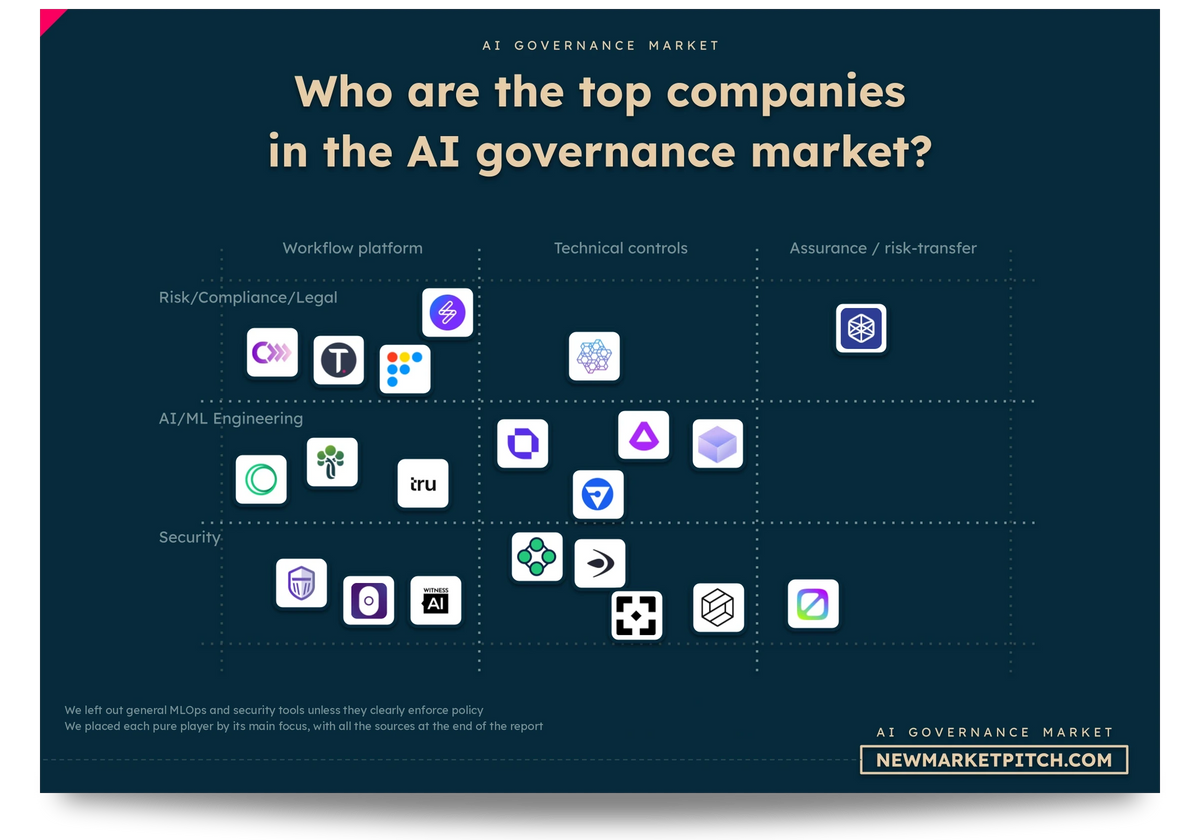
In our research about AI governance tools, we turn what is vague and complex into simple, useful visuals. Market maps like this one show you at a glance where every startup stands.
Are famous generalist VCs dominating AI governance?
No, famous generalist VCs matter in AI governance, but they do not dominate the market today.
Andreessen Horowitz has joined 4 rounds, while Bessemer Venture Partners, Norwest and Redpoint Ventures each have 3. Sequoia Capital has 2. Those are serious positions, but the broader market still includes 226 named investors, and none of these firms sits alone at the top.
Their investment theses also point in different directions. Andreessen Horowitz has recently argued that enterprise security teams need to know which agents are running, what they can access and whether a human or agent is behind an action. Bessemer describes Onyx Security as a control plane for enterprise AI agents. Sequoia's AIR Security thesis focuses more on the tools, plugins and external context agents consume.
That spread is why the big brands have not crowded everyone else out. AI governance still covers several technical control points, and specialists can win a round before the market agrees on which layer becomes the main platform.
Do security-focused VCs have an edge in AI governance?
Largely yes, security-focused VCs have an edge in AI governance because the newest problems look much more like enterprise security than policy paperwork, and SYN Ventures is the clearest example.
In AI governance, the firm has backed Cranium AI, Opsin Security, CodeIntegrity, Arcade.dev and AIceberg. Arcade.dev sits in the action path and checks permissions and policy before an agent acts. Opsin Security looks at whether an agent's behavior still matches its intended purpose, permissions and data access.
That fits SYN Ventures closely. The firm already works around cybersecurity, privacy, regulatory compliance and data governance, and it was started in 2021 by former CISOs, CTOs and founders. A startup selling runtime agent controls needs exactly those buyers to test whether the product works inside real identity, access and security systems.
AI governance is now moving deeper into enforcement. That gives security-focused investors an advantage because they already understand the budgets, integrations and buyers around the control layer.

In our market report about AI governance tools, we always try to gather several sources and make estimates that make sense, so you can work with solid numbers.
Are the busiest AI governance investors actually leading rounds?
Yes, the busiest AI governance investors are usually leading the rounds they join rather than appearing as passive names in large syndicates.
SYN Ventures led every round where its lead role was published. Race Capital, TLV Partners, Andreessen Horowitz and Lightspeed Venture Partners also led all of their rounds. Glilot Capital Partners, Norwest, Hetz Ventures, Bessemer Venture Partners and Redpoint Ventures show the same pattern across their smaller round counts.
The public announcements line up with that behavior. Opsin Security said in October 2026 that its latest financing was led by SYN Ventures and Race Capital, two of the busiest investors in the market. Andreessen Horowitz has published dedicated investment theses for both Neo Security and Keycard, while Felicis framed Runlayer as infrastructure for getting agents into enterprises with security and governance built in.
Leading a round says a lot more about conviction than a famous logo on a cap table. In a market this young, the firms that set the price and lead are betting on which tools will turn into lasting companies.
Which AI governance investors are still investing this year?
SYN Ventures and TLV Partners are the busiest AI governance investors this year, with 4 rounds each.
Among the 20 most active investors in our ranking, 16 have joined at least one round this year and 4 have not. SYN Ventures moved from 1 round last year to its current pace, while TLV Partners has built its position almost entirely through recent early-stage activity.
The types of companies being backed also look different from the older responsible-AI market. Noma now sells a governance layer that discovers agents, controls access and enforces policy at runtime. Zenity describes itself as security and governance built specifically for enterprise AI agents. Andreessen Horowitz recently put the problem in similarly practical terms: teams need to know which agents exist, who owns them, what they can access and what they actually do. That is where current investor attention is moving.
The table below shows, year by year, how many rounds 12 of the most active AI governance investors joined, so it is easy to see who is still investing and who has slowed down.
If you want to go more into detail and see which investors are still writing checks and which have slowed down, please check our AI governance report.
| Investor | 2024 | 2025 | 2026* | Total |
|---|---|---|---|---|
| SYN Ventures | 1 | 4 | 5 | |
| TLV Partners | 4 | 4 | ||
| Norwest | 3 | 3 | ||
| Bessemer Venture Partners | 3 | 3 | ||
| Glilot Capital Partners | 1 | 2 | 3 | |
| Hetz Ventures | 1 | 2 | 3 | |
| Redpoint Ventures | 1 | 2 | 3 | |
| Ugly Duckling Ventures | 2 | 2 | ||
| Race Capital | 3 | 1 | 4 | |
| Andreessen Horowitz | 1 | 2 | 1 | 4 |
| Jump Capital | 1 | 1 | 2 | |
| MaC Venture Capital | 1 | 1 | 2 |
* 2026: January to 12 November. Darker cells mean more rounds that year. Data from January 2024 through 12 November 2026.
Are some of last year’s busiest AI governance investors already going quiet?
Yes, some AI governance investors that were very active last year have gone quiet this year while others have accelerated.
Lightspeed Venture Partners joined 4 rounds last year and none this year. Insight Partners joined 2 last year and none this year, while Gradient and Shield Capital are also inactive this year among the top 20. Norwest moved the other way and has joined 3 rounds this year after none last year.
That does not mean the quieter investors have stopped caring about the market. Insight's Promptfoo bet became more strategically important after Promptfoo joined OpenAI, and Lightspeed's Virtue AI investment still sits squarely inside AI security and compliance. The change is more about where new rounds are happening now.
The newest financings lean heavily toward agent access, endpoint control, runtime policy and secure tool use. Older bets in evaluation or model testing can still be valuable, but the current wave is pulling investors toward the infrastructure that decides what an agent is allowed to do.
Is AI governance still attracting new investors?
AI governance is still bringing in new investors, not just the same early backers.
TLV Partners, Norwest and Bessemer Venture Partners made their first AI governance bets this year, yet all have already reached the most active group. Ugly Duckling Ventures is another recent entrant with 2 rounds.
The timing makes sense. Norwest describes Zenity around end-to-end security and governance for enterprise AI agents, and Zenity's own announcement says the company is scaling around enterprise demand for agent security. Bessemer has gone further, arguing that agent security can create a very large new cybersecurity category. Cranium AI now markets a single platform that discovers, observes, governs, secures and proves models, agents and vendors across the enterprise AI supply chain.
So the investor pool is getting wider because the category is easier to recognize. What once looked like a narrow responsible-AI niche now overlaps with enterprise security, identity, infrastructure and developer tooling.

Our document detailing everything you need to know about AI governance gets updated several times a month, so you always get the latest view of where things stand.
Which AI governance investors back seed rounds, and which back growth rounds?
Most AI governance rounds are still seed rounds, 108 of the 154 rounds where the stage is known.
TLV Partners is the most active seed investor with 4 rounds. At Series B, Booz Allen Ventures leads with 2 rounds. At Series C, LG Technology Ventures leads with 2, and there are only 2 Series C or later rounds in the stage totals.
That gap tells us how young the market remains. A large share of companies are still being funded around first products, first enterprise deployments and first attempts to define a control layer for agents. Once companies get bigger, investors are looking for proof that governance can become a broad enterprise system rather than a narrow compliance feature.
Zenity is a good example of what that later-stage story now looks like. The company describes itself as an AI security and governance platform built for enterprise agents, and its August 2026 financing announcement says the money is meant to support global expansion and rising enterprise demand.
The table below shows, for 12 of the most active AI governance investors, how many rounds they joined at each stage, from seed to growth.
If you want to go more into detail and see where each investor places its bets, from seed to growth, please check our AI governance report.
| Investor | Seed | Series A | Series B | Series C | Series D+ | Growth |
|---|---|---|---|---|---|---|
| SYN Ventures | 2 | 1 | · | · | · | · |
| Race Capital | 2 | 1 | · | · | · | · |
| TLV Partners | 4 | · | · | · | · | · |
| Andreessen Horowitz | 3 | 1 | · | · | · | · |
| Lightspeed Venture Partners | 3 | 1 | · | · | · | · |
| Glilot Capital Partners | 2 | 1 | · | · | · | · |
| Norwest | 1 | 1 | · | 1 | · | · |
| Hetz Ventures | 3 | · | · | · | · | · |
| Bessemer Venture Partners | 1 | 1 | 1 | · | · | · |
| Redpoint Ventures | 3 | · | · | · | · | · |
| Jump Capital | · | 2 | · | · | · | · |
| Ugly Duckling Ventures | 2 | · | · | · | · | · |
Most active at each stage, among all AI governance investors: Seed, TLV Partners · Series A, 4 investors tied with 2 rounds · Series B, Booz Allen Ventures · Series C, LG Technology Ventures. Bigger dots mean more rounds. Data from January 2024 through 12 November 2026.
Why are so many AI governance rounds still at seed?
AI governance is still seed-heavy because investors are funding competing answers to a problem that has not settled into one standard architecture.
Companies are trying to control different layers: endpoints, agent identity, MCP access, red teaming, policy engines, evaluation, runtime blocking and audit evidence. That gives investors many early technical teams to back, but far fewer mature companies with a long operating history.
Regulation adds urgency without deciding the product design. The European Commission is implementing the AI Act, and NIST continues to push practical AI risk-management guidance. Both increase the need for oversight and evidence, but neither tells an enterprise whether the winning control should live at the endpoint, identity layer, developer workflow or agent runtime.
That uncertainty is exactly where seed investors can move fastest. They can back several technical approaches before one becomes the default enterprise layer.
Who funds AI governance once startups get bigger?
Later-stage AI governance is much narrower, and a different set of investors shows up once companies move beyond seed and Series A.
Booz Allen Ventures is the most active Series B investor with 2 rounds, while LG Technology Ventures leads Series C with 2. Bessemer Venture Partners has joined Onyx Security's $113M Series B, and Norwest's largest joined round is Zenity's $125M Series C.
The product story also changes at that point. Onyx Security is selling a control plane for enterprise agents, and Norwest describes Zenity as end-to-end security and governance across enterprise AI agents. These are broad infrastructure pitches rather than single-purpose compliance tools.
Later-stage investors need to see that breadth. A clever control can raise seed money, but a larger round usually needs proof that the product can sit across a large enterprise, integrate with existing systems and support a recurring software business at scale.
Are cybersecurity investors taking over AI governance?
Only partly, cybersecurity investors are becoming central to AI governance, but security still does not cover the whole market.
SYN Ventures, Glilot Capital Partners, Redpoint Ventures, Andreessen Horowitz, Bessemer Venture Partners and Sequoia Capital all have exposure that runs directly through security. Their companies focus on agent access, runtime behavior, red teaming, identity, policy enforcement and the software supply chain around agents.
Recent product language makes the overlap obvious. Noma lets security teams discover agents, define what they may do and enforce policy at runtime. Keycard gives agents their own identity and evaluates access requests against policy before issuing credentials. Cranium AI combines discovery, governance, runtime observation and evidence across models, agents and vendors.
But AI governance also includes lifecycle approvals, independent assurance, audit evidence, model evaluation and regulatory workflows. Attestable, for example, focuses on verifiable AI integrity rather than classic threat detection. Security is currently the strongest route into the market, not the full definition of it.

In our report covering the AI governance market, we look at what the winners do differently, so you can learn from the best instead of guessing.
Are specialist funds winning the earliest AI governance rounds?
Yes, specialist and early-stage funds are doing very well in seed AI governance, but large generalists still win plenty of early deals.
TLV Partners leads seed activity with 4 rounds. SYN Ventures has 2 seed rounds, Hetz Ventures has 3 and Redpoint Ventures has 3. Andreessen Horowitz also has 3 seed rounds, which is the clearest reminder that specialist knowledge helps without being mandatory.
The reason is simple: these companies often sell a technical thesis before a clear software category exists. Investors have to decide whether the important control belongs at the endpoint, identity layer, agent runtime, model layer or developer workflow. Funds that already know security and infrastructure can make that call earlier.
The table below shows how seed exposure differs among several of the most active investors.
| Investor | Rounds | Seed rounds |
|---|---|---|
| SYN Ventures | 5 | 2 |
| Race Capital | 4 | 2 |
| TLV Partners | 4 | 4 |
| Andreessen Horowitz | 4 | 3 |
| Lightspeed Venture Partners | 4 | 3 |
| Glilot Capital Partners | 3 | 2 |
| Norwest | 3 | 1 |
| Hetz Ventures | 3 | 3 |
Are Andreessen Horowitz and Sequoia seriously betting on AI governance?
Andreessen Horowitz and Sequoia Capital are both making real AI governance bets, but they are backing different parts of the stack.
Andreessen Horowitz has joined 4 rounds and led all of them. Its companies include Neo Security, Keycard and Promptfoo. In its recent security writing, the firm argues that enterprises need to know which agents are running, who owns them and what they can access, while its Neo thesis focuses on enforcing policy in real time at the endpoint.
Sequoia Capital has joined 2 rounds, backing Irregular and AIR Security. Its AIR Security thesis centers on the external components agents consume, including skills, plugins and MCP servers, then extends into monitoring and policy control.
Neither firm is the market leader by activity. What matters is that both now treat AI governance as infrastructure inside enterprise AI deployment, rather than a small compliance add-on that sits outside the main software stack.
Did OpenAI buying Promptfoo make AI governance more valuable?
Yes, Promptfoo becoming part of OpenAI made AI governance more strategically important and raised the bar for standalone startups at the same time.
OpenAI announced its plan to acquire Promptfoo in March 2026 for security testing, evaluation and compliance capabilities around agentic systems. OpenAI's current developer documentation now describes Promptfoo as part of OpenAI and recommends it for evaluation and red-teaming workflows.
That is good news for the category because it shows that governance tooling can become important enough to sit inside a frontier AI platform. It also creates a harder question for independent startups. Model providers can absorb testing, evaluation and security features that live close to their own stack.
The stronger standalone positions are likely to sit across providers. Identity, permissions, audit evidence, runtime policy and cross-model controls are harder for one model vendor to own completely because enterprises need them to work across many systems.
Are AI governance investors really betting on regulation?
Only partly, AI governance investors increasingly look more interested in controlling autonomous software than in selling regulatory checklists.
The European Commission is implementing and enforcing the AI Act, while NIST continues to publish AI risk-management guidance. Those frameworks help normalize documentation, monitoring and accountable control, so regulation clearly supports demand.
But look at the products being financed now. Noma controls agent access and runtime behavior across enterprise environments. Keycard evaluates agent permissions at the moment access is requested. Cranium AI maps governance policy to frameworks such as NIST AI RMF and the EU AI Act while also monitoring agents in operation. These products solve day-to-day control problems as much as regulatory ones.
Those products would still be useful if specific rules changed. Enterprises are giving agents access to data, applications and business workflows, which creates an operational control problem on its own. Regulation speeds up procurement and defines some evidence requirements, but agent adoption is the deeper reason investors are backing this layer.

In our research about AI governance tools, we don't want to repeat what boring consulting reports say. Instead, we show you the real and latest market signals that matter.
Which AI governance investors most often invest together?
In AI governance, no group of investors keeps investing together yet, and the 2 closest pairs have shared only 2 rounds each.
Andreessen Horowitz and Merlin Ventures are one of those pairs, with the shared activity tied to Neo Security. Lightspeed Venture Partners and Walden Catalyst Ventures form the other leading pair through Virtue AI. Each pair is concentrated around 1 startup, so the repetition is still narrow.
That fits the rest of the market. Investors do not yet agree on one control layer, and a fund that likes red teaming may not make the same call on agent identity, endpoint control or model assurance. For founders, that means syndicates are still assembled deal by deal rather than coming from a fixed club of funds that repeatedly invest together.
The table below lists the pairs of AI governance investors named together in at least two equity rounds, with the startups they backed together.
If you want to go more into detail and see which investor networks back the same startups, please check our AI governance report.
| Investor pair | Rounds together | Startups backed together |
|---|---|---|
| Andreessen Horowitz + Merlin VenturesNeo Security | 2 | Neo Security |
| Lightspeed Venture Partners + Walden Catalyst VenturesVirtue AI | 2 | Virtue AI |
Pairs of investors named in the same equity round. Data from January 2024 through 12 November 2026.
So, who are the biggest investors in AI governance?
SYN Ventures is the clearest answer today because it is the most active AI governance investor by rounds joined.
The market still does not have one fund that dominates every stage. Race Capital, TLV Partners, Andreessen Horowitz and Lightspeed Venture Partners form the next activity group, while TLV Partners leads seed and different investors lead the scarce later-stage rounds.
The bigger shift is in what investors are funding. AI governance now reaches into agent identity, runtime permissions, endpoint control, red teaming, evidence and auditability. That is pulling cybersecurity funds, enterprise software investors and famous generalists into the same market.
For founders, the best investor still depends on the control layer and the stage. For anyone asking who funds the category most consistently right now, SYN Ventures has the strongest claim.
The table below shows what we found.
| Question | Answer |
|---|---|
| Who is most active right now? | SYN Ventures leads with 5 rounds joined. It also led 4 rounds where a lead was published. That combination gives it the strongest current claim. |
| Do famous VCs dominate? | No, AI governance still has a very fragmented investor base. We found 226 named investors across the rounds we track. Big brands matter, but none controls the market. |
| Is seed still the main stage? | Yes, seed dominates the rounds with a known stage. It accounts for 108 of the 154 known-stage rounds. That keeps early technical investors unusually important. |
| Who leads seed investing? | TLV Partners is the most active seed investor. It has joined 4 seed rounds so far. That puts it ahead at the market's busiest stage. |
| Do active investors actually lead? | Yes, the busiest firms usually take the lead role. Several led every round where the lead was published. That shows stronger conviction than passive participation alone. |
| Has current activity shifted? | Yes, the active group has moved quickly this year. SYN Ventures and TLV Partners are busiest right now. Several previously active firms have gone quiet. |
| Are new investors still arriving? | Yes, recent entrants have already reached the active group. Norwest and Bessemer Venture Partners each reached 3 rounds. AI governance is still attracting fresh capital sources. |
| Is cybersecurity taking over? | Partly, security is currently the strongest route into AI governance. Runtime controls now look a lot like enterprise security infrastructure. Assurance and compliance still sit outside that security core. |
| Do investors keep co-investing? | Not much, repeat syndicates are still rare in AI governance. The leading pairs have only 2 shared rounds each. Most partnerships still look deal-specific. |
| Is regulation the main bet? | No, agent adoption now looks like the deeper investment thesis. Investors are backing permissions, runtime controls, evidence and auditability. Those needs survive changes in regulation. |
| Did Promptfoo change the market? | Yes, Promptfoo is now part of OpenAI. That proves governance tooling can become strategically important to a frontier platform. It also raises the bar for standalone products. |
| Can one fund own this market? | Not yet, leadership still changes by stage and product layer. The later-stage investor map is especially thin. There is still room for a new long-term leader. |

Learning from others' mistakes is the cheapest lesson there is. In our market report about AI governance tools, we look at what broke startups before you, so you don't repeat it.
Our methodology
Our data runs through November 12, 2026. We cover equity rounds since January 2024, the point from which we track this market systematically deal by deal. We define AI governance as products and independent assurance services that let organizations inventory and oversee AI models, applications and agents; implement accountable policies; assess or enforce AI-specific risks and controls; and retain evidence for oversight, audit or regulatory compliance. Every company counted is a startup under our definition, and we include companies on the border of this definition rather than excluding them when their product clearly performs an AI-governance function.
We count each equity round an investor joined and each round it led. We do not estimate how much an investor itself contributed because individual checks are rarely public. IPOs and offerings after a listing are excluded because they are not private rounds joined by venture investors. Investor names come from company announcements and reliable press reports, are merged when the same firm appears under several names, and vague references such as existing investors or angel investors are not counted. Duplicate reports of the same financing are merged. The current-year column begins in March, once there are three months of data.
Rounds confirmed by a company announcement, a press article or a regulatory filing are counted in full. Where no article exists, a round is counted only when at least two recognised databases agree on its date (within one month) and amount (within 5%), and it is marked as low confidence; a round found in a single database stays in the company's history but is left out of totals. For companies that have raised more than $100M, every round counted is backed by an article.
Commercial database investor lists are never used on their own because they can add investors that were not actually in a round or mix equity with debt and grants. We found at least one named investor for 160 of the 168 rounds we count, so every investor total should be read as a floor rather than a complete map of undisclosed participation.
Our investor counts do not equal the deal counts in a funding tracker because the unit is different. One financing round counts once in a deal tracker, but in this article it counts once for each named investor that joined it; rounds with no named investor remain in the market total but cannot appear in the investor tables. That is why an active investor ranking answers who repeatedly backs companies, not how many financings occurred overall.
A well-known specialist can rank below a broader fund without any contradiction. We rank investors by confirmed rounds joined, not by reputation, assets under management, check size or the theoretical relevance of a fund's mandate. That choice makes the comparison reproducible and keeps us from pretending to know private investment amounts. It also means a firm can have one strategically important large investment and still rank below an investor that has repeatedly led smaller early-stage rounds.
Key sources include SYN Ventures investment focus across cybersecurity, privacy, regulatory compliance and data governance., SYN Ventures portfolio description of Arcade and its runtime authorization, policy and auditing layer., Opsin Security on agent intent, access, policy boundaries and SYN Ventures/Race Capital backing., Andreessen Horowitz thesis on Neo Security and real-time control for agentic software., Andreessen Horowitz thesis on Keycard and identity and access for AI agents., Andreessen Horowitz on current enterprise security problems created by AI agents., Bessemer Venture Partners thesis on Onyx Security as an enterprise AI control plane., Bessemer Venture Partners thesis on endpoint controls for AI agents., Onyx Security enterprise adoption, agent governance positioning and financing announcement., TLV Partners portfolio description of Attestable and its AI integrity positioning., Norwest portfolio description of Zenity as enterprise AI agent security and governance., Sequoia Capital thesis on AIR Security, agent add-ons, monitoring and policy control., Promptfoo announcement about joining OpenAI and continuing its open-source project., OpenAI announcement explaining the strategic role of AI security testing, evaluation and compliance., OpenAI developer documentation describing Promptfoo as part of OpenAI., Insight Partners on Promptfoo's enterprise AI security positioning and investment thesis., Felicis thesis on Runlayer, MCP infrastructure, security and governance for agents., Glilot Capital on Noma Security and AI security, compliance and lifecycle risk., NIST AI Risk Management Framework and ongoing AI governance guidance., European Commission description of AI Act governance and enforcement architecture., Zenity on its enterprise AI agent security and governance platform and Series C expansion., Noma on agent discovery, access control, runtime enforcement and compliance reporting., Keycard on runtime authorization, agent identity, policy evaluation and audit logs., and Cranium AI on enterprise AI discovery, governance, runtime monitoring and evidence..

If you build or invest in the AI governance market, you need to know which business models pay off now and which ones are fading. That's why our report covering it has a whole section on it.
Written by the New Market Pitch teamWe track new markets so founders and investors can move faster. About us