
What are the top AI inference chip startups by revenue today?
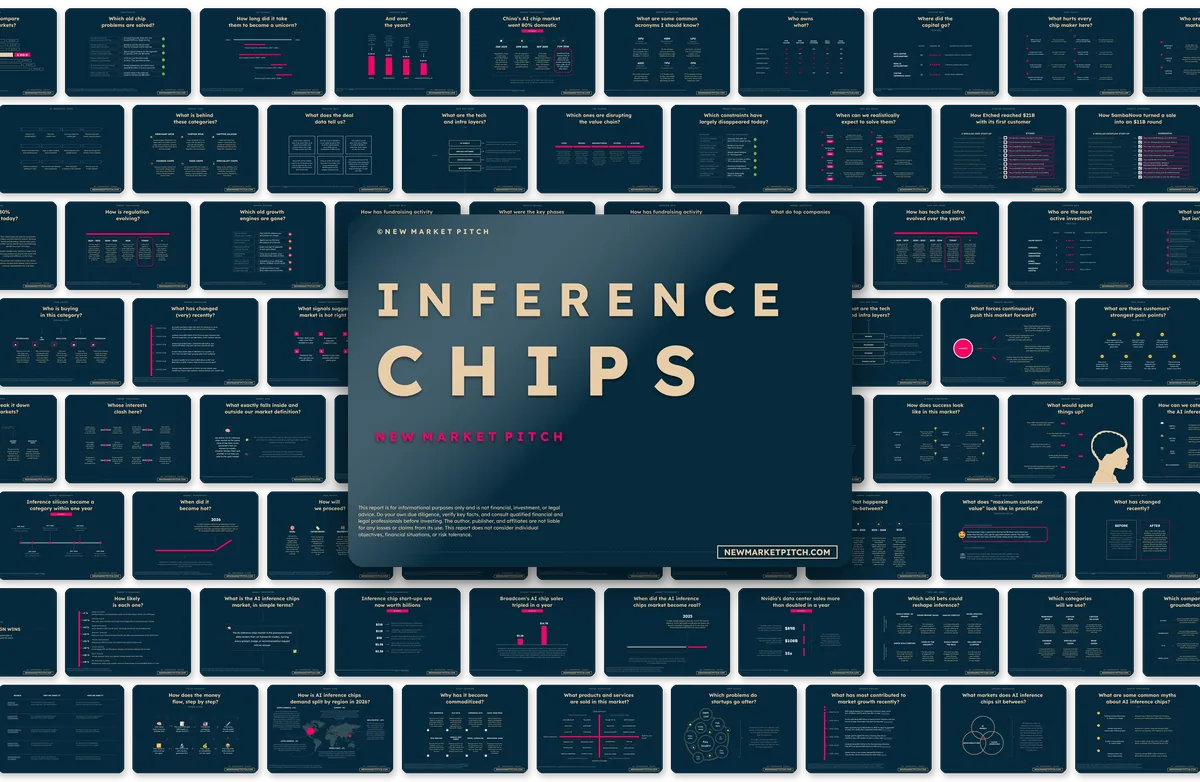
Whether you're building or investing in the AI inference chip market, our report covers everything you need to know: the players, the money, and what's coming next.
Summary
Cerebras is currently the top Western AI inference chip challenger by independently reported revenue, generating approximately $681 million over the twelve months through June 2026. Cambricon leads the broader global comparison, with roughly $900 million in reported 2025 revenue, although both companies are publicly traded and serve AI training as well as inference.
The private-company ranking is much harder to establish. Groq, SambaNova, Tenstorrent and Etched have attracted enormous investment and commercial interest, but none has published recent annual revenue figures comparable to Cerebras's financial disclosures.
Cerebras's business is changing faster than its headline revenue suggests. Hardware accounted for approximately 70% of its 2025 sales, whereas cloud and other services generated around 70% of second-quarter 2026 revenue. The company is increasingly monetizing its processors through computing services.
Groq's commercial footprint is impressive, with millions of developers and a growing international data-center network. But its last widely cited revenue estimate remains approximately $90 million for 2024, and management's subsequent forecasts cannot be treated as realized sales.
Chinese accelerator manufacturers are already reaching considerable commercial scale. Cambricon grew revenue 453% in 2025, while Moore Threads generated more revenue during the first half of 2026 than throughout the previous year. The market extends well beyond American inference startups.
Edge inference is another established revenue opportunity. Ambarella generated $390.7 million in fiscal 2026 sales, with approximately 80% coming from edge AI processors used in cameras, vehicles and other devices. Cloud-based language-model inference is only one part of the industry.
Valuations and recognized sales remain strikingly disconnected. Etched secured a $21 billion valuation around the time of its first announced inference rack deployment, while Nvidia committed approximately $17 billion to a technology licensing arrangement involving Groq. Neither figure represents annual operating revenue.
Cerebras also reported $25.4 billion in remaining performance obligations, offering unusually substantial visibility into future contracted business. Those commitments dwarf its current annual sales, but they will become recognized revenue only as contractual performance requirements are satisfied.
Profitability varies enormously. Cambricon reported approximately RMB 2.06 billion in attributable net income for 2025, while Cerebras remained loss-making on its core non-GAAP measure despite reporting positive GAAP net income. Rapid inference demand does not automatically translate into attractive margins.
Cerebras is the clearest Western candidate to cross $1 billion in annual revenue next, needing roughly 47% growth from its reported trailing figure. The longer-term winners will depend on processor performance, production capacity, cloud utilization and whether growing token demand can offset falling inference prices.

Written by the New Market Pitch teamWe track new markets so founders and investors can move faster. About us

In our report covering the AI inference chip market, we turn what is vague and complex into simple, useful visuals. Market maps like this one show you at a glance where every startup stands.
The ranking of top startups in the AI inference chips market by revenue
Below is a table ranking all the companies in this market by their current revenue scale. You can find our methodology at the end of this page.
If you want a deeper understanding of the market and its current dynamics, get our report covering the AI inference chips market.
| Ranking | Company | Latest Metric | Metric Type | Freshness | Disclosed When | Source Quality | Confidence | Segment | Why This Ranking | Local Metric | Country |
|---|---|---|---|---|---|---|---|---|---|---|---|
| 1 | Amazon | $717B | Fiscal-Year Revenue | Fresh · 10mo | Feb 2026 | Filed / Audited | Low | Cloud inference ASICs | Largest corporate revenue among included companies. AWS contributed $128.725B, but Inferentia revenue is undisclosed; position does not imply chip-market leadership. | us | |
| 2 | Apple | $416B | Fiscal-Year Revenue | Fresh · 13mo | Oct 2025 | Filed / Audited | Low | On-device NPUs | Below Amazon on reported company scale and above Alphabet. Neural Engine is embedded in Apple silicon, without standalone inference-chip sales. | us | |
| 3 | Alphabet | $403B | Fiscal-Year Revenue | Fresh · 10mo | Feb 1, 2026 | Filed / Audited | Low | Cloud TPU accelerators | Below Apple on total revenue. Google Cloud generated $58.705B, but proprietary TPU inference revenue is not separated. | us | |
| 4 | Microsoft | $332B | Fiscal-Year Revenue | Very Fresh · 4mo | Oct 2026 | Filed / Audited | Low | Cloud inference ASICs | Recent audited group revenue places Microsoft below Alphabet. Maia silicon is part of Azure infrastructure, not a separately reported business. | us | |
| 5 | Samsung Electronics | ~$235B | Fiscal-Year Revenue | Fresh · 10mo | Jan 29, 2026 | Company Disclosed | Low | Mobile AI NPUs | Larger total business than NVIDIA, but most revenue comes from memory, devices and other operations rather than its Exynos inference processors. | KRW 334T | kr |
| 6 | NVIDIA | $216B | Fiscal-Year Revenue | Fresh · 9mo | Feb 25, 2026 | Filed / Audited | Medium | Data-center AI GPUs | Ranks below Samsung on group revenue but has far more directly relevant accelerator sales. The disclosed figure still includes training, inference and non-AI products. | us | |
| 7 | Huawei | ~$123B | Fiscal-Year Revenue | Fresh · 10mo | Mar 31, 2026 | Filed / Audited | Low | Ascend AI processors | Below NVIDIA on consolidated size. Ascend accelerators qualify, but the figure combines telecommunications, consumer devices, cloud and other divisions. | CNY 881B | cn |
| 8 | Broadcom | $63.9B | Fiscal-Year Revenue | Fresh · 11mo | Dec 1, 2025 | Company Disclosed | Low | Custom AI XPUs | Significant custom AI-chip business, but the reported total includes VMware software and networking. Ranks below Huawei on overall company size. | us | |
| 9 | Intel | $52.9B | Fiscal-Year Revenue | Fresh · 10mo | Jan 1, 2026 | Filed / Audited | Low | CPUs and AI accelerators | Below Broadcom on total revenue. Xeon inference and Gaudi processors qualify, but Intel does not isolate inference revenue. | us | |
| 10 | Qualcomm | $44.3B | Fiscal-Year Revenue | Fresh · 13mo | Nov 5, 2025 | Filed / Audited | Low | Mobile NPUs and AI accelerators | Below Intel on revenue. Hexagon NPUs are commercially deployed, but most sales also reflect mobile connectivity and licensing. | us | |
| 11 | AMD | $34.6B | Fiscal-Year Revenue | Fresh · 10mo | Feb 3, 2026 | Filed / Audited | Medium | Data-center AI GPUs | Below Qualcomm on consolidated revenue. AMD disclosed $16.635B in data-center revenue, but that includes CPUs and training-oriented products. | us | |
| 12 | MediaTek | ~$19.2B | Fiscal-Year Revenue | Fresh · 10mo | Feb 1, 2026 | Company Disclosed | Low | Mobile and edge NPUs | Similar corporate scale to Baidu in USD terms, but its Dimensity products include widely deployed on-device inference processors. Revenue is not NPU-specific. | TWD 596B | tw |
| 13 | Baidu | ~$18B | Fiscal-Year Revenue | Fresh · 10mo | Feb 26, 2026 | Filed / Audited | Low | Kunlun AI accelerators | Near MediaTek in converted group revenue. Kunlunxin is a controlled subsidiary, so it is not separately counted without standalone revenue. | CNY 129B | cn |
| 14 | NXP Semiconductors | $12.3B | Fiscal-Year Revenue | Fresh · 10mo | Feb 1, 2026 | Filed / Audited | Low | Embedded and automotive AI processors | Above STMicroelectronics by consolidated revenue, though its NPU-capable processing products represent only part of the business. | nl | |
| 15 | STMicroelectronics | $11.8B | Fiscal-Year Revenue | Fresh · 10mo | Jan 2026 | Filed / Audited | Low | Edge AI microcontrollers | Below NXP on total sales. STM32N6 and related neural-processing capabilities qualify, but inference revenue is not disclosed. | ch | |
| 16 | Renesas Electronics | ~$8.84B | Fiscal-Year Revenue | Fresh · 10mo | Feb 5, 2026 | Filed / Audited | Low | Embedded AI processors | Below ST on converted revenue, above Marvell. IFRS revenue is used rather than the lower non-GAAP figure. | JPY 1.32T | jp |
| 17 | Marvell Technology | $8.2B | Fiscal-Year Revenue | Fresh · 9mo | Mar 2026 | Company Disclosed | Medium | Custom AI compute ASICs | Below Renesas on total revenue. Custom AI compute is material, but inference-only revenue is unavailable and networking products are included. | us | |
| 18 | Arm Holdings | $4.92B | Fiscal-Year Revenue | Fresh · 7mo | May 1, 2026 | Filed / Audited | Medium | NPU architecture IP | Below Marvell on revenue. Relevant Ethos and processor IP is licensed commercially, but most licensing and royalty revenue is not inference-specific. | gb | |
| 19 | Cambricon Technologies | ~$1.34B | Nine-Month Revenue | Very Fresh · 1mo | Oct 23, 2026 | Credible Reported | Medium | Data-center AI accelerators | Newer operating revenue is already substantially above FY2025's RMB6.497B. Ranks above Synaptics on approximate converted scale despite using nine months instead of a full year. | CNY 9.53B | cn |
| 20 | Synaptics | $1.2B | Fiscal-Year Revenue | Very Fresh · 4mo | Aug 6, 2026 | Filed / Audited | Medium | Edge AI processors | More recent full-year figures than most companies below. Astra processors qualify, though enterprise, connectivity and interface products dominate the reported perimeter. | us | |
| 21 | Himax Technologies | $832M | Annual Revenue | Fresh · 10mo | Feb 1, 2026 | Filed / Audited | Low | Ultra-low-power AI sensing chips | Below Synaptics on revenue. WiseEye inference chips qualify, but most consolidated sales remain display-driver products. | tw | |
| 22 | Rockchip Electronics | ~$613M | Annual Revenue | Fresh · 10mo | Apr 1, 2026 | Credible Reported | Medium | Edge AI SoCs | Below Himax on converted revenue, but the commercial processor business is more directly linked to AI-capable edge devices. | CNY 4.4B | cn |
| 23 | Horizon Robotics | ~$523M | Annual Revenue | Fresh · 10mo | Mar 19, 2026 | Filed / Audited | High | Automotive inference chips | Below Rockchip on revenue but above Lattice and Cerebras on approximate annual scale. Journey processors are commercially deployed; licensing and software are included. | CNY 3.76B | cn |
| 24 | Lattice Semiconductor | $523M | Annual Revenue | Fresh · 10mo | Feb 2026 | Company Disclosed | Low | Edge AI FPGAs | Slightly above Cerebras by FY revenue, but the business covers general-purpose FPGAs and supporting products rather than solely AI inference. | us | |
| 25 | Cerebras Systems | $510M | Annual Revenue | Fresh · 10mo | May 2026 | Filed / Audited | High | Wafer-scale AI compute | Just below Lattice on reported annual revenue, but much more directly relevant. Includes $358.440M hardware and $151.551M cloud/services, spanning inference and training. | us | |
| 26 | VeriSilicon | ~$439M | Annual Revenue | Fresh · 10mo | 2026 | Filed / Audited | Medium | NPU IP and custom silicon | Below Cerebras on converted company scale. Its neural-processing IP is relevant, but broader chip-design and licensing activities are included. | CNY 3.15B | cn |
| 27 | Allwinner Technology | ~$395M | Annual Revenue | Fresh · 10mo | 2026 | Filed / Audited | Medium | Edge AI SoCs | Below VeriSilicon and above Ambarella on approximate revenue. NPU-equipped SoCs qualify, but not all devices use AI inference. | CNY 2.84B | cn |
| 28 | Ambarella | $391M | Fiscal-Year Revenue | Fresh · 9mo | Feb 26, 2026 | Filed / Audited | High | Edge vision AI SoCs | Close to Allwinner on converted revenue. Its filing explicitly identifies higher sales of AI inference processors as a driver, giving it stronger segment relevance. | us | |
| 29 | Syntiant | $272M | Annual Revenue | Fresh · 10mo | 2026 | Filed / Audited | Medium | Ultra-low-power neural processors | Below Ambarella on total revenue. Crucially, only $12.336M was reported in Syntiant's AI segment; the rest was largely digital and analog sensors. | us | |
| 30 | Moore Threads | ~$245M | Half-Year Revenue | Very Fresh · 4mo | Aug 1, 2026 | Filed / Audited | Medium | Data-center AI GPUs | Above MetaX on this newer half-year figure. AI training and inference are both supported; the amount is not annualized. | CNY 1.74B | cn |
| 31 | MetaX Integrated Circuits | ~$229M | Annual Revenue | Fresh · 10mo | Apr 1, 2026 | Filed / Audited | Medium | Data-center AI GPUs | Below Moore Threads because Moore's 2026 half-year already exceeds this 2025 annual amount. MetaX's revenue covers both inference and other GPU compute. | CNY 1.64B | cn |
| 32 | Biren Technology | ~$174M | Half-Year Revenue | Very Fresh · 4mo | Aug 2026 | Filed / Audited | Medium | Data-center AI accelerators | Ahead of Enflame on latest half-year revenue. The 2026 figure already exceeds Biren's FY2025 RMB1.035B; most H1 revenue came from intelligent computing solutions. | CNY 1.24B | cn |
| 33 | Enflame Technology | ~$158M | Half-Year Revenue | Very Fresh · 4mo | Sep 1, 2026 | Credible Reported | Medium | Cloud AI accelerators | Below Biren on H1 sales. Stronger current evidence than Enflame's RMB990M FY2025 figure, supported by disclosed mass chip shipments. | CNY 1.12B | cn |
| 34 | Iluvatar CoreX | ~$144M | Annual Revenue | Fresh · 10mo | Mar 30, 2026 | Filed / Audited | High | Data-center and edge AI GPUs | Slightly below Biren and Enflame on available current evidence. Its inference-focused ZK series generated RMB338.9M in 2025; H1 2026 inference-series revenue rose to RMB654.2M. | CNY 1.03B | cn |
| 35 | Black Sesame Technologies | ~$115M | Annual Revenue | Fresh · 10mo | Mar 1, 2026 | Filed / Audited | High | Automotive inference SoCs | Below Iluvatar on revenue. RMB686.9M came from driving-assistance products and solutions, a strong but not chip-only commercial perimeter. | CNY 822M | cn |
| 36 | Ceva | $110M | Annual Revenue | Fresh · 10mo | Feb 2026 | Company Disclosed | Medium | Neural processor IP | Below Black Sesame on converted revenue. Includes $63.595M licensing and $46.003M royalties; AI accounted for more than 20% of licensing revenue, not the entire total. | us | |
| 37 | Groq | >$40M | Cloud Revenue | Fresh · 10mo | 2026 | Credible Reported | Medium | LPU inference systems | Above Blaize because disclosed investor materials indicate over $40M cloud revenue alone. This is not group revenue and predates Groq's major NVIDIA technology transaction. | us | |
| 38 | Blaize | $38.6M | Annual Revenue | Fresh · 10mo | Mar 24, 2026 | Filed / Audited | Medium | Edge and data-center inference | Below Groq's reported cloud figure but with stronger complete-company accounting. Much of the revenue reflects wider infrastructure deliveries, not necessarily proprietary-chip sales alone. | us | |
| 39 | GSI Technology | $25.1M | Fiscal-Year Revenue | Fresh · 7mo | May 7, 2026 | Filed / Audited | Low | Compute-in-memory AI processors | Below Blaize on total sales. The company explicitly states that Gemini APU products had not generated material revenue, so current inference scale is much smaller. | us | |
| 40 | Rebellions | ~$22.5M | Annual Revenue | Fresh · 10mo | Oct 27, 2026 | Credible Reported | Medium | Data-center inference NPUs | Approximately below GSI on converted revenue. More directly focused on inference than GSI, but the company-wide figure comes from financial reporting rather than a directly inspected filing. | KRW 32B | kr |
| 41 | FuriosaAI | ~$4.01M | Annual Revenue | Fresh · 10mo | Aug 2026 | Credible Reported | Medium | Data-center inference NPUs | Below Rebellions on reported revenue. Large 2026 expectations are not substituted for actual 2025 sales. | KRW 5.7B | kr |
| 42 | BrainChip | $1.89M | Annual Revenue | Fresh · 10mo | Feb 2026 | Filed / Audited | High | Neuromorphic inference processors | Lowest ranked company with verified annual revenue in this set. Its audited amount is preferable to much larger startup funding announcements lacking recognized sales. | au | |
| 43 | Etched | >$1B | Signed Customer Contracts | Very Fresh · 4mo | Jun 30, 2026 | Company Disclosed | Low | Dedicated LLM inference ASICs | Largest non-revenue financial signal found. Kept below companies with verified recognized revenue, despite the larger contractual amount. | us | |
| 44 | EdgeCortix | Not disclosed | Aggregate Program Value | Very Fresh · 1mo | Sep 8, 2026 | Company Disclosed | Low | Edge inference accelerators | Stronger financial evidence than simple adoption counts, but the contract value spans several years and may include development rather than hardware revenue. | jp | |
| 45 | Axelera AI | >600 customers | Customers Using Chips | Very Fresh · 1mo | Sep 15, 2026 | Company Disclosed | Low | Edge and data-center inference accelerators | Demonstrated customer adoption. CEO also mentioned contracts worth tens of millions, but without an exact amount; the $1.5B sales pipeline is excluded. | nl | |
| 46 | Expedera | >10M devices deployed | Devices Deployed | Undated | Company Disclosed | Low | Embedded NPU IP | Much larger device deployment count than most startups, but units incorporating licensed IP are not directly comparable to customer count or revenue. | us | ||
| 47 | Positron AI | >50 racks deployed | Racks Deployed | Very Fresh · 2mo | Sep 2026 | Company Disclosed | Low | Data-center inference systems | Concrete hyperscaler deployment supports commercial traction, but revenue and contract value remain undisclosed. | us | |
| 48 | SiMa.ai | 4x revenue growth | Revenue Growth | Fresh · 10mo | Sep 2026 | Company Disclosed | Low | Edge inference SoCs | Direct evidence of accelerating revenue, but no absolute amount. Cannot responsibly place it above companies with measured sales. | us | |
| 49 | Innatera | 1 ODM customer | Named ODM Customer | Fresh · 11mo | Nov 11, 2025 | Company Disclosed | Low | Neuromorphic edge processors | A verified commercial design relationship, but insufficient to infer unit volumes or revenue. Exact position among non-financial proxies is indicative only. | nl | |
| Unranked | Hailo | Not disclosed | Other Scale Signal | Undated | Company Disclosed | Low | Edge inference accelerators | Important commercial inference-chip developer, but lacking a comparable reliable public revenue figure in this review. | il | ||
| Unranked | Kneron | Not disclosed | Other Scale Signal | Undated | Company Disclosed | Low | Edge NPUs | Established proprietary NPU offering; commercial revenue scale could not be independently verified. | us | ||
| Unranked | DEEPX | Not disclosed | Other Scale Signal | Undated | Company Disclosed | Low | Edge AI accelerators | Relevant standalone inference silicon; funding and product-launch announcements are not treated as sales. | kr | ||
| Unranked | d-Matrix | Not disclosed | Other Scale Signal | Very Fresh · 4mo | Jun 2026 | Company Disclosed | Low | Data-center inference accelerators | Production milestone is meaningful, but no recognized revenue or precise shipment value supports a numerical rank. | us | |
| Unranked | SambaNova Systems | Not disclosed | Other Scale Signal | Undated | Company Disclosed | Low | Data-center AI processors | Commercial systems and inference services exist, but an authoritative current revenue number was not established. | us | ||
| Unranked | Tenstorrent | Not disclosed | Other Scale Signal | Very Fresh · 0mo | Oct 2026 | Company Disclosed | Low | AI compute processors and IP | Its significant financing cannot substitute for disclosed hardware revenue. | ca | |
| Unranked | EnCharge AI | Not disclosed | Other Scale Signal | Undated | Company Disclosed | Low | Analog inference accelerators | Relevant specialized chip architecture, without a verified commercialization amount. | us | ||
| Unranked | MemryX | Not disclosed | Other Scale Signal | Undated | Company Disclosed | Low | Edge AI accelerators | Product availability does not establish recognized sales. | us | ||
| Unranked | Neurophos | Not disclosed | Other Scale Signal | Very Fresh · 0mo | 2026 | Company Disclosed | Low | Optical AI inference processors | Development and investment milestones are not revenue; future shipments should not be projected into current results. | us | |
| Unranked | MatX | Not disclosed | Other Scale Signal | Fresh · 8mo | Feb 2026 | Company Disclosed | Low | LLM inference silicon | Relevant purpose-built processor startup, but no verified revenue. | us | |
| Unranked | Fractile | Not disclosed | Other Scale Signal | Very Fresh · 0mo | 2026 | Company Disclosed | Low | Inference compute-in-memory | Funding and hardware plans do not establish revenue. | gb | |
| Unranked | Taalas | Not disclosed | Other Scale Signal | Very Fresh · 0mo | 2026 | Company Disclosed | Low | Model-specific inference processors | Qualifies on specialized processor design, but a current monetary scale is unavailable. | ca | |
| Unranked | Rivos | Not disclosed | Other Scale Signal | Undated | Company Disclosed | Low | RISC-V AI compute | Hardware-development company included for processor relevance; no defensible sales rank. | us | ||
| Unranked | Quadric | Not disclosed | Other Scale Signal | Undated | Company Disclosed | Low | Edge NPU / GPNPU IP | Proprietary licensed processor architecture qualifies; royalty and licensing amounts remain unverified. | us | ||
| Unranked | Mythic | Not disclosed | Other Scale Signal | Undated | Company Disclosed | Low | Analog inference processors | Commercial chip designs exist, but historical restructuring makes undated commercial estimates especially unreliable. | us | ||
| Unranked | Mobilint | Not disclosed | Other Scale Signal | Very Fresh · 0mo | 2026 | Company Disclosed | Low | Edge inference NPUs | Relevant Korean processor developer; recent fundraising does not establish sales. | kr | |
| Unranked | HyperAccel | Not disclosed | Other Scale Signal | Very Fresh · 0mo | 2026 | Company Disclosed | Low | LLM inference accelerators | Proof-of-concept samples and prospective customers cannot be converted into sales. | kr | |
| Unranked | Moffett AI | Not disclosed | Other Scale Signal | Undated | Company Disclosed | Low | AI inference acceleration hardware | Appears in the funding database, but no reliable recognized-revenue disclosure was identified. | cn | ||
| Unranked | Netrasemi | Not disclosed | Other Scale Signal | Undated | Company Disclosed | Low | Edge AI SoCs | Proprietary edge-processing chip developer; revenue not verified. | in | ||
| Unranked | SEMRON | Not disclosed | Other Scale Signal | Undated | Company Disclosed | Low | Capacitive AI processors | Relevant low-power processor architecture, without a validated operating-sales amount. | de | ||
| Unranked | CogniFiber | Not disclosed | Other Scale Signal | Undated | Company Disclosed | Low | Photonic inference processors | Optical processor developer; no credible sales comparison can be established. | il | ||
| Unranked | Lumai | Not disclosed | Other Scale Signal | Fresh · 10mo | 2025 | Company Disclosed | Low | Optical inference accelerators | Recently financed processor architecture; revenue remains undisclosed. | gb | |
| Unranked | Sunrise | Not disclosed | Other Scale Signal | Very Fresh · 0mo | 2026 | Company Disclosed | Low | AI chip architecture | Appears twice in our AI-chip funding data. Revenue and corporate perimeter could not be verified sufficiently for a rank. | cn | |
| Unranked | D-Robotics | Not disclosed | Other Scale Signal | Very Fresh · 1mo | Sep 2026 | Company Disclosed | Low | Robotics and edge AI SoCs | Relevant processor business, but standalone reporting must be separated from historical Horizon Robotics consolidation. | cn | |
| Unranked | Synthara | Not disclosed | Other Scale Signal | Undated | Company Disclosed | Low | Compute-in-memory edge AI processors | Qualifying architecture developer; commercial scale not reliably quantified. | ch |

Our research about AI inference chips gets updated several times a month, so you always get the latest view of where things stand.
Which AI inference chip startups make the most revenue today?
Cerebras is currently the strongest revenue leader among Western AI inference chip challengers with verified financial results, while Cambricon leads the broader global comparison when publicly traded Chinese AI accelerator companies are included.
Cerebras reported $510 million in 2025 revenue and approximately $681 million in trailing twelve-month revenue through June 2026. Cambricon generated RMB 6.50 billion in 2025, equivalent to roughly $900 million. Ambarella, another established public semiconductor company, reported $390.7 million for its fiscal year ending January 2026.
The private-company picture is less straightforward. Groq, SambaNova, Tenstorrent, Etched and Hailo have all developed specialized AI processors, but their latest recognized annual revenue is either undisclosed or supported mainly by external estimates.
According to Sacra, Groq generated an estimated $90 million in 2024 revenue. That is meaningful commercial activity, although the figure is too old to establish Groq's precise current position against companies reporting more recent financial results.
We also need to distinguish between companies selling chips, those selling access to inference computing through cloud services, and those developing processors for both AI training and inference. Their reported company-wide revenue does not necessarily represent inference-only sales.
Why are AI inference chip startups becoming such a big business now?
AI inference chip startups are attracting more business today because running AI models has become a massive computing expense, particularly as AI assistants and agents handle increasingly complicated tasks.
Training a model requires large amounts of computing power, but inference happens every time someone actually uses it. A coding assistant, for example, may generate hundreds of model requests while completing a single software engineering task.
This creates opportunities for companies that can deliver AI responses faster or at a lower cost than conventional GPU systems.
Recent investments show how seriously companies are taking that opportunity. Groq raised $650 million in June 2026 to expand its inference cloud, while SambaNova announced a $350 million financing round alongside its new SN50 processor in February 2026. Etched also raised $700 million in August 2026 after delivering its first inference rack to Jane Street.
These companies are starting to compete on commercial execution rather than chip demonstrations alone. Customers increasingly care about how many useful tokens an accelerator can generate, how quickly it can respond and how much operating a complete system costs.
Still, the gap between investor expectations and recognized revenue remains enormous. Some companies are valued in the billions before publishing even one full year of meaningful hardware sales.

In our market report about AI inference chips, we look at what the winners do differently, so you can learn from the best instead of guessing.
How much revenue does Cerebras make today?
Cerebras now generates approximately $681 million in trailing twelve-month revenue, making it one of the most commercially established independent AI accelerator challengers.
Its SEC filings show a remarkable expansion. Revenue increased from $24.6 million in 2022 to $78.7 million in 2023, $290.3 million in 2024 and $510 million in 2025. Across those three years, annual revenue multiplied by approximately 20.7.
The company has continued growing since its IPO. Its second-quarter 2026 financial results showed $180.1 million in GAAP revenue, an increase of 74% from $103.3 million a year earlier.
Cloud and other services generated $126 million during the quarter, compared with $33 million in the same quarter of 2025. That represents approximately 282% growth, far faster than Cerebras's overall revenue expansion.
The business has also changed substantially. Hardware represented approximately 70% of total revenue in 2025, but cloud and other services accounted for approximately 70% in the second quarter of 2026.
Cerebras started as a wafer-scale processor developer. Its fastest-growing business now involves selling access to computing capacity rather than simply shipping processors.
| Period | Revenue | Growth | Revenue metric |
|---|---|---|---|
| 2022 | $24.6M | - | Annual revenue |
| 2023 | $78.7M | +220% | Annual revenue |
| 2024 | $290.3M | +269% | Annual revenue |
| 2025 | $510M | +76% | Annual revenue |
| Q2 2025 | $103.3M | - | Quarterly revenue |
| Q2 2026 | $180.1M | +74% | Quarterly revenue |
| TTM June 2026 | ~$681M | +112% | Trailing revenue |
Is Groq making more money than Cerebras?
Groq may be one of Cerebras's closest competitors in AI inference, but there is currently no verified revenue disclosure establishing that Groq makes more money.
Sacra estimates Groq generated approximately $90 million in 2024 revenue. It also reports that the company guided investors toward more than $500 million in 2025 revenue, after previously projecting more than $2 billion.
That revision reduced the stated revenue ambition by at least 75%. Sacra attributed the change primarily to data-center capacity constraints that pushed some expected revenue into later periods.
Those were projections. We cannot assume Groq actually recognized $500 million in 2025 simply because management expected to reach that level.
Groq has continued expanding its business. Its August 2026 announcement described 13 operating data centers and more than six million developers, up from five million reported in June.
Its latest financing also provides useful context. Groq raised $350 million in August at a $3.5 billion valuation, following the $650 million raised in June. The two rounds brought $1 billion into the company during a relatively short period.
Groq clearly operates a sizable inference platform. But without a recent revenue disclosure, Cerebras retains the much stronger position in a financial ranking.

In our document detailing everything you need to know about AI inference chip, you will always find fresh funding data, taken straight from our own verified funding database.
Is Cambricon bigger than Cerebras in AI chips?
Cambricon is already bigger than Cerebras based on reported 2025 revenue, although both companies sell AI acceleration technology for more than inference alone.
Cambricon reported RMB 6.497 billion in 2025 revenue, representing approximately $900 million using a representative annual exchange rate. Cerebras generated $510 million during the same year.
That puts Cambricon at roughly 1.8 times Cerebras's revenue.
Cambricon also grew exceptionally quickly. Its 2024 revenue was RMB 1.174 billion, meaning sales increased by 453% in 2025.
The company's commercial expansion has taken place in a Chinese market increasingly focused on domestic AI computing technology. Restrictions on advanced American semiconductor exports have strengthened the incentive for Chinese customers to develop and purchase alternatives.
Cambricon reported approximately RMB 2.06 billion in attributable net income for 2025, compared with a loss the previous year. That's particularly notable in an industry where many AI accelerator challengers remain unprofitable.
However, Cambricon is publicly listed and serves both training and inference workloads. We include it as a major global comparison rather than classifying it as a current private inference startup.
Which AI inference chip companies have disclosed the most revenue?
Cambricon, Cerebras, Ambarella and Moore Threads are among the largest AI accelerator challengers with directly reported annual revenue, while the private specialists generally disclose much less financial information.
The difference becomes striking when we compare the available figures. Cambricon and Cerebras have reached hundreds of millions of dollars in annual sales, whereas companies such as SambaNova, Tenstorrent and Etched have yet to provide equivalent public financial results.
Moore Threads is another important example. Its reported revenue increased from approximately RMB 439 million in 2024 to RMB 1.506 billion in 2025. It then generated RMB 1.736 billion during the first half of 2026 alone, exceeding its entire previous year's sales.
At the smaller end of the market, Blaize reported $38.6 million in 2025 revenue, up from just $1.6 million in 2024. That's an impressive jump, although its product mix and customer concentration deserve closer examination.
We also include Ambarella because inference extends beyond large language models. The company's edge AI processors already serve cameras, vehicles and other physical devices.
| Company | Financial evidence | Period | Market focus |
|---|---|---|---|
| Cambricon | ~$900M revenue | 2025 | Training and inference |
| Cerebras | ~$681M revenue | TTM June 2026 | AI accelerators and cloud |
| Ambarella | $390.7M revenue | FY2026 | Edge AI inference |
| Moore Threads | ~$209M revenue | 2025 | GPUs and AI acceleration |
| Groq | ~$90M estimated revenue | 2024 | Cloud inference |
| Blaize | $38.6M revenue | 2025 | Edge and data-center inference |
| SambaNova | Undisclosed | - | Inference systems and cloud |
| Tenstorrent | Undisclosed | - | AI processors and licensing |
| Etched | Undisclosed | - | Transformer inference ASICs |
| Hailo | Undisclosed | - | Edge AI processors |
The figures are deliberately labeled by metric and period. Groq's figure is an external estimate, while the other financial amounts shown here come from company reporting. The table compares commercial scale, not inference-only revenue, and does not place undisclosed businesses below companies with reported sales.

Learning from others' mistakes is the cheapest lesson there is. In our report covering the AI inference chip market, we look at what broke startups before you, so you don't repeat it.
How much revenue does SambaNova generate?
SambaNova has become a serious AI inference hardware competitor, but its latest annual revenue remains undisclosed.
The company reported record bookings and revenue when announcing its SN50 accelerator in February 2026. However, it did not provide the dollar amount needed to compare its financial scale with Cerebras or Groq.
SambaNova has developed several generations of Reconfigurable Dataflow Unit processors, which are designed to handle demanding AI workloads without relying entirely on conventional GPUs.
Its latest product strategy focuses heavily on inference for AI agents. The company claims the SN50 can deliver up to five times the speed of competing chips and a threefold lower total cost of ownership than GPUs under its specified comparisons.
SoftBank was announced as the first customer expected to deploy SN50 chips in next-generation Japanese AI data centers. SambaNova also revealed a planned collaboration with Intel covering cloud-scale inference infrastructure.
These partnerships are commercially significant, but the amounts involved have not been disclosed in a way that establishes annual revenue.
SambaNova could already be generating substantial sales. We can confirm serious customer relationships and product development, but there's not enough financial evidence to give it a reliable revenue rank.
Is Tenstorrent already making serious money from AI chips?
Tenstorrent has attracted substantial investment and major industry attention, but its annual revenue is still not publicly established.
The company is led by semiconductor engineer Jim Keller and develops programmable AI processors built around its own architecture and RISC-V technology.
Unlike companies concentrating entirely on selling cloud inference, Tenstorrent pursues several commercial opportunities. These include processor products, complete computing systems and intellectual-property licensing.
Its December 2024 financing round raised approximately $693 million, demonstrating how much investors were willing to commit to alternative AI computing architectures.
But investment and sales tell us different things about Tenstorrent. Licensing agreements can generate revenue through development fees, milestones and royalties, while hardware revenue generally depends on actual product deliveries.
A large licensing announcement therefore tells us something about future commercial potential without necessarily revealing current recurring revenue.
Tenstorrent remains one of the industry's better-known private AI chip developers, but we would need disclosed sales or licensing revenue before treating it as a confirmed revenue leader.

Your time is limited. In our research about AI inference chips, we put numbers on each part of the market, so you can see where it makes sense to focus.
Could Etched become one of the biggest AI inference chip companies?
Etched has rapidly become one of the most valuable specialized inference-chip startups, but it is still early in proving how much revenue its technology can generate.
In August 2026, Etched announced that it had shipped its first Sohu-powered rack to Jane Street. The same announcement disclosed a $700 million financing round at a $21 billion valuation.
Jane Street confirmed that it had tested the hardware and was operating a rack in its own data center. That gives Etched something more substantial than an engineering demonstration: a real customer deployment.
Etched also takes an unusually focused technical approach. Its Sohu architecture is built specifically for transformer inference instead of attempting to support the broad range of workloads handled by general-purpose GPUs.
That specialization could translate into better performance and lower costs for supported models. The trade-off is a narrower range of workloads and greater exposure to changes in AI model architectures.
The company's valuation is remarkable considering that its first publicly announced rack shipment came only recently. Investors are clearly assigning enormous value to expected future production.
Still, one delivery cannot establish a meaningful annual revenue run rate. Etched's position among the revenue leaders will depend on how quickly production shipments grow from this initial deployment.
Which AI inference chip startups make more than $100 million annually?
The number of AI inference-chip challengers with verified annual revenue above $100 million is smaller than their funding announcements might suggest.
Cerebras, Cambricon, Ambarella and Moore Threads have all reported annual revenue above that threshold, although they are already publicly traded and some sell processors for training as well as inference.
For independent private specialists, the evidence is less complete. Groq's $90 million estimated revenue in 2024 falls below $100 million, while its later projections suggested much higher sales without providing a confirmed actual figure.
SambaNova announced record revenue in 2025 but did not disclose the amount. Tenstorrent and Etched also lack comparable public annual revenue figures.
Look at the valuations. Etched reached a $21 billion valuation shortly after announcing its first rack shipment, while Groq received a $3.5 billion valuation in its August 2026 financing round.
Neither valuation tells us whether the company generated more than $100 million in annual sales.
The confirmed nine-figure group is therefore dominated by businesses with public financial reporting. Several private companies may already qualify, but the published evidence does not establish how many.

In our market report about AI inference chips, we always try to gather several sources and make estimates that make sense, so you can work with solid numbers.
Are Chinese AI inference chip startups catching up with American competitors?
Chinese AI accelerator companies are growing extremely fast commercially, with Cambricon and Moore Threads providing some of the clearest evidence.
Cambricon increased its reported annual revenue by 453% in 2025. Moore Threads grew 243% over the same year, then reported a further 147% increase in first-half 2026 revenue compared with the previous year's first half.
Those are unusually high growth rates, even for an expanding semiconductor market.
Other Chinese developers, including Biren, Muxi and Suiyuan, are also pursuing the market for domestic AI computing hardware. The competitive environment has been shaped by restrictions on advanced foreign accelerators and strong demand for locally available alternatives.
The financial growth is real, but we should separate it from claims about technical superiority. Revenue can expand quickly when customers have fewer alternative suppliers, even if performance, software support and manufacturing capabilities remain behind global leaders.
For Western inference specialists, the implication is significant. Chinese competitors are already reporting substantial sales, not simply preparing to challenge American suppliers in some distant future.
Their growth also shows why a ranking limited to American startups would miss a large part of the emerging AI accelerator market.
Is Ambarella one of the largest AI inference chip businesses?
Ambarella is already a substantial edge AI inference-chip business, with $390.7 million in fiscal 2026 revenue and approximately $1 billion in cumulative edge AI revenue.
The company reported 37.2% annual revenue growth, up from $284.9 million the previous year. Its management also stated that edge AI systems-on-chip accounted for approximately 80% of fiscal 2026 revenue.
That implies roughly $313 million of annual sales associated with its edge AI processor portfolio.
Ambarella has reached a scale that many better-funded AI chip startups have yet to demonstrate. It reported shipping approximately 45 million edge AI systems-on-chip cumulatively and supporting more than 200 AI model architectures.
Its customers operate in markets such as automotive cameras, security systems, industrial devices and robotics. These applications require AI processing directly inside physical products rather than at remote cloud data centers.
The company's June 2026 long-term agreement with Hanwha Vision also highlights how edge inference chips can become part of multi-generation product designs.
Ambarella is a mature public semiconductor business, so it belongs in the broader industry comparison rather than a strict startup list. Its revenue nevertheless makes it an important benchmark for the commercial maturity of edge inference.

If you build or invest in the AI inference chip market, you need to know which business models pay off now and which ones are fading. That's why our report covering it has a whole section on it.
How much money is Blaize making from AI inference chips?
Blaize generated $38.6 million in 2025 revenue, a major increase from $1.6 million in 2024, but its business is still at an early stage.
Its full-year results showed revenue multiplying by nearly 25 times. Fourth-quarter revenue reached approximately $23.8 million, more than double the previous quarter.
That gives us a better indication of how rapidly commercial deliveries accelerated during the year.
However, Blaize's regulatory filings contain two important details. Some 2025 revenue came from third-party hardware sold alongside its own semiconductor products, and approximately $35.2 million of annual revenue came from China.
China therefore accounted for roughly 91% of total reported sales.
That's a lot of geographic concentration, making the company's financial performance sensitive to a relatively narrow commercial market.
Blaize has moved beyond negligible sales, but the durability of its revenue will depend on repeat orders, broader customer adoption and a larger contribution from its own technology.
Are edge AI inference chips a bigger business than cloud inference?
Edge AI inference already supports hundreds of millions of dollars in annual semiconductor sales, although available company disclosures do not establish that the total edge market is larger than cloud inference.
Ambarella provides a clear example. Its edge AI products are used in cameras, robots and other devices where processing needs to happen locally.
Cloud-focused companies such as Groq and Cerebras operate differently. Their customers can purchase inference capacity without installing proprietary hardware, making revenue dependent on ongoing computing consumption.
The two approaches also serve different economic needs.
A security camera may need to recognize objects continuously while operating within strict power limits. A cloud coding assistant may instead need to generate thousands of tokens rapidly while handling many simultaneous requests.
Hailo and SiMa.ai are developing specialized processors for local AI workloads, while SambaNova and Groq target larger computing systems and cloud deployments.
These companies are often grouped together because they all accelerate inference, but their customer bases, sales cycles and revenue models differ substantially.
Ambarella's established sales show that edge inference is already commercially mature in several device categories. Cloud inference, meanwhile, is attracting some of the most aggressive new infrastructure investments.

Theory only gets you so far. In our report covering the AI inference chip market, we dig up the real signals from the field and show you the ones worth watching.
Did Nvidia's deal with Groq change the AI inference chip market?
Nvidia's licensing agreement with Groq was a major strategic development because it gave Nvidia access to specialized inference technology while allowing Groq's cloud business to continue independently.
The agreement was announced in December 2025. Groq founder Jonathan Ross and several senior employees joined Nvidia as part of the arrangement.
Nvidia's subsequent annual filing described approximately $17 billion of consideration, including $13 billion paid at closing and $4 billion payable within one year.
Importantly, Nvidia stated that it did not acquire Groq's existing products, customer contracts or equity interests.
That structure explains why Groq was able to continue operating and raise additional capital afterward. Nvidia obtained technology and expertise, while the remaining company concentrated on expanding GroqCloud.
The relationship became more concrete when Nvidia introduced its next-generation LPX platform incorporating Groq inference technology.
A multibillion-dollar licensing commitment from the world's dominant GPU supplier says quite a lot about the strategic value of specialized inference architectures.
But that licensing consideration should never be confused with Groq's annual operating revenue.
Are AI inference chip startups making more money from chips or cloud services?
Among the leading Western AI inference specialists, cloud services are becoming an increasingly important revenue source, but the industry still contains several very different business models.
Cerebras illustrates the change most clearly. Its hardware generated $358.4 million in 2025, compared with $151.6 million from cloud and other services.
By the second quarter of 2026, the proportions had effectively reversed.
Groq has also concentrated on inference as a managed cloud service. Customers purchase computing capacity through GroqCloud rather than necessarily owning the underlying processors.
SambaNova takes a mixed approach, combining accelerators, complete systems and cloud inference. Tenstorrent adds intellectual-property licensing to the mix.
The economics are different. Selling hardware can generate large amounts of revenue when systems are delivered, while operating an inference cloud can create repeated customer spending over time.
Cloud businesses also carry substantial infrastructure costs, and their financial results depend heavily on how efficiently installed capacity is used.
The shift toward cloud services could eventually give inference specialists more recurring revenue. Cerebras already provides clear reported evidence of this transition, while other private competitors still need to disclose comparable figures.

In our research about AI inference chips, we don't want to repeat what boring consulting reports say. Instead, we show you the real and latest market signals that matter.
Can AI inference chip startups really beat Nvidia on price?
Specialized AI inference processors can outperform Nvidia GPUs on selected workloads, but no company has demonstrated a universal cost advantage across every major AI application.
Groq's architecture focuses on fast, predictable token generation. Cerebras uses wafer-scale processors to deliver high-speed inference, while SambaNova's SN50 was introduced with claims of lower total operating costs for agentic AI workloads.
These are meaningful technical approaches, but performance depends on the actual model and deployment configuration.
A chip that produces tokens extremely quickly for one transformer model may be less attractive for another workload requiring different memory capacity, precision or software support.
The full cost of inference also includes electricity, networking, server utilization, engineering and the ability to keep expensive hardware busy.
Nvidia benefits from CUDA, a broad software ecosystem and support across a wide range of models and applications. That flexibility can compensate for performance differences on individual benchmarks.
For customers, the useful comparison is the total cost of running a specific production workload at the latency and reliability they need.
Specialized hardware will likely win some of those comparisons. The evidence available today doesn't justify claiming that inference startups have broadly displaced Nvidia on cost.
Are AI inference chip startups profitable yet?
Profitability remains a major dividing line in the AI inference-chip market, even among companies that already generate substantial revenue.
Cambricon reported approximately RMB 2.06 billion in attributable net income for 2025, showing that a domestic AI accelerator manufacturer can reach profitability at scale.
Cerebras reported $237.8 million in GAAP net income for 2025, but the result included significant accounting effects. Excluding specified items, the company reported a non-GAAP net loss of $75.7 million.
Its more recent operating results show how expensive expansion can become. In the second quarter of 2026, Cerebras reported a GAAP operating margin of negative 265%, compared with a core non-GAAP operating margin of negative 16%.
Ambarella reported a fiscal 2026 GAAP net loss of approximately $75.9 million despite generating nearly $391 million in revenue.
Moore Threads also remained loss-making in 2025, although its first-half 2026 results showed a much smaller attributable net loss of approximately RMB 11.6 million.
Strong demand can support rapid semiconductor revenue growth, but profitability depends on research spending, manufacturing costs, gross margins and the amount of infrastructure needed to serve customers.
For cloud inference providers, keeping expensive processors highly utilized is especially important. Revenue growth alone cannot tell us whether a business is making attractive returns.

In our market report about AI inference chips, we like to show you the big picture. We know your time is precious, so we make every page quick to read and packed with as much learning as possible per minute.
Which AI inference chip startups have the biggest customer contracts?
Cerebras currently has some of the strongest publicly disclosed commercial commitments among alternative AI accelerator companies, with $25.4 billion in remaining performance obligations reported in its second-quarter 2026 results.
That figure is extraordinary compared with the company's current revenue, but it represents future contractual obligations rather than sales already earned.
A major part of the balance relates to Cerebras's agreement with OpenAI. Its quarterly filing described a multiyear services arrangement and additional capacity options that could significantly expand the relationship.
The company also reported more than 600 megawatts of data-center capacity either operating or under contract for delivery by the end of 2027.
Groq provides a different kind of evidence. As seen earlier, its cloud platform already serves millions of developers across a global network of data centers, although it does not publish an equivalent contracted-revenue figure.
SambaNova has announced SoftBank as a customer for its new SN50 systems, while Etched's Jane Street deployment represents a first step into production use.
Cerebras has substantial financial obligations attached to future services, Groq has large operating usage, and Etched has demonstrated an initial commercial shipment.
These companies are at different stages of turning demand into recognized revenue. Cerebras currently provides the clearest financial visibility.
Could cheaper AI inference hurt chip startups?
Cheaper inference could put serious pressure on AI chip startups, especially companies selling cloud computing capacity, unless customers increase their usage fast enough.
A cloud provider charging customers per token faces a simple challenge. If the average price of processing tokens falls by 50%, it must double token volume just to maintain the same revenue, assuming its pricing mix remains unchanged.
That creates very different outcomes depending on the company's ability to attract more customers and process workloads efficiently.
For Groq and Cerebras, cheaper inference can make AI applications economically viable at much larger volumes. But it can also reduce revenue per unit of computing capacity.
Hardware suppliers face a related challenge. They need to make their processors faster and cheaper while competing against new generations of GPUs and alternative accelerators.
The biggest commercial risk is sustained price pressure combined with expensive infrastructure expansion.
If inference demand grows faster than prices fall, the market can still support much larger businesses. But the companies with the lowest costs and highest utilization will have a considerable advantage over those competing mainly on advertised processing speed.

When you build or invest in the AI inference chip market, you need clarity, not confusion. In our document detailing everything you need to know about AI inference chip, we always try to put numbers on and quantify whatever is usually vague and confusing.
Which AI inference chip startups could reach $1 billion in revenue next?
Cerebras is currently the clearest Western candidate to reach $1 billion in annual revenue, while Groq and SambaNova remain potential contenders whose latest financial scale is much less transparent.
Cerebras's approximately $681 million trailing revenue means it needs roughly 47% additional growth to reach $1 billion.
That's a demanding target, but it is below the company's recent historical growth rates. Its large customer commitments and planned capacity expansion also provide evidence of potential demand beyond the next few quarters.
Groq has increased its cloud footprint and developer adoption, but its latest recognized annual revenue remains undisclosed. We therefore cannot calculate a reliable distance to $1 billion.
SambaNova's SN50 rollout could increase commercial sales if announced customer deployments translate into substantial deliveries. Tenstorrent's licensing model offers another potential route to revenue, although the company has not published enough financial information to forecast a billion-dollar milestone.
Etched faces a different challenge. Its first rack delivery establishes that the hardware is reaching customers, but moving from an initial shipment to a billion-dollar business requires sustained large-scale production.
The next major revenue winner will likely be the company that can turn growing demand into repeatable sales while expanding manufacturing and computing capacity without losing control of costs.
So, what are the top AI inference chip startups by revenue today?
Cerebras is the most convincingly established revenue leader among Western AI inference-chip challengers, while Cambricon leads the broader comparison of reported 2025 revenue when Chinese public AI accelerator companies are included.
The financial evidence is strongest for companies already reporting audited or regularly filed results. Cambricon generated approximately $900 million in 2025 revenue, Cerebras reached around $681 million on a trailing basis, and Ambarella reported nearly $391 million for its latest completed fiscal year.
Moore Threads has also grown quickly, with first-half 2026 revenue already exceeding its full-year 2025 figure.
Among private companies, Groq stands out through its cloud infrastructure, customer usage and historical revenue estimates. SambaNova, Tenstorrent and Etched remain important competitors, but public financial disclosures are still too limited to rank them confidently by current annual sales.
Financial success and strategic value can also diverge dramatically. Nvidia's Groq technology agreement and Etched's multibillion-dollar valuation show how highly investors and technology companies value specialized inference architectures.
Those valuations may eventually be supported by large recurring revenue streams, but that has not yet been established for every company.
Cerebras offers the strongest combination of independently reported revenue growth, expanding cloud activity and large customer commitments among Western AI accelerator challengers. Groq is one of its most important competitors, while Chinese companies and established edge AI suppliers make the global market considerably larger and more competitive than a private US startup ranking would suggest.

A good product starts with a real problem. In our report covering the AI inference chip market, we show you the ones customers still live with.
Our methodology
This analysis identifies the AI inference chip companies with the strongest evidence of current revenue, rather than ranking them by valuation, fundraising or commercial announcements. We reviewed financial information covering the past ten years, prioritizing recent company disclosures, regulatory filings and reported financial results.
Our comparison includes specialist inference chip developers, broader AI accelerator manufacturers and established semiconductor companies with substantial inference businesses. We distinguish private startups from publicly traded companies and identify when reported revenue includes AI training, cloud services, hardware systems, edge processing or intellectual-property licensing.
We examined annual revenue, fiscal-year revenue, quarterly sales, trailing twelve-month revenue, externally estimated revenue, ARR, bookings, customer contracts and other commercial indicators. These measures are not interchangeable. Forecasts and bookings are kept separate from recognized revenue, and customer adoption or contracted capacity is not automatically converted into sales.
When multiple financial disclosures were available for a company, we selected the figure that best represented its latest commercial scale while preserving the reporting period and metric. Company-reported financial results take priority over external estimates. We also used historical revenue to evaluate growth, revenue composition and progress toward commercial maturity.
We did not attribute all reported company revenue to inference where businesses also serve AI training or other semiconductor markets. Similarly, we did not calculate hypothetical revenue from developer counts, token volumes, hardware shipments, customer announcements or infrastructure capacity. Profitability, contract obligations and valuation figures were considered separately from operating revenue.
Key sources include Cerebras's SEC registration materials, Cerebras's second-quarter 2026 financial results, its SEC-filed results announcement, Sacra's Groq financial research, Groq's June financing announcement, Groq's August commercial update, and Nvidia's annual filing covering the Groq licensing transaction.
Additional sources include SambaNova's SN50 announcement, Etched's first deployment and financing update, Ambarella's fiscal 2026 results, Ambarella's annual report, Moore Threads' first-half 2026 regulatory report, Blaize's full-year financial results, and Blaize's regulatory filing detailing revenue composition and geographic concentration.

In our research about AI inference chips, we try to remove everything that could confuse you, especially if you're investing or building in this market.
Written by the New Market Pitch teamWe track new markets so founders and investors can move faster. About us