
Which AI inference chip startup is growing the fastest?
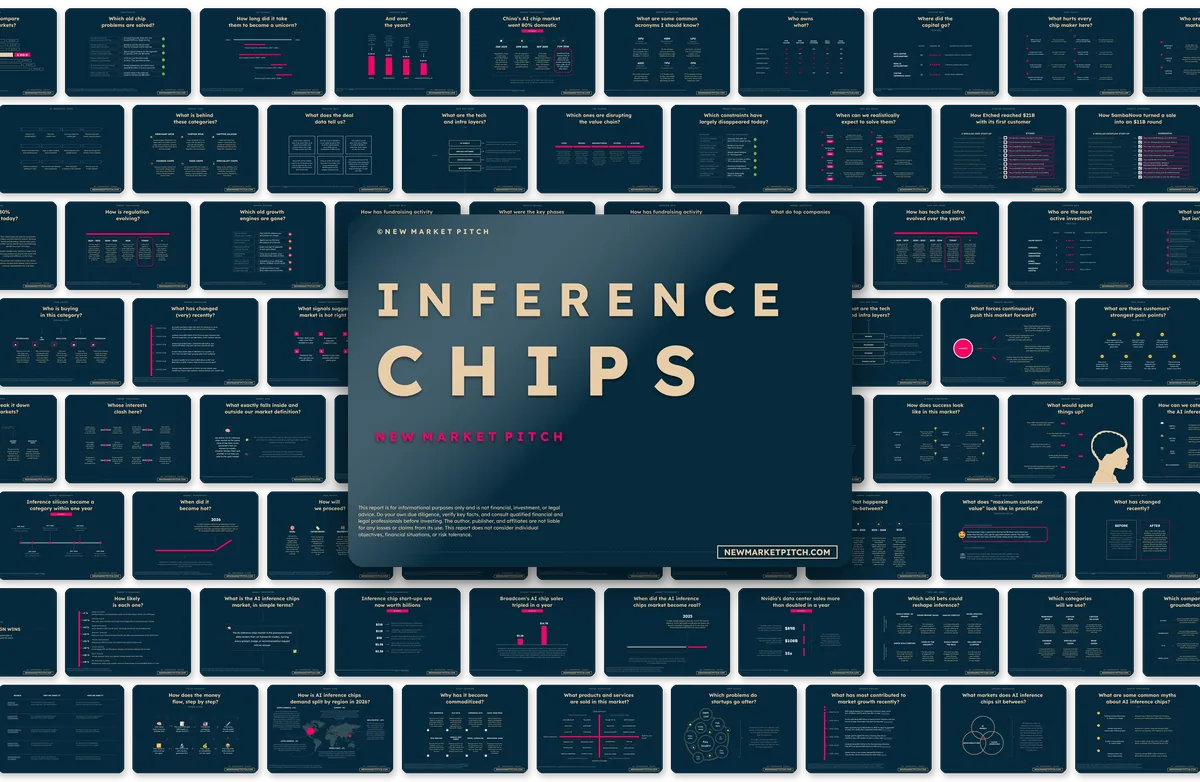
Whether you're building or investing in the AI inference chip market, our report covers everything you need to know: the players, the money, and what's coming next.
Summary
Groq is the fastest-growing private AI inference chip startup by demonstrated platform adoption as of October 2026. Its developer base has grown more than sixfold since March 2025, although Cerebras has stronger evidence of actual revenue growth.
Groq surpassed six million developers in August 2026, up from one million seventeen months earlier. It also operates 13 data centers and processes trillions of AI tokens weekly, putting it well ahead of most private competitors in publicly reported platform adoption.
The catch is that six million developers don't necessarily mean six million paying customers. Groq hasn't disclosed comparable revenue figures, so its adoption lead doesn't establish that it has the fastest-growing commercial business.
Cerebras provides the clearest financial benchmark. Its first-half 2026 revenue increased 84% year over year, while second-quarter cloud and other services revenue jumped 281% to $126 million. However, Cerebras completed its IPO in 2026 and is no longer a private startup.
Cerebras's changing revenue mix is particularly revealing. Cloud services accounted for approximately 70% of second-quarter revenue, up from 32% a year earlier, while hardware revenue actually declined. The strongest growth is increasingly coming from selling computing capacity rather than individual machines.
Etched is the fastest-rising challenger by investor expectations. Its reported valuation reached $21 billion in August 2026, roughly doubling in a month, and it has disclosed more than $1 billion in customer contracts. But only its first commercial systems have begun reaching customers.
Positron AI offers a different kind of evidence: more than 50 Atlas racks being deployed at Oracle Cloud Infrastructure. Its valuation rose roughly 4.7 times in seven months to $5 billion, giving it both substantial financial backing and a named infrastructure customer.
SambaNova's recovery is also worth watching. After a difficult period, it announced a $1 billion first close of new financing at an $11 billion valuation and secured relationships with SoftBank and JPMorganChase. d-Matrix and Tenstorrent are advancing too, but their commercial growth remains harder to measure.
Groq's $17 billion technology licensing arrangement with Nvidia adds an unusual twist. Nvidia acquired access to its inference technology and hired key employees without buying Groq's cloud business, which has continued expanding independently.
The next phase of competition will be decided by manufacturing capacity, installed systems and paying inference workloads. Etched's contracts and Positron's deployments could translate into enormous revenue without either company ever reaching Groq's developer count.
Our conclusion is that Groq leads private inference chip startups on visible adoption growth, Cerebras leads on verified financial evidence, and Etched leads on recent valuation momentum. No private competitor has yet disclosed enough comparable revenue data to establish an undisputed commercial growth winner.

Written by the New Market Pitch teamWe track new markets so founders and investors can move faster. About us

In our report covering the AI inference chip market, we turn what is vague and complex into simple, useful visuals. Market maps like this one show you at a glance where every startup stands.
Why are AI inference chip startups growing so fast right now?
AI inference chip startups are growing quickly because companies now need enormous amounts of computing power to run AI models, and Nvidia GPUs are no longer the only option attracting serious investment.
For years, much of the AI industry's attention went toward training increasingly powerful models. That business is still enormous, but inference has become a major spending priority as millions of people use AI assistants, coding tools and automated agents every day. Every response requires computing power, and more demanding applications can generate thousands of tokens during a single task.
The money flowing into inference chip startups shows how quickly investors have reacted. Groq announced $1 billion in financing across two rounds in June and August 2026. SambaNova announced more than $350 million in February and the first $1 billion close of another financing in July. Positron AI raised $230 million in February before announcing another $875 million in September. Etched secured $300 million in July and another $700 million in August.
Together, those four companies announced at least $4.15 billion in financing within roughly seven months. And that excludes Cerebras, Tenstorrent, d-Matrix and several smaller competitors.
What has changed is the type of customer these startups can reach. A company building AI coding agents may care more about how quickly a model generates its next response than about the theoretical peak performance of a GPU. Large cloud providers, meanwhile, are looking for ways to reduce the cost of serving millions of AI requests.
These needs have created room for specialized processors that would have struggled to compete with Nvidia in the earlier, training-focused AI market.
What does growing fastest actually mean for an AI inference chip startup?
The fastest-growing AI inference chip startup should be the one expanding its real business most quickly, although the available data forces us to distinguish revenue growth from developer adoption, chip shipments and customer contracts.
A company selling inference chips can grow through hardware sales, cloud services or licensing agreements. Those businesses have different economics, and their public announcements often measure different things.
Cerebras reported $510 million in revenue for 2025. Groq disclosed more than six million developers using its inference platform by August 2026. Etched announced over $1 billion in customer contracts while beginning commercial deliveries. Positron reported more than 50 racks being deployed at Oracle Cloud Infrastructure.
All four figures are impressive, but they measure different stages of business growth.
Revenue gives us the clearest picture of commercial activity that has already happened. Contracts show how much business a company expects to deliver. Deployed hardware tells us whether its technology is reaching customers. Developer accounts reveal how widely a platform is being adopted, although some of those accounts may generate little or no revenue.
For this comparison, we'll separate the fastest-growing private platform from the company with the strongest verified revenue growth. Otherwise, the ranking would reward whichever startup happens to publish the most eye-catching number.

Our research about AI inference chips gets updated several times a month, so you always get the latest view of where things stand.
Is Groq the fastest-growing AI inference chip startup today?
Groq currently has the strongest case for being the fastest-growing private AI inference chip platform, with developer adoption increasing more than sixfold between March 2025 and August 2026.
GroqCloud launched in March 2024 and reported more than 70,000 developers by April. At that early stage, Groq also reported 19,000 applications using its inference engine through the API.
By March 2025, the platform had reached one million developers. Groq then passed five million developers in June 2026 and six million in August.
That means its reported developer base expanded more than 85 times from April 2024 to August 2026. More importantly, Groq added at least five million developer accounts after reaching its first million.
We can see two different periods in that growth. The first year brought rapid adoption from a small starting base. The following seventeen months showed that Groq could keep attracting developers even after reaching a million accounts.
Using the disclosed milestones, the platform added an average of roughly 294,000 developer accounts per month between March 2025 and August 2026. That average doesn't mean growth occurred at a constant rate, but it gives us a sense of the scale involved.
Groq's expansion also extends beyond developer registrations. By August 2026, the company reported operating 13 data centers across North America, Europe, the Middle East and Asia-Pacific, with its infrastructure processing trillions of AI tokens weekly.
Those figures put Groq well beyond the prototype stage. Still, we cannot calculate its revenue growth because the company hasn't disclosed comparable financial results or how many of its registered developers are paying customers.
| GroqCloud milestone | Reported developers | What it shows |
|---|---|---|
| March 2024 | Platform launch | Public launch |
| April 2024 | 70,000+ | Early adoption |
| March 2025 | 1 million | First major milestone |
| June 2026 | 5 million+ | Broader developer reach |
| August 2026 | 6 million+ | Continued expansion |
| April 2024-August 2026 | More than 85x | Growth from early baseline |
| March 2025-August 2026 | More than 6x | Growth after reaching scale |
If you want more recent data on this point, please see our latest AI inference chip market report.
Is Cerebras growing faster than Groq?
Cerebras has much stronger evidence of revenue growth than Groq, with sales increasing more than twentyfold between 2022 and 2025 and cloud revenue accelerating sharply in 2026.
According to Cerebras's SEC filings, annual revenue increased from $24.6 million in 2022 to $78.7 million in 2023, $290.3 million in 2024 and $510 million in 2025.
That is a remarkable increase over three years. Annual growth slowed to approximately 76% in 2025, although the company was already operating from a much larger revenue base.
Growth picked up again during the first half of 2026. Cerebras reported $373.5 million in revenue, compared with $202.8 million during the same period in 2025, an increase of about 84%.
Its cloud business was growing even faster. Second-quarter cloud and other services revenue reached $126 million, up 281% year over year.
This gives Cerebras an advantage in our comparison: we have actual revenue figures rather than developer registrations or estimates of future demand.
There is one important difference, however. Cerebras completed its IPO in 2026, raising approximately $6.4 billion in gross proceeds. It is now a publicly listed company with financial resources that most private chip startups cannot match. Its August results also showed approximately $8.6 billion in cash, restricted cash, cash equivalents and short-term investments.
Cerebras therefore provides an excellent benchmark for commercial growth, but it falls outside a strict ranking of privately held startups.
And even within Cerebras, we need to be precise. Its revenue includes hardware and cloud services supporting different AI workloads, so the reported growth cannot be treated as entirely inference-specific.
| Cerebras metric | Earlier period | Latest comparable period | Growth |
|---|---|---|---|
| Annual revenue, 2022-2023 | $24.6M | $78.7M | +220% |
| Annual revenue, 2023-2024 | $78.7M | $290.3M | +269% |
| Annual revenue, 2024-2025 | $290.3M | $510.0M | +76% |
| First-half revenue, 2025-2026 | $202.8M | $373.5M | +84% |
| Q2 total revenue, 2025-2026 | $103.3M | $180.1M | +74% |
| Q2 cloud revenue, 2025-2026 | $33.0M | $126.0M | +281% |
| Q2 core cloud revenue, 2025-2026 | Approx. $33.0M | $127.7M | +287% |

In our market report about AI inference chips, we look at what the winners do differently, so you can learn from the best instead of guessing.
Is Cerebras becoming mostly an AI inference company?
Cerebras is increasingly becoming a cloud computing business, with cloud and other services accounting for approximately 70% of second-quarter 2026 revenue, compared with roughly 32% one year earlier.
That change is especially interesting because hardware revenue actually declined during the period.
In the second quarter of 2025, Cerebras generated $70.3 million from hardware and $33 million from cloud and other services. One year later, hardware revenue had fallen to $54.1 million, while cloud revenue had increased to $126 million.
The cloud business added $93 million in quarterly revenue, more than offsetting the $16.2 million decline in hardware sales.
Cerebras is now making far more money from operating computing infrastructure for customers than it did a year earlier. Its business is also becoming less dependent on individual hardware deliveries, which can fluctuate substantially between quarters.
The company's relationships with OpenAI, AWS, AMD, Cognition and Lovable help explain why demand for its computing services is growing. These customers operate AI products or infrastructure where inference speed and available capacity have direct commercial value.
We should still avoid treating all cloud revenue as inference revenue. Cerebras doesn't disclose a clean inference-only figure. But the shift toward cloud services is one of the strongest measurable changes among companies developing AI accelerators.
Is Etched actually growing faster than Groq?
Etched is growing faster than Groq in valuation and reported customer commitments, but Groq has a much longer record of operating a large inference platform.
Etched is developing specialized processors for transformer-based AI models. Its approach is more focused than that of general-purpose GPU providers, and investors have put extraordinary amounts of money behind the company.
In June 2026, Etched disclosed more than $1 billion in customer contracts while validating its first rack-scale inference systems.
The following month, it raised $300 million at a $10.3 billion valuation. Reuters then reported that an additional $700 million round in August valued Etched at $21 billion.
Its valuation roughly doubled in a month. Compared with the $5 billion valuation reported for an earlier financing, the August figure was approximately 4.2 times higher.
Etched has also made real manufacturing progress. Its first-generation chips were successfully manufactured at TSMC, and the company started testing systems with customers. Jane Street became its first publicly named customer, receiving a rack in July.
But the commercial record is still young. Etched hasn't disclosed how much of its $1 billion order book has turned into recognized revenue, how many systems have been fully deployed or what margins those systems generate.
A $21 billion valuation tells us investors expect enormous future growth. Groq, meanwhile, has already built a platform used by millions of developers across multiple regions.
For now, Etched looks like the fastest-rising challenger in terms of investor expectations rather than the fastest-growing proven operating business.
If you want more recent data on this point, please see our latest AI inference chip market report.

In our document detailing everything you need to know about AI inference chip, you will always find fresh funding data, taken straight from our own verified funding database.
Could Positron AI be growing even faster than Groq?
Positron AI is one of the fastest-rising inference chip startups by valuation, and its large Oracle deployment gives it more commercial substance than many early-stage competitors.
The company's valuation increased from approximately $1.06 billion in February 2026 to $5 billion in September, according to Reuters, PitchBook data and Positron's financing announcements.
That represents an increase of about 4.7 times in seven months, or roughly 372%.
Positron raised $230 million in February and another $875 million in September. The second financing was particularly large for a company still developing its next generation of inference hardware.
More interestingly, Positron announced that Oracle Cloud Infrastructure was deploying more than 50 racks of its first-generation Atlas systems.
That gives us a concrete example of a major infrastructure customer using the company's technology. It also distinguishes Positron from chip startups whose commercial announcements are mostly future commitments.
Its next-generation Asimov processor, designed to improve memory capacity and bandwidth for AI inference, is targeted for production in the second half of 2027.
We still lack revenue figures, historical shipment volumes and utilization data. Those missing numbers make it impossible to calculate how quickly Positron's operating business is growing.
Nevertheless, Positron deserves serious attention. Its combination of a major named customer, substantial deployment plans and rapidly increasing financing makes it one of Groq's most credible emerging competitors.
Is SambaNova finally making a comeback?
SambaNova is making a serious comeback in AI inference chips after several difficult years, helped by new processors, large financing rounds and major enterprise customers.
The company's history makes its latest announcements more interesting than a normal startup funding story.
SambaNova reached a valuation of approximately $5.1 billion in 2021, during the first major wave of investment in alternative AI accelerators. By 2025, reports suggested it was exploring a potential sale at a much lower valuation.
Then its position changed.
In February 2026, SambaNova introduced its SN50 processor alongside more than $350 million in strategic financing. SoftBank Corp. was announced as the first customer expected to deploy SN50 in its next-generation Japanese AI data centers.
In July, SambaNova announced the first $1 billion close of its Series F financing at an $11 billion post-money valuation.
It also named JPMorganChase as a customer choosing its reconfigurable dataflow processors for on-premises inference.
These developments show that SambaNova has managed to attract fresh capital and large customers after a period when its future appeared much less certain.
Still, the company hasn't released enough information about revenue, deployed processor counts or inference workload growth to rank it ahead of Groq.
SambaNova has recovered considerable ground. Whether that recovery turns into one of the industry's fastest-growing businesses depends on how quickly its new enterprise relationships translate into sales.

Learning from others' mistakes is the cheapest lesson there is. In our report covering the AI inference chip market, we look at what broke startups before you, so you don't repeat it.
Is d-Matrix starting to catch up with Groq and Cerebras?
d-Matrix is moving into commercial manufacturing, but it hasn't yet shown the revenue or deployment growth needed to challenge Groq and Cerebras.
The startup raised $275 million in November 2025 at a $2 billion valuation, bringing its total financing to approximately $450 million.
Its Corsair inference platform entered full production in June 2026, with the company preparing shipments to hyperscalers, neocloud providers and frontier AI laboratories.
That is a major milestone for a chip startup. Designing and testing a processor is one challenge; manufacturing and delivering it reliably is another.
d-Matrix is also pursuing a somewhat different strategy from Groq. Its technology is designed to improve inference performance in computing environments that combine specialized accelerators with conventional GPU infrastructure.
This could make adoption easier for customers that already operate large Nvidia-based systems and want to accelerate particular workloads without replacing their entire infrastructure.
But the publicly available data remains limited. We don't have a multiyear revenue series, an equivalent of Groq's developer figures or a clearly quantified order book comparable with Etched's.
Corsair's production launch puts d-Matrix in the commercial race. The next test is how many working systems actually reach customers.
Is Tenstorrent becoming a major AI inference chip competitor?
Tenstorrent is becoming a serious AI computing competitor, backed by a new $1.5 billion financing round, although its business extends well beyond inference chips.
On October 19, 2026, the company announced a $1.5 billion Series E financing at a $6.2 billion post-money valuation.
The financing is intended to accelerate manufacturing, global expansion and deployment of its Galaxy server systems.
Tenstorrent is unusual because it sells several types of products. Alongside accelerator cards, workstations, racks and computing clusters, it also licenses processor technology to companies developing their own chips.
That gives it more potential ways to generate revenue than companies focused entirely on selling inference capacity through cloud APIs.
For customers, Tenstorrent's appeal includes hardware flexibility and an alternative processor ecosystem. For investors, its licensing business creates opportunities that don't depend entirely on operating its own data centers.
The problem for our ranking is that Tenstorrent doesn't disclose comparable inference revenue growth, chip shipment volumes or developer adoption.
Its latest financing provides substantial resources for expansion, and the company could become a major competitor. But its current commercial growth is less visible than Groq's platform adoption or Cerebras's financial results.

Your time is limited. In our research about AI inference chips, we put numbers on each part of the market, so you can see where it makes sense to focus.
Which AI inference chip startup is attracting the most money?
Etched, Tenstorrent and Positron have attracted some of the largest recent private financings in AI inference hardware, while Groq and SambaNova have also secured major capital commitments.
The most striking example is Etched. Its reported valuation reached $21 billion in August 2026, despite the company only recently beginning commercial system deliveries.
Tenstorrent announced a $1.5 billion financing in October, one of the largest recent private rounds in the sector. Positron secured $875 million in September, while SambaNova announced the first $1 billion close of its latest financing in July.
These transactions show investors are increasingly willing to finance chip manufacturing and infrastructure deployment on an enormous scale.
They also reveal how differently companies are being valued. Etched's reported $21 billion valuation is more than four times Positron's $5 billion valuation, even though both are still working to expand commercial deployments.
Funding alone gives us little information about which company has the fastest-growing revenue. But the amounts are important because designing chips, manufacturing them and deploying entire racks of computing infrastructure can require hundreds of millions of dollars before a company reaches significant sales.
| Company | Major recent financing | Reported valuation | Commercial evidence |
|---|---|---|---|
| Etched | $700M, Aug. 2026 | $21B | $1B+ customer contracts |
| SambaNova | $1B first close, Jul. 2026 | $11B | Named enterprise customers |
| Tenstorrent | $1.5B, Oct. 2026 | $6.2B | Galaxy expansion plans |
| Positron AI | $875M, Sep. 2026 | $5B | 50+ racks deploying at Oracle |
| Groq | $350M, Aug. 2026 | $3.5B | 6M+ developers |
| d-Matrix | $275M, Nov. 2025 | $2B | Corsair entered production |
| Cerebras | $6.4B IPO proceeds, 2026 | Public-market valuation | $510M revenue in 2025 |
If you want more recent data on this point, please see our latest AI inference chip market report.
Did Groq's Nvidia agreement change its growth prospects?
Groq's agreement with Nvidia changed its business considerably, but the company has continued expanding its inference cloud since the transaction.
In December 2025, Groq announced a non-exclusive licensing agreement covering its inference technology.
Founder Jonathan Ross, president Sunny Madra and several other employees joined Nvidia. Groq remained an independent company under new leadership.
Nvidia's fiscal 2026 annual report disclosed approximately $17 billion in total consideration associated with the licensing arrangement and related employee transfer. Nvidia also stated that it had not acquired Groq's customer contracts, existing products or equity.
That distinction is important for understanding what happened. Nvidia secured access to valuable inference technology and engineering talent, while Groq continued operating a separate cloud business.
Groq's subsequent financing and infrastructure announcements suggest that investors still see considerable value in that independent operation.
The company announced another $1 billion in financing across June and August 2026 and reported an expanding global network of inference data centers.
The agreement may also create advantages for Groq as it develops its cloud business around Nvidia technology. However, we don't have enough information to measure how much of its subsequent growth came specifically from the agreement.
Groq's business has changed significantly. Comparing its current operations with its original chip strategy requires some care, particularly when evaluating long-term customer growth and revenue.

In our market report about AI inference chips, we always try to gather several sources and make estimates that make sense, so you can work with solid numbers.
Are AI inference chip startups actually shipping hardware at scale?
Several AI inference chip startups are now delivering commercial systems, but Cerebras, Groq, Positron and Etched report their deployment progress in very different ways.
Groq reported operating 13 data centers by August 2026. Positron identified a deployment of more than 50 Atlas racks at Oracle Cloud Infrastructure. Etched began delivering its first systems in 2026, including a rack to Jane Street. d-Matrix announced that Corsair had entered full production.
Cerebras provides another measure of scale, reporting more than 600 megawatts of data center capacity live and under contract for delivery by the end of 2027.
We cannot simply rank those numbers from largest to smallest. A data center can house very different quantities of computing equipment. The number of racks tells us more about physical deployment, but rack capacity varies between systems. Contracted megawatts include infrastructure that may still be under construction.
The available figures nevertheless show how far the sector has progressed.
Groq already operates a geographically distributed inference service. Positron has a substantial deployment with a named hyperscale customer. Etched and d-Matrix are moving through the first stages of manufacturing and commercial delivery.
These businesses are at different stages of scale, which helps explain why Groq currently has a stronger operating track record than some of its newer competitors.
Are Groq's six million developers actually generating revenue?
Groq's six million developer accounts show enormous interest in its inference platform, but the company hasn't disclosed how much money those developers generate.
This is the biggest weakness in Groq's claim to being the fastest-growing private inference chip startup.
GroqCloud offers developers access to fast model inference through APIs, making it relatively easy to experiment with the platform. Registered accounts can therefore grow much faster than paying customers.
Groq has also reported processing trillions of AI tokens weekly, which suggests substantial activity beyond people simply creating accounts.
But that figure still leaves several important questions unanswered. We don't know exactly how many tokens are processed by paying customers, what those customers pay on average or how much revenue comes from large enterprise contracts.
The comparison with Cerebras is revealing. Cerebras reported $126 million in second-quarter 2026 cloud and other services revenue. Groq hasn't published an equivalent quarterly figure.
That doesn't mean Groq is generating less revenue. We simply cannot establish the comparison from public information.
To confirm whether Groq leads private inference chip startups in commercial growth, we would need comparable quarterly revenue, paying customer counts or recurring cloud consumption figures.
For now, Groq's developer growth is impressive enough to put it ahead on adoption, but we cannot assign it the revenue crown.
If you want more recent data on this point, please see our latest AI inference chip market report.

If you build or invest in the AI inference chip market, you need to know which business models pay off now and which ones are fading. That's why our report covering it has a whole section on it.
Could manufacturing slow down the fastest-growing AI inference chip startups?
Manufacturing could become one of the biggest limits on growth for AI inference chip startups, especially as Etched, Positron and d-Matrix move from early hardware deliveries toward larger deployments.
Cerebras offers a useful example of the scale required. In its August 2026 results, the company described plans to increase manufacturing capacity by more than tenfold during the year, supported by additional contract manufacturing lines and greater wafer supply.
Etched has opened manufacturing and prototyping facilities in Taiwan and San Jose as it prepares to deliver more of its specialized inference systems.
Positron's September financing is partly intended to support its next-generation Asimov processor and Titan systems. d-Matrix, meanwhile, has moved Corsair into full production.
All these companies face the same basic challenge: customers may want the chips, but orders only become revenue once working systems are produced and delivered.
Manufacturing is particularly difficult for smaller companies because they must commit substantial money to production before knowing exactly how quickly customers will deploy the hardware.
Groq faces a related problem through its cloud business. Expanding inference capacity requires data center infrastructure, power, networking equipment and ongoing operational spending.
A company with strong demand but delayed deliveries could lose ground quickly to a competitor that installs and operates new capacity faster. The growth race is going to depend increasingly on execution.
Can Groq keep growing faster than Etched, Positron and SambaNova?
Groq has a strong head start in developer adoption, but Etched, Positron and SambaNova are building businesses that could grow just as quickly without attracting millions of individual developers.
The difference comes down to who buys their products.
GroqCloud reaches developers directly through an inference API. That allows its customer base to expand quickly across startups, independent developers and enterprises.
Etched is pursuing large infrastructure customers with specialized transformer inference systems. Positron is working with cloud providers such as Oracle, while SambaNova has announced relationships with SoftBank and JPMorganChase.
A single large infrastructure contract can generate substantial revenue without producing anything like Groq's developer-account figures.
This means Groq's lead in users may not translate into a lead in hardware shipments or revenue. Etched's billion-dollar order book and Positron's Oracle deployment are good examples of how competitors can scale through much smaller numbers of very large customers.
Groq's advantage is that it already has a widely used platform and a global infrastructure footprint. Its developer adoption has continued increasing even after the Nvidia licensing agreement changed the business.
The next question is whether those developers become a large base of paying customers. If they do, Groq could build a particularly valuable recurring cloud business. If enterprise-focused competitors generate more revenue from fewer customers, the commercial ranking could look very different.

Theory only gets you so far. In our report covering the AI inference chip market, we dig up the real signals from the field and show you the ones worth watching.
Which AI inference chip startup is growing the fastest right now?
Groq is currently our top choice for the fastest-growing private AI inference chip startup by demonstrated platform adoption, while Cerebras has the strongest verified revenue growth and Etched has experienced the most dramatic reported valuation increase among the leading contenders.
Groq's developer base expanded more than sixfold between March 2025 and August 2026, reaching over six million accounts. The company also operates 13 data centers and reports processing trillions of AI tokens weekly.
That combination gives Groq a stronger documented record of large-scale platform adoption than most private competitors.
Cerebras offers a more convincing case if we focus strictly on financial growth. Its first-half 2026 revenue increased approximately 84% year over year, while second-quarter cloud and other services revenue climbed 281%. However, Cerebras is now publicly listed.
Etched deserves attention for a different reason. Its reported valuation reached $21 billion after the company disclosed more than $1 billion in customer contracts. Positron has also grown remarkably quickly in valuation, reaching $5 billion while deploying systems at Oracle. Both could become much larger commercial competitors as hardware deliveries increase.
SambaNova is recovering strongly, while Tenstorrent and d-Matrix have secured the financing or manufacturing progress needed to compete more seriously.
Our final judgment is that Groq currently leads the private-company comparison on visible adoption growth, but the evidence doesn't justify calling it the fastest-growing by revenue. Cerebras is the stronger documented commercial grower, and the remaining private companies disclose too little comparable financial data to establish an undisputed revenue winner.
The next few quarters of revenue, chip deliveries and paid inference consumption should make this race much easier to judge. For now, Groq has the clearest adoption lead, while the financial competition remains open.
If you want more recent data on this point, please see our latest AI inference chip market report.
Our methodology
This analysis identifies the fastest-growing AI inference chip startup using the evidence available as of October 2026. We compared Groq, Cerebras, Etched, Positron AI, SambaNova, d-Matrix and Tenstorrent across reported revenue growth, developer adoption, customer contracts, deployed infrastructure, manufacturing progress, financing and valuation changes.
We used actual reported revenue as the strongest measure of commercial growth, followed by operating metrics that could be compared across multiple periods. Developer registrations, contracted orders, installed racks and data center capacity were assessed separately because they measure different aspects of growth. Financing and valuation changes were used to evaluate investor expectations rather than as substitutes for revenue.
We calculated growth rates from disclosed historical figures wherever possible. Groq's developer growth was measured from its April 2024, March 2025, June 2026 and August 2026 milestones. Cerebras's revenue growth was calculated from its annual SEC disclosures and second-quarter 2026 financial statements. Etched's and Positron's valuation increases were compared against their reported earlier financing valuations. We distinguished contracted capacity from operational infrastructure and announced customer commitments from recognized revenue.
We also separated publicly traded companies from privately held startups. Cerebras was included as a commercial benchmark because it provides regulated financial reporting, but it was excluded from the final private-company ranking following its 2026 IPO. Groq's adoption figures and other companies' deployment milestones are treated as company-reported operating metrics, rather than independently audited customer or revenue figures.
The research prioritized company announcements, SEC filings, customer disclosures and Reuters reporting. These sources establish concrete milestones and allow comparisons across periods, although not every company publishes the same financial or operational measures.
Key sources for Groq include Groq's April 2024 developer adoption announcement, its March 2025 one-million-developer milestone, its June 2026 financing and infrastructure update, its August 2026 six-million-developer announcement, and its Nvidia licensing announcement. The approximately $17 billion transaction consideration is documented in Nvidia's fiscal 2026 Form 10-K.
For Cerebras, the principal financial sources are its May 2026 SEC registration statement, its second-quarter 2026 results, its June 2026 Form 10-Q, and its IPO completion filing.
For Etched and Positron AI, we used Etched's first commercial delivery and financing update, Reuters reporting on Etched's valuation and customer contracts, Positron's company milestones and Oracle deployment information, Positron's September 2026 financing announcement, and Reuters reporting on Positron's valuation growth.
Other sources include SambaNova's SN50 launch and February 2026 financing announcement, its July 2026 Series F announcement, d-Matrix's Series C announcement, its Corsair production update, and Tenstorrent's October 2026 Series E financing announcement.

In our research about AI inference chips, we don't want to repeat what boring consulting reports say. Instead, we show you the real and latest market signals that matter.
Written by the New Market Pitch teamWe track new markets so founders and investors can move faster. About us