
AI inference chips: what are the biggest unsolved problems?
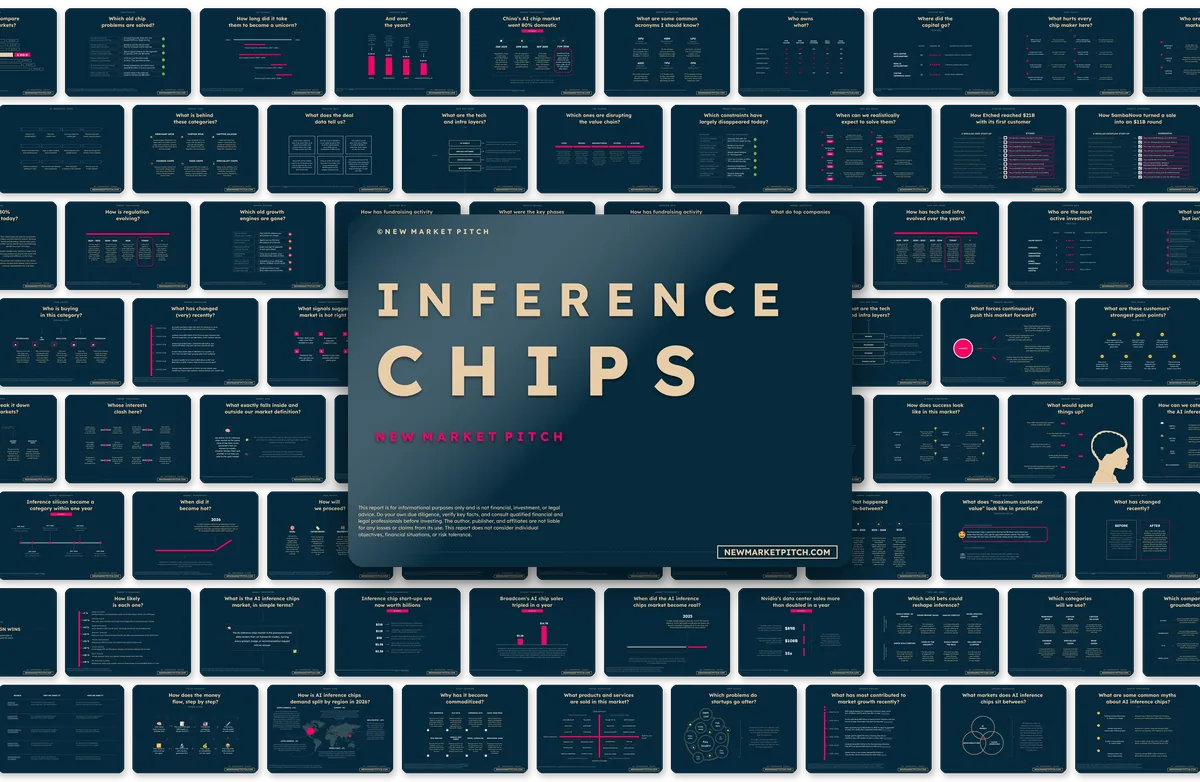
Whether you're building or investing in the AI inference chip market, our report covers everything you need to know: the players, the money, and what's coming next.
Summary
The biggest unsolved problems in AI inference chips are memory bandwidth, the cost of completing real AI tasks, long-context memory consumption, unpredictable latency, and power consumption. Memory movement and real-world operating economics remain the two most fundamental constraints, even as processors become dramatically faster.
Computing power is advancing faster than the memory systems feeding it. Google's Ironwood TPU offers roughly five times the BF16 computing capacity of TPU v5p but only 2.67 times the memory bandwidth, illustrating why faster processors can still spend valuable time waiting for data.
Long conversations create a second memory problem that raw processing speed cannot solve. Under one conventional transformer configuration, a single 128,000-token conversation needs roughly 42 GB of KV-cache memory, and 100 simultaneous conversations can require more than 4 TB before optimization.
Specialized processors offer impressive speed, but combining them introduces new bottlenecks. NVIDIA's decision to pair Vera Rubin GPUs with Groq-derived inference processors shows the appeal of dividing workloads across architectures, while making communication and synchronization increasingly important.
AI agents are making latency harder to manage. A processor can deliver excellent tokens-per-second performance while individual users experience frustrating delays because their requests compete with long prompts, reasoning workloads, and repeated model calls.
The economics are less straightforward than benchmark results suggest. A chip generating four times as many tokens may deliver little actual cost advantage if utilization is poor, hardware is expensive, or the application requires extensive reasoning and repeated processing.
Energy efficiency is improving, but total electricity demand continues to rise. Research estimates a representative inference query at roughly 0.31 Wh, yet long reasoning tasks can consume substantially more, while the IEA projects data-center electricity consumption approaching 950 TWh by 2030.
Memory supply is becoming a strategic constraint. HBM production depends on relatively few manufacturers, and new fabrication capacity can take years to build, leaving even promising chip designs exposed to shortages and rising component costs.
Lower precision and mixture-of-experts models help reduce computation, but neither eliminates the underlying trade-offs. Four-bit quantization can affect accuracy, while expert routing introduces memory, networking, and load-balancing problems that peak FLOPS figures rarely capture.
The likely winners will be determined by software maturity, production scalability, and the economics of finished AI tasks rather than token-generation records alone. Specialized chips can beat GPUs on particular workloads, but no single architecture has demonstrated superiority across the entire inference market.

Written by the New Market Pitch teamWe track new markets so founders and investors can move faster. About us
Why are AI inference chips still struggling when they're getting so much faster?
AI inference chips are improving incredibly fast, but memory, latency, power consumption, and operating costs are still holding them back. In fact, some of these problems are getting harder as AI models become more capable.
The latest MLPerf Inference results show how strange the situation has become. In September 2026, MLCommons reported a 5.7-fold improvement in the best per-accelerator DeepSeek-R1 server result compared with the previous year. Its visual-language-model benchmark improved 2.99-fold in just six months.
Yet the same benchmark release introduced new tests for AI agents and end-to-end retrieval-augmented generation. The workloads were changing so quickly that the existing benchmarks could no longer capture everything companies wanted their chips to do.
NVIDIA's Vera Rubin platform shows where the industry is heading. It combines GPUs with specialized Groq inference processors, assigning different parts of an AI workload to different hardware. Even NVIDIA, which dominates the GPU ecosystem, sees an advantage in using processors built specifically for certain inference tasks.
Is memory bandwidth now a bigger problem than computing power for AI inference?
Memory bandwidth is now one of the biggest obstacles to faster AI inference. Many powerful accelerators can perform calculations much faster than they can retrieve the data needed to perform them.
The difference becomes clearer when we look at how a language model generates a response. First, it processes the user's prompt in a stage called prefill. This involves many calculations that can run in parallel. Then it generates the response token by token, repeatedly accessing model weights and previously calculated information.
That second stage, called decoding, is often limited by memory bandwidth, particularly when serving relatively few requests at once. NVIDIA explained this distinction in a technical analysis published in July 2026.
Google's Ironwood TPU is a good example of how quickly hardware manufacturers are improving memory performance. According to Google's published specifications, Ironwood provides 7.38 TB/s of high-bandwidth memory throughput per chip, compared with 2.765 TB/s for TPU v5p. That's approximately 2.67 times more bandwidth.
Over the same generations, peak BF16 computing capacity increased from 459 to 2,307 TFLOPS, roughly fivefold. Despite the architectural differences between the chips, the comparison reveals something important: computing capacity is still growing faster than memory bandwidth.
Google's own TPU7x documentation acknowledges that high-bandwidth memory can remain a bottleneck, especially for inefficient data-access patterns.
If you want more recent data on this point, please see our latest AI inference chip market report.

A good product starts with a real problem. In our report covering the AI inference chip market, we show you the ones customers still live with.
Why can't AI inference chips fit large models and long conversations into memory?
Even today's most advanced AI inference chips struggle to hold the largest models and their conversation histories entirely in fast memory. Model weights alone can occupy hundreds of gigabytes, while long conversations add substantial memory requirements.
A dense language model containing 70 billion parameters requires approximately 140 GB of storage at 16-bit precision. At 8-bit precision, that falls to 70 GB, and at 4-bit precision, to around 35 GB before additional quantization overhead.
For a hypothetical dense 400-billion-parameter model, raw weights would occupy approximately 800 GB at 16-bit precision or 200 GB at 4-bit precision.
Google has made major progress here. Its Ironwood TPU provides 192 GiB of HBM per chip, compared with 32 GiB on Trillium, the previous generation. That's a sixfold increase.
Groq's SRAM-based architecture takes a different route. NVIDIA's Groq 3 LPX system combines 256 processors with 128 GB of aggregate on-chip SRAM, offering extremely high bandwidth but far less storage capacity than a large collection of HBM-equipped GPUs.
The approaches come with different compromises. HBM provides substantial capacity and bandwidth, while SRAM can deliver much faster access but is expensive in silicon area and difficult to scale to enormous capacities.
Long conversations add another problem: the key-value cache, or KV cache. This stores information from previous tokens so the model can continue generating responses without recalculating everything from the beginning.
Consider a conventional transformer with 80 layers, eight key-value heads, and a head dimension of 128. A conversation containing 128,000 tokens requires roughly 42 GB of KV-cache memory at 16-bit precision.
Extend that conversation to one million tokens under the same assumptions, and the requirement grows to approximately 328 GB.
For 100 separate conversations containing 128,000 tokens each, the theoretical total exceeds 4 TB before compression or shared-cache optimizations. And that's just the cache. These are illustrative calculations for a particular architecture, rather than universal requirements for every language model.
The original vLLM PagedAttention research, published in 2023, reported twofold to fourfold higher throughput than the serving systems it compared against by making memory management more efficient.
Since then, developers have added techniques such as prefix caching, sliding-window attention, sparse attention, and KV-cache quantization. These improvements reduce memory pressure, although long conversations involving thousands of simultaneous users remain expensive to serve.
Why is splitting AI inference between different chips so difficult?
Splitting AI inference between specialized processors can make models much faster, but moving information between those processors remains a difficult engineering problem.
Different parts of inference need different hardware capabilities. Prefill benefits from strong parallel computing performance. Decoding often depends heavily on memory access. Attention processing, feed-forward networks, and mixture-of-experts routing can also have different requirements.
NVIDIA's Groq 3 LPX architecture is one of the clearest examples of this approach. The company pairs Vera Rubin GPUs with 256 specialized Groq processors. GPUs handle prefill and attention-related operations, while Groq processors accelerate latency-sensitive parts of decoding, including feed-forward and expert-network execution.
According to NVIDIA's March 2026 technical specifications, the LPX system provides approximately 40 PB/s of aggregate on-chip SRAM bandwidth and 640 TB/s of scale-up communication bandwidth.
Cerebras and AWS have pursued another arrangement, combining Cerebras systems with Trainium accelerators to handle different stages of inference.
The challenge is keeping data transfers and synchronization from eating into the performance gains. When processors must constantly wait for one another, the theoretical advantage of specialization shrinks.

If you build or invest in the AI inference chip market, you need to know which business models pay off now and which ones are fading. That's why our report covering it has a whole section on it.
Why do AI inference chips slow down when too many users and AI agents connect?
AI inference chips can process huge amounts of work, but response times become harder to predict when many users and autonomous AI agents compete for the same hardware.
The problem comes partly from batching. Instead of running every request separately, inference servers group multiple requests together. This improves hardware utilization because model weights and computing resources can be shared across more operations.
But larger batches can increase waiting time, particularly when requests have different lengths or computational requirements.
Imagine an AI coding assistant serving someone who needs an immediate answer while the same accelerator processes dozens of lengthy document-analysis jobs. The hardware might achieve excellent overall throughput while the coding assistant feels frustratingly slow.
AI agents make scheduling even harder. A coding agent can inspect files, search documentation, execute tools, evaluate results, and call a language model repeatedly before completing one task.
Some requests involve long prompts and short responses. Others require substantial reasoning or fast interaction with external tools. The same agent may also need to preserve a large amount of context between steps.
MLPerf separates offline throughput, server performance, and interactive scenarios for this reason. Its September 2026 benchmark round also introduced an agentic edge benchmark involving multi-turn coding tasks and accuracy requirements.
The release updated its GPT-OSS-120B interactive scenario to support speculative decoding, a technique that accelerates generation by predicting and verifying multiple tokens.
In August 2026, NVIDIA reported that Artificial Analysis measured a median generation speed of 3,431 output tokens per second on Groq 3 LPX for Gemma 4 31B with a 100,000-token context. That's an impressive workload-specific result, although it excludes the tool execution, networking, and other delays involved in completing an entire agent task.
For interactive applications, companies increasingly need to monitor tail latency, particularly the slowest 1% of requests, alongside the total number of tokens their hardware can produce.
Can AI inference chips actually make AI much cheaper?
AI inference chips can make AI considerably cheaper, but the savings depend heavily on how much useful work each system completes under real operating conditions.
A chip generating four times as many tokens does not necessarily reduce costs by 75%. Its purchase price, electricity consumption, memory requirements, networking, software, and utilization all affect the calculation.
Consider two hypothetical systems costing $20 per hour to operate. The first produces 100,000 usable output tokens per hour, while the second produces 400,000.
The first costs $200 per million output tokens. The second costs $50, giving it a fourfold economic advantage.
Now imagine the faster system is only 25% utilized because customer demand is unpredictable. Its effective output falls to 100,000 tokens per hour, eliminating the advantage in our simplified example.
Real deployments introduce more variables. Input tokens and output tokens have different costs. Cached prompts can reduce repeated work. Reasoning models may generate thousands of internal tokens before producing a relatively short answer.
NVIDIA has claimed that combining Vera Rubin with Groq 3 LPX could deliver up to 35 times more inference throughput per megawatt than GB200 NVL72 for certain trillion-parameter workloads. That's an impressive vendor-reported result, but it concerns a specific operating point and cannot be applied to every model.
| Metric | What it tells us | What it misses |
|---|---|---|
| Peak FLOPS | Maximum computing capacity | Memory delays and utilization |
| Memory bandwidth | How quickly data can move | Whether the software uses it efficiently |
| Tokens per second | Generation speed | Electricity and hardware costs |
| Time to first token | How quickly a response begins | Speed of the remaining response |
| Inter-token latency | How smoothly tokens appear | Total server throughput |
| Tokens per joule | Energy efficiency | Hardware purchase costs |
| Tokens per dollar | Cost efficiency | Differences in model quality |
| P99 latency | Response time for the slowest 1% of requests | Average serving economics |
If you want more recent data on this point, please see our latest AI inference chip market report.

Learning from others' mistakes is the cheapest lesson there is. In our market report about AI inference chips, we look at what broke startups before you, so you don't repeat it.
Is electricity becoming a bigger problem for AI inference chips?
Electricity is becoming a bigger constraint for AI inference infrastructure, even though individual AI queries are getting more energy-efficient.
A study published in Joule in April 2026 estimated that a representative frontier-scale inference query consumed around 0.31 Wh under realistic large-scale deployment assumptions. That was four to twenty times lower than several widely circulated estimates.
However, the same researchers found that reasoning queries generating approximately 5,000 output tokens could consume around thirteen times more energy than standard queries.
Their calculations also showed that if just 10% of daily requests involved long reasoning, total energy use could more than double in the modeled deployment.
The International Energy Agency's updated outlook provides the bigger picture. It estimates that data-center electricity consumption could rise from approximately 485 TWh in 2025 to 950 TWh by 2030. Electricity consumption from AI-focused data centers is expected to triple over that period.
These projections cover entire facilities, including training and other computing activities, rather than inference chips alone.
Cooling makes the situation harder. A rack-scale system containing dozens or hundreds of high-performance processors needs substantial power delivery and heat removal. Liquid cooling is increasingly important for dense configurations such as NVIDIA's Vera Rubin NVL72.
Are memory-chip shortages threatening the growth of AI inference?
Memory shortages are becoming a serious threat to AI inference hardware production, especially for accelerators relying on advanced high-bandwidth memory.
HBM is supplied by a relatively small group of manufacturers, including SK hynix, Samsung, and Micron. Building more capacity requires substantial investment, specialized equipment, and lengthy manufacturing qualification.
In July 2026, SK hynix CEO Kwak Noh-jung told Reuters that 2027 could bring the worst memory supply shortage in the industry's history. He also expected customer demand to exceed available supply beyond 2030.
That's a particularly important warning because SK hynix is one of the companies supplying advanced memory for AI accelerators.
The pressure is understandable when we look at hardware evolution. Google's Ironwood has 192 GiB of HBM per chip, twice the capacity of TPU v5p and six times that of Trillium. Large GPU systems also use substantial amounts of advanced memory.
Meanwhile, the Center for Strategic and International Studies noted in a September 2026 analysis that new DRAM fabrication facilities typically require two to three years or longer to construct, qualify, and ramp.
AI demand can increase within a few months, but semiconductor manufacturing capacity cannot respond nearly as quickly. The shortage may favor established manufacturers that can secure long-term supply agreements and reserve advanced packaging capacity.

When you build or invest in the AI inference chip market, you need clarity, not confusion. In our document detailing everything you need to know about AI inference chip, we always try to put numbers on and quantify whatever is usually vague and confusing.
Can AI inference chips use 4-bit precision without making models worse?
Four-bit inference is one of the most promising ways to make AI chips faster and cheaper, but preserving model accuracy remains a problem for certain architectures and workloads.
The potential savings are substantial. Moving from 16-bit weights to 4-bit weights reduces raw model-weight storage by approximately 75%.
A 70-billion-parameter dense model would theoretically shrink from 140 GB of weights to 35 GB, excluding quantization metadata and other memory requirements.
Lower precision can also improve computing throughput when the hardware supports efficient four-bit operations.
The difficulty is that quantization changes the numerical values used by the model. Small errors may have little effect on straightforward text generation but become more noticeable in coding, mathematical reasoning, scientific tasks, or sensitive model layers.
Research presented at ICLR 2026 examined limitations of MXFP4 and NVFP4 formats. The researchers proposed MR-GPTQ, reporting up to 2.2 times end-to-end speedup over FP16 on NVIDIA B200 under the evaluated conditions while improving the accuracy-performance trade-off.
Other approaches, including quantization-aware training and mixed-precision execution, try to preserve accuracy by treating sensitive parts of a model differently.
If you want more recent data on this point, please see our latest AI inference chip market report.
Why are mixture-of-experts AI models still difficult to run efficiently?
Mixture-of-experts models can dramatically reduce computation per token, but inference chips still struggle with their memory requirements, communication overhead, and uneven workloads.
These models divide parts of their neural networks into separate experts. Instead of activating every expert for every token, they select a smaller subset.
This allows a model to contain many more total parameters than it actively uses during a particular calculation.
However, those parameters still need to be stored somewhere. If different experts sit on different processors, tokens must travel between them, creating extra network traffic.
Some experts may also receive more tokens than others. When that happens, busy processors become bottlenecks while other processors have unused capacity.
An IEEE Micro study published in June 2026, examining MLPerf Power results across 1,841 submissions from 60 systems, identified memory-bandwidth penalties associated with sparse mixture-of-experts inference.
The latest MLPerf results suggest this problem is becoming increasingly relevant. GPT-OSS-120B attracted 54 system submissions in September 2026, making it the most popular datacenter benchmark model in that round. DeepSeek-R1 attracted another 32.
NVIDIA's Groq 3 LPX architecture is explicitly designed to accelerate parts of mixture-of-experts execution, while conventional GPUs handle other operations.

In our report covering the AI inference chip market, we look at what the winners do differently, so you can learn from the best instead of guessing.
Why does software still matter so much for AI inference chip performance?
Inference software can make an enormous difference to chip performance, sometimes producing gains comparable to a major hardware upgrade.
An inference server needs to decide which requests run together, where data is stored, how memory is reused, and when different processors execute their operations.
The importance of these decisions became clear with vLLM's PagedAttention research in 2023. The researchers reported twofold to fourfold higher throughput than their evaluated serving-system baselines by improving how KV-cache memory was allocated and shared.
Since then, techniques such as continuous batching, prefix caching, speculative decoding, and specialized attention kernels have become central to inference performance.
Software also determines which models can run efficiently on a given accelerator.
NVIDIA benefits from years of CUDA development and an extensive software ecosystem. AMD supports ROCm, Google provides TPU software through frameworks such as JAX and PyTorch, and companies like Cerebras and Groq use more specialized execution stacks.
Google's TPU7x documentation, for example, supports JAX and PyTorch but explicitly states that TensorFlow is not supported on that generation. Even a mature accelerator platform can have framework restrictions.
Can specialized AI inference chips actually beat NVIDIA?
Specialized inference chips can beat NVIDIA GPUs on selected workloads, but no independent competitor has demonstrated a clear advantage across the entire inference market.
Groq has focused on fast, predictable token generation using SRAM-based processing. Cerebras uses wafer-scale processors with unusually large amounts of on-chip memory bandwidth. Etched is developing hardware specifically optimized for transformer execution.
Each company is attacking a different inefficiency in conventional GPU inference.
Etched reached an important milestone in August 2026 when it announced that its first rack had been shipped to Jane Street after the customer tested its hardware.
The company also raised $700 million at a $21 billion valuation, according to its announcement.
That shipment is meaningful evidence of product development, but it remains an early commercial milestone. Etched has not yet established the same broad production footprint or independent performance record as established accelerator manufacturers.
Groq has moved further into commercial deployment, although comparing its infrastructure directly with NVIDIA's remains difficult because of differences in supported models, system configurations, and customer workloads.
NVIDIA's own strategy is revealing. By integrating Groq-derived processors into Vera Rubin, the company has effectively acknowledged that specialized inference hardware can provide advantages over GPU-only execution for certain tasks.
| Company or platform | Main approach | What it does well | Biggest remaining question |
|---|---|---|---|
| NVIDIA Vera Rubin | Large GPU-based systems | Broad model support and high throughput | Power and total system cost |
| NVIDIA Groq 3 LPX | SRAM-based specialized processing | Low-latency generation | Economics across different workloads |
| Google Ironwood | Large-scale TPU acceleration | Memory capacity and cloud deployment | Software compatibility outside preferred environments |
| AMD Instinct MI350 | General-purpose AI GPUs | Alternative to NVIDIA accelerators | Software maturity and optimization |
| Cerebras | Wafer-scale processors | Fast model execution | Cost and scalability across workloads |
| Groq inference systems | Compiler-scheduled LPUs | Predictable token generation | Production economics across model types |
| Etched Sohu | Transformer-specialized ASIC | Highly specialized execution | Manufacturing and broad commercial validation |
| AWS Trainium | Cloud-integrated accelerators | Economics for supported AWS workloads | Portability and software adaptation |
If you want more recent data on this point, please see our latest AI inference chip market report.

Your time is limited. In our research about AI inference chips, we put numbers on each part of the market, so you can see where it makes sense to focus.
Why don't AI inference benchmarks tell us which chip is best?
AI inference benchmarks are getting better, but the results still depend heavily on which models, response times, and operating conditions are being tested.
A processor optimized for batch inference may perform extremely well when generating millions of tokens in the background. That same chip may be less competitive when serving interactive applications where every fraction of a second matters.
Different models also create different demands. A dense language model, a mixture-of-experts model, a speech-recognition system, and a video-generation model may favor different architectures.
The September 2026 MLPerf Inference release illustrates how much the benchmark landscape is changing. Thirty organizations submitted 120 systems, the largest participation in the benchmark's history.
GPT-OSS-120B attracted 54 system submissions, while Llama2-70B attracted 39 and DeepSeek-R1 attracted 32.
Yet the new end-to-end question-answering and vector-database workloads attracted only one system submission each.
The industry therefore has much more comparable performance data for established model-execution tasks than for complex AI applications involving retrieval, multiple models, and several processing stages.
MLPerf also recorded its largest system submission to date, involving 512 accelerators, alongside heterogeneous configurations combining different hardware.
Can AI inference chips run powerful models directly on phones and robots?
AI inference chips can already run useful models on phones, computers, and robots, but larger models remain difficult to deploy locally because of memory, battery, and cooling limits.
A smartphone cannot use the same power-hungry hardware as a data center. An autonomous robot also needs predictable response times while operating within strict thermal and energy constraints.
The memory problem is particularly obvious. A dense 70-billion-parameter model requires around 35 GB just for raw 4-bit weights. Many edge devices cannot dedicate that much memory to a single model.
Smaller models, quantization, and dedicated neural processing units can reduce the requirements substantially. Apple, Qualcomm, AMD, and Intel have all invested in hardware for local AI processing.
A smartphone assistant may benefit from keeping personal data local and avoiding network delays. A robot performing real-time perception needs fast, predictable responses. A complex scientific reasoning application may be better served by a remote accelerator cluster.
MLPerf's recent expansion into multi-turn agentic edge workloads shows how on-device inference evaluation is moving beyond simpler tasks such as image classification.

In our market report about AI inference chips, we always try to gather several sources and make estimates that make sense, so you can work with solid numbers.
Can specialized AI inference chips keep up with changing models and manufacturing demands?
Specialized AI inference chips face two major risks: model architectures may change before the hardware becomes profitable, and manufacturing constraints may prevent promising designs from reaching customers at scale.
Chip development can take years, while AI researchers continually modify attention mechanisms, expert routing, numerical formats, and model execution.
Etched offers an interesting example. Its Sohu architecture is built around transformer specialization, potentially allowing major efficiency gains for that family of models.
The trade-off is that greater specialization can reduce flexibility. A processor designed around one particular operation might lose its advantage if future models rely on a different mixture of calculations.
GPUs offer a different compromise. They may use more hardware resources for operations that a dedicated ASIC handles efficiently, but they can run a wider variety of models through programmable software.
Google's TPUs and AWS Trainium sit between these approaches, combining specialized matrix-processing hardware with programmability for supported workloads.
Manufacturing creates another difficulty. A successful chip design still needs semiconductor fabrication, packaging, testing, reliable supply agreements, and production yields high enough to keep costs under control.
Etched's August 2026 announcement captures the problem. Alongside its first rack shipment and $700 million financing round, the company identified factory development, global supply chains, and fleet software among the challenges involved in scaling production.
Established manufacturers have some advantages here. NVIDIA, AMD, Google, and AWS can draw on larger supplier relationships, infrastructure investments, and customer commitments.
Are AI inference chips reliable enough for critical applications?
Modern inference chips can operate reliably in production, but guaranteeing consistent results and response times across large AI systems remains difficult.
The problem becomes more complicated as companies combine hundreds of processors, different memory systems, networking equipment, and specialized software.
The September 2026 MLPerf results included a system using 512 accelerators. Coordinating hardware at that scale requires scheduling, communication, fault recovery, and monitoring that go far beyond the reliability of an individual processor.
Numerical precision creates another issue. Models running at lower precision may produce slightly different outputs, and those differences can affect applications where numerical accuracy or consistency matters.
For financial analysis, scientific research, autonomous systems, and industrial applications, companies may need stricter validation than ordinary chatbot services.
A processor can perform its calculations correctly while the model still produces an incorrect conclusion. Hardware reliability and model accuracy therefore need to be evaluated separately.

In our document detailing everything you need to know about AI inference chip, we turn what is vague and complex into simple, useful visuals. Market maps like this one show you at a glance where every startup stands.
What are the biggest unsolved problems in AI inference chips today?
The biggest unsolved problems in AI inference chips are memory efficiency, the cost of completing real AI tasks, predictable response times, power consumption, and software compatibility. Memory movement and real-world inference economics are currently the two most fundamental challenges.
Hardware performance is improving rapidly. MLPerf's 5.7-fold improvement in leading DeepSeek-R1 results, Google's expansion of high-bandwidth memory capacity, and the development of heterogeneous GPU-LPU systems all demonstrate substantial technical progress.
But longer context windows require more memory. Larger numbers of simultaneous users complicate scheduling. Specialized architectures create communication overhead. Low-precision computation introduces accuracy concerns. More powerful systems also depend on increasingly expensive memory, packaging, power, and cooling infrastructure.
We ranked the unresolved problems according to how broadly they affect inference workloads, how strongly they influence real operating costs, and how difficult they remain to solve.
| Priority | Unsolved problem | Why it remains difficult |
|---|---|---|
| 1 | Memory bandwidth and data movement | Compute capacity keeps growing faster than efficient data access |
| 2 | Cost per completed AI task | Utilization, latency, and model quality complicate the economics |
| 3 | Long-context memory consumption | KV-cache requirements increase with context length and concurrent users |
| 4 | Power and thermal limits | More efficient processors still need substantial infrastructure |
| 5 | Predictable low-latency inference | Large batches improve throughput but can delay individual users |
| 6 | Software compatibility | Performance depends heavily on model-specific optimizations |
| 7 | Communication between processors | Specialized hardware adds data-transfer and synchronization overhead |
| 8 | HBM and advanced packaging supply | Manufacturing capacity takes years to expand |
| 9 | Low-precision accuracy | Smaller numerical formats can affect model behavior |
| 10 | Hardware adaptability | Model architectures change faster than chip development cycles |
NVIDIA's decision to combine GPUs with specialized Groq hardware reflects this direction. Google's Ironwood emphasizes memory capacity and large-scale execution, while Cerebras and other specialized developers are exploring different ways to accelerate selected inference workloads.
For now, the biggest opportunity is making AI inference cheaper and more predictable across actual applications. A chip that generates tokens at record speed is impressive, but the companies that can turn that speed into reliable, affordable AI services at scale will have solved the harder problem.
If you want more recent data on this point, please see our latest AI inference chip market report.
Our methodology
This analysis examines why AI inference chips continue to face significant technical and economic constraints despite rapid improvements in processing speed. We reviewed recent benchmark results, technical research, manufacturer specifications, energy studies, and semiconductor supply developments available through October 2026.
We divided the investigation into memory bandwidth, model and KV-cache capacity, processor communication, latency, inference economics, energy consumption, manufacturing supply, numerical precision, software compatibility, and hardware adaptability. Each problem was evaluated using measurable technical evidence and its practical effect on real AI workloads.
We distinguished peak hardware specifications from measured system performance and operating economics. Manufacturer-reported comparisons, including specialized inference throughput and energy-efficiency claims, were treated as workload-specific results rather than universal advantages. The illustrative memory and cost calculations use explicitly stated assumptions and are not presented as measurements of production deployments.
Our final ranking considers three factors: how broadly each constraint affects AI inference, how directly it influences performance and operating costs, and how difficult it remains to solve. We gave greater weight to problems that persist across multiple chip architectures and workloads rather than those limited to one product or deployment.
Key benchmark and hardware sources include MLCommons' September 2026 MLPerf Inference results, MLCommons' analysis of benchmark submissions, MLPerf's datacenter inference methodology, Google Cloud's Ironwood TPU7x specifications, Google Cloud's Trillium specifications, NVIDIA's analysis of long-context inference, NVIDIA's Groq 3 LPX architecture documentation, and AMD's Instinct MI350 specifications.
For inference software and numerical precision, we used the original vLLM PagedAttention research published by ACM, the ICLR 2026 research on FP4 quantization and MR-GPTQ, and AMD's ROCm inference deployment documentation.
For energy and semiconductor supply constraints, we drew on the April 2026 Joule study of AI inference energy use, the International Energy Agency's energy and AI outlook, and the Center for Strategic and International Studies' analysis of HBM and semiconductor shortages.
For specialized inference architectures and commercialization, we examined Cerebras' announcement of its AWS collaboration, Etched's August 2026 production and financing update, and NVIDIA's analysis of Groq 3 LPX power-efficient inference.

Our report covering the AI inference chip market gets updated several times a month, so you always get the latest view of where things stand.
Written by the New Market Pitch teamWe track new markets so founders and investors can move faster. About us