What’s the latest funding news in the AI materials discovery market? (October 2026)
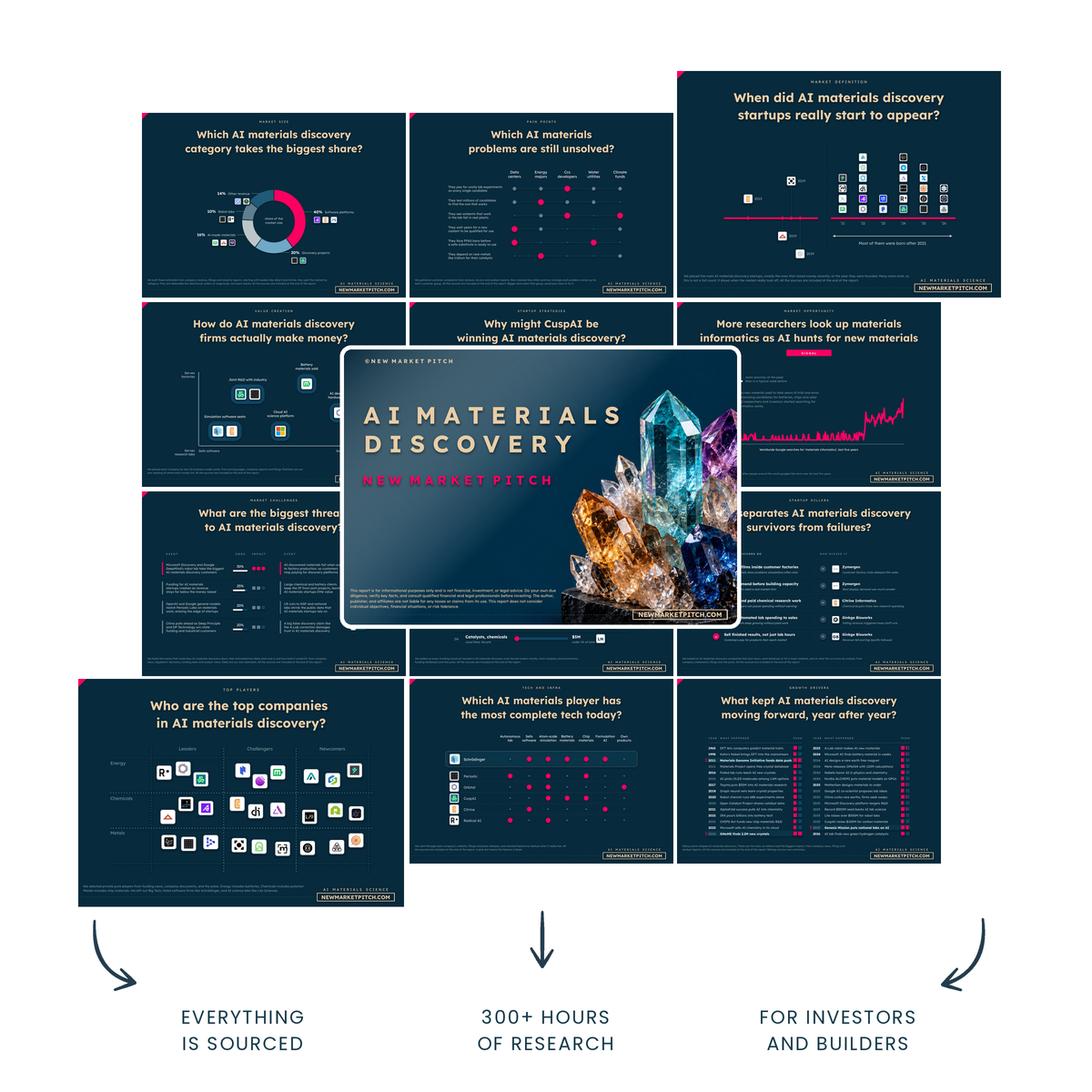
Whether you're building or investing in the AI materials discovery market, our report covers everything you need to know: the players, the money, and what's coming next.
AI materials discovery is moving beyond computer simulations, with startups now using artificial intelligence and automated laboratories to develop materials for semiconductors, energy storage, industrial chemicals and advanced manufacturing.
As of October 2026, the 12 companies in our funding shortlist range from early-stage university spinouts to well-funded platforms pursuing industrial commercialization.
The largest announced financing came from CuspAI, which raised $450 million in July, while smaller companies such as Matter Machine and Discovered Materials are targeting specific materials challenges.
And if you want to better understand this new industry, you can download our pitch covering the AI materials discovery market.
Insights
- CuspAI's $450 million Series B represented roughly 71% of the approximately $637 million in individually disclosed 2026 rounds in this shortlist, excluding cumulative funding figures and the 2025 financing.
- The AI materials discovery market is attracting two different investment strategies: large horizontal platforms that search across material classes and smaller specialists focused on magnets, semiconductor compounds, polymers or crystalline materials.
- Five companies in the shortlist have operations in the United Kingdom, including Matter Machine, CuspAI, Apoha, Orbital Industries and Polaron, making the country an important center for AI-driven materials research and commercialization.
- Semiconductor demand is shaping several funding decisions. Discovered Materials focuses on thermal materials for chips, SynMatAI targets advanced electronic chemicals, and CuspAI works with industrial partners on semiconductor material design.
- The laboratory is becoming a competitive advantage, not just a cost center. Companies including Deep Principle, alqem and Periodic Labs are investing in physical experiments that generate proprietary data and validate AI predictions.
- Industrial adoption is already visible in parts of the market. Polaron has moved from customer pilots to enterprise deployments, while Orbital Industries is using newly raised capital to commercialize physical products for data centers.
- The $8 million seed round secured by Polaron illustrates a different approach to materials AI: improving existing materials through microstructure analysis rather than relying entirely on the discovery of new chemical compounds.
- Two of the 12 companies require extra classification care. Azulene Labs and Apoha serve applications beyond industrial materials, including pharmaceuticals, so their materials-specific business concentration remains unverified.
- Funding announcements need careful interpretation in this industry. Deep Principle reported more than $100 million across its Series A financing, while Apoha disclosed $36 million across multiple rounds, not as standalone latest-round amounts.

Written by the New Market Pitch teamWe track new markets so founders and investors can move faster. About us

In our report covering the AI materials discovery market, you will always find fresh funding data, taken straight from our own verified funding database.
Summary table of the latest funding deals in the AI materials discovery market as of October 2026
We define the AI materials discovery market as AI platforms used to identify, design or optimize materials with desired properties.
We include models and experimental platforms for discovering chemicals, alloys, polymers, battery materials and other functional materials.
We exclude drug discovery, routine quality inspection and materials manufacturing without an AI-led discovery function.
The following table presents 12 reported financing announcements and closely related candidates, ordered from newest to oldest through October 16, 2026. Amounts are expressed in US dollars, with approximate conversions where necessary. Two entries report cumulative funding rather than a separately disclosed latest round, and two companies have provisional market classifications.
| Name | When | Amount in $ | Round Type | Category |
|---|---|---|---|---|
| Matter Machine | October 12, 2026 | ~$5.3M | Pre-Series A | Crystalline Materials Discovery |
| Deep Principle | October 1, 2026 | Undisclosed (over $100M cumulative Series A) | Series A Completion | AI Scientists & Autonomous Materials Laboratories |
| Azulene Labs | September 23, 2026 | $3.4M | Pre-Seed | Molecular Simulation & Industrial Chemical Design (Provisional) |
| SynMatAI | September 21, 2026 | ~$1.4M | Angel+ | Semiconductor Materials & Polymer Design |
| Discovered Materials | August 10, 2026 | $9M | Seed | Semiconductor & Thermal Materials Discovery |
| CuspAI | July 20, 2026 | $450M | Series B | Generative Materials Discovery |
| alqem | July 6, 2026 | ~$9.3M | Pre-Seed | AI Crystalline Materials & Rare-Earth-Free Magnets |
| Apoha | June 3, 2026 | Undisclosed ($36M cumulative) | Unlettered Financing | Molecular Intelligence & Formulation Design (Provisional) |
| Orbital Industries | May 28, 2026 | $50M | Series B | Functional Materials & Industrial Cooling |
| Polaron | February 3, 2026 | $8M | Seed | Materials Optimization & Generative Design |
| Cambium | January 5, 2026 | $100M | Series B | AI Polymer Discovery & Advanced Composites |
| Periodic Labs | September 30, 2025 | $300M | Seed | Autonomous Scientific Laboratories & Materials Discovery |
All the latest funding deals in the AI materials discovery market as of October 2026
Matter Machine raised approximately $5.3 million in October 2026 to accelerate AI-powered materials discovery.
When was it?
Matter Machine announced its financing on October 12, 2026.
Who are they?
Matter Machine is a University of Liverpool spinout developing AI tools and automated experiments to discover new inorganic crystalline materials.
Geographical focus?
Matter Machine operates from Liverpool in the United Kingdom and is developing partnerships with industrial customers across sectors such as energy, electronics and manufacturing.
Why do we include them in the AI materials discovery market?
Matter Machine directly develops AI-guided discovery technology for crystalline functional materials, including potential battery materials and catalysts.
What is the company stage?
Matter Machine is an early-stage university spinout moving its scientific research toward commercial industrial applications.
How much did they raise?
Matter Machine secured £4 million, equivalent to approximately $5.3 million, led by IP Group with support from Northern Gritstone and other investors.
What round is it?
The financing was described as a pre-Series A round in the university and investor announcements, although some funding databases classify it as Series A.
Why did they raise?
Matter Machine raised the capital to expand its scientific and commercial teams, advance its materials discovery platform and establish more industrial partnerships.
Deep Principle completed its Series A financing in October 2026, bringing cumulative funding above $100 million.
When was it?
Deep Principle publicly announced the completion of its Series A financing on October 1, 2026.
Who are they?
Deep Principle develops AI scientists and automated laboratories that predict material properties, propose new compounds and test promising candidates through physical experiments.
Geographical focus?
Deep Principle is headquartered in Hangzhou, China, and targets industrial materials customers in China and international markets.
Why do we include them in the AI materials discovery market?
Deep Principle builds AI materials discovery systems for catalysts, advanced chemicals, energy materials, electronics and other industrial applications.
What is the company stage?
Deep Principle is in early commercial growth, with an operating AI Scientist platform, automated laboratory capabilities and reported industrial orders.
How much did they raise?
Deep Principle reported more than $100 million in cumulative Series A financing, but did not disclose the amount of the latest October tranche.
What round is it?
The announcement marked the completion of a Series A financing process that included several earlier extensions.
Why did they raise?
Deep Principle is using its financing to improve its AI Scientist platform, expand its AI Materials Factory and commercialize materials developed through its research system.

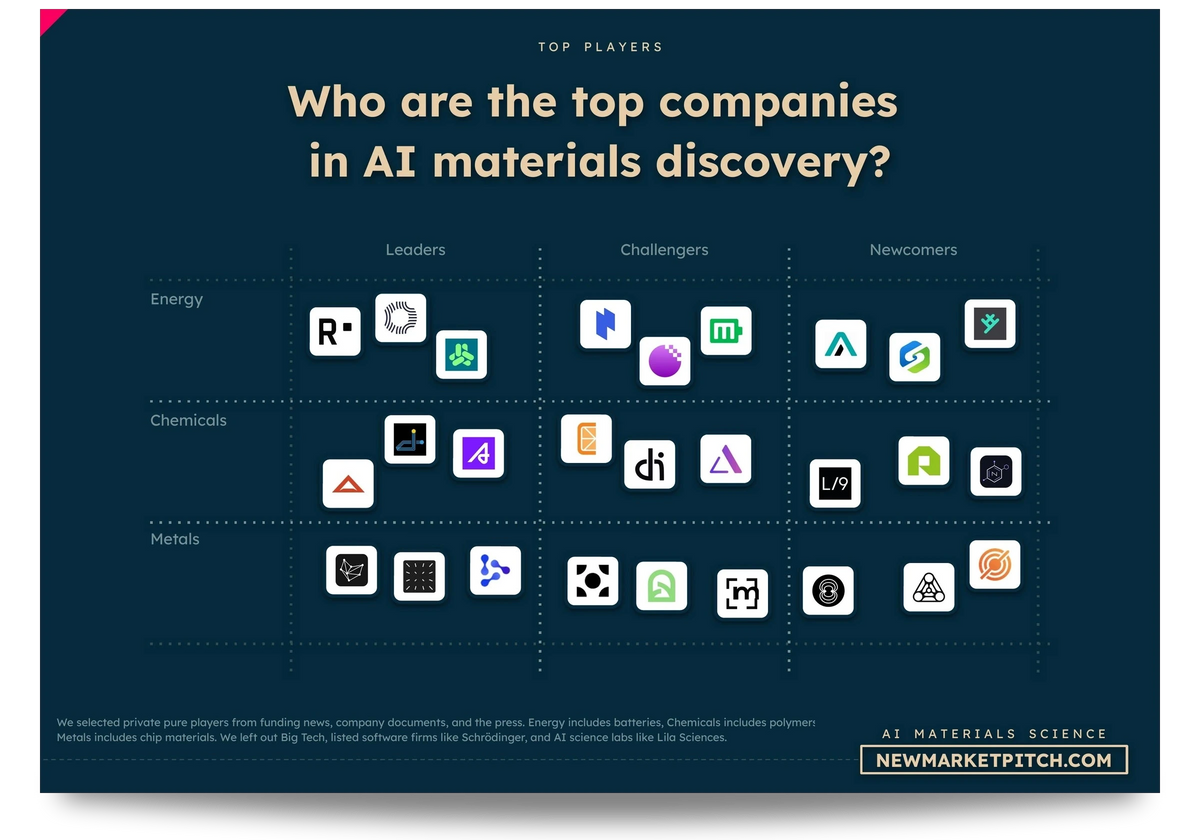
In our research about AI for materials discovery, we turn what is vague and complex into simple, useful visuals. Market maps like this one show you at a glance where every startup stands.
Azulene Labs raised $3.4 million in September 2026 to develop predictive AI models for chemistry.
When was it?
Azulene Labs announced its financing on September 23, 2026.
Who are they?
Azulene Labs is a Berkeley-based startup building physics-informed AI models to predict chemical behavior, molecular properties and interactions before laboratory testing.
Geographical focus?
Azulene Labs operates in the United States and develops technology for customers in industrial chemistry, materials development and biotechnology.
Why do we include them in the AI materials discovery market?
Azulene Labs supports industrial chemical design through molecular simulation, although pharmaceutical applications also form an important part of its business, making its materials-market classification provisional.
What is the company stage?
Azulene Labs is at the pre-seed stage, developing its models and working with early research and commercial partners.
How much did they raise?
Azulene Labs raised $3.4 million, led by Ground State Ventures with participation from Entrada Ventures and angel investors.
What round is it?
The financing was announced as a pre-seed round.
Why did they raise?
Azulene Labs raised the funding to expand its scientific team and make AI-driven chemical property prediction more accurate and practical for industrial research.
SynMatAI raised approximately $1.4 million in September 2026 to expand its AI-driven materials research platform.
When was it?
SynMatAI announced its angel-plus financing on September 21, 2026.
Who are they?
SynMatAI is a Chinese materials technology company developing AI agents, simulation models and predictive tools to help researchers design materials and optimize their properties.
Geographical focus?
SynMatAI operates in Shenzhen and Hangzhou, initially targeting China's advanced-materials, semiconductor and clean-energy industries.
Why do we include them in the AI materials discovery market?
SynMatAI uses AI to design and optimize specialty polymers, electronic chemicals, semiconductor packaging materials and other functional materials.
What is the company stage?
SynMatAI is an early-stage commercial company with an operating materials AI platform and industrial research collaborations.
How much did they raise?
SynMatAI secured a CNY 10 million-class financing, worth approximately $1.4 million, with Qifu Capital identified as the lead investor.
What round is it?
The latest investment was reported as an angel-plus financing, following earlier seed and angel funding.
Why did they raise?
SynMatAI raised the capital to improve its materials AI models and accelerate the development of functional materials for semiconductor packaging and other industrial applications.

Your time is limited. In our market report about AI for materials discovery, we put numbers on each part of the market, so you can see where it makes sense to focus.
Discovered Materials raised $9 million in August 2026 to discover better semiconductor materials using AI agents.
When was it?
Discovered Materials announced its funding on August 10, 2026.
Who are they?
Discovered Materials develops AI agents that identify promising materials for semiconductor chips and evaluates them through simulation, synthesis and laboratory testing.
Geographical focus?
Discovered Materials is based in San Francisco and targets the global semiconductor industry, particularly companies seeking better chip efficiency and thermal performance.
Why do we include them in the AI materials discovery market?
Discovered Materials focuses directly on AI-guided semiconductor materials discovery, starting with compounds and thermal interface materials that can improve heat management.
What is the company stage?
Discovered Materials is a seed-stage startup with early experimental results, a published materials discovery benchmark and ongoing laboratory validation.
How much did they raise?
Discovered Materials raised $9 million, led by Lightspeed India Partners with participation from Y Combinator, Peak XV Partners and several angel investors.
What round is it?
The financing was a seed round announced after the company's participation in Y Combinator.
Why did they raise?
Discovered Materials secured the funding to expand its team and laboratory operations while improving AI agents that can move new semiconductor materials toward industrial use.
CuspAI raised $450 million in July 2026 at a $2.6 billion valuation to scale generative materials discovery.
When was it?
CuspAI announced its Series B financing on July 20, 2026.
Who are they?
CuspAI develops generative AI technology that searches large chemical spaces to identify new materials matching specific industrial performance requirements.
Geographical focus?
CuspAI is headquartered in Cambridge, United Kingdom, and is expanding its industrial discovery network across Europe, North America and Asia-Pacific.
Why do we include them in the AI materials discovery market?
CuspAI is a direct materials discovery platform serving semiconductor, energy, chemical, filtration and advanced manufacturing applications through AI-based material design.
What is the company stage?
CuspAI is in its growth and commercialization stage, with a $2.6 billion reported valuation and an expanding international AI Materials Foundry ecosystem.
How much did they raise?
CuspAI raised $450 million, co-led by Kleiner Perkins and NEA, with backing from Bezos Expeditions and several other international investors.
What round is it?
The investment was a Series B round, one of the largest disclosed financing events in the AI materials discovery market in 2026.
Why did they raise?
CuspAI raised the capital to expand its computational research capabilities, develop its AI Materials Foundry and support industrial partners bringing new materials into practical use.

In our document detailing everything you need to know about AI materials discovery, we always try to gather several sources and make estimates that make sense, so you can work with solid numbers.
alqem raised approximately $9.3 million in July 2026 to discover new materials, starting with rare-earth-free magnets.
When was it?
alqem announced its financing on July 6, 2026.
Who are they?
alqem is a Munich-based startup using AI, large materials databases and laboratory testing to identify new compounds with useful physical properties.
Geographical focus?
alqem is based in Germany and initially targets European industrial supply chains, while developing a discovery platform that could serve customers internationally.
Why do we include them in the AI materials discovery market?
alqem develops an AI-driven materials discovery engine that predicts and validates crystalline compounds, with rare-earth-free permanent magnets as its first major application.
What is the company stage?
alqem is at the pre-seed stage, with a pipeline of predicted material candidates and experimental capabilities for validating their properties.
How much did they raise?
alqem secured €8 million, approximately $9.3 million, in financing co-led by UVC Partners and Union Square Ventures.
What round is it?
The financing was a pre-seed round supporting the company's initial development and commercialization activities.
Why did they raise?
alqem raised the capital to expand its AI materials database, validate promising compounds and develop permanent magnets that reduce reliance on rare-earth elements.
Apoha disclosed $36 million in cumulative financing in June 2026, including a recent round of undisclosed size.
When was it?
Apoha announced its financing history and emergence from stealth on June 3, 2026, following a new investment completed earlier that spring.
Who are they?
Apoha develops specialized laboratory instruments and AI models that analyze how substances behave under physical stresses to predict and improve their properties.
Geographical focus?
Apoha operates in London and San Francisco and works with customers across pharmaceutical, food, chemical and materials industries.
Why do we include them in the AI materials discovery market?
Apoha's platform supports material and formulation design through experimental molecular intelligence, although its broader biotechnology activities make its materials-specific classification provisional.
What is the company stage?
Apoha is in early commercial development, having completed customer projects and established industry relationships while continuing to expand its experimental platform.
How much did they raise?
Apoha disclosed $36 million raised across its 2024 seed financing and a subsequent 2026 round, but the standalone amount of the latest investment was not published.
What round is it?
The latest financing was described as an unlettered round, despite some databases labeling the June announcement as Series A.
Why did they raise?
Apoha secured financing to expand its laboratory hardware, improve AI predictions of molecular behavior and accommodate more material types and industrial customers.

Our report covering the AI materials discovery market gets updated several times a month, so you always get the latest view of where things stand.
Orbital Industries raised $50 million in May 2026 to commercialize advanced materials and AI-designed industrial hardware.
When was it?
Orbital Industries announced its financing on May 28, 2026.
Who are they?
Orbital Industries, formerly Orbital Materials, uses artificial intelligence to develop functional materials and build industrial products, initially for data-center infrastructure.
Geographical focus?
Orbital Industries operates from London and San Francisco and targets industrial customers internationally, starting with the data-center sector.
Why do we include them in the AI materials discovery market?
Orbital Industries uses AI-led materials design to develop products for cooling and other industrial applications, combining discovery with hardware engineering and commercialization.
What is the company stage?
Orbital Industries is in commercial growth, with two initial products and plans to expand industrial deployment and its approximately 50-person workforce.
How much did they raise?
Orbital Industries raised $50 million, led by Plural with participation from NVentures, Radical Ventures, Compound and Fly Ventures.
What round is it?
The financing was a Series B round supporting the company's transition toward larger-scale commercial operations.
Why did they raise?
Orbital Industries raised the capital to deploy its first industrial products, expand its team and extend its AI-driven materials and hardware platform into additional applications.
Polaron raised $8 million in February 2026 to expand its AI platform for advanced materials design.
When was it?
Polaron announced its financing on February 3, 2026.
Who are they?
Polaron is an Imperial College London spinout using AI to connect a material's microscopic structure, manufacturing process and final performance.
Geographical focus?
Polaron operates from London and serves industrial customers in sectors including automotive, batteries, energy and advanced manufacturing.
Why do we include them in the AI materials discovery market?
Polaron directly supports AI-led materials optimization and generative design, helping researchers improve alloys, battery electrodes, ceramics and other industrial materials.
What is the company stage?
Polaron is at the seed-funded commercial expansion stage, with software that has progressed from early customer pilots to enterprise deployments.
How much did they raise?
Polaron secured $8 million, led by Racine2, with participation from Speedinvest, Futurepresent and industrial AI angel investors.
What round is it?
The investment was a seed round supporting further product development and customer adoption.
Why did they raise?
Polaron raised the money to expand its engineering team, accelerate the rollout of its generative design tools and meet demand from industrial materials researchers.

In our research about AI for materials discovery, we look at what the winners do differently, so you can learn from the best instead of guessing.
Cambium raised $100 million in January 2026 to accelerate AI-designed polymers and advanced materials manufacturing.
When was it?
Cambium announced its financing on January 5, 2026.
Who are they?
Cambium develops high-performance polymers and composite materials using AI, chemical informatics and computational tools alongside industrial manufacturing capabilities.
Geographical focus?
Cambium is based in El Segundo, California, and serves industrial customers across the United States and Europe, particularly in aerospace, defense and energy.
Why do we include them in the AI materials discovery market?
Cambium uses AI-led chemical design to develop new monomers, polymers and advanced composites, although its business also includes substantial materials production.
What is the company stage?
Cambium is a growth-stage industrial materials company with established customers and expanding manufacturing capabilities.
How much did they raise?
Cambium raised $100 million, led by 8VC with participation from Lockheed Martin Ventures, MVP Ventures and other institutional investors.
What round is it?
The financing was a Series B round supporting the expansion of the company's materials development and industrial operations.
Why did they raise?
Cambium raised the capital to develop its proprietary materials pipeline and increase production capacity in the United States and Europe.
Periodic Labs raised $300 million in September 2025 to build autonomous AI laboratories for scientific discovery.
When was it?
Periodic Labs announced its seed financing on September 30, 2025, with no later completed funding round confirmed in the reviewed research through October 16, 2026.
Who are they?
Periodic Labs develops AI research systems connected to automated laboratories that can design experiments, gather physical data and investigate new materials.
Geographical focus?
Periodic Labs is based in the United States and develops scientific research technology with potential applications across global energy, electronics and advanced manufacturing industries.
Why do we include them in the AI materials discovery market?
Periodic Labs directly targets AI-guided scientific experimentation, with superconductors and other advanced materials among its initial research applications.
What is the company stage?
Periodic Labs is in technology development, supported by substantial seed capital for AI models, robotics and laboratory infrastructure.
How much did they raise?
Periodic Labs secured $300 million from investors including Andreessen Horowitz, DST, NVentures, Accel and several prominent technology executives.
What round is it?
The investment was a seed round, despite its unusually large size for a company at this development stage.
Why did they raise?
Periodic Labs raised the financing to build an AI-powered scientific research platform that combines automated experiments, proprietary data and model development to accelerate materials discovery.
Written by the New Market Pitch teamWe track new markets so founders and investors can move faster. About us