AI materials discovery funding: where is the money going?
Whether you're building or investing in the AI materials discovery market, our report covers everything you need to know: the players, the money, and what's coming next.
Summary
AI materials discovery funding is going overwhelmingly to three companies building expensive scientific and industrial capabilities: CuspAI, Periodic Labs and Cambium. Together, they received $850 million, or 87.4% of the $973 million in disclosed funding measured over the latest 12 months.
The market is nevertheless getting broader. Funding transactions increased from 19 to 30, the number of funded companies rose from 16 to 25, and first financings doubled from five to ten. More startups are attracting investors, even though relatively few are raising extraordinary amounts.
Measured funding increased from at least $266 million to $973 million, but those totals don't capture every transaction. Usable amounts were available for only 17 of 30 current deals and 15 of 19 previous deals. The apparent 265.8% increase is a mechanical comparison of recorded amounts, not a reliable estimate of total market growth.
Without rounds above $50 million, disclosed funding increased by just 10.8%, from $111 million to $123 million. The headline financing boom therefore says much more about a few exceptional companies than about the fundraising conditions faced by most materials startups.
The typical disclosed round barely changed, rising from $8 million to $8.1 million. Meanwhile, the current average reached $57.23 million because a handful of enormous financings pulled it upward. The gap between ordinary fundraising and the largest transactions has become striking.
Investors are backing younger businesses. Seed transactions now represent 83.3% of deals, compared with 63.2% previously, while the median age of funded companies fell from three years to one. The median disclosed first-financing amount also increased, although that calculation relies on a small sample.
Follow-on financing is becoming more frequent without becoming uniformly larger. Follow-on transactions increased from 14 to 20, but their median disclosed size declined from approximately $10 million to $8.1 million. More companies are raising again, yet the largest checks remain concentrated among a few industrial platforms.
Metals and alloys, battery materials, and semiconductor-related materials are attracting more transactions. Demand from AI computing is particularly interesting: CuspAI is focusing heavily on semiconductor materials, while Orbital Industries is developing cooling products for GPU-intensive infrastructure.
China accounted for 14 of the latest 30 deals, compared with four of 19 previously. That represents nearly half of current transactions, although incomplete disclosures prevent a reliable comparison of Chinese and Western capital totals. US and UK companies still dominate several of the largest known financings.
The next test is whether this wider generation of Seed-stage companies can secure follow-on capital and move from technical research toward commercially useful products. AI materials discovery has become healthier in deal activity and startup formation, but its capital totals remain highly dependent on a few costly bets on scientific infrastructure, manufacturing and industrial applications.

Written by the New Market Pitch teamWe track new markets so founders and investors can move faster. About us

In our report covering the AI materials discovery market, you will always find fresh funding data, taken straight from our own verified funding database.
All funding deals in the AI materials discovery market over the last 24 months
Below is the table listing all the deals. You can find our methodology at the end of this page.
If you want a deeper understanding of the market and its current dynamics, get our report covering the AI materials discovery market.
| Company | Category | Date | Stage | Deal size | What they do | Region | Lead investors | Country | Rank |
|---|---|---|---|---|---|---|---|---|---|
| SOG Intelligent Computing (索格智算(上海)科技有限公司) | Battery Materials | September 2026 | Seed | Not Disclosed | Develops AI materials foundation models and simulation systems combining atomistic prediction with experimental feedback for new-materials discovery. | Asia-Pacific | Fosun Capital | China | |
| SynMatAI | Semiconductor & Electronic Materials | September 2026 | Seed | Not Disclosed | Builds AI materials discovery agents and simulation tools for developing semiconductor packaging materials, photoresists and electronic chemicals. | Asia-Pacific | Qifu Capital | China | |
| Deep Material | Metals & Alloys | September 2026 | Series A | ≈$14M | Uses AI agents and automated high-throughput laboratories to discover and develop high-performance metal alloys and other advanced metallic materials. | Asia-Pacific | Source Code Capital; Jolmo Capital | China | |
| Rhinovate (鼎犀智创) | Catalysts & Chemical Materials | September 2026 | Seed | Not Disclosed | Develops AI foundation models and autonomous experimental systems to design and validate advanced materials, including carbon-based materials and polymers. | Asia-Pacific | CDH Baifu | China | |
| Meissner | Metals & Alloys | September 2026 | Seed | $2.6M | Uses machine learning, computational simulation and laboratory validation to discover new superconducting materials. | North America | BDC Capital — Thrive Venture Fund | Canada | |
| MatSource | Battery Materials | August 2026 | Seed | Not Disclosed | Combines AI materials agents, physics-based models, proprietary materials data and automated experimentation to discover and optimize functional materials. | Asia-Pacific | Matrix Partners China | China | |
| Discovered Materials, Inc. | Semiconductor & Electronic Materials | August 2026 | Seed | $9M | Develops autonomous AI agents to discover and experimentally validate new materials for semiconductor chips and packaging. | North America | Lightspeed India Partners | United States | |
| Heguang Zhicheng (北京和光智成科技有限公司) | Catalysts & Chemical Materials | August 2026 | Seed | Not Disclosed | Develops AI materials research agents and experimental capabilities to accelerate the design and discovery of new functional materials. | Asia-Pacific | Not disclosed | China | |
| CuspAI | Energy & Climate Materials | July 2026 | Series B | $450M | Operates a generative AI platform for discovering and validating new materials, with a substantial focus on advanced semiconductor materials. | Europe | Kleiner Perkins; New Enterprise Associates (NEA) | United Kingdom | |
| alqem GmbH | Metals & Alloys | July 2026 | Seed | ≈$9.4M | Develops an AI-powered materials discovery engine combining computational databases, property prediction and experimental validation to identify novel high-performance materials. | Europe | UVC Partners; Union Square Ventures | Germany | |
| Orbital Industries | Energy & Climate Materials | May 2026 | Series B | $50M | Uses generative atomistic AI models and experimental workflows to discover advanced materials, including a dielectric GPU cooling fluid, and commercialize AI-designed infrastructure. | Europe | Plural | United Kingdom | |
| SynMatAI | Semiconductor & Electronic Materials | May 2026 | Seed | Not Disclosed | Develops AI agents and simulation tools to discover and optimize semiconductor packaging adhesives, thermal-interface materials and electronic chemicals. | Asia-Pacific | Ivy Capital (常春藤资本) | China | |
| FuAnAI (Shanghai) Intelligent Technology Co., Ltd. (上海复鞍智能科技有限公司) | Catalysts & Chemical Materials | May 2026 | Seed | Not Disclosed | Develops LASPAI, an AI-powered atomic simulation and materials-design platform for predicting material properties, chemical reactions and catalyst performance. | Asia-Pacific | Xiaomiao Langcheng (小苗朗程); FutureX Capital (天际资本) | China | |
| Atomic Tessellator Limited | Metals & Alloys | April 2026 | Seed | ≈$8.1M | Operates an AI-guided computational laboratory for discovering rare-earth-free magnetic materials and high-performance alloys. | Asia-Pacific | Crane Venture Partners | New Zealand | |
| Aionics Holdings Inc. (Aionics) | Battery Materials | April 2026 | Seed | $501.7K | Develops physics-informed AI models to discover and optimize electrolyte formulations for advanced batteries. | North America | Not disclosed | United States | |
| Level Nine Labs GmbH (Level Nine) | Catalysts & Chemical Materials | March 2026 | Seed | ≈$4.6M | Uses machine learning to discover enzyme-inspired industrial catalysts that convert biomass into chemical intermediates. | Europe | Visionaries Tomorrow | Germany | |
| Kairos Materials | Energy & Climate Materials | March 2026 | Seed | Not Disclosed | Develops materials foundation models, AI agents and experimental platforms to discover and validate advanced energy and functional materials. | Asia-Pacific | Monolith | China | |
| Apoello Ltd. (Apoello) | Semiconductor & Electronic Materials | February 2026 | Seed | ≈$642K | Develops an AI-enabled computational platform for discovering and designing molecules and materials for organic electronics and other functional applications. | Europe | Not disclosed | United Kingdom | |
| Polaron Ltd. (Polaron) | Battery Materials | February 2026 | Seed | $8M | Uses microscopy-trained AI and generative design to optimize materials' microstructures and properties, including for battery electrodes. | Europe | Racine2 | United Kingdom | |
| MatSource | Battery Materials | January 2026 | Seed | Not Disclosed | Operates an AI-driven materials development platform combining predictive models, proprietary experimental data and automated laboratories for energy and catalyst materials. | Asia-Pacific | Yongxin Capital (永鑫方舟) | China | |
| RARA Factory S.r.l. | Metals & Alloys | January 2026 | Seed | ≈$3.7M | Combines physics-driven AI, high-throughput synthesis and experimental characterization to discover functional materials that can replace rare earths. | Europe | Primo Capital; CDP Venture Capital | Italy | |
| Cambium Biomaterials, Inc. (Cambium) | Polymers & Plastics | January 2026 | Series B | $100M | Uses AI, chemical informatics and computational design to discover advanced polymers and composite materials for demanding industrial applications. | North America | 8VC | United States | |
| Novyte Materials | Catalysts & Chemical Materials | December 2025 | Seed | ≈$459K | Uses AI agents and physics-based simulation to discover and optimize specialty chemicals, polymers, coatings and other materials. | Asia-Pacific | Theia Ventures | India | |
| Mater-AI | Energy & Climate Materials | December 2025 | Seed | ≈$2M | Uses AI and physics-based models to discover thermoelectric materials capable of converting waste heat into electricity. | Europe | Twin Path Ventures | United Kingdom | |
| Kairos Materials | Energy & Climate Materials | November 2025 | Seed | Not Disclosed | Builds foundation models and automated experimental infrastructure to discover, validate and optimize new functional materials. | Asia-Pacific | IDG Capital; BlueRun Ventures China | China | |
| Deep Principle (深度原理) | Catalysts & Chemical Materials | November 2025 | Series A | Not Disclosed | Develops AI agents, molecular-design models and autonomous experimentation systems for discovering chemical and functional materials. | Asia-Pacific | Alibaba Entrepreneurs Fund Greater Bay Area Fund; Ant Group | China | |
| MatSource | Battery Materials | November 2025 | Seed | Not Disclosed | Combines materials databases, physics-informed AI models and autonomous high-throughput experiments to discover and optimize functional materials. | Asia-Pacific | CAS Star | China | |
| Altrove | Metals & Alloys | October 2025 | Seed | $10M | Uses generative AI and automated synthesis laboratories to discover alternatives to critical materials, initially targeting rare-earth-free magnets. | Europe | Alven | France | |
| Rhinovate (鼎犀智创) | Catalysts & Chemical Materials | October 2025 | Seed | Not Disclosed | Develops AI models and automated laboratory systems to design, synthesize and optimize advanced materials. | Asia-Pacific | Kinzon Capital; YuanBio Venture Capital | China | |
| Periodic Labs | Semiconductor & Electronic Materials | September 2025 | Seed | $300M | Builds AI scientists and autonomous physical laboratories to synthesize and test new materials, initially including superconductors and semiconductor-related materials. | North America | Andreessen Horowitz | United States | |
| CuspAI | Energy & Climate Materials | September 2025 | Series A | $100M | Operates a generative-AI platform that designs synthesizable materials with specified properties for climate, energy, water-treatment and electronic applications. | Europe | New Enterprise Associates (NEA); Temasek | United Kingdom | |
| Deep Material | Metals & Alloys | September 2025 | Series A | Not Disclosed | Combines AI materials models with high-throughput experimental laboratories to develop and optimize advanced metal alloys and additive-manufacturing powders. | Asia-Pacific | Not disclosed | China | |
| SynMatAI | Semiconductor & Electronic Materials | September 2025 | Seed | Not Disclosed | Develops a generative-AI materials research platform for designing and optimizing semiconductor chemicals, photoresists and advanced packaging materials. | Asia-Pacific | Jingrui Electronic Materials | China | |
| Radical AI | Metals & Alloys | July 2025 | Seed | $55M | Develops AI models and autonomous laboratories to design, synthesize and experimentally validate new functional materials. | North America | RTX Ventures | United States | |
| Xatoms | Catalysts & Chemical Materials | June 2025 | Seed | $1.5M | Uses AI and quantum chemistry to discover photocatalytic materials that remove water contaminants using sunlight or LED light. | North America | Quantacet | Canada | |
| Mitra Chem | Battery Materials | June 2025 | Series B | $15.6M | Combines machine learning, simulations and high-throughput experimentation to discover and optimize lithium-based battery cathode materials. | North America | Not disclosed | United States | |
| Mitra Chem | Battery Materials | March 2025 | Series B | $10M | Uses machine learning and automated experimentation to discover, develop, and optimize iron-based lithium-ion battery cathode materials. | North America | Not disclosed | United States | |
| Deep Principle (深度原理) | Catalysts & Chemical Materials | March 2025 | Seed | Not Disclosed | Combines generative AI, quantum-chemical simulations, and automated experiments to discover and optimize chemical and functional materials. | Asia-Pacific | Not disclosed | China | |
| PhaseTree | Energy & Climate Materials | March 2025 | Seed | $3.2M | Uses AI-enhanced, multiscale physics simulations to discover sustainable materials with targeted properties. | Europe | Heartcore Capital | Denmark | |
| Albert Invent | Catalysts & Chemical Materials | February 2025 | Growth Equity | $20M | Provides an AI-enabled chemical R&D platform that predicts material properties and helps scientists design and optimize chemical formulations. | North America | J.P. Morgan Private Capital's Growth Equity Partners | United States | |
| Citrine Informatics, Inc. | Catalysts & Chemical Materials | February 2025 | Unknown | $2.6M | Provides an AI materials-informatics platform for discovering and optimizing chemical formulations and advanced materials. | North America | Not disclosed | United States | |
| Mattiq, Inc. | Catalysts & Chemical Materials | December 2024 | Seed | $4.5M | Combines AI with ultrahigh-throughput experimental screening to discover functional materials and electrocatalysts for industrial applications. | North America | Not disclosed | United States | |
| Albert Invent | Catalysts & Chemical Materials | December 2024 | Series A | $22.5M | Provides an AI-enabled chemistry and materials R&D platform for predicting molecular properties and designing or optimizing formulations. | North America | Coatue | United States | |
| Copernic Catalysts | Catalysts & Chemical Materials | November 2024 | Seed | $8M | Uses AI-supported computational materials design and high-throughput experimentation to discover catalysts for lower-carbon industrial chemicals and fuels. | North America | Breakout Ventures | United States | |
| Deep Principle (深度原理) | Catalysts & Chemical Materials | November 2024 | Seed | Not Disclosed | Uses generative AI, quantum chemistry and high-throughput experimentation to discover and optimize chemical materials and catalysts. | Asia-Pacific | Not disclosed | China | |
| Dunia Innovations GmbH | Catalysts & Chemical Materials | October 2024 | Seed | $11.5M | Combines AI, robotic experimentation and quantum chemistry to discover electrocatalysts for low-carbon fuels and chemicals. | Europe | Elaia; Redalpine | Germany | |
| ExoMatter | Energy & Climate Materials | October 2024 | Seed | ≈$1.8M | Provides an AI- and quantum-modeling-based platform to discover and optimize materials for performance, cost and sustainability. | Europe | Vanagon Ventures | Germany | |
| Phaseshift Technologies | Metals & Alloys | October 2024 | Seed | $3M | Develops an AI-powered computational platform to discover, design and optimize high-performance metallic alloys and composites. | North America | Innospark Ventures | Canada |

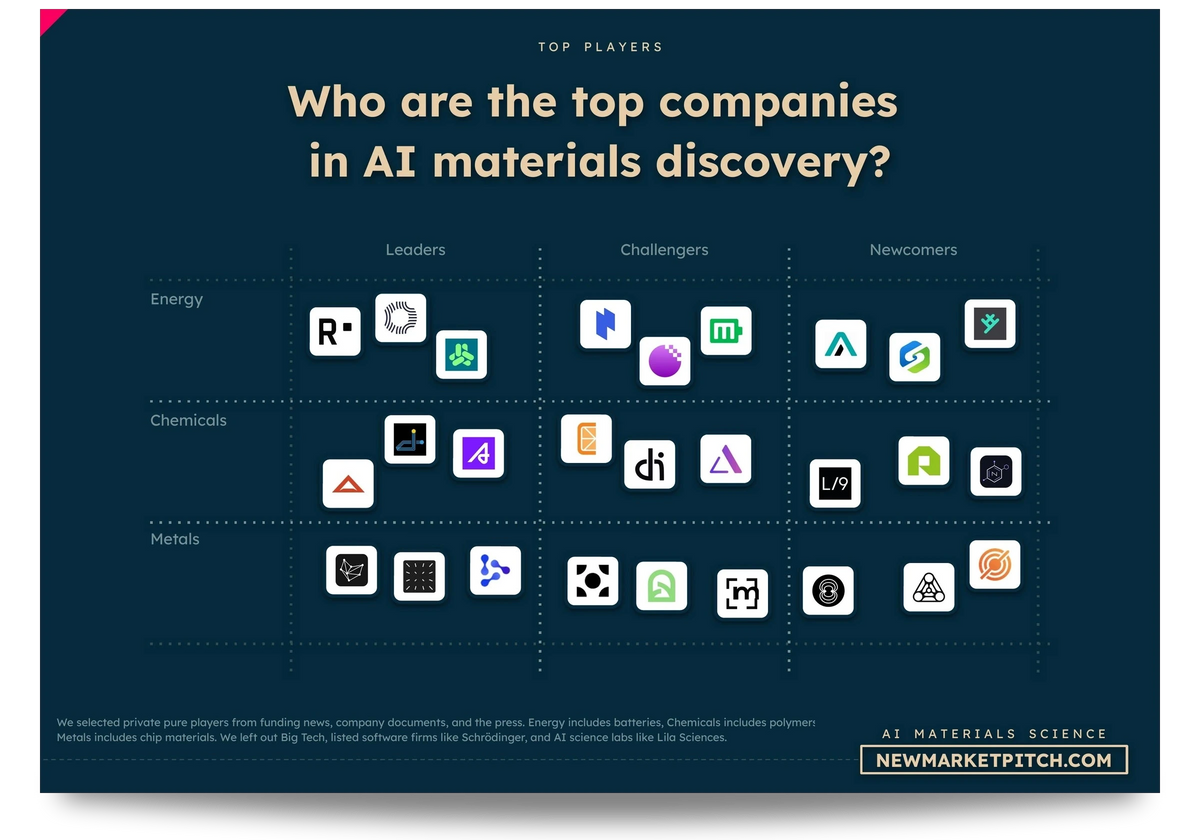
In our research about AI for materials discovery, we turn what is vague and complex into simple, useful visuals. Market maps like this one show you at a glance where every startup stands.
Is the AI materials discovery market actually healthier than a year ago?
The AI materials discovery market is healthier for young startups, but most companies are not raising much more money than they were a year ago.
We counted 30 funding deals involving 25 companies over the latest 12 months, compared with 19 deals across 16 companies in the previous period. That's a 57.9% increase in transactions and a 56.3% increase in funded businesses. More companies are getting funded, and the market is producing twice as many first financings.
The money tells a more complicated story. Measured disclosed funding increased from at least $266 million to $973 million, yet the median disclosed round barely moved, from $8 million to $8.1 million. Three companies, CuspAI, Periodic Labs and Cambium, accounted for the vast majority of current measured funding.
There are two very different financing environments here. Young materials startups are finding investors for relatively modest rounds, while a few companies building scientific infrastructure or industrial products can attract hundreds of millions of dollars. And because many transactions lack disclosed amounts, the measured totals should not be mistaken for complete market funding.
| Indicator | Previous 12M | Current L12M | Change |
|---|---|---|---|
| Funding deals | 19 | 30 | +57.9% |
| Funded companies | 16 | 25 | +56.3% |
| First financings | 5 | 10 | +100% |
| Follow-on financings | 14 | 20 | +42.9% |
| Measured disclosed capital | At least $266M | $973M | Not reliably comparable |
| Deals with usable amounts | 15 of 19 | 17 of 30 | Lower coverage |
| Median disclosed round | $8.0M | $8.1M | +1.3% |
| Capital excluding rounds above $50M | $111M | $123M | +10.8% measured |
| Early-stage deal share | 78.9% | 90.0% | +11.1 pp |
The disclosed-capital comparison is affected by missing amounts in both periods and a lower-bound treatment of an earlier CuspAI financing. The $973 million figure covers the 17 current transactions with usable amounts, not all 30 deals.
Is the AI materials discovery funding boom mostly coming from three startups?
Yes. CuspAI, Periodic Labs and Cambium are responsible for $850 million of the $973 million in measured AI materials discovery funding.
CuspAI raised $450 million in July 2026 to expand its AI Materials Foundry, a network combining AI models, laboratories, data and industrial partners. Periodic Labs announced a $300 million Seed round in September 2025 to develop autonomous scientific laboratories. Cambium secured $100 million in January 2026 to develop and manufacture advanced materials for demanding industrial applications.
Together, those three financings represent 87.4% of measured capital despite accounting for only three of the 30 deals. That percentage uses the $973 million disclosed-funding denominator; the share of all capital raised, including undisclosed transactions, cannot be calculated.
The previous period was already concentrated, with its three largest financings accounting for approximately 66.7% of measured funding under our lower-bound convention. The recorded figures suggest considerably greater concentration, although incomplete disclosures limit an exact comparison.
What's interesting is the kind of companies attracting these checks. Investors are putting enormous amounts of money behind businesses that want to change how physical materials are discovered, tested or manufactured. Their funding needs look very different from those of a startup developing a specialized materials prediction tool.

Your time is limited. In our market report about AI for materials discovery, we put numbers on each part of the market, so you can see where it makes sense to focus.
Would AI materials discovery funding still be growing without the megadeals?
Yes, in the disclosed funding records, but growth becomes much less impressive once we remove the biggest rounds.
Without transactions above $50 million, measured capital increased from $111 million to $123 million, or 10.8%. Excluding rounds reported above $100 million produces a larger increase of approximately 34.3%, still far below the headline comparison.
Removing the three largest current transactions leaves the same $123 million. Removing CuspAI's financing alone cuts current measured funding almost in half, to $523 million.
There is another reason to be careful with the dollar comparison. Only 17 of 30 current deals have usable financing amounts, versus 15 of 19 previously. Several Chinese investments were announced without precise figures, and an earlier CuspAI round was disclosed as exceeding $100 million rather than having an exact value.
The raw reported sums give a mechanical increase of 265.8% when the earlier CuspAI financing is counted at a $100 million floor. But this is neither a verified market-wide growth rate nor a mathematical upper bound: undisclosed amounts exist in both periods, and the previous total is already a lower-bound calculation.
We therefore have strong evidence of growing transaction activity, but much less evidence that ordinary AI materials startups can now raise substantially larger amounts.
| Funding measure | Previous 12M | Current L12M | Comparison |
|---|---|---|---|
| Measured disclosed funding | At least $266M | $973M | +265.8% mechanical ratio, not verified market growth |
| Excluding rounds reported above $100M | $166M | $223M | +34.3% measured |
| Excluding rounds above $50M | $111M | $123M | +10.8% measured |
| Largest recorded round | More than $100M | $450M | Exact comparison unavailable |
| Top three share of measured capital | Approximately 66.7% | 87.4% | Higher recorded concentration |
| Top five share of measured capital | Approximately 80.1% | 93.9% | Higher recorded concentration |
| Top ten share of measured capital | Approximately 95.4% | 98.5% | Higher recorded concentration |
| Deals with usable amounts | 15 of 19 | 17 of 30 | 78.9% vs 56.7% coverage |
| Deals without usable amounts | 4 of 19 | 13 of 30 | Missing amounts increased |
The previous measured total includes a $100 million minimum for financing disclosed above that amount. The size-filtered totals and concentration ratios are calculated from recorded usable amounts, not from complete funding across every transaction. The previous financing reported above $100 million is excluded from the corresponding size-filtered calculation using its reported threshold, rather than treating its $100 million accounting floor as an exact round size.
Are more AI materials discovery startups getting funded now?
AI materials discovery funding is reaching many more companies, and that improvement looks more convincing than the increase in total dollars.
The number of funded businesses rose from 16 to 25, while every month in the current rolling period contained at least one financing. Two months had no deals in the previous period. Average monthly activity increased from 1.58 to 2.5 transactions.
More importantly, the increase spans several technical areas. Metals and alloys deals rose from two to six, battery materials also went from two to six, and semiconductor-related materials increased from one to five.
The latest activity includes companies working on different parts of the materials development process. Altrove raised $10 million in October 2025 to accelerate materials discovery and production workflows. Polaron secured $8 million in February 2026 for software that connects AI with materials imaging and analysis. Discovered Materials raised $9 million in August 2026 to develop new electronic materials.
These companies are pursuing different products and serving different industrial needs. The market is developing beyond its best-known research platforms.

In our document detailing everything you need to know about AI materials discovery, we always try to gather several sources and make estimates that make sense, so you can work with solid numbers.
Are investors still willing to fund brand-new AI materials startups?
Yes. Investors are backing new AI materials discovery startups more often, and first financings have become a bigger part of the market.
We identified ten first financings in the latest period, double the previous five. Their share of all deals increased from 26.3% to 33.3%.
The median disclosed first-financing amount also increased, from approximately $2.54 million to $5.8 million. That comparison relies on a small number of usable disclosures, so it cannot establish that initial checks are getting bigger everywhere.
Recent financings show how varied the entry-level market has become. Polaron's $8 million Seed round supports AI tools for materials characterization, while Altrove's $10 million Seed financing supports faster development of advanced materials. At the extreme end, Periodic Labs entered the market with $300 million.
Periodic Labs is especially unusual because its founders brought extensive experience from OpenAI and Google Brain. Investors were financing a new company with experienced researchers and an ambitious laboratory automation strategy.
The broader increase in first financings shows that investors are still willing to back new businesses, even as they reserve their largest checks for a very small group.
Are existing AI materials startups getting bigger follow-on rounds?
Existing AI materials discovery startups are raising more often, but their typical follow-on financing has actually become smaller.
Follow-on transactions increased from 14 to 20, a 42.9% rise, while their median disclosed amount declined from approximately $10 million to $8.1 million.
The largest examples create a different impression. CuspAI raised $450 million in Series B financing, Cambium raised $100 million, and Orbital Industries secured $50 million. Those deals are real, but they sit far above the ordinary follow-on transaction.
We also counted four companies with multiple financings in the current period, compared with three previously. As a share of funded businesses, repeat fundraisers declined from 18.8% to 16%.
Some companies have raised repeatedly within relatively short periods, but the public records are not complete enough to calculate a reliable market-wide interval between rounds.
For now, existing startups appear to have more opportunities to raise again, but we don't see evidence that follow-on checks are generally getting larger or that fundraising has become faster.

Our report covering the AI materials discovery market gets updated several times a month, so you always get the latest view of where things stand.
Are AI materials investors taking bigger risks on younger companies?
AI materials investors are funding much younger companies now, although the strongest teams can bring substantial scientific experience despite their short corporate histories.
Seed-stage transactions represented 83.3% of current deals, up from 63.2% previously. The median age of funded companies fell from three years to just one year.
Investors are participating earlier in company development, and the growing number of first financings supports the same conclusion.
But a young company doesn't necessarily mean an inexperienced team. Periodic Labs was founded by Liam Fedus, formerly an OpenAI research leader, and Ekin Dogus Cubuk, who worked on materials research at Google Brain and DeepMind. Their backgrounds help explain why investors were willing to support such an ambitious venture immediately.
At the same time, companies such as Altrove and Polaron are tackling specific scientific and engineering problems with more conventional Seed financings.
Investors appear more comfortable funding young corporate entities, particularly when the founders have strong scientific credentials or a convincing technical approach. Whether they are accepting greater underlying technology risk is harder to establish.
Why can an AI materials startup raise $300 million at Seed stage?
Some AI materials discovery startups can raise extraordinary Seed rounds because they need to build expensive scientific infrastructure long before reaching conventional software-style scale.
Periodic Labs is the clearest example. Its $300 million Seed round, announced in September 2025 and led by Andreessen Horowitz, was intended to help develop AI-driven autonomous laboratories capable of conducting and learning from physical experiments.
That business requires more than model training. Automated laboratory equipment, scientific instrumentation, researchers and experimental facilities are part of the product itself.
CuspAI offers a related example at a later stage. Its $450 million financing accompanied the launch of an AI Materials Foundry involving more than 45 founding partners, including NVIDIA, Meta, Samsung and Applied Materials.
Cambium represents another capital-intensive path: developing advanced materials and then building the manufacturing capability needed to produce them commercially.
These businesses are taking on physical-world costs that can be substantial even before mass-market revenue develops. That helps explain why certain rounds are so large, although it doesn't make those amounts representative of the Seed market.

In our research about AI for materials discovery, we look at what the winners do differently, so you can learn from the best instead of guessing.
Which AI materials discovery categories are getting the most investor attention?
Metals and alloys, semiconductor materials, and battery materials are currently attracting the clearest increase in AI materials discovery deal activity.
Metals & Alloys expanded from two deals to six, with $47.8 million in current disclosed funding. Its growth is particularly interesting because several companies contributed to the activity rather than a single exceptional transaction.
Semiconductor & Electronic Materials increased from one deal to five, although Periodic Labs accounts for most of the category's recorded capital. Battery Materials also reached six deals, but many financings, particularly in China, lack exact publicly disclosed amounts.
Catalysts & Chemical Materials moved in the opposite direction by losing 24.1 percentage points of deal share. This is a relative decline in fundraising activity, not proof that investment in chemical research has stopped.
Metals and alloys deserves particular attention because its increase combines more transactions with meaningful disclosed funding across multiple businesses. Semiconductor materials has attracted enormous capital, but its financial growth is much more dependent on a standout company.
Is demand for AI chips driving more materials discovery funding?
AI computing infrastructure is becoming an important source of demand for materials discovery startups, and several recent financings are directly connected to semiconductors or data centers.
CuspAI's July 2026 announcement is particularly revealing. According to reporting around the financing, approximately 80% of its near-term research was directed toward semiconductor materials. The company's foundry partnership includes chip manufacturers, equipment suppliers and other technology businesses.
Orbital Industries provides another example. Its May 2026 financing supports AI-designed cooling fluids and modular hardware intended for increasingly powerful GPU systems. NVIDIA's investment arm, NVentures, participated in the round.
Periodic Labs is pursuing a broader scientific objective, but its autonomous experimentation approach could also support research into materials used in electronics and computing.
Materials discovery companies are increasingly positioning themselves around the physical challenges created by advanced computing, including heat management, specialized compounds and faster experimentation.
Those applications give investors something more concrete than the broad promise of using AI to discover better materials.

In our market report about AI for materials discovery, we don't want to repeat what boring consulting reports say. Instead, we show you the real and latest market signals that matter.
Is China taking over AI materials discovery fundraising?
China is becoming a much bigger part of AI materials discovery fundraising by deal count, but the available figures don't show it taking the lead in total capital.
Chinese transactions increased from four to 14, meaning the country represented 46.7% of recorded deals in the latest period. Across Asia-Pacific, the number increased from four to 16.
Several companies illustrate this growing activity. Deep Material, which develops AI-enabled approaches to metals and alloys, appears in both comparison periods. MatSource recorded multiple battery materials financings, while SynMatAI attracted repeated investment announcements in semiconductor-related materials.
The complication is monetary disclosure. Many Chinese financings were described using broad RMB amounts rather than exact figures. Their transaction counts are included in our analysis, but we could not assign precise dollar values.
North America shows almost the opposite pattern. Its deal count declined considerably while measured capital increased, thanks partly to Periodic Labs and Cambium.
China is producing far more recorded transactions, while some of the largest disclosed checks are going to US and UK companies. The available data cannot establish a definitive geographic ranking by total invested capital.
| Geographic indicator | Previous 12M | Current L12M | What changed |
|---|---|---|---|
| Total market deals | 19 | 30 | +57.9% |
| Asia-Pacific deals | 4 | 16 | Fourfold increase |
| China deals | 4 | 14 | +250% |
| China share of deals | 21.1% | 46.7% | +25.6 pp |
| North American deal volume | Higher | Roughly half | Fewer transactions |
| North American measured capital | Lower | Higher | Exceptional US rounds |
| UK financing activity | Less visible | CuspAI and Orbital prominent | Strong large-round presence |
| Chinese funding amounts | Often incomplete | Often incomplete | Limited dollar comparability |
Are corporate investors putting more money into AI materials discovery?
Corporate investors are highly visible in several of the biggest AI materials discovery financings, but they actually participated in a smaller share of deals than before.
Strategic-investor participation declined from 36.8% to 20% of transactions. That's a meaningful fall in frequency, even though major corporations remain involved in some high-profile rounds.
AMD Ventures participated in CuspAI's $450 million Series B. NVentures backed Orbital Industries, whose products address GPU cooling and data-center infrastructure. Lockheed Martin Ventures joined Cambium's $100 million round, reflecting the importance of advanced materials to aerospace and defense.
These companies have understandable reasons to be interested in materials research. Semiconductor manufacturers need new materials and more efficient computing systems. Aerospace businesses depend on specialized polymers and composites. Data-center operators face increasingly difficult cooling requirements.
We don't have complete investor syndicate information for every deal, so we cannot reliably calculate whether the overall investor base became broader or narrower. And participation from a corporate venture arm does not necessarily mean that its parent company is already a customer.
Strategic investors are present in some of the biggest industrially relevant financings, despite appearing less frequently across the recorded market. Their visibility in large rounds should not be confused with an increase in participation across all deals or a measured increase in total corporate capital.

Learning from others' mistakes is the cheapest lesson there is. In our document detailing everything you need to know about AI materials discovery, we look at what broke startups before you, so you don't repeat it.
Do AI materials startups need more proof before investors will fund them?
AI materials startups can still raise money very early, but the biggest rounds increasingly come with a clear explanation of what the company can build, test or eventually manufacture.
The rise in Seed activity shows that investors haven't universally started demanding mature revenue or large customer contracts.
Look at three quite different examples. Periodic Labs secured $300 million with a highly experienced founding team and a strategy for autonomous scientific experimentation. CuspAI attracted $450 million while launching an industrial research network with major technology partners. Cambium raised $100 million to expand its product pipeline and manufacturing capabilities.
These examples suggest that scientific expertise, research infrastructure, industrial relevance and manufacturing capability can each help support a major financing.
We cannot establish that the minimum proof required to raise has increased across the entire market. Company announcements don't consistently disclose revenue, technical validation milestones, customer contracts or other comparable measures.
Still, the largest recent rounds reveal what investors are willing to finance at scale: businesses with credible ways to turn AI-driven materials research into scientific capabilities or commercially useful products.
Are AI materials startups finally moving from research to manufacturing?
Several well-funded AI materials startups are now putting serious money into manufacturing and commercial deployment, although most funded companies remain at an early stage.
Cambium's $100 million Series B, announced in January 2026, specifically targets advanced materials development and manufacturing in the United States and Europe. Its applications span aerospace, defense, energy and other industries requiring high-performance materials.
Orbital Industries offers another example. Its $50 million Series B supports commercial deployment of AI-designed cooling products and data-center hardware. According to its company announcement, it also plans to expand its teams in London and San Francisco.
CuspAI is building an AI Materials Foundry that combines computational research with laboratories and industrial partners. Periodic Labs, meanwhile, is investing heavily in the scientific experimentation infrastructure that could make future discovery faster.
Those four companies are pursuing different stages of the materials innovation process, from discovery and validation to product development and manufacturing.
The important qualification is that 90% of current transactions are still classified as early-stage. Commercialization is becoming a significant destination for large checks, while most companies are still building their underlying technologies.

If you build or invest in the AI materials discovery market, you need to know which business models pay off now and which ones are fading. That's why our report covering it has a whole section on it.
Is the typical AI materials discovery funding round getting bigger?
The typical AI materials discovery funding round is barely bigger than it was a year ago, despite the sharp increase in total disclosed capital.
The median increased from $8 million to $8.1 million, a difference of only $100,000. Meanwhile, the average known financing reached $57.23 million because exceptionally large transactions pulled it upward. That average covers the 17 current deals with usable amounts, rather than all 30 transactions.
The distinction becomes even clearer when we compare different stages. The current Series B median reached $100 million versus $12.8 million previously, but that figure comes from just three current Series B deals.
Seed financing became much more common, accounting for 83.3% of transactions. The median first-financing amount increased, while the median follow-on amount declined.
New businesses are getting funded more often, the biggest industrial platforms can raise exceptionally large amounts, and the ordinary disclosed round has stayed around the same size.
For founders judging their actual fundraising prospects, the industry's largest financing announcements are a poor guide to the check sizes most startups are likely to encounter.
Is AI materials discovery funding becoming more stable?
AI materials discovery funding is becoming more reliable in terms of transaction frequency, but the amount of money raised each month still swings dramatically.
Every month in the latest rolling period recorded at least one transaction, whereas two months in the previous period had no activity. The median monthly deal count increased from 1.5 to two.
Monthly capital moved differently. The average measured monthly amount reached approximately $81.1 million, but the median declined from about $14.8 million to $9.5 million under our reporting convention.
The month containing CuspAI's Series B reached approximately $459.4 million in recorded funding. Other months were far smaller, showing how strongly a single announcement can change the annual picture.
Those monthly dollar figures contain only financing amounts that could be measured. Since 13 current deals lack usable amounts, the recorded monthly distributions aren't complete representations of all capital raised.
The market has become more consistently active, but fundraising conditions haven't become consistently generous. A steady flow of smaller deals is encouraging; occasional large transactions still dominate the biggest capital totals.

In our research about AI for materials discovery, we like to show you the big picture. We know your time is precious, so we make every page quick to read and packed with as much learning as possible per minute.
Could AI materials discovery funding slow down again?
AI materials discovery funding could easily show a sharp decline in reported dollars even if the underlying market continues growing.
The latest period contains several unusually large rounds that will be difficult to repeat every year. If a future 12-month window includes more first financings and follow-ons but no comparable CuspAI or Periodic Labs transaction, the disclosed total could fall substantially.
That would not automatically mean investors had abandoned the sector.
The more important test will be whether companies receiving Seed financing now can raise again and reach meaningful scientific or commercial milestones. We would pay particular attention to businesses working on metals, batteries and semiconductor materials, where deal activity has already increased.
Another question is whether industrial interest becomes repeatable demand. Orbital Industries' cooling products, Cambium's materials manufacturing and CuspAI's industry collaborations offer specific areas where commercial progress could help support further investment.
For now, the risk is concentrated in the capital totals rather than in the number of companies entering the market. A slowdown in headline funding could coexist with a growing population of active materials startups.
What really changed over the last 12 months?
AI materials discovery became a broader funding market. More companies are receiving investment, first financings doubled, and deal activity became more consistent across the year. There's a healthier pipeline of young businesses than in the previous period.
A few companies captured an extraordinary share of the money. CuspAI, Periodic Labs and Cambium dominated measured funding. Without rounds above $50 million, recorded growth was much more modest. The incomplete funding disclosures also make the headline dollar comparison less definitive than the deal-count growth.
Investors are backing younger startups, but ordinary rounds are not much larger. The funded-company population became more Seed-oriented, and its median age declined. As seen above, those changes came with very little movement in the overall median disclosed check.
Industrial applications are becoming more important. Semiconductor materials, metals and battery technologies gained deal activity. Major financings also show growing interest in laboratory automation, data-center cooling and advanced materials manufacturing.
China has become a major source of new fundraising activity. Chinese companies accounted for nearly half of current transactions. Incomplete monetary disclosures mean their contribution is much clearer in deal counts than in capital totals.
The market is developing two different financing tracks. Many young companies are raising relatively modest amounts to develop and validate technologies. Meanwhile, a small group is receiving enormous investments to build scientific infrastructure or move advanced materials toward industrial production.
The biggest mistake would be to focus only on the surge in total funding. AI materials discovery has genuinely improved in market breadth, while recorded capital has become more concentrated. The next test is whether today's growing group of early-stage companies can secure follow-on capital and turn technical progress into commercially useful products.

When you build or invest in the AI materials discovery market, you need clarity, not confusion. In our market report about AI for materials discovery, we always try to put numbers on and quantify whatever is usually vague and confusing.
Our methodology
This analysis examines where AI materials discovery funding is going and whether financing conditions have improved beyond a handful of exceptional transactions. We assess both the amount of capital recorded and the breadth of fundraising across companies, financing stages, industrial applications and geographies.
We compare two consecutive, non-overlapping 12-month periods: September 25, 2025 to September 24, 2026, and September 25, 2024 to September 24, 2025. Our research database contains 56 AI materials discovery financing records across its historical coverage, of which 49 fall within the two comparison periods: 30 current and 19 previous.
We use a narrow market definition covering companies whose core activities involve AI-driven materials discovery, design, optimization or closely related scientific development. Financing records are classified by announcement date, funding stage, company, geography, application category and investor participation where the evidence supports those distinctions. Equity financing is the relevant basis; debt, grants and other non-equity instruments are not treated as equivalent venture investment. Mixed financing structures are assessed using their identifiable equity components.
We researched company announcements, investor communications, institutional releases, regulatory filings and established financial and industry reporting. Each separately reported financing was assessed on its own merits, including extensions and additional closes. We reviewed possible duplicate announcements and overlapping financing records when reconciling the dataset.
Our capital calculations use disclosed amounts rather than estimates of undisclosed investments. Usable funding amounts were available for 17 of 30 current transactions and 15 of 19 previous transactions. This means the $973 million current figure and the previous figure of at least $266 million describe measurable disclosed funding, not complete capital raised across all recorded deals. The previous total includes a $100 million accounting floor for CuspAI's earlier financing, which was reported as exceeding that amount. A mechanical comparison of these figures produces a 265.8% increase, but it should not be interpreted as a verified total-market growth rate or an upper bound.
To measure the influence of exceptional financings, we recalculated disclosed capital excluding rounds above $50 million and financings reported above $100 million. These comparisons produce measured increases of 10.8% and approximately 34.3%, respectively, but their denominators still exclude transactions without usable amounts. Concentration ratios also refer exclusively to measured funding: the three largest current rounds total $850 million, representing 87.4% of the $973 million disclosed-capital denominator, rather than a verified share of all capital invested.
We assessed market breadth using deal counts, unique funded companies, first financings, follow-on transactions, median disclosed round sizes, funding stages, company ages and monthly transaction activity. We also examined industrial categories, geographic distribution and strategic-investor participation. Company milestones, previous-round dates and complete investor syndicates were not consistently available, so they were not converted into unsupported market-wide statistics.
We prioritize direct and attributable sources for major transactions. Key references include CuspAI's $450 million Series B and AI Materials Foundry announcement, CuspAI's earlier Series A announcement, Andreessen Horowitz's investment announcement for Periodic Labs, Cambium's $100 million Series B announcement, and Orbital Industries' Series B announcement.
Additional company-level evidence includes Altrove's Seed financing announcement, Polaron's $8 million financing announcement, UnternehmerTUM's announcement on alqem, the University of Liverpool's Apoello spinout announcement, Deep Material's corporate announcement, Legend Star's investment announcement, Redalpine's investment in Dunia Innovations, and US Securities and Exchange Commission financing documentation.
The final assessment combines recent financing records across these dimensions rather than relying on reported funding totals alone. Transaction counts establish whether activity is spreading across more companies; disclosed amounts show where measurable capital is concentrated; stage and company-age data indicate where investors are entering; and company announcements help distinguish scientific research platforms from businesses developing industrial products and manufacturing capabilities.

A good product starts with a real problem. In our document detailing everything you need to know about AI materials discovery, we show you the ones customers still live with.
Written by the New Market Pitch teamWe track new markets so founders and investors can move faster. About us