What are the most valuable AI sales agent startups?
Whether you're building or investing in the AI sales agent market, our report covers everything you need to know: the players, the money, and what's coming next.
Summary
Rox is the most valuable AI sales agent startup, valued at $1.1 billion to $1.3 billion, followed by Monaco at $350 million to $600 million and Netic at $443 million to $450 million. Rox is currently the only billion-dollar startup in our ranking of the AI sales agents market.
The valuation gap is substantial. Rox is worth more than twice as much as its closest competitors, while most AI sales startups remain valued below $100 million. Investors are placing their biggest bets on companies that could become central to how businesses manage sales.
Three different business models are emerging at the top. Rox builds agents that work across existing CRM systems, Monaco wants to combine sales functions into one AI-native platform, and Netic specializes in converting customer inquiries into bookings for trades businesses. There is no single formula for attracting a high valuation.
Rox's valuation is particularly aggressive compared with its reported financial performance. Its $1.2 billion financing valuation represented roughly 150 times the $8 million in annual recurring revenue that investors reportedly projected for year-end 2025. That leaves considerable pressure to deliver rapid growth.
Funding has spread well beyond general-purpose sales platforms. Monaco raised $50 million in May 2026, while Nooks, Unify, 1mind, and Sela have attracted meaningful investment for prospecting, inbound sales, and specialized voice automation. Investors are financing several competing approaches rather than concentrating exclusively on autonomous sales representatives.
The strongest commercial results are appearing where AI agents handle clearly defined tasks. Salesforce reported that its internal agents contacted 130,000 neglected leads and generated 3,200 opportunities, while mortgage startup Sela said its technology supported more than $1 billion in monthly mortgage originations. Neither figure alone establishes how much additional profit the automation creates.
Fully autonomous sales development representatives face a harder commercial test than their marketing suggests. The controversy surrounding 11x showed why customer references, qualified meetings, and actual conversions matter much more than outreach volume. Sending thousands of automated messages is easy to demonstrate; consistently generating profitable sales is harder.
Human salespeople retain an important advantage in complex purchases. Gartner found that 69% of B2B buyers preferred to validate AI-generated information with a sales representative. This helps explain why tools such as Nooks and Unify, which support existing sales teams, may be easier for some businesses to adopt than fully autonomous alternatives.
Industry-specific agents have a particularly compelling business case. Netic can measure booked service appointments, Sela can connect conversations to mortgage applications, and Uniti AI can track leasing activity. Clear commercial outcomes make it easier to justify spending on automation, even when the product serves a narrower market.
The biggest threat to smaller startups comes from established software providers. Salesforce is expanding Agentforce Sales into research, prospecting, lead nurturing, pipeline management, and quoting. Independent companies will increasingly need better integrations, specialized capabilities, or demonstrably stronger results to defend their position.
Monaco and Netic are the most obvious candidates to become the next AI sales agent unicorns, with Nooks, Unify, and Yalo also worth watching. The market has substantial growth potential, but future valuations will depend less on the number of tasks an agent can automate and more on recurring revenue, customer retention, conversion improvements, and sustainable margins.

Written by the New Market Pitch teamWe track new markets so founders and investors can move faster. About us

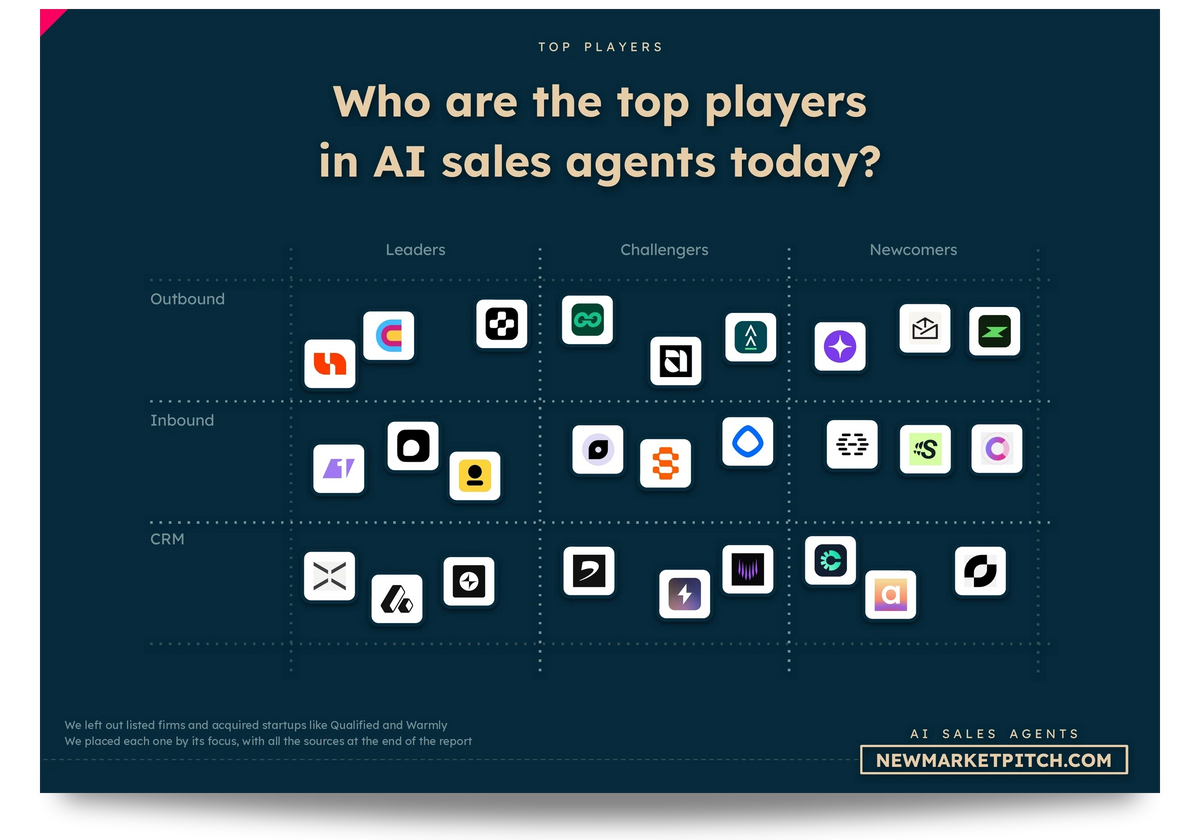
In our report covering the AI sales agent market, we turn what is vague and complex into simple, useful visuals. Market maps like this one show you at a glance where every startup stands.
Top startups in the AI sales agents market ranked by valuation
Here is an updated table that ranks the top startups in the AI sales agents market based on their latest reported or estimated valuations.
If you need to dig deeper and get more detailed data, please check our report covering the AI sales agents market.
| # | Startup | Valuation | Confidence | Valuation basis | Last round | Total funding |
|---|---|---|---|---|---|---|
| 1 | Rox1Autonomous AI sales operations agents | $1.1B–$1.3B | Strong | Implied valuation from raise | UndisclosedGrowth / venture · 2025 | $50M+valued at 24.0× this |
| 2 | Monaco1AI-native end-to-end sales platform | $350M–$600M | Partial | Implied valuation from raise | $50MSeries B · May 2026 | $85Mvalued at 5.6× this |
| 3 | Netic1AI sales agents for trades | $443M–$450M | Partial | Implied valuation from raise | $23MSeries B · Nov 2025 | $43M+valued at 10.4× this |
| 4 | UnifyAI-powered outbound sales automation | $267M–$500Mas of Jul 2025 | Strong | Implied valuation from raise | $12MSeries A · Jun 2026 | $59Mvalued at 6.5× this |
| 5 | 11xAutonomous AI sales development representatives | $350Mas of Sep 2024 | Partial | Implied valuation from raise | $50MSeries B · Sep 2024 | $76Mvalued at 4.6× this |
| 6 | AttentionAutomates sales conversations and follow-ups | $200M–$375Mas of Jun 2026 | Strong | Implied valuation from raise | $30MSeries B · Jun 2026 | $47Mvalued at 6.1× this |
| 7 | NooksAI sales prospecting and coaching | $230M–$340M | Partial | Comparables-based estimate | $43MSeries B · Oct 2024 | $70Mvalued at 4.1× this |
| 8 | Yalo2AI conversational commerce and sales | $190M–$320Mas of Oct 2026 | Partial | Comparables-based estimate | $20MSeries C extension · Dec 2023 | $93Mvalued at 2.7× this |
| 9 | Regie.aiAI-powered prospecting and sales engagement | $180M–$320Mas of Oct 2026 | Partial | Comparables-based estimate | $30MSeries B · Feb 2025 | $46Mvalued at 5.4× this |
| 10 | 1mindAI agents for inbound sales | $150M–$250Mas of Dec 2025 | Strong | Implied valuation from raise | $30MSeries A · Nov 2025 | $40Mvalued at 5.0× this |
| 11 | LandbaseAutonomous B2B customer acquisition agents | $155M–$245M | Partial | Implied valuation from raise | $30MSeries A · Jun 2025 | $42Mvalued at 4.7× this |
| 12 | SableInteractive AI sales demonstration agents | $170M–$210M | Strong | Implied valuation from raise | $45MSeries A · Jul 2026 | $45Mvalued at 4.2× this |
| 13 | ConversicaConversational AI for revenue engagement | $120M–$250Mas of Oct 2026 | Partial | Comparables-based estimate | $25MSeries E · Apr 2022 | $132Mvalued at 1.4× this |
| 14 | ArtisanAutomates personalized B2B sales outreach | $110M–$200Mas of Oct 2026 | Partial | Comparables-based estimate | $25MSeries A · Apr 2025 | $39M+valued at 4.0× this |
| 15 | AurasellAI-native CRM and sales automation | $120M–$180M | Partial | Comparables-based estimate | $30MSeed · Aug 2025 | $30Mvalued at 5.0× this |
| 16 | LightfieldAI-native CRM and sales automation | $110M–$150M | Strong | Implied valuation from raise | $47MSeries A · Sep 2026 | $122Mvalued at 1.1× this |
| 17 | AltaAI agents for revenue operations | $100M–$140M | Strong | Implied valuation from raise | $25MSeries A · Jul 2026 | $32Mvalued at 3.8× this |
| 18 | SelaAI voice agents for mortgages | $80M–$150Mas of Oct 2026 | Partial | Comparables-based estimate | UndisclosedSeries A · Sep 2026 | $21Mvalued at 5.5× this |
| 19 | VambeAI-powered conversational sales agents | $85M–$120M | Strong | Comparables-based estimate | $14MSeries A · Dec 2025 | $18Mvalued at 5.7× this |
| 20 | AirspeedAutomates post-call sales execution workflows | $80M–$100M | Strong | Implied valuation from raise | $20MSeries A · Jun 2026 | $26Mvalued at 3.5× this |
| 21 | AmplemarketAI-powered multichannel sales prospecting | $60M–$110M | Partial | Comparables-based estimate | UndisclosedSeries A · Apr 2022 | $12M+valued at 7.1× this |
| 22 | telliAI agents for customer conversations | $60M–$100Mas of Jul 2026 | Strong | Implied valuation from raise | $15MSeed · Jul 2026 | $19Mvalued at 4.3× this |
| 23 | Uniti AIAI leasing and sales agents | $60M–$100M | Strong | Implied valuation from raise | $12MSeries A · Jul 2026 | $16Mvalued at 5.0× this |
| 24 | SparaAI agents converting inbound leads | $60M–$100Mas of Sep 2025 | Strong | Implied valuation from raise | $15MSeed · Sep 2025 | $15Mvalued at 5.3× this |
| 25 | DocketAI sales engineering and enablement | $60M–$90M | Partial | Comparables-based estimate | $15MSeries A · Jul 2024 | $20Mvalued at 3.8× this |
| 26 | Simple AIAI voice agents for sales | $56M–$93Mas of Feb 2026 | Strong | Implied valuation from raise | UndisclosedSep 2026 | $14Mvalued at 5.3× this |
| 27 | RemarkAI shopping advice and conversion | $60M–$85M | Partial | Comparables-based estimate | $16MSeries A · Jul 2025 | $26Mvalued at 2.8× this |
| 28 | Sprouts.aiAutonomous B2B revenue generation agents | $45M–$70M | Partial | Implied valuation from raise | $9MPre-Series A · May 2026 | $14Mvalued at 4.1× this |
| 29 | OutRival3Enterprise outbound conversational AI agents | $30M–$80M | Low | Proxy-based estimate | $52Mvalued at 1.1× this | |
| 30 | Rep AIAI sales concierge for ecommerce | $45M–$65M | Partial | Implied valuation from raise | $6.2MSeries A extension · May 2026 | $20Mvalued at 2.8× this |
| 31 | ZeroAutonomous CRM and sales workflows | $41M–$59M | Strong | Implied valuation from raise | $10MSeed · Sep 2026 | $13Mvalued at 3.8× this |
| 32 | ForgepointAutomates manufacturing quoting and sales | $39M–$59M | Strong | Implied valuation from raise | $9.8MSeed · Oct 2026 | $9.8Mvalued at 5.0× this |
| 33 | ZeliqAI sales prospecting and outreach | $35M–$60M | Partial | Comparables-based estimate | ~$8MSeed extension · Sep 2026 | $20Mvalued at 2.4× this |
| 34 | Jeeva AIAI sales prospecting workflow agents | $36M–$54M | Partial | Implied valuation from raise | $9MSeed · Dec 2025 | $38M+valued at 1.2× this |
| 35 | DaptaAI agents converting inbound leads | $30M–$45M | Strong | Implied valuation from raise | $6MSeed · Oct 2026 | $7.4M+valued at 5.1× this |
| 36 | Swan AIAutonomous go-to-market workflow agents | $24M–$36M | Strong | Implied valuation from raise | $6MSeed · Feb 2026 | $6Mvalued at 5.0× this |
| 37 | HobbesAutonomous interactive B2B product demos | $22M–$34M | Partial | Implied valuation from raise | $5MSeed · Apr 2026 | $6Mvalued at 4.7× this |
| 38 | SupersonikAutonomous interactive software demo agents | $21M–$34M | Partial | Comparables-based estimate | $5MSeed · Sep 2025 | $5Mvalued at 5.5× this |
| 39 | ThoughtlyAI voice and customer engagement | $22M–$33M | Strong | Implied valuation from raise | $5.5MSeed · Apr 2026 | $9.5Mvalued at 2.9× this |
| 40 | ArrowheadVoice AI agents for financial sales | $18M–$30M | Partial | Implied valuation from raise | $3MSeed · Jan 2026 | $3.3Mvalued at 7.3× this |
| 41 | Expertise AIAI agents for enterprise sales | $18M–$30M | Partial | Implied valuation from raise | ~$2.3MSeed · Sep 2026 | $2.3Mvalued at 10.4× this |
| 42 | RaynmakerAutonomous sales platform for SMBs | $18M–$30M | Partial | Implied valuation from raise | $5MSeed · May 2025 | $5Mvalued at 4.8× this |
| 43 | LeadOpMultichannel AI lead qualification agents | $17M–$30M | Low | Implied valuation from raise | $4.5MSeed · 2026 | $4.5Mvalued at 5.2× this |
| 44 | SharpiWhatsApp-based B2B sales automation | $18M–$28M | Partial | Implied valuation from raise | $4MSeed · Aug 2026 | $5.2Mvalued at 4.4× this |
| 45 | DialogAI shopping agents for ecommerce | $12M–$28M | Low | Proxy-based estimate | ~$4.4MSeed · Nov 2025 | $4.4Mvalued at 4.5× this |
| 46 | BreakoutConverts website visitors into leads | $13M–$20M | Partial | Comparables-based estimate | $3.2MSeed · Feb 2025 | $3.2Mvalued at 5.1× this |
| 47 | AvinaAI-driven buyer intent and outreach | $12M–$19M | Partial | Comparables-based estimate | $3.2MSeed · Oct 2024 | $3.2Mvalued at 4.8× this |
| 48 | AiSDRAutonomous outbound prospecting and meetings | $11M–$19M | Partial | Comparables-based estimate | UndisclosedSeed / Angel · Apr 2026 | $3.1M+valued at 4.8× this |
| 49 | Outcraft AIOmnichannel autonomous revenue recovery agents | $9M–$15M | Partial | Implied valuation from raise | ~$2.4MPre-seed · Apr 2026 | $4.4M+valued at 2.8× this |
| 50 | Venta AIAI agents for compliant prospecting | $8M–$14M | Partial | Comparables-based estimate | $2MPre-seed · Jul 2025 | $2.1Mvalued at 5.2× this |
| 51 | FloworksAutonomous AI sales development agents | $5M–$13M | Low | Proxy-based estimate | $1.5MSeed · Aug 2023 | $1.7Mvalued at 5.4× this |
| 52 | EnrolaAI sales agents for B2C | $7M–$11M | Partial | Implied valuation from raise | ~$1.5MSeed · Aug 2026 | $2.2M+valued at 4.2× this |
| 53 | TopoAI outbound prospecting and qualification | $4M–$8M | Low | Implied valuation from raise | ~$1MConvertible / Pre-Seed · Apr 2024 | $1.6M+valued at 3.8× this |
No startups match this search.
- Total funding is a minimum: some rounds have no public amount.
- Total funding: yalo's total may be $93M or $113M; one 2023 round may overlap.
- Total funding includes Career Karma's earlier funding, before it became OutRival.

Our research about AI sales agents gets updated several times a month, so you always get the latest view of where things stand.
Which startups in the AI sales agents market are worth the most?
Rox currently leads the AI sales agents market with a valuation of $1.1B–$1.3B, followed by Monaco at $350M–$600M and Netic at $443M–$450M.
These three companies approach sales automation quite differently. Rox develops agents that work across existing CRM and revenue systems. Monaco is building an AI-native sales platform that combines several functions in one product. Netic focuses on trades businesses, where handling customer inquiries and booking appointments can directly increase revenue.
Unify, valued at $267M–$500M, 11x, valued at $350M, and Nooks, valued at $230M–$340M, follow further down the ranking. Nooks and Unify both focus on prospecting, although Nooks combines automation with tools for human sales representatives, while Unify emphasizes identifying potential buyers and automating outbound campaigns.
The biggest bets are going toward companies that want to automate entire sales workflows. Rox and Monaco have particularly broad ambitions, while Netic shows that a company targeting one industry can also attract a substantial valuation.
These are very different businesses, though. A company selling AI agents to enterprise revenue teams faces different adoption barriers and operating costs from one helping local trades businesses book more jobs. Their valuations reflect those different opportunities.
How many AI sales agent startups are worth more than $1 billion?
There is currently just one AI sales agents unicorn in our ranking: Rox, with a valuation of $1.1B–$1.3B.
Rox reached that position after a financing round reported by TechCrunch in March 2026. The publication said the transaction had closed in 2025 at approximately $1.2 billion, with General Catalyst among the investors.
The gap between Rox and the other startups is substantial. Monaco, ranked second at $350M–$600M, would need a considerable increase in valuation to reach $1 billion. Netic, ranked third at $443M–$450M, is also well below that threshold.
Across the 53 private startups we analyzed, most remain relatively small compared with the leading companies. Only a handful have reached valuations in the hundreds of millions of dollars.
That makes this an unusually top-heavy market. One company has secured a billion-dollar valuation, a small group is approaching the half-billion-dollar level, and many competitors are still building their customer bases and proving their business models.
The next unicorn could emerge quickly if a startup combines rapid revenue growth with a large funding round. But for now, Rox has a clear lead.

In our market report about AI sales agents, we look at what the winners do differently, so you can learn from the best instead of guessing.
Why is Rox the most valuable AI sales agent startup?
Rox is valued at $1.1B–$1.3B largely because investors believe its autonomous agents could become an important part of how businesses manage sales, customer accounts, and revenue operations.
Founded in 2024 by former New Relic executive Ishan Mukherjee, Rox announced $50 million in funding in November 2024, backed by Sequoia, General Catalyst, and GV.
Its agents work alongside existing business software, monitoring customer accounts, researching prospects, updating CRM records, and identifying opportunities. Rather than requiring companies to replace their existing systems, Rox aims to make those systems more useful through automation.
The valuation is particularly interesting when compared with the company's reported revenue. TechCrunch reported that, when Rox completed its subsequent financing in 2025, investors were working with a projection of approximately $8 million in annual recurring revenue by year-end.
Using the $1.2 billion transaction valuation reported by TechCrunch, that represents around 150 times projected ARR. That's a huge multiple, even for a fast-growing AI software company.
Investors were clearly betting on Rox becoming much bigger than its revenue at the time suggested. Its customers reportedly include Ramp, MongoDB, and New Relic, giving the company some recognizable enterprise references.
There is a practical reason the model appeals to investors. Businesses have already spent years building their CRM systems, customer databases, and sales processes. An agent that improves those systems without requiring a full replacement could be easier to deploy and expand across an organization.
But a revenue multiple this high leaves very little room for disappointing growth or weak retention. Rox will need to turn its broad platform ambitions into a substantially larger recurring-revenue business to justify its valuation.
Is Monaco becoming a serious competitor to Rox?
Monaco is already one of the biggest AI sales agent startups, with a valuation of $350M–$600M, but it hasn't matched Rox's position.
The company emerged from stealth in February 2026 under the leadership of Sam Blond, formerly president of Brex. Just three months later, Monaco announced a $50 million Series B led by Benchmark, bringing total funding to more than $85 million.
According to the company's May 2026 announcement, Monaco had already attracted hundreds of customers during its public beta.
That's a fast start for a newly launched sales platform. The more important test will be how many of those customers expand their spending and continue using the product over time.
Monaco is trying to replace several separate sales tools with one integrated platform. Rox takes another route by connecting agents to systems businesses already use.
The distinction is significant. Monaco needs companies to adopt its platform more broadly, while Rox can potentially expand within organizations that want to keep their existing software.
Monaco could eventually benefit from controlling more of the sales workflow and reducing the need for separate subscriptions. Rox, on the other hand, has the advantage of fitting into established enterprise software environments.
Neither strategy has clearly won. Monaco has demonstrated early customer interest and strong investor backing, while Rox currently holds a much higher valuation. How quickly Monaco turns that initial adoption into recurring revenue will be particularly interesting to watch.

In our document detailing everything you need to know about AI sales agent, you will always find fresh funding data, taken straight from our own verified funding database.
Are investors putting more money into AI sales agent startups?
Investors are committing substantial amounts to AI sales automation, with large funding rounds going to platforms, prospecting tools, and specialized agents.
Monaco raised a $50 million Series B in May 2026, following earlier financing that brought its total above $85 million. Rox had announced $50 million back in November 2024 before its subsequent billion-dollar valuation.
Nooks raised $43 million in October 2024, bringing its total funding to $70 million. Meanwhile, 1mind publicly launched in November 2025 with $40 million in cumulative financing, including a $30 million Series A led by Battery Ventures.
The range of business models is revealing. Nooks helps human sales teams generate pipeline, 1mind builds agents for inbound sales, and Monaco wants to manage much more of the sales process.
Further down the market, smaller financing rounds continue to support narrowly focused products. Sela announced $21 million in financing in September 2026 to expand its mortgage sales voice agents.
There is plenty of funding activity across different stages and products, although these announcements alone don't establish a market-wide acceleration. Some rounds closed months before they were reported, and the transactions span several years.
The more interesting development is that investors are no longer backing only the idea of an autonomous AI salesperson. They are financing companies that automate individual steps of the sales process, industry-specific conversations, and entire revenue operations platforms.
That creates room for different winners. A startup does not necessarily need to build the most capable general-purpose agent to become a valuable business.
Which types of AI sales startups get the highest valuations?
AI sales startups that automate broad revenue workflows currently attract some of the highest valuations, although highly specialized businesses can also command hundreds of millions of dollars.
Rox, Monaco, Aurasell, Lightfield, and Zero focus on CRM systems, revenue operations, or wider sales workflows. Their products can potentially become part of a company's everyday sales infrastructure.
Nooks, Unify, 11x, Artisan, Regie.ai, and Amplemarket concentrate more heavily on prospecting and outbound engagement.
A third group targets specific types of transactions. Netic builds agents for trades businesses, Sela handles mortgage sales conversations, and Uniti AI automates leasing and sales interactions.
These differences affect how customers evaluate the products. A prospecting tool might be judged by qualified meetings and pipeline generated. A mortgage sales agent can be assessed against loan applications, conversions, and funded mortgages. A broader revenue platform must prove that integrating multiple functions creates enough value to justify its cost.
There are also different commercial trade-offs. Broad platforms have larger potential markets but face more competition from established software providers. Specialized agents can solve a very specific problem, though their addressable customer base may be smaller.
The highest valuations are spread across both approaches. There's no clear winner yet between companies building comprehensive sales infrastructure and those automating narrower, high-value activities.
Over time, the companies with the strongest positions are likely to be those that become difficult to replace because they control important workflows, improve measurable sales outcomes, or accumulate useful customer-specific data.

Learning from others' mistakes is the cheapest lesson there is. In our report covering the AI sales agent market, we look at what broke startups before you, so you don't repeat it.
Can AI sales agents actually replace human salespeople?
AI sales agents can already take over a significant amount of repetitive sales work, but they still fall short of replacing human representatives in complex B2B purchases.
Gartner's May 2026 research gives us a useful comparison. In a survey of 645 B2B buyers conducted in August and September 2025, respondents were 28 percentage points more likely to say a human representative helped advance their purchase than generative AI.
The human advantage increased to 32 percentage points for creating confidence in a purchase decision and 39 percentage points for understanding buyer needs.
At the same time, Gartner found that 69% of B2B buyers preferred to validate AI-generated information with a salesperson, even though many wanted to handle the earlier stages of purchasing themselves.
This fits the products emerging in the market. Companies such as Artisan and 11x automate outbound prospecting. Nooks assists human representatives. Rox handles administrative and research workflows, while Sela can involve a human loan officer when a mortgage conversation requires one.
The most straightforward sales activities are already being automated: researching accounts, drafting messages, following up with leads, scheduling meetings, and updating records.
Complex negotiations, organizational politics, unusual customer requirements, and large financial commitments are much harder to delegate completely.
Consider a company buying enterprise software worth several million dollars. The decision can involve procurement teams, technical evaluations, internal disagreements, legal negotiations, and executives with competing priorities. An AI agent may help manage the process, but replacing the people responsible for those relationships is another matter.
Gartner has also predicted that AI agents could outnumber human sellers ten to one by 2028, while fewer than 40% of sellers would report productivity improvements from those agents.
That forecast captures the industry's main problem: deploying more agents is relatively easy, but making a sales organization genuinely more effective is harder.
Are autonomous AI SDRs really working?
Autonomous AI sales development representatives can generate outreach at scale, but their ability to produce qualified sales opportunities consistently is still being tested.
11x is a particularly useful example. The company raised a reported $50 million Series B after a $24 million Series A in 2024, attracting support from Andreessen Horowitz and Benchmark.
Its pitch was straightforward: AI sales representatives could research prospects, personalize outreach, and schedule meetings with less human involvement.
However, TechCrunch reported in March 2025 that ZoomInfo and Airtable disputed being presented as customers after conducting limited trials. ZoomInfo said the product performed worse than its own sales development representatives during testing, while Airtable said the software had never been deployed to its production sales team.
11x disputed aspects of the reporting, and TechCrunch also confirmed that other companies, including Pleo and Rho, were genuine users.
The episode exposed a problem that applies across automated prospecting. A product can generate large numbers of messages and conversations while producing relatively few valuable sales opportunities.
More outreach doesn't necessarily mean better selling. In fact, poorly targeted automation can create extra work for sales teams that have to filter out irrelevant meetings or respond to prospects who were never serious buyers.
That distinction also affects how we assess Artisan, Regie.ai, AiSDR, and Floworks. Their commercial success depends on customers renewing subscriptions because the software improves actual selling results.
We would pay particularly close attention to qualified meetings, opportunities accepted by sales teams, customer retention, and the cost of generating each successful opportunity.
These figures reveal much more about an autonomous SDR than the total number of emails it sends.

Your time is limited. In our research about AI sales agents, we put numbers on each part of the market, so you can see where it makes sense to focus.
Are AI sales agents generating real revenue for businesses?
AI sales agents are already producing measurable commercial activity, although the evidence for incremental profit remains much thinner than the evidence for higher productivity.
Salesforce reported in February 2026 that its internal agents had contacted 130,000 previously neglected leads over four months and created 3,200 sales opportunities.
That represents an opportunity creation rate of approximately 2.46%, or one opportunity for every 41 leads contacted.
The result is meaningful because those leads might otherwise have remained untouched. But Salesforce did not disclose how many of the opportunities became paying customers or how much incremental profit the agents generated.
Sela provides another concrete example. In September 2026, the mortgage AI startup announced more than $10 million in annualized run-rate revenue after approximately 18 months. It also said its agents helped loan officers originate over $1 billion in mortgages per month.
Those mortgage originations are customer transaction volumes supported by Sela, rather than revenue earned by the startup. Still, they demonstrate that the product is being used in commercially important processes.
Gartner's May 2026 research also found that sales organizations using AI-enabled recommendations for the next best action were 2.6 times more likely to achieve commercial growth. This is an association, rather than proof that AI independently caused the improvement.
There is a sizable gap between the activity generated by an agent and the additional profit attributable to it. The following measures help show where that gap appears.
| Measure | What it tells us | Main limitation |
|---|---|---|
| Leads contacted | Volume of outreach | No proof of buyer interest |
| Conversations completed | Customer engagement | Conversation quality can vary |
| Meetings booked | Initial conversion | Meetings may be unqualified |
| Qualified opportunities | Potential sales pipeline | Deals may never close |
| Pipeline generated | Estimated future sales | Values can be overstated |
| Contracts signed | Actual sales conversion | Revenue may not yet be collected |
| Revenue collected | Real customer spending | Incremental contribution can remain unclear |
| Net profit contribution | Financial benefit after attributable costs | Requires reliable cost and attribution data |
Are Nooks and Unify better bets than fully autonomous sales agents?
Nooks and Unify offer a potentially safer approach to AI sales automation because businesses can use their products to improve existing teams without handing over the entire sales process.
Nooks is valued at $230M–$340M and has raised $70 million. Its AI Sales Assistant Platform combines prospecting, dialing, and coaching, with salespeople remaining responsible for important customer interactions.
Unify, valued at $267M–$500M, has raised $59 million. Its software uses buying signals to help companies identify potential customers and automate outbound engagement.
Their approaches address two persistent problems. Salespeople spend a lot of time researching potential buyers, and companies frequently struggle to contact prospects at the right moment.
Salesforce's 2026 State of Sales report helps put that problem into context. In its survey, 48% of sales professionals said they lacked enough time for adequate cold outreach, despite already spending nearly a full working day each week prospecting.
For tools such as Nooks and Unify, that creates a practical opportunity. They can save time and help sales teams contact more relevant prospects without promising that an AI agent will independently close every deal.
There is also a simpler purchasing argument. A sales manager may be more comfortable buying software that helps ten existing representatives become more productive than replacing those representatives with an unfamiliar autonomous system.
That doesn't automatically make the assisted model more profitable or defensible. Fully autonomous agents could eventually have a bigger impact on labor costs if they achieve comparable sales results.
But supporting an existing sales team can be an easier product to adopt than replacing its established workflow altogether. For the moment, that is a meaningful advantage.

In our market report about AI sales agents, we always try to gather several sources and make estimates that make sense, so you can work with solid numbers.
Are industry-specific AI sales agents becoming more valuable?
Industry-specific AI sales agents are becoming an attractive part of the market because their results can often be tied to appointments, applications, leases, or completed transactions.
Netic is the strongest valuation example, at $443M–$450M. It develops sales agents for trades businesses, where a missed customer call may mean losing a service booking to a competitor.
Sela, valued at $80M–$150M, applies voice AI to mortgage conversations. According to its September 2026 announcement, six of the ten largest independent mortgage banks were already using its technology.
Uniti AI, valued at $60M–$100M, focuses on leasing and sales. Its customers can evaluate automation through inquiry handling, appointments, and potentially signed leases.
All three businesses operate in environments where speed matters and the next step in the sales process is relatively clear.
A plumbing company wants to turn an inquiry into a booked job. A mortgage lender wants to move an eligible applicant toward a funded loan. A property manager wants to turn a prospective tenant into a lease.
That's considerably more concrete than asking whether a general-purpose chatbot improved sales productivity.
The downside of specialization is a smaller initial customer market. Products also need to handle industry-specific rules, data, and integrations.
Mortgage agents, for instance, must work within a regulated financial environment. Trades businesses have different scheduling and customer-management requirements. Property leasing brings its own operational and legal complexities.
Still, the ability to connect automation with a recognizable financial outcome gives vertical sales agents a strong commercial argument, particularly when customers can measure improvements against their previous performance.
Is conversational AI becoming important for ecommerce sales?
Conversational AI is already being used to sell products through messaging and online stores, although its overall contribution to ecommerce revenue remains difficult to quantify.
Yalo, valued at $190M–$320M, is the highest-ranked conversational commerce startup. In May 2021, TechCrunch reported that Yalo had raised $50 million, bringing its disclosed funding at that time to $75 million.
The company was already working with brands such as Unilever, Nestlé, Coca-Cola, and Walmart, primarily helping businesses engage customers through channels including WhatsApp.
In that reporting, Yalo's CEO said some customers were generating as much as 80% of their sales through messaging applications. That was a claim about selected customers, rather than an industry-wide conversion figure.
More recently, startups such as Remark, Rep AI, and Dialog have built products that help online shoppers find suitable products, ask questions, and complete purchases.
Remark is valued at $60M–$85M, Rep AI at $45M–$65M, and Dialog at $12M–$28M.
The products differ in their target customers and integrations, but all attempt to make online buying more conversational.
There's a natural fit here. Customers already ask questions before purchasing products, especially when choosing between similar items, checking availability, or trying to understand technical specifications.
An AI shopping assistant can handle those conversations without making customers search through product pages or wait for a support representative.
For ecommerce merchants, though, the important question is whether AI assistance creates additional sales. A chatbot that answers product questions may improve customer experience, yet its financial value becomes much clearer when a controlled experiment shows higher conversion or larger orders.

If you build or invest in the AI sales agent market, you need to know which business models pay off now and which ones are fading. That's why our report covering it has a whole section on it.
Are AI voice sales agents becoming a big business?
AI voice sales agents are gaining commercial traction, especially in businesses where answering calls quickly can increase the number of customers who complete a transaction.
Sela currently stands out among voice-focused sales startups with its $80M–$150M valuation and reported annualized run-rate revenue above $10 million.
Its mortgage specialization gives it a direct connection to loan origination, an activity where a successful customer conversion can be worth considerably more than a routine support interaction.
Other startups are pursuing related opportunities. Simple AI, valued at $56M–$93M, develops voice agents for sales. Thoughtly, valued at $22M–$33M, offers voice and customer engagement automation. Arrowhead, valued at $18M–$30M, focuses on financial sales conversations.
The economics can become attractive when agents handle high call volumes outside regular business hours or reduce the number of missed inquiries.
Imagine a potential customer calling a business at 9 p.m. An AI agent that answers immediately, handles basic questions, and books an appointment can create value from a conversation that might otherwise have been lost.
But voice quality alone is a weak measure of success. An agent needs to answer accurately, qualify customers, follow industry rules, and recognize situations that require a human.
For a mortgage lender or financial services company, getting an answer wrong can be much more serious than failing to book an appointment.
The stronger products will be those that show how many additional customers they convert after accounting for call costs, failed interactions, and human supervision.
Can small AI sales startups compete with Rox and Monaco?
Smaller AI sales startups can compete effectively in particular workflows, even though Rox and Monaco have far more ambitious valuations and broader platform strategies.
Jeeva AI, valued at $36M–$54M, focuses on sales prospecting workflows. Dapta, at $30M–$45M, helps convert inbound leads. Swan AI, at $24M–$36M, automates go-to-market activities.
Other companies concentrate on even narrower problems. Breakout, valued at $13M–$20M, converts website visitors into leads, while Avina, at $12M–$19M, helps identify buyer intent.
These companies do not necessarily need to replace an entire sales organization to succeed. A business might pay for one tool that consistently increases qualified inbound opportunities, even while keeping its existing CRM and other sales software.
The challenge is defending that niche.
Salesforce and other established vendors are adding agent capabilities to platforms their customers already use. In March 2026, Salesforce introduced a broader Agentforce Sales offering, including research, prospecting, lead nurturing, pipeline management, and quoting.
Its distribution advantage is considerable. Salesforce said approximately 170,000 companies already operated on its platform, giving it a large customer base to approach with AI features.
A standalone startup selling an AI prospecting tool may therefore find itself competing with a feature that customers can activate inside software they already pay for.
Smaller startups will need to outperform these built-in alternatives through better specialized workflows, cross-platform integrations, faster deployment, or stronger customer results.
That is achievable, but simply offering an AI-powered feature is becoming less distinctive. A narrowly focused startup with excellent results can still win customers; one offering only a slightly better version of a standard CRM feature will have a much tougher time.

In our report covering the AI sales agent market, we don't want to repeat what boring consulting reports say. Instead, we show you the real and latest market signals that matter.
Which countries have the most valuable AI sales agent startups?
The United States dominates the top of the AI sales agents ranking, while Latin America and Europe have produced several notable companies serving more specific markets.
The first seven companies, Rox, Monaco, Netic, Unify, 11x, Attention, and Nooks, are American. Mexico's Yalo appears in eighth position, making it the highest-ranked company headquartered outside the United States.
Israel is represented by Alta, valued at $100M–$140M, while Chile's Vambe is valued at $85M–$120M.
Germany has telli and Venta AI, France has Zeliq, Topo and Dialog, and the United Kingdom is represented by Airspeed.
Latin America is particularly interesting because messaging-based commerce plays an important role in customer interactions. Yalo, Vambe, and Sharpi approach sales automation through different regional and commercial needs.
The US advantage is most visible in the largest funding rounds and platform-focused companies. Its enterprise software ecosystem also gives sales automation startups access to customers already accustomed to paying for CRM, prospecting, and revenue operations tools.
Elsewhere, local selling practices create opportunities for more specialized businesses. A company automating WhatsApp conversations for Latin American merchants may face a very different competitive environment from one building AI agents for American enterprise sales teams.
| Country | Startups | Main focus |
|---|---|---|
| United States | Rox, Monaco, Nooks | Sales platforms and prospecting |
| Mexico | Yalo | Conversational commerce |
| Israel | Alta, Swan AI | AI revenue operations |
| Chile | Vambe | Conversational sales |
| Germany | telli, Venta AI | Customer conversations and prospecting |
| United Kingdom | Airspeed | Post-call sales workflows |
| France | Zeliq, Topo | Prospecting and outreach |
| Brazil | Sharpi | WhatsApp sales automation |
| India | Arrowhead, Floworks | Financial sales and outbound agents |
Are AI sales agent startups overvalued right now?
Some AI sales agent valuations look aggressive relative to the revenue disclosed so far, particularly at the top of the market. But labeling the entire industry overvalued would be premature.
Rox offers the clearest example. Its $1.1B–$1.3B valuation reflects expectations of considerable future growth, especially compared with TechCrunch's report of approximately $8 million in projected year-end ARR at the time of its financing.
Sela presents a different profile. Its $80M–$150M valuation sits alongside a company-announced annualized run-rate revenue figure above $10 million.
Those figures come from different periods and reflect different business models, so a direct comparison would be misleading. Still, they show just how differently AI sales companies can be valued.
There's also a broader concern about the economics of AI agents.
In an October 2026 analysis, Gartner said fewer than 10% of the nearly 1,000 agentic AI deployments it reviewed were delivering robust ROI. The firm also warned that inference costs per agentic workflow could rise more than fivefold through 2028 as agent tasks become more complex.
Those findings cover agentic AI broadly, rather than AI sales startups specifically. But the underlying cost issue applies to companies running large volumes of automated research, conversations, and multistep workflows.
A startup can grow revenue rapidly while spending heavily on model inference, infrastructure, implementation, and customer acquisition.
Usage-based costs are particularly important. If an agent needs increasingly expensive models and many separate operations to complete a sale, revenue growth may not translate into the software margins investors expect.
There is a real valuation risk for companies whose pricing and margins fail to keep pace with their operating costs. The strongest businesses should be able to show growing recurring revenue, good customer retention, and improving contribution margins as usage increases.
For highly valued startups, the bar is even higher. Investors are already pricing in substantial expansion, so merely proving that AI agents work will not be enough.

In our research about AI sales agents, we like to show you the big picture. We know your time is precious, so we make every page quick to read and packed with as much learning as possible per minute.
Which AI sales agent startups could become the next unicorns?
Monaco and Netic currently look like the most natural candidates to follow Rox into billion-dollar territory, based on their valuations and opportunities to expand.
Monaco's $350M–$600M valuation already places it within reach of a higher funding-round valuation if customer growth continues. Its more than $85 million in financing also gives it substantial resources to develop its platform and expand sales.
Netic, valued at $443M–$450M, could benefit from the large number of trades businesses seeking better lead handling and appointment conversion.
Nooks and Unify are also worth following. Both have accumulated meaningful financing and focus on activities that sales teams perform repeatedly.
Yalo offers a different route through conversational commerce, particularly in markets where messaging platforms are widely used for customer relationships.
These companies would reach the billion-dollar mark through very different strategies. Monaco could grow by replacing multiple sales tools. Netic could expand across more trades businesses and related services. Nooks and Unify could capture a larger share of spending on sales productivity and prospecting.
But reaching $1 billion requires a major increase in company value, and a large addressable market alone will not establish that value.
We would look for three things: rapidly growing recurring revenue, customers who keep paying because the product improves sales outcomes, and enough margin to support further expansion.
For Monaco, the immediate question is how quickly its early customer base turns into meaningful recurring revenue. For Netic, it is whether industry-specific automation can scale across a large enough customer base.
Both have attractive opportunities. Neither is guaranteed to become a unicorn simply because investors have already assigned it a substantial valuation.
What is the outlook for AI sales agent startup valuations?
AI sales agent valuations have room to grow, but future winners will be the companies that consistently deliver measurable sales improvements rather than simply automate more tasks.
Rox currently leads the market, with Monaco and Netic forming the next tier. The remaining companies span prospecting, CRM automation, ecommerce, voice agents, and industry-specific sales workflows.
The commercial opportunity is genuine. Salesforce has shown that agents can work through previously neglected leads. Sela has disclosed substantial mortgage activity supported by its software. Gartner's research also shows that AI-enabled recommendations can be associated with stronger commercial results.
Yet the evidence points to clear limits. Buyers still rely heavily on human sales representatives for confidence and complex decisions, and many organizations struggle to calculate the financial benefit of agent deployments.
We expect companies that automate valuable workflows inside existing organizations to have an advantage, particularly when they can prove improvements in conversion rates, sales productivity, or customer acquisition costs.
Some highly specialized agents may also build substantial businesses, especially where every additional completed transaction has a clear financial value.
Competition will become tougher as established CRM and enterprise software companies add more agent capabilities. That could put pressure on standalone startups whose products overlap with features customers already have.
At the same time, AI agents could expand the overall market for sales software by making automation affordable for businesses that previously could not justify large sales teams or complex CRM implementations.
Our view is that AI sales agents are becoming an important software market, but valuations at the top are still running ahead of fully demonstrated profitability. Rox has established the strongest lead, while Monaco and Netic have credible paths toward much larger businesses.
The next wave of valuation growth will depend on whether these companies can turn impressive automation into recurring, profitable revenue at scale. That's the test that will separate lasting sales software businesses from expensive AI experiments.

When you build or invest in the AI sales agent market, you need clarity, not confusion. In our market report about AI sales agents, we always try to put numbers on and quantify whatever is usually vague and confusing.
Our methodology
This analysis ranks the most valuable independent private startups in the AI sales agents market as of November 2026. We focus on companies whose core products automate sales activities, including prospecting, customer engagement, CRM workflows, inbound conversion, voice sales, and industry-specific transactions.
Our valuations draw on completed funding rounds, company and investor announcements, financial reporting, revenue and ARR figures, customer adoption, operating performance, and comparable private-company transactions. We distinguish between valuations established through financing transactions and estimated current company values. Where a directly reported valuation is unavailable, we use a range that reflects the company's financing history, commercial progress, business model, and relevant market comparisons.
Recent completed financing rounds generally receive greater weight than older transactions. We also consider how a company's circumstances may have changed since its last financing, rather than automatically treating every historical valuation as its current worth. Publicly listed companies, acquired businesses, and divisions of established technology groups are excluded from the independent private-startup ranking.
Funding totals, customer activity, and revenue are assessed separately from company valuations. In particular, transaction volumes handled by AI agents, sales opportunities generated, and customer revenue are not treated as revenue earned by the startup itself. We also consider the economics of automation, including recurring revenue, retention, infrastructure costs, and whether the technology produces measurable commercial results.
Key company and financing sources include TechCrunch's reporting on Rox's $1.2 billion valuation, Monaco's Series B announcement, Nooks' funding announcement, 1mind's financing and launch announcement, Sela's funding and commercial results, Axios' coverage of Sela, TechCrunch's reporting on Yalo, and TechCrunch's investigation into 11x.
For broader market context, we used Salesforce's 2026 State of Sales report, Salesforce's Agentforce Sales announcement, Salesforce's product updates, Gartner's research on B2B buyer preferences, Gartner's findings on AI-enabled sales recommendations, Gartner's forecast for AI sales agents, and Gartner's analysis of agentic AI costs and ROI.
A company can appear in this ranking even when its total funding is undisclosed: its position depends on its valuation, not on the capital it has raised.

A good product starts with a real problem. In our document detailing everything you need to know about AI sales agent, we show you the ones customers still live with.
Written by the New Market Pitch teamWe track new markets so founders and investors can move faster. About us