How large is the AI training data market after synthetic data?
Whether you're building or investing in the AI training data market, our report covers everything you need to know: the players, the money, and what's coming next.
Summary
The AI training data market is currently worth about $8 billion to $12 billion a year in external spending, with roughly $10 billion as the most defensible midpoint after including synthetic-data services, expert post-training work, evaluations, proprietary data and reinforcement-learning environments.
Traditional labeling estimates still provide a useful floor, but they no longer describe the whole market. Published figures of roughly $4 billion to $6 billion sit below the visible scale of newer suppliers serving frontier-model development.
The biggest structural shift is not that synthetic data has replaced human data. It is that cheap machine-generated examples are pushing human spending toward harder work: expert task design, verification, evaluation, domain-specific reasoning and long-horizon environments.
Supplier economics show why the category has outgrown old definitions. Scale AI has approached the $2 billion level, while Mercor, Handshake, Micro1 and Snorkel have all reported very large revenue or annualized run-rate figures around newer forms of model-improvement work.
Those supplier figures cannot simply be added together. Some are gross marketplace billings, some are retained revenue, and some are annualized run rates rather than completed annual revenue, so a clean market estimate has to discount overlap and accounting differences.
Standalone synthetic-data revenue remains much smaller than its technological importance. The category is still measured in the hundreds of millions of dollars, while internal synthetic generation inside frontier labs creates no external market revenue at all.
Reinforcement-learning environments are becoming part of the market because advanced models increasingly need interactive tasks rather than static files of labeled examples. That shifts spending toward repositories, browsers, terminals, simulations, reward systems and evaluation logic.
Proprietary licensing adds meaningful revenue but is not the main growth engine. Reddit, publishers and rights holders show that legally clean data can command real money, yet expert post-training work appears to be expanding faster and at larger visible scale.
The scarce asset is increasingly not raw data volume but difficult, trustworthy information near the edge of what current models can do. One verified task that exposes a capability gap can be more valuable than a huge pile of routine synthetic examples.
Synthetic data should keep lowering the cost per example without necessarily lowering total data spending. The more likely near-term pattern is cheaper generation combined with much larger training programs, with human experts concentrated at the hard end of the market.
At roughly 20% to 30% annual growth, today's market could plausibly reach about $20 billion to $30 billion near the end of the decade. That forecast assumes the current startup boom normalizes rather than disappears, and that enterprise AI, robotics and specialized model developers broaden the buyer base beyond a handful of frontier labs.

Written by the New Market Pitch teamWe track new markets so founders and investors can move faster. About us

In our report covering the AI training data market, we always try to gather several sources and make estimates that make sense, so you can work with solid numbers.
What should we actually count as the AI training data market today?
The AI training data market today should include the external data, expert work, evaluations and training environments that companies buy to improve AI models, while internally generated synthetic data should stay outside the revenue total.
That definition has become much more important because “training data” no longer means mainly paying people to label images or transcribe audio. Frontier AI labs now buy difficult coding problems, mathematical reasoning tasks, expert critiques, preference data, model evaluations and interactive environments where agents can learn by doing.
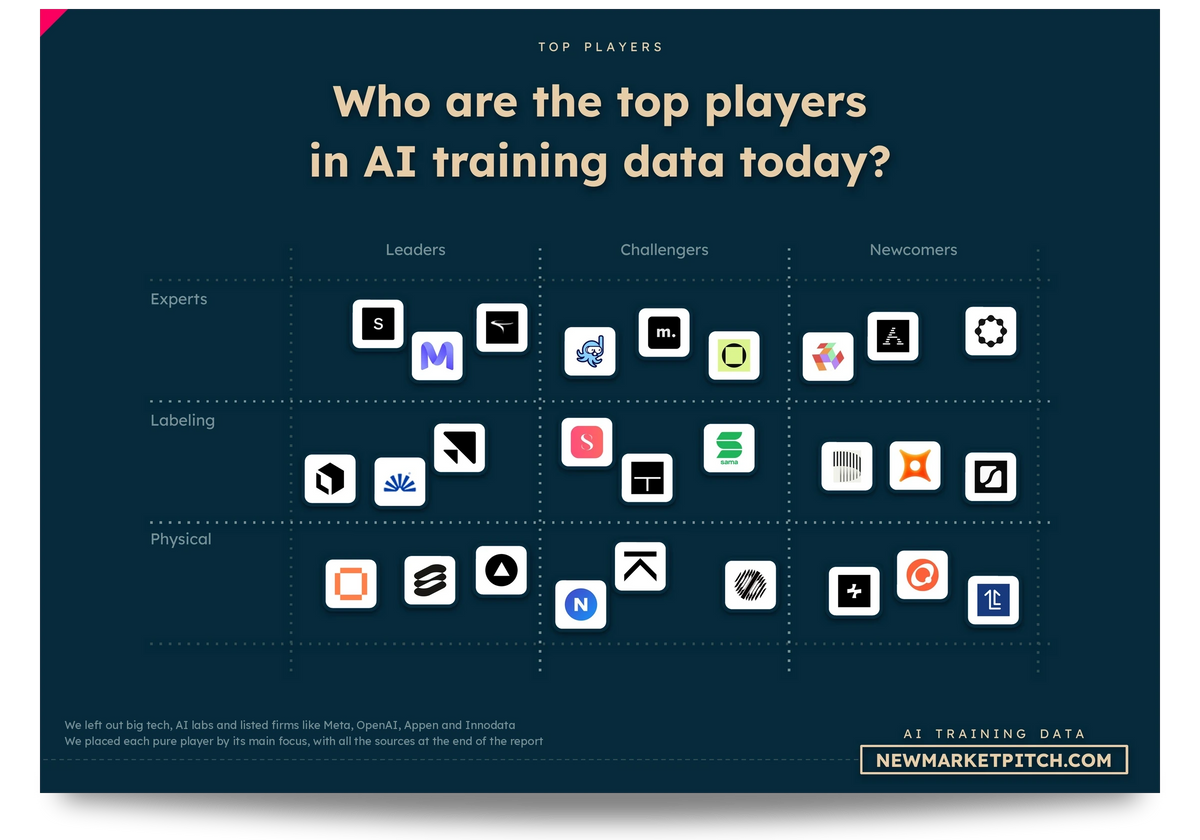
Scale AI, Surge AI, Mercor, Handshake, Turing, Snorkel AI and Micro1 all capture parts of that spending. The terminology changes from supplier to supplier, expert data, post-training, reinforcement learning, evaluations or data-as-a-service, but the customer is ultimately paying for information that makes an AI system better.
Commercial synthetic data also belongs here when money changes hands. A company paying a vendor to generate privacy-safe financial records, simulated driving scenes or artificial training examples creates real market revenue.
Internal generation is different. Meta can use one Llama model to create millions of examples for another Llama model, and the resulting data can be extremely valuable without creating an external data transaction. Counting that activity at some hypothetical market price would inflate the market dramatically.
| Part of the market | What it includes | Count it? |
|---|---|---|
| Human data services | Collection, labeling, annotation | Yes |
| Expert post-training data | Coding, science, reasoning, specialist feedback | Yes |
| Model evaluations | Human or expert scoring of model behavior | Yes |
| RL environments | Interactive tasks and training worlds | Yes |
| Commercial synthetic data | Synthetic datasets and generation services sold to customers | Yes |
| Proprietary data licensing | Paid text, image or specialist datasets used for AI | Yes, when AI-related |
| Internal synthetic generation | Examples produced inside an AI lab | No |
| Training compute | GPUs used to create or process training data | No |
| General databases and storage | Snowflake, data lakes, cloud storage | Usually no |
Why do estimates of the AI training data market differ so much?
AI training data estimates differ so much because the fastest-growing part of the market barely resembles the labeling industry that many research reports still measure.
Grand View Research currently puts global data collection and labeling at about $6.3 billion. Fortune Business Insights gives the narrower AI training dataset market a value of $4.44 billion. Those estimates are close enough to agree on the traditional market's order of magnitude, but they struggle to capture what frontier AI companies now buy.
Mercor pays doctors, lawyers, engineers and scientists to create or review complex model-training work. Snorkel sells complete datasets and reinforcement-learning environments. Prime Intellect provides environments, evaluation tools and RL infrastructure. Arena has built a sizeable business around information generated by people evaluating AI models.
Calling all of that “data labeling” feels increasingly outdated.
There is another complication: suppliers report revenue differently. A marketplace may charge an AI lab $100, pay perhaps $60 or $70 to the expert and describe the full $100 as gross revenue. A different supplier may sell the finished dataset and record the full customer payment as revenue while putting expert compensation into cost of sales.
This is why one market-research number cannot settle the question anymore. We need both top-down estimates and bottom-up supplier evidence.

In our research about AI training data, we don't want to repeat what boring consulting reports say. Instead, we show you the real and latest market signals that matter.
How big is the conventional AI data-labeling market today?
Conventional AI data collection and labeling is roughly a $6 billion global market today, which gives us a useful floor for the broader training-data economy.
Grand View Research estimates $6.3 billion for the current year, up from $3.8 billion two years earlier. Its model implies growth of roughly 29% a year through 2030. Fortune Business Insights takes a narrower view of AI training datasets and estimates $4.44 billion.
Public companies give us another check.
TaskUs generated $214 million from AI Services in 2025, up almost 59% from the previous year. The pace has cooled since then, but AI Services still grew about 26% year over year in its latest reported quarter and remained TaskUs' fastest-growing service line for the sixth consecutive quarter.
Appen has gone through a similar shift. Its overall business stopped behaving like the high-growth labeling company it once was, while generative-AI work became a much larger part of its revenue mix.
Taken together, these figures show why the $4 billion to $6 billion estimates still matter. There is a real, large conventional market underneath the newer AI-data boom. They just no longer capture everything buyers mean when they purchase “training data.”
| Measure | Earlier figure | Current/latest figure | What it tells us |
|---|---|---|---|
| Grand View data collection & labeling | $3.8B in 2024 | $6.3B in 2026 | Traditional market is still growing fast |
| Fortune AI training datasets | $3.59B in 2025 | $4.44B in 2026 | Narrow dataset definition remains smaller |
| TaskUs AI Services | $135M in 2024 | $214M in 2025 | AI work grew 58.6% |
| TaskUs latest AI Services growth | - | ~26% YoY | Growth remains strong but has cooled |
| Grand View 2030 forecast | - | $17.1B | 28.4% projected annual growth |
| Fortune 2034 forecast | - | $23.18B | 22.9% projected annual growth |
| Synthetic-data generation | $218M in 2023 | $528M in 2026 | Standalone synthetic revenue is much smaller |
How big are the largest AI training data companies now?
The largest AI training data suppliers now represent several billion dollars of annual customer spending, which makes a $4 billion estimate for the entire market far too narrow.
Scale AI was expected to approach $2 billion of revenue in 2025 after producing around $870 million in 2024, according to figures reported around Meta's investment in the company.
The newer expert marketplaces have grown even faster. Mercor crossed $2 billion in gross annualized revenue this summer, only four months after crossing $1 billion. Handshake reached roughly $1 billion of gross annualized AI-training revenue. Micro1 moved from about $100 million to $500 million of gross annual run rate in eight months.
Snorkel provides a cleaner comparison because its business model is different. The company said recently that its new data-as-a-service operation had grown more than eighteenfold in a year and reached a $375 million annualized revenue run rate.
Prime Intellect has also reached a reported $100 million annualized run rate from its broader RL and agent-development platform.
We cannot simply add all of these numbers. Mercor, Handshake and Micro1 pass a large share of their billings to contractors, while Scale and Snorkel use different accounting models. Annualized run rates can also exaggerate the revenue a young company will actually recognize over a full year.
Even after those adjustments, the scale is difficult to ignore.
| Supplier | Latest visible scale | Main business represented |
|---|---|---|
| Scale AI | ~$2.0B expected revenue | Data, post-training, evaluation |
| Mercor | ~$2.0B gross annualized | Expert AI training work |
| Handshake | ~$1.0B gross annualized | Expert AI training work |
| Micro1 | ~$500M gross annualized | Expert and AI-generated data |
| Snorkel AI | $375M annualized revenue | Datasets and RL environments |
| TaskUs AI Services | $214M 2025 revenue | AI training and related services |
| Prime Intellect | ~$100M annualized revenue | RL, environments and training tools |
| Arena | ~$100M annualized business | Model evaluation and benchmarking |

In our market report about AI training data, we like to show you the big picture. We know your time is precious, so we make every page quick to read and packed with as much learning as possible per minute.
So how much are companies actually spending on AI training data?
Companies are probably spending around $8 billion to $12 billion a year on external AI training data and closely related model-improvement work today, with roughly $10 billion as our best midpoint.
The top-down evidence gives us the floor. Conventional collection and labeling alone sits around $6 billion under the broader published estimates.
The bottom-up evidence pushes us higher. Scale, Mercor, Handshake, Micro1, Snorkel and other visible specialists account for several billion dollars of activity before we fully include Appen, TaskUs, Turing, TELUS Digital, Sama, Labelbox, regional suppliers, evaluation companies and data-licensing deals.
Some of that activity overlaps with the conventional $6 billion category, so adding everything would overstate the market. Gross marketplace run rates also need to be discounted because a large share goes directly to workers.
That leaves a range rather than a precise number. Below roughly $6 billion, the estimate becomes hard to reconcile with visible supplier activity. Above roughly $15 billion, we would need to include much more software, simulation, data infrastructure and internal work than we think belongs in a clean external-market calculation.
Around $10 billion fits the evidence best for now.
If you want more recent data on this point, please see our latest AI training data market report.
Is synthetic data already a multibillion-dollar market?
Standalone synthetic data is still well below a multibillion-dollar market today, even though synthetic data already plays a huge role inside AI training.
Grand View Research estimates the synthetic-data-generation market at about $528 million. Other research firms use broader definitions and reach higher figures, but the category still sits far below the several-billion-dollar human and expert-data economy.
The gap makes sense once we look at how synthetic data is produced.
A frontier lab can generate millions of artificial examples using models it already owns. The company pays for compute and engineering, but no synthetic-data vendor receives a fee for each generated example.
Synthetic generation is also increasingly hidden inside larger products. Snorkel mixes expert work, software and machine-generated data. Micro1 has started automating parts of data creation. Scale combines people and software in the same workflows. NVIDIA can generate synthetic robotics data through Cosmos and Omniverse while capturing the economic benefit through software, cloud consumption or GPU sales.
So the standalone synthetic-data market understates the technology's influence, but that does not justify treating every internally generated token or simulation as market revenue.
The distinction is important: synthetic data can dominate training volume long before it dominates training-data spending.

In our document detailing everything you need to know about AI training data, we turn what is vague and complex into simple, useful visuals. Market maps like this one show you at a glance where every startup stands.
Has synthetic data actually replaced human training data?
Synthetic data has replaced humans for some repetitive data generation, while demand for difficult human training data has grown sharply at the same time.
Meta gives us a clear example of the first trend. During the development of Llama 3.1, the company said it generated most of its supervised fine-tuning examples synthetically. Microsoft has also made synthetic data central to parts of the Phi training process.
At first glance, that sounds bad for human-data suppliers.
Yet Mercor went from a young startup to $2 billion of gross annualized revenue. Handshake built an AI-training business around $1 billion. Micro1 reached $500 million. Snorkel's newer data business grew more than eighteenfold.
The reason is fairly simple. AI can cheaply generate thousands of variations once someone has defined a good task. Creating the original difficult task, deciding what a strong answer looks like and checking whether the result is actually correct remain much harder.
An experienced software engineer can build a realistic debugging exercise from a production problem. A doctor can create an unusual clinical reasoning case. A mathematician can design a question near the edge of current model ability. Models can then generate variations around those examples.
That is where human work is moving. The market is paying less for repetitive clicking and more for expertise, task design, verification and judgment.
The rapid growth of expert marketplaces is one of the clearest pieces of evidence in the entire market: AI models have become vastly better at generating data, yet spending on high-end human data has surged rather than collapsed.
If you want more recent data on this point, please see our latest AI training data market report.
Are reinforcement-learning environments becoming part of the training data market?
Reinforcement-learning environments are quickly becoming a major part of AI training data because agents need places to act, fail and receive feedback rather than static datasets alone.
A traditional dataset might show a model a coding question and its correct answer. An RL environment can instead give the model a repository, terminal or browser and let it work through the problem step by step.
Those interactions generate trajectories, rewards, failures and evaluations that can feed back into training.
Several suppliers have moved in this direction at once. Snorkel now sells RL environments alongside datasets. Mercor has expanded into environment-building for domains including coding and professional work. Prime Intellect provides hosted environments, reinforcement-learning tools and evaluations. Surge has also pushed further into RL-related work.
Prime Intellect is particularly useful as a reality check because the company has already reached around $100 million of annualized revenue while serving customers such as Ramp and Zapier with a broader training and agent-development stack.
This category barely appeared in older labeling-market definitions.
Today, it belongs in any serious attempt to measure the AI training data economy. As agents become more important, a growing share of “data spending” will look like buying interactive exercises rather than downloading files full of examples.

Our report covering the AI training data market gets updated several times a month, so you always get the latest view of where things stand.
Does licensing Reddit, news and other proprietary data add much to the market?
Proprietary AI data licensing probably adds hundreds of millions of dollars today and could eventually reach low single-digit billions, but it does not change our overall market estimate by an order of magnitude.
Reddit showed what premium internet data can be worth when its pre-IPO filings disclosed more than $200 million of contracted data-licensing value over agreements lasting roughly two to three years. Google's Reddit deal alone was reported at about $60 million annually.
Publishers have followed. OpenAI's multi-year News Corp partnership was reported as potentially worth more than $250 million over five years, including cash and technology credits. OpenAI has also signed agreements with the Financial Times, Axel Springer, Associated Press, Le Monde and other publishers.
Images are moving in the same direction. Getty and other rights holders can offer datasets with clear commercial licensing, which becomes more valuable as model developers worry about copyright exposure.
Many contracts are private, so public deal values understate the category.
Still, the deals we can see mostly sit in the tens of millions rather than hundreds of millions per year for each provider. Even dozens of comparable agreements produce a market measured in hundreds of millions or a few billion dollars.
Proprietary licensing is therefore meaningful, especially for high-quality and legally clean data, but expert post-training work is currently the more dramatic growth story.
Is AI running out of training data, or just good training data?
Frontier AI is increasingly short of new, difficult and trustworthy training information rather than raw bytes or words.
There is an enormous amount of text online. Epoch AI has estimated the useful stock of public human-generated text in the hundreds of trillions of tokens, depending on quality assumptions.
The problem is diminishing value. Once leading models have already consumed enormous portions of accessible web text, another trillion ordinary tokens adds less than the first trillion did.
Current supplier behavior reflects that change. Frontier labs are paying for difficult software-engineering tasks, advanced science questions, professional reasoning, long-horizon computer use and adversarial evaluations. Those examples sit much closer to the boundary of what models can currently do.
Synthetic data helps increase the quantity once a valuable task has been found. It cannot automatically turn an easy idea into a hard one.
A million mediocre synthetic algebra questions will not teach a frontier model much if it already solves them reliably. One genuinely difficult task with a verified answer may be far more useful because it exposes an actual capability gap.
These days, the scarce asset is increasingly the next piece of information that teaches the model something it does not already know.
If you want more recent data on this point, please see our latest AI training data market report.

In our research about AI training data, you will always find fresh funding data, taken straight from our own verified funding database.
Can synthetic data keep growing without fresh human or real-world data?
Synthetic data can scale extremely far, but strong training pipelines still need grounding from human expertise, real-world observations or outcomes that can be objectively checked.
Research on recursive model training has shown why blindly feeding generated data back into models can degrade the underlying distribution over time. The widely cited Nature work led by Ilia Shumailov demonstrated a version of this “model collapse” problem.
Successful synthetic-data pipelines handle the problem much more carefully.
Meta generated large volumes of Llama training data, then filtered and curated the outputs. Microsoft used deliberately designed synthetic corpora in its Phi work. Robotics systems combine simulation with observations collected from the physical world.
NVIDIA's Cosmos is a useful example. The company can generate artificial worlds for robots and autonomous systems, but the models themselves were developed using enormous amounts of real video and physical-world data.
That relationship is likely to persist. Strong real data gives synthetic generation something useful to imitate, expand or stress-test. Human experts also help identify where models are failing and what kind of synthetic examples should come next.
Synthetic data works especially well as a multiplier. Expecting the multiplier to create its own ground truth forever is much harder to defend.
Where is synthetic data worth the most money?
Synthetic data is worth the most where collecting the equivalent real data would be expensive, risky, private or painfully rare.
Robotics and autonomous driving are obvious examples. A company cannot cheaply stage every strange road accident, warehouse failure, lighting condition or rare pedestrian behavior it wants a system to experience. Simulation can reproduce those cases repeatedly and change one variable at a time.
That is why NVIDIA has pushed synthetic physical data through Omniverse and Cosmos. Early Cosmos users and partners have included robotics companies such as Figure AI, Agility Robotics and 1X.
Healthcare and financial services offer a different advantage. Real records contain sensitive information and are hard to share. Properly designed synthetic tabular data can let companies test systems or develop models while reducing direct exposure of individual records.
LLM post-training gives us the third major use case. Once a strong teacher model exists, it can produce demonstrations, critiques and variations for a fraction of the marginal cost of hiring people to write each one.
These examples share the same economics. Synthetic data becomes especially useful when it creates an experience that would otherwise be difficult to collect.
Generating another generic paragraph of internet-style text is much easier to commoditize.

In our market report about AI training data, we look at what the winners do differently, so you can learn from the best instead of guessing.
Will synthetic data make AI training data dramatically cheaper?
Synthetic data will make individual examples much cheaper, but total AI training data spending can still rise because developers are using cheaper generation to train on far more ambitious tasks.
We can already see this pattern in company revenue.
Mercor, Handshake, Micro1 and Snorkel grew while synthetic generation was becoming much better. TaskUs has now seen its AI growth moderate, yet AI Services still expanded about 26% in its latest quarter while the company overall grew only 5%.
What companies buy has shifted.
Models can handle more of the simple generation and first-pass labeling. Human spending moves toward people who can create difficult tasks, judge ambiguous outputs and build training environments.
Cheaper synthetic generation then lets labs multiply that expensive work. One carefully designed expert task can become the seed for hundreds or thousands of variations.
The result could look similar to what happened with computing itself: the cost of a unit falls, while total spending rises because companies use vastly more units.
For the next few years, that looks more likely than a collapse in total data spending.
If you want more recent data on this point, please see our latest AI training data market report.
Is the AI training data market controlled by only a few buyers?
High-end AI training data is still unusually dependent on a small group of frontier labs, which makes today's revenue boom less secure than the headline growth rates suggest.
OpenAI, Anthropic, Google, Meta and a few other large technology companies appear repeatedly across the customer lists and reported relationships of major suppliers.
That concentration can create huge companies very quickly. A vendor that wins several large frontier-lab contracts can add hundreds of millions of dollars of billings in a short period.
It can lose them quickly as well.
AI labs can bring a workflow in-house, build better synthetic generation, change their training recipe or shift work to another supplier. Meta's investment in Scale AI showed how one strategic relationship can reshape an entire supplier's position.
Established companies also reveal the concentration problem. Appen has historically depended heavily on a handful of large technology customers, and losing major programs had a brutal impact on its business.
The market becomes much more durable if demand spreads beyond frontier labs into enterprise AI, robotics, autonomous vehicles, governments and specialized model developers.
That broadening has started, but the biggest contracts still come from a remarkably short buyer list.

If you build or invest in the AI training data market, you need to know which business models pay off now and which ones are fading. That's why our report covering it has a whole section on it.
How fast can the AI training data market grow from here?
The AI training data market can realistically grow around 20% to 30% a year for several more years, which would put a roughly $10 billion market somewhere around $20 billion to $30 billion near the end of the decade.
That range lines up surprisingly well across independent forecasts.
Grand View Research projects data collection and labeling to grow at 28.4% annually through 2030. Fortune Business Insights expects its narrower AI training dataset category to grow at about 22.9%. Grand View's synthetic-data category is growing faster still, with a forecast above 30%.
Supplier growth has recently run far ahead of those market forecasts. Mercor doubled its gross annualized revenue from $1 billion to $2 billion in only four months. Micro1 moved from $100 million to $500 million in eight months. Snorkel says its newer data business grew more than eighteenfold in a year.
Those rates are obviously too high to extrapolate for long.
TaskUs offers a useful counterweight. Its AI Services business grew nearly 59% in 2025, then slowed to about 26% in the latest reported quarter. That is probably closer to the type of normalization we should expect as this market gets larger.
At 25% annual growth, a $10 billion market becomes about $24 billion after four years. At 30%, it reaches roughly $29 billion.
A $20 billion to $30 billion market therefore requires strong growth, but nothing close to the spectacular rates currently being reported by the youngest startups.
Could synthetic data eventually shrink the human AI training data market?
Synthetic data will probably wipe out a lot of low-value annotation work, while high-end human training work can keep growing until models become much better at creating and verifying their own difficult curriculum.
Simple image descriptions, straightforward classification, basic transcription and easy text generation are increasingly vulnerable to automation.
The harder work has moved in the opposite direction so far.
The expansion of Mercor, Handshake, Micro1, Snorkel and specialist RL providers happened while model quality was improving at extraordinary speed. Buyers started paying for harder work because better models needed harder examples.
There is eventually a point where that logic could break. A sufficiently capable model might design useful training tasks, solve them, verify the answer and decide what it should learn next with little human input.
If frontier labs reach that stage, today's expert-data boom could unwind surprisingly quickly.
We have little evidence that this has happened yet. As seen above, companies selling expert training work are still expanding rapidly, and even the more mature TaskUs AI business continues to grow much faster than the company overall.
So human participation is likely to shrink first at the easy end of the market. The frontier is still paying people very well.
If you want more recent data on this point, please see our latest AI training data market report.

When you build or invest in the AI training data market, you need clarity, not confusion. In our report covering the AI training data market, we always try to put numbers on and quantify whatever is usually vague and confusing.
What could make our $8 billion to $12 billion AI training data estimate wrong?
Our $8 billion to $12 billion AI training data estimate could move materially in either direction because supplier accounting and market boundaries remain unusually messy.
The biggest risk on the high side comes from gross marketplace revenue. Mercor's $2 billion figure represents gross annualized customer spending. Handshake and Micro1 also report large gross figures, with substantial portions passed directly to experts. Treating every dollar as retained supplier revenue would exaggerate the vendor market.
Annualization creates another risk. A company that signs several giant contracts over a few months can produce an impressive run rate without proving that demand will stay there for a full year.
The estimate could also be too low. Private licensing contracts are poorly disclosed. Robotics and simulation spending can be classified as software rather than data. Large companies perform huge amounts of data work internally. Enterprise post-training is only beginning to become a meaningful category.
Classification creates the hardest boundary. An RL environment contains software, data and evaluation logic at the same time. A model-evaluation platform may also generate training signals. Synthetic generation can appear inside a data service rather than as a separate product.
That is why we would rather defend a $4 billion-wide range than invent a number such as $9.7 billion and pretend the underlying market can be measured that precisely.
How large is the AI training data market after synthetic data?
The AI training data market is currently about $8 billion to $12 billion in annual external spending by our estimate, with roughly $10 billion as the most defensible midpoint.
Traditional published measures still cluster lower. Grand View Research puts data collection and labeling around $6.3 billion, while Fortune Business Insights estimates the narrower training-dataset category at $4.44 billion.
Those figures become harder to accept as complete market totals once we look at supplier activity. Scale alone has approached the $2 billion level. Mercor reports $2 billion of gross annualized revenue, Handshake roughly $1 billion and Micro1 $500 million. Snorkel recently crossed $375 million of annualized revenue after growing its newer data business more than eighteenfold.
Synthetic data adds a smaller amount of directly visible revenue. Grand View currently estimates the standalone synthetic-data-generation market at roughly $528 million. Its real influence is much bigger because synthetic generation is already built into the workflows of model developers and data suppliers.
The important change, then, is where the money goes. Routine labeling is becoming easier to automate. Spending is moving toward expert-created problems, verified answers, evaluations, proprietary information and RL environments. Synthetic models can multiply those scarce inputs cheaply once they exist.
For that reason, synthetic data has so far expanded what AI developers can train on without collapsing what they spend on data. The old labeling market is gradually turning into a broader model-development economy.
Around $10 billion is the best estimate today. If current growth settles into the 20% to 30% range rather than disappearing with the present startup boom, the external AI training data market can plausibly reach roughly $20 billion to $30 billion near the end of the decade.
Our methodology
The central difficulty with the AI training data market is that there is no single number that cleanly captures what the market has become. Traditional estimates still focus heavily on labeling and datasets, while newer spending increasingly appears through expert post-training work, evaluations, reinforcement-learning environments, proprietary data and synthetic-data services. Rather than choosing one definition or headline estimate and treating it as definitive, we broke the question into the dimensions that determine the answer.
For each dimension, we looked for the freshest evidence that could show what is actually happening: published market estimates, reported supplier revenue and run rates, public-company disclosures, commercial data-licensing agreements, changes in how frontier models are trained, and the emergence of categories such as RL environments and synthetic physical-world data. We prioritized first-hand company disclosures, regulatory filings and original research wherever possible, using high-quality reporting mainly when companies had not publicly disclosed the relevant figures.
We then assessed those signals together rather than reading any one of them in isolation. Traditional market estimates gave us a baseline; supplier economics showed whether that baseline remained plausible; synthetic-data adoption helped separate technological importance from directly monetized revenue; and licensing, evaluation and RL activity showed where older market definitions were missing increasingly meaningful spending.
We also distinguished completed revenue from annualized run rates and gross marketplace activity. That matters because unusually fast-growing companies can reveal the direction and scale of the market without their headline run rates becoming mechanically additive market size.
The final estimate is therefore an aggregation of several independent signals rather than an extrapolation from a single report. We used the evidence to establish a credible lower bound, test how far newer categories push spending above it, and reject totals that would require counting large amounts of internal model-generated data, compute or general data infrastructure as external training-data revenue. That comparison leads to the $8 billion to $12 billion range and roughly $10 billion midpoint used in the article.
The same approach guides the forward estimate. Instead of extending the extraordinary growth rates of individual startups indefinitely, we compared them with broader market forecasts and the normalization already visible at more mature suppliers. The objective is to determine what range remains consistent with the strongest recent evidence across the market.
Key sources used for this analysis include: Grand View Research on data collection and labeling, Fortune Business Insights on the AI training dataset market, Grand View Research on synthetic-data generation, TaskUs FY2025 results, TaskUs Q2 2026 results, Snorkel AI on its data-as-a-service growth, Arena on its $100 million annualized run rate, Micro1's newsroom, Meta on Llama 3.1 and synthetic training data, Microsoft Research on Phi-4, Microsoft Research on Phi-1.5 synthetic data, Nature on recursive synthetic training and model collapse, NVIDIA on Cosmos, NVIDIA on Cosmos and Omniverse physical-AI data tools, Epoch AI on the stock of usable human-generated text, Reddit's SEC filing on contracted data-licensing agreements, Reuters reporting on the Google-Reddit licensing deal, OpenAI's News Corp partnership announcement, OpenAI's Financial Times partnership announcement, and Reuters reporting on Meta's Scale AI investment.

A good product starts with a real problem. In our research about AI training data, we show you the ones customers still live with.
Written by the New Market Pitch teamWe track new markets so founders and investors can move faster. About us