Who pays for AI training data, and how do providers make money?
Whether you're building or investing in the AI training data market, our report covers everything you need to know: the players, the money, and what's coming next.
Summary
Frontier AI labs pay the biggest AI training-data bills today, and providers make money mainly by taking a spread on expert work or selling finished datasets, evaluations, reinforcement-learning environments and proprietary data.
The boom is no longer centered on cheap labeling. The expensive end of the market has moved toward lawyers, doctors, engineers, scientists and other specialists who can create or judge work that strong models still get wrong.
That shift explains why companies such as Mercor, Handshake and Micro1 can reach enormous gross revenue quickly. A small number of frontier labs can fund programs involving thousands of specialists, so suppliers do not need thousands of customers to become very large.
The headline revenue figures can still be deceptive. Expert marketplaces often pass 60% to 70% of customer billings to contractors, which means a billion dollars of gross run-rate revenue can translate into only a few hundred million dollars retained before operating costs.
The better economics are appearing where providers sell a finished asset rather than labor hours. Completed datasets, reusable evaluations, reinforcement-learning environments and proprietary operational data can support repeated use without rebuilding the product from scratch each time.
Software alone is not automatically the winning model. Frontier labs often prefer a provider that handles recruiting, workflow design, quality control and delivery, which is why software-heavy vendors are increasingly wrapping their tooling inside managed data services.
Synthetic data will shrink routine annotation faster than it eliminates human work. Automation can generate candidate examples cheaply, but independent experts become more valuable when the model cannot reliably grade its own answer or reproduce a real professional workflow.
Customer concentration is the biggest structural weakness in the current boom. A provider can reach a billion-dollar run rate through a handful of customers, then lose a large piece of that business because of one procurement or competitive decision.
Pricing power therefore depends on scarcity. Generic labor gets commoditized; vetted specialists, exclusive enterprise workflows, authentic robotics demonstrations and hard-to-build evaluation environments are much harder for a lab to replace quickly.
The strongest long-term providers should be the ones that turn temporary access to experts into reusable data, environments and evaluation infrastructure. Human expertise is where much of the money enters the market today, but repeatable assets are where the best margins are likely to end up.

Written by the New Market Pitch teamWe track new markets so founders and investors can move faster. About us

A good product starts with a real problem. In our report covering the AI training data market, we show you the ones customers still live with.
Why is AI training data suddenly such a big business again?
AI training data is booming again because frontier AI labs now need huge amounts of difficult, human-generated work to make already capable models better.
The old data-labeling industry was built around relatively repetitive jobs: identify pedestrians in camera footage, tag products, transcribe audio or classify search results. Autonomous-driving programs created enormous volumes of this work, often handled by large international workforces.
Generative AI has pushed the expensive end of the market toward much harder tasks. Today, labs hire software engineers to review code, lawyers to build legal problems, scientists to create difficult questions and experienced professionals to reproduce real workflows that models still struggle to complete reliably.
The recent growth is hard to explain any other way. The Information reported that Handshake's AI-training business went from roughly $5 million-$10 million of annualized gross revenue shortly after launch to around $550 million early in 2026 and nearly $1 billion a few months later. Mercor has since reached more than $2 billion of gross annualized revenue. Micro1 went from roughly $100 million to $500 million of gross annualized revenue in eight months.
Snorkel AI shows the same demand from a different angle. The company said in September that its data-as-a-service business had grown more than 18-fold in twelve months and reached a $375 million annualized revenue run rate.
These companies use different accounting methods, so their figures cannot simply be added together. But the speed of the growth shows how much AI labs are willing to spend on examples, environments and judgments that cannot simply be scraped from the public internet.
Who actually pays for AI training data, and are frontier AI labs driving the boom?
Frontier AI labs currently pay the biggest bills for high-end AI training data, and OpenAI, Anthropic, Google DeepMind, Meta and a few other major developers are still driving most of the spectacular growth.
These companies appear repeatedly across the customer bases of Mercor, Scale AI, Surge AI, Handshake and Turing. Nvidia, Microsoft and other major technology companies also buy specialized data or evaluation work.
Mercor gives us an unusually clear look at how concentrated demand has become. Financial documents reviewed by The Information showed $614 million of gross revenue in the first half of 2026, with 91% coming from foundation-model companies. That works out to roughly $559 million in six months from one customer category. Mercor's customers have included OpenAI, Anthropic, Google DeepMind, Reflection AI and Thinking Machines Lab.
Deccan AI has disclosed a similar concentration problem from another angle: its five largest customers account for about 80% of revenue.
Handshake's growth points in the same direction. The Information attributed its rise toward $1 billion of gross annualized AI-training revenue largely to demand from AI companies hiring lawyers, doctors, PhDs and other specialists to create and grade difficult model-training tasks.
The scale of an individual contract can also be huge. Reuters reported in 2025 that Google had expected to spend roughly $200 million with Scale AI that year before reconsidering much of the relationship following Meta's investment in Scale. For comparison, Appen generated $230.8 million of total operating revenue across its entire business in 2025.
Spending outside the frontier labs is much more fragmented. Scale said it added 10 robotics customers during 2025 and delivered more than 150,000 hours of physical-AI data. Its enterprise business also works with organizations such as Mayo Clinic, BP and Allianz. Sama has described data programs spanning Walmart product information, automotive systems, healthcare, robotics and industrial computer vision.
There are growing signs of diversification. The Information reported when Mercor passed a $2 billion gross run rate that demand was also coming from AI application developers and Fortune 500 companies building or fine-tuning their own models. For now, though, the biggest checks still come from a very small group of frontier AI developers.
| Buyer | What it typically pays for | Why it uses outside providers | Current spending profile |
|---|---|---|---|
| Frontier AI labs | Expert post-training data, RL tasks, evaluations | Need specialized data very quickly and at huge scale | Extremely high |
| Large tech companies | Model training, search, recommendation, evaluations | Need large workforces and specialist coverage | High |
| Robotics companies | Demonstrations, video, trajectories, evaluation | Physical data is expensive and slow to collect | Rising quickly |
| Autonomous-driving companies | Image, video, LiDAR and edge cases | Sensor datasets are enormous | Established |
| Large enterprises | Workflow data, fine-tuning, model evaluation | Internal information needs cleaning and expert interpretation | Growing |
| Healthcare AI companies | Medical annotation and expert validation | Qualified specialists are required | High value, smaller volume |
| Governments and defense | Geospatial, intelligence and model evaluation | Security and specialist knowledge matter | Growing |
| Data owners | Usually sell or license data rather than buy it | Operational information can be monetized | Emerging |

If you build or invest in the AI training data market, you need to know which business models pay off now and which ones are fading. That's why our report covering it has a whole section on it.
What are AI labs actually paying humans to do?
AI labs now pay heavily for people who can show models how difficult professional work is done, judge whether an answer is genuinely good and create problems that today's models still fail.
A doctor might inspect clinical reasoning. A software engineer can write difficult coding tasks and test whether the model's solution actually works. A lawyer can build legal scenarios where small mistakes change the conclusion. Finance professionals can create valuation or underwriting exercises. Other specialists reproduce multi-step workflows inside software so AI agents can learn how a real job is completed.
The rates show how far this market has moved from basic annotation. Mercor has said some specialists can earn as much as $200 an hour. Deccan AI has disclosed contributor rates ranging from roughly $10 to $700 an hour depending on expertise. Handshake says its AI network covers close to 200 specialist fields.
Business Insider also reported on an OpenAI-related Handshake project involving roughly 3,000-4,000 specialists across occupations ranging from agriculture and aviation to music and professional services. Contributors were reportedly paid at least $50 an hour, with additional review layers before the data reached the customer.
The expensive part of AI training data these days increasingly looks like temporary access to highly specialized workers rather than traditional labeling.
How much money is flowing through AI training-data companies right now?
Several billion dollars a year is now flowing through a surprisingly small group of AI training-data providers, although headline revenue figures need careful interpretation.
Mercor recently passed $2 billion in gross annualized revenue. Handshake reached roughly $1 billion earlier in the year. Micro1 hit a $500 million gross run rate. Together, those three businesses were processing customer spending at roughly a $3.5 billion annual pace at their latest disclosed levels.
Snorkel AI adds another $375 million annualized revenue run rate through a different model based on completed datasets and reinforcement-learning environments. Turing had already reached roughly $300 million in annual recurring revenue by early 2025. Surge AI had previously crossed the billion-dollar annualized revenue level according to industry reporting.
Appen offers a useful mature benchmark. Its 2025 operating revenue was $230.8 million, with the China unit reaching $102.9 million after growing 75%.
Those numbers use different definitions, periods and accounting treatments, so combining them into a supposed market-size figure would be misleading. What they do show is that specialized AI-data providers are already handling several billion dollars of annual customer spending.

Learning from others' mistakes is the cheapest lesson there is. In our market report about AI training data, we look at what broke startups before you, so you don't repeat it.
Are the billion-dollar AI training-data revenue numbers misleading?
Partly. Billion-dollar gross revenue shows enormous customer demand, while the amount providers actually keep can be dramatically smaller.
Mercor is the clearest example. According to financial documents reported by The Information, the company generated $614 million of gross revenue in the first half of 2026. Around two-thirds of its revenue has historically gone to contractors. Its gross margin was 27% in 2025 and improved to 33% in the second quarter of 2026.
When Mercor's gross annualized run rate first crossed $1 billion, paying 60%-70% of revenue to contractors implied only around $300 million-$400 million remained after contractor payments. At a $2 billion gross run rate, the same broad cost structure points toward roughly $600 million-$800 million before the rest of the company's operating costs.
Micro1 has similar economics. TechCrunch reported that the company retains roughly 30%-40% of its $500 million gross annualized run rate after specialist payouts, putting the corresponding net annual run rate around $150 million-$200 million.
Snorkel AI reports its business differently. The company sells completed datasets and reinforcement-learning environments, while payments to human experts are recorded in cost of goods sold. Its $375 million annualized revenue figure therefore cannot be compared directly with a marketplace reporting customer billings before most contractor costs.
The businesses are large. But a dollar of gross marketplace revenue is not equivalent to a dollar of high-margin software revenue.
| Provider | Recent reported scale | What the number tells us |
|---|---|---|
| Mercor | $2B+ gross annualized run rate | Customer billings before large contractor costs |
| Handshake AI | ~ $1B gross annualized AI-training run rate | Large expert-work marketplace |
| Micro1 | $500M gross annualized run rate | Roughly $150M-$200M after specialist payouts at reported economics |
| Snorkel AI | $375M annualized revenue run rate | Completed datasets and RL environments |
| Surge AI | $1B+ annualized revenue previously reported | Heavy exposure to major AI developers |
| Scale AI | Billion-dollar-scale broader business | Mix spans data, evaluations, enterprise and government work |
| Turing | ~ $300M ARR reported in early 2025 | Expert AI work plus enterprise services |
| Appen | $230.8M FY2025 operating revenue | Mature provider with a 40.3% gross margin |
If you want more recent data on this point, please see our latest AI training data market report.
How do Mercor, Handshake and Micro1 actually make money?
Mercor, Handshake and Micro1 mainly make money by charging AI companies more for expert work than they pay the specialists who perform it.
That sounds simple, but the service contains much more than finding someone with the right job title. A frontier lab may suddenly need hundreds of physicists, lawyers, doctors or software engineers who can pass technical screening, follow detailed instructions, work securely and consistently produce usable training examples.
The provider recruits those people, verifies them, tests their skills, assigns work, tracks quality, processes payments and replaces contributors who perform badly. It can also design the workflow around the customer's model-training goal.
Handshake had a particularly useful starting position because its existing education and recruitment network already covered around 18 million students and alumni, including roughly 500,000 PhDs. When AI labs started paying heavily for experts, Handshake could turn an existing talent network into a new supply chain.
Mercor and Micro1 came from recruiting as well. Their growth suggests that access to expert supply is currently valuable enough for AI labs to tolerate a substantial intermediary margin.

When you build or invest in the AI training data market, you need clarity, not confusion. In our document detailing everything you need to know about AI training data, we always try to put numbers on and quantify whatever is usually vague and confusing.
Is software becoming a better business than selling human AI training work?
Software can produce better margins, but the fastest-growing AI-data companies currently combine software with a finished service instead of asking customers to run everything themselves.
Labelbox shows the software side of the market. Its platform helps customers organize data, generate model-assisted labels, run evaluations and manage human review. Automation can remove a large share of straightforward manual work before a person ever sees the example.
The commercial problem with a pure software model is that frontier labs often want the finished result. Giving a laboratory better annotation software still leaves the laboratory responsible for recruiting experts, designing tasks, checking quality and managing production.
Snorkel AI's recent shift captures that change well. The company originally became known for software that programmatically labeled data. Its newer data-as-a-service operation delivers completed datasets and reinforcement-learning environments using software, synthetic generation and human experts behind the scenes. Snorkel says that business grew more than 18-fold in twelve months.
For many buyers, the more attractive product is now a finished training asset rather than another tool their own team has to operate.
If you want more recent data on this point, please see our latest AI training data market report.
Will synthetic data make human AI trainers unnecessary?
Synthetic data will wipe out plenty of routine annotation work, while difficult human judgment is likely to become more valuable.
Modern models can already create candidate questions, draft answers, describe images, generate code and produce synthetic scenarios at almost zero marginal labor cost. Providers such as Snorkel, Labelbox and Micro1 increasingly use automation somewhere inside the production process.
That changes what humans do. Instead of paying people to create every example from scratch, providers can generate a large candidate pool automatically and send the difficult or uncertain cases to specialists for review.
The limitation appears when generated data starts recycling the model's own mistakes. A synthetic answer can be fluent and still be wrong. A simulated workflow can miss details that matter in a real company. Evaluating a difficult mathematical proof or a medical recommendation still requires an independent source of judgment if the model itself cannot be trusted to grade the result.
Traditional labeling companies are already adapting. Appen's China business grew 75% in 2025 as LLM-related work expanded, even while its older global activities declined. Sama increasingly combines automation with human review for edge cases rather than treating every example identically.
AI should steadily reduce the amount of ordinary human annotation. The remaining work should shift toward experts, reviewers and cases where models cannot reliably judge themselves.

In our report covering the AI training data market, we look at what the winners do differently, so you can learn from the best instead of guessing.
Is proprietary company data becoming more valuable than basic annotation?
Yes. Proprietary operational data is becoming one of the most interesting parts of the AI training-data market because labs will pay for information they cannot reproduce from public datasets.
Labelbox's Prism business gives us a concrete example. Prism says more than 1,000 companies are licensing real-world operational data through its platform and more than $100 million has already been distributed to data owners.
The material being sought is unusually specific: coding sessions, scientific workflows, financial models, research traces, field operations and records showing how employees use tools such as Salesforce, Jira, SAP and ServiceNow. These datasets show how real work gets done rather than how somebody describes the work in a textbook.
Current Prism pricing also gives us a rare public view into the value of these assets. Smaller targeted datasets can start around $50,000, while larger enterprise partnerships can reach $1 million or more depending on scale, exclusivity and ongoing use.
Scale is pursuing a similar idea through its data-partnership program, which seeks structured and de-identified signals generated by businesses in software, finance, legal services, healthcare, manufacturing, logistics and other sectors.
A valuable dataset can potentially be cleaned and packaged once, then generate revenue over a longer period under whatever usage rights the contract permits. That is a much more attractive economic profile than recreating similar work hour by hour.
Why are AI training-data companies building reinforcement-learning environments?
AI training-data companies are building reinforcement-learning environments because AI agents need places to practise real tasks and receive reliable feedback when they succeed or fail.
An AI coding agent, for example, learns more from working inside an executable software repository with tests than from reading another static answer about programming. A computer-use agent needs interfaces where it can click, type, make mistakes and discover whether it completed the job. Robotics models need physical or simulated environments that generate trajectories and measurable outcomes.
That has pushed several data providers deeper into the model-development stack.
Mercor recently acquired Deeptune, a company specializing in reinforcement-learning environments. Snorkel now sells RL environments as a major part of its data-as-a-service offering. Scale publishes work around reinforcement learning for software-engineering agents and physical AI.
A good environment can also be reused across model versions, training runs and evaluations, giving providers a better chance of staying inside the customer's development cycle.

In our research about AI training data, we always try to gather several sources and make estimates that make sense, so you can work with solid numbers.
Can AI model evaluation become a big business by itself?
Yes. AI model evaluation is becoming a real business because every new generation of stronger models creates a new measurement problem.
Standard benchmarks eventually become too easy, widely memorized or poorly matched to what users actually do. Developers then need harder questions, fresh test sets, specialist graders, adversarial testing and realistic tasks.
Scale's Safety Evaluation and Alignment Lab gives us a sense of the pace. Scale said it introduced 15 new benchmarks during 2025 and published more than 450 evaluations covering over 50 model releases.
Labelbox also runs human evaluation across text, voice, image, video and agentic systems. Sama sells fact checking, preference ranking, model validation and red-team work alongside conventional data services.
Evaluation also repeats naturally. Each important model release gives customers another reason to test accuracy, safety and task performance, which can make evaluation more recurring than a one-off training dataset.
Who has more pricing power in AI training data: the labs or the providers?
AI labs have the stronger long-term bargaining position, although providers with scarce experts or exclusive data can still charge a serious premium today.
The customer base is concentrated enough that one procurement decision can change a supplier's trajectory. Google's planned roughly $200 million of Scale spending showed the size of that leverage. After Meta invested in Scale, several competing labs reconsidered how much sensitive work they wanted to send there.
Providers regain leverage when supply becomes scarce. Hundreds of generic annotators can be sourced in many places. Hundreds of properly vetted specialists in a narrow scientific or professional field are harder to assemble quickly. Exclusive operational data is harder still.
Current contributor rates capture that difference. Work at the lower end can still be paid around ordinary annotation levels, while Deccan has reported specialist rates reaching hundreds of dollars an hour.
The closer a provider gets to interchangeable labor, the more pricing power shifts to the lab. Scarce expertise and exclusive data push some of that power back toward the supplier.
If you want more recent data on this point, please see our latest AI training data market report.
How risky is customer concentration for AI training-data companies?
Customer concentration is probably the biggest weakness in the current AI training-data boom because a company can reach enormous revenue before building a broad customer base.
According to documents seen by The Information, 91% of Mercor's first-half revenue came from foundation-model companies. Its biggest customers have included OpenAI, Anthropic and Google DeepMind. Deccan says its top five customers generate about 80% of revenue.
That structure can produce astonishing growth. A conventional software company may need thousands of customers to reach a billion dollars of annual revenue. An AI-data provider can get there through a handful of huge programs.
The Scale-Meta episode showed how quickly that can reverse. After Meta bought a major stake in Scale, customers that compete with Meta began reconsidering their relationships with the provider.
Diversification toward enterprises, robotics, government and AI application companies should help, but several of today's fastest-growing providers are still highly exposed to a few procurement teams.

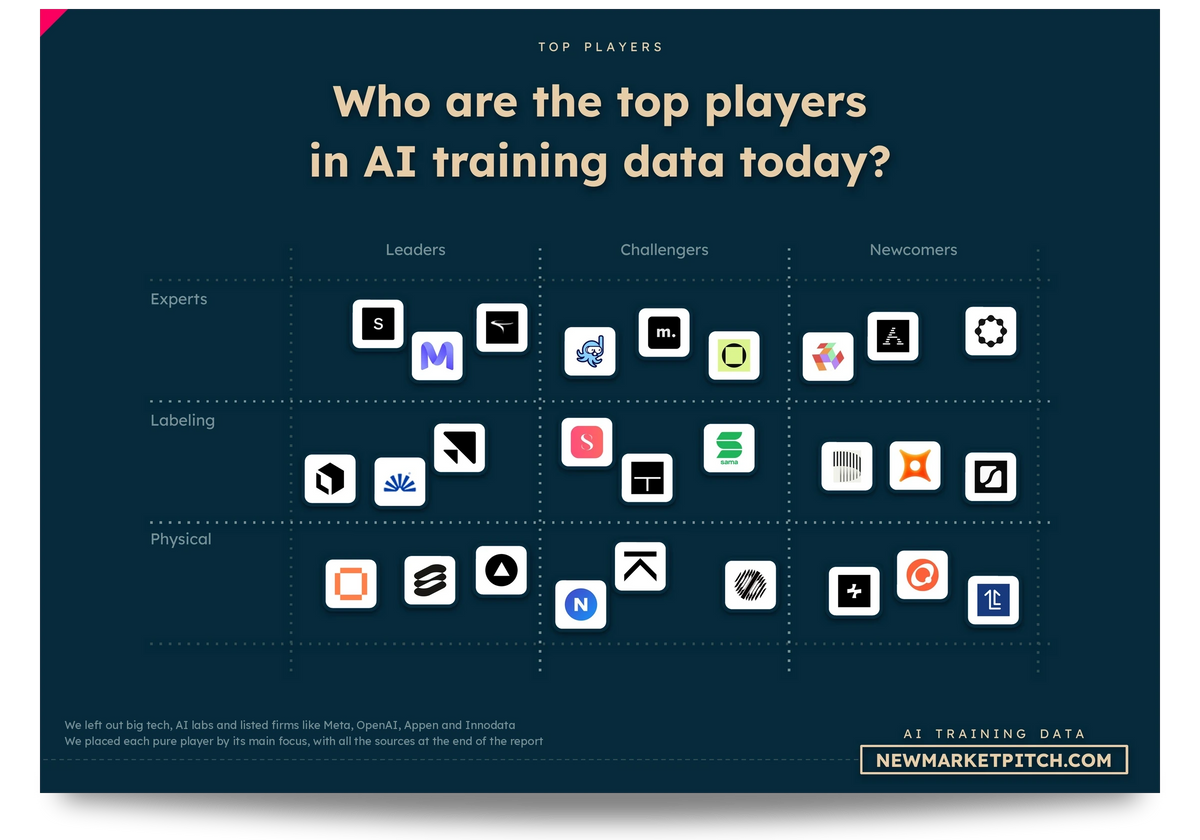
In our market report about AI training data, we turn what is vague and complex into simple, useful visuals. Market maps like this one show you at a glance where every startup stands.
Will OpenAI and other AI labs eventually do their training-data work themselves?
OpenAI and other frontier labs will bring more sensitive AI training-data work in-house, but outsourcing should remain useful whenever demand changes too quickly to justify a permanent internal workforce.
The labs already have internal researchers, data teams, evaluators and recruiting operations. Better models also allow them to automate more data generation every year.
External spending has still exploded while those internal capabilities have improved. One training cycle might require advanced mathematics. Another might need cybersecurity specialists, doctors or users who understand enterprise accounting software. An agent project can suddenly require thousands of examples from dozens of occupations.
Keeping all of those people on permanent payroll would make little sense.
Labs are therefore likely to keep the most sensitive data, proprietary research and strategically important workflows inside while outsourcing specialist production and temporary capacity. Providers selling easily replaceable labor face the greatest insourcing risk.
Where are the best margins in AI training data?
The best AI training-data margins are moving toward reusable assets such as proprietary datasets, software, evaluation systems and reinforcement-learning environments.
Hourly expert marketplaces can become very large, but paying specialists 60%-70% of gross billings puts a natural ceiling on gross margin. Mercor's 33% gross margin in the second quarter of 2026 makes that trade-off visible.
Traditional managed annotation can also produce respectable margins. Appen reported a 40.3% gross margin for 2025, although its growth is much slower than that of the new expert-data providers.
Reusable assets have more attractive economics. A software workflow can be used for many customers. A benchmark can evaluate multiple model generations. An RL environment can support repeated training runs. A legally reusable dataset may be licensed more than once depending on its contractual terms.
Micro1 has reportedly achieved gross margins around 80%-90% on some off-the-shelf datasets, which shows what happens when the cost of producing an asset is separated from the number of times it can be sold.
| Business model | How the provider gets paid | Main cost | Margin potential | Biggest risk |
|---|---|---|---|---|
| Basic annotation | Per label, task or project | Human labor | Low to medium | Automation and price pressure |
| Managed data services | Project or volume contract | Labor, QA and operations | Medium | Heavy operations |
| Expert marketplace | Spread on specialist work | Expert compensation | Medium | High contractor payouts |
| Data-as-a-service | Completed dataset or program | Experts, generation and software | Medium to high | Constant quality demands |
| Data/evaluation software | Subscription or usage | Product development and compute | High at scale | Customers may want finished work |
| RL environments | Project, usage or recurring program | Engineering and expert design | Medium to high | Expensive to build |
| Model evaluation | Project or recurring testing | Experts and tooling | Medium to high | Trust can be lost quickly |
| Proprietary data licensing | Licensing fees and possible revenue share | Rights, cleaning and acquisition | High | Privacy and legal constraints |
| Reusable datasets | Repeated licensing | Upfront creation and validation | Potentially very high | Easy replication can destroy scarcity |
If you want more recent data on this point, please see our latest AI training data market report.

Our document detailing everything you need to know about AI training data gets updated several times a month, so you always get the latest view of where things stand.
What keeps AI training data from becoming a commodity?
AI training data stays valuable when a provider controls expertise, proprietary information or infrastructure that customers cannot easily replace.
Generic annotation is already under pressure. Models can pre-label easier examples, contractors can be sourced globally and several companies can compete for standardized projects. That pushes prices down.
Handshake has a different kind of asset: distribution. Its network spans millions of students and alumni, including a very large population of advanced-degree holders. That lets the company recruit specialist contributors quickly when an AI lab suddenly needs them.
Operational execution can be valuable too. Scaling a project from 50 experts to several thousand requires screening, payments, security, quality control and constant replacement of weak contributors. Providers that do this reliably save labs from building an entire temporary organization.
Proprietary data creates stronger scarcity. An authentic collection of enterprise workflows, robotics demonstrations or specialized professional records cannot be recreated simply by hiring more annotators. RL environments and evaluation infrastructure add another layer because they require technical work, domain knowledge and repeated maintenance.
Basic training data will get cheaper. Scarce training inputs can remain expensive.
Which AI training-data business models look strongest today?
The strongest AI training-data businesses today combine access to scarce inputs with technology that lets them deliver those inputs repeatedly and at better margins.
Mercor and Handshake currently have a huge advantage in expert distribution. They can recruit specialized workers at a scale that frontier labs clearly value. Their weak points are equally visible: large contractor payouts and unusually concentrated customers.
Scale has built a broader business across frontier data, evaluation, government work, enterprise applications and robotics. The company said its data unit was profitable after strong growth in 2025, and its physical-AI business is now collecting more than 1,000 hours of robotics demonstration data per day.
Snorkel has taken a different route by packaging software, synthetic generation and experts into completed datasets and RL environments. Its jump to a $375 million annualized revenue run rate is one of the clearest recent signs that buyers are willing to pay for finished training assets rather than annotation tools alone.
Labelbox is pushing into proprietary operational data. Prism says more than 1,000 companies are already licensing data and more than $100 million has been distributed, suggesting that data ownership itself could become a serious revenue pool.
Appen and Sama remain important where customers need large, controlled annotation operations, especially in computer vision, industrial AI and regulated sectors. The economics there are more mature and the growth is less spectacular.
Today, the strongest setup appears to be a provider that controls something scarce, automates as much production as possible and can sell the resulting asset or infrastructure repeatedly.
If you want more recent data on this point, please see our latest AI training data market report.

In our report covering the AI training data market, we don't want to repeat what boring consulting reports say. Instead, we show you the real and latest market signals that matter.
So who pays for AI training data, and how do providers make money?
Frontier AI labs currently pay most of the huge high-end AI training-data bills, while providers make money by selling access to experts, completed datasets, model evaluations, reinforcement-learning environments and proprietary real-world data.
The customer side of the market is unusually concentrated. OpenAI, Anthropic, Google, Meta and other major model developers have supported the rise of suppliers processing hundreds of millions or even billions of dollars of annualized customer spending. Enterprise, robotics and government demand is growing, but it has not yet replaced frontier labs as the main engine behind the recent boom.
The provider economics vary much more than the revenue headlines suggest. Expert marketplaces can send roughly two-thirds of customer billings straight to contractors. Managed annotation companies carry large operating workforces. Software and data-as-a-service providers can capture better margins when automation reduces the labor required. Proprietary datasets and reusable environments have the strongest potential economics because the same underlying asset can support more than one customer or training cycle.
The biggest money today comes from frontier labs buying human expertise at massive scale. The stronger long-term businesses should be the providers that turn that expertise into reusable data, environments and infrastructure instead of reselling human hours forever.
Our methodology
The AI training-data market is unusually difficult to read from the outside. The same market now includes expert work, traditional annotation, evaluations, proprietary datasets, reinforcement-learning environments and software, while companies often describe their scale using different revenue measures. Rather than relying on headline numbers or broad assumptions about where the money is going, we broke the question into the analytical dimensions that actually determine how this market works.
We looked separately at who is buying the data, what they are paying humans and providers to produce, how much spending is flowing through the leading companies, what those companies retain after contributor costs, where automation is changing the economics, how proprietary data and RL environments are emerging, and where customer concentration or bargaining power changes the picture. We also compared the different business models on scarcity of the underlying input, labor intensity, repeatability, margin structure and the ability to serve more than one customer or training cycle from the same underlying asset.
For each dimension, we prioritized recent, concrete evidence over general market commentary: reported customer relationships and contract sizes, company financial disclosures, current contributor rates, disclosed margins, product launches, operating metrics, customer concentration and changes in what providers are actually selling. Where companies report fundamentally different measures, particularly gross marketplace billings, annualized revenue run rates, ARR and conventional operating revenue, we treated them according to what they show rather than combining them into an artificial market-size number.
The final conclusions come from aggregating those observations across the different dimensions and looking for where the evidence consistently points in the same direction. A single large contract does not define the buyer market, just as a billion-dollar gross run rate does not by itself prove attractive unit economics. What matters is the pattern that emerges when spending, customer mix, labor costs, product evolution, margins and repeatability are considered together.
Key sources used for this analysis include: Mercor on AI training data and the role of expert human judgment, Mercor Research on expert datasets, evaluations and reinforcement-learning environments, Mercor on its expert marketplace and specialist compensation, Mercor on its acquisition of Deeptune, Handshake on the launch of Handshake AI, its network and specialist coverage, Handshake on current AI specialist opportunities, Snorkel AI on data-as-a-service growth and its $375 million annualized revenue run rate, Scale AI on 2025 business performance, robotics customers, enterprise work and evaluation activity, Scale AI on physical-AI and robotics training data, Scale AI on reinforcement-learning environments, Scale AI on proprietary operational-data partnerships, Scale AI on benchmark and model-evaluation activity, Labelbox Prism on operational-data licensing, payments to data owners and dataset pricing, Labelbox documentation on labeling, automation, RLHF and model evaluation, Sama on model validation, preference ranking and human-in-the-loop workflows, Appen's annual reports covering 2025 revenue, gross margin and generative-AI work, and Reuters reporting on Google's planned Scale AI spending and the customer pullback after Meta's investment.

In our research about AI training data, you will always find fresh funding data, taken straight from our own verified funding database.
Written by the New Market Pitch teamWe track new markets so founders and investors can move faster. About us