What’s the latest funding news in the AI Trust, Risk and Security Management (AI TRiSM) market? (November 2026)
Whether you're building or investing in the AI TRiSM market, our report covers everything you need to know: the players, the money, and what's coming next.
AI TRiSM funding is moving toward controls that decide what autonomous agents may do inside enterprise systems before the action happens.
The 15 latest AI trust, risk and security management (AI TRiSM) deals below, announced between September 22 and November 10, 2026, represent about $454.1 million in disclosed funding, plus nearly $3 million that Guardrail Technologies reported across two seed rounds.
Arena's $200 million Series B is the largest round, while seven of the 15 companies build runtime guardrails and policy enforcement for AI agents. For every deal in this market, see the full list of AI TRiSM funding deals.
And if you want to better understand this new industry, you can download our pitch covering the AI Trust, Risk and Security Management (AI TRiSM) market.
Insights
- The 15 latest AI TRiSM deals total about $454.1 million in disclosed funding, and Arena's $200 million Series B accounts for about 44% of that amount.
- Seven of the 15 companies build runtime guardrails and policy enforcement: Bay, WhiteMatter, Pluto Security, Rein Security, Kontext, Palma.ai and Outerlimit.
- Agent identity is becoming a TRiSM topic of its own. Mintive issues scoped credentials to each agent, Beltic verifies an agent's authority before a transaction, and Rig Security tracks the permissions that agents inherit from employees.
- Evaluation money splits in two: Arena sells model evaluations at scale, while Crux Labs builds custom evaluations from the judgment of a company's own experts.
- Employee AI use remains a funded risk area. Harmonic Security controls sensitive data in employee AI interactions, and Opsin maps what agents connected to platforms such as Microsoft Copilot can actually access.
- The funding range runs from Palma.ai's $1.8 million pre-seed round to Arena's $200 million Series B, so AI TRiSM attracts both brand-new agent security startups and scaled evaluation platforms.
- Several companies announced their funding as they came out of stealth, including Bay, Crux Labs, Beltic, Rig Security, Kontext and Outerlimit, which shows how quickly new AI agent security teams are reaching the market.
- Funding data still needs careful reading. Bay disclosed a seed round and a Series A together, and Guardrail Technologies reported nearly $3 million across two seed rounds without a split between them. The largest cumulative totals are ranked in the AI TRiSM startups that raised the most.
- Lead investors in this list include Battery Ventures, Lightspeed Venture Partners, Khosla Ventures, Crosspoint Capital Partners and Cowboy Ventures, and the most active backers are ranked in the top AI TRiSM investors.

Written by the New Market Pitch teamWe track new markets so founders and investors can move faster. About us

In our report covering the AI TRiSM market, you will always find fresh funding data, taken straight from our own verified funding database.
Summary table of the latest funding deals in the AI Trust, Risk and Security Management (AI TRiSM) market as of November 2026
We define the AI trust, risk and security management (AI TRiSM) market as tools that help organizations govern AI use and manage its trust, risk and security.
We include AI inventories, policy enforcement, model-risk controls, runtime security and monitoring for safe AI operation.
We exclude general cybersecurity without an AI focus, pure model-development tools and governance consulting without a technology product.
| Name | When | Amount in $ | Round Type | Category |
|---|---|---|---|---|
| Bay | November 10, 2026 | $50M total | Seed + Series A | Runtime Guardrails & Policy Enforcement |
| WhiteMatter | November 10, 2026 | $20M | Series A | Runtime Guardrails & Policy Enforcement |
| Crux Labs | October 29, 2026 | $6M+ | Undisclosed | AI Monitoring & Observability |
| Mintive | October 29, 2026 | $7M | Seed | AI Governance & Inventory |
| Opsin | October 15, 2026 | $21M | Undisclosed | Data & Privacy Controls |
| Harmonic Security | October 14, 2026 | $50M | Series B | Data & Privacy Controls |
| Pluto Security | October 13, 2026 | ≈$34M | Series A | Runtime Guardrails & Policy Enforcement |
| Arena | October 8, 2026 | $200M | Series B | Model Risk & Evaluation |
| Rein Security | October 8, 2026 | $25M | Series A | Runtime Guardrails & Policy Enforcement |
| Guardrail Technologies | October 6, 2026 | Nearly $3M combined | Two seed rounds | AI Governance & Agent Control |
| Beltic | September 30, 2026 | $7.3M | Seed | Compliance & Audit Management |
| Rig Security | September 29, 2026 | $12M | Seed | AI Security & Red Teaming |
| Kontext | September 24, 2026 | $4M | Seed | Runtime Guardrails & Policy Enforcement |
| Palma.ai | September 23, 2026 | $1.8M | Pre-seed | Runtime Guardrails & Policy Enforcement |
| Outerlimit | September 22, 2026 | $16M | Pre-seed | Runtime Guardrails & Policy Enforcement |
Funding amounts reflect publicly reported financing through October 16, 2026. Guardrail's amount combines two seed rounds whose individual sizes were not established. AIR's disclosed seed rounds were $10 million and $40 million, respectively. Rig and AIUC have business models that extend beyond AI TRiSM. The table ranks companies by their public funding announcements rather than necessarily by transaction closing dates.
All the latest funding deals in the AI Trust, Risk and Security Management (AI TRiSM) market as of November 2026
Bay raised $50 million in November 2026 to control what enterprise AI agents can do before they act.
When was it?
Bay announced the financing on November 10, 2026, as it emerged from stealth.
Who are they?
Bay discovers the AI assistants, coding agents and custom agents used inside a company, along with the MCP servers and tools they rely on, and decides in real time whether each agent action can proceed.
Geographical focus?
Bay is headquartered in Tel Aviv and serves enterprise customers in the United States and Europe.
Why do we include them in the AI Trust, Risk and Security Management (AI TRiSM) market?
Bay combines AI discovery, posture management, session-level observability and real-time enforcement of agent actions, placing it in runtime guardrails and policy enforcement.
What is the company stage?
Bay is at the early-commercial stage less than a year after its founding, with dozens of enterprise customers including Micron, Peloton, ClickUp and Wix.
How much did they raise?
Bay disclosed $50 million in total, made of a previously undisclosed $13 million seed round and a new $37 million Series A.
What round is it?
The seed round was led by YL Ventures and Striker Venture Partners. The Series A was led by Battery Ventures, with Micron Ventures, M12 and Wiz chief executive Assaf Rappaport participating.
Why did they raise?
Bay will expand its product and engineering teams and grow its sales, marketing and customer teams in the United States and Europe.
WhiteMatter raised $20 million in November 2026 to govern and secure enterprise AI agents across their lifecycle.
When was it?
WhiteMatter announced the Series A on November 10, 2026.
Who are they?
WhiteMatter, formerly known as QuilrAI, governs AI agents, models and MCP servers from pre-production validation to runtime action control, and assigns a dedicated guardian agent to enforce policy for each agent.
Geographical focus?
WhiteMatter operates from San Francisco and Austin and sells to large enterprises, including Sentara Health, Alter Domus, New American Funding and Concentrix.
Why do we include them in the AI Trust, Risk and Security Management (AI TRiSM) market?
WhiteMatter validates agents before production and controls their actions at runtime, placing it in runtime guardrails and policy enforcement.
What is the company stage?
WhiteMatter is in early growth. The company reports that it tripled its customer base in 2026 and grew revenue fivefold over the past six months, with 2.25 million agents under management.
How much did they raise?
WhiteMatter raised $20 million.
What round is it?
WhiteMatter raised a Series A led by Blumberg Capital, with existing investors Crew Capital and Sprout & Oak participating.
Why did they raise?
WhiteMatter will invest in research and development, go-to-market expansion and its executive leadership team.

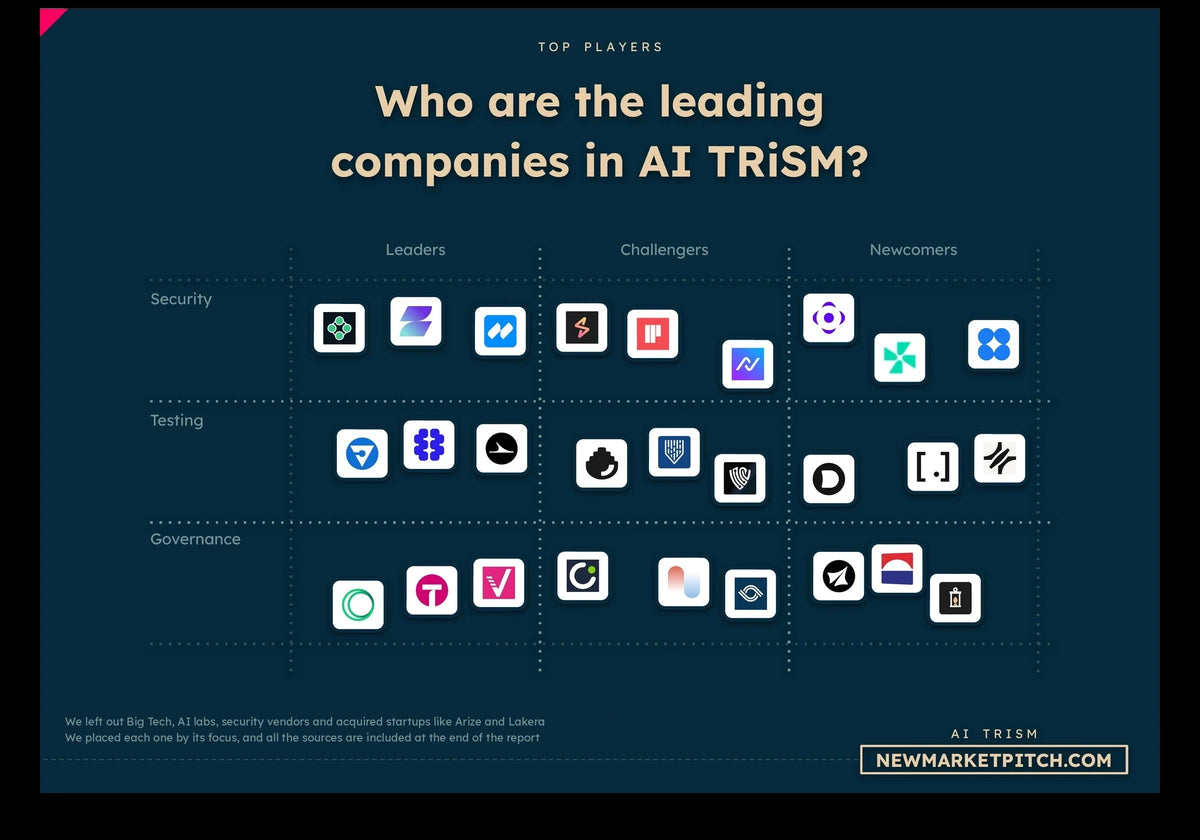
In our research about AI trust and risk tools, we turn what is vague and complex into simple, useful visuals. Market maps like this one show you at a glance where every startup stands.
Crux Labs raised more than $6 million in October 2026 to align enterprise AI agents with expert human judgment.
When was it?
Crux Labs announced the financing on October 29, 2026, as it emerged from stealth.
Who are they?
Crux Labs captures expert knowledge inside a company's workflows, turns it into calibrated evaluations, monitors production agent traffic and feeds the results back into agent improvements.
Geographical focus?
Crux Labs announced its financing from New York and works with high-growth startups and Fortune 500 enterprises in healthcare, cybersecurity and financial services.
Why do we include them in the AI Trust, Risk and Security Management (AI TRiSM) market?
Crux Labs continuously monitors production agent behavior against calibrated evaluations, placing it in AI monitoring and observability.
What is the company stage?
Crux Labs is at the early-commercial stage, with enterprise deployments but no disclosed customer names or revenue figures.
How much did they raise?
Crux Labs raised more than $6 million.
What round is it?
Crux Labs did not name the series. The oversubscribed round was co-led by Benchstrength and Misneach, with Analog Ventures and Pareto Holdings participating.
Why did they raise?
Crux Labs will expand research and engineering and accelerate deployments with enterprise customers.
Mintive raised $7 million in October 2026 to govern the identities, tools and actions of enterprise AI agents.
When was it?
Mintive announced the funding on October 29, 2026.
Who are they?
Mintive provides gateways for agent tool access and model calls, scoped and revocable credentials for each agent, and monitoring that records the chain from person to agent to action.
Geographical focus?
Mintive is a U.S. company whose customers include Ro, Modern Treasury, Braze, Coursera, the University of Michigan, Apax and Stability AI.
Why do we include them in the AI Trust, Risk and Security Management (AI TRiSM) market?
Mintive inventories agent identities and governs their access to tools and models, placing it in AI governance and inventory.
What is the company stage?
Mintive is in production with more than 50 paying customers and more than 2.5 million agent calls per day.
How much did they raise?
Mintive raised $7 million, bringing its total funding to $11 million.
What round is it?
The $7 million round is classified as a seed round. It was led by Cowboy Ventures, with Operator Collective and Burst Capital joining existing investors Coatue, Hustle Fund and Maven Ventures.
Why did they raise?
Mintive did not detail the use of funds in its announcement.
Opsin raised $21 million in October 2026 to expand enterprise AI agent governance and runtime risk protection.
When was it?
Opsin announced its financing on October 15, 2026.
Who are they?
Opsin builds software that maps AI agents' identities, permissions, intended tasks and real-world behavior to detect and contain enterprise security risks.
Geographical focus?
Based in the United States, Opsin targets enterprises using AI platforms such as Microsoft Copilot, ChatGPT Enterprise and other agent-connected corporate systems.
Why do we include them in the AI Trust, Risk and Security Management (AI TRiSM) market?
Opsin directly addresses AI agent inventory, behavioral governance and continuous risk monitoring through its Risk Graph, which connects what an agent intends to do with what it can actually access.
What is the company stage?
Opsin is in early commercial expansion, with an enterprise security platform available for agent discovery, risk assessments and continuous monitoring.
How much did they raise?
Opsin secured $21 million in financing led by SYN Ventures and Race Capital, with no publicly disclosed valuation.
What round is it?
Opsin did not clearly identify the financing as a conventional Series A or Series B in its public announcement.
Why did they raise?
Opsin will speed up product development, serve more customers in regulated industries, extend its coverage as agents gain autonomy and recruit talent.

Your time is limited. In our market report about AI trust and risk tools, we put numbers on each part of the market, so you can see where it makes sense to focus.
Harmonic Security secured $50 million in an October 2026 Series B to expand protection for employees using AI tools.
When was it?
Harmonic Security publicly announced the funding on October 14, 2026.
Who are they?
Harmonic Security develops software that discovers employee AI activity, understands the context of interactions and applies controls when sensitive information could be exposed.
Geographical focus?
Harmonic operates across the United States and United Kingdom and serves large enterprises through a platform covering browser-based AI, desktop applications and agentic workflows.
Why do we include them in the AI Trust, Risk and Security Management (AI TRiSM) market?
Harmonic is a direct AI TRiSM provider because its main product identifies shadow AI usage, monitors employee interactions and enforces security policies around corporate AI adoption.
What is the company stage?
Harmonic is in commercial growth, reporting protection for millions of employees across more than 100 organizations and a workforce exceeding 90 people.
How much did they raise?
Harmonic raised $50 million led by Crosspoint Capital Partners, bringing its cumulative financing to $76 million.
What round is it?
Harmonic completed a Series B with participation from existing investors, although the company did not disclose its valuation.
Why did they raise?
Harmonic will expand its engineering and go-to-market teams on both sides of the Atlantic while extending security coverage to new forms of workplace AI.
Pluto Security raised approximately $34 million in October 2026 to protect enterprises against risks from employee-created AI applications.
When was it?
Pluto Security's latest funding was publicly reported on October 13, 2026.
Who are they?
Pluto Security helps security teams find and assess risky AI applications, autonomous agents, browser extensions and integrations created or connected by employees.
Geographical focus?
Pluto has teams in Israel and the United States and serves enterprise customers such as Oscar Health, Workato, Sixt and AlphaSense.
Why do we include them in the AI Trust, Risk and Security Management (AI TRiSM) market?
Pluto focuses on AI asset discovery, shadow AI risk assessment and security monitoring, particularly where employees build AI-powered tools outside traditional IT approval processes.
What is the company stage?
Pluto has demonstrated early product-market fit, reporting more than 30 enterprise customers and annual recurring revenue above $2 million.
How much did they raise?
Pluto secured approximately $34 million in new funding, with the announcement also reporting around $42 million in cumulative financing.
What round is it?
Pluto completed a Series A led by Jump Capital, with participation from Skinos Ventures, Ansa Capital and other investors.
Why did they raise?
Pluto will invest in product development and security research and grow its presence in the United States.
Arena raised $200 million in October 2026 to expand independent evaluation of AI models.
When was it?
Arena announced the Series B on October 8, 2026.
Who are they?
Arena, formerly LMArena, started in 2023 as a UC Berkeley research project. It runs a crowdsourced leaderboard where users compare AI models and sells AI Evaluations, a product that gives model labs and enterprises detailed performance analytics.
Geographical focus?
Arena is a U.S. company, and it says its public leaderboard draws tens of millions of monthly visitors worldwide.
Why do we include them in the AI Trust, Risk and Security Management (AI TRiSM) market?
Arena sells model evaluations to labs and enterprises beyond its public leaderboard, placing it in model risk and evaluation, although much of its activity is broader performance benchmarking.
What is the company stage?
Arena is at the growth stage, with run-rate revenue that reached $100 million in June 2026, up from $30 million in January.
How much did they raise?
Arena raised $200 million at a $3.1 billion valuation.
What round is it?
Arena raised a Series B co-led by Lightspeed Venture Partners and Khosla Ventures, with Salesforce Ventures, 01 Advisors, Dell Technologies Capital, Endeavor Catalyst, Andreessen Horowitz and Felicis participating.
Why did they raise?
Arena did not detail the use of funds. The company says the world needs a neutral third party to measure how safe and aligned AI is in real use, and that static benchmarks break down once models recognize they are being tested.

In our document detailing everything you need to know about AI TRiSM, we always try to gather several sources and make estimates that make sense, so you can work with solid numbers.
Rein Security secured $25 million in October 2026 to strengthen real-time protection for autonomous AI agents.
When was it?
Rein Security announced its latest investment on October 8, 2026.
Who are they?
Rein Security develops runtime protection technology that observes AI agent behavior, detects attacks and blocks unsafe actions inside business applications.
Geographical focus?
Rein operates from Tel Aviv and New York, serving organizations deploying AI agents across enterprise software environments and international markets.
Why do we include them in the AI Trust, Risk and Security Management (AI TRiSM) market?
Rein provides AI runtime security, continuous agent monitoring, policy enforcement and supply chain protection, making the platform directly relevant to controlling autonomous AI operations.
What is the company stage?
Rein is in commercial growth, reporting thousands of protected AI agents and an eightfold increase in revenue since January 2026.
How much did they raise?
Rein raised $25 million, increasing its cumulative funding to $35 million.
What round is it?
Rein completed a Series A co-led by Glilot Capital and Sienna Venture Capital, with Corner Ventures, Atlacle and RNP Capital Advisors participating.
Why did they raise?
Rein will invest in product development, research into agent-driven attacks and expansion of its international team as autonomous software becomes more common in production.
Guardrail Technologies disclosed nearly $3 million across two seed rounds in October 2026 to expand its AI control platform.
When was it?
Guardrail Technologies' financing announcement first appeared publicly on October 6, 2026, with additional coverage published the following day.
Who are they?
Guardrail Technologies develops software that helps organizations monitor AI systems, control autonomous agent activity and maintain evidence of how AI behaves in production.
Geographical focus?
Headquartered in the United States with Australian operations, Guardrail plans further expansion into Asian and European markets, particularly among highly regulated organizations.
Why do we include them in the AI Trust, Risk and Security Management (AI TRiSM) market?
Guardrail's core offering combines AI governance, agent visibility and security controls that help organizations supervise what autonomous systems can access and execute.
What is the company stage?
Guardrail is in early commercial development, with customers on two continents, issued patents and a platform targeting organizations with strict accountability requirements.
How much did they raise?
Guardrail disclosed nearly $3 million in combined seed financing, but the amount raised in the most recent individual transaction remains unverified.
What round is it?
Guardrail reported two seed rounds led by Filter Fund Venture Capital alongside strategic angel investors, rather than one newly announced financing of the full combined amount.
Why did they raise?
Guardrail intends to hire across its operations, advance its AI security platform and support geographic expansion as companies delegate more business tasks to software agents.
Beltic raised $7.3 million in September 2026 to verify the identity and authority of AI agents.
When was it?
Beltic announced the seed round on September 30, 2026, as it emerged from stealth.
Who are they?
Beltic runs a Know Your Agent platform that checks an AI agent's identity, authority and transactional legitimacy in real time, so businesses can accept and send agent traffic.
Geographical focus?
Beltic is based in San Francisco and works with a select group of design partners in agentic commerce and payments.
Why do we include them in the AI Trust, Risk and Security Management (AI TRiSM) market?
Beltic verifies agent identity and authorization at the point of transaction, placing it in compliance and audit management.
What is the company stage?
Beltic is at an early stage, working with design partners. It acquired Verifiet in 2025, which brings an entity data platform covering more than 500 million entities.
How much did they raise?
Beltic raised $7.3 million, bringing its total funding to $8.8 million.
What round is it?
Beltic raised a seed round led by Norwest, with Restive Ventures, Oxford Seed Fund and Collide Capital participating.
Why did they raise?
Beltic raised the funding to build the trust infrastructure that lets businesses rely on AI agents acting on their behalf.

Our report covering the AI TRiSM market gets updated several times a month, so you always get the latest view of where things stand.
Rig Security emerged from stealth with $12 million in September 2026 to address identity risks created by AI agents.
When was it?
Rig Security publicly announced its seed financing on September 29, 2026, although reporting indicates the underlying investment closed in late 2025.
Who are they?
Rig Security builds an identity security platform that maps employees, service accounts and AI agents to identify dangerous permissions and distinguish agent activity from human actions.
Geographical focus?
Based in Israel, Rig targets enterprise identity environments and is expanding its commercial reach into the United States.
Why do we include them in the AI Trust, Risk and Security Management (AI TRiSM) market?
Rig addresses AI-agent identity discovery, permission-risk assessment and runtime monitoring, although its protection of human and machine identities also extends beyond the AI-specific security market.
What is the company stage?
Rig has entered early commercialization following its stealth launch, with its identity security technology already deployed in large enterprise environments.
How much did they raise?
Rig announced $12 million in financing from a group of institutional and individual cybersecurity investors.
What round is it?
Rig's seed round was co-led by Ten Eleven Ventures and Brightmind Partners, with participation from CrowdStrike Falcon Fund and industry angels.
Why did they raise?
Rig plans to deepen identity-risk research, improve its detection and enforcement capabilities, and expand commercial operations as agents increasingly operate under employee credentials.
Kontext raised $4 million in September 2026 to control what enterprise AI agents can do before they act.
When was it?
Kontext announced the investment on September 24, 2026, alongside the public introduction of its runtime security platform.
Who are they?
Kontext develops software that checks an AI agent's intended actions against corporate policies, considering its identity, assigned task and requested access before allowing execution.
Geographical focus?
Headquartered in Munich, Germany, Kontext is developing its initial enterprise business with particular relevance to software development and financial services organizations.
Why do we include them in the AI Trust, Risk and Security Management (AI TRiSM) market?
Kontext directly fits AI runtime authorization and policy enforcement because its platform can prevent agents from taking actions outside their assigned responsibilities, even when valid credentials exist.
What is the company stage?
Kontext is at the seed stage with operational software, early production deployments and a focus on expanding enterprise adoption.
How much did they raise?
Kontext secured $4 million in funding to advance its agent authorization infrastructure.
What round is it?
Kontext completed a seed financing led by 42CAP, with a16z CSX and High-Tech Gründerfonds participating.
Why did they raise?
Kontext will expand its engineering team and develop runtime enforcement technology that helps companies grant agents useful access without losing control over their actions.

In our research about AI trust and risk tools, we look at what the winners do differently, so you can learn from the best instead of guessing.
Palma.ai raised $1.8 million in September 2026 to build a governance layer between AI agents and enterprise systems.
When was it?
Palma.ai's financing was reported on September 23, 2026.
Who are they?
Palma.ai checks policies whenever an AI agent attempts an action and can allow, deny or rate-limit it or require human approval, while keeping downstream credentials away from agents and logging actions in an audit trail.
Geographical focus?
Palma.ai did not give a headquarters location in its funding announcement. It targets larger organizations deploying agents across several AI platforms, and its software can run in a customer's own infrastructure, including on-premises and air-gapped setups.
Why do we include them in the AI Trust, Risk and Security Management (AI TRiSM) market?
Palma.ai enforces policies on agent actions at the moment they happen and keeps an audit trail, placing it in runtime guardrails and policy enforcement.
What is the company stage?
Palma.ai is at the pre-seed stage. Its product has been live since early 2026, and investors D11Z and Plug and Play already use it internally.
How much did they raise?
Palma.ai raised $1.8 million.
What round is it?
Palma.ai raised a pre-seed round led by D11Z, with Plug and Play Ventures, Deel, Scale Now Ventures and angel investors participating.
Why did they raise?
Palma.ai will expand its engineering and go-to-market teams as it targets larger organizations that deploy agents across several platforms.
Outerlimit secured $16 million in September 2026 to develop zero-trust authorization infrastructure for autonomous AI agents.
When was it?
Outerlimit emerged from stealth and announced its financing on September 22, 2026.
Who are they?
Outerlimit develops a decentralized authorization system that checks whether an AI agent is permitted to perform a specific action before accessing tools or enterprise systems.
Geographical focus?
Operating from London and New York, Outerlimit is positioning its technology for large enterprises deploying autonomous agents across complex international IT environments.
Why do we include them in the AI Trust, Risk and Security Management (AI TRiSM) market?
Outerlimit provides AI-agent authorization, zero-trust controls and execution monitoring, extending traditional identity security to decisions made at the moment an autonomous agent acts.
What is the company stage?
Outerlimit is at the pre-seed stage following its stealth launch, with a defined technical architecture but limited public evidence of broad production adoption.
How much did they raise?
Outerlimit attracted $16 million from institutional venture investors and strategic angel backers.
What round is it?
Outerlimit's pre-seed financing included AlbionVC, Evolution Equity Partners and Crane Venture Partners, alongside several experienced cybersecurity entrepreneurs.
Why did they raise?
Outerlimit will develop and commercialize its authorization infrastructure so businesses can replace broad agent permissions with security decisions tied to individual actions.
Written by the New Market Pitch teamWe track new markets so founders and investors can move faster. About us