Is the AI trust, risk and security market big enough to stand alone?
Whether you're building or investing in the AI TRiSM market, our report covers everything you need to know: the players, the money, and what's coming next.
Summary
Yes, the AI trust, risk and security management (AI TRiSM) market is big enough to support standalone software companies, including several with the potential to exceed $100 million in annual recurring revenue. But much of the spending will probably end up inside established cybersecurity, cloud and enterprise governance platforms.
The market is already worth several billion dollars. Gartner forecasts $2.835 billion in worldwide spending on securing AI in 2026, rising to $4.783 billion in 2027 and nearly $7.7 billion in 2028. MarketsandMarkets puts the broader AI TRiSM market at $3.09 billion in 2026.
Security is becoming the main growth engine. AI application security, usage controls and gateways represent almost $1.2 billion in combined 2026 spending, with annual growth rates above 80%. Companies deploying autonomous agents have immediate reasons to pay for protection against prompt injection, unauthorized actions and sensitive-data exposure.
AI governance is a smaller opportunity than the overall market figures suggest. Gartner separately estimates governance-platform spending at $492 million in 2026, while its narrower securing-AI classification assigns $275 million to governance. A specialist reaching $100 million in governance revenue alone would already control a substantial portion of the market.
There is real commercial traction beyond forecasts. HiddenLayer reported more than tenfold ARR growth in September 2026, reaching the tens of millions of dollars, with over 90% of that growth coming from new customers. Still, independent vendors reporting $100 million or more in recurring revenue remain rare.
The acquisitions tell a revealing story. Palo Alto Networks, Check Point and F5 spent approximately $981.5 million combined acquiring Protect AI, Lakera and CalypsoAI in 2025. Specialized AI security technology is clearly valuable, but those buyers intend to distribute it through larger security platforms.
The strongest standalone opportunities are emerging around autonomous-agent protection, runtime enforcement and independent AI assurance. These products address problems that become harder as AI systems gain permissions, access sensitive information and operate across multiple applications.
Vendor neutrality may prove more valuable than owning another governance dashboard. Enterprises running OpenAI, Anthropic, Google and internally hosted models need consistent controls across providers. A specialist that delivers that protection independently has a clearer reason to exist.
Regulation strengthens the market without guaranteeing specialist revenues. The EU AI Act creates continuing obligations around documentation, risk management and monitoring, but customers can meet parts of those requirements through internal teams and existing compliance software.
AI TRiSM could exceed $10 billion in annual spending around 2030. The unresolved question is how much independent vendors will capture. The likely outcome is a handful of substantial specialists surrounded by much larger cybersecurity and enterprise software companies, rather than an entirely separate AI TRiSM industry.

Written by the New Market Pitch teamWe track new markets so founders and investors can move faster. About us
Why is AI TRiSM suddenly becoming a real market?
AI trust, risk and security management (AI TRiSM) is becoming a real enterprise software market, and the recent surge in AI security spending is making that increasingly hard to dispute.
Gartner's February 2025 Market Guide described AI TRiSM as a set of technical capabilities for enforcing AI governance policies. By June 2026, Gartner had introduced a dedicated Magic Quadrant for AI governance platforms, while its August spending forecast put the broader market for securing AI at $2.835 billion in 2026.
The change comes from what companies are doing with AI. Chatbots were relatively easy to supervise when employees used them for drafting or research. AI agents that access internal databases, write code, process customer information and execute business tasks create a much wider range of risks.
Cybersecurity companies have reacted quickly. Palo Alto Networks acquired Protect AI in July 2025, F5 bought CalypsoAI in September, and Check Point completed its acquisition of Lakera in October. Three established security companies acquired specialist AI protection technology within four months.
That buying spree tells us something about where AI TRiSM is heading. Specialized AI security technology has become valuable enough to attract major acquisitions, although the buyers clearly believe it can become part of their existing platforms.
What exactly counts as the AI TRiSM market?
AI TRiSM covers three closely related businesses: AI governance, AI security and AI assurance. We need to separate them because they serve different buyers, solve different problems and generate revenue in different ways.
AI governance software helps companies track which models they use, document who owns them, evaluate risks and enforce internal policies. Credo AI, ModelOp and OneTrust compete for parts of this spending.
AI security protects models, applications and agents against attacks, unauthorized behavior and sensitive-data exposure. HiddenLayer, Protect AI and Lakera have built products around those problems.
AI assurance focuses on testing whether AI systems behave as expected, monitoring failures and producing evidence of their reliability. Patronus AI and Galileo operate in this area, although their products also overlap with model development and observability.
There is considerable overlap between the three businesses. A platform monitoring an AI agent might identify security threats, check compliance rules and evaluate the quality of its responses during the same interaction.
For market sizing, we count software and directly attributable services sold to control AI-related risks. Ordinary cybersecurity, generic observability, legal consulting and AI development spending should only be included when the revenue is specifically connected to those activities.
Otherwise, almost any enterprise software vendor could claim part of the AI TRiSM market.

Your time is limited. In our report covering the AI TRiSM market, we put numbers on each part of the market, so you can see where it makes sense to focus.
How big is the AI TRiSM market today?
The AI TRiSM market is already worth several billion dollars annually, although published estimates still measure somewhat different groups of products and services.
MarketsandMarkets estimated the global AI TRiSM market at $3.09 billion in 2026. Gartner separately forecast $2.835 billion in worldwide spending on securing AI during the same year, up 83% from 2025. Gartner expects that spending to reach $4.783 billion in 2027 and nearly $7.7 billion in 2028.
The two estimates are relatively close, despite their different definitions. MarketsandMarkets includes broader trust, governance and risk-management activities, while Gartner's securing-AI forecast specifically covers application security, usage controls, gateways, governance platforms and related products.
Gartner's figures imply a particularly sharp acceleration. Worldwide securing-AI expenditure rises from approximately $1.55 billion in 2025 to $4.78 billion in 2027, more than tripling in just two years.
We can also see where the additional money is going. AI application security, usage controls and gateways account for $1.192 billion in projected 2026 spending. Together, those three categories reach $2.029 billion in 2027, adding approximately $837 million in one year.
The spending is large enough to support dedicated vendors. The harder question is how much of it will remain available to independent specialists once large cybersecurity and cloud providers expand their own products.
| Securing-AI segment | 2026 spending | 2027 forecast | Growth |
|---|---|---|---|
| AI application security | $508M | $851M | 67.5% |
| AI usage control | $433M | $749M | 73.0% |
| AI governance platforms | $275M | $462M | 68.0% |
| AI gateways | $251M | $429M | 70.9% |
| Other securing-AI products | $1,368M | $2,292M | 67.5% |
| Total securing-AI spending | $2,835M | $4,783M | 68.7% |
Source: Gartner's August 2026 securing-AI spending forecast. The categories use Gartner's definitions and should not be added to other estimates of the broader AI TRiSM market.
Is AI governance big enough to become its own software market?
AI governance is already a serious software business, but the dedicated market is still relatively small compared with cybersecurity.
Gartner estimated AI governance platform spending at $492 million in 2026 and projected that it would exceed $1 billion by 2030. In its separate August securing-AI forecast, Gartner used a narrower governance-platform category worth $275 million in 2026. Fortune Business Insights estimated the broader AI governance market at approximately $352 million.
The highest estimate is almost 80% larger than the lowest. That difference is a reminder that companies selling AI governance software often overlap with compliance management, enterprise risk management and AI security.
At Gartner's $492 million starting point, reaching $1 billion by 2030 requires roughly 19% annual growth. That is attractive for enterprise software, especially when much of the spending is driven by recurring obligations to document and monitor AI systems.
However, a $1 billion global market cannot support an unlimited number of large vendors. A specialist generating $100 million annually would already account for 10% of that market.
Credo AI, ModelOp and other dedicated governance providers must also compete with IBM, ServiceNow, OneTrust and SAP, which already sell software to the teams responsible for risk and compliance.
There is room for standalone AI governance companies, particularly those serving large regulated organizations. But governance alone looks unlikely to produce a broad collection of very large independent vendors. The numbers just aren't there yet.
If you want more recent data on this point, please see our latest AI TRiSM market report.

In our research about AI trust and risk tools, we always try to gather several sources and make estimates that make sense, so you can work with solid numbers.
Is AI security growing faster than AI governance?
AI security is currently producing some of the strongest growth rates in the AI TRiSM market, especially in application protection, usage controls and gateways.
Gartner's August 2026 forecast shows those three categories growing between 80.6% and 86.6% during 2026. AI governance platforms also grow quickly at 77.4%, but the spending pattern gives us a useful clue about what companies are prioritizing.
AI application security is the largest named category in Gartner's forecast, at $508 million in 2026. Usage controls follow at $433 million, while AI gateways account for $251 million.
These products address risks that appear directly when a company deploys AI applications. Security teams need to detect prompt injections, restrict access to sensitive information and control how applications communicate with models.
Governance software addresses the policies and evidence surrounding those deployments. It can be essential, but implementation may happen through existing risk-management systems.
The commercial difference is particularly relevant for new vendors. A company providing runtime protection can potentially charge according to the number of applications, agents or interactions it protects. Governance platforms are more likely to sell through enterprise subscriptions based on organizational scope, users or managed systems.
Both models can work. The rapid growth in runtime security spending currently makes the first one especially interesting.
Are companies actually paying for AI TRiSM software?
Enterprises are already spending real money on AI TRiSM, and HiddenLayer provides one of the clearest examples of how quickly a specialist can grow.
In September 2026, HiddenLayer CEO Chris Sestito told TechCrunch that the company's annual recurring revenue had increased more than tenfold over the preceding year, reaching the tens of millions of dollars.
More than 90% of that growth reportedly came from newly signed customers. That detail is unusually useful because it shows the company has been expanding its customer base rather than simply selling additional products to its earliest clients.
HiddenLayer also raised $100 million in a Series B round led by Delta-v Capital, with participation from Microsoft M12, Morgan Stanley and Booz Allen Ventures.
The customer mix helps explain the demand. Financial institutions and large technology companies building AI products were among HiddenLayer's biggest customer groups, alongside defense and intelligence organizations.
There is an interesting historical comparison. Reporting by The Information in 2025 indicated that Lakera and CalypsoAI had each generated less than $5 million in annual revenue before their acquisitions. Those figures are from different companies and periods, so they cannot establish a sector-wide growth rate. They do show how young the commercial market was when major cybersecurity companies began buying its specialists.
HiddenLayer has since demonstrated that a dedicated AI security company can reach eight-figure recurring revenue. What we have not yet seen publicly is a large group of independent AI TRiSM vendors reporting $100 million or more in annual recurring revenue.

In our market report about AI trust and risk tools, we don't want to repeat what boring consulting reports say. Instead, we show you the real and latest market signals that matter.
Are enterprises buying AI TRiSM products, or just talking about AI risks?
Large companies have moved beyond discussing AI risk, although adoption of dedicated AI TRiSM software remains uneven.
Grant Thornton's 2026 AI Impact Survey, cited by IBM in June, found that 78% of executives were unsure whether their organizations could pass an independent AI governance audit within 90 days.
That is a serious preparedness gap, but it does not mean 78% of companies are shopping for AI governance software. Some will hire consultants, assign internal compliance teams or expand tools they already use.
The stronger evidence of actual purchasing comes from specialist vendors reporting customers and revenue. HiddenLayer's growth among financial services and technology companies indicates that at least some enterprises now treat AI security as an ongoing operating expense.
The distinction between governance and protection also affects buying decisions. A company experimenting with a few internal chatbots can often manage its risks through existing policies. An organization deploying hundreds of AI agents with access to customer records, financial systems or production code has more immediate reasons to purchase dedicated controls.
Adoption will probably remain concentrated among enterprises with substantial AI deployments, sensitive data and meaningful exposure to operational or regulatory consequences.
Will the EU AI Act make AI TRiSM a must-have product?
The EU AI Act is creating lasting demand for AI governance, particularly among companies developing or deploying high-risk AI systems. But businesses will not all need to buy the same kind of compliance software.
The law requires different levels of oversight depending on the AI system and how it is used. Requirements can include documentation, risk management, transparency, human oversight and monitoring.
The timetable has also changed. The EU's 2026 AI Omnibus extended transition periods for certain high-risk AI requirements, changing when some organizations must comply.
That matters for revenue forecasts. A compliance obligation scheduled several years away does not automatically translate into immediate software spending.
The impact will be strongest in industries where AI systems already interact with regulated decisions. Banks, insurers, healthcare organizations and companies selling sensitive AI applications may need structured records of testing, model ownership, policy compliance and ongoing monitoring.
Gartner's February 2026 forecast that AI governance platform spending would exceed $1 billion by 2030 is consistent with this growing regulatory pressure.
There is still competition over who captures the spending. Companies may use Credo AI or ModelOp, extend existing ServiceNow or IBM deployments, or manage parts of the process internally.
Regulation should give AI governance a durable customer base. It also gives established compliance software companies another reason to add AI-specific functionality.

In our document detailing everything you need to know about AI TRiSM, we like to show you the big picture. We know your time is precious, so we make every page quick to read and packed with as much learning as possible per minute.
Do AI agents really need security tools that didn't exist before?
AI agents introduce risks that conventional cybersecurity products were not originally designed to monitor, especially when models can use tools and take actions without constant human approval.
A traditional application follows programmed instructions. An AI agent can interpret an external document, decide which tools to use and execute a sequence of actions. That flexibility creates opportunities for attackers to influence its behavior through the information it processes.
The OWASP Top 10 for Large Language Model Applications identifies several relevant weaknesses, including prompt injection, sensitive information disclosure and excessive agency.
The problems become easier to understand through specific examples. A malicious document might instruct an agent to send confidential data elsewhere. An AI coding assistant could execute an unsafe command after reading manipulated repository content. A customer-service agent with excessive permissions might retrieve information belonging to another customer.
Existing identity management, access controls and application security remain important. The additional challenge is evaluating what an AI system is being asked to do, whether that action is authorized and how instructions from untrusted material affect its decisions.
Gartner expects more than half of successful cyberattacks against AI agents to exploit access-control weaknesses and prompt injections by 2029. That is a forecast, rather than a measured attack rate today, but it explains why vendors are building products specifically for agent security.
This looks like one of the strongest areas for independent AI TRiSM companies. Enterprises using multiple model providers need consistent protection across applications, tools and agents, regardless of which company supplies the underlying models.
If you want more recent data on this point, please see our latest AI TRiSM market report.
Can AI TRiSM startups compete with Microsoft, Palo Alto Networks and IBM?
Independent AI TRiSM vendors face a difficult fight against larger platforms, and the biggest threat comes from customers buying AI protection through software contracts they already have.
Palo Alto Networks is integrating Protect AI into Prisma AIRS. Check Point acquired Lakera to extend its protection for generative AI applications and agents. F5 has incorporated CalypsoAI technology into its application delivery and security portfolio.
IBM competes from the governance side through watsonx.governance, while Microsoft operates across identity security, cloud infrastructure, AI development and enterprise compliance.
Those distribution advantages are substantial. A bank already using Microsoft security and compliance products may prefer an additional native AI control instead of purchasing, integrating and maintaining another standalone platform.
Yet independent vendors have a real opening when customers run AI across competing providers. A company using OpenAI, Anthropic, Google models and internally hosted systems may need a neutral security layer that applies consistent rules everywhere.
That creates room for vendors that perform technically difficult tasks, such as cross-model threat detection, agent runtime protection and independent evaluations.
The weaker business models are those based on functionality that established platforms can reproduce easily. Generic AI inventories, basic prompt filters and standard policy dashboards will face increasing pressure on pricing.
| Competitive group | Examples | Main advantage | Main limitation |
|---|---|---|---|
| Cybersecurity platforms | Palo Alto Networks, Check Point | Existing customers and sales channels | AI capabilities compete with broader security priorities |
| Cloud providers | Microsoft Azure, AWS, Google Cloud | Direct access to cloud deployments | Limited neutrality across competing platforms |
| Enterprise governance vendors | ServiceNow, OneTrust | Established compliance workflows | May lack deep runtime inspection |
| AI governance specialists | Credo AI, ModelOp | Dedicated AI policies and audit evidence | Smaller distribution footprint |
| AI security specialists | HiddenLayer, Lakera technology | Specialized AI threat detection | Competition from bundled security products |
| AI evaluation vendors | Patronus AI, Galileo | Model testing and reliability monitoring | Overlap with AI development platforms |
| Model providers | OpenAI, Anthropic, Google | Direct control over model behavior | Limited independence when assessing their own systems |

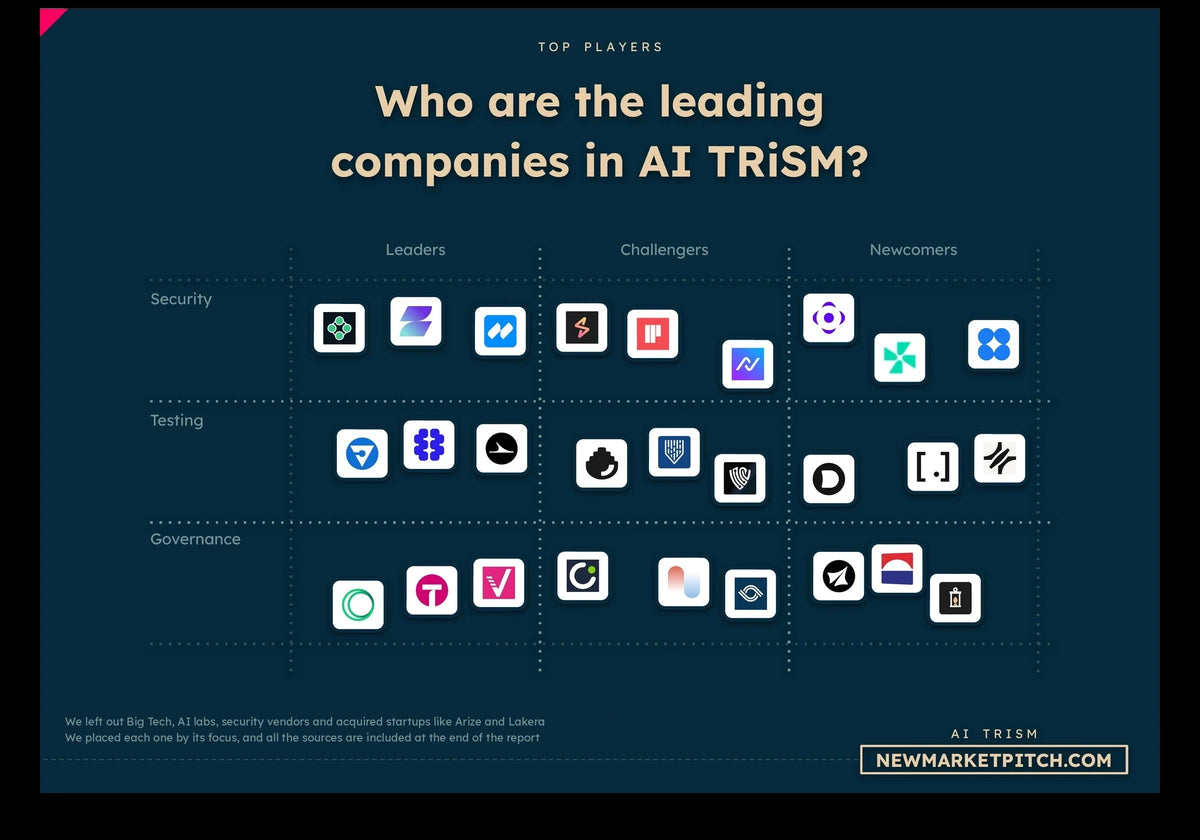
In our report covering the AI TRiSM market, we turn what is vague and complex into simple, useful visuals. Market maps like this one show you at a glance where every startup stands.
Do the AI security acquisitions prove there's a big standalone market?
The recent AI security acquisitions prove that specialized technology has become valuable, but the buyers are mainly building larger cybersecurity platforms rather than backing an independent AI TRiSM category.
We examined three transactions completed in 2025 using purchase consideration disclosed in regulatory filings.
Palo Alto Networks paid approximately $634.5 million for Protect AI. Check Point's filings recorded approximately $201.8 million for Lakera. F5 disclosed approximately $145.2 million in cash consideration for CalypsoAI, below the $180 million initially announced when the deal was proposed.
Together, those acquisitions represent approximately $981.5 million.
Three established cybersecurity vendors committed almost $1 billion to AI security specialists within four months. That's a lot of money for a category whose early vendors were still generating relatively modest revenue.
The buyers' strategies were remarkably similar. Each wanted capabilities that could be integrated into a broader product sold to existing enterprise customers. Palo Alto Networks emphasized AI lifecycle protection, Check Point focused on securing AI applications and agents, and F5 prioritized runtime protection for AI inference.
The valuations also exceeded what the acquired businesses' disclosed or reported revenues alone could easily explain. CalypsoAI, for example, reportedly generated less than $5 million in annual revenue before its acquisition.
Buyers were evidently willing to pay heavily for technology, engineering teams and the opportunity to distribute AI protection through existing sales channels.
For investors, acquisitions of this size create attractive exit possibilities. For independent vendors hoping to become major public software companies, the same deals reveal the difficulty of remaining separate once their products become strategically important.
If you want more recent data on this point, please see our latest AI TRiSM market report.
Which AI TRiSM products could become big standalone businesses?
AI agent security, runtime enforcement and independent AI assurance currently have the strongest case for becoming major standalone AI TRiSM businesses.
Runtime protection is particularly attractive because AI applications need to be supervised while they operate. A security product can inspect instructions, restrict tool access, detect suspicious activity and enforce policies across multiple models.
This type of protection can become an ongoing operational expense. As companies deploy more agents and applications, the amount of activity requiring supervision also grows.
Cross-platform governance has a different advantage. Enterprises using several model providers still need consistent ownership records, risk assessments and internal controls. Maintaining those records separately inside each provider's software can become difficult.
Independent assurance is promising when customers need credible testing and monitoring outside the AI developer's own systems. This is relevant for highly regulated deployments, procurement requirements and situations where model failures have serious consequences.
The commercial potential varies considerably across product types. Runtime security can potentially charge according to protected applications or usage. Governance platforms tend to rely more heavily on enterprise subscriptions. Evaluation software may be sold to engineering teams as part of development and testing workflows.
The question we would ask of any specialist is simple: would a customer still pay for this product if Microsoft, AWS or Palo Alto Networks offered a cheaper version?
Companies that can demonstrate better protection, consistent controls across platforms or stronger independent testing have a much better chance of keeping their customers.

Our research about AI trust and risk tools gets updated several times a month, so you always get the latest view of where things stand.
Could AI TRiSM end up as just another feature inside cybersecurity software?
A large part of AI TRiSM will almost certainly become standard functionality inside cybersecurity, cloud and enterprise governance products. The acquisitions we've examined show that integration is already underway.
Palo Alto Networks can offer specialized AI protection alongside its broader security portfolio. IBM can connect AI governance with enterprise risk management. Microsoft can combine model deployment, identity controls, logging and security policies within its cloud ecosystem.
For customers, that can reduce the number of vendors, integrations and contracts they need to manage.
We have seen similar competition in cloud security and observability, where major platforms provide native capabilities while independent vendors continue selling more specialized products.
AI TRiSM may follow the same pattern, especially because many enterprises need protection across multiple cloud providers and AI models.
The dividing line will be technical differentiation. Products offering ordinary reporting or standardized policy controls are easier to absorb into a larger platform. Specialized threat detection, independent evaluation and controls spanning several providers are harder to replace.
This is also why AI TRiSM should not be treated as one perfectly unified market. Governance, runtime security and assurance may end up belonging to different software categories, with different leading companies.
If you want more recent data on this point, please see our latest AI TRiSM market report.
Can standalone AI TRiSM companies reach $100 million in annual revenue?
AI TRiSM is already large enough for individual specialists to reach $100 million in annual revenue, although very few independent vendors have publicly demonstrated that scale.
We can test the opportunity against Gartner's spending figures. The 2026 securing-AI market is estimated at $2.835 billion. A vendor capturing 1% would generate approximately $28 million annually, while a 5% share would represent $142 million.
By 2028, Gartner expects the market to approach $7.7 billion. Capturing just 2% of that spending would represent approximately $154 million in annual revenue.
Those are market-share calculations rather than company forecasts, and the denominator includes revenue that may go to established software providers.
HiddenLayer's reported ARR in the tens of millions shows that a specialist can already achieve meaningful commercial scale. But getting from $20 million or $30 million to $100 million requires more than general market growth. Vendors need to retain customers, expand deployments and keep enough pricing power as competitors introduce similar capabilities.
At the same time, the competitive field is expanding. Gartner's June 2026 Magic Quadrant for AI Governance Platforms included 13 companies, ranging from dedicated specialists to IBM, SAP, OneTrust and ServiceNow. Security specialists face additional competitors outside that governance-focused group.
The industry can support several sizable independent businesses. Supporting dozens of companies with $100 million in recurring revenue would require a much larger share of AI TRiSM spending to remain with specialists.
We have enough commercial evidence to believe the first outcome is realistic. The second is still unproven.

In our market report about AI trust and risk tools, you will always find fresh funding data, taken straight from our own verified funding database.
How big could the AI TRiSM market become by 2030?
AI TRiSM could become a market generating more than $10 billion in annual spending around the end of the decade, although the result will depend heavily on how much AI protection companies continue buying separately.
MarketsandMarkets forecasts that its broadly defined AI TRiSM market will grow from $3.09 billion in 2026 to $11.61 billion in 2031, equivalent to approximately 30.3% compound annual growth.
Gartner's separate securing-AI forecast reaches nearly $7.7 billion in 2028. If that market then grows by 20% annually for two more years, it would reach approximately $11.1 billion in 2030. At 30% annual growth, the figure would be around $13.0 billion.
Those final two figures are our scenario calculations using Gartner's 2028 forecast, rather than published Gartner projections.
The potential growth is understandable. More AI agents mean more systems that need permission controls, threat detection, monitoring and audit records. Companies operating across multiple model providers may also need independent controls to keep policies consistent.
The biggest uncertainties concern pricing and distribution. Better native security from model providers could reduce the need for some external products. Large cybersecurity companies may bundle AI protection into broader contracts, making it difficult to measure the spending as a separate market.
Even so, a low-double-digit-billion-dollar market is plausible if enterprise AI deployments continue growing and organizations keep paying for dedicated controls.
The harder forecast concerns who collects that revenue. The market may become much larger while independent AI TRiSM vendors capture a relatively small share of it.
Is the AI trust, risk and security market big enough to stand alone?
Yes, AI TRiSM is already big enough to support standalone software businesses, but the evidence favors a handful of strong specialists rather than an entirely independent software industry.
Gartner forecasts $2.835 billion in spending on securing AI in 2026 and $4.783 billion in 2027. HiddenLayer has reported more than tenfold ARR growth, reaching the tens of millions of dollars. Major cybersecurity vendors have also paid substantial sums to acquire AI security technology.
Those developments establish that enterprise customers are spending money and that specialized products have commercial value.
The problem for independent vendors is that AI TRiSM covers several businesses that existing software platforms are already entering. Governance overlaps with enterprise compliance, AI security overlaps with cybersecurity, and assurance overlaps with model testing and observability.
The best standalone opportunities are in products that protect autonomous agents, enforce policies across multiple AI systems and independently evaluate model behavior. Companies operating in those areas have a stronger reason to exist outside any single cloud, model provider or security platform.
Generic governance dashboards and basic AI security features face a much tougher future as large vendors incorporate similar functionality into their products.
Our conclusion is that AI TRiSM can support several meaningful independent software companies, including some with the potential to exceed $100 million in annual recurring revenue. The overall spending pool could surpass $10 billion around 2030, but much of that money will probably flow through established cybersecurity, cloud and enterprise software platforms.
AI TRiSM has become a real market. Its biggest winners, however, may be the companies that own the security and governance layers surrounding AI, rather than those selling AI TRiSM as a separate category.
If you want more recent data on this point, please see our latest AI TRiSM market report.

In our document detailing everything you need to know about AI TRiSM, we look at what the winners do differently, so you can learn from the best instead of guessing.
Our methodology
This analysis examines whether AI trust, risk and security management can support durable standalone software companies, rather than simply become functionality within established cybersecurity, cloud and governance platforms. We assess the market through eight dimensions: spending, specialist revenue, enterprise purchasing, technological differentiation, regulatory demand, strategic acquisitions, competition and long-term growth.
For each dimension, we collected recent, verifiable evidence, grouped comparable observations and assessed what those findings reveal about the market. We then compared conclusions across dimensions. Market forecasts establish the size of the opportunity; revenue and customer disclosures reveal how much demand has already become commercial; acquisitions show what established vendors are willing to pay; and product-level analysis helps identify where independent companies may retain a competitive advantage.
We define AI TRiSM as AI governance, AI security and AI assurance software, together with directly attributable services. We exclude ordinary cybersecurity, generic observability, broad enterprise compliance and AI development spending unless the activity is specifically related to controlling AI risks. We also distinguish Gartner's narrower securing-AI forecast from broader AI TRiSM estimates instead of adding overlapping categories together.
For market sizing, we used Gartner's August 2026 securing-AI spending forecast, MarketsandMarkets' AI TRiSM market projections, and Gartner's February 2026 AI governance analysis. These sources provide separate views of the overall spending pool, its component categories and the potential development of governance software.
Commercial maturity was assessed using disclosed revenue, funding and customer information, particularly TechCrunch's September 2026 reporting on HiddenLayer. We treat reported ARR growth as evidence of traction at an individual company, without assuming that it describes the entire sector. For acquisitions, we relied on Palo Alto Networks' SEC filing, Check Point's SEC filing and F5's SEC filing, using recorded purchase consideration rather than relying solely on initial transaction announcements.
Regulatory analysis draws on the European Commission's AI Act framework, its 2026 AI Omnibus update, and the obligations applying to deployers of high-risk AI systems. Technical risks were assessed against the OWASP Top 10 for LLM Applications and NIST's AI Risk Management Framework. These materials help distinguish genuine AI-specific protection requirements from controls that conventional software already provides.
Competitive analysis also incorporates direct product documentation, including IBM's watsonx.governance capabilities and Microsoft's AI threat-protection offering. We compared those integrated capabilities with specialist products to assess where neutral, cross-platform enforcement or independent assurance could justify a separate vendor.
The 2030 figures are scenarios, not additional published forecasts. We extrapolated Gartner's 2028 spending estimate under specified annual growth assumptions and calculated potential vendor revenues as shares of the relevant spending pool. These calculations were considered alongside competitive concentration and bundling risk. Our conclusion comes from the combination of spending trends, commercial traction and the ability of specialist vendors to retain customers as larger platforms expand their own AI protection products.

If you build or invest in the AI TRiSM market, you need to know which business models pay off now and which ones are fading. That's why our report covering it has a whole section on it.
Written by the New Market Pitch teamWe track new markets so founders and investors can move faster. About us