What are the most valuable AI video generation startups?
Whether you're building or investing in the AI video generation market, our report covers everything you need to know: the players, the money, and what's coming next.
Summary
Decart is currently the most valuable AI video generation startup, valued at $4.0 billion to $7.0 billion, followed by Runway at $5.1 billion to $5.8 billion and Higgsfield at $5.4 billion. Their overlapping valuations make the exact order less certain, but these three companies lead a rapidly expanding private market.
Eight of the 56 independent AI video generation startups in our ranking have reached unicorn status. Together, they are valued at $28.5 billion to $36.4 billion, while the remaining 48 companies are each worth less than $1 billion.
Five of those eight unicorns are based in the United States, accounting for approximately 70% to 73% of the group's combined valuation ranges. The United Kingdom, China, and Singapore each contribute one additional unicorn.
The biggest surprise is how quickly application companies have caught up with foundation-model developers. Higgsfield has reached a higher valuation than Luma AI despite raising roughly half as much capital, while Synthesia and HeyGen have built substantial businesses around enterprise video rather than general-purpose model research.
Higgsfield's commercial growth is particularly striking. Its valuation increased approximately 315% between January and August 2026, and by September it reported more than $1 billion in annualized revenue run rate, nearly one million paying subscribers, and over 32 million users.
HeyGen offers a different example of capital efficiency. It surpassed $200 million in annual recurring revenue in June 2026 despite a valuation substantially below Synthesia's, showing that private funding valuations and commercial progress can diverge considerably.
Foundation-model development remains extremely expensive. Luma AI has raised approximately $1.057 billion, more than any other company in the ranking, while Runway and ShengShu Technology have also accumulated substantial funding to develop advanced video models and related technology.
Real-time generation is becoming the market's most ambitious technological bet. Decart's reported $7 billion acquisition discussions with Amazon illustrate the strategic interest in interactive environments, simulations, and world models, even though these applications have yet to demonstrate the commercial scale of established video-production tools.
Basic AI video generation is already relatively inexpensive. Runway's published developer prices range from $0.50 for ten seconds of Gen-4 Turbo to $4.00 for ten seconds of Google's Veo 3.1 with audio, putting more pressure on companies to differentiate through workflows, editing, consistency, and business outcomes.
The clearest commercial opportunities currently appear in advertising, corporate training, localization, and other recurring business uses. More speculative opportunities in robotics, interactive entertainment, and world simulation could eventually become much larger, but they also require considerably more research spending.
Our conclusion is that the AI video generation market has moved beyond impressive demonstrations into a real software business, although valuations remain aggressive. Higgsfield, Synthesia, HeyGen, and Runway have particularly interesting commercial positions today; Decart and Luma AI offer larger technological bets whose ultimate economics are still taking shape.

Written by the New Market Pitch teamWe track new markets so founders and investors can move faster. About us

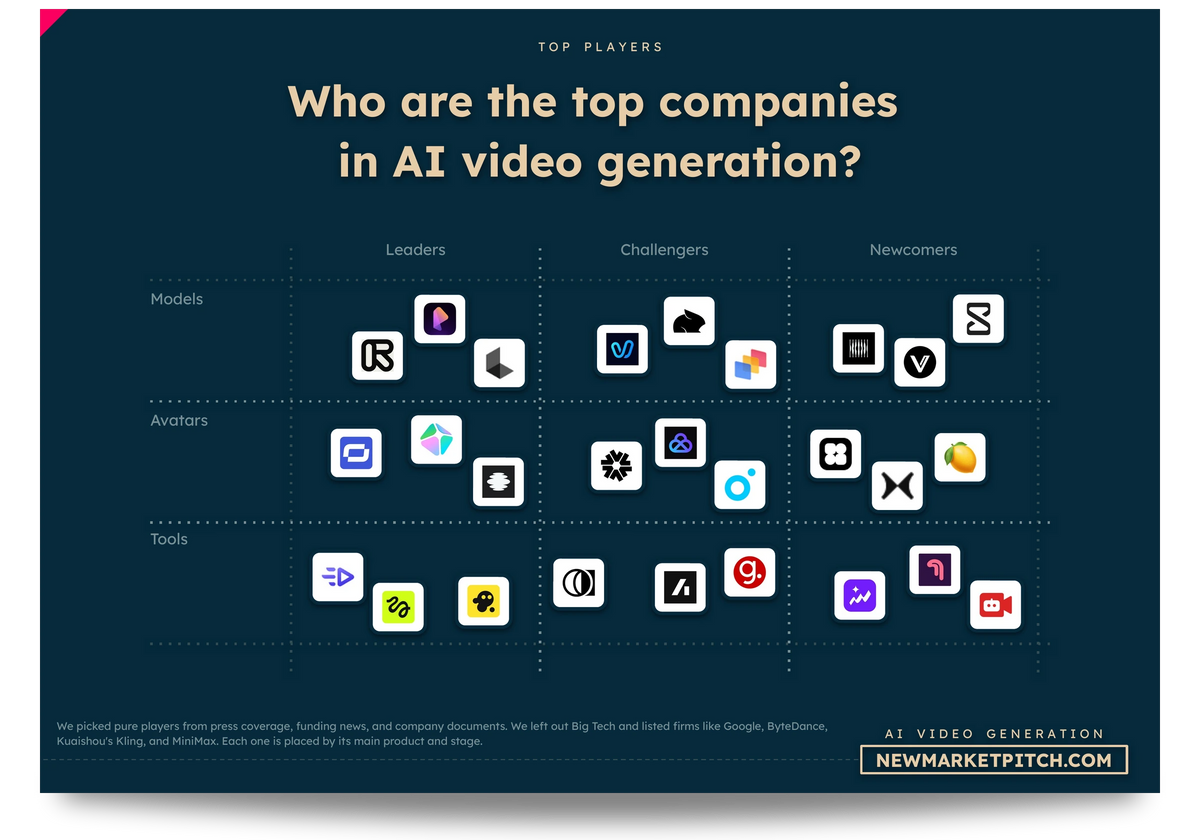
In our report covering the AI video generation market, we turn what is vague and complex into simple, useful visuals. Market maps like this one show you at a glance where every startup stands.
Top startups in the AI video generation market ranked by valuation
Here is an updated table that ranks the top startups in the AI video generation market based on their latest reported or estimated valuations.
If you need to dig deeper and get more detailed data, please check our report covering the AI video generation market.
| # | Startup Name | What They Do | Current Valuation ($) | Valuation Confidence Level | Valuation Type | Evidence Status | Total Funding ($) | Funding Confidence Level | Country |
|---|---|---|---|---|---|---|---|---|---|
| 1 | Decart | Real-time generative video and AI infrastructure | $4.0B–$7.0B | Strong Confidence | Implied Valuation from Raise | Estimated | ~$456M | Strong Confidence | United States |
| 2 | Runway | Generative video and world models | $5.1B–$5.8B | Strong Confidence | Implied Valuation from Raise | Estimated | $859.5M+ | Strong Confidence | United States |
| 3 | Higgsfield | AI cinematic video generation platform | $5.4B | Strong Confidence | Implied Valuation from Raise | Estimated | $538M | Strong Confidence | United States |
| 4 | Luma AI | Multimodal AI video foundation models | $3.8B–$5.6B | Strong Confidence | Implied Valuation from Raise | Estimated | $1.057B | Strong Confidence | United States |
| 5 | Synthesia | Enterprise AI avatar video creation | $3.8B–$4.3B | Strong Confidence | Implied Valuation from Raise | Estimated | $536.6M+ | Strong Confidence | United Kingdom |
| 6 | ShengShu Technology | Vidu multimodal AI video models | $2.8B–$3.5B | Strong Confidence | Implied Valuation from Raise | Estimated | ~$963M+1 | Partial Confidence | China |
| 7 | HeyGen | AI avatar videos and localization | $1.6B–$2.8B | Strong Confidence | Revenue or ARR Multiple Estimate | Estimated | $74M | Partial Confidence | United States |
| 8 | PixVerse | AI video and interactive generation | $2.0B+ | Strong Confidence | Implied Valuation from Raise | Estimated | ~$584M+2 | Partial Confidence | Singapore |
| 9 | Mirage | AI video editing and generation | $400M–$650M | Partial Confidence | Comparables-Based Estimate | Estimated | $175M+ | Partial Confidence | United States |
| 10 | Pika | Generative AI video creation tools | $470M | Partial Confidence | Implied Valuation from Raise | Estimated | $135M | Partial Confidence | United States |
| 11 | Reactor | Real-time generative world model infrastructure | $240M–$390M | Partial Confidence | Implied Valuation from Raise | Implied | $59M | - | United States |
| 12 | Sand AI | Open-source generative video foundation models | $210M–$340M | Partial Confidence | Revenue or ARR Multiple Estimate | Estimated | ~$100M3 | Low Confidence | China |
| 13 | Video Rebirth | Industrial-grade AI video generation | $220M–$290M | Strong Confidence | Implied Valuation from Raise | Estimated | $80M | Partial Confidence | Singapore |
| 14 | Tavus | Conversational AI video agents | $250.8M | Strong Confidence | Implied Valuation from Raise | Estimated | $64M+ | - | United States |
| 15 | InVideo | AI video creation and editing | $180M–$320M | Partial Confidence | Revenue or ARR Multiple Estimate | Estimated | ~$52.5M | Partial Confidence | Singapore |
| 16 | Hedra | AI-generated expressive character videos | $160M–$260M | Partial Confidence | Implied Valuation from Raise | Estimated | $42M | - | United States |
| 17 | DeepBrain AI | AI human avatars and videos | $110M–$210M | Low Confidence | Comparables-Based Estimate | Estimated | $45.7M+ | Partial Confidence | South Korea |
| 18 | Genmo | AI video generation models | $120M–$190M | Partial Confidence | Comparables-Based Estimate | Estimated | $28.4M | - | United States |
| 19 | D-ID | Interactive digital humans and videos | $100M–$200M | Partial Confidence | Comparables-Based Estimate | Estimated | $42.69M+ | Partial Confidence | Israel |
| 20 | Arcads | AI-generated video advertising | $105M–$175M | Strong Confidence | Revenue or ARR Multiple Estimate | Estimated | $16M | - | France |
| 21 | Creatify | Automated AI video advertisements | $75M–$135M | Partial Confidence | Revenue or ARR Multiple Estimate | Estimated | $20M+ | - | United States |
| 22 | NaukNauk | AI animation for toy collectors | $80M–$120M | Partial Confidence | Implied Valuation from Raise | Implied | $20M | - | United States |
| 23 | Klleon | Real-time conversational digital humans | $65M–$110M | Low Confidence | IPO or Listing Range Valuation | Estimated | $11M+ | - | United States |
| 24 | Idomoo | Personalized enterprise video automation | $65M–$105M | Partial Confidence | Revenue or ARR Multiple Estimate | Estimated | $27M | - | Israel |
| 25 | Viggle AI | Controllable AI character animation | $65M–$105M | Partial Confidence | Comparables-Based Estimate | Estimated | $19M | - | Canada |
| 26 | Pollo AI | Unified AI video creation suite | $65M–$95M | Partial Confidence | Implied Valuation from Raise | Implied | $14M | - | Singapore |
| 27 | TrueFan AI | Personalized enterprise AI avatar videos | $50M–$85M | Partial Confidence | Implied Valuation from Raise | Implied | $14.3M+ | - | India |
| 28 | ValkaAI | Real-time interactive AI digital humans | $45M–$85M | Partial Confidence | Implied Valuation from Raise | Implied | ~$14M | - | Netherlands |
| 29 | Lemon Slice | Real-time interactive AI video avatars | $42M–$75M | Partial Confidence | Implied Valuation from Raise | Implied | $10.5M | - | United States |
| 30 | Cinamon | AI-powered 3D animated storytelling | $40M–$70M | Partial Confidence | Comparables-Based Estimate | Estimated | ~$20M+ | - | South Korea |
| 31 | Colossyan | AI-generated corporate training videos | $35M–$75M | Partial Confidence | Comparables-Based Estimate | Estimated | ~$28M | - | Hungary |
| 32 | Anam | Real-time conversational video avatars | $35M–$65M | Partial Confidence | Implied Valuation from Raise | Implied | ~$11.4M | - | United Kingdom |
| 33 | Cheehoo | AI-assisted 3D animation production | $35M–$65M | Partial Confidence | Comparables-Based Estimate | Estimated | $10M | - | United States |
| 34 | AKOOL | AI avatars and video marketing | $25M–$75M | Low Confidence | Comparables-Based Estimate | Estimated | Undisclosed | - | United States |
| 35 | Visko | Interactive real-time video world models | $35M–$65M | Partial Confidence | Implied Valuation from Raise | Implied | $10M | - | United States |
| 36 | Krikey AI | AI-powered 3D character animation | $30M–$60M | Low Confidence | Comparables-Based Estimate | Estimated | $22M | - | United States |
| 37 | Kaiber | AI audiovisual creation and editing | $30M–$55M | Partial Confidence | Comparables-Based Estimate | Estimated | ~$10M | - | United States |
| 38 | Storykit | Automated branded business video production | $25M–$55M | Low Confidence | Comparables-Based Estimate | Estimated | ~$11.8M | - | Sweden |
| 39 | NationA | AI video and interactive storytelling | $30M–$47M | Partial Confidence | Implied Valuation from Raise | Implied | ~$8.1M | - | South Korea |
| 40 | Flick | AI filmmaking and editing platform | $25M–$40M | Partial Confidence | Implied Valuation from Raise | Implied | $6M | - | United States |
| 41 | Waymark | AI-generated television advertising creatives | $20M–$45M | Low Confidence | Comparables-Based Estimate | Estimated | ~$4.6M | - | United States |
| 42 | TopView AI | AI-generated ecommerce marketing videos | $30.7M | Strong Confidence | Implied Valuation from Raise | Estimated | $13.9M | - | Singapore |
| 43 | Argil | AI avatar video creation | $20M–$35M | Partial Confidence | Comparables-Based Estimate | Estimated | ~$5.5M | - | France |
| 44 | Gan.ai | Personalized AI marketing videos | $18M–$35M | Partial Confidence | Comparables-Based Estimate | Estimated | $5.3M | - | United States |
| 45 | 2wai | Interactive holographic AI avatars | $15M–$35M | Low Confidence | Implied Valuation from Raise | Implied | $5M | - | United States |
| 46 | MITO AI | Collaborative AI filmmaking workspace | $18M–$32M | Partial Confidence | Implied Valuation from Raise | Implied | $4.5M | - | Spain |
| 47 | Golpo AI | AI-generated educational explainer videos | $16M–$28M | Partial Confidence | Implied Valuation from Raise | Implied | ~$4.2M | - | United States |
| 48 | Airpost | AI video advertising optimization | $16M–$27M | Partial Confidence | Implied Valuation from Raise | Implied | $4.1M | - | United States |
| 49 | Mootion | Automated AI storytelling and videos | $14M–$28M | Low Confidence | Implied Valuation from Raise | Implied | $2.8M+ | - | Hong Kong |
| 50 | VidAU | AI video advertising generation | $12M–$28M | Low Confidence | Proxy-Based Estimate | Estimated | Undisclosed | - | Singapore |
| 51 | Pictory | AI text-to-video production software | $12M–$25M | Low Confidence | Comparables-Based Estimate | Estimated | $4.7M | - | United States |
| 52 | VideoGen | AI-assisted editable video production | $14M–$22M | Partial Confidence | Implied Valuation from Raise | Implied | ~$3.8M | - | United States |
| 53 | BHuman | Personalized synthetic video messages | $8M–$25M | Low Confidence | Proxy-Based Estimate | Estimated | $0.9M | - | United States |
| 54 | Shuffll | Automated branded video production infrastructure | $10M–$20M | Low Confidence | Comparables-Based Estimate | Estimated | $3M+ | - | United States |
| 55 | Magic Hour | AI multimedia generation and editing | $6M–$18M | Low Confidence | Proxy-Based Estimate | Estimated | $500K+ | - | United States |
| 56 | Knowlify | AI-generated social advertising services | $5M–$13M | Low Confidence | Comparables-Based Estimate | Estimated | $500K–$3.5M | - | United States |
Which startups in the AI video generation market have been acquired or gone public?
These startups no longer have a private-market valuation of their own, so we list them separately, using their acquisition price or their current market capitalization.
| # | Startup Name | What They Do | Current Valuation ($) | Valuation Confidence Level | Valuation Type | Evidence Status | Total Funding ($) | Funding Confidence Level | Country |
|---|---|---|---|---|---|---|---|---|---|
| 1 | Moonvalley | Cinematic AI video foundation models | $180M–$350M4 | Low Confidence | Proxy-Based Estimate | Estimated | $154M | Strong Confidence | Canada |
| 2 | Soul Machines | Interactive synthetic human avatars | $1M–$15M4 | Low Confidence | Proxy-Based Estimate | Estimated | ~$119.5M | - | New Zealand |
- Published estimates range from about $893M to $963M+.
- Published estimates range from about $584M to $925M.
- Published estimates range from about $100M to $145M.
- Deal prices undisclosed; ranges are rough estimates based on asset value.

Our research about AI video generators gets updated several times a month, so you always get the latest view of where things stand.
Which AI video generation startups are worth the most today?
Decart currently leads the AI video generation startup ranking at $4.0B–$7.0B, followed by Runway at $5.1B–$5.8B and Higgsfield at $5.4B.
Luma AI ranks fourth at $3.8B–$5.6B, followed by Synthesia at $3.8B–$4.3B. ShengShu Technology, HeyGen, and PixVerse complete the eight-company group valued above $1 billion.
Together, these eight startups represent $28.5B–$36.4B in combined valuations. The other 48 private companies in our ranking each carry valuations below $1 billion.
What's interesting is how different the leading businesses have become. Higgsfield sells tools for creating advertising and cinematic content, Decart develops real-time generative video technology, and Runway combines creative software with world-model research. Synthesia, meanwhile, has built its business around corporate training and communication.
Five of the eight unicorns are based in the United States. The remaining three are headquartered in the United Kingdom, China, and Singapore.
The valuation ranking shows where investors are placing their biggest bets, but it doesn't tell us which companies make the most money. That becomes much clearer when we look at their funding, customers, and reported financial performance.
How many AI video generation unicorns are there?
There are currently eight AI video generation unicorns, representing 14.3% of the 56 independent private startups in our ranking.
The group includes Higgsfield, Decart, Runway, Luma AI, Synthesia, ShengShu Technology, PixVerse, and HeyGen.
The gap below them is unusually large. PixVerse, in eighth position, is valued at $2.0B+. Mirage, immediately below the unicorn group, has an estimated valuation of $400M–$650M. Even the upper end of Mirage's range falls well short of PixVerse's valuation.
Most of these unicorns have reached their valuations through substantial private financing. HeyGen stands out because its valuation is closely tied to its reported revenue performance.
HeyGen reported passing $200 million in annual recurring revenue (ARR) in June 2026, while some more highly valued model developers have disclosed much less about their revenue.
The concentration is also visible in financing. The seven highest-ranked companies collectively account for approximately $4.5 billion in reported or estimated funding.
For now, the unicorn group is dominated by companies with substantial capital backing, large customer bases, or ambitious underlying AI technology. Several have all three, although the balance differs considerably.

In our market report about AI video generators, we look at what the winners do differently, so you can learn from the best instead of guessing.
Why have AI video startup valuations increased so much?
AI video startup valuations have risen sharply because several companies have started showing serious revenue growth while investors are also betting heavily on world models and real-time generation.
Higgsfield offers perhaps the clearest example. Its valuation increased from $1.3 billion in January 2026 to $5.4 billion in August, a gain of approximately 315% in seven months.
The company also reported annualized revenue rising from approximately $20 million a year before its August fundraising to $700 million at the time of that round. By September, Higgsfield was reporting a run rate above $1 billion.
Synthesia followed a different path. After reaching a $2.1 billion valuation in January 2025, it announced a $200 million financing round at $4 billion in January 2026, an increase of approximately 90% in twelve months.
Runway secured a $315 million Series E in February 2026. TechCrunch reported a $5.3 billion valuation for that transaction, reflecting investor enthusiasm for its expansion into world models.
These are three different reasons investors have been willing to pay more. Higgsfield demonstrated unusually rapid commercialization, Synthesia expanded an established enterprise software business, and Runway attracted capital for a potentially much larger technological opportunity.
Growth this fast creates demanding expectations, though. A company whose valuation doubles within a year has a lot to deliver over the next few years.
Is Higgsfield really one of the leading AI video generation startups?
Higgsfield ranks third in our AI video generation valuation ranking, only narrowly behind Decart and Runway, and its reported revenue growth gives that position unusually strong commercial backing.
The company is valued at $5.4B, with $538M in cumulative funding.
In August 2026, Higgsfield announced a $400 million Series B at a $5.4 billion valuation. Its financing followed a January round at $1.3 billion, making it one of the fastest valuation increases among the major AI video startups.
The business has grown just as quickly, at least according to its own disclosures.
In September, Higgsfield reported exceeding $1 billion in annualized revenue run rate, more than 32 million users, and nearly one million paying subscribers.
The annualized figure is calculated by multiplying the latest four weeks of revenue by 13. It measures the pace of current sales rather than revenue earned over a completed year.
More revealing is the change in how customers spend money. Subscriptions previously represented over 90% of Higgsfield's revenue. By September, that proportion had fallen to just over 60%, with on-demand generation accounting for a larger share.
That suggests customers are returning to generate more content beyond their subscription allowance.
Higgsfield also reported that revenue under contract from business customers had grown tenfold since June. Its more recent October financing extension, involving TCV and NVIDIA, was accompanied by a disclosure of more than 40 million users and monthly platform activity of approximately 150 million generations.
These figures are company-reported rather than independently audited. Still, the combination of rapid revenue growth, expanding usage, and new institutional investors makes Higgsfield's commercial position difficult to dismiss.

In our document detailing everything you need to know about AI video generation, you will always find fresh funding data, taken straight from our own verified funding database.
Is Decart actually worth more than Runway?
Decart ranks ahead of Runway in our AI video generation valuation ranking, although their overlapping valuation ranges make the exact difference uncertain.
Decart is valued at $4.0B–$7.0B, compared with Runway's $5.1B–$5.8B.
The comparison has become particularly interesting because of Decart's potential acquisition value.
In October 2026, Reuters reported that Amazon was in talks to acquire Decart for approximately $7 billion, citing The Wall Street Journal. The report also referred to an earlier financing valuation near $4 billion and previous acquisition interest from Anthropic.
Those talks had not been confirmed as a completed acquisition. Decart therefore remains in our private-company ranking.
Runway, meanwhile, has raised $859.5M+ and has an established creative software platform alongside its research into world simulation.
Decart focuses more directly on the technology needed to generate responsive visual environments in real time. Its Lucy model can modify live video, while Oasis has been developed to generate simulated environments.
Runway has a recognizable product used by creators and businesses today. Decart's potential opportunity extends into interactive simulation, robotics training, and other systems that need continuously generated visual environments.
A $7 billion acquisition would represent a major strategic bet on those capabilities. But until a transaction is completed, that price remains a possibility rather than a sale value.
Decart's acquisition interest strengthens the case for its technology having substantial strategic value. Runway, for its part, already has a more established position in creative software. It's a pretty different kind of business.
Why is Runway valued at more than $5 billion?
Runway's $5.1B–$5.8B valuation reflects an established AI video platform and a much bigger bet on world models.
In February 2026, Runway announced a $315 million Series E led by General Atlantic. Participants included NVIDIA, Adobe Ventures, AMD Ventures, Fidelity, and other major investors.
Its cumulative funding stands at $859.5M+.
Runway originally became known for tools that let creators generate, modify, and edit video using AI. Its Gen-4 family expanded those capabilities, while its subsequent work on world models pushed the company toward systems that can simulate changing environments.
That opens up applications well beyond filmmaking. A model capable of predicting how objects and environments change could eventually help with robotics, industrial simulations, and interactive entertainment.
Runway is already monetizing its technology through a developer platform. Its published pricing includes $0.05 per generated second for Gen-4 Turbo and $0.12 for Gen-4.5.
The company also distributes third-party models, including Google's Veo 3.1. This gives Runway another way to earn revenue from customers who want access to several video technologies through one platform.
Its valuation therefore rests on two businesses at different stages of development: commercially available creative software and more experimental world simulation.
The first has established customers and published pricing. The second could open up larger markets, but its commercial economics are still much harder to assess.

Learning from others' mistakes is the cheapest lesson there is. In our report covering the AI video generation market, we look at what broke startups before you, so you don't repeat it.
Why has Luma AI raised more than $1 billion?
Luma AI has raised approximately $1.057B because developing advanced multimodal video models requires enormous investment in computing infrastructure and research.
The company's largest financing event was its $900 million Series C in November 2025, led by HUMAIN, the Saudi Arabian AI company backed by the Public Investment Fund.
The financing was announced alongside a partnership to develop Project Halo, a planned two-gigawatt AI computing supercluster in Saudi Arabia.
Luma's ambitions go considerably beyond generating short videos from text prompts.
Its research focuses on multimodal systems capable of processing images, video, language, and other forms of information to understand and simulate the world.
The company has said these capabilities could eventually serve entertainment, advertising, education, robotics, and other industries.
Luma is valued at $3.8B–$5.6B despite having raised approximately twice as much capital as Higgsfield.
That comparison illustrates how differently AI video startups use money. Luma has committed itself to developing expensive underlying models and computing capabilities, while Higgsfield has concentrated on building a commercial creative platform.
The amount raised also shows how difficult this competition has become for smaller model developers.
Training advanced video models requires access to specialized chips, large datasets, researchers, and infrastructure. Every major improvement can require another substantial investment cycle.
Luma's financing gives it the resources to compete at that level. Whether the technology generates returns matching those investments will depend on adoption, licensing revenue, and the cost of operating its models.
Are AI video foundation models worth more than video creation apps?
AI video foundation-model companies attract some of the largest investments, but application businesses such as Higgsfield and Synthesia have already reached comparable valuations.
Runway, Luma AI, ShengShu Technology, Sand AI, and Genmo are focused on developing generative video technology. Decart, Reactor, and Visko pursue related infrastructure and interactive world-model capabilities.
Application-oriented companies include Higgsfield, Synthesia, HeyGen, InVideo, Creatify, Arcads, and numerous smaller video-production platforms.
Among the top companies, the contrast is particularly clear.
Luma AI has raised $1.057B and is valued at $3.8B–$5.6B. Synthesia, which sells enterprise video software, has raised $536.6M+ and is valued at $3.8B–$4.3B.
Higgsfield goes even further, ranking among the top three despite relying partly on models developed by other companies.
The economic trade-off is straightforward. A foundation-model developer can sell access to its technology through APIs and licensing, but must keep investing in training and inference. An application provider can use external models and spend more of its resources on customers, distribution, and features.
Applications face their own problem: competing products can often access the same underlying models.
Owning the model can create a technological advantage, while owning the customer relationship can create a commercial one. Both have produced multibillion-dollar valuations.
The strongest companies may eventually combine these advantages. For now, the commercial success of Higgsfield, Synthesia, and HeyGen shows that developing the underlying model isn't the only route to building a very valuable AI video business.

Your time is limited. In our research about AI video generators, we put numbers on each part of the market, so you can see where it makes sense to focus.
Which AI video startups have raised the most funding?
Luma AI leads AI video generation startups in cumulative funding, followed by ShengShu Technology, Runway, PixVerse, Higgsfield, Synthesia, and Decart.
The seven companies have collectively raised approximately $5 billion.
Luma's $900 million Series C accounts for most of its reported financing. Runway's $315 million Series E and Higgsfield's $400 million Series B also show how large individual funding rounds have become.
PixVerse provides another useful comparison. Its July 2026 announcement said its Series C and extension together had raised $439 million, with the company reporting plans to expand into interactive entertainment.
The largest fundraising amounts are concentrated among businesses building foundation models, interactive technologies, or rapidly growing platforms. Smaller application companies generally need less funding to develop and distribute their products.
| Startup | Total funding | Main business |
|---|---|---|
| Luma AI | $1.057B | Multimodal AI foundation models |
| ShengShu Technology | ~$963M+ | Vidu video models |
| Runway | $859.5M+ | Video generation and world models |
| PixVerse | ~$584M+ | Video and interactive generation |
| Higgsfield | $538M | AI creative production platform |
| Synthesia | $536.6M+ | Enterprise avatar videos |
| Decart | ~$456M | Real-time generative infrastructure |
Published funding totals for ShengShu Technology and PixVerse vary, with ShengShu estimates ranging from approximately $893M to $963M+ and PixVerse estimates from roughly $584M to $925M.
Regardless of those differences, one pattern is clear: building competitive AI video models can require hundreds of millions of dollars before the underlying technology becomes a mature business.
Is Synthesia worth more than HeyGen?
Synthesia is currently worth more than HeyGen according to our AI video generation valuation ranking, although HeyGen has reported particularly strong recent revenue growth.
Synthesia is valued at $3.8B–$4.3B, compared with HeyGen's estimated $1.6B–$2.8B.
Synthesia announced a $200 million Series E at a $4 billion valuation in January 2026. Google Ventures led the round, with participation from several existing investors, including NVIDIA's venture arm.
The company had already surpassed $100 million in ARR in April 2025, according to its official announcement.
HeyGen reported exceeding $200 million in ARR in June 2026, doubling that figure in eight months. It also disclosed more than 30 million users and adoption across 85% of Fortune 100 companies.
These revenue figures come from different reporting dates, so they cannot establish which company has higher ARR today.
Their products also serve somewhat different customer needs.
Synthesia has developed a strong position in corporate training, employee communication, and educational video. HeyGen focuses heavily on personalized video, translation, localization, and the ability to communicate through realistic digital avatars.
HeyGen's reported revenue is particularly impressive relative to its funding. The company said in June that it was generating approximately $2.70 in ARR for every dollar of equity capital raised.
The valuation difference says more about financing history and investor expectations than about which company has the stronger business. HeyGen's reported operating performance makes it a serious competitor despite its lower valuation.

In our market report about AI video generators, we always try to gather several sources and make estimates that make sense, so you can work with solid numbers.
Are AI avatar startups becoming a major part of the video market?
AI avatar startups have become one of the strongest commercial segments of AI video because businesses can use digital presenters repeatedly for training, communication, sales, and customer service.
Synthesia and HeyGen demonstrate the scale these products can reach. Further down our ranking, Tavus develops conversational video agents, while D-ID and DeepBrain AI focus on digital humans and synthetic video.
Colossyan specializes in corporate training videos. Anam, Lemon Slice, ValkaAI, and Klleon are pursuing real-time conversational avatars, while TrueFan AI focuses on personalized enterprise video.
The category covers two rather different products.
A prerecorded avatar can deliver a training course in multiple languages. A conversational avatar needs to listen, understand the user, generate an answer, and maintain a believable interaction.
The second product is technically harder because the entire process must happen with little delay.
That also changes the business model. A training platform may charge for users, subscriptions, or generated minutes, while an interactive agent may charge for conversations or usage.
Hedra provides a related example from character animation. Its May 2025 Series A announcement described a $32 million financing round and more than 10 million videos generated using its technology.
Large enterprise platforms and smaller specialist startups can coexist here because the applications differ substantially. The clearest commercial winners will probably be those that solve a recurring business problem rather than relying on the novelty of synthetic presenters.
Could real-time AI video become bigger than ordinary video generation?
Real-time AI video could eventually serve a larger range of industries than ordinary AI video creation, although commercial demand for interactive world models remains much less proven.
Decart is the clearest large-scale example, with its $4.0B–$7.0B valuation. Reactor and Visko are also developing technology related to real-time generative environments.
ShengShu Technology has been moving in a similar direction. Its Vidu S1 became available in July 2026, followed by Vidu S2 in September, extending its work on interactive, editable, and spatial video generation.
PixVerse has also expanded beyond conventional video creation. Its July financing announcement described a move into interactive entertainment powered by real-time world models.
These companies are addressing a different problem from generating a five-second cinematic clip.
An interactive system must adapt continually when a user moves, changes an object, or asks a character to respond. The environment must remain coherent, and the response needs to arrive quickly enough to feel natural.
Potential applications include games, virtual environments, robotics simulations, and interactive training.
The technological challenge is substantial. A conventional generation request can take seconds or minutes to complete, while an interactive environment must respond continuously.
That creates pressure on computing costs as well as model quality.
Decart's reported acquisition interest shows how much strategic value large technology companies may place on these capabilities. Yet there is still limited public evidence of large, recurring revenue from real-time simulation products.
The opportunity could be enormous. The harder question is whether these companies can make continuous generation cheap and reliable enough for customers to use it at scale.

If you build or invest in the AI video generation market, you need to know which business models pay off now and which ones are fading. That's why our report covering it has a whole section on it.
Can AI video startups really compete with OpenAI and Google?
Independent AI video startups can compete with OpenAI and Google today, particularly when they sell specialized tools that customers need for their work.
OpenAI's Sora and Google's Veo have raised expectations for AI-generated video quality. Both companies can draw on substantial research resources, computing infrastructure, and existing distribution networks.
Trying to beat these systems on general-purpose generation quality alone is an expensive strategy.
Runway has instead built a platform combining its own technology with access to external models. Higgsfield bundles models with creative tools, while Synthesia and HeyGen focus on enterprise communication and localization.
The commercial advantages are different.
A professional video team might choose Runway for its editing tools and developer access. A marketing department might choose Higgsfield to create advertising variations. A multinational company could use HeyGen to translate training or sales videos without filming each language separately.
These decisions depend on the complete workflow, including editing, collaboration, consistency, and ease of use.
Runway's developer pricing demonstrates how the market is changing. It distributes Google's Veo 3.1 alongside its own Gen-4 models, turning access to competing technology into part of its product.
That approach lets an independent platform benefit from improvements made by larger model developers.
OpenAI and Google will remain formidable competitors. But a business that saves companies hours of editing, production, or localization work can still be valuable even if it doesn't have the world's best video model.
How cheap is AI video generation today?
AI video generation now costs just a few dollars for many short clips, making repeated experimentation practical for businesses and creators.
Runway's published developer pricing provides a useful benchmark.
Gen-4 Turbo costs $0.05 per generated second, while Gen-4.5 costs $0.12. Google's Veo 3.1 costs $0.40 per second with audio when accessed through Runway's developer platform, or $0.20 without audio.
For a ten-second clip, those prices translate into $0.50, $1.20, and $4.00 respectively.
A business generating 100 ten-second clips using Gen-4.5 would spend approximately $120 on the raw generations, assuming no additional fees or retries.
That can be attractive compared with traditional filming, but the final cost depends on how much usable content the customer receives.
A campaign may require multiple attempts, character consistency, product accuracy, editing, sound, and localization. A cheap generation that cannot be used commercially is still wasted money.
| Video model | Price per generated second | Cost of 10 seconds |
|---|---|---|
| Runway Gen-4 Turbo | $0.05 | $0.50 |
| Runway Gen-4.5 | $0.12 | $1.20 |
| Google Veo 3.1 Fast, no audio | $0.10 | $1.00 |
| Google Veo 3.1 Fast, with audio | $0.15 | $1.50 |
| Google Veo 3.1, no audio | $0.20 | $2.00 |
| Google Veo 3.1, with audio | $0.40 | $4.00 |
| Runway Act Two | $0.05 | $0.50 |
Prices are based on Runway's published developer rates and may change with model versions, settings, and billing conditions.
For AI video startups, falling generation costs create an opportunity to attract more users and encourage greater production volume. They can also make it harder to charge a premium for basic generation.
We expect the economic value to shift increasingly toward producing usable final videos, rather than simply generating the underlying footage.

In our report covering the AI video generation market, we don't want to repeat what boring consulting reports say. Instead, we show you the real and latest market signals that matter.
Why are investors interested in AI video advertising startups?
AI video advertising startups are attracting investors because their products can reduce creative production costs while helping marketers test more advertising ideas.
Higgsfield has demonstrated how large that opportunity can become, but smaller companies are developing more specialized businesses.
Arcads creates advertising videos using AI actors. In December 2025, the company announced a $16 million seed round led by Eurazeo and reported more than 6,000 customers.
It also described itself as profitable, an important distinction in a category where many companies are still spending heavily on research and customer acquisition.
Creatify concentrates on automatically generating advertisements, while TopView AI specializes in ecommerce marketing videos. Airpost focuses on advertising optimization, and VidAU develops AI-generated commercial video content.
These businesses can offer practical advantages to online advertisers.
A brand selling products in several countries may need different video formats, languages, presenters, and messages. Generating those variations with AI can make creative testing much cheaper.
The commercial test, however, is whether the videos actually help advertisers sell more.
A platform that produces hundreds of variations but cannot improve campaign results may struggle to retain customers. Tools that connect creative production with measurable advertising performance could become considerably harder to replace.
Arcads' profitability claim and Higgsfield's rapid growth suggest that advertising is already producing viable businesses at very different scales.
Can smaller AI video startups still become unicorns?
Smaller AI video startups can still become unicorns, but the gap between the largest companies and the rest of the market has become difficult to close.
Mirage and Pika occupy the highest positions below the billion-dollar group, valued at $400M–$650M and $470M respectively.
Both would need substantial growth to reach a $1 billion valuation.
Further down, Reactor is valued at $240M–$390M, Sand AI at $210M–$340M, Tavus at $251M, and Video Rebirth at $220M–$290M.
These companies are pursuing different opportunities.
Mirage and Pika focus on video creation and editing. Tavus develops conversational video agents. Reactor and Sand AI are closer to the underlying technology, while Video Rebirth concentrates on industrial-grade video generation.
The amount of funding also varies considerably.
Pika has raised $135M, while Tavus has raised at least $64M and Reactor $59M.
Higher funding alone doesn't guarantee a higher valuation. Investors still need to see technology turning into paying customers or becoming valuable infrastructure.
The next unicorn could come from any of these segments, but the most credible routes are becoming clearer: rapid recurring revenue growth, unusually valuable proprietary technology, or a product that major enterprise customers use extensively.
The general popularity of AI video is no longer enough to justify a billion-dollar price tag.

In our research about AI video generators, we like to show you the big picture. We know your time is precious, so we make every page quick to read and packed with as much learning as possible per minute.
Which countries have the most valuable AI video generation startups?
The United States dominates AI video generation startup valuations, with five of the eight unicorns headquartered there.
Higgsfield, Decart, Runway, Luma AI, and HeyGen collectively represent $19.9B–$26.6B in valuations.
That accounts for approximately 70%–73% of the combined valuations of all eight unicorns.
The United Kingdom's Synthesia, China's ShengShu Technology, and Singapore's PixVerse make up the rest of the group.
Singapore has a particularly visible presence beyond PixVerse. Other Singapore-based startups in our ranking include Video Rebirth, InVideo, Pollo AI, TopView AI, and VidAU.
South Korea is represented by DeepBrain AI, Cinamon, and NationA. France has Arcads and Argil, while Israel has D-ID and Idomoo.
These geographic differences partly reflect the types of companies being financed.
The United States has attracted major investment in foundation models, large creative platforms, and real-time generative infrastructure. Singapore has become an important base for companies expanding AI video products across Asian and international markets.
PixVerse's March 2026 announcement specifically identified Singapore as a base for its international expansion.
Headquarters don't necessarily tell the whole story, of course. Many AI companies employ teams across several countries, and their customer bases can be highly international.
Still, the concentration at the top is clear. American startups currently account for most of the valuation attached to the market's largest private businesses.
Are AI video generation startups being acquired?
AI video generation startups are already becoming acquisition targets, although disclosed transaction values remain too limited to establish a reliable market-wide pattern.
Two important examples are Moonvalley and Soul Machines.
In June 2026, Reka announced that it was joining forces with Moonvalley, bringing AI researchers and engineers into its organization to expand work on models and infrastructure for physical AI.
Moonvalley had raised $154M. Its estimated asset-value range is $180M–$350M, although the financial terms of the transaction were not disclosed.
The transaction shows how a video-model developer can become valuable to a company pursuing broader AI capabilities.
Soul Machines followed a different route.
In September 2026, AppDirect announced its acquisition of Soul Machines, a developer of interactive digital humans. AppDirect said the technology would help businesses deploy AI-powered customer and employee experiences.
Soul Machines had raised approximately $119.5M, while its estimated asset-value range stands at $1M–$15M, far below its historical funding because the remaining business and technology appear to have commanded substantially less value than investors previously committed. The actual acquisition price remains undisclosed.
The contrast is instructive. Moonvalley's research team was attractive for physical AI development, while Soul Machines' technology was acquired for integration into an existing enterprise platform.
Acquisitions will probably remain an important route for startups with useful technology but insufficient resources to compete independently. These two transactions show that buyers are interested, although their financial outcomes are difficult to compare without disclosed purchase prices.

When you build or invest in the AI video generation market, you need clarity, not confusion. In our market report about AI video generators, we always try to put numbers on and quantify whatever is usually vague and confusing.
Are AI video generation startups overvalued right now?
Some AI video startup valuations look expensive, especially among companies with little disclosed revenue, but the largest commercial platforms have stronger financial backing than their headline valuations might suggest.
Higgsfield provides a useful benchmark.
At $5.4B and more than $1 billion in reported annualized revenue run rate, its valuation represents approximately 5.4 times that stated revenue pace, using $1 billion as the reference amount.
Because the company reported revenue above that threshold, the actual multiple would be somewhat lower if the reported run rate were sustained.
That is a relatively concrete valuation reference, although annualized revenue calculated from four weeks of activity can differ significantly from revenue earned over twelve months.
HeyGen offers another comparison.
Its estimated valuation of $1.6B–$2.8B and June 2026 disclosure of more than $200 million in ARR imply a multiple below approximately 8–14 times that disclosed ARR threshold.
Synthesia has also demonstrated substantial recurring revenue, while several foundation-model developers remain harder to assess using public financial figures.
The biggest uncertainty concerns companies whose valuations depend heavily on future technical capabilities.
A world model could become valuable infrastructure for gaming, robotics, or simulation. But investors are currently paying for those possibilities before the associated markets have reached maturity.
Meanwhile, competition from major technology companies and falling generation prices could put pressure on margins across the sector.
Our judgment is that AI video valuations are aggressive rather than universally irrational. Companies with substantial recurring revenue have a much clearer path to supporting their prices. Research-intensive startups still need to prove that their technology can generate returns proportionate to their capital requirements.
Which AI video generation startups are most likely to succeed?
The AI video generation startups best positioned to succeed are those already turning better AI models into recurring customer spending, with Higgsfield, Synthesia, HeyGen, and Runway offering particularly clear examples of different strategies.
Higgsfield has demonstrated exceptional revenue growth and expanding paid usage. Synthesia has established a large enterprise training business. HeyGen has combined strong ARR growth with relatively limited equity funding, while Runway has built a recognizable creative platform alongside advanced model research.
Decart and Luma AI represent a different kind of opportunity.
Their technologies could become important components of real-time computing, world simulation, and other future applications. Yet investors have less public evidence of their long-term commercial economics.
Our broader ranking contains eight unicorns worth a combined $28.5B–$36.4B. That's already a substantial private-market investment in AI video, and much of the capital has gone into businesses with very different revenue models and cost structures.
We expect competition to intensify as video models become more capable and cheaper to operate. Companies selling basic generation may find it difficult to maintain premium prices, while those embedded in advertising, training, localization, or interactive software could retain more pricing power.
The strongest commercial evidence today favors businesses with proven customer demand and growing repeat usage. For world-model developers, the upside could be larger, but the outcome remains much less certain.
Decart currently leads the valuation ranking by a narrow margin over Runway and Higgsfield. Whether Higgsfield remains the commercial leader will depend on how effectively it converts rapid growth into durable revenue and profits. Across the market, that same test will ultimately matter more than the quality of individual video demonstrations.
Our methodology
This analysis examines the most valuable independent private startups in the AI video generation market as of November 2026. We cover companies focused primarily on generative video foundation models, creative video applications, AI avatars, interactive video, and closely related world-model technology. Large established corporations and their subsidiaries are excluded from the private-startup ranking.
We estimate company valuations using completed financing rounds, announced transaction values, investor disclosures, revenue and annual recurring revenue figures, operating performance, and comparable private-company valuations. Recent financing rounds with disclosed valuations carry the most weight. Where a company has not announced a recent valuation, we use its financial performance, funding history, and comparable businesses to establish a reasonable range.
Valuation ranges reflect differences in financing dates, market conditions, business models, and growth expectations. A completed funding-round valuation carries more weight than an acquisition negotiation or an estimate based on revenue multiples. We distinguish private-company valuations from acquisition proceeds and asset values when a business has already been sold.
We also compare the companies' business models. Foundation-model developers typically require substantial investment in research, computing infrastructure, and inference, while application platforms can generate revenue through subscriptions, enterprise contracts, API usage, and on-demand video production. Revenue multiples are interpreted in that context, especially when comparing recurring software revenue with annualized revenue run rates.
For financial performance, we distinguish annual recurring revenue from annualized revenue run rates. ARR reflects recurring contracted or subscription revenue, while a run rate extrapolates revenue from a recent operating period. Both can be useful for understanding growth, but they are not interchangeable with audited annual revenue or profitability.
Our company selection and valuation analysis prioritize financial disclosures, primary announcements, established technology and financial publications, and independently reported transactions. We use company-reported customer numbers, generation volumes, and revenue growth to understand commercial traction, while treating completed financing and transactions as stronger valuation references.
Key financing and valuation sources include TechCrunch on Higgsfield's $400 million Series B, Runway's Series E announcement, Luma AI's $900 million Series C, Luma AI and HUMAIN's infrastructure partnership, Synthesia's $4 billion financing announcement, PixVerse's Series C announcement, and TechCrunch's reporting on PixVerse's valuation and fundraising.
For revenue, adoption, and product economics, we reference Higgsfield's billion-dollar annualized revenue announcement, its October 2026 financing extension and operating metrics, Synthesia's $100 million ARR announcement, HeyGen's $200 million ARR disclosure, Runway's developer API pricing, Arcads' funding and profitability announcement, and Hedra's Series A financing announcement.
For interactive video technology and acquisition activity, the principal references are ShengShu Technology's Vidu S development repository, PixVerse's interactive entertainment expansion, Reuters reporting on Decart's potential acquisition by Amazon, Reka's announcement concerning Moonvalley, Bessemer Venture Partners' Moonvalley portfolio record, and AppDirect's acquisition announcement concerning Soul Machines.
A company can appear in this ranking even when its total funding is undisclosed: its position depends on its valuation, not on the capital it has raised.
Written by the New Market Pitch teamWe track new markets so founders and investors can move faster. About us