What are the top alternative protein startups by total funding raised?
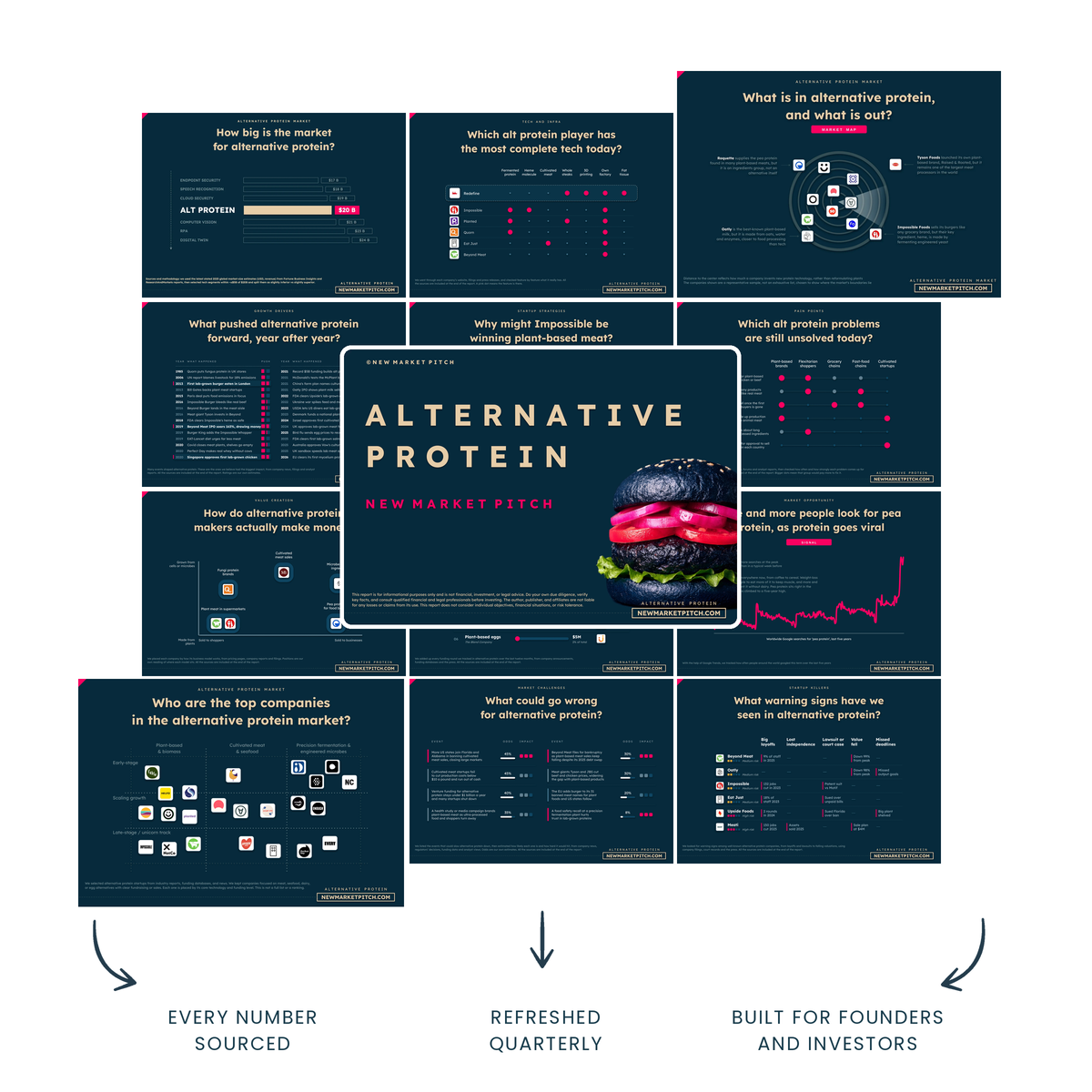
Whether you're building or investing in the alternative protein market, our report covers everything you need to know: the players, the money, and what's coming next.
Summary
Impossible Foods, Eat Just and Perfect Day are the top alternative protein startups by total funding raised, with $1.9 billion, $1.1 billion and $802 million respectively. LIVEKINDLY Collective and UPSIDE Foods complete the top five, showing how much venture capital has gone into plant-based food, fermentation and cultivated meat businesses across the alternative protein market.
The funding gap between the leaders and the rest of the industry is substantial. Only seven startups have raised more than $400 million, while the top 10 range from $1.9 billion to approximately $278 million.
There are 23 companies above $100 million in cumulative funding. Their businesses extend well beyond plant-based meat, covering animal-free dairy proteins, precision fermentation, fungal ingredients, cultivated seafood and alternative fats.
Fundraising strategies vary considerably. LIVEKINDLY Collective raised $670 million across just three rounds, while Eat Just needed 14 rounds to reach $1.1 billion. A high round count does not necessarily mean a company has raised capital more efficiently or achieved better commercial results.
Alternative protein investment remains active, but the industry is operating in a much more selective environment than during its earlier funding boom. Companies raised $881 million in 2025, according to the Good Food Institute, and financing activity in 2026 has increasingly favored businesses with credible industrial partnerships and production plans.
Fermentation is gaining ground. Plant-based companies attracted $450 million in 2025, compared with $357 million for fermentation, but fermentation startups raised $132 million in the second quarter of 2026, well ahead of plant-based businesses at $41 million and cultivated meat companies at $25 million.
Consumer demand remains a serious challenge for plant-based meat. U.S. retail sales fell 10% in 2025 to approximately $1 billion, while household penetration dropped to 11%, compared with around 20% at its 2021 peak.
Price is part of the problem. Plant-based meat averaged $8.23 per pound in U.S. retail stores, against $4.67 for conventional meat. The premium reached 149% for chicken, 185% for pork and 215% for turkey, making regular purchases difficult to justify for many households.
Precision fermentation offers a different commercial model. Companies such as Perfect Day and The EVERY Company can sell ingredients to established food manufacturers rather than relying entirely on consumer brands. However, animal-free dairy proteins can still cost five to 40 times more per kilogram than conventional equivalents, making production efficiency a major priority.
Cultivated meat has made regulatory progress in the United States and Singapore, but affordable mass production remains a long way off. Companies still need to reduce cell-culture and manufacturing costs before their products can compete with conventional meat at scale.
The United States dominates the largest fundraising stories, accounting for 10 of the top 20 companies. Most of the businesses in the wider ranking remain active, although acquisitions and closures show that substantial venture funding alone does not guarantee a sustainable food business.

Written by the New Market Pitch teamWe track new markets so founders and investors can move faster. About us

In our report covering the alternative protein market, you will always find fresh funding data, taken straight from our own verified funding database.
Top startups in the alternative protein market ranked by total funding raised
Here is an updated table that ranks the top startups in the alternative protein market based on the total amount of funding they have raised to date.
The table also includes the total number of funding rounds, the date and size of the latest round, the financing type (e.g. Series A, equity financing), key investors, the startup’s current status (active, IPO, acquired, or shut down), and a confidence score based on the data collected (we excluded startups with very low data confidence, to make sure everything is reliable).
If you need to dig deeper and get more detailed data, please check our report covering the alternative protein market.
| # | Startup | What They Do | Total Raised ($) | Total Rounds | Last Round Date | Last Round Amount ($) | Last Round Type | Key Investors | Current Stage | Confidence | Country |
|---|---|---|---|---|---|---|---|---|---|---|---|
| 1 | Impossible Foods | Plant-based meat with fermented heme | $1.9B | 12 | November 2021 | $543.7M | Series H | 1435 Capital | Active | Strong | United States |
| 2 | Eat Just | Plant-based eggs and cultivated meat | $1.1B1 | 14 | April 2025 | $14.6M | Venture Equity | Undisclosed | Active | Partial | United States |
| 3 | Perfect Day | Produces animal-free dairy proteins | $802M | 8 | January 2024 | $90M | Series E | SK Inc., Horizons Ventures, Temasek | Active | Strong | United States |
| 4 | LIVEKINDLY Collective | Global plant-based food brand portfolio | $670M | 3 | March 2021 | $335M | Growth Equity | TPG Rise Fund, Rabo Investments, S2G Ventures | Active | Strong | United States |
| 5 | UPSIDE Foods | Cultivated meat production | $581M | 5 | April 2022 | $400M | Series C | Temasek, Abu Dhabi Growth Fund, Baillie Gifford | Active | Strong | United States |
| 6 | Nature's Fynd | Produces fungal protein-based foods | $463M | 3 | July 2021 | $350M | Series C | SoftBank Vision Fund, Blackstone, Hillhouse Capital | Active | Strong | United States |
| 7 | NotCo | AI-developed plant-based food alternatives | $423M | 5 | December 2022 | $70M | Series D Extension | Princeville Capital, Bezos Expeditions | Active | Strong | Chile |
| 8 | Califia Farms | Plant-based beverages and dairy alternatives | $325M | 3 | January 2020 | $225M | Series D | Qatar Investment Authority, Temasek, Claridge | Active | Strong | United States |
| 9 | The EVERY Company | Precision-fermented animal-free egg proteins | $295M | 8 | November 2025 | $55M | Series D | McWin Capital Partners, Main Sequence, Bloom8 | Active | Strong | United States |
| 10 | Ripple Foods | Protein-rich plant-based dairy alternatives | ~$278M2 | 11 | December 2025 | $17M | Strategic Equity | OurCrowd, Prelude Ventures, Tao Capital Partners | Active | Partial | United States |
| 11 | Aleph Farms | Cultivated beef steaks | $253M | 6 | March 2025 | $29M | Series C Extension | Cargill, DisruptAD, Migdal Insurance | Active | Strong | Israel |
| 12 | Redefine Meat | Produces 3D-printed plant-based meat | $170M | 3 | January 2022 | $135M | Series B | Hanaco Ventures, Synthesis Capital | Active | Full | Israel |
| 13 | Mosa Meat | Cultivated beef grown from cells | $154M | 6 | December 2025 | $17.6M | Equity Financing | Invest-NL, LIOF, PHW Group | Active | Partial | Netherlands |
| 14 | Remilk | Animal-free dairy through fermentation | $151M | 3 | December 2024 | $20M | Late-stage VC | Tau Capital | Active | Strong | Israel |
| 15 | v2food | Plant-based meat alternatives | $133M | 5 | August 2025 | Undisclosed | Strategic Equity | Ajinomoto | Active | Partial | Australia |
| 16 | TiNDLE Foods | Produces plant-based chicken alternatives | $130M | 3 | February 2022 | $100M | Series A | Alpha JWC, EDBI, GGV Capital | Active | Full | Singapore |
| 17 | Starfield | Develops plant-based meat products | $125M | 4 | January 2022 | $100M | Series B | Primavera Capital Group, Ming Zeng, Sky9 Capital | Active | Strong | China |
| 18 | Planted | Whole-cut plant-based meat alternatives | ~$117M | 4 | December 2024 | Undisclosed | Media for Equity | SevenVentures, ZINTINUS | Active | Strong | Switzerland |
| 19 | Formo | Precision-fermented animal-free dairy products | $116M | 3 | September 2024 | $61M | Series B | FoodLabs, EQT Ventures, REWE Group | Active | Strong | Germany |
| 20 | Wildtype | Cell-cultivated salmon production | $116M | 3 | February 2022 | $100M | Series B | L Catterton, Temasek, Bezos Expeditions | Active | Full | United States |
| 21 | Air Protein | Air-derived fermented protein ingredients | $107M | 2 | May 2023 | $75M | Undisclosed-stage Equity | ADM Ventures, GV, Barclays | Active | Strong | United States |
| 22 | ENOUGH | Industrial-scale fungal protein production | $104M | 5 | February 2024 | Undisclosed | Series C Extension | Cargill | Active | Strong | United Kingdom |
| 23 | Oatside | Oat-based milk and beverages | $101M | 2 | June 2024 | $35M | Series B | TR Capital, Granite Asia, Temasek | Active | Strong | Singapore |
| 24 | DAIZ (SprouTx) | Germinated-soybean plant-based meat ingredients | $96M | 10 | October 2023 | $25M | Series C | Roquette, Nisshin Seifun Group, Mitsubishi UFJ Capital | Active | Partial | Japan |
| 25 | Heura Foods | Plant-based meat alternatives | $91M | 9 | February 2024 | $43M | Series B | Upfield, ECBF, Unovis Asset Management | Active | Partial | Spain |
| 26 | Fazenda Futuro | Brazilian plant-based meat alternatives | $90M | 3 | November 2021 | $60M | Series C | BTG Pactual, Bloom8, XP Investimentos | Active | Strong | Brazil |
| 27 | Nxtfood | Manufactures ACCRO plant-based meat products | ~$87M | 4 | September 2025 | $58M | Series C | Clay Capital, Creadev, Roquette Ventures | Active | Partial | France |
| 28 | Infinite Roots | Mycelium-based alternative protein production | $83M | 3 | January 2024 | $58M | Series B | Dr. Hans Riegel-Stiftung, REWE Group, Redalpine | Active | Partial | Germany |
| 29 | The Protein Brewery | Fermented fungal protein ingredients | ~$82M | 3 | June 2026 | ~$21M | Series B Extension | ABN AMRO, Invest-NL, Novo Holdings | Active | Strong | Netherlands |
| 30 | Kite Hill | Almond-based dairy alternatives | $75M | 4 | September 2019 | $10M | Venture Equity | Undisclosed | Active | Partial | United States |
| 31 | Gathered Foods | Plant-based seafood and ingredients | $74M | 5 | April 2021 | $26M | Series B Extension | Louis Dreyfus Company, Unovis Asset Management, Big Idea Ventures | Active | Strong | United States |
| 32 | Plantible Foods | Functional proteins extracted from duckweed | $74M | 5 | January 2025 | Undisclosed | Venture | Chipotle, Piva, Astanor Ventures | Active | Partial | United States |
| 33 | Green Monday | Plant-based meat and sustainable foods | $70M | 2 | September 2020 | $70M | Late-stage Equity | TPG Rise Fund, Swire Pacific, CPT Capital | Active | Partial | China |
| 34 | Alpine Bio | Animal-free plant-based cheese proteins | $68M | 5 | May 2026 | $10M | Series B-3 | Undisclosed | Active | Strong | United States |
| 35 | MyForest Foods | Mycelium-based whole-cut meat alternatives | $66M | 4 | February 2024 | $4M | Series A Extension | AiiM Partners, Ecovative | Active | Strong | United States |
| 36 | THIS | Produces plant-based meat alternatives | $65M | 5 | June 2024 | $15M | Series C | Planet First Partners | Active | Partial | United Kingdom |
| 37 | Savor | Produces fats directly from carbon | $65M | 3 | July 2026 | $32M | Strategic / Venture | AAK | Active | Strong | United States |
| 38 | BlueNalu | Cultivated seafood products | $64M | 4 | December 2025 | $6M | Series 1 | Agronomics, Lewis & Clark AgriFood, Siddhi Capital | Active | Strong | United States |
| 39 | La Vie | Plant-based bacon and meat alternatives | $58M | 3 | October 2024 | $27M | Series B | Sparkfood, Zintinus | Active | Strong | France |
| 40 | Parima | Develops cultivated duck and chicken | ~$58M3 | 2 | October 2022 | ~$48M | Series A | Earlybird Venture Capital, Keen Venture Partners, Omnes Capital | Active | Partial | France |
| 41 | Vow | Cultivated specialty meat products | $56M | 3 | November 2022 | $49M | Series A | Blackbird Ventures, Prosperity7 Ventures, Square Peg Capital | Active | Strong | Australia |
| 42 | Eclipse Foods | Plant-based dairy and ice cream | $52M | 3 | June 2022 | $40M | Series B | Sozo Ventures, Forerunner Ventures, Initialized Capital | Active | Partial | United States |
| 43 | Verley | Precision-fermented animal-free whey proteins | $50M4 | 3 | February 2026 | $30M | Series A | Alven, Blast, Sofinnova Partners | Active | Partial | France |
| 44 | The Mediterranean Food Lab | Fermented plant-based flavor ingredients | ~$49M5 | 4 | May 2024 | $13M | Series A Extension | Undisclosed | Active | Low | Netherlands |
| 45 | Evergreen Select | Cultivated beef production technology | $46M | 3 | January 2025 | $6M | Series A Extension | S2G Investments, BOLD Capital Partners, Good Startup | Active | Strong | United States |
| 46 | Standing Ovation | Ferments animal-free dairy proteins | $45M | 4 | March 2026 | $29M | Series B | Bpifrance, Crédit Mutuel Innovation, Danone Ventures | Active | Strong | France |
| 47 | No Meat Factory | Plant-based meat contract manufacturing | $42M | 1 | January 2023 | $42M | Series B | ECP Growth, Tengelmann Ventures | Active | Partial | Canada |
| 48 | The Better Meat Co. | Mycoprotein meat ingredients | $41M | 5 | August 2025 | $31M | Series A | Future Ventures, Resilience Reserve, EPIC Ventures | Active | Partial | United States |
| 49 | Onego Bio | Produces animal-free egg protein | ~$41M | 3 | July 2024 | Undisclosed | Series A Extension | EIC Fund | Active | Partial | Finland |
| 50 | HappyVore | French plant-based meat alternatives | $40M | 2 | June 2022 | $38M | Late-stage Equity | Invus, Bpifrance | Active | Strong | France |
| 51 | Fable Food | Shiitake mushroom-based meat alternatives | $40M | 4 | February 2023 | $9M | Series A | K3 Ventures, Blackbird Ventures, AgFunder | Active | Partial | Australia |
| 52 | Ivy Farm Technologies | Cultivated meat production technologies | $40M | 5 | January 2024 | $4M | Venture Equity | Undisclosed | Active | Partial | United Kingdom |
| 53 | Nourish Ingredients | Fermentation-derived animal-free fats | $40M | 2 | October 2022 | $29M | Series A | Horizons Ventures, Main Sequence Ventures, Hostplus | Active | Strong | Australia |
| 54 | Finless Foods | Cultivated seafood and tuna | $38M | 9 | July 2026 | $0M | SAFE / Crowdfunding | Republic crowdfunding investors | Active | Partial | United States |
| 55 | Prime Roots | Produces mycelium-based deli meats | ~$35M | 5 | May 2023 | $30M | Series B | True Ventures, Pangaea Ventures, Prosus Ventures | Active | Partial | United States |
| 56 | Revyve | Fermented yeast protein ingredients | ~$35M | 3 | September 2025 | ~$26M | Series B | ABN AMRO, Invest-NL, BOM | Active | Partial | Netherlands |
| 57 | Nutpods | Produces dairy-free creamers | $35M | 3 | July 2019 | $33M | Growth Equity | VMG Partners, CircleUp, Sidekick Fund | Acquired | Partial | United States |
| 58 | New Culture | Animal-free cheese using precision fermentation | $34M | 5 | March 2025 | $5M | Series A Extension | IndieBio, SOSV | Active | Partial | United States |
| 59 | Climax Foods | AI-designed plant-based cheeses | $33M | 5 | October 2025 | $7M | Series A | S2G Investments, At One Ventures, Manta Ray Ventures | Active | Partial | United States |
| 60 | Brevel | Microalgae protein ingredients | $32M | 3 | March 2025 | $13M | Seed | NevaTeam Partners, Good Protein Fund, Siddhi Capital | Active | Partial | Israel |
| 61 | ImaginDairy | Precision-fermented animal-free dairy proteins | $32M | 4 | April 2023 | $3M | Venture Financing | Danone Manifesto Ventures | Active | Partial | Israel |
| 62 | All G Foods | Precision-fermented dairy proteins | $30M | 3 | August 2022 | $18M | Series A | Agronomics, New Agrarian Company | Active | Partial | Australia |
| 63 | Changing Bio | Microbial dairy protein ingredients | $30M | 4 | September 2023 | Undisclosed | Later-stage VC | Undisclosed | Active | Partial | China |
| 64 | New School Foods | Whole-cut plant-based seafood alternatives | $29M | 3 | June 2026 | $11M | Series A | Verdex Capital, Inter IKEA, Lever VC | Active | Strong | Canada |
| 65 | CellX | Cultivated meat and seafood | $28M | 4 | June 2023 | Undisclosed | Series A+ | Undisclosed strategic investors | Active | Partial | China |
| 66 | Armored Fresh | Plant-based cheese alternatives | $27M | 2 | May 2022 | $21M | Bridge | Hana Financial Investment, Collaborative Fund, Korea Development Bank | Active | Strong | United States |
| 67 | Mission Barns | Cultivated animal fat for foods | $27M | 3 | August 2025 | Undisclosed | Strategic Equity | Grupo Lusiaves, Green Monday, Humboldt Fund | Active | Partial | United States |
| 68 | Project Eaden | Produces plant-based whole-cut meat | ~$27M | 3 | January 2025 | ~$16M | Series A | Planet A Ventures, Creandum, DeepTech & Climate Fonds | Active | Full | Germany |
| 69 | Bluu Seafood | Cultivated fish products | $26M | 2 | June 2023 | $18M | Series A | Sparkfood, LBBW Venture Capital, SeaX Ventures | Active | Partial | Germany |
| 70 | CellMEAT | Cultivated seafood and caviar | $26M | 3 | June 2023 | $13M | Series A | BNK Venture Investment, Ryukyung PSG Asset Management, Strong Ventures | Active | Strong | South Korea |
| 71 | Hoxton Farms | Cultivated animal fats | $26M | 3 | June 2025 | Undisclosed | Corporate Equity | Mitsui Chemicals | Active | Strong | United Kingdom |
| 72 | Roslin Technologies | Develops cultivated-meat animal cell lines | $26M | 4 | June 2023 | Undisclosed | Series A Extension | Kickstart Ventures | Active | Partial | United Kingdom |
| 73 | Novameat | Produces 3D-structured plant-based meat | ~$26M | 4 | September 2024 | $19M | Series A | Sofinnova Partners, Forbion, Unovis Asset Management | Active | Strong | Spain |
| 74 | Chunk Foods | Fermented plant-based whole cuts | $25M | 4 | January 2024 | $8M | Seed | Cheyenne Ventures | Active | Strong | Israel |
| 75 | Rebellyous Foods | Produces plant-based chicken | ~$25M | 5 | January 2025 | $3M | Series B Extension | Agronomics | Active | Partial | United States |
| 76 | Better Dairy | Precision-fermented dairy proteins | $24M | 3 | February 2022 | $22M | Series A | Vorwerk Ventures, Redalpine, Happiness Capital | Active | Strong | United Kingdom |
| 77 | MALK Organics | Organic plant-based milk and creamers | $24M | 3 | March 2024 | $7M | Series C | Benvolio Group, Rotor Capital | Active | Partial | United States |
| 78 | MATR Foods | Fermented plant-based meat alternatives | $23M | 2 | October 2025 | ~$23M | Series A | Novo Holdings, EIFO | Active | Partial | Denmark |
| 79 | Black Sheep Foods | Plant-based heritage meat alternatives | $18M | 3 | December 2022 | $12M | Series A | Unovis, Bessemer Venture Partners, AgFunder | Active | Strong | United States |
| 80 | Rival Foods | Develops whole-cut plant-based meat | ~$18M | 2 | June 2025 | ~$12M | Series B | APG, Pymwymic, ROM Utrecht Region | Active | Full | Netherlands |
| 81 | Oshi | Produces plant-based fish alternatives | ~$18M | 4 | May 2026 | $3M | Venture | Unovis Asset Management, Björn Öste, Nas Daily | Active | Partial | Israel |
| 82 | Cubiq Foods | Healthier fats for food manufacturers | $17M | 3 | May 2022 | $6M | Early VC | Cargill, Moira Capital Partners, Newtree Impact | Shutdown | Partial | Spain |
| 83 | GOOD PLANeT Foods | Plant-based cheese alternatives | $17M | 3 | January 2023 | $5M | Series B | Cleveland Avenue | Active | Strong | United States |
| 84 | Eden Brew | Precision-fermented animal-free milk | $17M | 3 | October 2023 | $13M | Series A | Orkla Group, Main Sequence Ventures, Digitalis Ventures | Active | Strong | Australia |
| 85 | Joe's Future Food | Cultivated pork production | $17M | 3 | April 2023 | $3M | Series A+ | Qiming Venture Partners | Active | Strong | China |
| 86 | Fork & Good | Cultivated pork production | $16M | 4 | November 2024 | Undisclosed | Venture Financing | 7 Hound Ventures | Active | Partial | United States |
| 87 | IntegriCulture | Cellular agriculture infrastructure and ingredients | $16M | 4 | July 2026 | Undisclosed | Series B | Hiroshima Venture Capital, Hakuhodo DY Ventures, Leave a Nest Capital | Active | Partial | Japan |
| 88 | Change Foods | Animal-free dairy proteins and cheese | $15M | 5 | April 2025 | Undisclosed | Early VC | Kale United | Active | Partial | United States |
| 89 | Those Vegan Cowboys | Produces casein without cows | $14M | 2 | March 2026 | $7M | Equity Crowdfunding | Invesdor investors | Active | Strong | Belgium |
| 90 | Multus | Growth media for cultivated meat | $12M | 3 | January 2023 | $10M | Series A | Big Idea Ventures, Mandi Ventures, SynBioVen | Active | Strong | United Kingdom |
| 91 | SuperMeat | Produces cultivated chicken meat | $11M | 3 | May 2026 | $6M | Series A | Agronomics, New Agrarian Company | Active | Partial | Israel |
| 92 | Umami Bioworks | Cultivated seafood production technology | $2M | 3 | August 2023 | Undisclosed | Seed Extension | CPT Capital, Umios | Active | Partial | Singapore |
- Past rounds and extensions have conflicting reported amounts.
- Some placements may overlap; the latest deal's equity status is disputed.
- May include non-equity funding; equity alone may be lower.
- The February 2026 round excludes about $8M of non-dilutive support.
- Several reported Series A deals may overlap, possibly overstating the total.

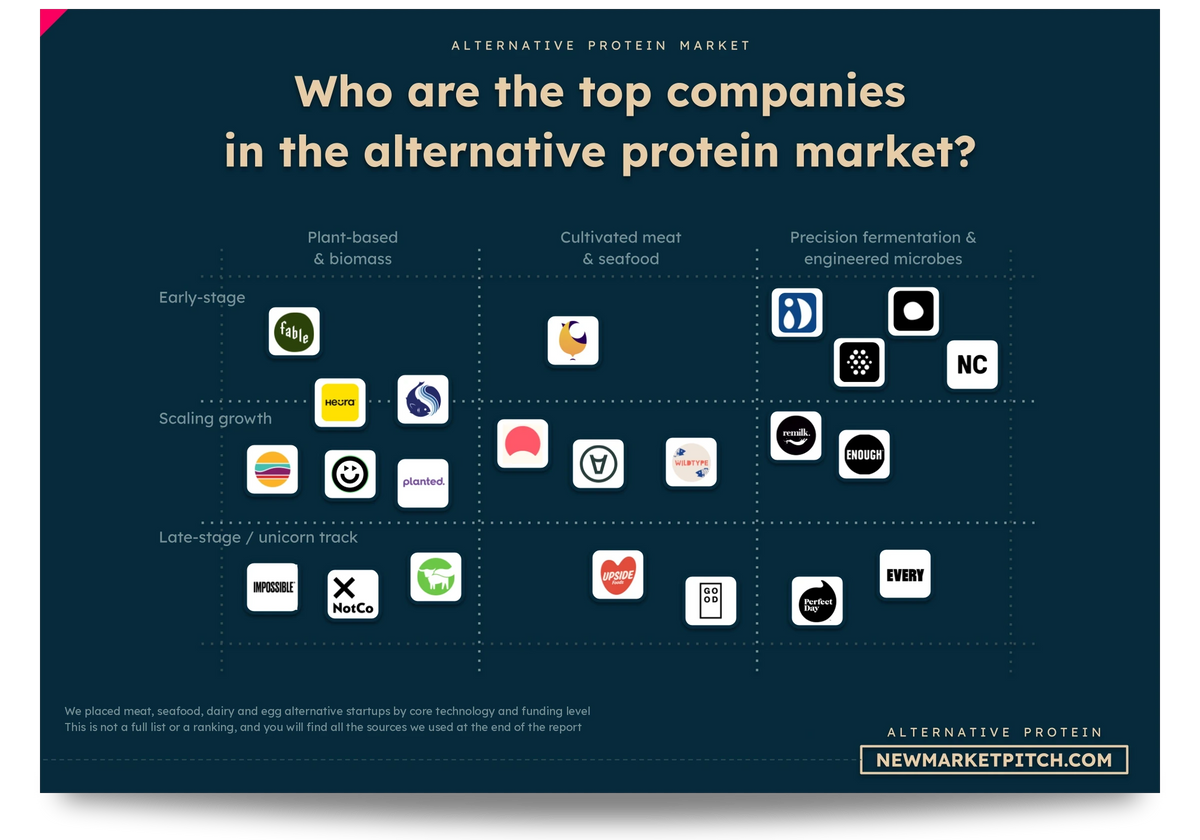
In our research about alternative proteins, we turn what is vague and complex into simple, useful visuals. Market maps like this one show you at a glance where every startup stands.
Which alternative protein startups have raised the most funding?
Impossible Foods leads our alternative protein startup ranking with $1.9 billion raised, followed by Eat Just with $1.1 billion and Perfect Day with $802 million. The gap between these companies and the rest of the industry is substantial, with only seven startups having raised more than $400 million.
The top 10 range from $1.9 billion to approximately $278 million. Some have built consumer food brands, while others have developed fermentation technologies or cultivated meat production platforms.
| Rank | Startup | Total funding | Rounds | Country |
|---|---|---|---|---|
| 1 | Impossible Foods | $1.9B | 12 | United States |
| 2 | Eat Just | $1.1B | 14 | United States |
| 3 | Perfect Day | $802M | 8 | United States |
| 4 | LIVEKINDLY Collective | $670M | 3 | United States |
| 5 | UPSIDE Foods | $581M | 5 | United States |
| 6 | Nature's Fynd | $463M | 3 | United States |
| 7 | NotCo | $423M | 5 | Chile |
| 8 | Califia Farms | $325M | 3 | United States |
| 9 | The EVERY Company | $295M | 8 | United States |
| 10 | Ripple Foods | ~$278M | 11 | United States |
Which alternative protein startups have raised more than $100 million?
There are 23 alternative protein startups above the $100 million threshold in our ranking, spanning plant-based foods, animal-free dairy ingredients, fermentation and cultivated meat.
Beyond the top 10, the list includes Aleph Farms ($253M), Redefine Meat ($170M), Mosa Meat ($154M), Remilk ($151M), v2food ($133M), TiNDLE Foods ($130M), Starfield ($125M), Planted (~$117M), Formo ($116M), Wildtype ($116M), Air Protein ($107M), ENOUGH ($104M) and Oatside ($101M).
Ingredient developers have attracted financing comparable to that of consumer-facing food brands. Perfect Day, The EVERY Company, Remilk and Formo have secured substantial backing for animal-free proteins, while UPSIDE Foods, Aleph Farms and Mosa Meat have attracted significant investment in cultivated meat.
The $100 million group therefore covers a much broader range of technologies than plant-based meat alone.

In our market report about alternative proteins, we always try to gather several sources and make estimates that make sense, so you can work with solid numbers.
How much funding have Impossible Foods and Eat Just raised?
Impossible Foods has raised $1.9 billion, while Eat Just has raised $1.1 billion, making them the two largest fundraising stories in our ranking.
Impossible Foods completed 12 funding rounds, with its latest recorded financing being a $543.7 million Series H in November 2021. Its fundraising history includes two particularly large transactions: a $500 million round in March 2020 and that November 2021 Series H.
Eat Just has raised $1.1 billion across 14 rounds. Its latest recorded transaction was a $14.6 million venture equity round in April 2025.
Their strategies are quite different. Impossible Foods concentrates heavily on plant-based meat products, while Eat Just combines its plant-based egg business with cultivated meat through GOOD Meat.
Eat Just's more recent financing activity deserves attention. The company continues to pursue both consumer food products and the longer-term opportunity in cultivated meat, giving it exposure to two distinct parts of the alternative protein industry.
Why have Perfect Day and LIVEKINDLY Collective raised so much money?
Perfect Day has raised $802 million through eight rounds, while LIVEKINDLY Collective has raised $670 million through only three rounds. Their financing histories reveal two very different ways of building an alternative protein business.
Perfect Day develops animal-free dairy proteins through precision fermentation. Its latest recorded financing was a $90 million Series E round in January 2024, backed by existing investors.
LIVEKINDLY Collective has taken a portfolio approach, bringing together plant-based food brands and building a broader international consumer business. Its latest recorded financing was a $335 million growth-equity round in March 2021, led by TPG Rise Fund, alongside Rabo Investments and S2G Ventures.
The difference in round frequency is striking. LIVEKINDLY Collective attracted large amounts of capital through three major financing events, while Perfect Day built its funding history across eight rounds.
The commercial challenges are also quite different. Perfect Day needs to make its ingredients competitive for food manufacturers, while LIVEKINDLY Collective must build brands that consumers buy repeatedly at prices that support profitable distribution.

Our document detailing everything you need to know about alternative protein gets updated several times a month, so you always get the latest view of where things stand.
How many funding rounds have the biggest alternative protein startups needed?
The leading alternative protein startups have followed very different fundraising paths, with the number of rounds ranging from three to 14 among the top 10 companies.
Eat Just has completed 14 rounds, compared with 12 for Impossible Foods and 11 for Ripple Foods. At the other end, LIVEKINDLY Collective, Nature's Fynd and Califia Farms each accumulated substantial funding through just three rounds.
| Startup | Rank | Total funding | Rounds |
|---|---|---|---|
| Impossible Foods | 1 | $1.9B | 12 |
| Eat Just | 2 | $1.1B | 14 |
| Perfect Day | 3 | $802M | 8 |
| LIVEKINDLY Collective | 4 | $670M | 3 |
| UPSIDE Foods | 5 | $581M | 5 |
| Nature's Fynd | 6 | $463M | 3 |
| NotCo | 7 | $423M | 5 |
| Califia Farms | 8 | $325M | 3 |
| The EVERY Company | 9 | $295M | 8 |
| Ripple Foods | 10 | ~$278M | 11 |
A high cumulative funding total does not necessarily require a long series of smaller financing events. LIVEKINDLY Collective raised $670 million across three rounds, while Eat Just needed 14 rounds to reach $1.1 billion.
Round counts tell us something about financing strategy, but they do not reveal how much capital was spent, how long the money lasted or whether a company has reached profitability.
Which alternative protein startups have raised money most recently?
Several alternative protein startups in our ranking have recorded financing activity during the past year, with 2026 rounds particularly interesting for fermentation, cultivated meat and alternative fats.
The following companies have a latest recorded round dated in 2026. We retain their original overall ranking positions.
| Overall rank | Startup | Latest round date | Amount | Round type |
|---|---|---|---|---|
| 29 | The Protein Brewery | June 2026 | ~$21M | Series B Extension |
| 34 | Alpine Bio | May 2026 | $10M | Series B-3 |
| 37 | Savor | July 2026 | $32M | Strategic / Venture |
| 43 | Verley | February 2026 | $30M | Series A |
| 46 | Standing Ovation | March 2026 | $29M | Series B |
| 54 | Finless Foods | July 2026 | $0M | SAFE / Crowdfunding |
| 64 | New School Foods | June 2026 | $11M | Series A |
| 81 | Oshi | May 2026 | $3M | Venture |
| 87 | IntegriCulture | July 2026 | Undisclosed | Series B |
| 89 | Those Vegan Cowboys | March 2026 | $7M | Equity Crowdfunding |
| 91 | SuperMeat | May 2026 | $6M | Series A |
Savor's $32 million financing stands out because it came with a strategic relationship with AAK, a major specialty fats and oils manufacturer. The partnership gives Savor access to commercial food-industry expertise as it develops its carbon-derived fats.
The Protein Brewery's approximately $21 million round supports its expansion of mycoprotein production ahead of broader European commercialization. SuperMeat also secured a $6 million initial closing of its Series A financing, with Agronomics leading the investment.
Finless Foods' $0M figure is the amount recorded for its latest financing entry, rather than evidence of a substantial conventional priced round.

In our report covering the alternative protein market, we look at what the winners do differently, so you can learn from the best instead of guessing.
Which investors keep backing alternative protein startups?
Temasek appears most frequently among the named investors in our ranking, with investments associated with five companies. Agronomics follows with four appearances, while Cargill, Main Sequence Ventures and Unovis Asset Management each appear three times.
Temasek has backed Perfect Day, UPSIDE Foods, Califia Farms, Wildtype and Oatside. Its portfolio covers animal-free dairy proteins, cultivated meat, plant-based beverages and cultivated seafood.
Agronomics has invested in BlueNalu, All G Foods, Rebellyous Foods and SuperMeat. Its repeated presence shows how specialist investors have continued to support cellular agriculture and alternative food technologies across several markets.
Cargill appears among the investors associated with Aleph Farms, ENOUGH and Cubiq Foods. Main Sequence Ventures is associated with The EVERY Company, Nourish Ingredients and Eden Brew.
| Investor | Ranked companies backed | Appearances |
|---|---|---|
| Temasek | Perfect Day, UPSIDE Foods, Califia Farms, Wildtype, Oatside | 5 |
| TPG Rise Fund | LIVEKINDLY Collective, Green Monday | 2 |
| S2G Ventures | LIVEKINDLY Collective, Wildtype | 2 |
| Bezos Expeditions | NotCo, Wildtype | 2 |
| Main Sequence Ventures | The EVERY Company, Nourish Ingredients, Eden Brew | 3 |
| Cargill | Aleph Farms, ENOUGH, Cubiq Foods | 3 |
| Unovis Asset Management | Heura Foods, Black Sheep Foods, Oshi | 3 |
| Agronomics | BlueNalu, All G Foods, Rebellyous Foods, SuperMeat | 4 |
Is alternative protein funding picking up again?
Alternative protein investment is still flowing, but the latest figures do not yet support a broad return to the funding boom of the early 2020s.
According to the Good Food Institute's investment tracking, alternative protein companies raised $881 million in 2025. The organization also reports more than $19.5 billion in cumulative investment since 2017.
The current environment is different from the period when companies could attract enormous rounds largely on the strength of their technology and long-term market potential. Investors are paying much closer attention to manufacturing costs, commercial agreements and the time needed to generate revenue.
There are still meaningful transactions. The EVERY Company raised $55 million in November 2025, The Protein Brewery secured an €18 million Series B extension in June 2026, and Savor attracted a $32 million strategic/venture round.
These transactions show that companies can still raise substantial money, particularly when they have a credible industrial or commercial plan. The financing environment remains selective, and the industry is not back in its previous fundraising cycle.

In our research about alternative proteins, we don't want to repeat what boring consulting reports say. Instead, we show you the real and latest market signals that matter.
Which alternative protein technologies are attracting the most investment?
Plant-based companies attracted the most global alternative protein investment in 2025, although fermentation is now receiving almost as much attention from investors.
The Good Food Institute recorded $450 million for plant-based companies, $357 million for fermentation businesses and $74 million for cultivated meat and seafood companies during 2025.
The distribution changed further in the second quarter of 2026. Fermentation companies raised $132 million, compared with $41 million for plant-based companies and $25 million for cultivated meat businesses.
Fermentation was the largest investment category that quarter. Companies developing proteins, fats and functional ingredients attracted substantial financing, reflecting growing interest in technologies that can supply existing food manufacturers.
Our ranking includes examples across all three areas. Impossible Foods and NotCo represent plant-based food innovation, Perfect Day and The EVERY Company are developing precision-fermented proteins, while UPSIDE Foods and Wildtype are working on cultivated meat and seafood.
The annual figures still favor plant-based businesses, but the more recent quarterly numbers point to a shift in investor attention toward fermentation.
Are plant-based meat sales still falling?
Yes, U.S. plant-based meat sales continued to decline in 2025, and the biggest problem is that fewer households are buying these products.
According to the Good Food Institute's analysis of SPINS retail data, U.S. plant-based meat and seafood sales reached approximately $1 billion in 2025, but dollar sales fell 10% and unit sales dropped 11%.
The decline becomes more concerning when we look at household penetration. Only 11% of U.S. households purchased plant-based meat and seafood in 2025, compared with approximately 20% at the 2021 peak.
Existing buyers have not disappeared completely. Around 62% of households that bought plant-based meat in 2025 purchased it more than once, and repeat-purchase rates remained relatively stable.
The bigger issue is purchasing frequency. Households buying plant-based meat averaged approximately six purchase occasions during the year, compared with 33 occasions for conventional meat among the same households.
Plant-based meat has established a customer base, but it remains a small part of everyday meat consumption. Winning occasional buyers is one thing; getting households to replace conventional meat regularly is much harder.

Learning from others' mistakes is the cheapest lesson there is. In our market report about alternative proteins, we look at what broke startups before you, so you don't repeat it.
Are plant-based meat alternatives still too expensive?
Yes, plant-based meat alternatives remain considerably more expensive than conventional meat in most U.S. retail categories, and the gap is particularly large for chicken, pork and turkey.
The Good Food Institute's 2026 industry report, based on 2025 retail data, found that plant-based meat averaged $8.23 per pound compared with $4.67 for conventional meat.
| Product category | Plant-based price | Conventional price | Premium |
|---|---|---|---|
| Meat, per pound | $8.23 | $4.67 | 76% |
| Beef, per pound | $7.74 | $7.18 | 8% |
| Chicken, per pound | $7.88 | $3.17 | 149% |
| Pork, per pound | $9.31 | $3.27 | 185% |
| Turkey, per pound | $8.25 | $2.62 | 215% |
| Milk, per gallon | $8.70 | $4.07 | 114% |
| Eggs, per dozen | $9.30 | $4.38 | 112% |
Plant-based beef is a particularly interesting exception, with only an 8% premium. Higher conventional beef prices have narrowed the gap, making plant-based beef much more competitive than plant-based chicken or pork.
For most other products, consumers still have to pay substantially more to choose the alternative. That makes it difficult for brands to persuade households to replace conventional products regularly, especially when food budgets are under pressure.
Why are investors backing precision fermentation startups?
Investors are paying more attention to precision fermentation because the technology offers alternative protein companies a way to sell functional ingredients to existing food manufacturers.
Perfect Day has raised $802 million to develop animal-free dairy proteins, while The EVERY Company has raised $295 million for its precision-fermented egg proteins. Remilk and Formo have also attracted substantial capital, with $151 million and $116 million raised respectively.
The commercial appeal is straightforward. A company producing animal-free whey or egg protein can potentially sell to several food manufacturers, rather than depending entirely on its own consumer brand and retail distribution.
The EVERY Company provides a particularly interesting recent example. After raising $55 million in Series D financing, it announced a partnership with Huvepharma in June 2026 that quadrupled its production capacity.
The company also reported that annual orders secured during the first four months of 2026 were worth 550% of its entire 2025 order volume. Those orders included demand from retail, e-commerce and foodservice customers.
The Protein Brewery is following a related path with its fungal protein ingredient Fermotein. Its latest €18 million financing extension will support additional production capacity and commercial expansion following European novel-food authorization.
These businesses have a route into several food categories through industrial customers. That is a different growth proposition from building a single consumer brand, and it helps explain why ingredient developers are attracting serious investment.

If you build or invest in the alternative protein market, you need to know which business models pay off now and which ones are fading. That's why our report covering it has a whole section on it.
Can precision fermentation compete with conventional proteins on price?
Precision fermentation still has a substantial cost problem, and some animal-free dairy proteins currently cost several times more to produce than conventional equivalents.
A 2026 review published in Frontiers in Nutrition summarized techno-economic analyses suggesting that animal-free dairy proteins can cost approximately five to 40 times more per kilogram than conventional dairy proteins at current production scales.
That range is wide because production costs depend on the protein being manufactured, the microorganism used, fermentation yields and purification requirements.
The main challenge is industrial efficiency. Companies need to produce more protein from each fermentation batch while reducing the cost of growth media, energy and downstream processing.
The EVERY Company's manufacturing agreement with Huvepharma is a good example of how startups are addressing this problem. Rather than building every production facility themselves, companies can work with established manufacturers that already have fermentation infrastructure and technical expertise.
Perfect Day, Remilk and Formo face similar challenges as they move from developing promising proteins toward producing them at volumes and prices that food manufacturers can accept.
Precision fermentation has a credible path into mainstream food production, but cost parity still needs to be demonstrated across large commercial operations.
Can cultivated meat be sold legally in the United States and Singapore today?
Yes, selected cultivated meat products have cleared key regulatory steps in both countries, although companies still face geographical restrictions.
In the United States, the FDA's published inventory of completed pre-market consultations includes products from UPSIDE Foods, GOOD Meat (Eat Just), Wildtype and Mission Barns, among the listed companies. These consultations form part of the federal food-safety pathway, alongside USDA responsibilities for inspection and labeling where applicable.
Singapore has also continued to approve new products. PARIMA received authorization for cultivated duck in April 2026, following its earlier approval for cultivated chicken. In August 2026, Singapore approved Aleph Farms' cultivated thin-cut beef steak.
These approvals expand the number of species and products that can enter regulated markets.
U.S. access remains complicated by state legislation. Several states have introduced restrictions on the manufacture or sale of cultivated meat, while others have adopted specific labeling requirements. The National Conference of State Legislatures has documented these differences.
A federal regulatory milestone therefore does not guarantee that a cultivated meat company can sell freely across every American state.

In our report covering the alternative protein market, we like to show you the big picture. We know your time is precious, so we make every page quick to read and packed with as much learning as possible per minute.
When could cultivated meat become a mass-market food?
Cultivated meat could become commercially meaningful over the coming years, but affordable mass-market production still depends on substantial improvements in manufacturing costs.
A 2022 study published in the Journal of Agriculture and Food Research estimated that cultivated meat could cost approximately $63 per kilogram at wholesale in an ambitious large-scale production scenario. Even that estimate assumed major improvements in cell-culture media and manufacturing efficiency, with a much higher final retail cost.
More recent industry modelling offers a more optimistic picture. Arthur D. Little estimated that representative finished-product costs could reach the low €40s per kilogram in 2026, with a potential path toward approximately €10 per kilogram by the end of the decade.
That is an industry projection, not proof that producers are already achieving those costs consistently.
Companies such as UPSIDE Foods, Eat Just, Aleph Farms and Mosa Meat have made important advances in production and regulatory development. Singapore's approvals for PARIMA and Aleph Farms also show that the commercial market is gradually opening.
But the economics remain difficult. Cultivated meat must compete with conventional products that are already produced through enormous, highly optimized global supply chains.
The next few years will show whether the technology can move beyond expensive initial production toward repeatable manufacturing at much larger volumes.
Which countries have the most heavily funded alternative protein startups?
The United States dominates the highest-funded part of our alternative protein ranking, accounting for 10 of the top 20 companies.
Impossible Foods, Eat Just, Perfect Day, LIVEKINDLY Collective, UPSIDE Foods, Nature's Fynd, Califia Farms, The EVERY Company, Ripple Foods and Wildtype are all headquartered in the United States.
Israel is the second most represented country in this group, with three companies: Aleph Farms, Redefine Meat and Remilk.
The remaining seven companies are distributed across Chile, the Netherlands, Australia, Singapore, China, Switzerland and Germany. They include NotCo, Mosa Meat, v2food, TiNDLE Foods, Starfield, Planted and Formo.
The geographical spread becomes more pronounced further down the ranking, with companies from France, the United Kingdom, Canada, Japan, Denmark, Brazil, Belgium and Finland also represented.
The United States has produced most of the largest individual fundraising outcomes, while Israel and Europe have developed important specialist businesses in cultivated meat, fermentation and plant-based food technologies.

When you build or invest in the alternative protein market, you need clarity, not confusion. In our research about alternative proteins, we always try to put numbers on and quantify whatever is usually vague and confusing.
Are the most heavily funded alternative protein startups still active?
Yes, the vast majority of companies in our ranking are still classified as active, although the industry has also experienced acquisitions and business closures.
Of the 92 startups, 90 are classified as active. Nutpods, ranked 57th with $35 million raised, is classified as acquired, while Cubiq Foods, ranked 82nd with $17 million raised, is classified as shut down.
Nutpods' acquisition and Cubiq Foods' closure illustrate two very different outcomes for companies that attracted venture financing.
The distinction is important when interpreting cumulative funding. A startup can attract tens or hundreds of millions of dollars without necessarily becoming a sustainable standalone business.
We therefore keep acquired and shut-down companies in their original ranking positions. Their historical equity fundraising remains part of the investment history of the alternative protein industry.
Which alternative protein startups are closest to commercial scale?
The EVERY Company, The Protein Brewery and Savor currently offer some of the clearest examples of alternative protein startups moving toward larger commercial operations.
The EVERY Company's agreement with Huvepharma quadrupled its production capacity, while its reported annual orders during the first four months of 2026 reached 550% of its total 2025 order volume.
The Protein Brewery has also moved beyond a purely technical development phase. Its latest €18 million financing extension is intended to expand production capacity to more than 2,000 metric tonnes and support European commercial sales of Fermotein.
Savor is taking another approach. Its partnership with AAK combines its carbon-derived fat technology with an established manufacturer's formulation capabilities and commercial relationships. The company is targeting applications in dairy alternatives and bakery products.
Oshi offers another example of a consumer-facing business moving toward broader distribution. The plant-based seafood startup has secured a further $3 million investment, supporting its efforts to expand production and commercial sales.
These developments do not establish that any of these businesses has reached profitability. They do show that some startups are now working on production volumes, industrial partnerships and customer demand rather than relying solely on laboratory progress.
Which business model looks stronger among Impossible Foods, Eat Just, Perfect Day and The EVERY Company?
Among these four companies, precision fermentation currently offers the clearest route to repeatable B2B demand, while consumer-facing businesses still have the advantage of selling directly into established food categories.
Impossible Foods has built a recognizable plant-based meat brand. However, the wider U.S. plant-based meat category has experienced declining retail sales and remains expensive compared with conventional meat.
Eat Just combines plant-based eggs with cultivated meat. This gives it exposure to two markets, but also means it faces different production and commercialization challenges.
Perfect Day develops animal-free dairy proteins. The company can potentially serve multiple manufacturers and food categories through its ingredient technology.
The EVERY Company is now expanding production through partnerships with industrial manufacturers. Its recent order growth offers a concrete example of how an ingredient business can build commercial demand.
We currently see the strongest near-term commercial case in the ingredient model represented by Perfect Day and The EVERY Company. Their products can fit into existing manufacturing and distribution systems, giving them a potentially easier route to repeat B2B orders than a new consumer food brand.
That advantage still depends on achieving competitive production costs and maintaining customer demand. Precision fermentation has a promising business model, but its long-term profitability remains to be proven.
Is alternative protein still worth investing in?
Yes, alternative protein remains an interesting investment market, but we would be much more selective about the companies and technologies receiving capital today.
The historical fundraising figures are impressive. The largest companies have attracted billions in venture financing, showing how strongly investors believed in the potential of alternative proteins during the industry's earlier growth phase.
The commercial evidence is more mixed. U.S. plant-based meat sales declined 10% in 2025, while cultivated meat still faces substantial production-cost and regulatory challenges.
Fermentation currently offers some of the more convincing commercial opportunities. The EVERY Company's manufacturing expansion, The Protein Brewery's European launch preparations and Savor's relationship with AAK all demonstrate how alternative protein startups can work with established industrial partners.
Plant-based food remains a large opportunity, particularly where companies can improve taste, reduce prices and win repeat customers. Cultivated meat could become a major technology over the longer term, but the path to affordable industrial production remains uncertain.
Alternative protein is entering a more demanding investment cycle. The strongest opportunities are likely to come from companies that can demonstrate real production capacity, repeat orders and competitive economics. Having raised hundreds of millions of dollars is a useful indicator of investor interest, but the next stage of the industry will be decided by what these businesses can actually produce and sell.
Our methodology
This ranking compares alternative protein startups by cumulative equity funding raised. We include companies whose core business focuses on alternative proteins, covering plant-based foods, animal-free ingredients, fermentation and cultivated meat. Acquired and shut-down companies remain included because their historical fundraising is part of the industry's financing history, while large established groups and divisions of broader companies are excluded.
We count equity financing and exclude debt, grants and other non-equity funding. Funding totals, round dates and investor information are based on company announcements, investor disclosures, regulatory filings and reputable financial and industry publications.
Key sources include the Good Food Institute's investment tracking and plant-based retail sales analysis; financing announcements from Impossible Foods, Perfect Day, UPSIDE Foods, The EVERY Company, The Protein Brewery, Savor and Agronomics and SuperMeat.
For regulatory developments, we consulted the FDA's inventory of completed cultivated animal-cell food consultations, the Singapore Food Agency's novel-food framework and the National Conference of State Legislatures. Industry economics were informed by research published in Frontiers in Nutrition and the Good Food Institute's 2026 industry report.
Written by the New Market Pitch teamWe track new markets so founders and investors can move faster. About us