
CCUS Funding Tracker (76 deals)
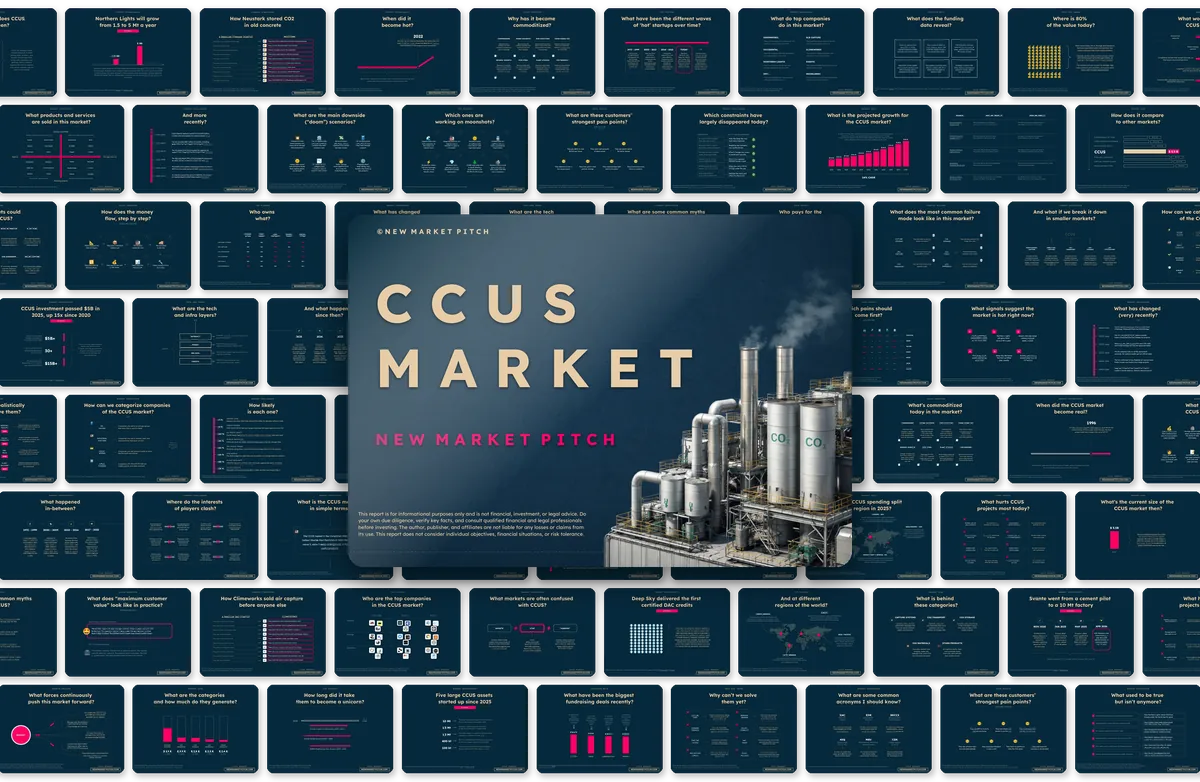
Everything we know about the CCUS market, in one place. Get our report whether you build or invest.
Summary
Across 76 tracked deals, CCUS is a real billion-dollar private funding market, but the normal financing is still a single-digit-million round and a small group of industrial-scale deals does a lot of the work.
We tracked 76 financings across 73 companies from January 2024 through September 21, 2026, with $1.388 billion of comparable known capital. The median round was $6.16 million, versus a $19.02 million average.
The gap comes from the top. Just seven rounds strictly above $50 million absorbed 49.1% of comparable capital, while the two $100 million-plus rounds from Climeworks and Heirloom alone contributed $312 million.
The market is broad but not very repetitive yet. Seventy of the 73 companies appear only once in the window, and only 44.01, Mantel and Sequestra show up twice.
Most financings still sit below $20 million. Among the 73 rounds with a comparable amount, 31 were below $5 million and another 23 were between $5 million and $20 million.
Direct Air Capture is where the largest checks cluster. DAC produced 24 deals and $698.6 million of comparable capital, just over half of the market, with a $13 million median round.
The stage data shows where the funnel narrows. Seed and Series A dominate deal count, but only three classified Series B rounds appear in the whole window, followed by one Series C, one Series D+ and one growth-equity deal.
Large rounds increasingly pay for physical scale rather than another software-style growth push: plants, reactors, capture units, pipelines, storage networks, manufacturing and site integration. That is why strategic industrial investors show up so often around the bigger financings.
North America and Europe dominate the visible private market. Europe produced more deals, while North America attracted more capital; the United States alone accounted for roughly $704 million of comparable funding.
The boundary between startup finance and project finance is already getting blurry. Grants, debt, strategic capital, project companies and multiyear commitments now sit beside venture rounds, so headline deal values need to be read carefully rather than added together mechanically.
The clearest weakness is the post-Series-A market. CCUS has plenty of early experimentation and some very large winners, but the middle layer of companies repeatedly raising $30 million, $50 million and then larger rounds is still thin.

Written by the New Market Pitch teamWe track new markets so founders and investors can move faster. About us

In our report covering the carbon capture market, you will always find fresh funding data, taken straight from our own verified funding database.
Our funding tracker covering the CCUS market
Below is the table listing all the deals. You may find our methodology at the end of this page.
And, if you want to gain a deeper understanding of the market and its current dynamics, get our report covering the Carbon Capture Market.
| Company | Category | Date | Stage | Deal size | What they do | Region | Lead investors | Country |
|---|---|---|---|---|---|---|---|---|
| Mantel | Carbon Capture Systems | August 2026 | Series A | $18.3M | Develops molten-borate systems that capture CO₂ directly from high-temperature industrial flue gas in boilers, kilns and furnaces. | North America | Not disclosed | United States |
| HexSeed Technology Limited | CO2 Utilization Platforms | August 2026 | Seed | >$812K | Converts captured CO₂ into lab-grown industrial diamond coatings and advanced materials for power electronics. | Europe | Carbon13 | United Kingdom |
| Carbonology Co., Ltd. (上海碳生万物科技有限公司) | Direct Air Capture | June 2026 | Series A | ≈$18.5M | Develops integrated direct-air-capture systems that convert atmospheric CO₂ with green hydrogen into e-SAF and other carbon-based products. | Asia-Pacific | YRD Investments; Gaorong Ventures; BioTrack Capital | China |
| D-CRBN | CO2 Utilization Platforms | May 2026 | Series A | $20.4M | Builds electrified plasma reactors that convert captured industrial CO₂-rich gases into carbon monoxide and syngas for fuels, chemicals and materials. | Europe | Astaia | Belgium |
| CrewCarbon | CO2 Storage Services | May 2026 | Series A | $19M | Uses alkaline minerals in wastewater systems to improve treatment while permanently removing CO₂ as stable bicarbonate. | North America | Burnt Island Ventures | United States |
| Reduciner | CO2 Utilization Platforms | May 2026 | Seed | $4.2M | Converts captured industrial CO₂ into carbon monoxide and activated carbon using an electrified thermochemical process. | Europe | Voima Ventures; Lifeline Ventures | Finland |
| Inherit Carbon Solutions AS | CO2 Storage Services | April 2026 | Unknown | ≈$4.3M | Develops carbon-removal projects that capture biogenic CO₂ from biogas operations and arrange its transport and permanent geological storage. | Europe | Not disclosed | Norway |
| Carbonyx | CO2 Utilization Platforms | April 2026 | Seed | ≈$879K | Uses electrochemical processing to turn mineral-rich industrial waste and CO₂ into useful materials while permanently mineralizing the CO₂. | North America | WUTIF Capital | Canada |
| Sequestra | CO2 Utilization Platforms | March 2026 | Seed | $3.5M | Develops accelerated-carbonation systems that permanently bind CO₂ in industrial mineral residues and turn the carbonated material into usable construction inputs. | Europe | VSE Beteiligungs-GmbH | Austria |
| Rubi Laboratories | CO2 Utilization Platforms | March 2026 | Unknown | $7.5M | Uses a cell-free enzyme system to capture waste CO₂ and convert it into cellulose and other industrial materials. | North America | AP Ventures; FH One Investments | United States |
| Intrinsic Foundries | CO2 Utilization Platforms | February 2026 | Seed | $1.4M | Builds microbial biorefinery systems that capture industrial CO₂ and convert it into high-value biochemicals. | Asia-Pacific | Transition VC | India |
| Phathom Technologies | Carbon Capture Systems | February 2026 | Seed | $2.9M | Develops point-source carbon capture systems that convert captured biogenic CO₂ into dissolved bicarbonate for durable ocean storage. | North America | Propeller Ventures | Canada |
| Co-Reactive | CO2 Utilization Platforms | January 2026 | Seed | $7.8M | Mineralizes captured CO₂ with silicate minerals or metallurgical slags into CO₂-negative supplementary cementitious materials. | Europe | High-Tech Gründerfonds (HTGF) | Germany |
| Forge Minerals Ltd | CO2 Utilization Platforms | January 2026 | Seed | $1.4M | Converts waste CO₂ into stable, high-purity carbonate minerals such as magnesium carbonate for industrial use. | Europe | Sustainable Ventures; The Conduit Impact Fund | United Kingdom |
| LimeNet | CO2 Storage Services | December 2025 | Seed | $8.2M | Produces decarbonized lime used to remove atmospheric CO₂ through ocean alkalinity enhancement and store it as seawater bicarbonate. | Europe | CDP Venture Capital SGR; Fassa Bortolo | Italy |
| Carbonova Corp. | CO2 Utilization Platforms | December 2025 | Seed | $3.7M | Converts captured CO₂ and methane into carbon nanofibers for advanced-material applications. | North America | Not disclosed | Canada |
| OXCCU | CO2 Utilization Platforms | September 2025 | Series B | $28M | Develops catalysts and reactors that directly convert CO₂ and other waste-carbon gas streams with hydrogen into sustainable fuels and chemicals. | Europe | Not disclosed | United Kingdom |
| Enadyne | CO2 Utilization Platforms | September 2025 | Seed | ≈$8.2M | Develops modular non-thermal plasma-catalysis reactors that convert industrial CO₂ into chemicals such as methanol and ethylene. | Europe | Amadeus APEX Technology Fund; Energy Capital Ventures | Germany |
| Brineworks | Direct Air Capture | September 2025 | Seed | ≈$5.9M | Develops an electrochemical direct-air-capture system that captures CO₂ while co-producing hydrogen for e-fuels and other utilization pathways. | Europe | SeaX Ventures | Netherlands |
| DACLab | Direct Air Capture | September 2025 | Seed | $3M | Designs, licenses and manufactures modular low-temperature direct-air-capture systems for sequestration and CO₂-utilization projects. | North America | Peter Relan | United States |
| Carbon CryoCapture Co., Ltd. (株式会社カーボンクライオキャプチャー) | Carbon Capture Systems | September 2025 | Seed | ≈$404K | Designs and develops CO₂ capture plants using a proprietary rubber-based absorbent for separating CO₂ from concentrated industrial gas streams. | Asia-Pacific | Incubate Fund | Japan |
| Equatic | Carbon Capture Systems | August 2025 | Series A | $11.6M | Uses seawater electrolysis to remove atmospheric CO₂, permanently store it as bicarbonate/carbonate species, and co-produce hydrogen. | North America | Catalytic Capital for Climate and Health (C3H); Kibo Invest | United States |
| Peak Cluster Limited | CO2 Transport Infrastructure | July 2025 | Unknown | $81.2M | Develops a CO₂ transport pipeline connecting Peak District cement and lime capture sites to offshore storage in Morecambe Bay. | Europe | Not disclosed | United Kingdom |
| Climeworks | Direct Air Capture | July 2025 | Series D+ | $162M | Develops and operates direct air capture systems that remove atmospheric CO₂ for permanent storage and carbon-removal services. | Europe | BigPoint Holding; Partners Group | Switzerland |
| Aircapture | Direct Air Capture | June 2025 | Series A | $50M | Develops modular direct-air-capture systems that remove atmospheric CO₂ for on-site industrial use and permanent sequestration. | North America | Larsen Lam Climate Change Foundation | United States |
| BKV dCarbon Project, LLC | CO2 Storage Services | May 2025 | Unknown | $500M | Develops, constructs and operates U.S. CCUS projects that capture and permanently store industrial CO₂ in geological formations. | North America | Not disclosed | United States |
| RepAir Carbon | Carbon Capture Systems | April 2025 | Series A | $15M | Develops modular electrochemical systems that capture and concentrate CO₂ from dilute industrial emissions and ambient air. | Middle East | Taranis Carbon Ventures; Extantia Capital | Israel |
| novoMOF AG | Carbon Capture Systems | April 2025 | Unknown | $5.4M | Develops and manufactures metal-organic-framework sorbent materials for point-source CO₂ capture systems. | Europe | GTT Strategic Ventures | Switzerland |
| Skytree | Direct Air Capture | April 2025 | Series A | Not Disclosed | Builds modular direct-air-capture machines that capture atmospheric CO₂ onsite for utilization or permanent removal. | Europe | Division Q | Netherlands |
| ARK Capture Solutions | Carbon Capture Systems | March 2025 | Seed | >$2.4M | Develops modular hybrid equipment for capturing CO₂ from low-concentration industrial flue gases. | Europe | Aperam Ventures; Seeder Fund | Belgium |
| Homeostasis | CO2 Utilization Platforms | March 2025 | Seed | $600K | Converts CO₂ from atmospheric and industrial sources into high-purity synthetic graphite and other solid carbon materials. | North America | Not disclosed | United States |
| Carbon Reform | Carbon Capture Systems | March 2025 | Seed | $5.5M | Builds retrofit HVAC systems that capture and permanently mineralize CO₂ from building air while reducing ventilation energy requirements. | North America | Not disclosed | United States |
| Spiritus | Direct Air Capture | March 2025 | Series A | $30M | Develops passive-sorbent direct air capture systems with low-temperature CO₂ desorption and permanent sequestration. | North America | Aramco Ventures | United States |
| Mitico | Carbon Capture Systems | February 2025 | Seed | $4.3M | Develops modular granulated-metal-carbonate sorbent systems for capturing and purifying CO₂ from industrial post-combustion flue gases. | North America | Exergon | United States |
| ReCarber | CO2 Storage Services | February 2025 | Seed | ≈$5.5M | Develops, commercializes and finances BECCS projects that capture biogenic CO₂ and permanently store it underground. | Europe | Luminar Ventures; Spintop Ventures; Course Corrected | Sweden |
| 44.01 | CO2 Storage Services | February 2025 | Series A | $5M | Permanently stores captured CO₂ by injecting it into reactive rock formations and accelerating its mineralization into solid carbonate. | Europe | Not disclosed | United Kingdom |
| Sequestra | CO2 Utilization Platforms | February 2025 | Seed | ≈$1.1M | Develops carbonation technology that permanently binds CO₂ in industrial residues such as steel slag, incineration ash and concrete waste. | Europe | Not disclosed | Austria |
| Origen | Direct Air Capture | January 2025 | Series A | $13M | Develops limestone-based direct air capture systems that remove atmospheric CO₂ and enable its permanent geological storage. | Europe | Barclays Climate Ventures | United Kingdom |
| Terradot | CO2 Storage Services | December 2024 | Series A | $54M | Deploys enhanced rock weathering on agricultural land to remove atmospheric CO₂ and durably store it through mineral weathering products. | North America | John Doerr | United States |
| Heirloom | Direct Air Capture | December 2024 | Series B | $150M | Develops limestone-based direct air capture systems that extract atmospheric CO₂ for permanent storage. | North America | Future Positive; Lowercarbon Capital | United States |
| Everest Carbon | CO2 Storage Services | December 2024 | Seed | $3M | Develops in-field alkalinity sensors that measure and verify durable CO₂ removal from enhanced rock weathering projects. | North America | Carbon Removal Partners | United States |
| Barton Blakeley Technologies Limited | CO2 Utilization Platforms | November 2024 | Seed | ≈$3M | Deploys modular industrial systems that capture CO₂ emissions and permanently convert them into synthetic silica while generating clean energy. | Europe | Elbow Beach Capital | United Kingdom |
| SeaO2 | Carbon Capture Systems | November 2024 | Seed | >$2.2M | Develops electrochemical Direct Ocean Capture systems that extract CO₂ from seawater for permanent removal, storage, or utilization. | Europe | Not disclosed | Netherlands |
| Rhinoflux Inc. | Carbon Capture Systems | October 2024 | Seed | $1.4M | Develops integrated bioenergy plants that generate electricity while capturing high-purity CO₂ from biomass conversion. | Asia-Pacific | Not disclosed | Japan |
| Turnover Labs | CO2 Utilization Platforms | October 2024 | Seed | $1.4M | Uses electrolysis to convert impure industrial waste CO₂ directly into chemical building blocks that replace petroleum-derived feedstocks. | North America | Pace Ventures; GC Ventures | United States |
| Cool Planet Technologies | Carbon Capture Systems | October 2024 | Series A | $25.6M | Develops compact membrane-based systems for capturing CO₂ from industrial point-source emissions. | Europe | Taranis Carbon Ventures | United Kingdom |
| OOYOO | Carbon Capture Systems | October 2024 | Seed | $3.1M | Develops membrane-based gas-separation systems for low-cost capture of CO₂ from industrial gas streams. | Asia-Pacific | Kyoto University Innovation Capital | Japan |
| Octavia Carbon | Direct Air Capture | October 2024 | Seed | $3.9M | Builds direct-air-capture machines that remove atmospheric CO₂ for subsequent permanent geological storage. | Africa | Lateral Frontiers; E4E Africa | Kenya |
| Paebbl | CO2 Utilization Platforms | October 2024 | Series A | $25M | Mineralizes captured CO₂ into permanently carbon-storing mineral material for use in construction products. | Europe | Capnamic | Sweden |
| JCCL, Inc. | Carbon Capture Systems | October 2024 | Series A | $2.7M | Develops and commercializes low-cost CO₂ separation and capture materials, modules and capture equipment. | Asia-Pacific | Keio Innovation Initiative; DBJ Capital | Japan |
| Phlair | Direct Air Capture | September 2024 | Seed | ≈$13.4M | Develops hydrolyzer-based electrochemical Direct Air Capture systems that remove CO₂ from ambient air through a pH-swing process. | Europe | Extantia Capital | Germany |
| Mantel | Carbon Capture Systems | September 2024 | Series A | $30M | Develops high-temperature molten-borate systems that capture CO₂ from industrial flue gases in boilers, kilns and furnaces. | North America | Shell Ventures; Eni Next | United States |
| Carbyon | Direct Air Capture | September 2024 | Series A | ≈$16.9M | Develops fast-swing solid-sorbent Direct Air Capture machines that capture CO₂ directly from ambient air. | Europe | Not disclosed | Netherlands |
| UP Catalyst | CO2 Utilization Platforms | August 2024 | Seed | ≈$2.6M | Converts industrial CO₂ emissions into graphite and carbon nanomaterials using molten-salt electrolysis. | Europe | Warsaw Equity Group; SmartCap Green Fund | Estonia |
| Fortera | CO2 Utilization Platforms | August 2024 | Series C | $85M | Captures cement-kiln CO₂ and mineralizes it into low-carbon cement through its ReCarb process. | North America | Not disclosed | United States |
| Maple Materials, Inc. | CO2 Utilization Platforms | August 2024 | Series A | $6.2M | Converts point-source CO₂ electrochemically into graphite for battery and industrial-material applications. | North America | Not disclosed | United States |
| Planeteers GmbH | Carbon Capture Systems | July 2024 | Seed | Not Disclosed | Captures point-source CO₂ into mineralized water and converts it to bicarbonate for permanent ocean storage. | Europe | Not disclosed | Germany |
| 44.01 | CO2 Storage Services | July 2024 | Series A | $37M | Permanently stores captured CO₂ by injecting it with water into reactive rock formations where it mineralizes into solid carbonate. | Europe | Equinor Ventures; Shorooq Partners | United Kingdom |
| KC8 Capture Technologies | Carbon Capture Systems | July 2024 | Series A | ≈$6.7M | Develops solvent-based post-combustion systems that capture CO₂ from cement, steel, power and chemical exhaust streams. | Asia-Pacific | Woodside Energy; Cemex Ventures; Undisclosed major petrochemical company | Australia |
| Fugu Carbon | Direct Air Capture | July 2024 | Seed | ≈$1.1M | Develops modular solid-sorbent direct-air-capture machines for low-cost atmospheric CO₂ capture. | Asia-Pacific | Investible | Australia |
| Yama | Direct Air Capture | July 2024 | Seed | $3M | Develops hybrid electrochemical direct-air-capture technology for low-energy removal of atmospheric CO₂. | Europe | Not disclosed | France |
| Sirona Technologies | Direct Air Capture | June 2024 | Seed | $6.4M | Builds modular direct-air-capture machines that remove atmospheric CO₂ for subsequent permanent geological storage. | Europe | LocalGlobe; XAnge | Belgium |
| Neustark | CO2 Storage Services | June 2024 | Growth Equity | $69M | Captures biogenic CO₂, liquefies and transports it, then permanently mineralizes it in demolition concrete and other mineral waste. | Europe | Decarbonization Partners | Switzerland |
| CE-TEK Co., Ltd. | Carbon Capture Systems | June 2024 | Unknown | $654K | Develops wet-process CO₂ capture solvents and process designs for power, cement, steel, chemical, natural-gas and marine exhaust streams. | Asia-Pacific | Not disclosed | South Korea |
| CryoCollect | Carbon Capture Systems | May 2024 | Unknown | ≈$4.3M | Designs systems that capture, purify and liquefy biogenic CO₂ from biogas off-gas into liquid CO₂. | Europe | Not disclosed | France |
| 280 Earth, Inc. | Direct Air Capture | May 2024 | Series B | $50M | Develops and operates direct air capture systems that remove atmospheric CO₂ for permanent sequestration or downstream use. | North America | Builders VC; Gideon Yu; Alphabet Inc. | United States |
| TerraFixing Inc. | Direct Air Capture | May 2024 | Seed | ≈$1.2M | Develops direct air capture systems optimized for cold, dry climates, with captured CO₂ intended for permanent sequestration. | North America | Laurent Abbatiello; Pierre Rivard | Canada |
| Planet Savers, Inc. (Planet Savers株式会社) | Direct Air Capture | April 2024 | Seed | ≈$1.6M | Develops zeolite-based sorbents and capture equipment for removing CO₂ directly from ambient air. | Asia-Pacific | Not disclosed | Japan |
| ION Clean Energy | Carbon Capture Systems | April 2024 | Series A | $45M | Develops liquid-amine post-combustion systems that capture CO₂ from power-generation and industrial point sources. | North America | Chevron New Energies; Carbon Direct Capital | United States |
| AirMyne | Direct Air Capture | March 2024 | Seed | $6.9M | Develops low-temperature-heat direct air capture systems designed to remove atmospheric CO₂ at industrial scale. | North America | Not disclosed | United States |
| Mission Zero Technologies | Direct Air Capture | March 2024 | Series A | ≈$27.8M | Develops modular electrochemical direct air capture systems that recover atmospheric CO₂ for durable storage or utilization. | Europe | 2150 | United Kingdom |
| CarbonCapture | Direct Air Capture | March 2024 | Series A | $80M | Develops and deploys modular solid-sorbent direct air capture machines that can be combined into large-scale CO₂-removal arrays. | North America | Prime Movers Lab | United States |
| Greenlyte Carbon Technologies | Direct Air Capture | March 2024 | Seed | ≈$11.4M | Develops liquid-sorbent direct air capture systems that remove atmospheric CO₂ while co-producing hydrogen. | Europe | Earlybird Venture Capital; Green Generation Fund | Germany |
| Clairity Technology | Direct Air Capture | February 2024 | Seed | $6.8M | Develops modular direct air capture systems that capture atmospheric CO₂ for durable sequestration or utilization. | North America | Initialized Capital; Lowercarbon Capital | United States |
| Avnos | Direct Air Capture | February 2024 | Series A | $36M | Develops hybrid direct air capture systems that remove CO₂ and water from ambient air using moisture-swing sorbents. | North America | Subsidiary of NextEra Energy Resources, LLC | United States |
| Concrete4Change (now Vateris) | CO2 Utilization Platforms | January 2024 | Seed | $3.2M | Develops a carrier-material technology that captures CO₂ and permanently mineralizes it within concrete. | Europe | Zacua Ventures; Counteract | United Kingdom |

In our research about carbon capture, we turn what is vague and complex into simple, useful visuals. Market maps like this one show you at a glance where every startup stands.
Is CCUS funding actually big right now, or are a few giant deals doing all the work?
CCUS funding is a real billion-dollar market today, but a small group of unusually large financings makes the market look much richer than the experience of most companies.
We tracked 76 financings involving 73 companies from January 2024 through the end of our research window, representing $1.388 billion of comparable known capital. The typical check was far smaller than that total might suggest: the median financing was $6.16 million, compared with a $19.02 million average.
The biggest rounds explain most of that gap. Climeworks raised $162 million, Heirloom $150 million, Fortera $85 million, Peak Cluster about $81.2 million and CarbonCapture $80 million. Seven rounds strictly above $50 million absorbed 49.1% of all comparable capital even though they represented less than 10% of financings with a usable amount.
There is another reason to be careful with headline numbers. BKV and Copenhagen Infrastructure Partners announced up to $500 million for their dCarbon joint venture in 2025. The agreement commits that capital over five years as projects are developed; it was not a $500 million cash injection at closing. We count the financing event, but leave that $500 million out of comparable capital. Adding it mechanically would push the apparent market toward $1.9 billion and give the wrong picture of how much money actually changed hands at financing.
How many CCUS companies are actually getting funded?
CCUS funding currently reaches a surprisingly broad group of companies, but almost all of them appear only once in our research window.
The 76 financings involve 73 separate companies. Seventy companies raised only once, while 44.01, Mantel and Sequestra were the only three to appear twice. Nobody appears three times.
That gives the market a different shape from SaaS or some mature biotech categories, where the same companies can show up repeatedly as they work through a familiar sequence of rounds. Here, we mostly see one financing event from each company at a particular point in its development.
A window of less than three years is too short to read every missing second round as a failure. Industrial technologies often need more time between financings. Still, the picture as of now is clear: CCUS has breadth, while repeat fundraising remains unusual.
What can a normal CCUS startup realistically raise today?
A typical CCUS startup can currently expect a financing in the single-digit millions, with $20 million already putting a round well above the middle of the market.
Among the 73 financings with a comparable amount, 31 were below $5 million and another 23 sat between $5 million and $20 million. That means roughly three quarters of known rounds came in below $20 million.
At company level, the result is almost identical. Median cumulative funding during our window was $6.29 million, and 42.9% of companies with measurable capital had raised less than $5 million in total.
The $50 million, $80 million and $150 million headlines belong to a small upper tier. They are possible in CCUS, clearly, but they are far from normal.
| Round size | Deals | Share of known deals | Capital | Share of capital |
|---|---|---|---|---|
| Under $5M | 31 | 42.5% | $73.2M | 5.3% |
| $5M to under $20M | 23 | 31.5% | $229.0M | 16.5% |
| $20M to under $50M | 10 | 13.7% | $304.8M | 22.0% |
| $50M to under $100M | 7 | 9.6% | $469.2M | 33.8% |
| $100M+ | 2 | 2.7% | $312.0M | 22.5% |

In our market report about carbon capture, we always try to gather several sources and make estimates that make sense, so you can work with solid numbers.
Who has actually raised the most money in CCUS?
CCUS capital is heavily concentrated among a small group of companies, and the top ten account for almost 60% of all comparable funding we tracked.
The striking part is how little repeat fundraising is needed to create that concentration. Nine of the ten companies below appear only once in the window. Mantel is the sole exception.
Climeworks and Heirloom alone account for $312 million. Add Fortera, Peak Cluster and CarbonCapture, and the five largest companies reach 40.2% of comparable market capital.
The concentration also survives if we remove the single largest company. Heirloom still sits at $150 million, followed by several companies between roughly $50 million and $85 million. Large CCUS checks are broader than one exceptional Climeworks round, even though very few companies reach that level.
| Company | Financings in window | Comparable capital |
|---|---|---|
| Climeworks | 1 | $162.0M |
| Heirloom | 1 | $150.0M |
| Fortera | 1 | $85.0M |
| Peak Cluster | 1 | $81.2M |
| CarbonCapture | 1 | $80.0M |
| Neustark | 1 | $69.0M |
| Terradot | 1 | $54.0M |
| 280 Earth | 1 | $50.0M |
| Aircapture | 1 | $50.0M |
| Mantel | 2 | $48.34M |
Which CCUS technologies are getting the biggest checks?
Direct Air Capture is getting the biggest share of serious CCUS money today by a wide margin.
DAC represents 24 of the 76 financings, yet those deals attracted $698.6 million, just over half of all comparable capital. Its median round was $13 million.
CO2 Utilization Platforms have almost as many deals, 21, but only $215.8 million of capital and a $3.45 million median. Carbon Capture Systems produced another 20 financings while attracting $187.5 million, with a $4.34 million median.
CO2 Storage Services sit somewhere between those two worlds. We recorded ten deals worth $205 million and an $8.23 million median, helped by larger financings such as Neustark and Terradot.
Transport looks huge per deal because the only company in that category is Peak Cluster. One £59.6 million development-equity financing converts to about $81.2 million in our dataset, so treating transport as the best-funded CCUS category would tell us almost nothing about the wider market.
| CCUS category | Deals | Companies | Comparable capital | Median round |
|---|---|---|---|---|
| Direct Air Capture | 24 | 24 | $698.6M | $13.0M |
| CO2 Utilization Platforms | 21 | 20 | $215.8M | $3.45M |
| Carbon Capture Systems | 20 | 19 | $187.5M | $4.34M |
| CO2 Storage Services | 10 | 9 | $205.0M | $8.23M |
| CO2 Transport Infrastructure | 1 | 1 | $81.2M | $81.2M |
Why is Direct Air Capture getting so much more money?
Direct Air Capture is getting larger checks because even the better-funded DAC companies are still spending heavily on hardware, sorbents, energy efficiency, manufacturing and real-world plant performance.
Climeworks gives us the clearest recent example. The company raised $162 million in 2025 to keep developing its technology and lower removal costs. Then, in September 2026, it reported that upgrades at Mammoth had more than doubled CO2 capture performance in upgraded collector containers and reduced operating costs by more than 50%.
Its actual production numbers make the engineering challenge easier to understand. Mammoth delivered 675 tons of net carbon removal in the first half of 2026, up from 119 tons a year earlier. Climeworks also said upgraded collector containers were reaching a roughly 40% to 50% capacity factor. Those are large performance improvements, and investors are still funding them after the company has already raised more than $1 billion over its lifetime.
Heirloom's $150 million Series B came with investors from aviation, shipping, manufacturing and industrial technology. CarbonCapture used its $80 million Series A for technology development and early installations. Mission Zero raised £21.8 million to move toward a mass-deployable 1,000-ton-per-year system after putting smaller first-of-a-kind units in the field.
The pattern is pretty consistent. DAC companies can raise huge rounds before the technology has reached anything close to a finished industrial cost curve. Money keeps going into the machines themselves.

Our document detailing everything you need to know about carbon capture gets updated several times a month, so you always get the latest view of where things stand.
What are the biggest non-DAC CCUS rounds actually paying for?
Large non-DAC CCUS rounds usually show up when a company starts building something industrial: cement capacity, transport infrastructure, storage networks, reactors or physical deployment systems.
Fortera's $85 million Series C is a good example. Its ReCarb technology is designed to plug into existing cement plants, capture production emissions and turn the CO2 into low-carbon cement. Fortera says a full-scale plant could mineralize about 165,000 tons of CO2 a year while producing around 375,000 tons of cement. At that point, the company is financing industrial capacity rather than another laboratory milestone.
Peak Cluster goes further. Its £59.6 million equity raise supports development of a CO2 pipeline connecting cement and lime plants in England's Peak District with offshore storage. The UK's National Wealth Fund invested £28.6 million alongside industrial participants including Tarmac, Breedon, Holcim and SigmaRoc.
Neustark raised $69 million in growth equity to expand its network for capturing, transporting and mineralizing biogenic CO2 in demolition concrete and other mineral waste. OXCCU raised $28 million in Series B funding to scale its waste-carbon-to-fuel technology, with aviation and energy groups such as IAG, Safran, ORLEN, Aramco and Eni among its backers.
Once CCUS reaches this stage, the funding question becomes much more physical: how many units need to be built, how much infrastructure has to be connected, and who is going to operate or buy the output.
How early-stage is CCUS funding today?
CCUS funding is still overwhelmingly early-stage by deal count, with more than nine out of ten classified rounds sitting at Seed or Series A.
We identified 39 Seed rounds and 24 Series A financings. Everything beyond Series A adds up to only six classified deals: three Series B rounds, one Series C, one Series D+ and one Growth Equity financing.
The dollars look much less early-stage. Seed and Series A account for 57.7% of classified capital, while that tiny later-stage group absorbs the remaining 42.3%.
Check size climbs quickly as well. Median funding rises from $3.02 million at Seed to $20.4 million at Series A, then reaches $50 million at Series B. Companies that progress through the ladder are entering a very different financing market at each step.
| Stage | Deals | Capital | Median round | Average round |
|---|---|---|---|---|
| Seed | 39 | $147.1M | $3.02M | $3.87M |
| Series A | 24 | $593.6M | $20.4M | $25.81M |
| Series B | 3 | $228.0M | $50.0M | $76.0M |
| Series C | 1 | $85.0M | $85.0M | $85.0M |
| Series D+ | 1 | $162.0M | $162.0M | $162.0M |
| Growth Equity | 1 | $69.0M | $69.0M | $69.0M |
| Unknown | 7 | $103.4M | $4.87M | $17.23M |

In our report covering the carbon capture market, we look at what the winners do differently, so you can learn from the best instead of guessing.
Where does CCUS funding dry up?
CCUS funding gets dramatically thinner after Series A, just when companies start needing much bigger checks.
We counted 24 Series A financings and only three Series B rounds. The gap between Seed and Series A is much smaller, 39 versus 24. The real break comes one rung later.
That timing makes sense when we look at what companies are trying to do. Series A capital can still fund engineering teams, pilots and early commercial systems. By Series B, many CCUS companies are talking about manufacturing, larger facilities, site integration, storage, permitting or first commercial projects. A $20 million financing can quickly turn into a $50 million-plus requirement.
The IEA reached a similar conclusion from the project-finance side of the sector in its 2026 review. It found more than 30 final investment decisions over the previous two years, but still described CCUS projects as complex and difficult to finance because commercial viability and risk allocation remain unresolved in many projects.
For founders, the hardest part of the market currently starts after the technology has already survived the obvious early technical questions. Financing industrial scale is where the field narrows sharply.
Are new CCUS startups still getting funded?
New CCUS startups are still entering the market, although most of the serious money currently goes to companies that have already raised before.
We classify 23 of the 76 financings as first financings, or 30.3% of the total. Those rounds have a median size of $2.69 million. Follow-on financings have a median of $11.51 million.
First financings account for about $139.2 million. Follow-on rounds absorb roughly $1.20 billion, or 86.4% of comparable market capital, with a small remainder not cleanly classifiable by previous-financing status.
Companies such as Clairity Technology, Yama, Planet Savers and Reduciner show that investors are still backing new teams and new technical approaches. Once the checks get large, investors overwhelmingly favor companies that have already gone through at least one financing cycle.
That is a fairly healthy pattern for experimentation, but it also tells founders what changes after the first round: the bar for accessing meaningful scale capital becomes much higher.
How old are CCUS companies when investors start writing serious checks?
CCUS investors appear comfortable funding very young companies at Seed, while larger rounds usually arrive after several years of technical development.
We could establish a reliable founding year for only 34 of the 76 financing records, so age is one of the few areas where we would avoid pretending to have more precision than we do. A corrupted 2009 value appears repeatedly in the raw company-founding field and had to be discarded except where we could independently verify it, as with Climeworks.
Within the usable sample, the median company was about three years old when financed. Seed companies had a median age of roughly one year, while Series A companies were around four years old.
The examples fit the pattern. Mission Zero was founded in 2020 and raised its large Series A in 2024 after putting real systems into deployment. Paebbl, founded in 2021, raised $25 million in 2024 as it moved its mineralization technology toward commercial scale. Climeworks, founded in 2009, was already a 16-year-old industrial technology company when it raised $162 million in 2025.
So a large CCUS financing often comes after years of proving that the chemistry, hardware and deployment model can survive outside the lab.

In our research about carbon capture, we don't want to repeat what boring consulting reports say. Instead, we show you the real and latest market signals that matter.
Where is CCUS money actually going?
CCUS funding currently has two main centers of gravity: Europe produces more deals, while North America attracts more money.
Europe accounts for 36 financings and $619 million of comparable capital. North America has 28 financings but $712.7 million, giving it 51.3% of the market's capital.
The United States alone contributes 24 deals and roughly $704 million. The United Kingdom comes next with 11 financings worth around $226 million.
Some smaller countries punch far above their deal count. Switzerland has just three financings but about $236 million of capital, largely because Climeworks and Neustark are based there.
Asia-Pacific shows the reverse pattern. We found ten deals, 13.2% of total activity, but only $37.6 million of comparable capital and no financing above $50 million. Africa and the Middle East are also present without producing any $50 million-plus transaction in the cohort.
Private-company funding visibility is uneven across countries, particularly where large projects may sit inside industrial groups or state-backed structures. Even with that caveat, the gap is too large to miss: the biggest observable private CCUS checks remain heavily concentrated in North America and Europe.
Who keeps CCUS funded: VCs or industrial companies?
Industrial companies are becoming the more visible connective tissue in CCUS funding, while lead venture investors remain surprisingly fragmented.
We found an identifiable lead investor on 54 financings, involving 81 different lead names. Only Lowercarbon Capital, Taranis Carbon Ventures and Extantia Capital led more than one deal. There is no small VC club repeatedly leading most of the market.
Strategic investors show up much more often. Half of all financings contain at least one corporate or industrial investor, and the median round with a strategic is $18.39 million, compared with $3.10 million without one.
The names make sense once we look at what CCUS companies need. Siemens brings industrial equipment and financing expertise. Shell, Aramco and Eni understand energy projects. Holcim can integrate technologies into cement. GTT works with gas infrastructure. Aviation investors show up around carbon removal and synthetic fuels.
This is still happening today. Mantel announced another $18 million financing in August 2026, bringing its total funding to $50 million, with Constellation Technology Ventures joining as the company moves into large-scale deployments across power and heavy industry. CREW Carbon's $19 million equity Series A in 2026 included Idemitsu Ventures and Sony Innovation Fund as it pushed its system into more wastewater facilities.
A corporate investor does not automatically make a company fundable. What these companies can offer is often just as valuable as the check: a deployment site, engineering knowledge, infrastructure access, a customer relationship or a route into the industry the technology is supposed to serve.
| Recurring strategic investor | Financings |
|---|---|
| Siemens Financial Services | 4 |
| Shell Ventures | 3 |
| Aramco Ventures | 3 |
| Eni Next | 3 |
| Holcim | 3 |
| Equinor Ventures | 2 |
| GTT Strategic Ventures | 2 |
| H&M | 2 |

Learning from others' mistakes is the cheapest lesson there is. In our market report about carbon capture, we look at what broke startups before you, so you don't repeat it.
Is CCUS already turning into project finance?
CCUS funding is already spilling out of traditional venture capital and into a mix of equity, grants, corporate money, debt and project-level financing.
Peak Cluster is structured around infrastructure development. BKV dCarbon is a joint venture with up to $500 million committed over five years. CREW Carbon announced a $25 million package in 2026, but only $19 million was equity; the remaining $6 million came from grants and other non-dilutive sources.
We see smaller versions of the same thing elsewhere. RepAir's $15 million equity financing came alongside a separate $3 million Israeli Innovation Authority grant. Phlair's €12 million-plus Seed round was announced alongside €2.5 million from the European Union. Neustark paired its $69 million growth-equity financing with debt from UBS.
The wider market has moved even further in this direction. According to the IEA's 2026 financing review, more than $15 billion of commercial debt had been raised for CCUS projects over the previous two years, mostly through a small number of large non-recourse transactions in Europe and North America. The IEA also found that total CCUS investment reached more than $5 billion in 2025.
For larger CCUS projects, one venture round increasingly looks like only one piece of the capital stack. Companies that reach commercial infrastructure need to combine several types of money and convince several types of capital provider.
What's still missing from the CCUS funding market?
The biggest missing piece in CCUS funding today is a dense middle layer of companies repeatedly moving from Series A into Series B and beyond.
Carbon Capture Systems makes that gap particularly visible. We counted 20 financings in the category, yet none of its classified rounds sits beyond Series A. CO2 Utilization is packed with Seed-stage companies as well, with one large Fortera financing doing a lot of work in the category's capital total.
Repeat fundraising remains thin, as seen above. That leaves us with a market full of companies being tested, but far fewer examples of the same businesses returning with progressively larger rounds.
The investor structure is still fragmented too. Specialist climate funds are active, but only a few lead investors reappear. Industrial companies provide more continuity than financial leads.
Large private rounds outside North America and Europe are also scarce in the companies we could document. That may partly reflect how projects are financed and disclosed in different regions, but the visible gap is substantial.
Put those pieces together and the current CCUS market looks like a wide funnel at the start and a very narrow one once companies need tens of millions of dollars for industrial deployment.

If you build or invest in the carbon capture market, you need to know which business models pay off now and which ones are fading. That's why our report covering it has a whole section on it.
What should we actually take away from the funding data?
CCUS has become a sizable private funding market, with more than 70 companies raising during our research window, but the billion-dollar headline hides a much smaller typical financing. Most companies are still operating in a single-digit or low-double-digit-million funding world.
Serious capital is concentrated around companies that have moved beyond a basic technology story. DAC companies need money for better machines, lower energy use and real plants. Cement, storage and infrastructure companies need physical assets, logistics and industrial integration. Those are the businesses producing the $50 million-plus checks.
The funding ladder is still young. Seed activity is broad and Series A is reasonably deep, but very few companies make it into Series B territory. That post-Series-A gap is probably the cleanest way to understand where this market currently struggles.
Industrial investors play an unusually important role. The sector has plenty of VCs, yet the companies that keep appearing around bigger rounds are energy groups, cement producers, equipment companies, airlines and other businesses that can actually help deploy the technology.
And lately the boundary between startup financing and infrastructure financing has become harder to draw. Equity rounds, strategic investments, grants, debt, project companies and multiyear commitments increasingly sit beside one another. Understanding CCUS funding now requires looking at the structure of the money, not just the headline amount.
Our methodology
This analysis tracks private-company CCUS fundraising from January 1, 2024 through September 21, 2026. The final dataset contains 76 qualifying financings across 73 companies and is designed to give a realistic view of what companies are actually raising, rather than reproduce a single database total.
We used a minimum disclosed or reliably established financing size of $300,000. To qualify, carbon capture, carbon utilization, permanent CO2 storage, Direct Air Capture or dedicated CO2 transport infrastructure had to be a core part of the company's business at the time of financing.
We focused on equity and equity-like private-company financings where the investable component could be identified. Debt, loans, public offerings and stand-alone grants were excluded from deal size. When a package mixed equity with grants or other non-dilutive funding, we used only the equity component where it could be separated.
Each financing was treated as a separate deal. Duplicate reports of the same closing were consolidated, while genuine extensions, later closes and new tranches were reviewed individually. This is why 44.01, Mantel and Sequestra can each appear more than once.
Round stage, lead investor, strategic investors, previous-financing status, company age and unusual financing structures were recorded only when supported by public evidence. We did not infer a stage from check size, assume that a prominent investor led a round, or convert vague language such as "several million" into an artificial exact amount.
The main comparable-capital total excludes structures that would distort a venture-style comparison. The clearest example is BKV dCarbon Project, where up to $500 million was committed over five years to a joint venture. We count the event in financing activity, but do not treat the full commitment as cash funded at closing.
Currency conversions are approximate, lower-bound announcements remain lower bounds, and two financing amounts were undisclosed. Founding-year analysis received extra scrutiny because the raw field contained a recurring 2009 data error, so company-age statistics use only independently supportable observations.
We also ran a separate quality-control pass for date boundaries, minimum size, market fit, duplicates, financing extensions, stage labels, deal structure and major outliers. When a number could not be defended from public evidence, we left the uncertainty visible rather than manufacture precision.
Key sources include the International Energy Agency's Financing CCUS at Scale and its 2026 CCUS financing and deployment update, plus first-hand company and investor materials for major transactions including Climeworks, Heirloom, CarbonCapture, Fortera, the UK National Wealth Fund on Peak Cluster, Neustark, 44.01, CREW Carbon, OXCCU, BKV dCarbon, Mission Zero and Mantel.

In our report covering the carbon capture market, we like to show you the big picture. We know your time is precious, so we make every page quick to read and packed with as much learning as possible per minute.
Written by the New Market Pitch teamWe track new markets so founders and investors can move faster. About us