What are the top cell therapy startups by total funding raised?
Building a startup or looking for your next investment in cell therapy? Our report gives you the full picture.
Summary
Iovance Biotherapeutics has raised the most equity funding in cell therapy, at roughly $3.1 billion, ahead of Legend Biotech at about $2.4 billion, Sana Biotechnology at at least $1.7 billion and Immatics at roughly $1.4 billion.
The funding leaderboard is unusually top-heavy. The first five companies account for roughly $9.7 billion, while the top 20 reach about $21.6 billion in cumulative equity financing.
These totals do not look like a conventional venture-capital ranking. Most of the companies near the top have been public for years, so IPOs, follow-on offerings, PIPEs and ATM sales now account for a large share of lifetime funding. Public-market money and private venture money chase different bets, and we follow where each one goes in our cell therapy market report.
Private companies can still raise enormous rounds. Arsenal Biosciences has accumulated roughly $630 million, including a $325 million Series C, while OriCell, Sonoma, Umoja, AvenCell and Aspen have each attracted hundreds of millions without building the decade-long public financing histories of Iovance or Legend.
Recent capital is spreading beyond the oncology programs that dominate the historical ranking. Autoimmune CAR-T, in-vivo cell engineering, regenerative medicine and next-generation TIL approaches are all attracting nine-figure financings or major pharmaceutical transactions.
In-vivo CAR-T is one of the sharper shifts. Umoja raised $100 million, while pharmaceutical buyers have paid heavily for Capstan and EsoBiotec, showing that direct programming of immune cells inside the body has moved into serious strategic territory.
Solid tumors remain expensive and risky, but investors have not walked away. Arsenal, Obsidian, Immatics and OriCell have all raised large amounts around differentiated approaches to T-cell targeting, TIL engineering or solid-tumor CAR-T.
Manufacturing is almost a funding category of its own. Cell therapy companies are raising money not only for clinical programs but also for automation, internal manufacturing, logistics and technologies that could eliminate parts of the ex-vivo production chain.
Large cumulative funding is not a reliable proxy for success. Adaptimmune, Achilles, Gamida Cell and Instil Bio all raised substantial amounts before restructuring, selling assets, winding down or sharply changing strategy.
At the same time, relatively lightly funded companies can generate enormous strategic value. EsoBiotec reached a potential $1 billion acquisition despite little disclosed venture funding, while Arcellx's reconstructed fundraising was tiny beside the roughly $7.8 billion implied equity value cited around its Gilead acquisition.
The current market is still capable of producing very large checks, but they are more concentrated. Investors increasingly want a defined clinical program, unusual manufacturing advantage, convincing human data or a clear answer to a problem that earlier cell therapies failed to solve.

Written by the New Market Pitch teamWe track new markets so founders and investors can move faster. About us

In our report covering the cell therapy market, you will always find fresh funding data, taken straight from our own verified funding database.
Top startups in the Cell Therapy Market ranked by total funding raised
Here is an updated table that ranks the top startups in the Cell Therapy Market based on the total amount of funding they have raised to date.
The table also includes the total number of funding rounds, the date and size of the latest round, the financing type (e.g. Series A, equity financing), key investors, the startup’s current status (active, IPO, acquired, or shut down), and a confidence score based on the data collected. Lower-confidence cases are clearly flagged so the reliability of each funding estimate is transparent.
If you need to dig deeper and get more detailed data, please check our report covering the Cell Therapy Market.
| # | Startup | What They Do | Total Raised ($) | Total Rounds | Last Round Date | Last Round Amount ($) | Last Round Type | Key Investors | Current Stage | Confidence |
|---|---|---|---|---|---|---|---|---|---|---|
| 1 | Iovance Biotherapeutics | TIL therapies for solid tumors | $3.1B | 20 | June 2026 | $50M | ATM | Undisclosed public-market investors | IPO | Strong |
| 2 | Legend Biotech | CAR-T cancer cell therapies | $2.4B | 10 | June 2026 | $226M | Follow-on Offering | Morgan Stanley, Jefferies, Citigroup | IPO | Strong |
| 3 | Sana Biotechnology | Engineered cell and gene therapies | ≥$1.7B | 6 | December 2025 | $47M | ATM Offering | Public-market investors undisclosed | IPO | Strong |
| 4 | Immatics | TCR-based cancer immunotherapies | $1.4B | 14 | August 2026 | $173M | Follow-on Offering | Institutional/public investors | IPO | Strong |
| 5 | Kite Pharma | Autologous CAR-T cancer therapies | $1.1B | 6 | March 2017 | $410M | Follow-on Offering | Jefferies-led public offering | Acquired | Strong |
| 6 | Mesoblast | Allogeneic mesenchymal cell medicines | $1.1B | 17 | January 2025 | $160M | Private Placement | Major US, UK, Australian shareholders | IPO | Partial |
| 7 | Vor Biopharma | Engineered stem-cell immune therapies | $1.0B | 9 | March 2026 | $75M | Private Placement | TCGX | IPO | Strong |
| 8 | Lyell Immunopharma | Next-generation cancer T-cell therapies | $1.0B | 4 | March 2020 | $493M | Series C | Milky Way Investments, ARCH Venture Partners, Foresite Capital | IPO | Full |
| 9 | Atara Biotherapeutics | Allogeneic T-cell immunotherapies | $926M | 13 | January 2024 | $15M | Registered Direct | Institutional investors | IPO | Partial |
| 10 | Century Therapeutics | iPSC-derived allogeneic cell therapies | $916M | 7 | January 2026 | $135M | Private Placement | TCGX, RA Capital, Deep Track Capital | IPO | Full |
| 11 | Nkarta | Engineered allogeneic NK cell therapies | $885M | 5 | March 2024 | $240M | Public Offering | RA Capital, Samsara BioCapital, Deerfield | IPO | Strong |
| 12 | Adaptimmune | Engineered T-cell cancer therapies | $813M | 11 | March 2025 | <$1M | ATM | Undisclosed public-market investors | Active | Partial |
| 13 | Instil Bio | Autologous TIL cancer therapies | $749M | 4 | March 2021 | $368M | IPO | Public-market investors | IPO | Full |
| 14 | Caribou Biosciences | CRISPR-edited allogeneic cell therapies | $713M | 9 | June 2026 | $18M | ATM Equity | Jefferies | IPO | Strong |
| 15 | CARsgen Therapeutics | CAR-T therapies for cancer | $688M | 7 | June 2021 | $400M | IPO | Goldman Sachs, UBS | IPO | Full |
| 16 | Obsidian Therapeutics | Engineered TIL therapies for tumors | $675M | 4 | July 2026 | $350M | PIPE | Balyasny, Redmile, Wellington Management | IPO | Full |
| 17 | Kyverna Therapeutics | CAR-T therapies for autoimmunity | $659M | 5 | December 2025 | $105M | Follow-on Offering | Institutional investors | IPO | Strong |
| 18 | Arsenal Biosciences | Programmable solid-tumor CAR-T therapies | $630M | 3 | September 2024 | $325M | Series C | ARCH Venture Partners, NVentures, Regeneron Ventures | Active | Full |
| 19 | TScan Therapeutics | TCR-engineered T-cell cancer therapies | $598M | 7 | December 2024 | $30M | Registered Direct | Lynx1 Capital Management | IPO | Strong |
| 20 | Adicet Bio | Gamma-delta allogeneic CAR-T therapies | $577M | 7 | October 2025 | $80M | Registered Direct | Institutional investors | IPO | Strong |
| 21 | Capricor Therapeutics | Cell therapy for muscular dystrophy | ≥$531M | 15 | December 2025 | $173M | Underwritten Public Offering | Public investors undisclosed | IPO | Partial |
| 22 | Gracell Biotechnologies | Fast-manufactured next-generation CAR-T therapies | ≥$525M | 5 | August 2023 | $100M | Private Placement | Adage Capital, OrbiMed, Vivo Capital | Acquired | Strong |
| 23 | Celularity | Placental-derived allogeneic cell therapies | $483M | 12 | July 2025 | $1M | PIPE | Institutional investors undisclosed | IPO | Partial |
| 24 | Precision BioSciences | ARCUS-edited cell and gene therapies | $477M | ~10 | March 2026 | $2M | Strategic Equity | TG Therapeutics | IPO | Strong |
| 25 | CARGO Therapeutics | Next-generation CAR-T cancer therapies | $450M | 4 | November 2023 | $319M | IPO | Public institutional investors | Acquired | Full |
| 26 | Gamida Cell | Allogeneic therapies for hematologic diseases | ≥$432M | 16 | December 2023 | $44M | ATM Offering | Public-market investors undisclosed | Acquired | Partial |
| 27 | Achilles Therapeutics | Personalized neoantigen T-cell therapies | $403M | 4 | April 2021 | $176M | IPO | Public-market investors | Shutdown | Strong |
| 28 | OriCell Therapeutics | CAR-T therapies for solid tumors | ≥$395M | 6 | April 2026 | ≥$110M | Pre-IPO | Vivo Capital, Qiming Venture Partners, Beijing Medical Fund | Active | Strong |
| 29 | Sonoma Biotherapeutics | Engineered Treg therapies for autoimmunity | $365M | 4 | March 2023 | $30M | Strategic Equity Investment | Regeneron | Active | Full |
| 30 | Umoja Biopharma | In-vivo engineered immune cell therapies | $363M | 3 | January 2025 | $100M | Series C | DCVC Bio, Double Point Ventures, ARK Invest | Active | Full |
| 31 | AvenCell Therapeutics | Switchable universal CAR-T therapies | $362M | 2 | October 2024 | $112M | Series B | Novo Holdings, F-Prime Capital, Eight Roads Ventures Japan | Active | Strong |
| 32 | Senti Biosciences | Gene-circuit engineered cell therapies | ≥$346M | 5 | January 2025 | $48M | PIPE | Celadon Partners, NEA, Leaps by Bayer | IPO | Partial |
| 33 | Capstan Therapeutics | In-vivo CAR-T RNA therapies | $340M | 3 | March 2024 | $175M | Series B | Forbion, Johnson & Johnson Innovation, Mubadala Capital | Acquired | Full |
| 34 | Aspen Neuroscience | Autologous neuron replacement therapies | $339M | 4 | November 2025 | $115M | Series C | OrbiMed, ARCH, Frazier Life Sciences | Active | Full |
| 35 | Celyad Oncology | CAR-T technology and intellectual property | $333M | ~9 | July 2026 | <$1M | Private Placement | Tolefi-related investor | IPO | Partial |
| 36 | Wugen / Allotera Therapeutics | Off-the-shelf allogeneic cell therapies | $331M | 4 | July 2026 | $8M | Series C Extension | BioGenerator Ventures, Blood Cancer United, existing investors | Active | Partial |
| 37 | Poseida Therapeutics | Allogeneic CAR-T and genetic medicines | $317M | 5 | June 2020 | $110M | Series D | Fidelity, Adage Capital, Schonfeld | Acquired | Strong |
| 38 | Allogene Therapeutics | Allogeneic off-the-shelf CAR-T therapies | $300M | 1 | April 2018 | $300M | Series A/A-1 | TPG, Vida Ventures, Pfizer | IPO | Full |
| 39 | Lineage Cell Therapeutics | Cell therapies for degenerative diseases | ≥$289M | 20 | November 2025 | $23M | ATM Offering | Janus Henderson, public-market investors | IPO | Low |
| 40 | A2 Biotherapeutics | Logic-gated solid-tumor T-cell therapies | $271M | 4 | January 2025 | $80M | Series C | Samsara BioCapital, The Column Group | Active | Strong |
| 41 | Acepodia | Antibody-conjugated allogeneic cell therapies | $266M | 4 | June 2023 | $100M | Series D | Digital Mobile Venture | IPO | Strong |
| 42 | IASO Biotherapeutics | CAR-T and antibody therapeutics | ≥$243M | 4 | January 2023 | $75M | Series C1 | Shanghai Guoxin, Efung Capital, Waigaoqiao FTZ | Active | Strong |
| 43 | Quell Therapeutics | Engineered regulatory T-cell therapies | $240M | 2 | November 2021 | $156M | Series B | Jeito Capital, Ridgeback Capital, SV Health Investors | Active | Strong |
| 44 | Arcellx | Controllable CAR-T cell therapies | $230M | 3 | April 2021 | $115M | Series C | Samsara BioCapital, CAM Capital, Adage Capital | Acquired | Strong |
| 45 | BlueRock Therapeutics | iPSC-derived regenerative cell therapies | $225M | 1 | December 2016 | $225M | Series A | Bayer, Versant Ventures | Acquired | Full |
| 46 | JW Therapeutics | CAR-T therapies for Chinese patients | $200M | 3 | May 2020 | $100M | Series B | CPE, Mirae Asset, Loyal Valley Capital | IPO | Strong |
| 47 | Artiva Biotherapeutics | Off-the-shelf NK-cell therapies | $198M | 2 | February 2021 | $120M | Series B | Venrock Healthcare, Acuta Capital, Cormorant | IPO | Full |
| 48 | Affini-T Therapeutics | TCR therapies targeting driver mutations | $193M | 2 | October 2024 | $18M | Series A Extension | Vida Ventures, Leaps by Bayer | Active | Full |
| 49 | T-knife Therapeutics | TCR-engineered cancer T-cell therapies | $188M | 2 | August 2021 | $110M | Series B | Fidelity, Andera Partners, EQT Life Sciences | Active | Full |
| 50 | Shoreline Biosciences | iPSC-derived NK and macrophage therapies | $186M | 3 | November 2021 | $140M | Series B | Ally Bridge Group, Eventide, BeiGene | Active | Full |
| 51 | Autolus Therapeutics | Programmable CAR-T cancer therapies | $181M | 3 | September 2017 | $80M | Series C | Cormorant, Nextech Invest, Syncona | IPO | Strong |
| 52 | EXUMA Biotech | CAR-T and rapid point-of-care therapies | $177M | 5 | August 2026 | $70M | Series C | Undisclosed | Active | Partial |
| 53 | GentiBio | Engineered Tregs for autoimmune diseases | $177M | 2 | August 2021 | $157M | Series A | Matrix Capital, Avidity Partners, JDRF T1D Fund | Active | Strong |
| 54 | Juventas Cell Therapy | CAR-T therapies for blood cancers | $168M | 4 | October 2021 | $63M | Series C | CICC Capital, Oceanpine Capital, Delian Capital | Active | Partial |
| 55 | ImmPACT Bio | Engineered CAR-T cancer therapies | $166M | 4 | April 2024 | $4M | Series B Extension | Novartis Venture Fund | Acquired | Strong |
| 56 | BrainStorm Cell Therapeutics | Neurodegenerative autologous cell therapies | $151M | ~9 | May 2026 | <$1M | Private Placement | Private strategic investors | IPO | Low |
| 57 | Interius BioTherapeutics | In-vivo CAR cell engineering | $129M | 3 | June 2024 | $51M | Series B | Undisclosed syndicate | Acquired | Strong |
| 58 | AbelZeta Pharma | Autologous CAR-T and immune therapies | $120M | 1 | September 2021 | $120M | Series A | CICC Capital, HongShan, GIC | Active | Partial |
| 59 | Triumvira Immunologics | T-cell receptor fusion therapies | $100M | 2 | March 2022 | $45M | Series A Extension | B Capital, ATEM Capital, Myeloma Investment Fund | Active | Strong |
| 60 | Bioheng Therapeutics | Allogeneic off-the-shelf CAR-T therapies | $95M | 3 | March 2021 | $80M | Series B | Decheng Capital, Hillhouse, Octagon Capital | Active | Strong |
| 61 | Abata Therapeutics | TCR-targeted Tregs for autoimmune disease | ≥$95M | 2 | August 2024 | Undisclosed | Strategic Equity Investment | Bristol Myers Squibb | Shutdown | Partial |
| 62 | Cabaletta Bio | Engineered T-cells for autoimmune disease | $88M | 2 | January 2019 | $50M | Series B | 5AM Ventures, Adage Capital, Cormorant | IPO | Full |
| 63 | Clade Therapeutics | iPSC-derived immune cell therapies | $87M | 1 | November 2021 | $87M | Series A | Syncona, LifeSci Venture Partners, Bristol Myers Squibb | Acquired | Full |
| 64 | Inceptor Bio | Next-generation solid-tumor cell therapies | $84M | 3 | February 2025 | $21M | Series A2 | Kineticos Life Sciences, insider syndicate | Active | Partial |
| 65 | Curocell | Next-generation CAR-T cancer therapies | $83M | ~7 | April 2026 | $3M | PIPE | BNH Investment | IPO | Partial |
| 66 | Verismo Therapeutics | KIR-CAR solid-tumor cell therapies | $82M | 6 | April 2026 | $28M | Strategic Equity | HLB Innovation | Acquired | Partial |
| 67 | Tr1X | Allogeneic regulatory T-cell therapies | $75M | 1 | January 2024 | $75M | Series A | The Column Group, NEVA SGR, Alexandria Ventures | Active | Full |
| 68 | Indapta Therapeutics | Allogeneic g-NK cell therapies | ≥$73M | 2 | December 2024 | $23M | Venture Round | RA Capital, Leaps by Bayer, Vertex Ventures HC | Active | Strong |
| 69 | TC BioPharm | Gamma-delta T-cell cancer therapies | $64M | 8 | August 2024 | $2M | Post-IPO Equity | Institutional investors | Shutdown | Partial |
| 70 | Fate Therapeutics | Off-the-shelf cellular immunotherapies | $59M | 3 | October 2012 | $17M | Series C | Polaris Venture Partners, Venrock, OVP Venture Partners | IPO | Full |
| 71 | Sernova | Implantable islet cell-replacement therapies | $55M | ~12 | April 2026 | $3M | Unit Financing | Insider investor | IPO | Partial |
| 72 | PeproMene Bio | BAFF-R targeted CAR-T therapies | $52M | 4 | April 2018 | $2M | Corporate Minority | CODI-M | Active | Partial |
| 73 | Appia Bio | Stem-cell-derived allogeneic cell therapies | ≥$52M | 3 | 2025 (month undisclosed) | Undisclosed | Extension | 8VC, Sherpa Healthcare, Freeflow | Shutdown | Partial |
| 74 | Noile-Immune Biotech | PRIME-enhanced CAR-T cancer therapies | $51M | ~7 | June 2023 | $19M | IPO | Public investors | IPO | Partial |
| 75 | Kelonia Therapeutics | In-vivo CAR-T gene delivery | $50M | 1 | April 2022 | $50M | Series A | Alta Partners, Horizons Ventures, Venrock | Acquired | Full |
| 76 | MiNK Therapeutics | Allogeneic iNKT cell therapies | $46M | 2 | May 2024 | $6M | PIPE | GKCC | IPO | Strong |
| 77 | Chimeric Therapeutics | CAR-T and NK-cell therapies | $45M | 9 | March 2026 | $1M | Post-IPO Equity | Institutional investors | IPO | Partial |
| 78 | Invectys | Cancer vaccines and CAR-T therapies | $42M | 5 | October 2018 | $17M | Venture Round | Historical shareholders | Shutdown | Partial |
| 79 | Catamaran Bio | Allogeneic CAR-NK cell therapies | $42M | 1 | November 2020 | $42M | Series A | Lightstone Ventures, Sofinnova Partners, Astellas Venture Management | Shutdown | Full |
| 80 | AffyImmune Therapeutics | Affinity-enhanced engineered T-cell therapies | $38M | 2 | October 2021 | $30M | Series A Extension | ORI Capital | Active | Strong |
| 81 | Immuneel Therapeutics | Affordable autologous CAR-T therapies | $37M | 3 | June 2026 | $10M | Series B | Singularity AMC, Eight Roads, F-Prime | Active | Strong |
| 82 | ONK Therapeutics | Engineered off-the-shelf NK therapies | $36M | 3 | January 2022 | $22M | Series A | Acorn Bioventures, ALSHC, Cormorant | Active | Strong |
| 83 | Simnova Biotherapeutics | CAR-T cell therapy development | ≥$28M | 2 | March 2024 | $28M | Series A+ | Youshan Capital, Oriza Equity, PagodaTree Partners | Active | Partial |
| 84 | Leucid Bio | Lateral CAR-T solid-tumor therapies | ≥$24M | 3 | February 2025 | $9M | Series A1 | Epidarex, 2Invest | Active | Strong |
| 85 | Coeptis Therapeutics | Engineered NK-cell cancer platforms | ≥$23M | ≥3 | February 2025 | $10M | Series A Preferred | CJC Investment Trust | IPO | Low |
| 86 | Cellectis | Gene-edited allogeneic cell therapies | $18M | 3 | 2005 (month undisclosed) | $7M | Venture Round | BankInvest Biomedical Venture, AGF Private Equity, Odyssée Venture | IPO | Strong |
| 87 | Elicera Therapeutics | iTANK-armed CAR-T cancer therapies | $18M | 4 | June 2026 | $6M | Rights Issue | Existing shareholders, guarantors | IPO | Strong |
| 88 | Prescient Therapeutics | OmniCAR and targeted cancer therapies | ≥$18M | Multiple | August 2026 | $5M | Share Purchase Plan | Existing shareholders | IPO | Low |
| 89 | PersonGen BioTherapeutics | CAR-T and CAR-NK therapies | ≥$16M | 3 | May 2021 | $16M | Series A | YuanBio Venture Capital, Puen Guoxin, Sangel Capital | Active | Partial |
| 90 | Luminary Therapeutics | Allogeneic ligand-based CAR-T therapies | $15M | Several | November 2025 | $1M | Series A Extension | Undisclosed investors | Active | Partial |
| 91 | Glycostem Therapeutics | Stem-cell-derived NK cancer therapies | ≥$15M | 2 | September 2019 | $15M | Venture Round | E&F Healthcare, LUPUS Ventures, inno.N | Active | Strong |
| 92 | Cartherics | iPSC-derived CAR-NK cell therapies | ≥$10M | 1+ | October 2024 | ≥$10M | Private Financing | Existing and private investors | Active | Partial |
| 93 | CytoMed Therapeutics | Donor-derived cellular cancer immunotherapies | $10M | 1 | April 2023 | $10M | IPO | Public investors | IPO | Strong |
| 94 | Carina Biotech | CAR-T therapies for solid tumors | $9M | 3 | August 2022 | $5M | Seed | Tattarang | Active | Partial |
| 95 | Gadeta | Gamma-delta TCR cancer therapies | ≥$8M | 2 | July 2018 | Undisclosed | Strategic Equity | Kite Pharma | Acquired | Partial |
| 96 | EsoBiotec | In-vivo engineered CAR-T therapies | ≥$6M | 2+ | September 2024 | Undisclosed | Venture Round | UCB Ventures, Thuja Capital, Invivo Capital | Acquired | Partial |
| 97 | Xyphos Biosciences | Convertible CAR-cell therapy platform | $0M disclosed | 0 | — | — | — | Parker Institute | Acquired | Low |
| 98 | Shenzhen Geno-Immune Medical Institute | Experimental gene and cell therapies | $0M disclosed | 0 | — | — | — | — | Active | Low |
| 99 | Antion Biosciences | Multiplex cell and gene engineering | $0M disclosed | 0 | — | — | — | University of Geneva | Active | Low |

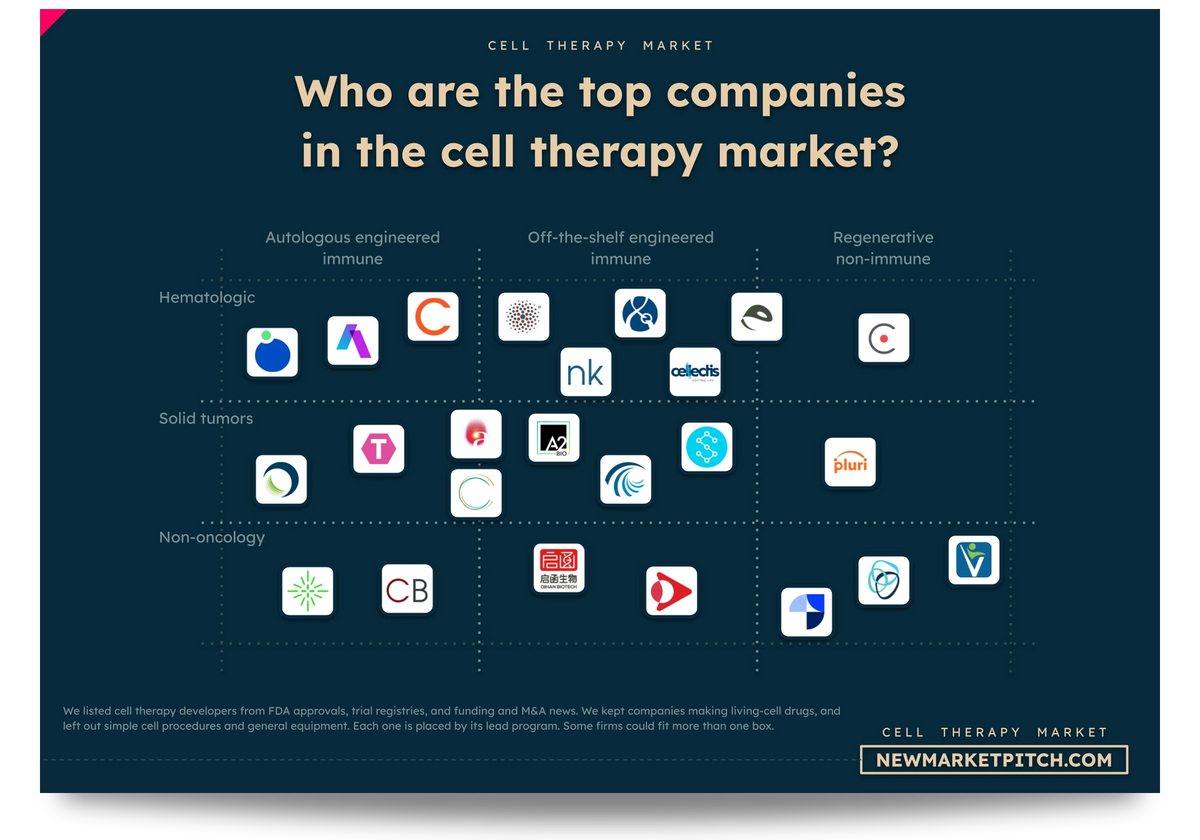
In our research about cell therapies, we turn what is vague and complex into simple, useful visuals. Market maps like this one show you at a glance where every startup stands.
Which cell therapy startups have raised the most money?
Iovance Biotherapeutics, Legend Biotech, Sana Biotechnology and Immatics currently sit in a different funding league from most of the cell therapy market.
Using the reconstructed equity-financing histories in our dataset, Iovance leads at roughly $3.1 billion raised, followed by Legend Biotech at about $2.4 billion, Sana at at least $1.7 billion and Immatics at roughly $1.4 billion. Kite Pharma, acquired by Gilead, and Mesoblast each sit around $1.1 billion.
The scale drops fairly quickly from there. Vor Bio and Lyell Immunopharma are around $1.0 billion each, while Atara Biotherapeutics, Century Therapeutics and Nkarta are in the roughly $885 million to $926 million range.
That gives us a market with a very heavy top. The first five companies alone account for about $9.7 billion of cumulative equity funding in our ranking. The top 20 reach roughly $21.6 billion.
There is an important caveat, though. Several leaders have been public for years, so their totals combine venture rounds with IPO proceeds, follow-on offerings, private placements and ATM sales. Someone searching for the "most funded cell therapy startup" may expect a venture-backed private company. At the top of this particular market, that definition quickly stops working.
| Rank | Company | Approx. cumulative equity funding | Current situation |
|---|---|---|---|
| 1 | Iovance Biotherapeutics | $3.1B | Public |
| 2 | Legend Biotech | $2.4B | Public |
| 3 | Sana Biotechnology | ≥$1.7B | Public |
| 4 | Immatics | $1.4B | Public |
| 5 | Kite Pharma | $1.1B | Acquired by Gilead |
| 6 | Mesoblast | $1.1B | Public |
| 7 | Vor Bio | $1.0B | Public; business repositioned |
| 8 | Lyell Immunopharma | $1.0B | Public |
| 9 | Atara Biotherapeutics | $926M | Public |
| 10 | Century Therapeutics | $916M | Public |
How far ahead is Iovance Biotherapeutics in cell therapy funding?
Iovance is clearly number one by cumulative equity raised in our ranking, with roughly $700 million more funding than second-place Legend Biotech.
The gap comes from years of repeated public-market fundraising rather than one giant venture round. Iovance has financed the development, manufacturing and commercial launch of its TIL platform through numerous stock offerings and ATM programs.
The company was also the first in this ranking to turn a TIL program into an FDA-approved commercial product. The FDA granted accelerated approval to Amtagvi, Iovance's lifileucel, for previously treated advanced melanoma in 2024. That required building manufacturing capacity and funding a commercial organization on top of the usual clinical-development costs.
Iovance was still raising equity recently. Its SEC filing for the second quarter of 2026 shows $49.6 million of net proceeds during that quarter through its ATM program. The filing also says the company had a facility allowing it to sell up to $350 million of common stock over time.
So Iovance's $3.1 billion total is the cumulative financing history of a company that has gone all the way from development-stage biotech to commercial cell-therapy manufacturer. That is a very different funding story from a private Series B company raising money to reach its first clinical readout.

In our market report about cell therapies, we always try to gather several sources and make estimates that make sense, so you can work with solid numbers.
Is Legend Biotech catching Iovance in total funding?
Legend Biotech is the closest challenger to Iovance, and it is still adding substantial amounts of equity capital.
Legend ranks second in our reconstruction at around $2.4 billion. Its latest major financing was an underwritten public offering announced in June 2026. The company priced 7.7 million American Depositary Shares at $29.35 each, for expected gross proceeds of about $226 million before any exercise of the underwriters' option.
Legend is no longer an early cell-therapy developer. Its BCMA CAR-T therapy Carvykti, developed with Johnson & Johnson, is already FDA-approved for multiple myeloma. Funding therefore supports a company with an approved product, international development programs and continuing manufacturing requirements.
The roughly $700 million gap with Iovance remains substantial, but Legend is close enough that the top two form a separate tier from most of the ranking. Sana, in third place, trails Legend by roughly another $700 million.
Why has Sana Biotechnology raised so much money?
Sana reached the top three because investors funded an unusually broad cell-engineering platform very aggressively before the company had mature clinical data.
Sana's 2021 IPO alone raised $587.5 million before the underwriters' option, one of the largest biotech IPOs of that cycle. That came after very large private financings, pushing the company's reconstructed cumulative equity funding above $1.7 billion.
The company has continued tapping public markets. Sana reported $47.4 million of gross proceeds through its ATM program during 2025, alongside an $86.3 million underwritten offering. Public offerings are one source of cell therapy funding; we follow which investors keep backing it, and which pass, in our cell therapy market report.
Sana is also a useful warning against reading funding totals as a simple success ranking. Its work across engineered cells, hypoimmune technology and multiple disease areas gives it more possible upside, but it also demands more capital.
The $1.7 billion figure tells us that Sana persuaded investors to finance a very large technical vision. It does not tell us that the company has already converted that spending into equivalent commercial value.
Why are so many of the most funded cell therapy companies already public?
Cell therapy development burns so much capital that the largest companies usually cannot remain dependent on venture rounds for long.
Of the top 20 companies in our ranking, most have already reached public markets at some point. IPO proceeds are only the beginning. Once listed, companies can return repeatedly through follow-on offerings, registered directs, PIPEs and ATM programs.
Nkarta illustrates the size of those later financings. It raised roughly $240 million in a single underwritten public offering in March 2024. Legend added approximately $226 million in its 2026 offering. Century Therapeutics raised $135 million privately from institutional investors despite already being listed. Kyverna added roughly $105 million in gross proceeds from its late-2025 follow-on transaction.
Those deals can be as large as, or larger than, private biotech Series B and Series C rounds. Over several years they push cumulative funding totals far above what a normal venture-funding database might suggest when someone thinks only in terms of pre-IPO rounds.
This is where "startup funding" gets fuzzy in cell therapy. The underlying businesses can remain clinical-stage biotechnology companies for years after listing, and they continue consuming development capital in much the same way a private startup does.

Our document detailing everything you need to know about cell therapy gets updated several times a month, so you always get the latest view of where things stand.
Which private cell therapy startups have raised the most funding?
Arsenal Biosciences is the clearest private-company heavyweight in the ranking, with roughly $630 million raised and a $325 million Series C that rivals major public offerings.
Arsenal's Series C closed in 2024 and included ARCH Venture Partners, NVentures, Regeneron Ventures, T. Rowe Price-related accounts and several existing backers. At $325 million, that single financing represents more equity than many cell therapy companies have raised over their entire lives.
Other large private or historically private names include Sonoma Biotherapeutics at roughly $365 million, Umoja Biopharma at about $363 million, AvenCell Therapeutics at roughly $362 million and Aspen Neuroscience at around $339 million in equity under our methodology.
Aspen is particularly interesting because its own announcement says it had raised more than $340 million when grants are included following its $115 million Series C in 2025. We exclude the CIRM grant when ranking cumulative equity, which explains why our equity-only figure can differ slightly from a company's headline "capital raised" number.
OriCell is another company moving rapidly up the private-company group. It announced a pre-IPO financing of more than $110 million in 2026, taking its reconstructed equity funding to at least roughly $395 million.
| Company | Approx. equity funding | Large recent round | Main current focus |
|---|---|---|---|
| Arsenal Biosciences | $630M | $325M Series C | Programmable CAR-T for solid tumors |
| OriCell Therapeutics | ≥$395M | >$110M pre-IPO | CAR-T for solid tumors |
| Sonoma Biotherapeutics | $365M | $30M strategic equity | Treg therapies |
| Umoja Biopharma | $363M | $100M Series C | In-vivo CAR-T |
| AvenCell Therapeutics | $362M | $112M Series B | Switchable CAR-T |
| Aspen Neuroscience | ~$339M equity | $115M Series C | Cell replacement for Parkinson's |
| A2 Biotherapeutics | $271M | $80M Series C | Logic-gated T-cell therapies |
| Quell Therapeutics | $240M | $156M Series B | Engineered Tregs |
What are the biggest cell therapy funding rounds in the ranking?
The largest individual rounds show that investors have sometimes been willing to put several hundred million dollars behind a single cell-therapy company at once.
Lyell Immunopharma's $493 million Series C remains an extraordinary private financing. Kite raised $410 million in a public offering before Gilead acquired it. CARsgen raised roughly $400 million in its IPO, while Instil Bio's IPO generated about $368 million.
More recently, Obsidian Therapeutics completed a $350 million private placement alongside its transaction with Galera Therapeutics. Arsenal Biosciences raised $325 million in its Series C. CARGO Therapeutics raised about $319 million in its IPO.
These rounds are large even by biotechnology standards. They also show how quickly a cumulative funding total can jump after one event. Arsenal moved into the upper part of the ranking without needing ten separate rounds. Iovance got to a much larger total the opposite way: years of repeated financings.
| Company | Round | Amount |
|---|---|---|
| Lyell Immunopharma | Series C | $493M |
| Kite Pharma | Follow-on offering | $410M |
| CARsgen Therapeutics | IPO | ~$400M |
| Instil Bio | IPO | ~$368M |
| Obsidian Therapeutics | Private placement | $350M |
| Arsenal Biosciences | Series C | $325M |
| CARGO Therapeutics | IPO | ~$319M |
| Nkarta | Public offering | ~$240M |

In our report covering the cell therapy market, we look at what the winners do differently, so you can learn from the best instead of guessing.
Which cell therapy companies have raised big rounds most recently?
The market is still producing nine-figure cell therapy financings, but investors are choosing their bets much more selectively than during the broad biotech boom.
Immatics raised $150 million through an underwritten offering in August 2026. The final amount differs from the earlier $173 million figure in our working dataset, so we use the company's announced $150 million gross offering figure for the latest round.
Obsidian closed its $350 million private placement shortly before that, alongside the completion of its transaction with Galera. Century Therapeutics raised $135 million in January 2026. Legend priced a roughly $226 million offering in June. OriCell completed more than $110 million of pre-IPO financing in April. A cluster of nine-figure rounds within months is a signal we revisit each quarter in our report on cell therapy.
Kyverna raised roughly $105 million in gross proceeds from its late-2025 follow-on, while Aspen Neuroscience closed a $115 million Series C around the same period.
That is already a substantial cluster of nine-figure financings. Cell therapy has not become an unfundable category. Capital is still there when investors see a program, platform or clinical trajectory worth concentrating money behind.
Is cell therapy funding moving from cancer into autoimmune disease?
Yes, autoimmune cell therapy has become one of the clearest destinations for new capital, even though oncology still dominates cumulative funding.
The historical ranking is heavily shaped by cancer. Iovance, Legend, Immatics, Kite, Lyell, Atara, Adaptimmune, Instil, Caribou, CARsgen, Obsidian, Arsenal, TScan and several other highly funded companies were built primarily around oncology.
Newer financing tells a broader story. Kyverna is centered on CAR-T for autoimmune diseases and raised about $105 million in its latest follow-on. Century's $135 million 2026 placement supports a portfolio that now includes type 1 diabetes and autoimmune programs. Nkarta has been developing NKX019 in autoimmune disease. AvenCell explicitly describes autoimmune disease as part of the potential reach of its switchable CAR-T platform.
The biggest strategic clue may be acquisition activity. AstraZeneca acquired Gracell partly for opportunities spanning oncology and autoimmune disease, while AbbVie's agreement to pay up to $2.1 billion for Capstan Therapeutics centered on an in-vivo CAR-T approach being developed for autoimmune conditions.
The money accumulated over the last decade still looks predominantly like cancer funding. The marginal dollar being deployed today is much more willing to chase immune reset outside oncology.
Is in-vivo CAR-T becoming a serious funding category?
In-vivo CAR-T has moved well beyond the "interesting experiment" stage and is now attracting both major venture rounds and billion-dollar pharmaceutical deals.
Umoja Biopharma raised $100 million in a 2025 Series C specifically to push its in-vivo CAR-T pipeline through clinical milestones. Capstan Therapeutics had raised about $340 million in our dataset before AbbVie agreed to acquire it for up to $2.1 billion in cash.
EsoBiotec provides another strong example. Its disclosed venture funding was small relative to the leaders in our ranking, yet AstraZeneca bought the company in 2025 for $425 million upfront and up to $575 million in additional payments. AstraZeneca highlighted the possibility of engineering immune cells directly inside the patient rather than extracting, modifying and reinfusing them.
Kelonia Therapeutics, another in-vivo cell-engineering company, was also acquired after raising about $50 million according to our reconstruction.
The attraction is pretty clear. Conventional autologous CAR-T can require complex collection, manufacturing, logistics and conditioning. An in-vivo system that reliably programs immune cells inside the body could remove several expensive steps at once.
We still do not know which technical approach will ultimately work best at commercial scale. What has changed is the amount of serious money willing to find out.

Theory only gets you so far. In our research about cell therapies, we dig up the real signals from the field and show you the ones worth watching.
Are investors still funding cell therapies for solid tumors?
Solid-tumor cell therapy remains one of the best-funded high-risk bets in biotechnology.
Arsenal Biosciences raised $325 million to advance programmable T-cell therapies for solid tumors. Obsidian secured $350 million around its public-market transaction to develop engineered TIL therapies, including programs in melanoma and non-small-cell lung cancer. Immatics raised another $150 million while developing a PRAME franchise that includes TCR-T cell therapy across multiple solid tumors. Engineered TIL and TCR-T programs for solid tumors are the kind of technology we place between proven and still on paper in our report covering the cell therapy market.
OriCell's latest financing adds another example. The company raised more than $110 million ahead of a planned capital-market step while advancing CAR-T programs for solid tumors, including hepatocellular carcinoma.
These companies are attacking the same broad problem from different directions: better T-cell targeting, TIL engineering, logic gating, intracellular cancer targets and more controllable cell behavior.
Investors have already watched many solid-tumor cell therapy programs disappoint. Yet the money going into Arsenal, Obsidian, Immatics and OriCell shows the category itself has not been abandoned. Capital has moved toward companies that can explain why their version should behave differently from earlier attempts.
Are allogeneic "off-the-shelf" cell therapies still attracting money?
Allogeneic cell therapy is still well funded, although investors no longer appear willing to finance the idea simply because it promises an off-the-shelf product.
Century Therapeutics, Caribou Biosciences, Nkarta, Adicet Bio, AvenCell and several other highly funded companies are developing allogeneic or donor-derived approaches. Roche's acquisition of Poseida also brought donor-derived CAR-T programs into a major pharmaceutical company.
The logic remains compelling. Making cells in advance could shorten treatment time, standardize manufacturing and potentially spread fixed production costs across more doses.
But years of clinical development have made the questions tougher. The cells must persist, avoid immune rejection, remain potent and deliver enough efficacy to compete with autologous products that already work very well in several blood cancers.
That explains the current funding pattern. Investors still write large checks, as Century's $135 million placement shows, but increasingly want a differentiated biological answer rather than the generic promise of cheaper manufacturing.
Is autologous cell therapy losing investor support?
Autologous cell therapy is still attracting huge amounts of capital, especially when investors see strong efficacy or a credible route into solid tumors.
Iovance is the most funded company in the entire ranking and sells an autologous TIL therapy. Legend's Carvykti is an autologous CAR-T. Obsidian raised $350 million around an engineered autologous TIL program. Arsenal's programs also involve highly engineered patient-specific T cells.
Aspen Neuroscience provides a completely different example outside cancer. Its $115 million Series C backs an autologous iPSC-derived neuronal replacement therapy for Parkinson's disease.
The manufacturing burden has not killed the model. Investors will tolerate a complicated process when the therapy may deliver an outcome that simpler medicines cannot.
The pressure is coming from another direction: autologous approaches increasingly have to prove that the clinical benefit is worth the logistics. The arrival of in-vivo and better allogeneic systems raises that bar, but it has not made patient-specific cell therapy obsolete.

In our market report about cell therapies, we don't want to repeat what boring consulting reports say. Instead, we show you the real and latest market signals that matter.
Are TIL therapies becoming a real investment category?
TIL therapy has gained much more financial credibility since Iovance turned the modality into an approved product.
Iovance's Amtagvi became the first FDA-approved tumor-derived T-cell therapy for advanced melanoma in 2024. That commercial milestone changed the discussion for every company trying to improve the TIL model because the modality is no longer purely experimental.
Obsidian is the clearest next-generation financing example. Its $350 million private placement supports amsoki-cel, formerly OBX-115, an engineered TIL therapy designed to provide regulated IL-15 activity. The combined company began trading on Nasdaq under the OBX ticker after its transaction with Galera.
Instil Bio also raised very large amounts around autologous TIL development, although its subsequent strategic changes show how unforgiving the field can be.
The financing story today is less about whether TIL can work at all. Iovance answered part of that question. The harder investment question is whether engineered TIL products can improve efficacy, manufacturing or patient experience enough to justify another generation of spending.
Why are investors putting so much money into cell therapy manufacturing?
Manufacturing can decide whether a promising cell therapy becomes a scalable medicine, so investors are effectively funding factories, logistics and process development alongside the science.
This is especially obvious in autologous therapy. Cells have to move from a patient to a manufacturing system and back again, often under tight time constraints. Each additional manipulation step creates cost and operational risk. Every extra manufacturing step adds cost and risk, and we rank risks like this by how likely they are in our report on cell therapy.
That helps explain why different financing themes keep converging on manufacturing. Nkarta said its $240 million offering would partly fund internal manufacturing capabilities. Aspen talks about automation and robotics as part of making personalized cell therapy commercially viable. In-vivo companies such as Umoja and the acquired EsoBiotec are trying to remove much of the ex-vivo manufacturing chain altogether.
Process engineering can be almost as strategically important as the biological target in this market. A better receptor is valuable; a better way to manufacture, or avoid manufacturing, the therapy can change the economics of the whole product.
Who are the biggest investors backing cell therapy startups?
A relatively small group of specialist biotech investors keeps appearing across major cell therapy financings.
RA Capital appears across companies including Century Therapeutics, Nkarta and Obsidian. TCGX led Century's $135 million placement and Vor Bio's $75 million financing and also appears among Obsidian's existing investors. ARCH Venture Partners is prominent in Arsenal Biosciences and Aspen Neuroscience.
Cormorant, OrbiMed, Foresite, Deep Track, RTW and Samsara BioCapital also recur across the market. Strategic investors add another layer: Regeneron Ventures backed Arsenal, Bristol Myers Squibb has appeared in several cell-therapy syndicates, Bayer helped create BlueRock, and major pharmaceutical companies have repeatedly bought entire platforms.
The overlap is useful because these are not generalist investors wandering into one fashionable round. Many have financed cell therapy repeatedly across different modalities, diseases and development stages.
They are not all betting on the same technology either. The same sophisticated capital base is spread across autologous, allogeneic, TIL, NK, Treg, iPSC and in-vivo approaches.

Learning from others' mistakes is the cheapest lesson there is. In our document detailing everything you need to know about cell therapy, we look at what broke startups before you, so you don't repeat it.
Does a huge funding total mean a cell therapy company is succeeding?
No. Cell therapy has several examples where enormous cumulative funding was followed by restructuring, asset sales, shutdowns or disappointing shareholder outcomes.
Adaptimmune raised roughly $813 million of equity in our reconstruction and became one of the best-funded engineered T-cell companies in the field. Yet in 2025 it agreed to sell Tecelra and several other cell-therapy assets to US WorldMeds for $55 million upfront plus possible milestone payments, and it subsequently delisted from Nasdaq.
Achilles Therapeutics raised roughly $403 million before winding down. Gamida Cell raised at least roughly $432 million before its public-company story ended in an acquisition following severe financial pressure. Startups that raised hundreds of millions and still wound down tend to share a few traits, which we study in our market report about cell therapy.
Instil Bio raised about $749 million, including a roughly $368 million IPO, but later radically reduced its original TIL ambitions.
Cumulative funding is useful as a measure of how much capital investors committed, not as a proxy for value creation. In cell therapy, a company can spend several hundred million dollars simply discovering that a biological or manufacturing problem is harder than expected.
How much of cell therapy funding is concentrated in the biggest companies?
Cell therapy funding is highly concentrated: the top 20 companies in our dataset have raised about $21.6 billion of equity between them.
The top five alone account for roughly $9.7 billion. The first ten reach about $14.6 billion.
That concentration is partly mechanical. Once a company reaches public markets, every subsequent offering adds to its lifetime total. A long-lived public biotech can therefore accumulate more equity than a younger private company even when the younger company is raising much larger rounds today.
Still, the difference is striking. Many companies in the lower half of the ranking have raised less than $50 million, while Iovance alone is around $3.1 billion.
The market effectively contains two financing worlds: a small set of mature developers with access to repeated nine-figure transactions, and a much larger group that has to reach meaningful scientific milestones with tens rather than hundreds of millions.
Are cell therapy acquisitions validating the money investors put into the sector?
Several acquisitions show that pharmaceutical companies will pay far more than the capital originally invested when they want a specific cell-therapy asset or platform.
Gilead's $11.9 billion acquisition of Kite remains the clearest historical example. Kite had raised roughly $1.1 billion in our reconstruction before the deal.
More recently, Roche agreed to acquire Poseida for roughly $1.0 billion upfront equity value and up to $1.5 billion including contingent payments. AstraZeneca acquired Gracell in a transaction worth approximately $1.0 billion upfront and up to $1.2 billion including the contingent component.
AbbVie agreed to pay up to $2.1 billion at closing for Capstan Therapeutics. AstraZeneca paid $425 million upfront for EsoBiotec, with total potential consideration of up to $1 billion. Gilead then completed its acquisition of Arcellx at an implied equity value of about $7.8 billion, with additional contingent consideration possible.
These deals also show how little cumulative funding alone can tell us about eventual strategic value. EsoBiotec sat near the bottom of our funding ranking because relatively little equity financing had been publicly disclosed. Its technology still attracted a potential $1 billion acquisition.
| Company | Approx. funding in our dataset | Acquirer | Announced/realized deal value |
|---|---|---|---|
| Kite Pharma | $1.1B | Gilead | $11.9B |
| Arcellx | $230M | Gilead | ~$7.8B implied equity value + CVR |
| Capstan Therapeutics | $340M | AbbVie | Up to $2.1B at closing |
| Poseida Therapeutics | $317M | Roche | ~$1.0B upfront equity value; up to ~$1.5B |
| Gracell Biotechnologies | ≥$525M | AstraZeneca | ~$1.0B upfront; up to ~$1.2B |
| EsoBiotec | ≥$6M disclosed | AstraZeneca | $425M upfront; up to $1.0B |
| BlueRock Therapeutics | $225M | Bayer | Bayer acquired full control |

If you build or invest in the cell therapy market, you need to know which business models pay off now and which ones are fading. That's why our report covering it has a whole section on it.
Why can a lightly funded cell therapy startup sell for so much money?
Pharma companies buy differentiated technology and future drug economics, not a reimbursement of the startup's historical fundraising.
EsoBiotec makes the point unusually well. Our public funding reconstruction finds only a small amount of disclosed venture equity compared with the hundreds of millions raised by better-known peers. AstraZeneca nevertheless agreed to pay $425 million upfront and as much as $1 billion in total. Reconstructing funding from thin public records is why we keep every assumption visible in our own ground-up estimates in our report covering the cell therapy market.
The attraction was an in-vivo platform that could potentially program immune cells through an intravenous infusion and avoid weeks of conventional ex-vivo cell manufacturing.
Arcellx shows the same phenomenon at a much larger scale. Its reconstructed pre-acquisition fundraising of roughly $230 million is tiny compared with the approximately $7.8 billion implied equity value cited by Gilead when it completed the acquisition. The value sat in anito-cel and the underlying binding technology rather than in the amount previously spent financing the company.
The lower half of a funding ranking should not be mistaken for a list of weaker businesses. Capital efficiency, licensing economics and strategic scarcity can create enormous value without producing a giant cumulative fundraising number.
Which smaller cell therapy startups are attracting attention now?
Some of the most interesting current financings sit well below the billion-dollar leaders because the companies are younger or are pursuing newer approaches.
Umoja stands out with its $100 million Series C for in-vivo CAR-T. AvenCell raised $112 million for switchable CAR-T technology. Aspen secured $115 million for personalized neuron replacement in Parkinson's disease. OriCell raised more than $110 million in its pre-IPO financing while advancing solid-tumor CAR-T programs.
Quell remains a major Treg bet after its $156 million Series B, while Tr1X entered the market with a $75 million Series A for regulatory T-cell therapies.
None of these companies needs to catch Iovance's $3.1 billion lifetime financing total to become important. For younger companies, the more revealing question is how much money investors are willing to commit at the current stage and what milestone that money is supposed to reach.
A $100 million Series B or C today can be more informative about fresh investor conviction than a billion-dollar cumulative total built across 15 years.
Is cell therapy funding becoming more selective?
Yes. Investors are still writing very large checks, but the recent deals are clustering around a narrower set of technical and clinical ideas.
Recent nine-figure financings include Obsidian in engineered TIL, Immatics in PRAME-directed therapies, Century in iPSC-derived therapies including type 1 diabetes, OriCell in solid-tumor CAR-T and Aspen in neuronal replacement.
At the same time, the historical ranking contains multiple companies that shut down, sold assets, were acquired after financial difficulty or dramatically changed strategy. The market has already absorbed several expensive lessons.
That makes today's environment different from the period when a broad platform story could command a huge private round with very limited human data. Large checks now tend to come with a more concrete thesis: a defined clinical program, an unusual manufacturing advantage, compelling human data, an autoimmune use case or a credible path to a pivotal trial.
The money has not disappeared. It has become harder to earn.

In our research about cell therapies, we like to show you the big picture. We know your time is precious, so we make every page quick to read and packed with as much learning as possible per minute.
What does Vor Bio's $1 billion funding history tell us about how fast this market can change?
Vor Bio shows why a cumulative funding ranking can preserve the history of a company even after the company itself has changed direction.
Vor built its original identity around engineered hematopoietic stem-cell therapies for cancer. That history helped produce roughly $1 billion of cumulative equity funding in our reconstruction.
The company is very different today. Its current strategy is centered on telitacicept and autoimmune disease rather than the original cell-therapy platform. In March 2026, Vor raised $75 million in a private placement led by TCGX, and the company described itself as focused on transforming the treatment of autoimmune diseases.
Vor still belongs in a historical ranking of cell-therapy fundraising because that is where much of the capital was originally raised and deployed. But for someone trying to understand where fresh cell-therapy dollars are going now, counting its latest $75 million as a new cell-therapy financing would be misleading.
Cumulative funding measures financing history. Current market activity requires looking at what the business is actually funding today.
So where is the money really going in cell therapy now?
Cell therapy is still attracting enormous amounts of capital, but today's money is concentrating around companies that can solve one of the field's hardest remaining problems.
The historical leaders by cumulative financing are mostly oncology companies that spent years building CAR-T, TCR-T or TIL platforms. Iovance, Legend, Sana and Immatics sit at the top because they combined large early financings with continued access to public capital. Whether CAR-T, TCR-T and TIL all count as cell therapy is a line we draw in our report on cell therapy.
Fresh funding looks more diverse. Autoimmune CAR-T has become a major destination. In-vivo engineering is drawing venture money and pharmaceutical acquisitions. Solid-tumor cell therapy continues to attract nine-figure bets when companies bring a differentiated biological mechanism. Regenerative medicine is also producing large financings, as Aspen's Parkinson's program shows.
Manufacturing runs through all of these themes. Investors are backing companies that make therapies faster, more controllable, more scalable or easier to deliver rather than simply funding another version of the original CAR-T playbook.
More than $21.6 billion has gone into the top 20 companies in our reconstruction alone, and recent transactions show that nine-figure rounds remain possible. The bigger change is the burden of proof. The largest new checks increasingly go to companies with a specific answer to a problem the first generation of cell therapies left unresolved.
Our methodology
Our objective was to build an analytically reliable ranking of cell therapy startups and biotech companies by cumulative equity funding raised, rather than copying the total displayed by any single database. The broader dataset and market coverage are available in our report covering the cell therapy market.
We focused on companies whose businesses were genuinely centered on cell therapy during the period being measured. Financing histories were reconstructed round by round using company and investor announcements, regulatory filings, official press releases, reputable financial and industry reporting, venture databases and other credible transaction records.
We count equity financing, including venture rounds, IPO proceeds, follow-on offerings, PIPEs, private placements and other equity issuances. Debt, grants and other non-equity financing are excluded from cumulative totals. This is why our figures can differ from a company's own statement about "total capital raised" when that number includes grants or debt.
For public companies, lifetime funding can include many years of equity issuance after the IPO. That is particularly important in cell therapy, where ATM programs and repeated follow-on offerings can add hundreds of millions of dollars to a company's cumulative financing history.
Historical financings remain relevant because the ranking measures lifetime equity funding, but recent filings and announcements were also checked to capture newer transactions. When a company had materially changed strategy, we kept its historical cell-therapy financing in the lifetime ranking while distinguishing that from capital being raised for a different business today.
When sources disagreed, we gave more weight to direct company disclosures, investor announcements, regulatory filings and other authoritative transaction records. We also checked for round extensions, overlapping announcements, ATM proceeds and transactions that mixed equity with debt, grants or other forms of capital.
Acquisition values are kept separate from cumulative funding. They are used in the analysis to compare historical capital raised with later strategic value, but an acquisition price is not counted as equity funding received by the company.
Some company financing histories are necessarily approximate, particularly where older private rounds were not fully disclosed. In those cases we use minimum figures such as "at least" or "≥" rather than pretending the underlying record is more precise than it is.
Key sources used in the analysis include Iovance's SEC filing covering 2026 ATM proceeds and financing arrangements, the FDA's Amtagvi approval record, Legend Biotech's public-offering announcement, Sana Biotechnology's IPO announcement, Immatics' $150 million offering announcement, Century Therapeutics' $135 million private placement, Arsenal Biosciences' $325 million Series C announcement, Obsidian Therapeutics' transaction and $350 million private placement announcement, Umoja Biopharma's $100 million Series C announcement, and Aspen Neuroscience's $115 million Series C disclosure.
For acquisition context, we also relied on primary announcements from Gilead on Kite Pharma, Roche on Poseida Therapeutics, AstraZeneca on Gracell, AbbVie on Capstan Therapeutics, AstraZeneca on EsoBiotec, and Gilead on Arcellx.
The guiding principle throughout is simple: a round-by-round total we can reconcile is more useful than a cleaner-looking number whose underlying financing history cannot be verified.

When you build or invest in the cell therapy market, you need clarity, not confusion. In our market report about cell therapies, we always try to put numbers on and quantify whatever is usually vague and confusing.
Written by the New Market Pitch teamWe track new markets so founders and investors can move faster. About us