What are the top circular economy startups by revenue today?

Whether you're building or investing in the circular economy, our report covers everything you need to know: the players, the money, and what's coming next.
Summary
Reconomy is the top circular economy startup by revenue today, with more than £1.32 billion in 2024 annual revenue. Vinted follows with €1.1 billion in 2025, ahead of Back Market, FINN and momox. Our ranking covers 35 companies across resale, refurbishment, waste management, recycling and product subscriptions.
Consumer resale has become one of the circular economy's biggest commercial successes. Vinted, Back Market, momox, ThredUp and other platforms have reached hundreds of millions in annual revenue, while Reconomy shows that business-to-business waste and resource management can operate at an even larger scale.
The revenue figures need careful interpretation. Vinted's €10.8 billion in 2025 marketplace GMV translated into €1.1 billion in company revenue, while Back Market generated €440 million from approximately €3 billion in transaction volume. Marketplace activity and recognized revenue are very different measures.
Profitability is becoming a clearer dividing line. Vinted earned €62 million in net profit in 2025, momox remained profitable and Back Market reported its first profitable year. Meanwhile, ThredUp and Too Good To Go continued to report net losses despite growing revenue.
Product subscriptions have also reached substantial scale. FINN generated €444 million in annual revenue, Rent the Runway $330 million and Grover €211 million. Their recurring-payment models are attractive, but financing vehicles, clothing, electronics and other physical assets makes them more capital-intensive than many marketplaces.
Food-waste prevention is already a sizeable business. Too Good To Go increased its annual revenue by approximately 29% to €249 million in 2025, although it remained loss-making. Its growth shows that recovering value from surplus food can support significant commercial activity.
The industrial recycling market tells a tougher story. Redwood Materials has an estimated $200 million in annual revenue, but Li-Cycle's financial difficulties and Ascend Elements' liquidation demonstrate how expensive it can be to turn battery-recovery technology into a sustainable business.
Advanced textile recycling and reusable packaging are at earlier stages. Circ has an estimated $18.3 million in annual revenue, while companies such as Syre and Samsara Eco are developing large industrial facilities. Planned processing capacity, however, says little about actual sales until those facilities reach commercial operation.
Regulation and material scarcity are pushing circularity further into mainstream business operations. The EU's packaging rules and product-design framework are creating opportunities for reuse, repair, traceability and compliance services, particularly for companies with existing logistics and customer networks.
The most important distinction is between financial scale and environmental impact. A company can generate billions in sales without preventing an equivalent amount of waste. The strongest circular economy businesses will be those that combine profitable operations with demonstrable product reuse, material recovery and reduced demand for virgin resources.

Written by the New Market Pitch teamWe track new markets so founders and investors can move faster. About us

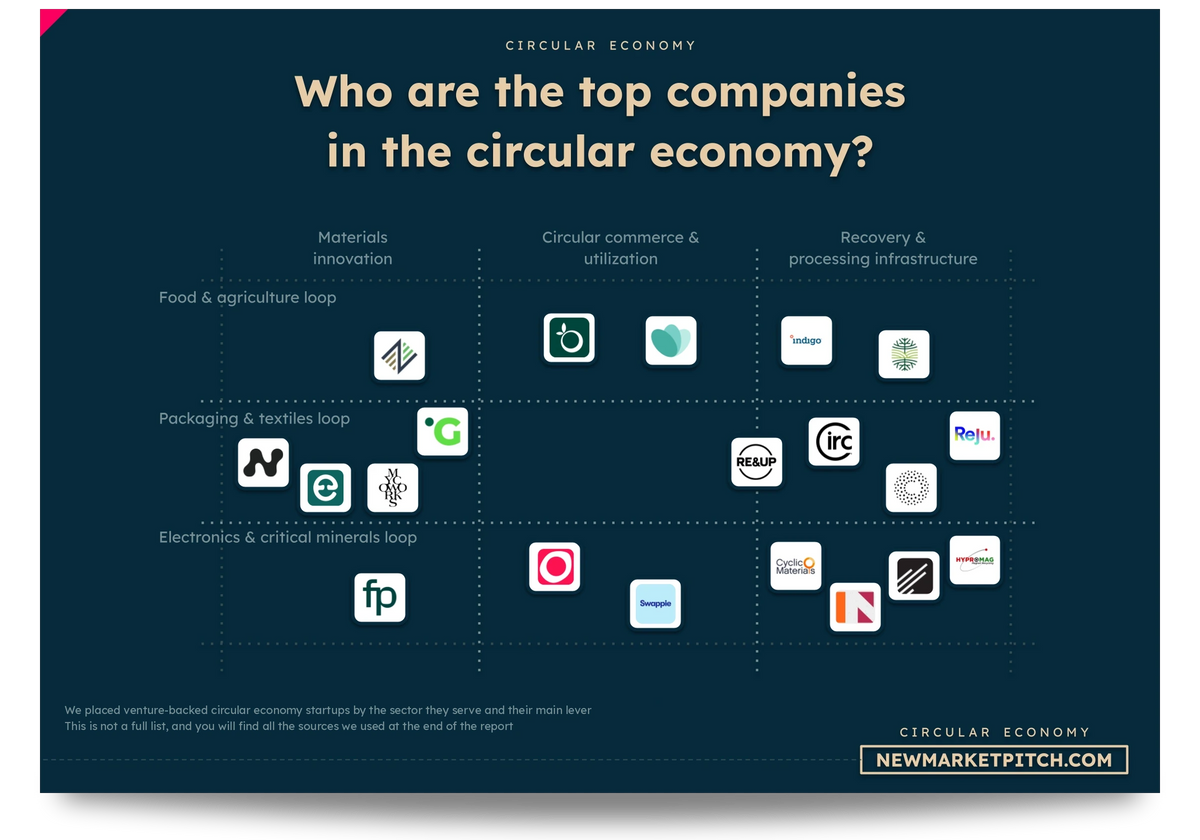
In our report covering the circular economy market, we turn what is vague and complex into simple, useful visuals. Market maps like this one show you at a glance where every startup stands.
The ranking of top startups in the circular economy by revenue
Below is a table ranking the startups of this market by their current revenue scale. You can find our methodology at the end of this page.
If you want a deeper understanding of the market and its current dynamics, get our report on the circular economy.
| Ranking | Company | Latest Metric | Metric Type | Freshness | Disclosed When | Source Quality | Confidence | Segment | Why This Ranking | Local Metric | Country |
|---|---|---|---|---|---|---|---|---|---|---|---|
| 1 | Reconomy | >$1.69B | Annual Revenue | Aging · 22mo | May 22, 2025 | Company Disclosed | Medium | Circular Resource Management | Strong company-wide revenue from an explicitly circular specialist puts it first among startups, though the figure is aging while Vinted's is fresher. | >£1.32B | gb |
| 2 | Vinted | ~$1.24B | Annual Revenue | Fresh · 10mo | Apr 9, 2026 | Company Disclosed | High | Resale Marketplace | Very recent ~$1.24B revenue from a pure secondhand marketplace; below Reconomy's >$1.69B and well ahead of Back Market's ~$497M. | €1.1B | lt |
| 3 | Back Market | ~$497M | Annual Revenue | Fresh · 10mo | Feb 17, 2026 | Credible Reported | Medium | Refurbished Electronics Marketplace | More recent than FINN's selected realized-revenue figure and therefore edges it despite the slightly smaller nominal amount. | €440M | fr |
| 4 | FINN | ~$481M | Annual Revenue | Aging · 22mo | Oct 2025 | Credible Reported | Medium | Product-as-a-Service / Cars | Realized revenue is stronger than a run-rate; fresher 2026 ARR above €300M supports ongoing scale, but does not replace the 2024 revenue figure. | €444M | de |
| 5 | momox | ~$445M | Annual Revenue | Fresh · 10mo | Apr 16, 2026 | Company Disclosed | High | Books & Media Recommerce | Fresh direct revenue from a mature recommerce operator. | €394M | de |
| 6 | Rent the Runway | $330M | Fiscal-Year Revenue | Fresh · 9mo | 2026 | Filed / Audited | High | Fashion Rental | Highly comparable recent revenue from a product-as-a-service model. | us | |
| 7 | ThredUp | $311M | Fiscal-Year Revenue | Fresh · 10mo | 2026 | Filed / Audited | High | Apparel Resale | Slightly lower current recognized revenue than Rent the Runway but equally strong evidence quality. | us | |
| 8 | Too Good To Go | ~$281M | Annual Revenue | Fresh · 10mo | May 29, 2026 | Filed / Audited | High | Food Surplus Marketplace | Fresh audited revenue and a direct waste-prevention model. | €249M | dk |
| 9 | rebuy | >$271M | Annual Revenue | Fresh · 10mo | Apr 2026 | Company Disclosed | High | Electronics & Media Recommerce | Essentially comparable to Too Good To Go but reported as an “over” threshold rather than an exact audited number. | >€240M | de |
| 10 | Swappie | ~$264M | Annual Revenue | Fresh · 10mo | 2026 | Filed / Audited | Medium | Smartphone Refurbishment | Strong recognized revenue, but corporate-perimeter uncertainty keeps it below rebuy. | €234M | fi |
| 11 | Vestiaire Collective | ~$252M | Annual Revenue | Fresh · 10mo | Jul 21, 2026 | Filed / Audited | Medium | Luxury Resale Marketplace | Very recent filing, though the French legal entity may not capture every group activity. | €223M | fr |
| 12 | Grover | ~$228M | Annual Revenue | Historical · 34mo | Dec 15, 2025 | Filed / Audited | Low | Electronics Rental | Large direct revenue but materially penalized because 2023 is no longer representative enough of current scale. | €211M | de |
| 13 | Redwood Materials | ~$200M | Annual Revenue Estimate | Aging · 22mo | 2025 | Third-Party Estimate | Low | Battery Recycling | Important commercial-scale recycler, but a third-party estimate ranks below comparable verified revenue. | us | |
| 14 | Recommerce Group | ~$189M | Annual Revenue | Aging · 22mo | Nov 25, 2024 | Company Disclosed | Medium | Electronics Refurbishment | Direct company-wide revenue but now aging; still stronger than marketplace gross-volume proxies. | €175M | fr |
| 15 | Recykal | ~$170M | Gross Revenue | Fresh · 7mo | 2026 | Company Disclosed | Medium | Recycling Marketplace | Very current financial metric, but “gross revenue” is less comparable with recognized net revenue above it. | INR 15B | in |
| 16 | EasyCep | $100M | Annual Turnover | Aging · 22mo | Jul 3, 2025 | Credible Reported | Medium | Electronics Refurbishment | Clear $100M turnover disclosure but an older 22-month period, below Recykal's fresher ~$170M gross revenue; ranks above refurbed because cumulative GMV is not revenue. | tr | |
| 17 | refurbed | >$3.49B | Cumulative GMV | Fresh · 7mo | Mar 3, 2026 | Company Disclosed | Low | Refurbished Marketplace | Huge transaction scale, but deliberately kept below verified ~$100M corporate-revenue businesses because GMV cannot be treated as revenue. | >€3B | at |
| 18 | AMP | ~$50–100M | Annual Revenue Estimate | Very Fresh · 4mo | Jun 2026 | Third-Party Estimate | Low | AI Recycling Infrastructure | Potentially substantial revenue, but the company itself has declined to disclose revenue; estimate uncertainty drives the lower position. | us | |
| 19 | Raylo | ~$55M | Annual Revenue | Fresh · 13mo | Feb 2026 | Credible Reported | Medium | Electronics Product-as-a-Service | Recent realized revenue from device subscriptions is more comparable than Fairmat's contracted-revenue proxy. | £41.5M | gb |
| 20 | Rebike | >$45.2M | Annual Revenue | Fresh · 10mo | 2026 | Credible Reported | Medium | Bicycle Refurbishment | Recent realized revenue, albeit reported as a threshold rather than an exact amount. | >€40M | de |
| 21 | TerraCycle US | $47.6M | Annual Revenue | Fresh · 10mo | Apr 30, 2026 | Filed / Audited | Medium | Hard-to-Recycle Materials | Strong filed revenue but only for the U.S. reporting entity, so it cannot safely be treated as TerraCycle's global revenue. | us | |
| 22 | Fairmat | ~$56.5M | Contracted Annual Revenue | Fresh · 18mo | Apr 2025 | Company Disclosed | Medium | Composite Materials Recycling | Nominally exceeds nearby companies but ranks below recognized revenue because signed annual value is not yet booked revenue. | €50M | fr |
| 23 | Le Fourgon | ~$35.3M | Annual Revenue | Fresh · 10mo | May 11, 2026 | Credible Reported | Medium | Reusable Packaging / Deposit Delivery | Fresh realized revenue from an explicitly reuse-based model. | €31.2M | fr |
| 24 | Vapaus | ~$32.1M | Annual Revenue | Fresh · 13mo | 2026 | Credible Reported | Medium | Bicycle-as-a-Service | Similar scale to Li-Cycle but materially fresher and without the same restructuring problem. | €28.4M | fi |
| 25 | Li-Cycle | $28M | Annual Revenue | Aging · 22mo | 2025 | Filed / Audited | Low | Battery Recycling | Strong historical evidence, but old period plus subsequent restructuring reduce its usefulness for current revenue. | ca | |
| 26 | Circ | ~$18.3M | Annual Revenue Estimate | Fresh · 10mo | 2026 | Third-Party Estimate | Low | Textile Recycling | Useful ~$18.3M scale indication, but a third-party estimate; below Li-Cycle's filed figure and above NORNORM's narrower subscription-revenue metric. | us | |
| 27 | NORNORM | ~$15.8M | Annual Subscription Revenue | Fresh · 12mo | Oct 1, 2025 | Company Disclosed | Medium | Furniture-as-a-Service | Direct recurring commercial metric, but narrower than full recognized company revenue. | €14M | se |
| 28 | Ascend Elements | ~$35M | Annual Revenue Estimate | Aging · 22mo | 2025 | Third-Party Estimate | Low | Battery Recycling | The nominal figure would rank higher historically, but the 2026 bankruptcy makes it particularly weak evidence of current operating scale. | us | |
| 29 | Excess Materials Exchange | ~$5M | Annual Revenue Estimate | Fresh · 10mo | 2026 | Third-Party Estimate | Low | Secondary Materials Marketplace | Its ~$5M third-party estimate is barely above Pyrum Innovations' audited ~$4.64M and far below Ascend Elements' ~$35M estimate; weak source quality makes this ordering tentative. | nl | |
| 30 | Pyrum Innovations | ~$4.64M | Annual Revenue | Fresh · 10mo | May 8, 2026 | Filed / Audited | High | Tire Recycling | Smaller figure but high-quality, recent recognized revenue. | €4.11M | de |
| 31 | Wastelink | ~$3.06M | Revenue from Operations | Aging · 19mo | Sep 12, 2025 | Credible Reported | Medium | Food & Organic-Waste Circularity | Realized operational revenue gets more weight than similar-sized external estimates. | INR 265M | in |
| 32 | METYCLE | ~$3.5M | Annual Revenue Estimate | Fresh · 10mo | 2026 | Third-Party Estimate | Low | Scrap-Metals Marketplace | Commercial evidence exists, but it remains an external estimate. | de | |
| 33 | ReSmart / RecycleSmart | ~$1.93M | ARR | Fresh · 16mo | Jul 2025 | Company Disclosed | Medium | Waste & Recycling Software | Direct recurring run-rate is useful but less comparable than realized annual revenue. | AUD 3M | au |
| 34 | Altilium | ~$2.1M | Annual Revenue Estimate | Fresh · 10mo | Sep 18, 2025 | Third-Party Estimate | Low | Battery Recycling | Recently financed and scaling, but available revenue evidence remains estimated and small. | gb | |
| 35 | Infinited Fiber Company | ~$76.8K | Annual Revenue | Aging · 22mo | 2026 | Credible Reported | Low | Textile Recycling | The latest defensible legal-entity revenue found is extremely small; a much higher external estimate is not substituted. | €71K | fi |
| NR | Upway | >100K e-bikes sold/refurbished | Cumulative Units Sold | Fresh · 11mo | Nov 2025 | Company Disclosed | Low | E-bike Refurbishment | Strong commercial traction but units sold cannot be converted into revenue without unsupported assumptions. | fr | |
| NR | Greyparrot | >250 active analyzer units | Installed Units | Very Fresh · 3mo | Jul 28, 2026 | Company Disclosed | Low | AI Recycling Infrastructure | Significant installed footprint, but no financial metric robust enough for a revenue rank. | gb | |
| NR | Getmobil | >300K households reached | Other Scale Signal | Very Fresh · 0mo | 2026 | Company Disclosed | Low | Electronics Refurbishment | Recent fundraise disclosed ~60% revenue growth but not the underlying absolute revenue. | tr | |
| NR | Fleek | >50K retailers | Customers / Suppliers | Very Fresh · 3mo | Jul 8, 2026 | Credible Reported | Low | Secondhand Wholesale Marketplace | Strong network scale from a very recent fundraiser, but no revenue or GMV was disclosed. | gb | |
| NR | Archive | ~60 brand partners | Paying/Commercial Customers | Fresh · 14mo | Aug 8, 2025 | Credible Reported | Low | Resale Infrastructure Software | Brand count and rapid GMV growth establish relevance, but neither gives a defensible revenue position. | us | |
| NR | Cyclic Materials | 600 t/year planned rare-earth oxide output | Other Scale Signal | Forecast | Jan 29, 2026 | Company Disclosed | Low | Rare-Earth Recycling | Recent major fundraisings make it important to track, but its disclosed metric is production capacity, not current revenue. | ca | |
| NR | cylib | >100 t batteries recycled | Units / Volume Processed | Fresh · 10mo | 2026 | Company Disclosed | Low | Battery Recycling | Actual recycling volume exists, while the 60,000-t planned facility is future capacity; neither supports synthetic revenue. | de | |
| NR | Samsara Eco | 20K t/year nylon plant planned | Other Scale Signal | Forecast | Sep 25, 2025 | Company Disclosed | Low | Enzymatic Plastics Recycling | Recently funded and strategically important, but still scaling toward its first large commercial plant. | au | |
| NR | Syre | Up to 10K t/year plant capacity | Other Scale Signal | Fresh · 10mo | Feb 17, 2026 | Company Disclosed | Low | Textile-to-Textile Recycling | Now entering commercialization, but no reliable revenue disclosure yet. | se | |
| NR | Notpla | ~75M packaging units rollout | Other Scale Signal | Fresh · 10mo | 2026 | Credible Reported | Low | Compostable Packaging | Meaningful volume signal, but it is not equivalent to units already sold or recognized revenue. | gb | |
| NR | Vytal | >8M single-use containers avoided | Transactions / Reuse Events | Very Fresh · 3mo | Jul 2026 | Company Disclosed | Low | Reusable Packaging | Large reuse footprint, but no reliable financial metric was found. | de | |
| NR | Moment Energy | 10 deployed projects | Locations / Projects | Very Fresh · 1mo | Jun 2026 | Company Disclosed | Low | Second-Life Batteries | Series B and planned 45 MWh + 300 MWh deployments show momentum, but funding/project pipeline is not revenue. | ca | |
| NR | Phoenix Tailings | 200 t/year production capacity | Production Capacity | Fresh · 12mo | Oct 23, 2025 | Company Disclosed | Low | Tailings & Rare-Earth Recovery | Current production capacity is credible, but no revenue disclosure exists even after the 2026 financing. | us | |
| NR | tozero | >1,500 t/year processing capacity | Production Capacity | Fresh · 7mo | Mar 27, 2026 | Company Disclosed | Low | Battery Recycling | Actual industrial capacity is now online, but revenue has not yet been disclosed. | de |

Our research about the circular economy gets updated several times a month, so you always get the latest view of where things stand.
Which circular economy startups make the most revenue today?
Reconomy is the top-ranked circular economy startup in our ranking, with more than £1.32 billion in 2024 annual revenue, followed by Vinted, Back Market, FINN and momox.
The ranking includes 35 startups with credible financial or commercial-scale figures. Their business models range from secondhand marketplaces and refurbished electronics to waste management, battery recycling, reusable packaging and product subscriptions.
| Rank | Company | Revenue figure | Metric | Period |
|---|---|---|---|---|
| 1 | Reconomy | >£1.32B | Annual Revenue | 2024 |
| 2 | Vinted | €1.1B | Annual Revenue | 2025 |
| 3 | Back Market | €440M | Annual Revenue | 2025 |
| 4 | FINN | €444M | Annual Revenue | 2024 |
| 5 | momox | €394M | Annual Revenue | 2025 |
| 6 | Rent the Runway | $330M | Fiscal-Year Revenue | FY2025 |
| 7 | ThredUp | $311M | Fiscal-Year Revenue | 2025 continuing operations |
| 8 | Too Good To Go | €249M | Annual Revenue | 2025 |
| 9 | rebuy | >€240M | Annual Revenue | 2025 |
| 10 | Swappie | €234M | Annual Revenue | 2025 |
| 11 | Vestiaire Collective | €223M | Annual Revenue | 2025 |
| 12 | Grover | €211M | Annual Revenue | 2023 |
| 13 | Redwood Materials | ~$200M | Annual Revenue Estimate | 2024 |
| 14 | Recommerce Group | €175M | Annual Revenue | 2024 |
| 15 | Recykal | INR 15B | Gross Revenue | FY2026 |
| 16 | EasyCep | $100M | Annual Turnover | 2024 |
| 17 | refurbed | >€3B | Cumulative GMV | Since launch through Mar 2026 |
| 18 | AMP | ~$50–100M | Annual Revenue Estimate | 2026 estimate |
| 19 | Raylo | £41.5M | Annual Revenue | FY2025 |
| 20 | Rebike | >€40M | Annual Revenue | 2025 |
| 21 | TerraCycle US | $47.6M | Annual Revenue | FY2025 |
| 22 | Fairmat | €50M | Contracted Annual Revenue | As of Apr 2025 |
| 23 | Le Fourgon | €31.2M | Annual Revenue | 2025 |
| 24 | Vapaus | €28.4M | Annual Revenue | FY2025 |
| 25 | Li-Cycle | $28M | Annual Revenue | FY2024 |
| 26 | Circ | ~$18.3M | Annual Revenue Estimate | 2025 |
| 27 | NORNORM | €14M | Annual Subscription Revenue | 2025 / current run level |
| 28 | Ascend Elements | ~$35M | Annual Revenue Estimate | 2024 |
| 29 | Excess Materials Exchange | ~$5M | Annual Revenue Estimate | 2025 |
| 30 | Pyrum Innovations | €4.11M | Annual Revenue | FY2025 |
| 31 | Wastelink | INR 265M | Revenue from Operations | FY2025 |
| 32 | METYCLE | ~$3.5M | Annual Revenue Estimate | 2025 |
| 33 | ReSmart / RecycleSmart | AUD 3M | ARR | As of Jun 2025 |
| 34 | Altilium | ~$2.1M | Annual Revenue Estimate | 2025 |
| 35 | Infinited Fiber Company | €71K | Annual Revenue | 2024 |
The ranking contains an important distinction between different types of commercial figures. Redwood Materials and AMP rely on revenue estimates, Recykal reports gross revenue, and refurbed's figure represents cumulative GMV rather than annual revenue. Fairmat's figure is contracted annual revenue, while ReSmart reports ARR.
We retain these differences because the figures are not directly interchangeable. Positions reflect the quality, relevance and freshness of the available evidence rather than a simple descending sort of nominal amounts.
What do circular economy startups actually sell?
Circular economy startups make money by reselling used products, collecting and processing waste, recovering valuable materials, renting physical goods or helping other businesses reuse resources.
Consumer resale is one of the easiest models to understand. Vinted connects individuals selling secondhand products, while Back Market connects customers with professional electronics refurbishers. momox and rebuy take a more direct approach, buying used products and reselling them through their own commercial channels.
Industrial recycling works differently. Redwood Materials recovers materials from used batteries, while Reconomy manages waste, reuse, compliance and reverse logistics for businesses.
Product subscriptions offer another route. FINN, Grover and Rent the Runway allow customers to access cars, electronics and clothing without purchasing them permanently.
There are also businesses operating further upstream. AMP develops automated recycling systems, Fairmat recycles composite materials, and Infinited Fiber Company works on producing textile fibres from recycled materials.
Some companies earn commissions on transactions, others recognize the full selling price of products, while industrial businesses earn money from processing services and recovered materials. Two startups with similar revenue can therefore have very different operating economics.

In our market report about the circular economy, we look at what the winners do differently, so you can learn from the best instead of guessing.
Why is the circular economy becoming a serious business now?
The circular economy is becoming a much bigger commercial opportunity because the world is still extracting enormous quantities of new materials while leaving a large amount of reusable economic value untapped.
According to Circle Economy and Deloitte's Circularity Gap Report 2025, only 6.9% of materials entering the global economy came from secondary sources, down from 7.2% in 2018. Only 11.2% of materials leaving the economy were recycled.
The electronic-waste market shows how large the problem has become. The Global E-waste Monitor 2024, published by UNITAR and the International Telecommunication Union, estimated that the world generated 62 million tonnes of electronic waste in 2022. Only 22.3% was documented as formally collected and recycled in an environmentally sound way.
That leaves enormous opportunities for companies recovering valuable components, refurbishing electronics or organizing collection and processing.
Consumer behaviour is changing too. Secondhand marketplaces are making used products easier to buy and sell, while refurbished electronics have become a more accepted alternative to purchasing new devices.
We can already see the financial consequences. Vinted has reached billion-euro revenue, Back Market has built a substantial international business, and several other resale and refurbishment companies have reached hundreds of millions in annual sales.
Economic incentives are doing much of the work. Customers want cheaper products, manufacturers want recovered materials, and businesses are under pressure to reduce waste-management costs.
How much revenue does Reconomy make, and what does it actually do?
Reconomy generates more than £1.32 billion in annual revenue through business-to-business waste management, recycling, compliance and reuse services.
According to its 2024 Sustainability Report, the company served more than 23,000 customers across over 150 countries, with approximately 4,000 employees.
Its revenue also has a substantial international footprint. The UK accounted for 50% of group revenue, the European Union for 25%, North America for 20% and the rest of the world for 5%.
Reconomy's business is organized around three broad activities. Recycle Loop handles waste management and resource recovery. Comply Loop helps businesses manage environmental and regulatory requirements. Re-use Loop focuses on extending product lifetimes and managing reverse supply chains.
That combination gives Reconomy access to several sources of recurring business spending. A manufacturer can need waste collection, regulatory compliance and product-return services simultaneously.
Customers pay Reconomy to handle operational problems that would otherwise be expensive and complicated to manage internally.
Its revenue comes from a broad portfolio of services rather than dependence on one particular recycled material or consumer trend.

In our document detailing everything you need to know about circular economy, you will always find fresh funding data, taken straight from our own verified funding database.
How much money does Vinted make from secondhand sales?
Vinted generated €1.1 billion in 2025 annual revenue, up 38% from €813 million in 2024, while its marketplace GMV increased 47% to €10.8 billion.
The company's April 2026 financial results show how large secondhand commerce has become. Vinted also reported €62 million in net profit, although this was down 19% from the previous year.
Its strategy is increasingly focused on building more of the infrastructure around secondhand transactions. Vinted Go is expanding its delivery services, while Vinted Pay is developing its own payment and wallet capabilities.
The international expansion is also worth watching. Vinted launched in New York in January 2026 and entered Australia in July 2026, bringing its marketplace into a country with an already established secondhand-shopping culture.
Vinted is also expanding beyond fashion into sports equipment, collectibles and electronics.
One detail from its latest results deserves attention: the company is willing to accept lower short-term profitability while investing in shipping, payments and international growth. Management believes that reducing transaction costs will make lower-priced secondhand products more attractive.
The harder test will be reproducing its European marketplace economics in markets where it does not yet have the same network density.
Is Back Market finally making money from refurbished electronics?
Back Market reached €440 million in 2025 annual revenue and reported its first profitable year at global group level, making it one of the most commercially successful refurbished-electronics businesses.
According to Cinco Días in February 2026, Back Market generated approximately €3 billion in global transaction volume during 2025, alongside its €440 million in company revenue.
The business has spent years building a marketplace connecting customers with professional refurbishers. Its proposition is particularly attractive for smartphones, laptops, tablets and other electronics, where purchasing refurbished products can offer significant savings.
The company has also been broadening the categories available through its platform, helping customers move beyond refurbished smartphones.
Getting to profitability took time. Refurbished-electronics marketplaces have to manage quality control, customer confidence, returns and warranty expectations. Those costs can make the business harder to scale than a conventional marketplace selling new products.
Back Market's 2025 performance suggests that its marketplace has reached sufficient scale to support its operating structure.
The challenge now is maintaining profitability while expanding internationally and competing for both customers and reliable refurbishment partners.

Learning from others' mistakes is the cheapest lesson there is. In our report covering the circular economy market, we look at what broke startups before you, so you don't repeat it.
Which resale startups are already making serious money?
Consumer resale has produced some of the largest businesses in the circular economy, with companies operating across fashion, luxury goods, books, media and electronics.
Vinted has built a large consumer-to-consumer marketplace, while momox has developed a more inventory-intensive business around purchasing and reselling used books, media and clothing.
ThredUp focuses on secondhand apparel, and Vestiaire Collective specializes in luxury fashion. rebuy operates across electronics and media, while Swappie concentrates on refurbished smartphones.
The wider refurbishment category also includes Recommerce Group and EasyCep, which operate around used electronics, trade-ins and resale.
refurbed is another important name. Its reported figure of more than €3 billion represents cumulative GMV since launch, not annual revenue. Its position in the ranking should therefore be interpreted differently from companies reporting annual sales.
These businesses need reliable access to used products, efficient quality checks, pricing systems and customer trust. Companies that get these processes right can build repeat-purchase behaviour and substantial commercial operations.
The distinction between marketplaces and inventory-based resellers is particularly important. A marketplace can earn revenue without purchasing every product itself, whereas a reseller has to finance stock, manage its condition and absorb the risk of products that do not sell.
Can product-rental startups really make money?
Product-rental and subscription businesses have already produced several sizeable circular economy startups, particularly in cars, clothing and consumer electronics.
FINN generated €444 million in 2024 annual revenue. The company offers car subscriptions, allowing customers to access vehicles through recurring payments.
Rent the Runway generated $330 million in FY2025 revenue by renting clothing and accessories to customers. Grover generated €211 million in 2023 annual revenue through electronics subscriptions.
Smaller businesses are applying the same approach to other product categories. Raylo offers electronics through subscription plans, Vapaus operates a bicycle-as-a-service model, and NORNORM provides subscription-based office furniture.
| Company | Figure | Revenue model |
|---|---|---|
| FINN | €444M | Car subscriptions |
| Rent the Runway | $330M | Fashion rental |
| Grover | €211M | Electronics rental |
| Raylo | £41.5M | Electronics subscriptions |
| Vapaus | €28.4M | Bicycle-as-a-service |
| NORNORM | €14M | Furniture subscriptions |
The advantage is that companies can generate repeated revenue from the same physical products. A car, dress, laptop or office desk can serve multiple customers over its useful life.
The difficult part is financing and maintaining those assets. Rental companies need to manage depreciation, repairs, logistics, utilization rates and eventual resale values.
Recurring revenue looks attractive, but it doesn't remove the substantial capital requirements of owning physical products.

In our research about the circular economy, we always try to gather several sources and make estimates that make sense, so you can work with solid numbers.
How much money can food-waste startups make?
Too Good To Go has demonstrated that preventing food waste can support a business generating hundreds of millions of euros in annual revenue.
The company generated €249 million in 2025 revenue, compared with €193.4 million in 2024, representing growth of approximately 29%.
Its model connects consumers with restaurants, bakeries, supermarkets and other retailers selling surplus food at discounted prices.
The business creates value from inventory that would otherwise be discarded. Retailers recover part of the value of unsold products, while consumers receive cheaper food.
However, Too Good To Go still reported a net loss of approximately €4.8 million in 2025, according to its annual accounts filed with the Danish Business Authority.
Wastelink offers a different approach to food circularity. The Indian startup generated INR 265 million in FY2025 revenue from operations, focusing on turning food and agricultural byproducts into commercially useful materials.
The two companies operate at different stages of the food supply chain. Too Good To Go focuses on preventing surplus food from becoming waste, while Wastelink works with waste streams and byproducts that can be reused.
Both models have established commercial activity, although their economics depend heavily on sourcing, transportation and processing costs.
Are circular economy startups actually profitable?
Several circular economy startups are profitable today, but the financial results show that substantial revenue does not guarantee positive net income.
Vinted reported €62 million in net profit in 2025. momox also remained profitable, with €7.74 million in profit after tax on €393.47 million in sales revenue, according to its audited 2025 group report.
Back Market announced that its global group became profitable for the first time in 2025. Rent the Runway reported $22.6 million in FY2025 net income, although its adjusted EBITDA fell from $46.9 million to $24.9 million.
Other companies are still working toward sustainable profitability. ThredUp reported a $20.2 million loss from continuing operations in 2025, despite generating positive adjusted EBITDA of $13.5 million.
Too Good To Go also remained loss-making, with its 2025 net loss reaching approximately €4.8 million.
Cost structures explain part of the difference. Marketplaces can benefit from network effects and relatively low inventory ownership, while rental and industrial recycling businesses often need to finance physical assets, processing facilities and logistics.
Vinted and momox show that profitable circular-commerce businesses are already possible at scale. Industrial recycling companies have generally had a harder time reaching the same point.

If you build or invest in the circular economy market, you need to know which business models pay off now and which ones are fading. That's why our report covering it has a whole section on it.
Does a $3 billion secondhand marketplace really make $3 billion in revenue?
No. Gross merchandise value measures the value of transactions taking place through a marketplace, while revenue measures what the company recognizes from its own business activities.
Vinted provides a clear example. Its €10.8 billion in 2025 GMV generated €1.1 billion in company revenue. That gives us a simple calculated ratio of approximately 10.2%.
Back Market's reported €3 billion transaction volume and €440 million in revenue produce a similar calculation of approximately 14.7%.
These percentages are indicative ratios rather than standardized take rates, because companies can recognize different services and revenue streams in different ways.
refurbed illustrates another distinction. Its more than €3 billion figure represents cumulative GMV since launch through March 2026. It cannot be treated as annual revenue or even as annual GMV.
A marketplace handling billions of euros in transactions may recognize only a fraction of that amount as revenue, depending on whether it earns commissions, service fees or revenue from directly selling products.
For investors comparing resale startups, mixing up GMV and revenue can dramatically overstate a company's financial scale.
Are battery-recycling startups generating real revenue yet?
Yes. Battery recycling has already produced several companies with measurable commercial revenue, although the financial results remain uneven.
Redwood Materials has an estimated $200 million in 2024 annual revenue, reflecting its growing activity in battery collection, recycling and recovered-material production.
Li-Cycle generated $28 million in FY2024 revenue, while Ascend Elements had an estimated ~$35 million in 2024 annual revenue before its subsequent financial collapse.
Altilium remains much earlier in its commercial development, with an estimated ~$2.1 million in 2025 annual revenue.
These companies are trying to recover materials such as lithium, nickel, cobalt and other valuable components from used batteries and manufacturing waste.
The opportunity is particularly attractive because battery production requires large quantities of materials, and manufacturers have an incentive to secure alternative sources of supply.
But the economics are unforgiving. Companies need enough battery feedstock, reliable processing technology, customers willing to purchase recovered materials and facilities operating at sufficient utilization.
So far, achieving industrial scale has proved much harder than demonstrating that the recycling technology works.

In our document detailing everything you need to know about circular economy, we don't want to repeat what boring consulting reports say. Instead, we show you the real and latest market signals that matter.
Why are battery-recycling startups struggling to become profitable?
Battery recycling is difficult to make profitable because industrial facilities are expensive to build, processing costs are substantial and the value of recovered materials changes with commodity prices.
Li-Cycle's FY2024 financial results illustrate the problem particularly clearly. The company generated $28 million in revenue, but its cost of sales reached $76.6 million and its net loss was $137.7 million.
Its recycling-service revenue increased to $11.9 million, more than doubling from the previous year. That was a positive development, but it was still far from enough to offset the company's operating and financing costs.
Li-Cycle was subsequently acquired by Glencore, with the acquisition completed on August 8, 2025. It retains its original position in our ranking, although it is now part of Glencore.
Ascend Elements provides another warning. Despite its historical estimated revenue, the company entered Chapter 11 proceedings in April 2026, and its liquidation plan became effective on September 8, 2026.
The problem is particularly acute for businesses that build large facilities before securing enough reliable material supply and long-term customers.
Even promising recycling technology can become a very expensive business when processing plants are underused and recovered-material prices weaken.
Can AI recycling startups make money from automated waste sorting?
AI recycling companies are developing commercially useful technology, but their long-term financial success depends on converting installations into recurring customer revenue.
AMP is ranked eighteenth, with an estimated ~$50–100 million in 2026 annual revenue. Its business focuses on automated recycling infrastructure using artificial intelligence and robotics to identify and sort different materials.
Greyparrot is another interesting company, although it remains unranked because it has not disclosed a comparable revenue figure. The company reported more than 250 active analyzer units in 2026.
Its technology uses computer vision to analyze waste streams and identify the materials moving through recycling facilities.
This can help operators understand what enters their facilities, identify valuable materials and improve sorting processes.
The commercial opportunity goes beyond selling machines. Recycling operators also need information about waste composition, material recovery and operational performance.
AI software could generate recurring revenue through analytics and monitoring services, potentially improving the economics compared with one-time equipment sales.
Still, 250 installed analyzers don't tell us how much Greyparrot earns. Deployments, equipment sales and recurring software revenue need to be assessed separately.

In our report covering the circular economy market, we like to show you the big picture. We know your time is precious, so we make every page quick to read and packed with as much learning as possible per minute.
Which circular economy startups have commercial traction but no disclosed revenue?
Several circular economy startups have already demonstrated meaningful operating activity without publishing a financial figure that supports a comparable revenue position.
Their progress is worth following, particularly in battery recycling, reusable packaging, textile recycling and secondhand commerce.
| Company | Disclosed commercial indicator |
|---|---|
| Upway | >100K e-bikes sold/refurbished |
| Greyparrot | >250 active analyzer units |
| Getmobil | >300K households reached |
| Fleek | >50K retailers |
| Archive | ~60 brand partners |
| Cyclic Materials | 600 t/year planned rare-earth oxide output |
| cylib | >100 t batteries recycled |
| Samsara Eco | 20K t/year nylon plant planned |
| Syre | Up to 10K t/year plant capacity |
| Notpla | ~75M packaging units rollout |
| Vytal | >8M single-use containers avoided |
| Moment Energy | 10 deployed projects |
| Phoenix Tailings | 200 t/year production capacity |
| tozero | >1,500 t/year processing capacity |
Cyclic Materials is developing rare-earth recycling infrastructure, while cylib and tozero are working on battery-material recovery.
Samsara Eco and Syre are particularly interesting in textile recycling. Both are moving toward industrial production, although their disclosed figures describe planned capacity rather than recognized sales.
Greyparrot and Archive represent a different opportunity: building the infrastructure and technology that helps other businesses operate circular models.
These companies remain outside the numbered revenue ranking. Their operating indicators cannot be converted into reliable revenue estimates without additional financial evidence.
Is secondhand demand a lasting trend or just a response to expensive shopping?
Secondhand demand appears to be becoming a lasting consumer behaviour, although price remains one of the strongest reasons people choose used products.
ThredUp's 2026 Resale Report, conducted with GlobalData, projects that the global secondhand apparel market will reach $393 billion by 2030, growing twice as fast as the overall apparel market.
The report also found that the US secondhand market grew nearly four times faster than the broader retail clothing market in 2025.
The financial performance of resale companies supports this trend. Vinted increased its revenue by 38% in 2025, while ThredUp increased continuing-operations revenue by 19.5%.
There is also evidence that the appeal of secondhand shopping goes beyond saving money. In a survey commissioned by Vinted in Australia in June 2026, 91% of respondents said they had bought or sold secondhand products. Decluttering was the most commonly reported reason for selling, ahead of cost-of-living pressure.
Consumers are increasingly treating secondhand marketplaces as normal shopping destinations rather than places they visit only when money is tight.
Interestingly, the next bottleneck may be getting enough products onto these platforms. The 2026 ThredUp report identifies access to secondhand inventory as a major issue for the next stage of market development.

When you build or invest in the circular economy market, you need clarity, not confusion. In our research about the circular economy, we always try to put numbers on and quantify whatever is usually vague and confusing.
Will new EU circular-economy rules create more business for startups?
Yes. European regulation is creating more demand for reuse, recycling, product traceability and waste-management services, although the financial benefits will depend on which companies can deliver these services competitively.
The Packaging and Packaging Waste Regulation began applying across the EU on August 12, 2026. It introduces common requirements covering packaging design, composition, reusability and recyclability.
This creates potential opportunities for reusable-packaging businesses such as Le Fourgon, as well as waste-management and compliance providers such as Reconomy.
The Ecodesign for Sustainable Products Regulation is another important development. It establishes a framework for improving product durability, repairability, reusability and recycling.
Digital Product Passports will gradually become part of this framework. Initial product groups include certain types of batteries, with textiles, iron and steel and construction products among the sectors expected to follow.
Companies that can organize product information, trace materials and help manufacturers comply with these requirements could benefit from growing demand.
Regulation will also increase compliance costs for companies without the right infrastructure.
Businesses that make compliance easier and cheaper for their customers are in a stronger position than those relying mainly on sustainability marketing.
Does higher circular-economy revenue actually mean more waste is being avoided?
No. Revenue measures the money a company generates, while environmental impact depends on how many products are reused, how much material is recovered and how much new production is genuinely avoided.
A resale marketplace can generate substantial revenue without necessarily producing the same environmental benefit for every transaction. A refurbished smartphone that replaces a new purchase has a different impact from one purchased as an additional device.
The same issue applies to recycling. Processing more tonnes of waste is useful, but the actual environmental benefit also depends on recovery rates, energy consumption, transportation and the quality of the recovered materials.
Companies such as Vytal report more than 8 million single-use containers avoided, while Upway reports more than 100,000 e-bikes sold or refurbished. Those indicators offer information that revenue alone cannot capture.
Reconomy's business also illustrates the difference. Its revenue includes compliance and resource-management services, which can support circularity without every pound of revenue corresponding to a specific quantity of material recovered.
Commercial performance and measurable environmental outcomes need to be assessed separately. Ideally, the leading businesses should demonstrate both.

A good product starts with a real problem. In our market report about the circular economy, we show you the ones customers still live with.
Are textile-recycling startups finally making real money?
Textile recycling is attracting substantial investment and industrial development, but its commercial revenues remain much smaller than those of established resale businesses.
Circ has an estimated ~$18.3 million in 2025 annual revenue, while Infinited Fiber Company's latest defensible legal-entity revenue is €71K for 2024.
Newer industrial projects are targeting a much larger scale, although their financial performance remains harder to assess.
Syre is developing textile-to-textile recycling capacity, with a plant designed for up to 10,000 tonnes per year. Samsara Eco has a planned 20,000-tonne-per-year nylon plant.
These projects aim to turn textile waste into materials that can be used again in manufacturing.
The potential market is large because the fashion industry consumes enormous quantities of fibres, and conventional textile recycling still faces problems involving blended fabrics, material quality and processing costs.
Building a production facility is only one part of the challenge. Companies still need consistent waste supply, reliable output quality and manufacturers willing to purchase recycled fibres at commercially attractive prices.
For now, advanced textile recycling remains closer to industrial commercialization than to the mature, profitable scale already achieved by some secondhand marketplaces.
Can reusable-packaging startups scale beyond pilots?
Reusable packaging can become a substantial circular economy business, but the economics depend on how efficiently companies collect, clean and redistribute containers.
Le Fourgon is an interesting example. The French company generated €31.2 million in 2025 annual revenue through a reusable-packaging and deposit-delivery model.
Customers purchase products in reusable containers and return the packaging so that it can be cleaned and used again.
Vytal is developing a different model around reusable food containers. Its reported operating indicator exceeds 8 million single-use containers avoided.
Notpla is also worth watching. Its partnership rollout involves approximately 75 million packaging units, although that figure does not represent units sold or recognized revenue.
The economics are challenging because reusable packaging requires repeated collection, transportation, cleaning and redistribution. The system becomes more attractive when containers are returned frequently and the logistics network operates efficiently.
The new EU packaging rules should increase pressure on businesses to consider reusable alternatives, potentially creating more commercial opportunities for companies with working collection and distribution networks.
Le Fourgon has already shown that the model can generate tens of millions in revenue. Expanding geographically without letting collection and cleaning costs eat into margins will be the next big test.

In our document detailing everything you need to know about circular economy, we try to remove everything that could confuse you, especially if you're investing or building in this market.
So, which circular economy startups are actually winning by revenue?
Reconomy is the top-ranked circular economy startup in our ranking, followed by Vinted, Back Market, FINN and momox.
The strongest commercial opportunities currently span three broad areas: consumer resale, business-to-business resource management and product subscriptions.
Consumer resale has produced some of the most visible successes, with Vinted, Back Market, momox, ThredUp and other platforms reaching substantial revenue levels.
Industrial circularity is developing along a different path. Reconomy has demonstrated the scale of outsourced resource management, while Redwood Materials, Li-Cycle and other recycling businesses have been working to build commercially viable material-recovery operations.
Product subscriptions add another dimension, allowing companies to generate repeated revenue from physical products rather than relying on one-time sales.
The main weakness remains industrial economics. Battery recycling and advanced textile recycling still require significant capital investment, and several companies have struggled to turn technological progress into sustainable profits.
The circular economy has already produced billion-euro businesses, profitable resale platforms and sizeable industrial operators. The next winners will be those that can keep growing without sacrificing profitability or losing sight of the actual waste they prevent.
Our methodology
We ranked circular economy startups by the strongest available evidence of revenue and commercial scale as of November 2026. Our analysis covers 35 ranked companies across secondhand marketplaces, refurbishment, waste management, industrial recycling, reusable packaging and product subscriptions, alongside additional businesses with meaningful operating activity but no comparable revenue disclosure.
To qualify as a startup, a company must have been founded in 2000 or later, must never have been publicly listed or must have first listed within the previous five years, and must generally operate independently rather than as a long-established group's division. Companies acquired within the previous three years remain eligible, with their ownership status identified where relevant. Historical financial figures are retained for qualifying businesses that have subsequently been acquired or entered insolvency proceedings.
We assessed company financial statements, annual reports, regulatory filings, official announcements and reputable financial and industry publications. Annual and fiscal-year revenue take priority where credible figures exist, followed by other relevant measures such as TTM revenue, ARR, run-rate revenue, gross sales, contracted revenue and third-party estimates. We considered metric relevance, source reliability and reporting freshness when choosing each company's main figure.
All figures retain their original currency, reporting period and metric. Marketplace GMV is distinguished from recognized revenue, cumulative transaction volume is kept separate from annual sales, and contracted revenue or ARR is identified explicitly. We also checked whether amounts covered an entire company, a geographic operation or a specific legal entity. Operating indicators such as products sold, recycling capacity, installed equipment and planned production are not treated as revenue.
We also examined profitability, acquisitions, insolvency proceedings, regulatory developments and industry demand to interpret the financial rankings. Historical estimates for companies such as Redwood Materials and Ascend Elements carry different levels of confidence from audited financial statements. The resulting positions therefore reflect the strength of the available commercial evidence as well as the figures themselves.
Key company sources include Reconomy's 2024 Sustainability Report, Vinted's 2025 financial results, Cinco Días on Back Market's financial performance, momox's audited 2025 group report, ThredUp's FY2025 SEC filing, Rent the Runway's FY2025 results, rebuy's investor information, Too Good To Go's annual accounts, and Recommerce Group's revenue announcement.
For industrial recycling and market developments, key sources include Li-Cycle's FY2024 financial results, Glencore's Li-Cycle integration information, Ascend Elements' Chapter 11 proceedings, ThredUp's 2026 Resale Report, the Circularity Gap Report 2025, the Global E-waste Monitor 2024, the European Commission's packaging regulation information, and the European Commission's Digital Product Passport framework.
Written by the New Market Pitch teamWe track new markets so founders and investors can move faster. About us