What are the most valuable conversational AI startups?
Building a startup or looking for your next investment in conversational AI? Our report gives you the full picture.
Summary
Moonshot AI is the most valuable conversational AI startup today, at $35B, followed by ElevenLabs ($21.0B–$23.0B), Perplexity ($20B), Sierra ($15.8B), and Glean ($7.2B).
These five companies are worth at least $99.0 billion combined. They also represent five different businesses: foundation models, AI search, voice technology, customer-service automation, and enterprise search. Conversational AI has become a collection of major markets rather than a single chatbot category.
Corporate spending is accelerating much faster than overall budgets. Gartner found that customer-service AI spending increased 38% in 2026 while total service and support budgets rose only 2%. Yet just 24% of leaders had demonstrated positive financial returns across their AI use cases. Investment is racing ahead of proven savings.
The strongest startups already have substantial revenue. ElevenLabs exceeded $500 million in annual recurring revenue, Sierra passed $400 million, and Glean reached $300 million. These are serious software businesses, although their valuations still require exceptional growth to continue.
Moonshot AI illustrates how quickly expectations can change. Its annualized revenue reportedly jumped from approximately $300 million in June to more than $1 billion in August 2026. That growth helped push its valuation to $35 billion in July, while a $50 billion figure is only a prospective raise target, not a completed valuation.
Voice AI is becoming particularly valuable because it can automate telephone interactions that businesses already spend billions handling. ElevenLabs, Deepgram, Vapi, PolyAI, and Bland AI approach this opportunity from different angles, combining speech infrastructure with agents capable of completing transactions.
Industry specialization is another route to billion-dollar valuations. Hippocratic AI, EliseAI, and Assort Health focus heavily on healthcare operations, while Cleo serves personal finance and Speak targets language learning. Deep integrations and specialized workflows can offer more durable advantages than a generic conversational interface.
Our ranking includes 21 clear unicorns among 93 independent conversational AI startups, with another seven companies valued around the $1 billion threshold. The market already supports multiple billion-dollar categories, but valuations remain heavily concentrated among its largest platforms.
Customers are also changing what they expect from automation. Gartner found they were three times more likely to use third-party generative AI than company chatbots, while 87% still considered access to human support essential. Businesses increasingly need agents that complete requests reliably and transfer difficult cases without friction.
The biggest valuation risk is the price investors are paying for growth. ElevenLabs and Sierra trade at roughly 40 times or more their reported ARR milestones, while Glean sits closer to 24 times. Conversational AI has genuine commercial momentum, but the highest valuations leave very little room for slowing adoption, disappointing margins, or stronger competition from major AI platforms.

Written by the New Market Pitch teamWe track new markets so founders and investors can move faster. About us

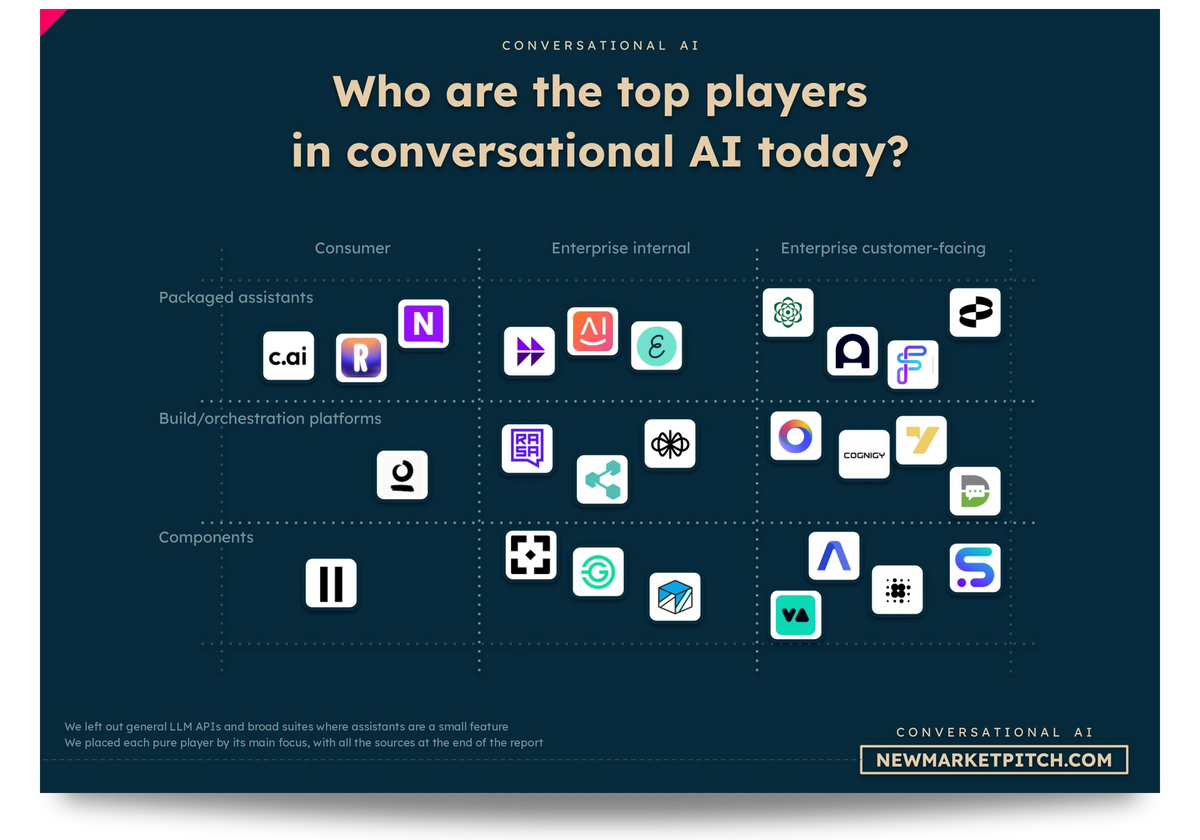
In our report covering the conversational AI market, we turn what is vague and complex into simple, useful visuals. Market maps like this one show you at a glance where every startup stands.
Top startups in the conversational AI market ranked by valuation
Here is an updated table that ranks the top startups in the conversational AI market based on their latest reported or estimated valuations.
If you need to dig deeper and get more detailed data, please check our report covering the conversational AI market.
| # | Startup Name | What They Do | Current Valuation ($) | Valuation Confidence Level | Valuation Type | Evidence Status | Total Funding ($) | Funding Confidence Level | Country |
|---|---|---|---|---|---|---|---|---|---|
| 1 | Moonshot AI | Develops Kimi conversational AI models | $35B | Strong Confidence | Active Raise Valuation | Estimated | ~$8.2B+ | - | China |
| 2 | ElevenLabs | AI voice generation and conversational agents | $21.0B–$23.0B | Strong Confidence | Implied Valuation from Raise | Estimated | $781M | - | United States |
| 3 | Perplexity | AI-powered conversational answer engine | $20B | Partial Confidence | Implied Valuation from Raise | Estimated | ~$2.3B+ | - | United States |
| 4 | Sierra | Enterprise AI customer service agents | $15.8B | Strong Confidence | Implied Valuation from Raise | Estimated | $1.58B | - | United States |
| 5 | Glean | Enterprise AI search and assistants | $7.2B | Partial Confidence | Announced Private Round Valuation | Observed | ~$725M | - | United States |
| 6 | Wonderful | Multilingual enterprise AI agents | $4.9B–$5.2B | Strong Confidence | Implied Valuation from Raise | Estimated | $834M | - | Israel |
| 7 | Decagon | Autonomous enterprise customer support agents | $4.5B | Strong Confidence | Implied Valuation from Raise | Estimated | ~$476M | - | United States |
| 8 | EliseAI | AI automation for housing and healthcare | $3.9B–$4.1B | Strong Confidence | Implied Valuation from Raise | Estimated | ~$772M | - | United States |
| 9 | Hippocratic AI | Safety-focused AI healthcare agents | $3.5B | Strong Confidence | Implied Valuation from Raise | Estimated | $404M | - | United States |
| 10 | Parloa | Enterprise conversational customer service agents | $3B | Strong Confidence | Implied Valuation from Raise | Estimated | ~$562M | - | Germany |
| 11 | Uniphore | Enterprise conversational AI automation platform | $2.5B–$3.2B | Strong Confidence | Implied Valuation from Raise | Estimated | ~$900M | - | United States |
| 12 | CHAI | Consumer AI character chat platform | $2.2B–$3.0B | Partial Confidence | Revenue or ARR Multiple Estimate | Estimated | $55M+ | - | United States |
| 13 | Instinct | Autonomous personal AI task assistant | $2.5B | Strong Confidence | Implied Valuation from Raise | Estimated | $350M | - | United States |
| 14 | Cleo | Conversational personal finance assistant | $1.8B–$2.8B | Partial Confidence | Revenue or ARR Multiple Estimate | Estimated | $175M | - | United Kingdom |
| 15 | Listen Labs | AI-powered customer research interviews | $1.5B–$2.1B1 | Partial Confidence | Comparables-Based Estimate | Estimated | ~$100M | - | United States |
| 16 | Deepgram | Speech recognition and voice AI infrastructure | $1.3B–$1.7B | Strong Confidence | Revenue or ARR Multiple Estimate | Estimated | ~$234M | - | United States |
| 17 | Xiaoice | AI companions and digital humans | $1.0B–$2.0B | Low Confidence | Comparables-Based Estimate | Estimated | ~$215M | - | China |
| 18 | Ada | Enterprise AI customer support agents | $1.1B–$1.6B | Partial Confidence | Revenue or ARR Multiple Estimate | Estimated | $202M | - | Canada |
| 19 | Speak | AI-powered language speaking tutor | $1.0B–$1.5B | Partial Confidence | Implied Valuation from Raise | Estimated | $162M | - | United States |
| 20 | Assort Health | AI healthcare patient access automation | $1.1B–$1.3B | Strong Confidence | Implied Valuation from Raise | Estimated | $222M | - | United States |
| 21 | HappyRobot | AI agents for enterprise operations | $1.1B–$1.3B | Strong Confidence | Implied Valuation from Raise | Estimated | ~$200M | - | United States |
| 22 | Cresta | AI agents for contact centers | $900M–$1.3B | Partial Confidence | Revenue or ARR Multiple Estimate | Estimated | ~$276M | - | United States |
| 23 | Avoca | AI agents for home services | $950M–$1.1B | Strong Confidence | Implied Valuation from Raise | Estimated | $125M+ | - | United States |
| 24 | Crescendo | AI-native customer service operations | $750M–$1.2B | Partial Confidence | Revenue or ARR Multiple Estimate | Estimated | $50M | - | United States |
| 25 | Sesame AI | Emotionally intelligent conversational voice assistants | $850M–$1.1B | Partial Confidence | Implied Valuation from Raise | Estimated | $308M | - | United States |
| 26 | AssemblyAI | Speech recognition and understanding APIs | $800M–$1.1B | Partial Confidence | Revenue or ARR Multiple Estimate | Estimated | $146M | - | United States |
| 27 | Kore.ai | Enterprise AI agent automation platform | $800M–$950M | Strong Confidence | Implied Valuation from Raise | Estimated | ~$365M | - | United States |
| 28 | Observe.AI | Contact center conversation intelligence software | $650M–$1.1B | Partial Confidence | Comparables-Based Estimate | Estimated | ~$213M | - | United States |
| 29 | AISpeech | Chinese speech AI technology provider | $650M–$1.0B | Partial Confidence | IPO or Listing Range Valuation | Estimated | Undisclosed | - | China |
| 30 | PolyAI | Enterprise conversational voice automation | $750M–$900M | Strong Confidence | Implied Valuation from Raise | Estimated | $204M | - | United Kingdom |
| 31 | Wrtn Technologies | Consumer AI chat and entertainment | $720M–$870M | Strong Confidence | Implied Valuation from Raise | Estimated | ~$166M | - | South Korea |
| 32 | Cartesia | Real-time voice AI infrastructure | $600M–$950M | Partial Confidence | Implied Valuation from Raise | Implied | $191M | - | United States |
| 33 | Scaled Cognition | Reliable enterprise agentic AI models | $700M–$800M | Strong Confidence | Implied Valuation from Raise | Estimated | $121M | - | United States |
| 34 | Sanas | Real-time speech and accent translation | $550M–$800M | Partial Confidence | Revenue or ARR Multiple Estimate | Estimated | $103M | - | United States |
| 35 | Hume AI | Emotionally intelligent voice AI models | $450M–$850M | Low Confidence | Revenue or ARR Multiple Estimate | Estimated | ~$74M | - | United States |
| 36 | Salient | AI-powered consumer loan servicing | $450M–$700M | Partial Confidence | Revenue or ARR Multiple Estimate | Estimated | $75M | - | United States |
| 37 | Gradium | Real-time speech and audio models | $450M–$650M | Partial Confidence | Implied Valuation from Raise | Implied | ~$100M | - | France |
| 38 | Infinitus | Automates healthcare administrative phone calls | $450M–$650M | Partial Confidence | Comparables-Based Estimate | Estimated | ~$103M | - | United States |
| 39 | Replicant | Automated enterprise customer support conversations | $450M–$650M | Partial Confidence | Comparables-Based Estimate | Estimated | $113M | - | United States |
| 40 | Yellow.ai | Enterprise conversational AI automation | $500M–$600M | Strong Confidence | IPO or Listing Range Valuation | Implied | ~$103M | - | India |
| 41 | Netomi | Enterprise AI customer support automation | $440M–$600M | Partial Confidence | Implied Valuation from Raise | Estimated | ~$160M–$200M | - | United States |
| 42 | Vapi | Developer infrastructure for voice agents | $470M–$530M | Strong Confidence | Implied Valuation from Raise | Estimated | ~$72M | - | United States |
| 43 | Bland AI | Enterprise conversational voice agents | $450M–$510M | Strong Confidence | Implied Valuation from Raise | Estimated | $111M | - | United States |
| 44 | Giga | Voice AI customer service agents | $350M–$550M | Partial Confidence | Implied Valuation from Raise | Implied | ~$65M | - | United States |
| 45 | Omilia | Enterprise voice customer service automation | $350M–$550M | Strong Confidence | Revenue or ARR Multiple Estimate | Estimated | ~$87M | - | Cyprus |
| 46 | Fish Audio | Expressive speech generation and cloning | $300M–$500M | Partial Confidence | Revenue or ARR Multiple Estimate | Estimated | $52M | - | United States |
| 47 | Slingshot AI | AI mental wellness conversational companion | $300M–$500M | Partial Confidence | Comparables-Based Estimate | Estimated | $93M | - | United States |
| 48 | Syllable | AI healthcare patient communication | $300M–$450M | Partial Confidence | Comparables-Based Estimate | Estimated | ~$298M | - | United States |
| 49 | ASAPP | Enterprise contact center AI automation | $250M–$500M | Low Confidence | Comparables-Based Estimate | Estimated | Undisclosed | - | United States |
| 50 | Scatter Lab | AI character chat entertainment apps | $250M–$450M | Partial Confidence | Implied Valuation from Raise | Implied | Undisclosed | - | South Korea |
| 51 | Conveo | AI-powered consumer research interviews | $250M–$420M | Partial Confidence | Implied Valuation from Raise | Implied | $55.8M | - | United States |
| 52 | DRUID | Enterprise conversational and agentic AI | $250M–$400M | Partial Confidence | Implied Valuation from Raise | Implied | ~$76M | - | Romania |
| 53 | Hyro | Healthcare conversational AI automation | $250M–$390M | Partial Confidence | Implied Valuation from Raise | Implied | $95M | - | United States |
| 54 | Tolan | Personalized conversational AI companions | $265M–$325M | Partial Confidence | Implied Valuation from Raise | Implied | ~$60M | - | United States |
| 55 | Speechmatics | Multilingual speech recognition APIs | $210M–$370M | Partial Confidence | Revenue or ARR Multiple Estimate | Estimated | ~$70M | - | United Kingdom |
| 56 | Attention | AI sales conversation workflow automation | $200M–$330M | Partial Confidence | Implied Valuation from Raise | Implied | $47.1M | - | United States |
| 57 | Liner | AI search and research agents | $200M–$320M | Partial Confidence | Implied Valuation from Raise | Implied | ~$69M–$73M | - | South Korea |
| 58 | Lorikeet | AI agents for complex support | $200M–$310M | Partial Confidence | Implied Valuation from Raise | Implied | ~$49M | - | Australia |
| 59 | Maven AGI | Enterprise customer experience AI agents | $200M–$300M | Partial Confidence | Implied Valuation from Raise | Implied | ~$78M | - | United States |
| 60 | Praktika | Conversational AI language learning avatars | $180M–$320M | Partial Confidence | Revenue or ARR Multiple Estimate | Estimated | $38M–$41M | - | United States |
| 61 | Yalo | AI-powered conversational commerce | $190M–$300M | Low Confidence | Comparables-Based Estimate | Estimated | ~$93M | - | Mexico |
| 62 | IVRy | Japanese AI telephone automation platform | $180M–$300M | Partial Confidence | Comparables-Based Estimate | Estimated | Undisclosed | - | Japan |
| 63 | Ushur | AI-powered customer experience automation | $190M–$260M | Partial Confidence | Comparables-Based Estimate | Estimated | ~$107M | - | United States |
| 64 | Slang AI | Hospitality AI phone receptionists | $190M–$260M | Strong Confidence | Implied Valuation from Raise | Implied | $68M | - | United States |
| 65 | Prosper AI | AI patient administration and scheduling | $170M–$260M | Partial Confidence | Implied Valuation from Raise | Implied | $30M+ | - | United States |
| 66 | Botpress | AI agent development platform | $150M–$250M | Partial Confidence | Comparables-Based Estimate | Estimated | $40M | - | Canada |
| 67 | Level AI | AI-powered contact center performance intelligence | $150M–$250M | Partial Confidence | Comparables-Based Estimate | Estimated | ~$73M | - | United States |
| 68 | Zhuiyi Technology | Enterprise NLP and AI assistants | $140M–$250M | Low Confidence | Proxy-Based Estimate | Estimated | Undisclosed | - | China |
| 69 | Inbenta | AI chatbots and knowledge automation | $140M–$240M | Partial Confidence | Comparables-Based Estimate | Estimated | ~$63M | - | United States |
| 70 | Quiq | Enterprise omnichannel conversational AI agents | $130M–$230M | Partial Confidence | Revenue or ARR Multiple Estimate | Estimated | $47.5M | - | United States |
| 71 | Rasa | Enterprise conversational AI development platform | $130M–$230M | Partial Confidence | Comparables-Based Estimate | Estimated | $71M | - | Germany |
| 72 | Encore AI | AI sales and customer interaction agents | $150M–$190M | Partial Confidence | Implied Valuation from Raise | Implied | $30M | - | United States |
| 73 | Newo | AI voice receptionists for businesses | $125M–$210M | Partial Confidence | Implied Valuation from Raise | Implied | ~$32M | - | United States |
| 74 | Solidroad | AI customer conversation quality assurance | $125M–$210M | Partial Confidence | Implied Valuation from Raise | Implied | $33M | - | Ireland |
| 75 | Coval | Voice AI testing and evaluation | $140M–$190M | Partial Confidence | Implied Valuation from Raise | Implied | $31M | - | United States |
| 76 | GetVocal | Hybrid human-AI customer service agents | $130M–$200M | Partial Confidence | Implied Valuation from Raise | Implied | $30M | - | France |
| 77 | ELSA Speak | AI-powered English speaking tutor | $110M–$210M | Low Confidence | Comparables-Based Estimate | Estimated | ~$48M | - | United States |
| 78 | Rime | Expressive speech synthesis for enterprises | $120M–$200M | Partial Confidence | Implied Valuation from Raise | Implied | $29.5M+ | - | United States |
| 79 | Conversica | AI revenue engagement assistants | $100M–$200M | Low Confidence | Comparables-Based Estimate | Estimated | $135.5M | - | United States |
| 80 | Voiceflow | Collaborative enterprise AI agent builder | $110M–$190M | Partial Confidence | Comparables-Based Estimate | Estimated | ~$39M | - | Canada |
| 81 | Hello Patient | AI patient communication and scheduling | $105M–$165M | Partial Confidence | Comparables-Based Estimate | Estimated | ~$29M | - | United States |
| 82 | Skit.ai | Voice AI for financial collections | $90M–$180M | Low Confidence | Revenue or ARR Multiple Estimate | Estimated | $28M–$48M | - | India |
| 83 | Xiaoduo AI | E-commerce AI customer service | $90M–$180M | Low Confidence | Proxy-Based Estimate | Estimated | Undisclosed | - | China |
| 84 | Loora | Conversational AI English learning tutor | $95M–$155M | Partial Confidence | Revenue or ARR Multiple Estimate | Estimated | $43M | - | Israel |
| 85 | Synthflow | No-code enterprise voice AI agents | $95M–$145M | Partial Confidence | Implied Valuation from Raise | Implied | ~$30M | - | Germany |
| 86 | Balto | Real-time contact center agent coaching | $80M–$140M | Low Confidence | Comparables-Based Estimate | Estimated | $52M | - | United States |
| 87 | Siena AI | AI customer support for commerce | $85M–$120M | Strong Confidence | Implied Valuation from Raise | Implied | $28.7M | - | United States |
| 88 | Hi Auto | AI drive-thru restaurant ordering | $75M–$125M | Partial Confidence | Implied Valuation from Raise | Implied | $23M | - | United States |
| 89 | Gradient Labs | AI agents for financial operations | $85M–$110M | Strong Confidence | Implied Valuation from Raise | Implied | ~$37M | - | United Kingdom |
| 90 | Smallest.ai | Real-time enterprise voice AI infrastructure | $65M–$110M | Partial Confidence | Implied Valuation from Raise | Implied | $21M+ | - | India |
| 91 | Mavenoid | AI troubleshooting for product support | $45M–$90M | Partial Confidence | Revenue or ARR Multiple Estimate | Estimated | ~$46M | - | Sweden |
| 92 | Character.AI | Consumer AI character conversations | $20M–$60M | Low Confidence | Proxy-Based Estimate | Estimated | $190M | - | United States |
| 93 | Wysa | AI mental health support | $25M–$55M | Low Confidence | Revenue or ARR Multiple Estimate | Estimated | Undisclosed | - | India |
Which startups in the conversational AI market have been acquired or gone public?
These startups no longer have a private-market valuation of their own, so we list them separately, using their acquisition price or their current market capitalization.
| # | Startup Name | What They Do | Current Valuation ($) | Valuation Confidence Level | Valuation Type | Evidence Status | Total Funding ($) | Funding Confidence Level | Country |
|---|---|---|---|---|---|---|---|---|---|
| 1 | Kasisto | Conversational AI for financial institutions | $40M–$120M | Low Confidence | Acquisition Value | Estimated | ~$92M | - | United States |
| 2 | Cogito | Real-time conversational intelligence coaching | $52M | Full Confidence | Acquisition Value | Observed | Undisclosed | - | United States |
- Salesforce deal pending; purchase price not disclosed.

Our research about conversational AI gets updated several times a month, so you always get the latest view of where things stand.
Why are conversational AI startups worth so much right now?
Conversational AI startups are attracting huge valuations because businesses are now spending serious money on AI agents that can handle customer requests, make calls, and complete tasks.
The change is visible in corporate budgets. Gartner surveyed 199 customer service leaders in April and May 2026 and found that AI spending had increased by 38%, while overall service and support budgets grew by only 2%. Companies are moving money from existing operations into automation, which gives conversational AI vendors a much larger commercial opportunity.
Investors have responded particularly strongly to startups that automate customer interactions. Sierra is valued at $15.8B, Decagon at $4.5B, and Parloa at $3B. These companies sell technology that can resolve customer problems, update accounts, and complete workflows that previously required employees.
The demand goes beyond customer service. ElevenLabs sells voice technology and conversational agents, Glean helps employees search and use company information, and Moonshot AI develops the Kimi models used in consumer and developer applications.
There is one reason to be careful with the enthusiasm. Gartner also found that only 24% of customer service leaders had demonstrated positive financial returns across their AI use cases. Companies are spending faster than they can prove the savings.
Commercial demand is growing quickly, but investors are already paying for several more years of successful adoption. That gap explains both the extraordinary valuations and the possibility of sharp corrections.
Which conversational AI startups are worth the most today?
Moonshot AI leads the conversational AI startup ranking at $35B, followed by ElevenLabs at $21.0B–$23.0B and Perplexity at $20B.
Sierra ranks fourth at $15.8B, while Glean completes the top five at $7.2B.
Together, these five companies represent at least $99.0 billion in estimated equity value using the lower endpoints of their valuation ranges. Even that conservative calculation shows how much private capital has concentrated around a small group of conversational AI businesses.
What's interesting is how different these companies are.
Moonshot AI develops general-purpose conversational models through Kimi. Perplexity competes in AI-powered search and research. ElevenLabs builds voice models and agents. Sierra sells enterprise customer-service automation, while Glean connects AI search to company information.
The five largest companies compete for different customers and spending categories. Their valuations reflect several commercial opportunities developing simultaneously, from consumer information discovery to automated enterprise operations.
Meanwhile, dozens of smaller conversational AI startups remain valued below $500 million. Investors clearly expect a relatively small number of platforms and category leaders to capture a substantial share of future revenue.

In our market report about conversational AI, we look at what the winners do differently, so you can learn from the best instead of guessing.
How many conversational AI unicorns are there?
Our conversational AI ranking currently has 21 clear unicorns, with another seven startups whose valuation ranges reach or cross $1 billion.
The 21 clear unicorns are Moonshot AI, ElevenLabs, Perplexity, Sierra, Glean, Wonderful, Decagon, EliseAI, Hippocratic AI, Parloa, Uniphore, CHAI, Instinct, Cleo, Listen Labs, Deepgram, Xiaoice, Ada, Speak, Assort Health, and HappyRobot.
Another seven companies sit around the threshold: Cresta, Avoca, Crescendo, Sesame AI, AssemblyAI, Observe.AI, and AISpeech. Their valuation ranges overlap or reach $1 billion, so we would not classify all seven as confirmed unicorns.
That gives us 21 clear unicorns among 93 independently ranked startups, or approximately 23%.
An interesting detail is how many of these billion-dollar businesses serve specific industries. Hippocratic AI works in healthcare, Cleo in personal finance, Speak in language learning, and EliseAI in housing and healthcare operations.
The unicorn club is increasingly diverse. Companies can now build billion-dollar conversational AI businesses without developing their own general-purpose chatbot or foundation model.
Is Moonshot AI really the most valuable conversational AI startup?
Moonshot AI currently holds the highest conversational AI startup valuation at $35B, backed by an extraordinary increase in demand for its Kimi models.
Bloomberg reported in March 2026 that Moonshot was seeking financing at approximately $18 billion, after earlier valuation references of $4.3 billion and $10 billion. By July, Bloomberg reported that the company had completed a $3.5 billion financing at a $35 billion valuation.
The commercial figures are even more interesting. Bloomberg reported in September that Moonshot had told investors its annualized revenue exceeded $1 billion in August, compared with approximately $300 million in June. The increase followed the July release of Kimi K3.
That represents more than a threefold increase in annualized revenue in approximately two months. It's an unusually fast change, although annualized revenue measures the current sales pace rather than revenue already earned over a full year.
Moonshot also benefits from selling through several channels. Consumers can pay for Kimi subscriptions, developers can purchase model access, and businesses can integrate its technology into applications.
The challenge is sustaining demand between major model releases. A successful release can attract enormous usage quickly, but developers can also switch models when competitors deliver better performance or lower prices.
For now, Moonshot has the strongest valuation position in conversational AI. The next test is whether its rapid revenue growth turns into a lasting commercial advantage.

In our document detailing everything you need to know about conversational AI, you will always find fresh funding data, taken straight from our own verified funding database.
Why is Perplexity worth so much when ChatGPT and Google already exist?
Perplexity's $20B valuation reflects the belief that a dedicated AI search product can remain valuable even when ChatGPT and Google offer similar conversational answers.
Perplexity has built its product around finding information, answering questions, and showing supporting sources. This appeals to people conducting research, comparing products, or investigating subjects where identifying the original information matters.
But the competitive pressure is obvious. Google already controls a major search distribution channel, while ChatGPT can handle research through conversational interfaces. Both can introduce similar features directly into products people already use.
Perplexity therefore needs to give users a reason to return independently of whichever foundation model produces the answer.
Glean offers an interesting contrast. Valued at $7.2B, it connects AI search to private company documents, business applications, and employee permissions. Those integrations make switching more complicated than choosing another public search interface.
Perplexity's opportunity is larger in potential audience, but public information discovery is also easier for major platforms to enter.
Its valuation will be difficult to defend without lasting usage and enough revenue from that audience. High-quality AI answers are becoming available everywhere, and that remains Perplexity's biggest strategic problem.
Why is ElevenLabs worth more than most conversational AI agent startups?
ElevenLabs is valued at $21.0B–$23.0B because it has managed to turn voice generation into a rapidly growing commercial platform used across several industries.
In May 2026, ElevenLabs announced that annual recurring revenue had passed $500 million, compared with $350 million at the end of 2025. That was an increase of more than 43% in roughly four months.
The valuation followed the business. ElevenLabs raised $500 million at an $11 billion valuation in February, then announced a $300 million employee tender offer at a $22 billion valuation in September.
The company has also expanded beyond voiceovers and speech generation. Its ElevenAgents platform supports customer service, sales, hiring, and other conversational workflows.
This gives ElevenLabs more ways to make money than a company selling a single voice assistant. Developers can buy its speech technology, enterprises can deploy agents, and media companies can use its creative tools.
Deepgram, valued at $1.3B–$1.7B, and Cartesia, valued at $600M–$950M, also develop technology used in voice applications. PolyAI and Bland AI focus more directly on enterprise voice agents.
ElevenLabs has combined these opportunities into a broader product offering, with revenue already reaching several hundred million dollars.
Its biggest risk is falling speech-generation costs. Voice models are improving quickly, and customers have more alternatives. ElevenLabs needs to keep winning on quality, latency, reliability, and developer experience as the underlying technology becomes more widely available.

Learning from others' mistakes is the cheapest lesson there is. In our report covering the conversational AI market, we look at what broke startups before you, so you don't repeat it.
Is Sierra currently winning the enterprise conversational AI market?
Sierra is the highest-valued specialist in enterprise customer-service agents in our ranking, and its latest revenue figures make its lead particularly convincing.
On October 30, 2026, Sierra announced that it had passed $400 million in annual recurring revenue, adding more than $150 million during the third quarter alone.
That means Sierra added an amount equivalent to more than 37.5% of its current ARR base during a single quarter. The company also said those quarterly additions exceeded the ARR it generated during the entire previous year.
Sierra's valuation has followed a similar trajectory. Its October 2024 financing valued the company at $4.5 billion. That increased to $10 billion in September 2025 and $15.8 billion following a $950 million financing in May 2026.
Its agents handle customer requests through chat and voice, with connections to systems that manage subscriptions, returns, and other transactions.
Decagon and Parloa are competing for similar customers. Decagon announced more than 100 new enterprise customers during 2025, while Parloa raised $350 million in January 2026 at a $3 billion valuation.
Sierra has become a major commercial success. Passing $400 million in ARR is a substantial achievement for a specialist in a relatively young software category.
Still, valuation leadership doesn't automatically mean Sierra has the best customer retention, margins, or deployment scale. Decagon and Parloa have plenty of room to challenge it as large businesses expand their use of AI agents.
Are AI customer service agents actually replacing old chatbots?
Modern conversational AI agents are taking over more customer-service tasks, but companies still struggle to persuade customers to use their own chatbots.
A Gartner survey of 3,566 customers in February and March 2026 found that people were approximately three times more likely to use third-party generative AI tools than company-provided customer-service chatbots.
Even more revealing, use of third-party AI tools had nearly doubled over the previous year, while use of company chatbots had remained statistically unchanged since 2022.
That's a serious problem for businesses that have spent years building automated support channels.
Customers increasingly expect AI to complete tasks. Gartner found that 58% of generative AI users had used it to take action on their behalf, rising to 74% among B2B users.
Sierra, Decagon, Ada, and Kore.ai are building products around this demand. Their agents can connect conversations to company systems and complete activities such as updating accounts, arranging appointments, or processing requests.
The practical difference is straightforward. A traditional chatbot might explain how to return a product. A working AI agent can start the return, check eligibility, and finish the transaction.
Customers are becoming more demanding, which creates a major opportunity for companies that can deliver reliable automation. It also makes basic question-and-answer chatbots increasingly difficult to sell as premium software.

In our research about conversational AI, we always try to gather several sources and make estimates that make sense, so you can work with solid numbers.
What kinds of conversational AI startups get the highest valuations?
The biggest conversational AI valuations currently go to general-purpose model companies, AI search platforms, voice technology providers, and enterprise automation businesses.
Moonshot AI, ElevenLabs, and Perplexity occupy the first three positions, while Sierra and Glean complete the top five. Their products can serve broad categories of customers or support many different applications.
More specialized startups tend to have smaller valuations. Hi Auto focuses on restaurant ordering, Slang AI handles hospitality phone calls, and Skit.ai develops voice AI for financial collections.
That pattern reflects differences in potential revenue scale. An infrastructure platform can earn money from thousands of developers building unrelated applications. A specialized restaurant agent is primarily selling into one industry.
Yet specialized software can have advantages. Industry-specific integrations, regulations, and customer workflows may make a focused product harder to replace.
The differences become clearer when we compare how these businesses make money.
| Business category | Examples | Main commercial opportunity |
|---|---|---|
| General-purpose conversational models | Moonshot AI | Model subscriptions and API usage |
| AI search and research | Perplexity, Liner | Information discovery and research |
| Voice infrastructure | ElevenLabs, Deepgram, Cartesia | Speech generation, recognition, and developer APIs |
| Enterprise search | Glean | Workplace information and productivity |
| Customer-service agents | Sierra, Wonderful, Decagon | Automated enterprise customer interactions |
| Healthcare agents | Hippocratic AI, EliseAI, Assort Health | Patient communication and administrative work |
| AI companions | CHAI, Xiaoice, Tolan | Consumer subscriptions and entertainment |
| Language learning | Speak, Praktika, Loora | Personalized speaking practice |
Broad platforms don't necessarily make better investments. The highest valuations require equally large future businesses. A smaller specialized startup can sometimes justify its valuation with much less revenue.
Is voice AI becoming the biggest opportunity in conversational AI?
Voice AI is becoming one of the fastest-moving parts of conversational AI, especially in customer service, where telephone conversations remain a major operating expense.
ElevenLabs' growth provides strong evidence. As discussed above, the company passed $500 million in ARR during the first months of 2026, with enterprise voice agents helping drive adoption.
There is activity across the infrastructure market too. Deepgram announced a $130 million Series C at a $1.3 billion valuation in January 2026. That funding supports speech recognition, synthesis, and other technology used by developers building real-time voice agents.
The technical requirements are demanding. Twilio's November 2025 engineering guidance identified a target mouth-to-ear response gap of 1,115 milliseconds for a straightforward voice agent, with an upper benchmark of 1,400 milliseconds.
Delays matter because telephone conversations rely on natural turn-taking. An agent that takes several seconds to respond after every sentence quickly becomes frustrating.
Companies are approaching the market from different positions. Vapi provides infrastructure for developers, Bland AI builds enterprise voice agents, and PolyAI specializes in conversational voice automation for customer service.
Text-based AI will remain important for research, coding, document analysis, and messaging. Voice has a particularly strong opportunity where customers already use telephone channels and businesses want to automate those interactions.
Companies combining reliable speech technology with practical business workflows are likely to capture more value than those focused only on producing natural-sounding voices.

If you build or invest in the conversational AI market, you need to know which business models pay off now and which ones are fading. That's why our report covering it has a whole section on it.
Why are healthcare conversational AI startups worth billions?
Healthcare conversational AI startups are reaching billion-dollar valuations because hospitals, clinics, and insurers have enormous volumes of repetitive communication and administrative work.
Hippocratic AI is valued at $3.5B, EliseAI at $3.9B–$4.1B, and Assort Health at $1.1B–$1.3B.
The companies serve different needs. Hippocratic AI develops safety-focused healthcare agents. EliseAI automates interactions in healthcare and housing, while Assort Health focuses on patient access.
Smaller specialists include Infinitus, which handles healthcare administrative calls, Hyro, which automates patient conversations, and Prosper AI, which addresses scheduling and administration.
These are attractive applications because many interactions are repetitive and time-consuming. A healthcare organization might need to confirm thousands of appointments, answer routine administrative questions, or contact patients about follow-up procedures.
However, healthcare introduces more demanding reliability requirements than many consumer applications. Errors involving patient information, medical instructions, or sensitive administrative processes can create serious consequences.
The clearest near-term opportunity is administrative work where tasks can be clearly defined and checked. Automating complex clinical conversations is considerably harder, and the consequences of getting them wrong can be much more serious.
Can AI companions like CHAI and Character.AI become billion-dollar companies?
AI companion startups can reach billion-dollar valuations, but Character.AI shows how quickly a popular conversational product can lose standalone value.
CHAI is valued at $2.2B–$3.0B and Xiaoice at $1.0B–$2.0B. Both build consumer experiences based on recurring conversations, virtual personalities, and entertainment.
Other businesses target narrower audiences. Tolan develops personalized companions, while Scatter Lab builds character-based conversational entertainment applications.
The commercial model can be attractive because users may return frequently and pay for subscriptions, additional capabilities, or premium interactions.
But retention is difficult to predict. Users can switch products, lose interest in characters, or move to general-purpose assistants as they become more personalized.
Character.AI is a useful warning. Its estimated valuation is currently $20M–$60M, below the $190 million it has raised, following Google's 2024 technology licensing agreement and the departure of key personnel, which substantially reduced its standalone business value.
A large audience and strong engagement clearly don't guarantee that investors will retain a valuable independent business.
AI companions have demonstrated genuine consumer demand. The harder question is how much of that demand becomes durable subscription revenue after model costs, competition, and changing user behavior are taken into account.

Theory only gets you so far. In our document detailing everything you need to know about conversational AI, we dig up the real signals from the field and show you the ones worth watching.
Which conversational AI startups have raised the most money?
Moonshot AI has attracted the largest cumulative funding total in our conversational AI ranking, at approximately $8.2B+, followed by Perplexity at approximately $2.3B+.
Sierra has raised $1.58B, Uniphore approximately $900M, and Wonderful $834M.
The amounts reflect very different costs. A company developing foundational AI models needs substantial computing resources and research spending. Enterprise software providers may spend more heavily on product integrations, customer acquisition, and international expansion.
Money raised tells us how much capital investors have committed, not how efficiently a startup uses it.
Consider ElevenLabs and Uniphore. ElevenLabs has raised $781 million and is valued at $21.0B–$23.0B. Uniphore has raised approximately $900 million and is valued at $2.5B–$3.2B.
Both have attracted substantial capital, but investors have very different expectations for their future businesses.
| Startup | Total funding | Main business |
|---|---|---|
| Moonshot AI | ~$8.2B+ | Conversational foundation models |
| Perplexity | ~$2.3B+ | AI search and research |
| Sierra | $1.58B | Enterprise customer-service agents |
| Uniphore | ~$900M | Enterprise conversational AI |
| Wonderful | $834M | Multilingual enterprise agents |
| ElevenLabs | $781M | Voice generation and AI agents |
| EliseAI | ~$772M | Housing and healthcare automation |
| Glean | ~$725M | Enterprise search and AI assistants |
| Parloa | ~$562M | Enterprise customer-service agents |
The most heavily funded companies aren't necessarily those with the highest valuations relative to their capital raised. That relationship varies enormously, even among startups operating in similar markets.
Which conversational AI startups have seen their valuations jump the most?
Moonshot AI, Sierra, Decagon, Parloa, and ElevenLabs have all experienced unusually large valuation increases, although the changes happened over different periods.
Moonshot AI had a valuation of approximately $4.3 billion in late 2025. Bloomberg subsequently reported an $18 billion financing target in March 2026 and a completed financing at $35 billion in July.
Sierra moved from $4.5 billion in October 2024 to $10 billion in September 2025 and $15.8 billion in May 2026. Its valuation increased approximately 3.5 times over that period.
Decagon announced a $250 million Series D in January 2026 that tripled its valuation to $4.5 billion in under six months. The company had added more than 100 enterprise customers during the preceding year.
Parloa reported a similar pattern. Its January 2026 financing valued it at $3 billion, following a previous round approximately seven months earlier. ElevenLabs doubled its valuation from $11 billion in February 2026 to $22 billion through its September employee tender offer.
Investors have been willing to reprice conversational AI companies very quickly when revenue growth, customer adoption, or model capabilities improve.
And some of these increases are supported by serious commercial progress. Sierra passed $400 million in ARR, while Decagon disclosed substantial enterprise customer growth. Those operating achievements make the valuation jumps more convincing than fundraising momentum alone.

In our report covering the conversational AI market, we don't want to repeat what boring consulting reports say. Instead, we show you the real and latest market signals that matter.
Are conversational AI startup valuations growing faster than revenue?
Some conversational AI startups are valued at more than 40 times annual recurring revenue, so investors are clearly expecting exceptional growth to continue.
Glean offers one of the clearest comparisons. In May 2026, the company announced that it had reached $300 million in ARR, up from $100 million just 15 months earlier. Against its $7.2B valuation, that works out to approximately 24 times the reported ARR milestone.
ElevenLabs had surpassed $500 million in ARR by May 2026. Its $21.0B–$23.0B valuation represents approximately 42–46 times that revenue threshold. Since the company had already exceeded $500 million, the multiple against its actual ARR at the time would be somewhat lower.
Sierra provides another useful comparison. The company reported more than $400 million in ARR in October 2026, against a $15.8B valuation. Using the $400 million milestone gives a ratio of approximately 40 times ARR, before accounting for revenue above that threshold.
These are substantial multiples even for rapidly growing software businesses.
Investors are betting that revenue can increase severalfold while operating margins improve. But growth needs to remain unusually fast for years to justify such prices.
There are also differences in revenue quality. A model developer paying heavily for computing may generate very different gross margins from an enterprise software company with recurring subscription contracts.
Those differences matter when comparing valuations. Two companies with similar revenue and growth rates can have very different economics, particularly when one carries far greater infrastructure costs.
Will ChatGPT, Google, and other large AI platforms kill smaller conversational AI startups?
Large AI platforms will put pressure on generic conversational AI products, but specialized startups can still build valuable businesses around customer workflows, industry knowledge, and integrations.
Glean is a good example. Despite competition from broad workplace AI products, the company announced that ARR increased from $100 million to $300 million in approximately 15 months.
Its product connects company documents, permissions, internal knowledge, and business applications. That combination is harder to replace than a basic chatbot interface.
Healthcare specialists face a similar situation. Assort Health and Infinitus build around patient communication and administrative processes, where access to relevant systems and reliable workflow execution is important.
There is also room for developer infrastructure. Vapi helps developers build voice agents, while Botpress provides tools for creating conversational AI systems. Their value depends partly on making deployment easier across different models and business requirements.
The weakest position is probably a product whose main advantage is access to a general-purpose language model. Those capabilities are becoming widely available through larger platforms.
Simple chatbot features will face more pricing pressure. Companies that own valuable integrations, customer relationships, and specialized workflows have a much better chance of holding their ground.

In our research about conversational AI, we like to show you the big picture. We know your time is precious, so we make every page quick to read and packed with as much learning as possible per minute.
Which conversational AI companies have been acquired?
Kasisto and Cogito are two conversational AI businesses listed separately from the independent startup ranking because they have been acquired.
Backbase announced its acquisition of Kasisto in June 2026. Kasisto developed conversational AI for financial institutions, and its estimated acquisition value is $40M–$120M.
The acquisition allowed Backbase to bring banking-focused AI agents into its broader financial software platform. It's a practical example of how specialized conversational technology can become part of a larger enterprise product.
Cogito, which developed real-time conversational intelligence and coaching technology, was acquired in a deal valued at $52M.
Listen Labs represents a more recent deal that had not yet closed as of November 2026. Salesforce signed a definitive acquisition agreement in September 2026, but the purchase consideration was not disclosed. Listen Labs therefore remains in our independent ranking at $1.5B–$2.1B.
Salesforce said Listen Labs could conduct research interviews in more than 120 languages and draw from a participant network exceeding 50 million people.
Established software companies have good reasons to acquire conversational AI capabilities. Buying specialized technology can be faster than developing and integrating comparable products internally.
The prices also vary dramatically. A business with valuable technology but limited standalone growth prospects can sell for a fraction of the valuation investors assign to a fast-growing independent platform.
Can conversational AI agents really replace human customer service workers?
Conversational AI agents are already taking over routine customer-service tasks, but Gartner's latest research suggests most companies are redesigning human jobs rather than eliminating entire support teams.
In April 2026, Gartner reported that 85% of surveyed service and support leaders were expanding human agents' responsibilities. Only 31% had implemented or planned AI-related frontline layoffs through the first quarter of 2027.
Customers also want human support to remain available. In a separate Gartner survey, 87% said access to a human agent was essential when companies used generative AI for customer service.
AI works particularly well for routine requests such as appointment changes, order status inquiries, account updates, and standard support questions.
More complicated situations can involve exceptions, disputes, missing information, or customers who are already frustrated. These interactions still benefit from human judgment.
That creates an opportunity for Sierra, Decagon, Cresta, and Parloa even without complete workforce replacement. Automating a large volume of routine conversations can reduce costs while allowing employees to spend more time on difficult requests.
Businesses will increasingly measure success through completed resolutions and the cost of handling each request. Counting how many conversations an AI agent has handled tells us relatively little unless we know how many problems it actually solved.

When you build or invest in the conversational AI market, you need clarity, not confusion. In our market report about conversational AI, we always try to put numbers on and quantify whatever is usually vague and confusing.
Are conversational AI startups overvalued right now?
Some conversational AI startups look expensive today, particularly those valued at more than 40 times annual recurring revenue, but the market also contains businesses with remarkable revenue growth.
ElevenLabs, Glean, and Sierra have demonstrated strong commercial demand. ElevenLabs passed $500 million in ARR, Glean reached $300 million, and Sierra exceeded $400 million.
Those are substantial businesses, and the speed at which they reached those figures helps explain investor enthusiasm.
However, valuations depend on continued growth. If a company valued at 40 times ARR grows only modestly over the following years, investors may struggle to justify the original price even if the business remains successful.
The broader spending environment adds another warning. Gartner found that AI spending by customer-service leaders increased 38%, while only 24% of respondents had demonstrated positive financial returns across their AI use cases.
Companies may be willing to experiment aggressively today and become more selective once they review actual savings, customer satisfaction, and contract renewals.
Conversational AI is a genuine high-growth market, but the most expensive valuations leave little room for disappointment.
The companies most likely to defend those prices will be the ones that keep growing revenue, improve margins, and become difficult for customers to replace. The rest could face painful valuation adjustments, even if their products continue to attract users.
Our methodology
Our analysis ranks the most valuable independent startups in the conversational AI market, focusing on businesses whose core products involve conversational models, AI search, voice agents, customer-service automation, enterprise assistants, or specialized conversational applications.
We prioritized recent completed funding rounds, official company announcements, investor disclosures, reputable financial reporting, and commercial metrics such as annual recurring revenue, customer growth, and product adoption. The goal was to estimate current private-market valuations rather than simply repeat historical fundraising figures.
Recent financing transactions served as the primary valuation anchors. For companies without a recent transaction, we considered commercial progress, comparable businesses, revenue multiples, and broader market conditions. Valuation ranges reflect differences in the available financial information and the assumptions required to assess each business. Employee tender offers and proposed funding rounds were considered separately from completed primary financings.
Our ranking focuses on independent private startups. Acquired companies are discussed separately, while businesses with announced but unfinished acquisitions remain included until their transactions close. Funding totals represent cumulative capital raised and should not be confused with company valuations. Revenue multiples use the companies' reported ARR milestones and are intended as comparisons rather than complete financial valuations.
A company can appear in this ranking even when its total funding is undisclosed: its position depends on its valuation, not on the capital it has raised.
Key sources for company valuations and operating performance include Bloomberg on Moonshot AI's $35 billion financing, Bloomberg on Moonshot AI's revenue growth, Sierra's financing and ARR announcements, ElevenLabs' Series D announcement, ElevenLabs' $500 million ARR milestone, ElevenLabs' $22 billion tender offer, Glean's financing announcement, and Glean's $300 million ARR announcement.
Additional company sources include Decagon's Series D announcement, Parloa's $3 billion valuation announcement, Deepgram's Series C announcement, Salesforce's agreement to acquire Listen Labs, and Backbase's acquisition of Kasisto.
For broader industry trends, we used Gartner's research on customer-service AI spending and returns, Gartner's comparison of third-party AI tools and company chatbots, Gartner's findings on customer-service employment, Gartner's research on customer preferences for human support, and Twilio's engineering guidance on voice-agent latency.

A good product starts with a real problem. In our document detailing everything you need to know about conversational AI, we show you the ones customers still live with.
Written by the New Market Pitch teamWe track new markets so founders and investors can move faster. About us