Who are the top investors in counter-UAS?
Building a startup or looking for your next investment in counter-UAS? Our report gives you the full picture.
Summary
Accel is the most active counter-UAS investor, with 5 equity rounds joined since January 2024. Lakestar follows with 4, and OTB Ventures, Valor Equity Partners and Vision Plus Capital share third place with 3 each. We identified 130 named investors across the market, so there is no single firm everyone follows.
The gap behind the leaders is small. Another 15 investors are tied with 2 rounds each, including well-known Silicon Valley funds, corporate investors and firms that mostly back defense technology.
The names at the top also differ from the names investing now. Accel has joined 1 round this year, while Lakestar, Khosla Ventures, Unusual Machines, Elad Gil and Green Flag Ventures are setting the current pace with 2 rounds each.
Andreessen Horowitz and Founders Fund get attention because they backed Anduril. Those enormous financings say plenty about Anduril's reach, but less about how often either fund backs a dedicated counter-drone company.
Accel's investments tell a different story. CHAOS Industries works on sensing, while Cambridge Aerospace builds interceptors. Both problems matter when customers need to find incoming drones and stop them.
That variety runs through the investor list. Hidden Level and MatrixSpace focus on detection; Fortem Technologies links detection software with physical interceptors; Aurelius Systems is working on lasers.
The earliest deals attract plenty of interest. Seed accounts for 38 of the 69 rounds with a known stage, although no single investor leads seed participation. There is room for specialized funds as well as familiar venture names.
Later-stage investors are harder to separate than they look. Accel, Vision Plus Capital and DFJ Growth are tied at Series C with 2 rounds each, and Founders Fund and 8VC share the lead at Series D+.
Some backers offer more than financing. Lockheed Martin is working with Fortem on an integrated defense system, while Unusual Machines has a supplier relationship with Powerus. Those connections can affect whether a product gets built and sold.
Our conclusion is a clear leader by overall activity, Accel, with several different leaders depending on the question. The firm most often named in a round is not necessarily the one investing now, backing a new company or helping an established supplier sell to defense customers.

Written by the New Market Pitch teamWe track new markets so founders and investors can move faster. About us

In our report covering the counter-UAS market, you will always find fresh funding data, taken straight from our own verified funding database.
Which VCs invest the most in counter-UAS right now?
Accel has joined the most counter-UAS funding rounds, with 5, ahead of Lakestar with 4.
Accel was named as lead in 2 of the 4 rounds where the lead is known, while Lakestar has not been named as lead in any of its rounds. OTB Ventures, Valor Equity Partners and Vision Plus Capital follow with 3 rounds each, and another 15 investors are tied with 2. Within that group of 15, the table lists first the firms named as lead in both of their rounds. Accel has joined 1 round this year in our count, so its lead rests mostly on earlier deals.
Their portfolios also look different. Accel backed CHAOS Industries, which develops advanced sensing systems, and Cambridge Aerospace, which builds air-defense interceptors. Lakestar backed Cambridge Aerospace and TYTAN Technologies, both interceptor makers. Vision Plus Capital's 3 rounds all went to one company, Beijing Lizheng Technology, a Chinese counter-drone company working with radio-frequency technology.
Across the market, we found named backers in 71 of 77 equity rounds, or 92%. A leading position here means appearing in more announced rounds than other investors. It does not tell us how large anyone's individual checks were.
The table below ranks the 20 most active counter-uas investors by the number of equity rounds they joined, with the rounds they led, their main stages, the startups they backed and the biggest round they joined.
If you want to go more into detail and get more data to understand what investors are betting on now, please check our counter-uas report.
| # | Investor | Rounds | Led | Main stages | Counter-uas startups backed | Biggest round joined | Latest round |
|---|---|---|---|---|---|---|---|
| 1 | Accel ▼ | 5 | 2Leads half its rounds (lead known for 4 of 5 rounds) |
Series C 2Series A 1 | CHAOS Industries, Cambridge Aerospace | $510MCHAOS Industries · 2025 | Aug 2026 |
| 2 | Lakestar ▲ | 4 | 0Never led (lead known for 3 of 4 rounds) |
Series A 2Seed 1 | Cambridge Aerospace, TYTAN Technologies | $300MCambridge Aerospace · 2026 | Aug 2026 |
| 3 | OTB Ventures ▼ | 3 | 2Usually leads (67% of its rounds) |
Seed 1Series A 1 | TYTAN Technologies, MatrixSpace | $33MTYTAN Technologies · 2026 | Feb 2026 |
| 4 | Valor Equity Partners | 3 | 2Usually leads (67% of its rounds) |
Series B 1Series C 1 | CHAOS Industries, Hidden Level | $510MCHAOS Industries · 2025 | Nov 2025 |
| 5 | Vision Plus Capital | 3 | 1Leads half its rounds (lead known for 2 of 3 rounds) |
Series C 2Series B 1 | Beijing Lizheng Technology | $43MBeijing Lizheng Technology · 2025 | Dec 2025 |
| 6 | Khosla Ventures | 2 | 2Named as lead in every round found | Seed 2 | Mara, Skapion | $36MSkapion · 2026 | Aug 2026 |
| 7 | DFJ Growth | 2 | 2Named as lead in every round found | Series C 2 | Cambridge Aerospace, Hidden Level | $300MCambridge Aerospace · 2026 | Aug 2026 |
| 8 | Draper Associates | 2 | 2Named as lead in every round found | Seed 1Series A 1 | Aurelius Systems | $40MAurelius Systems · 2026 | Aug 2026 |
| 9 | Andreessen Horowitz | 2 | 2Named as lead in every round found | Seed 1Series D+ 1 | Anduril, ZeroMark | $5.0BAnduril · 2026 | May 2026 |
| 10 | Founders Fund | 2 | 2Named as lead in every round found | Series D+ 2 | Anduril | $2.5BAnduril · 2025 | Jun 2025 |
| 11 | Craft Ventures | 2 | 2Named as lead in every round found | Seed 1Series A 1 | Allen Control Systems | $30MAllen Control Systems · 2025 | Mar 2025 |
| 12 | Unusual Machines | 2 | 1Leads half its rounds | Series B 1Growth 1 | Powerus, Fortem Technologies | $50MFortem Technologies · 2026 | Sep 2026 |
| 13 | Elad Gil | 2 | 1Leads half its rounds | Series B 1Series C 1 | Cambridge Aerospace | $300MCambridge Aerospace · 2026 | Aug 2026 |
| 14 | Expeditions Fund | 2 | 1Leads half its rounds | Seed 2 | Frankenburg Technologies, EGIDE | $9.3MEGIDE · 2026 | Mar 2026 |
| 15 | Freedom Fund | 2 | 1Leads half its rounds | Seed 2 | MaXon Systems | $300KMaXon Systems · 2025 | Feb 2026 |
| 16 | Green Flag Ventures | 2 | 1Named as lead in every round found (lead known for 1 of 2 rounds) |
Seed 2 | MaXon Systems, Claymore Industries | Undisclosed | Feb 2026 |
| 17 | 8VC | 2 | 1Leads half its rounds | Series D+ 2 | CHAOS Industries, Epirus | $510MCHAOS Industries · 2025 | Nov 2025 |
| 18 | ONE9 | 2 | 0Never led (lead known for 1 of 2 rounds) |
Seed 1Series A 1 | North Vector Dynamics | $20MNorth Vector Dynamics · 2026 | Oct 2026 |
| 19 | Lux Capital | 2 | 0Never led (lead known for 1 of 2 rounds) |
Series A 1Series C 1 | Cambridge Aerospace | $300MCambridge Aerospace · 2026 | Aug 2026 |
| 20 | Never Lift | 2 | 0Never led (lead known for 1 of 2 rounds) |
Seed 1Series C 1 | Cambridge Aerospace | $300MCambridge Aerospace · 2026 | Aug 2026 |
No investors match this search.
Data from January 2024 through 14 November 2026, which is enough to show who is active today and who has been for years. Rounds: equity rounds in which the investor is named. Led: rounds it led or co-led. ▲ more rounds in 2026 so far than its 2025 pace, ▼ fewer.

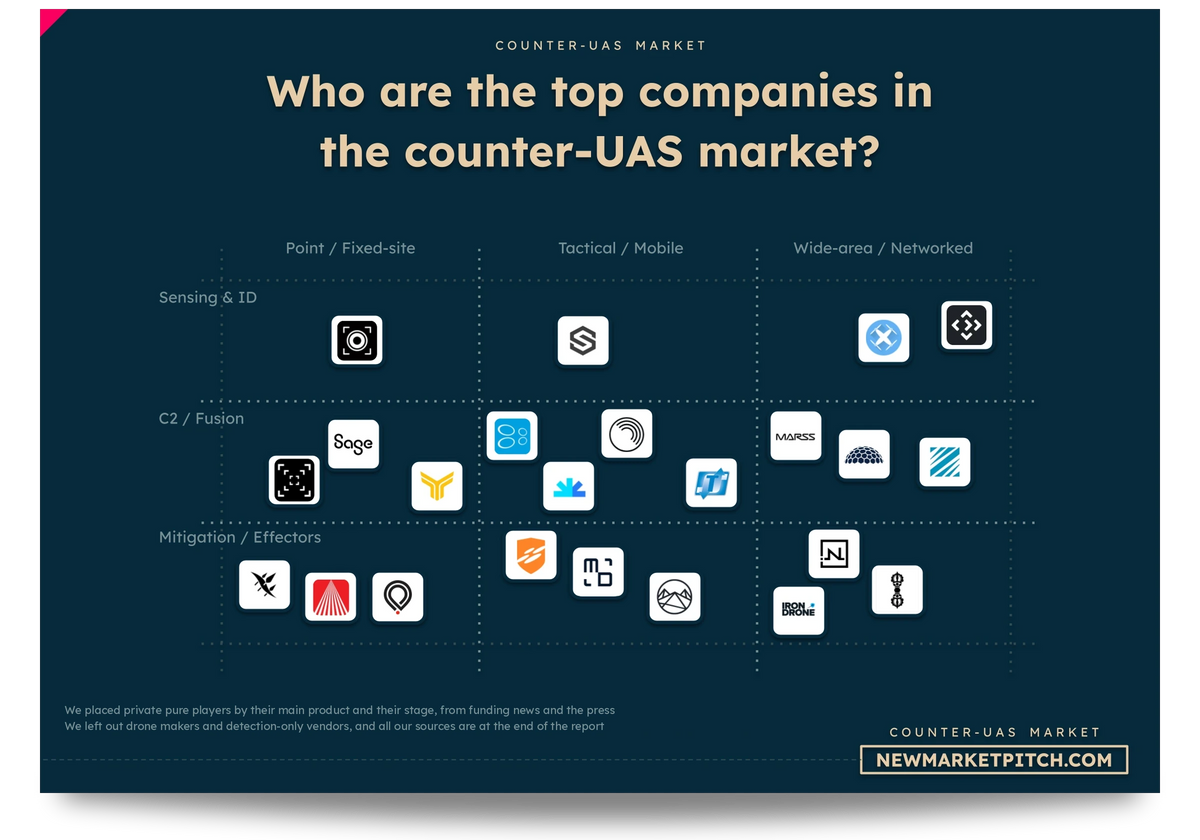
In our research about counter-drone systems, we turn what is vague and complex into simple, useful visuals. Market maps like this one show you at a glance where every startup stands.
Do Andreessen Horowitz and Founders Fund dominate counter-UAS investing?
No, Andreessen Horowitz and Founders Fund do not dominate counter-UAS investment activity by the number of rounds joined.
Andreessen Horowitz appears in 2 rounds involving Anduril and ZeroMark. Founders Fund appears in 2 rounds involving Anduril. Accel, Lakestar, OTB Ventures, Valor Equity Partners and Vision Plus Capital rank ahead of both on participation, despite attracting less attention for individual blockbuster deals.
It's easy to see where the perception comes from. Founders Fund led Anduril's $2.5B financing in 2025, and Andreessen Horowitz co-led its $5.0B round in 2026. Those are entire company financings, not checks written by the individual funds. Anduril also sells far more than counter-drone equipment, including a broader range of autonomous defense technology and its Lattice software.
Consider what a different investor portfolio looks like. Accel backed both CHAOS Industries and Cambridge Aerospace; DFJ Growth backed Hidden Level and Cambridge Aerospace. These investments cover sensing and interception rather than concentrating on one very large defense company. The Anduril investors matter enormously to that company's growth. But large checks and frequent investing answer different questions, and the round counts do not support calling either fund the market's sole leader.
Is Accel still the fund to watch in counter-UAS?
Accel is still the most active counter-UAS backer, but other investors have been busier this year.
The firm leads the overall activity ranking with 5 rounds and has joined 1 round this year. Its latest deal in our research is Cambridge Aerospace in August 2026. So Accel's position rests mostly on earlier investments, not a run of new counter-drone deals.
The investments themselves are worth watching. Accel explained its defense thesis publicly when it backed CHAOS Industries in November 2024. CHAOS later raised a $275M Series C co-led by Accel and New Enterprise Associates, and Accel also joined its $510M Series D+ in 2025. Its systems help customers sense threats across large areas, where a single radar or interceptor may not be enough.
Cambridge Aerospace tackles another part of the problem, building cheaper interceptors for incoming drone threats. Accel backed a business focused on finding threats and another focused on defeating them. That range is useful in a market where customers rarely need only one piece of equipment. Anyone looking for the latest counter-UAS investors, however, should look at Lakestar and Khosla Ventures as well as Accel.

In our market report about counter-drone systems, we always try to gather several sources and make estimates that make sense, so you can work with solid numbers.
Why are mainstream VCs suddenly investing in counter-drone defense?
Mainstream venture firms now back counter-UAS startups because drone defense offers concrete products that customers urgently need.
Accel, Khosla Ventures and Draper Associates have all supported counter-drone companies, despite having much wider investment interests. What draws them in is also what makes these businesses difficult: they must turn software and hardware into something that survives real tests.
CHAOS Industries develops sensing and communication technology, Mara is working on a system to detect and intercept small FPV drones, and Aurelius Systems builds the Archimedes laser platform. Each startup uses advanced software, but none can win customers through a polished demo alone. The equipment has to track fast targets, work in difficult conditions and be produced consistently.
Recent announcements offer a better test than investor enthusiasm. Mara described work with a U.S. special operations unit and deployment of its Spotter technology in August 2026. Aurelius described technical validation and manufacturing plans in its own August 2026 fundraising announcement. We can see why established funds are interested without assuming those tests already mean large recurring sales. Investors now have battlefield problems and real hardware milestones to assess, rather than an abstract promise that defense technology might one day become a big market.
Is Anduril making smaller counter-UAS startups irrelevant to investors?
No, Anduril's size has not pushed specialist counter-UAS startups out of the investment market.
Anduril sells a broad defense platform, while many counter-drone startups are built to solve a narrower problem. MatrixSpace makes portable radar, Allen Control Systems develops an autonomous gun system for stopping drones, and Fortem Technologies brings sensors, software and interceptors together. Their customers may buy these tools on their own or alongside larger defense systems.
The investment choices reflect that difference. OTB Ventures backed MatrixSpace's portable radar approach. Craft Ventures backed Allen Control Systems and its Bullfrog system. Lockheed Martin Ventures backed Fortem, then worked with the company to integrate counter-drone capabilities into a larger air-defense offering. These are concrete ways to build a business alongside a large platform company.
Anduril's scale raises expectations for manufacturing, software and delivery, but it cannot automatically replace every sensor, interceptor or integration partner. For a smaller company, the real question is whether its equipment works better, costs less or fits a customer's existing systems. That remains a reason for investors to finance specialists.
Which counter-UAS investors are still investing this year?
Lakestar, Khosla Ventures, Unusual Machines, Elad Gil and Green Flag Ventures are tied as the most active counter-UAS investors this year, with 2 rounds each.
Of the 20 most active counter-UAS investors, 15 have joined a round this year and 5 have not. Accel, the overall leader, has joined 1 round this year. We count 32 counter-UAS rounds this year, against 25 last year.
The active investors are not all funding the same kind of product. Lakestar backed Cambridge Aerospace and TYTAN Technologies, both interceptor makers. Khosla Ventures backed Mara and Skapion, companies addressing low-cost drones and swarms. Elad Gil appears in 2 Cambridge Aerospace rounds, Green Flag Ventures appears with MaXon Systems and Claymore Industries, and Unusual Machines backed Powerus and Fortem.
That spread is useful when deciding whom to approach. The backers active today include European and Silicon Valley venture firms, a specialist defense fund and a supplier with commercial interests in drone hardware. The best contact depends on what a startup has built and who needs to buy it.
The table below shows, year by year, how many rounds 12 of the most active counter-uas investors joined, so it is easy to see who is still investing and who has slowed down.
If you want to go more into detail and see which investors are still writing checks and which have slowed down, please check our counter-uas report.
| Investor | 2024 | 2025 | 2026* | Total |
|---|---|---|---|---|
| Lakestar | 2 | 2 | 4 | |
| Khosla Ventures | 2 | 2 | ||
| Unusual Machines | 2 | 2 | ||
| Elad Gil | 2 | 2 | ||
| Green Flag Ventures | 2 | 2 | ||
| Accel | 1 | 3 | 1 | 5 |
| OTB Ventures | 2 | 1 | 3 | |
| DFJ Growth | 1 | 1 | 2 | |
| Draper Associates | 1 | 1 | 2 | |
| Andreessen Horowitz | 1 | 1 | 2 | |
| Expeditions Fund | 1 | 1 | 2 | |
| Freedom Fund | 1 | 1 | 2 |
* 2026: January to 14 November. Darker cells mean more rounds that year. Data from January 2024 through 14 November 2026.
Is Lockheed Martin now investing in counter-drone startups?
Yes, Lockheed Martin Ventures is investing directly in counter-UAS startups, through Fortem Technologies.
Lockheed Martin Ventures led Fortem Technologies' $50M Series B. Lockheed Martin announced its investment in April 2026 and Fortem announced the close of the full round in September 2026, so we count one round, not two. With that single round, Lockheed Martin Ventures sits outside our top 20 by rounds joined.
Fortem makes the TrueView radar, the SkyDome command system and DroneHunter interceptors. Lockheed Martin is also integrating Fortem's technology into its Sanctum system, which aims to join different counter-drone capabilities into one operational setup. So the relationship goes beyond buying shares in a company that makes promising hardware.
Fortem's September announcement also mentioned work for U.S. Army installations and a Department of Homeland Security contract linked to World Cup venue protection. Those customer references do not guarantee future orders, but they show why a defense contractor might want Fortem's equipment in a system it can offer customers. For counter-UAS founders, the attraction of a corporate investor may be access to engineering teams, established buyers and integration work as much as funding.

Our document detailing everything you need to know about counter-UAS gets updated several times a month, so you always get the latest view of where things stand.
Is Khosla Ventures becoming a big backer of counter-drone startups?
Khosla Ventures is now among the most active new investors in early counter-UAS startups.
The firm joined 2 seed rounds and was named as lead in both. It backed Mara and Skapion, companies that aim to stop drones in quite different ways. These deals also show that seed-stage counter-drone companies can attract a mainstream Silicon Valley investor.
Mara's August 2026 announcement described its Spike system, which combines Spotter detection with a Seeker interceptor. The company is targeting small FPV drones that are hard to stop with conventional defenses. Skapion announced a $36M seed round to build a mobile counter-swarm system. Both are focused on threats that can arrive cheaply and in numbers, rather than on building a general defense company first.
Khosla's investments are a bet on the economics of interception. Customers cannot keep spending expensive missiles on every cheap drone, and systems designed for an isolated target may struggle when many drones arrive at once. The two startups offer different answers to that practical problem. Whether they can produce enough reliable systems will matter more than the size of their early fundraising headlines.
Why is Unusual Machines buying into counter-drone companies?
Unusual Machines is backing counter-UAS companies whose products also depend on the drone components it supplies.
The company joined 2 rounds involving Powerus and Fortem Technologies and was named as lead in 1. Its role is unusual because it has commercial reasons to help these companies build more hardware, not just a financial interest in their valuations.
Powerus announced a strategic equity investment from Unusual Machines in June 2026. The companies already had a supply relationship involving drone components and manufacturing. Fortem's defensive systems also require hardware production and included Unusual Machines in its Series B announcement.
That overlap is worth watching. A conventional VC can introduce customers and help finance growth. A component supplier may also influence how quickly a manufacturer can secure parts, ramp production and avoid shortages. But a supplier investing in its customer does not mean the finished counter-drone product will win contracts. Unusual Machines will need those companies to keep building and selling equipment for the industrial argument to hold up.
Are European VCs keeping up with U.S. counter-UAS investors?
European VCs are active in counter-UAS, especially in interceptors and sensors, but U.S. funds remain prominent.
Lakestar joined 4 counter-UAS rounds, second only to Accel, and OTB Ventures joined 3. OTB appears with TYTAN Technologies and MatrixSpace; Lakestar appears with TYTAN Technologies and Cambridge Aerospace. U.S.-based Accel still leads the overall ranking and shares 2 Cambridge Aerospace rounds with Lakestar, so the split between Europe and the United States is less simple than comparing headquarters.
OTB co-led MatrixSpace's $20M Series B in October 2025, supporting portable radar that can be used to detect and track drones. TYTAN Technologies, based in Munich, is developing interceptors meant to be made and deployed in large numbers. Cambridge Aerospace is pursuing a similar need for affordable air defense. The NATO Innovation Fund's support for TYTAN shows that European funding is tied to a push for more production capacity within allied supply chains.
The test for European startups is whether they can move from demonstrations to manufacturing and sell across national procurement systems. We can see meaningful investor participation already. A claim that European funds have overtaken the broader counter-UAS investor field would go further than our evidence supports.
Which counter-UAS investors back seed rounds, and which back growth rounds?
Seed attracts the most counter-UAS rounds, with 38 of the 69 rounds at a known stage, but no single investor leads that stage.
At the other end, there are only 15 rounds at Series C or later. Accel, Vision Plus Capital and DFJ Growth are tied at Series C with 2 rounds each, and Founders Fund and 8VC share the lead at Series D+ with 2 rounds each. Lakestar leads Series A participation with 2 rounds.
The companies explain why investors enter at different stages. Khosla Ventures and Expeditions Fund have backed young interceptor businesses still proving that their systems work. DFJ Growth backed Cambridge Aerospace and Hidden Level at Series C, where customers and investors expect more than early technical validation. Founders Fund's later-stage activity centers on Anduril, which is building a much wider defense business, while 8VC joined later rounds for CHAOS Industries and Epirus.
A seed investor may be prepared to fund tests and early product development. Larger rounds often involve factories, delivery schedules and systems that must work alongside equipment customers already own. That's why the most useful counter-UAS investor for a startup depends on how far the product has come.
The table below shows, for 12 of the most active counter-uas investors, how many rounds they joined at each stage, from seed to growth.
If you want to go more into detail and see where each investor places its bets, from seed to growth, please check our counter-uas report.
| Investor | Seed | Series A | Series B | Series C | Series D+ | Growth |
|---|---|---|---|---|---|---|
| Accel | · | 1 | 1 | 2 | 1 | · |
| Lakestar | 1 | 2 | · | 1 | · | · |
| OTB Ventures | 1 | 1 | 1 | · | · | · |
| Valor Equity Partners | · | · | 1 | 1 | 1 | · |
| Vision Plus Capital | · | · | 1 | 2 | · | · |
| Khosla Ventures | 2 | · | · | · | · | · |
| DFJ Growth | · | · | · | 2 | · | · |
| Draper Associates | 1 | 1 | · | · | · | · |
| Andreessen Horowitz | 1 | · | · | · | 1 | · |
| Founders Fund | · | · | · | · | 2 | · |
| Craft Ventures | 1 | 1 | · | · | · | · |
| Unusual Machines | · | · | 1 | · | · | 1 |
Most active at each stage, among all counter-uas investors: Seed, 4 investors tied with 2 rounds · Series A, Lakestar · Series B, no investor joined more than one round · Series C, Accel, Vision Plus Capital and DFJ Growth · Series D+, Founders Fund and 8VC · Growth, no investor joined more than one round. Bigger dots mean more rounds. Data from January 2024 through 14 November 2026.

In our report covering the counter-UAS market, we look at what the winners do differently, so you can learn from the best instead of guessing.
Who backs counter-UAS startups when they need factories?
DFJ Growth and Valor Equity Partners are among the counter-UAS investors helping hardware companies move toward large-scale production.
Our research records DFJ Growth in 2 Series C rounds and Valor Equity Partners in 3 rounds, including later financing for CHAOS Industries. Lockheed Martin Ventures also led Fortem Technologies' Series B. These investors are backing companies that need more than engineers and prototypes.
Cambridge Aerospace raised a $300M Series C led by DFJ Growth in August 2026 to expand interceptor manufacturing. Fortem Technologies announced a $50M Series B tied to production and deployment of its counter-drone equipment. CHAOS Industries raised a $510M later-stage round led by Valor Equity Partners to develop and build its defense systems. The equipment is different, but each business needs to deliver working hardware repeatedly, not just pass a test once.
The investors below back companies at different stages, so their latest recorded rounds should not be read as proof that every dollar went into factories. They show which firms have been close to counter-UAS companies facing the challenges of production and delivery.
The table below shows selected investors, the startups they backed and their latest recorded rounds.
| Investor | Startup | Latest round |
|---|---|---|
| Accel | Cambridge Aerospace | Aug 2026 |
| Lakestar | Cambridge Aerospace | Aug 2026 |
| OTB Ventures | TYTAN Technologies | Feb 2026 |
| Valor Equity Partners | CHAOS Industries | Nov 2025 |
| Vision Plus Capital | Beijing Lizheng Technology | Dec 2025 |
| Khosla Ventures | Mara | Aug 2026 |
| DFJ Growth | Cambridge Aerospace | Aug 2026 |
| Draper Associates | Aurelius Systems | Aug 2026 |
Are radar startups losing counter-UAS investors to interceptors?
No, counter-UAS investors are still backing drone detection companies alongside interceptor startups.
Hidden Level, MatrixSpace and CHAOS Industries focus on finding and tracking aerial threats. Cambridge Aerospace and Skapion aim to stop them. Both groups have attracted recognizable investors recently, so there is no clear evidence that money has abandoned detection technology.
Hidden Level announced a $65M Series C for its passive sensing business, with DFJ Growth among its backers. MatrixSpace raised a $20M Series B co-led by OTB Ventures and The Raptor Group for its portable radar platform. CHAOS Industries raised a $275M Series C for technology that helps detect and monitor threats. Investors have supported different ways of seeing drones, even while other funds back the systems that disable them.
Customers often need detection before they can decide what action is safe or legal. Airports and infrastructure operators may be able to monitor nearby drones without having authority to interfere with them. The FAA's guidance makes clear that detecting a drone and actively mitigating one are governed differently in the United States. That gives sensing products uses that do not depend on the customer buying an interceptor too.
Are laser weapons getting serious backing from counter-UAS VCs?
Yes, laser-based counter-UAS systems have attracted venture backing, led by firms willing to finance difficult hardware.
Draper Associates joined 2 rounds involving Aurelius Systems, which develops the Archimedes laser platform. The startup announced a $40M Series A in August 2026, co-led by Draper Associates and KAS Venture Partners, with General Catalyst among the participants.
Aurelius said it would use the financing to advance the system, expand its operations and improve manufacturing readiness. It also described work with American Rheinmetall and testing to show how the laser could fit into existing defense equipment. Those details are useful because a laser must track a fast target, deliver enough energy and keep working outside controlled conditions.
The appeal is straightforward: a reusable beam could avoid firing an expensive missile at every inexpensive drone. But the difficult engineering and operating conditions remain. Khosla Ventures is backing interceptors, OTB Ventures is backing radar and Draper Associates is backing directed energy. Investors are placing different bets because no single approach has solved every counter-drone problem.

In our research about counter-drone systems, we don't want to repeat what boring consulting reports say. Instead, we show you the real and latest market signals that matter.
Which counter-UAS investors most often invest together?
Five pairs of counter-UAS investors are tied as the most frequent co-investors, with 2 rounds together each, and each pair repeated inside a single startup.
Accel and Lakestar, Accel and Lux Capital, and Lakestar and Lux Capital each joined 2 Cambridge Aerospace rounds together. Accel and Valor Equity Partners joined 2 CHAOS Industries rounds, and Lakestar and OTB Ventures joined 2 TYTAN Technologies rounds.
That pattern says more about loyalty to a company than about a standing club. No pair in our count has invested together in two different counter-UAS startups. A shared second round shows that existing backers chose to support the same company again as it grew.
For founders, the distinction is practical. Backers who join one round together do not automatically team up again at another company. Lead investors and company-specific relationships matter more than assuming there is a standing group behind the whole counter-UAS market.
The table below lists the pairs of counter-uas investors named together in at least two equity rounds, with the startups they backed together.
If you want to go more into detail and see which investor networks back the same startups, please check our counter-uas report.
| Investor pair | Rounds together | Startups backed together |
|---|---|---|
| Accel + LakestarCambridge Aerospace | 2 | Cambridge Aerospace |
| Accel + Valor Equity PartnersCHAOS Industries | 2 | CHAOS Industries |
| Accel + Lux CapitalCambridge Aerospace | 2 | Cambridge Aerospace |
| Lakestar + OTB VenturesTYTAN Technologies | 2 | TYTAN Technologies |
| Lakestar + Lux CapitalCambridge Aerospace | 2 | Cambridge Aerospace |
Pairs of investors named in the same equity round. Data from January 2024 through 14 November 2026.
Do counter-UAS investors stick with startups after the seed round?
Some counter-UAS investors keep backing the same startup as it grows, while others first appear in larger rounds.
Craft Ventures backed Allen Control Systems at seed and Series A, and Draper Associates backed Aurelius Systems at those stages too. Both companies are developing equipment that needs extensive testing before it can be sold and deployed widely.
Allen Control Systems is building Bullfrog, an autonomous gun system designed to stop drones. Craft Ventures says it led the company's early financings, including the $30M Series A announced in March 2025. Aurelius later raised a Series A for its laser-based approach after earlier funding from Draper Associates. A fund that stays through those stages can judge whether the engineering progress it paid for is translating into a usable product.
DFJ Growth offers a different example. It appears with Hidden Level and Cambridge Aerospace at Series C, when production and sales become more pressing. Valor Equity Partners also backed later rounds for CHAOS Industries and Hidden Level. There is no single formula for the counter-UAS market investor relationship: some firms fund a product from the beginning, while others wait until there is more evidence that customers will buy it.
Can defense contractors help counter-UAS startups win customers?
Yes, defense contractors can help counter-UAS startups reach buyers and make their equipment work with existing systems.
Lockheed Martin's relationship with Fortem Technologies shows the value of integration. The contractor invested in Fortem and is bringing its sensing and interceptor technology into the Sanctum counter-drone architecture. That gives Fortem a potential route into purchases that involve several defense technologies, not just a standalone radar or interceptor.
Booz Allen Ventures offers another route through Hidden Level. Booz Allen's venture portfolio describes work connecting Hidden Level's Airspace Monitoring Service with its Sit(x) platform. Hidden Level's passive sensing technology helps organizations monitor drones, while the integration offers a way to use those observations with other security data.
A contractor can introduce engineers, customers and procurement experience that a normal VC may lack. But an investment does not guarantee a purchase order. The real benefit appears when the startup's product survives integration tests and a customer chooses to deploy it. That's the relationship founders should look for when evaluating a corporate backer.
Are civilian counter-drone startups as attractive to investors as military ones?
Civilian counter-UAS detection gives investors a different opportunity from military drone interception, mainly because customers face different rules.
Hidden Level and MatrixSpace sell sensing technology that can help organizations monitor airspace. Fortem Technologies and Skapion work on systems that can also stop threats. Both kinds of business have attracted investors, but customers cannot necessarily use every counter-drone capability in the same place.
For example, an airport or infrastructure operator may need to know whether a drone is nearby without having legal authority to disable it. The FAA's published guidance distinguishes detection from mitigation and describes restrictions on active countermeasures in U.S. airspace. A military customer can have a much clearer need for systems that physically intercept threatening drones.
That difference affects who can buy and operate a product, how it is tested and how often customers may renew their contracts. A company selling only detection does not need to prove the economics of each interception. A company selling a full defensive system must show that the system can stop threats reliably. Investors have to judge those markets separately rather than treating every counter-drone sale as interchangeable.

Learning from others' mistakes is the cheapest lesson there is. In our market report about counter-drone systems, we look at what broke startups before you, so you don't repeat it.
Can smaller defense funds beat big-name VCs in counter-UAS?
Specialist defense funds can back valuable counter-UAS niches before the largest venture firms pay attention.
Expeditions Fund backed Frankenburg Technologies and EGIDE at seed. Green Flag Ventures appears with MaXon Systems and Claymore Industries, and OTB Ventures backed both TYTAN Technologies and MatrixSpace. Their portfolios focus on problems that military buyers already recognize, including stopping cheap drones and identifying threats quickly.
The companies also show why specialist knowledge helps. Frankenburg is developing counter-drone missile technology, MaXon Systems is testing autonomous interception and MatrixSpace sells a portable radar system. Evaluating those products requires an understanding of field conditions, components and procurement that goes beyond assessing software growth.
Green Flag's portfolio materials describe testing and field-evaluation work by its counter-drone companies. That type of progress may make a small fund influential well before a large publicized financing. Specialist funds do not lead the overall participation ranking, which Accel leads. They can nonetheless matter more to a particular early-stage founder looking for help with a specific military customer or technical problem.
So, who really backs counter-UAS startups the most today?
Accel is the busiest counter-UAS investor by equity-round participation, with 5 rounds joined, ahead of Lakestar with 4.
Accel is not setting the pace for new deals this year. Lakestar, Khosla Ventures, Unusual Machines, Elad Gil and Green Flag Ventures lead current activity, while Accel, Vision Plus Capital and DFJ Growth share the lead at Series C. Founders Fund and 8VC lead at Series D+, and smaller specialists are active with sensors and interceptors.
The practical choice of investor depends on the startup. A young company testing an interceptor needs different help from a manufacturer supplying the military or a sensing company selling to infrastructure operators. Some funds bring money and technical advice; contractors and suppliers may also help get equipment into real customer systems.
The table below shows what we found.
| Question | Answer |
|---|---|
| Do famous VCs completely control counter-drone investing? | No, Accel leads, but Lakestar and three firms with 3 rounds each follow closely. Another 15 investors are tied with 2 rounds each. Counter-UAS funding reaches far beyond familiar Silicon Valley names. |
| Are the overall leaders also writing new checks? | Partly, Accel has joined 1 round this year and Lakestar 2. We found 15 active investors among the leading group of 20. The current pace is being set by a wider set of backers. |
| Can a defense contractor lead counter-drone funding? | It can lead a round, as Lockheed Martin Ventures did for Fortem Technologies. Fortem's $50M Series B counts as a single round in our data. Its product integration work can matter beyond the financing. |
| Do giant Anduril rounds prove venture dominance? | No, deal size does not measure how often investors participate. Andreessen Horowitz joined Anduril's enormous $5.0B financing round. The whole round says nothing about its individual check. |
| Do early counter-drone startups still find investors? | Yes, seed funding remains common across the counter-UAS startup market. We count 38 rounds at the seed stage. No single venture investor dominates those early counter-UAS deals. |
| Does one fund control later counter-drone rounds? | No, different backers share the lead at each later stage. Accel, Vision Plus Capital and DFJ Growth each joined 2 Series C rounds. Founders Fund and 8VC share the lead at Series D+. |
| Are investors ignoring drone detection technology now? | No, investors continue backing specialized counter-UAS sensing companies. Hidden Level announced a $65M Series C funding round. Demand for detection reaches beyond customers allowed to intercept drones. |
| Can smaller funds matter beside defense giants? | Yes, specialist funds support products built for immediate battlefield needs. Expeditions Fund joined 2 seed rounds involving counter-UAS companies. Early expertise can matter before a startup raises bigger sums. |
| Does backing manufacturers involve more than cash? | Yes, investors sometimes help suppliers build and sell equipment. Lockheed Martin Ventures backed Fortem Technologies through its venture arm. Their integration work offers a route into larger customer systems. |
| Is every counter-drone investor equally active today? | No, current investor activity differs sharply from total round participation. This year, 5 investors are tied with 2 rounds each. A famous earlier deal does not imply a new investment. |
| Does frequent participation reveal the biggest checks? | No, joining a round does not reveal an individual contribution. We counted 77 equity rounds across the market. The announced deal amounts belong to entire financings. |

If you build or invest in the counter-UAS market, you need to know which business models pay off now and which ones are fading. That's why our report covering it has a whole section on it.
Our methodology
Our data runs through November 14, 2026. We then reviewed this article and updated its answers on November 17, 2026, the date shown under the title. We systematically tracked equity rounds in the counter-UAS market deal by deal since January 2024, a period long enough to identify who is active today. We include companies dedicated to detecting, tracking, identifying, managing or defeating unauthorized or hostile drones, from specialized sensors and software to interceptors and operational systems. Every company counted meets our startup definition: an independent, technology-led business founded in 2000 or later, never listed or listed within the last 5 years, with acquisitions within the last 3 years kept within scope. We include borderline companies when their dedicated counter-UAS products justify inclusion rather than excluding meaningful activity by default.
We count each equity round an investor joined and note separately when that investor led it; we do not count the amount each investor invested, because individual checks are seldom disclosed. We exclude IPOs and offerings after listing because they are not private equity rounds joined by venture investors. We identify participants from company announcements, investor disclosures and reporting, merge the same firm across name variants, and do not count vague labels such as "existing investors" or "angel investors." Separate reports of a single financing are merged. Our current-year activity column starts in March, once there are three months of data.
Announcements name lead investors more reliably than smaller participants, so rounds that an investor joined without leading are undercounted and lead rates are an upper bound.
Rounds confirmed by a company announcement, a press article or a regulatory filing are counted in full. Where no article exists, a round is counted only when at least two recognised databases agree on its date (within one month) and amount (within 5%), and it is marked as low confidence; a round found in a single database stays in the company's history but is left out of totals. For companies that have raised more than $100M, every round counted is backed by an article.
We do not treat commercial-database investor lists as sufficient evidence on their own: they can include people not confirmed in the round and may mix grants or debt with equity. At least one investor is named in 71 of the 77 equity rounds, or 92%. Rounds without a named backer still count in the market's deal history but not in investor participation lists. The counts differ from a funding-deal tracker because a single round is counted once in the market total but once for each named investor who joined it in investor activity.
A final limitation is easy to misread: frequency is not dollars committed, influence over procurement, or the quality of an investment. A specialist may have joined fewer publicly named rounds than a generalist yet have much deeper customer access, while a famous firm may appear in a very large financing without writing the whole check. We use rounds joined as the primary answer because it is the most consistent observable measure of sustained investor activity across the category, and we discuss leads, stages and industrial relationships separately rather than treating them as interchangeable.
Key sources include Accel's original defense technology investment thesis and CHAOS Industries backing., CHAOS Industries Series C and its named lead investors., CHAOS Industries later financing, manufacturing plans and named participants., Counsel's confirmation of DFJ Growth's Cambridge Aerospace Series C and investors., Fortem Technologies financing, products, customers and industrial partnership., Lockheed Martin's Fortem equity investment and Sanctum integration., Mara's counter-FPV system, testing claims and Khosla-led investment., Skapion's counter-swarm product and venture backers., Aurelius Systems laser platform, Draper Associates and manufacturing plans., MatrixSpace funding, portable radar and OTB Ventures participation., Hidden Level's passive-sensing technology and DFJ-led Series C., North Vector Dynamics interceptor and its Series A investor group., TYTAN Technologies' interceptor strategy and European investor participation., NATO Innovation Fund's support for European interceptor manufacturing., Green Flag Ventures' portfolio, MaXon Systems and Claymore Industries milestones., Craft Ventures' repeat backing of Allen Control Systems., Booz Allen Ventures' commercial collaboration with Hidden Level., Unusual Machines and Powerus supply-chain-related investment., Founders Fund's role in Anduril's financing., Andreessen Horowitz's role in Anduril's later financing., and FAA distinction between detection and mitigation and restrictions on active systems..
Written by the New Market Pitch teamWe track new markets so founders and investors can move faster. About us