Who are the top investors in military drones?
Whether you're building or investing in the military drone market, our report covers everything you need to know: the players, the money, and what's coming next.
Summary
Lakestar is the most active investor in military drone startups, joining 8 rounds but leading only 1. Sequoia Capital is close behind with 7 rounds and leads 6 of them, while corporate and publicly backed investors also appear repeatedly. No single type of investor owns this market.
Participation and leadership tell different stories. We count the rounds a firm joined, not how much money it personally supplied. The amount raised by a startup cannot be treated as any one investor's check.
Sequoia concentrated on Mach Industries, STARK Defence and Neros Technologies. All are trying to turn autonomous military systems into products that can be built in volume, with the engineering and factories to support them.
Lakestar spread its investments across more companies, including UFORCE, Cambridge Aerospace and TYTAN Technologies. It has also launched a dedicated resilience fund for European and allied defense technology.
Lockheed Martin Ventures and Axon Enterprise give founders another route to capital. These companies already sell into defense or security markets, so their technical knowledge and customer relationships may be useful alongside funding.
The NATO Innovation Fund adds a different kind of backing. It has supported TEKEVER and TYTAN Technologies, companies building reconnaissance aircraft and autonomous drone interceptors for allied needs.
The kind of investor changes with the round. Freedom Fund is the most active participant at Seed, while Sequoia is especially active at Series C. Larger investment firms appear when aircraft and autonomy businesses need substantial capital to grow.
This year has been Lakestar's busiest. It joined 6 rounds this year, twice as many as Sequoia, which built its record over a longer run.
Several firms keep appearing alongside the same partners. Accel and Lakestar shared 3 rounds across Cambridge Aerospace and SE3, and Lakestar and OTB Ventures shared 3 across TYTAN Technologies and Twentyfour Industries.
We identified 190 named investors across the market. The most useful question for founders is who has returned, who has led and who understands the aircraft they are being asked to finance.

Written by the New Market Pitch teamWe track new markets so founders and investors can move faster. About us

In our report covering the military drone market, you will always find fresh funding data, taken straight from our own verified funding database.
Which VCs invest the most in military drones right now?
Lakestar is the most active investor in military drones, with 8 rounds joined, while Sequoia Capital leads more of its rounds.
Sequoia Capital follows with 7 rounds joined and 6 led. Lakestar was named lead in only 1 of its rounds, so the gap is small in participation but their investment styles differ.
Freedom Fund comes third alone with 5 rounds, mostly in Ukrainian drone companies. Lakestar's rounds span UFORCE, Cambridge Aerospace, TYTAN Technologies, SE3 and Twentyfour Industries. Sequoia has backed Mach Industries, STARK Defence and Neros Technologies, businesses focused on building military systems in volume.
Sequoia's profile of Neros describes the founders' early experience designing and racing drones. Lakestar's recent resilience-fund announcement emphasizes a wider set of European defense and autonomy businesses. A broad portfolio and a focused one can both produce repeat investments; the question is what each firm helps its founders build.
The table below ranks the 20 most active military drones investors by the number of equity rounds they joined, with the rounds they led, their main stages, the startups they backed and the biggest round they joined.
If you want to go more into detail and get more data to understand what investors are betting on now, please check our military drones report.
| # | Investor | Rounds | Led | Main stages | Military drones startups backed | Biggest round joined | Latest round |
|---|---|---|---|---|---|---|---|
| 1 | Lakestar ▲ | 8 | 1Mostly follows (led 17% of the 6 rounds with a known lead) |
Series A 4Seed 2 | UFORCE, Cambridge Aerospace, TYTAN Technologies, SE3, Twentyfour Industries | $700MUFORCE · 2026 | Nov 2026 |
| 2 | Sequoia Capital ▲ | 7 | 6Named as lead in every round found (lead known for 6 of 7 rounds) |
Series C 3Seed 1 | Mach Industries, STARK Defence, Neros Technologies | $600MMach Industries · 2026 | Sep 2026 |
| 3 | Freedom Fund ▲ | 5 | 2Leads half its rounds (lead known for 4 of 5 rounds) |
Seed 3 | Buntar Aerospace, M-Fly, MaXon Systems | $16MBuntar Aerospace · 2026 | Oct 2026 |
| 4 | Axon Enterprise ▲ | 4 | 4Named as lead in every round found | Seed 2Series D+ 2 | Skydio, Buntar Aerospace, Farsight Vision | $255MSkydio · 2026 | Nov 2026 |
| 5 | Founders Fund ▲ | 4 | 4Named as lead in every round found | Series D+ 2Series C 1 | Anduril, STARK Defence | $2.5BAnduril · 2025 | Jun 2026 |
| 6 | Lightspeed Venture Partners ▲ | 4 | 3Usually leads (75% of its rounds) |
Series A 2Seed 1 | Helsing, Vector, Orqa | $1.8BHelsing · 2026 | Jul 2026 |
| 7 | Accel ▲ | 4 | 2Usually leads (67% of the 3 rounds with a known lead) |
Series A 2Seed 1 | Cambridge Aerospace, SE3, Unmannd | $300MCambridge Aerospace · 2026 | Nov 2026 |
| 8 | Lockheed Martin Ventures ▲ | 4 | 2Leads half its rounds | Series B 2Seed 1 | Firestorm Labs, Fortem Technologies | $82MFirestorm Labs · 2026 | Sep 2026 |
| 9 | Coinvest Capital | 3 | 3Named as lead in every round found | Seed 2 | Unmanned Defense Systems, Monopulse, PDKINEMATICS | $3.5MUnmanned Defense Systems · 2024 | Oct 2026 |
| 10 | Shield Capital ▲ | 3 | 2Usually leads (67% of its rounds) |
Series A 2Seed 1 | UFORCE, Vector | $700MUFORCE · 2026 | Nov 2026 |
| 11 | Advent International ▲ | 3 | 2Usually leads (67% of its rounds) |
Series D+ 3 | Shield AI, Quantum Systems | $1.5BShield AI · 2026 | Nov 2026 |
| 12 | Baillie Gifford | 3 | 2Usually leads (67% of its rounds) |
Series B 1Series C 1 | TEKEVER | $580MTEKEVER · 2026 | Sep 2026 |
| 13 | General Catalyst | 3 | 2Usually leads (67% of its rounds) |
Series B 1Series C 1 | Helsing, Raphe mPhibr | $1.8BHelsing · 2026 | Jul 2026 |
| 14 | NATO Innovation Fund | 3 | 2Usually leads (67% of its rounds) |
Series A 1Series B 1 | TEKEVER, TYTAN Technologies | $80MTEKEVER · 2025 | Feb 2026 |
| 15 | OTB Ventures ▲ | 3 | 1Leads half its rounds (lead known for 2 of 3 rounds) |
Seed 1Series A 1 | TYTAN Technologies, Twentyfour Industries | $33MTYTAN Technologies · 2026 | Feb 2026 |
| 16 | Booz Allen Ventures ▲ | 3 | 0Never led | Series B 2Series A 1 | PDW, Firestorm Labs | $110MPDW · 2026 | Apr 2026 |
| 17 | Khosla Ventures | 2 | 2Named as lead in every round found | Seed 1Series B 1 | Mach Industries, Mara | $100MMach Industries · 2025 | Aug 2026 |
| 18 | Ondas Holdings | 2 | 2Named as lead in every round found | Series B 2 | PDW | $110MPDW · 2026 | Mar 2026 |
| 19 | Expeditions Fund | 2 | 2Named as lead in every round found | Seed 1Series A 1 | Orqa, Lendurai | $14MOrqa · 2026 | Mar 2026 |
| 20 | Balderton Capital | 2 | 2Named as lead in every round found | Series C 2 | Quantum Systems | $209MQuantum Systems · 2025 | Nov 2025 |
No investors match this search.
Data from January 2024 through 14 November 2026, which is enough to show who is active today and who has been for years. Rounds: equity rounds in which the investor is named. Led: rounds it led or co-led. ▲ more rounds in 2026 so far than its 2025 pace, ▼ fewer.

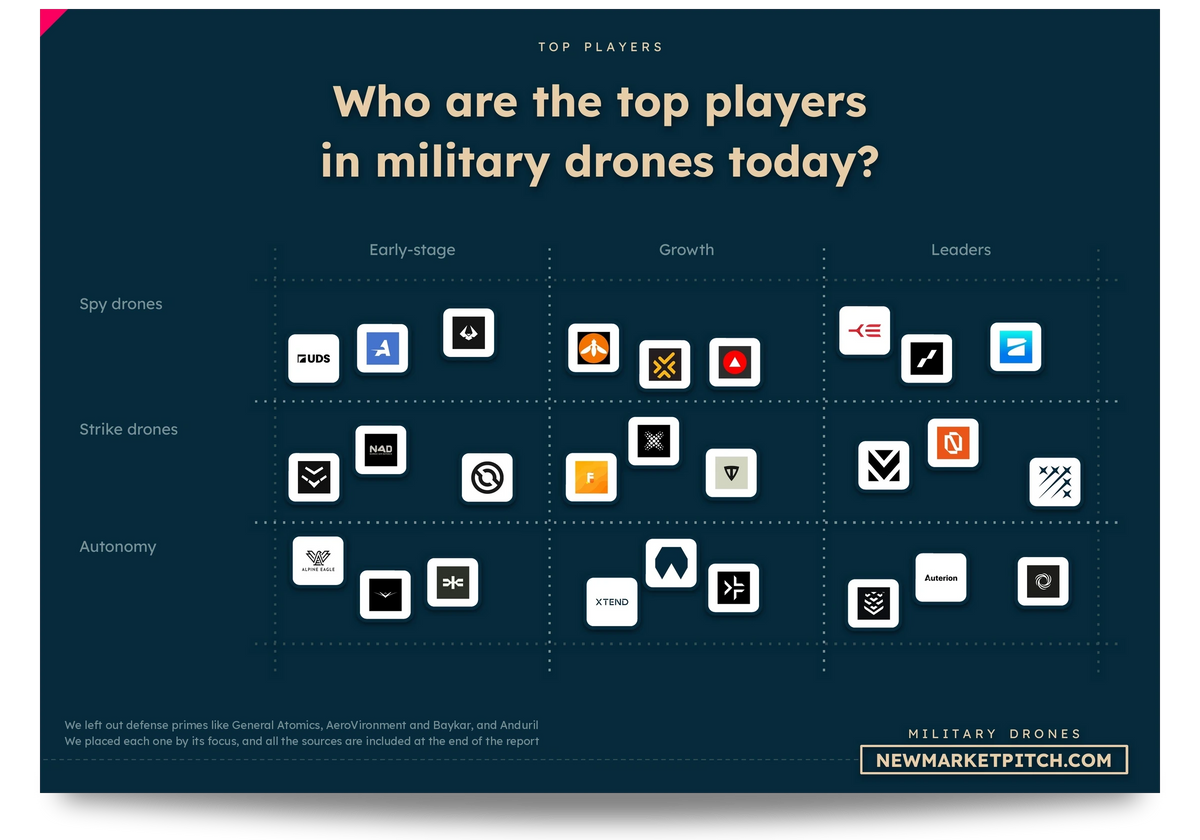
In our research about military drones, we turn what is vague and complex into simple, useful visuals. Market maps like this one show you at a glance where every startup stands.
Is Sequoia Capital really leading military drone funding rounds?
Among military drone VCs, Sequoia Capital frequently leads rounds instead of merely joining them.
We found Sequoia named as lead in 6 rounds and backing 3 companies: Mach Industries, STARK Defence and Neros Technologies. The largest round it joined was Mach Industries' $600M Series C in 2026. That amount belongs to the company's financing, not to Sequoia's own investment.
Sequoia wrote about Neros' engineering background in May 2024. Neros later described expanding its Archer and Bandit drone lines in August 2026, while Mach Industries used its September 2026 financing announcement to discuss factory expansion. Whenever a lead was named in a Sequoia round, it was Sequoia. That is a strong record of leadership, although investor announcements do not always disclose smaller participants.
Has Lakestar overtaken Sequoia in military drone investing?
Yes, on rounds joined. Lakestar has joined 8 military drone rounds against 7 for Sequoia, and it backs a wider group of companies.
Lakestar joined 8 rounds across 5 startups: UFORCE, Cambridge Aerospace, TYTAN Technologies, SE3 and Twentyfour Industries. It was named lead in 1 round. Sequoia remains ahead on rounds it led and has a more concentrated portfolio built around Mach Industries, STARK Defence and Neros Technologies.
Lakestar's July 2026 resilience-fund announcement highlighted European and allied defense technology, including aerial autonomy and domestic drone manufacturing. The company's drone investments cover strike aircraft, interception and mission software. Lakestar looks like a recurring partner for different types of military drone startups; Sequoia has more often taken the named lead role in repeated financings of manufacturers. We cannot rank their personal check sizes because those allocations are not public.

In our market report about military drones, we always try to gather several sources and make estimates that make sense, so you can work with solid numbers.
Which military drones investors are still investing this year?
This year, Lakestar is the busiest military drone investor, joining 6 rounds.
Sequoia Capital is still active with 3 rounds this year, compared with 2 last year. Lakestar's 6 rounds this year, against 2 last year, explain how it moved ahead of Sequoia over the whole period.
Among the 20 ranked investors, 19 participated in at least 1 round this year and 1 has not. Lockheed Martin Ventures and Freedom Fund returned to military drone financings, while Advent International made its first appearance with 3 rounds. They back different kinds of companies and stages.
Lakestar has been putting its recently announced resilience-fund focus into practice. Sequoia continues to finance a smaller set of manufacturers, including businesses trying to expand drone production. A current-year activity count tells founders who is showing up now; it does not reveal how much each firm has spent.
The table below shows, year by year, how many rounds 12 of the most active military drones investors joined, so it is easy to see who is still investing and who has slowed down.
If you want to go more into detail and see which investors are still writing checks and which have slowed down, please check our military drones report.
| Investor | 2024 | 2025 | 2026* | Total |
|---|---|---|---|---|
| Lakestar | 2 | 6 | 8 | |
| Sequoia Capital | 2 | 2 | 3 | 7 |
| Freedom Fund | 2 | 3 | 5 | |
| Axon Enterprise | 1 | 3 | 4 | |
| Advent International | 3 | 3 | ||
| Founders Fund | 1 | 1 | 2 | 4 |
| Lightspeed Venture Partners | 1 | 1 | 2 | 4 |
| Accel | 2 | 2 | 4 | |
| Lockheed Martin Ventures | 1 | 1 | 2 | 4 |
| Coinvest Capital | 1 | 2 | 3 | |
| Shield Capital | 1 | 2 | 3 | |
| OTB Ventures | 1 | 2 | 3 |
* 2026: January to 14 November. Darker cells mean more rounds that year. Data from January 2024 through 14 November 2026.
Is Founders Fund still funding military drone startups?
Founders Fund is still funding military drone startups beyond its long-standing relationship with Anduril.
Founders Fund joined 4 rounds, including 2 this year, and was named lead in 4. Its military drone investments include Anduril and STARK Defence. The largest round it joined was Anduril's $2.5B late-stage round in 2025, which was the whole company round, not Founders Fund's own check.
Anduril's August 2024 fundraising announcement named Founders Fund as a co-lead and described an effort to scale autonomous-defense manufacturing. STARK Defence offers a related route into European autonomous weapons. Founders Fund is backing companies with big production ambitions rather than appearing across a long list of early drone prototypes. That focus can make the firm influential without making it the investor with the most different companies in its portfolio.
Are Silicon Valley VCs moving into military drone startups?
Silicon Valley VCs now regularly back military drone startups, alongside defense specialists and corporate investors.
Sequoia Capital, Founders Fund, Lightspeed Venture Partners and Accel all appear among the leading participants, alongside Lakestar. Lightspeed joined 4 rounds backing Helsing, Vector and Orqa, while Accel joined 4 across Cambridge Aerospace, SE3 and Unmannd. These are businesses selling aircraft, interceptors or software that directly controls military drones.
The newer venture interest sits beside Lockheed Martin Ventures, Axon Enterprise, Booz Allen Ventures and the NATO Innovation Fund. Those investors may know defense procurement and system integration in ways a generalist VC does not. The market is attracting several kinds of backer because building a useful military drone takes software, manufacturing experience and access to military customers.
Does Lockheed Martin invest in military drone startups?
Lockheed Martin Ventures is among the most active corporate investors backing military drone startups.
The venture arm joined 4 rounds and was named lead in 2, backing Firestorm Labs and Fortem Technologies. Lockheed Martin Ventures joined 2 Series B rounds, tied with Booz Allen Ventures and Ondas Holdings for the most at that stage. These are defense products it can understand technically: Firestorm makes deployable drone-manufacturing systems, and Fortem builds DroneHunter interceptors.
Fortem announced in March 2026 that Lockheed Martin had selected its DroneHunter system for critical-infrastructure protection. Lockheed Martin Ventures then led Fortem's September 2026 financing, which the company linked to expanding production and field deployment. For a startup, a partner like Lockheed Martin may help with integration and access to customers. An investment still does not guarantee procurement, so the product has to stand up to military evaluation.

Our document detailing everything you need to know about military drone gets updated several times a month, so you always get the latest view of where things stand.
Is Axon Enterprise investing in military drones now?
Axon Enterprise now backs military drone companies alongside its better-known public-safety business.
Axon joined 4 tracked rounds and was named lead in all 4. The largest was Skydio's $255M Series D+ in November 2026. Its startup investments include Skydio, Buntar Aerospace and Farsight Vision, spanning US reconnaissance aircraft, Ukrainian battlefield systems and drone-related spatial intelligence.
The US Army has bought Skydio short-range reconnaissance drones, and Skydio announced an X10D military order in March 2026. Buntar makes reconnaissance drones and battlefield software, while Farsight Vision works with intelligence derived from aerial operations. The portfolio fits Axon's interest in sensing and security technologies, but the companies do not all build identical products. What we can verify is Axon's participation in their financings, not any undisclosed commitments to buy their equipment.
Is the NATO Innovation Fund investing in military drone startups?
The NATO Innovation Fund backs military drone companies making surveillance aircraft and autonomous interceptors.
The fund joined 3 rounds and led 2, investing in TEKEVER and TYTAN Technologies. TEKEVER makes reconnaissance UAVs, while TYTAN builds interceptors designed to destroy hostile drones. Both need physical products that can work with military systems, alongside their software.
In February 2026, the NATO Innovation Fund announced it had co-led TYTAN's Series A and described plans for increased manufacturing and integration with allied air defenses. Its portfolio also identifies TEKEVER as an aerial-intelligence company. The investment shows support for military drone suppliers, but it should not be confused with a NATO purchase order. A fund can help a company finance development without becoming its customer.
Who funds Ukraine’s military drone startups?
Freedom Fund is among the most active named backers of Ukrainian military drone startups, focusing on smaller battlefield-drone businesses.
We tracked Freedom Fund in 5 rounds covering Buntar Aerospace, M-Fly and MaXon Systems. It was named lead in 2 rounds and appeared in 3 Seed rounds. MITS Capital also joined repeated financings of M-Fly. These are different investors from those most often associated with the giant American and German manufacturing rounds.
Buntar makes reconnaissance drones and battlefield software. M-Fly works on UAV guidance, while MaXon develops autonomous interceptors. Those businesses may need quick design improvements and smaller production runs close to the front line. Our figures capture named equity investors, not military procurement, grants or other support for Ukraine's drone industry.
Which military drones investors back seed rounds, and which back growth rounds?
Freedom Fund is the busiest military drone investor at Seed, with 3 Seed rounds joined, while Advent International tops the rounds from Series D+ onward with 3.
Seed accounts for 45 of the 112 rounds with a known stage. At Series C, Sequoia Capital leads with 3 rounds joined.
We also counted 25 rounds with a known stage at Series C or later. Lakestar led Series A participation with 4 rounds, while Lockheed Martin Ventures, Booz Allen Ventures and Ondas Holdings tied at Series B with 2 each. From Series D+ onward, Advent International leads with 3 rounds. Different investors appear as companies move from testing aircraft to manufacturing them.
TYTAN's February 2026 Series A, backed by the NATO Innovation Fund, was tied to increasing interceptor production. Shield AI's later financing announcements involved platform expansion and acquisitions. Those examples show why a company building its first aircraft and one expanding a defense business may attract different backers.
The table below shows, for 12 of the most active military drones investors, how many rounds they joined at each stage, from seed to growth.
If you want to go more into detail and see where each investor places its bets, from seed to growth, please check our military drones report.
| Investor | Seed | Series A | Series B | Series C | Series D+ | Growth |
|---|---|---|---|---|---|---|
| Lakestar | 2 | 4 | · | 1 | · | · |
| Sequoia Capital | 1 | 1 | 1 | 3 | · | · |
| Freedom Fund | 3 | · | · | · | · | · |
| Axon Enterprise | 2 | · | · | · | 2 | · |
| Founders Fund | · | · | · | 1 | 2 | · |
| Lightspeed Venture Partners | 1 | 2 | · | · | 1 | · |
| Accel | 1 | 2 | · | 1 | · | · |
| Lockheed Martin Ventures | 1 | 1 | 2 | · | · | · |
| Coinvest Capital | 2 | · | · | · | · | · |
| Shield Capital | 1 | 2 | · | · | · | · |
| Advent International | · | · | · | · | 3 | · |
| Baillie Gifford | · | · | 1 | 1 | 1 | · |
Most active at each stage, among all military drones investors: Seed, Freedom Fund · Series A, Lakestar · Series B, Lockheed Martin Ventures, Booz Allen Ventures and Ondas Holdings · Series C, Sequoia Capital · Series D+, Advent International · Growth, Foresight Group funds. Bigger dots mean more rounds. Data from January 2024 through 14 November 2026.

In our report covering the military drone market, we look at what the winners do differently, so you can learn from the best instead of guessing.
Who will fund a military drone startup at Seed?
Freedom Fund leads Seed-round participation in military drones, but new founders have other named investors to approach.
Freedom Fund joined 3 Seed rounds. Coinvest Capital, Axon Enterprise and Lakestar each joined 2 Seed rounds. That is a useful range of investors: a fund close to Ukraine's battlefield drone industry, corporate capital and more conventional venture firms.
The products also vary. MaXon Systems develops interceptors, M-Fly works on UAV guidance, and TYTAN builds allied air-defense systems. A team working on a new aircraft needs investors who can judge its technical progress and its ability to manufacture safely. Sequoia's May 2024 profile of Neros, for example, emphasized the founders' hands-on drone experience. The first round is usually about proving the team and product; later rounds test whether customers will keep buying.
Does Sequoia back military drones beyond the early stage?
Sequoia Capital is also a major Series C backer of military drones, rather than concentrating only on early startup checks.
Sequoia joined 3 Series C rounds, more than any other investor at that stage. Its backed companies include Neros Technologies, Mach Industries and STARK Defence. Neros makes FPV strike and interceptor aircraft; Mach develops longer-range strike systems; STARK Defence builds autonomous defense products.
Mach Industries raised a $300M Series C in June 2026, followed by a $600M Series C continuation in September 2026. The later company announcement named Sequoia among its investors and described manufacturing expansion. Sequoia also co-led Neros' August 2026 Series C, which supported broader production of Archer and Bandit drones. These are substantial later-stage roles, even though each published round total includes money from other investors.
Who puts money behind billion-dollar military drone rounds?
Major investment firms now join billion-dollar military drone rounds alongside familiar venture funds.
Advent International joined 3 rounds from Series D+ onward, the most at that stage, in financings for Shield AI and Quantum Systems. Founders Fund backed later-stage Anduril and STARK Defence rounds, while Lightspeed Venture Partners returned to Helsing as its business expanded.
Shield AI's March 2026 announcement described a Series D+ led by Advent International alongside a separate preferred-equity commitment from Blackstone-managed funds. Its November 2026 announcement again distinguished common equity, structured capital and debt in a larger transaction. These arrangements are not interchangeable. Blackstone's preferred and structured capital sat outside both rounds, so we do not count Blackstone as a participant. We count eligible equity rounds and identify the investors that joined them, but the disclosed total of a company round cannot tell us any investor's personal check.

In our research about military drones, we don't want to repeat what boring consulting reports say. Instead, we show you the real and latest market signals that matter.
Is Lightspeed Venture Partners a serious military drone investor?
Lightspeed Venture Partners has become a repeat investor in military drones, backing software as well as physical aircraft.
We found Lightspeed in 4 rounds, including 3 where it was named lead. Its startups are Helsing, Vector and Orqa. The largest round Lightspeed joined was Helsing's $1.8B Series D+ in 2026, which was the company's financing total, not Lightspeed's contribution.
Helsing started with defense autonomy software and later announced the HX-2 loitering munition and factories for strike-drone production. Orqa works on FPV systems, while Vector develops other military drone products. Helsing's July 2026 financing announcement named Lightspeed among the participants and described plans for further AI defense platforms. Lightspeed's continued role is backed by concrete financings, although it is not the busiest firm across the market.
Which military drones investors most often invest together?
Two pairs appear together most often in military drone financings: Accel with Lakestar, and Lakestar with OTB Ventures, each sharing 3 rounds.
Accel and Lakestar met at Cambridge Aerospace and SE3, while Lakestar and OTB Ventures met at TYTAN Technologies and Twentyfour Industries. No other pair matches that count among the leading investor pairs we identified.
Other repeat pairs stayed within one company, including Lakestar and Shield Capital at UFORCE, and Booz Allen Ventures and Lockheed Martin Ventures at Firestorm Labs.
These partnerships arise in different businesses. Cambridge Aerospace and TYTAN Technologies build drone interceptors, while SE3 works on mission software. Shared rounds show repeated interest, but the announcements do not tell us that these investors put in equal amounts or agreed to invest together in future.
The table below lists the pairs of military drones investors named together in at least two equity rounds, with the startups they backed together.
If you want to go more into detail and see which investor networks back the same startups, please check our military drones report.
| Investor pair | Rounds together | Startups backed together |
|---|---|---|
| Accel + LakestarCambridge Aerospace, SE3 | 3 | Cambridge Aerospace, SE3 |
| Lakestar + OTB VenturesTYTAN Technologies, Twentyfour Industries | 3 | TYTAN Technologies, Twentyfour Industries |
| Lakestar + Shield CapitalUFORCE | 2 | UFORCE |
| Lakestar + Lux CapitalCambridge Aerospace | 2 | Cambridge Aerospace |
| Booz Allen Ventures + Lockheed Martin VenturesFirestorm Labs | 2 | Firestorm Labs |
| Freedom Fund + MITS CapitalM-Fly | 2 | M-Fly |
| Accel + Lux CapitalCambridge Aerospace | 2 | Cambridge Aerospace |
| Baillie Gifford + NATO Innovation FundTEKEVER | 2 | TEKEVER |
Pairs of investors named in the same equity round. Data from January 2024 through 14 November 2026.
Are Accel and Lakestar backing the same drone startups?
Accel and Lakestar have backed some of the same military drone startups, but each invests beyond those shared companies.
We recorded 3 rounds where both firms participated, involving Cambridge Aerospace and SE3. Accel joined 4 military drone financings overall, while Lakestar backed a wider set of companies including UFORCE and TYTAN Technologies. Cambridge Aerospace builds interceptors; SE3 develops software that helps military drones understand and act on their surroundings.
Lakestar's recent resilience-fund announcement specifically mentions aerial autonomy and sovereign drone technology. Accel's broader defense interest extends to European autonomy businesses as well. The shared financings show that the firms can agree on a company's prospects. They do not establish a permanent partnership, identical terms or a plan to co-invest in every new military drone company.
Are military drone investors choosing interceptors over strike drones?
Military drone investors are backing both interceptors and strike aircraft, often through the same companies or portfolios.
Lakestar has backed interceptor businesses TYTAN Technologies and Cambridge Aerospace, as well as strike-drone producer UFORCE. Sequoia's portfolio includes Neros Technologies, which discussed both Archer strike drones and Bandit interceptors in its August 2026 announcement. Founders Fund has backed Anduril and STARK Defence, companies pursuing autonomous military weapons.
The NATO Innovation Fund has explained why low-cost interceptors need to work with existing allied air-defense systems. Fortem Technologies has described integration of DroneHunter with Lockheed Martin technology. Helsing's February 2025 announcement made the case for producing strike munitions at scale for Ukraine. Those are different military jobs, but the underlying flight-control and production capabilities can overlap. The investor records do not show a universal move away from either category.

Learning from others' mistakes is the cheapest lesson there is. In our market report about military drones, we look at what broke startups before you, so you don't repeat it.
Can new investors still get into the military drone market?
Yes, military drone startups still attract new investors even as several familiar firms appear repeatedly.
We identified 190 named investors across 143 equity rounds. Exactly 123 rounds named an investor, representing 86% of the total. A round without publicly identified participants cannot add to anyone's known record, so individual participation counts are floors rather than complete histories.
Advent International has recently joined major later-stage military drone financings. Lakestar's dedicated resilience fund provides another pool of capital for European and allied technology, while the NATO Innovation Fund backs companies with a different mandate. New investors can join at Seed or much later, but military customers expect aircraft that work, reliable production and compliance with export rules. Being willing to finance those demands can matter more than a high-profile fund announcement.
So, who are the biggest investors in military drone startups today?
Lakestar is the most active military drone investor, with 8 confirmed rounds joined.
Sequoia Capital follows with 7, and Freedom Fund is third with 5. Sequoia leads on the number of rounds it was publicly named to lead. The leaders change with stage: Freedom Fund at Seed, Lakestar at Series A, Lockheed Martin Ventures, Booz Allen Ventures and Ondas Holdings at Series B, and Sequoia at Series C.
Founders should look past the investor ranking alone. A firm that has backed similar aircraft and returned for later rounds may be more useful than a bigger brand that has never financed a comparable product. Individual investor check sizes are rarely public, so joined-round amounts are a poor way to rank personal spending.
The table below shows what we found.
| Question | Answer |
|---|---|
| Are big technology VCs ignoring military drones? | No, established VCs are backing drone manufacturers and autonomy teams. Sequoia Capital led 6 tracked military drone rounds. Its repeated leadership goes beyond a single high-profile investment. |
| Does Lakestar always lead the drone deals? | No, Lakestar has mainly joined rounds led by others. It was named lead in 1 tracked military drone round. Its portfolio still spans several aircraft and software businesses. |
| Is the most active investor changing today? | No, the current-year leader is also the overall leader. Lakestar joined 6 military drone rounds this year. Its recent pace explains its lead over the full period. |
| Do defense contractors back smaller drone startups? | Yes, corporate investors are active alongside specialist venture firms. Lockheed Martin Ventures joined 4 military drone rounds. Its interest extends to manufacturable aircraft and interceptor systems. |
| Can NATO-backed money reach private drone makers? | Yes, the NATO Innovation Fund backs independent military drone companies. It joined 3 rounds involving TEKEVER and TYTAN Technologies. Financing a company remains separate from buying its products. |
| Who can help a military drone Seed founder? | Freedom Fund is the busiest investor at Seed. It joined 3 Seed financings. Its focus includes early Ukrainian companies developing battlefield-drone technology. |
| Do later military drone rounds need different investors? | Yes, larger investment firms appear as drone companies mature. Advent International joined 3 rounds from Series D+ onward. Production and acquisitions bring different needs from early flight tests. |
| Do major drone investors regularly work together? | Yes, repeat co-investment happens in several military drone businesses. Accel and Lakestar shared 3 tracked rounds. Their individual securities and check sizes can still differ. |
| Can a security business invest beyond policing? | Yes, Axon Enterprise has joined military drone startup financings. It participated in 4 rounds spanning reconnaissance and battlefield technologies. The products sit close to its existing security interests. |
| Is Ukrainian drone funding mainly American VC? | No, local battlefield-focused investors appear repeatedly in Ukrainian companies. Freedom Fund joined 5 tracked military drone financings. Its portfolio includes reconnaissance, guidance and interceptor businesses. |
| Are the named military drone investors numerous? | Yes, the investor base extends far beyond familiar venture brands. We identified 190 different named investors. Many appear only occasionally, while repeat leadership stays concentrated. |

If you build or invest in the military drone market, you need to know which business models pay off now and which ones are fading. That's why our report covering it has a whole section on it.
Our methodology
Our data runs through November 14, 2026. We then reviewed this article and updated its answers on November 17, 2026, the date shown under the title. We examine private equity rounds from January 2024, when we began tracking the military drones market systematically, deal by deal. We include independent technology-led startups founded in 2000 or later, including defensible borderline dual-use businesses, whose core products are armed-forces UAVs or the software that directly flies, tasks or coordinates them. Dedicated interceptors qualify; civilian-first drones, standalone sensors, jammers and generic defense analytics do not.
We count each investor's confirmed participation in a qualifying round and separately count rounds where it was named lead. We do not claim to know the amount each investor committed, because individual checks are rarely disclosed. Public offerings and investments after a listing are excluded. We normalize investor names, omit vague references such as existing investors or angel investors, merge duplicate reports of a single round and start displaying the current-year column once 3 months of that year are available.
Announcements name lead investors more reliably than smaller participants, so rounds that an investor joined without leading are undercounted and lead rates are an upper bound.
Rounds confirmed by a company announcement, a press article or a regulatory filing are counted in full. Where no article exists, a round is counted only when at least two recognised databases agree on its date (within one month) and amount (within 5%), and it is marked as low confidence; a round found in a single database stays in the company's history but is left out of totals. For companies that have raised more than $100M, every round counted is backed by an article.
We do not accept investor lists from Crunchbase, PitchBook or similar commercial databases without independent corroboration. Such lists can mix in debt, grants or investors who were not involved in the specific financing. We find named investors on 123 of 143 rounds; unnamed financings remain in the wider research but cannot increase an individual investor's participation count. The investor-focused round universe and participation rules can therefore produce counts that differ from the separate $300K-threshold funding tracker.
We rank by rounds joined, with ties preserved, and show lead counts separately; the size of the largest round joined is a company total, not an investor's personal commitment. Rounds in the stage comparison use their reported stage, while the geography and startup classification follow our military-drone market definition. This lets a generalist fund outrank a specialist when it has actually joined more confirmed rounds, rather than because it announced a large dedicated fund.
A skeptical reader may expect every prominent defense fund to appear near the top. A fund announcement establishes capital available for investment, not completed equity rounds in military drone startups. We prioritize verified participation during the stated window and repeat leadership over brand recognition, fund size or unverified portfolio claims.
Key sources include Sequoia's May 2024 explanation of its Neros investment, Sequoia portfolio entry for Neros Technologies, Lakestar's July 2026 resilience fund and defense portfolio description, Mach Industries' June 2026 financing and investor relationships, Mach Industries' September 2026 financing and production plans, Neros' August 2026 co-leads and aircraft manufacturing plans, Anduril's 2024 funding and Founders Fund participation, NATO Innovation Fund's role in TYTAN's Series A, NATO Innovation Fund's TEKEVER and TYTAN portfolio descriptions, Fortem's partnership and integration with Lockheed Martin, Fortem's financing and Lockheed Martin's leadership, Shield AI's March 2026 financing components, Shield's November 2026 equity, structured capital and debt distinctions, Quantum Systems' aerial-intelligence business and growth financing, Quantum Systems' expansion into multi-domain autonomous systems, Helsing's July 2026 financing and named participants, Helsing's strike drone manufacturing program, US Army short-range reconnaissance program involving Skydio, and Skydio's March 2026 military procurement announcement.

In our report covering the military drone market, we like to show you the big picture. We know your time is precious, so we make every page quick to read and packed with as much learning as possible per minute.
Written by the New Market Pitch teamWe track new markets so founders and investors can move faster. About us