
Will the midterms slow down the AI data center boom?
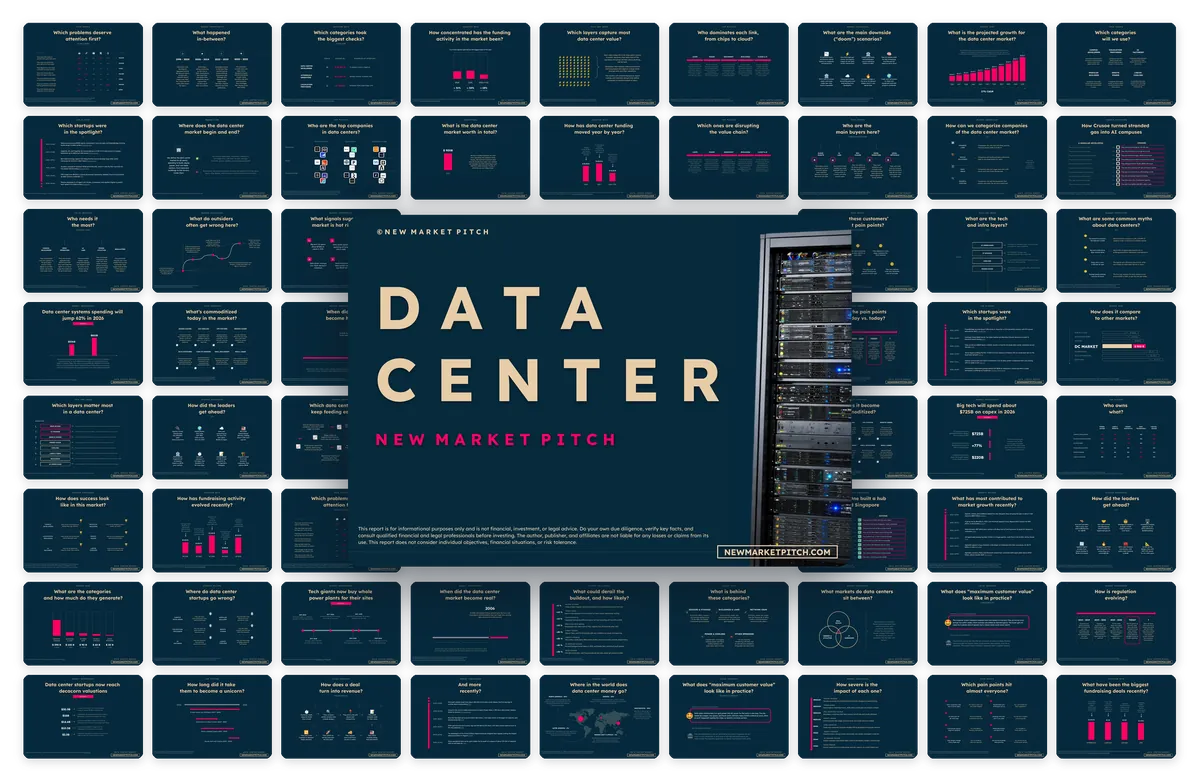
Building a startup or looking for your next investment in data center? Our report gives you the full picture.
Summary
Yes, the 2026 midterms will probably slow some AI data center projects, but they are unlikely to derail America's AI infrastructure boom. The bigger effect will be higher development costs, tougher local approvals, and a growing divide between projects that already have electricity and permits and those still trying to secure them.
The political backlash is growing faster than its measurable impact on construction. Pew Research Center found that negative views of data centers' effects on nearby communities increased by 19 percentage points in just seven months, yet the industry's largest investors are still expanding their infrastructure commitments. Even as opinion turns, the biggest investors keep expanding, so we trace who is getting funded, and by whom, in our report on data centers.
This is becoming a bipartisan problem for developers. Republican concern about household electricity costs increased from 33% to 44%, and Texas Governor Greg Abbott has already ordered a state permitting pause. Supporting American AI leadership no longer guarantees support for a data center in your own neighborhood.
The sheer number of proposed bans makes the opposition look stronger than its immediate impact. At least 16 states have considered restrictions, and more than 300 local moratoriums have been identified, but a SemiAnalysis assessment estimated that only about 2.3 GW of planned capacity faced actual delays from the restrictions it examined.
Existing approvals have become a major competitive advantage. Many moratoriums grandfather previously permitted developments, meaning a project with secured land, grid access, and regulatory approvals could gain value precisely because competing projects face a harder approval process.
The most consequential political response may be making technology companies pay more of their electricity infrastructure costs. Virginia's new large-customer tariff requires minimum payments covering 85% of contracted transmission and distribution demand and 60% of generation demand, reducing the risk that households are left paying for infrastructure built for speculative projects.
Electricity availability remains a bigger immediate constraint than election results. The IEA expects data centers to account for approximately half of more than 420 TWh of additional American electricity demand through 2030, while Amazon has reportedly purchased billions of dollars of AI hardware before the facilities needed to power it were ready.
Big Tech is showing little appetite for retreat. Amazon, Alphabet, Microsoft, and Meta are expected to spend approximately $725 billion on capital expenditures in 2026, while semiconductor equipment manufacturer ASML has reported customer interest in orders extending into 2029 and 2030. These commitments suggest a much longer investment cycle than the immediate election debate.
The financial consequences will be uneven. A one-cent increase in electricity prices adds approximately $87.6 million to the annual power bill of a fully loaded 1 GW campus. Hyperscalers with strong balance sheets and contracted customers can absorb costs that might make a smaller, debt-financed project impossible to justify.
Our conclusion is that the midterms are likely to reshape the geography and economics of AI infrastructure rather than stop its expansion. The real test will be whether political restrictions begin producing sustained project cancellations, longer grid-connection delays, and falling operational capacity additions. For now, the more immediate threat is the collision between enormous computing demand and an electricity system struggling to keep up.

Written by the New Market Pitch teamWe track new markets so founders and investors can move faster. About us

In our report covering the data center market, we always try to gather several sources and make estimates that make sense, so you can work with solid numbers.
Why have AI data centers become such a big issue in the midterms?
AI data centers have become a serious issue in the 2026 midterm elections because more voters are worried about electricity bills, water consumption, and the influence of Big Tech on their communities.
An August 2026 Washington Post investigation examined approximately 1,200 candidate websites and found that nearly 40% of races featured artificial intelligence or data center-related policies. AI appeared more frequently than several established political subjects, including manufacturing and Israel.
The geographical exposure is substantial. A June 2026 Business Insider investigation identified more than 200 data centers under construction across 40 of the 69 most competitive congressional districts. It also reported approximately 1,500 planned facilities across 232 congressional districts. With about 1,500 facilities planned, we ask whether the market is overbuilt or still full in our report covering data centers.
Those numbers explain why politicians are paying attention. Data centers are appearing in communities where elections can be decided by relatively small numbers of voters, and residents increasingly associate these projects with higher electricity demand, construction disruption, and pressure on local resources.
The industry has also become much more visible. Facilities that once attracted little attention now involve multibillion-dollar investments, enormous power requirements, and sometimes hundreds of acres of land.
For candidates, opposing a controversial project can be politically attractive even while supporting American leadership in artificial intelligence.
Are Americans actually turning against AI data centers?
Americans are becoming much more negative about data centers, and Pew Research Center's latest surveys show one of the clearest shifts in public opinion surrounding AI infrastructure.
Between January and August 2026, the share of Americans who considered data centers mostly bad for the environment increased from 39% to 54%. Negative views of their impact on household electricity costs rose from 38% to 50%, while concerns about nearby quality of life jumped from 30% to 49%.
That last increase is particularly striking. In seven months, the share expecting negative neighborhood effects rose by 19 percentage points.
Awareness also improved considerably. The percentage of Americans who had never heard of data centers dropped from 25% to 12%. As more people learned about these facilities, unfavorable opinions became more common.
The economic argument is getting weaker, too. Only 22% of respondents now expect data centers to have a mostly positive effect on local jobs, compared with 25% in January. Meanwhile, the share expecting negative employment effects increased from 15% to 24%.
Negative perceptions of local tax revenue also rose from 12% to 21%. Developers frequently justify new campuses through promises of tax receipts and economic development, so that shift is particularly awkward for the industry.
Public opposition is becoming broader, and the industry's traditional arguments about jobs and tax revenue are convincing fewer people.
| Public perception | January 2026 | August 2026 | Change |
|---|---|---|---|
| Mostly bad for environment | 39% | 54% | +15 pp |
| Mostly bad for household energy costs | 38% | 50% | +12 pp |
| Mostly bad for nearby quality of life | 30% | 49% | +19 pp |
| Mostly bad for local jobs | 15% | 24% | +9 pp |
| Mostly good for local jobs | 25% | 22% | -3 pp |
| Mostly bad for local tax revenue | 12% | 21% | +9 pp |
| Mostly good for local tax revenue | 23% | 22% | -1 pp |
| Never heard of data centers | 25% | 12% | -13 pp |

In our research about data centers, we don't want to repeat what boring consulting reports say. Instead, we show you the real and latest market signals that matter.
Are Republicans turning against AI data centers too?
Republican voters are becoming considerably more critical of AI data centers, making restrictions politically attractive to candidates from both parties.
Pew Research Center's 2026 surveys show that the share of Republican and Republican-leaning voters who consider data centers mostly bad for the environment rose from 31% in January to 47% in August.
Among Democrats and Democratic-leaning voters, the figure increased from 50% to 62%.
The gap between the parties remains meaningful, but opposition is rising on both sides. Republican concern about household energy costs climbed from 33% to 44%, while Democratic concern increased from 44% to 58%.
We see the same pattern in attitudes toward nearby quality of life. Negative views increased from 24% to 42% among Republicans and from 37% to 57% among Democrats.
Texas offers a concrete political example. Republican Governor Greg Abbott ordered a halt to state permits sought by data centers on September 21, citing electricity reliability and water resources.
Democratic lawmakers in New York and Pennsylvania have also supported proposals to suspend or restrict new data center developments.
This bipartisan opposition creates a real headache for developers. A Republican victory does not necessarily protect a project, and Democratic opposition is increasingly focused on specific local costs rather than rejecting artificial intelligence altogether.
Can the midterms actually change federal AI data center policy?
The midterms could change federal AI data center policy, but Congress has less direct control over construction than the political debate sometimes suggests.
Congress can investigate electricity pricing, introduce new infrastructure requirements, change federal tax incentives, and put pressure on regulators. A change in congressional control could also complicate the Trump administration's efforts to accelerate AI development.
However, much of the approval process happens outside Washington.
Local governments control many zoning and land-use decisions. State agencies handle important environmental permits, while electricity regulators decide how utilities charge large customers and recover infrastructure costs.
That leaves congressional candidates in an interesting position: they can campaign against data centers without necessarily having the authority to cancel a proposed facility in their district.
Timing creates another limitation. The election takes place on November 3, 2026, and the new Congress takes office in January 2027. Any major federal restriction would still need to move through the legislative process.
A change in political control could make future projects more difficult or expensive. Facilities already under construction are much less exposed to an immediate change in congressional policy.

In our market report about data centers, we like to show you the big picture. We know your time is precious, so we make every page quick to read and packed with as much learning as possible per minute.
Are AI data centers really making electricity bills more expensive?
AI data centers are adding pressure to electricity costs in parts of the United States, particularly where utilities need expensive grid upgrades to meet rapidly growing demand.
According to the Energy Information Administration, average American retail electricity rates increased approximately 7.1% in 2025.
The increases were much larger in certain markets. Brookings highlighted electricity price increases of 26.3% in Washington, D.C., 18.9% in Pennsylvania, and 16.3% in Rhode Island. Double-digit price jumps in a few states are the kind of unsolved problem we go through in our data centers market report.
These figures should not be interpreted as the amount of inflation caused by data centers. Natural gas prices, transmission investments, weather, and other infrastructure expenses also affect electricity bills.
Still, the demand created by AI infrastructure is large enough to influence the electricity system.
The International Energy Agency's Electricity 2026 outlook projects that American electricity consumption will increase by more than 420 terawatt-hours between 2026 and 2030. Data centers are expected to account for approximately half of that additional demand.
That implies roughly 210 TWh of additional annual electricity consumption from data centers by 2030, based on the IEA's forecast.
For context, 210 TWh represents about 5% of America's annual electricity consumption in recent years. That's a lot of new demand to accommodate over a relatively short period.
The political argument becomes especially contentious when utilities build new infrastructure for large commercial customers and recover part of those costs through residential electricity rates.
Can politicians make Big Tech pay for its own electricity infrastructure?
Regulators can force AI data center operators to cover more of their electricity infrastructure costs, and Virginia has already introduced one of the strongest examples.
In November 2025, Virginia's State Corporation Commission approved a separate GS-5 electricity rate class for customers requiring at least 25 megawatts of capacity.
Beginning in January 2027, affected large customers face minimum payment requirements covering 85% of their contracted transmission and distribution demand and 60% of generation demand, even when their electricity consumption falls below expectations.
The rules also include long-term service commitments and financial protections intended to prevent utilities from leaving existing customers responsible for infrastructure built for abandoned or underused projects.
Consider what happens if a utility spends hundreds of millions of dollars preparing for a data center that ultimately needs much less electricity than promised. Without adequate contractual protections, other customers could end up absorbing part of the financial burden.
The federal government has moved in a similar direction.
In March 2026, Amazon, Google, Meta, Microsoft, OpenAI, Oracle, and xAI signed the White House Ratepayer Protection Pledge, committing to cover the infrastructure costs associated with their electricity requirements.
However, these corporate commitments are less specific than Virginia's enforceable tariff rules.
A utility contract with minimum payments and financial guarantees provides clearer protection than a broad corporate promise. And Virginia has already given other states a model they can adapt.
Tougher cost-allocation rules could become one of the most lasting consequences of the political backlash, even if the national AI construction boom continues.

In our document detailing everything you need to know about data center, we turn what is vague and complex into simple, useful visuals. Market maps like this one show you at a glance where every startup stands.
Which states are trying to block new AI data centers?
At least 16 states have considered statewide restrictions on data centers during 2026, according to a September assessment by the National Conference of State Legislatures. But relatively few proposals have become binding statewide bans.
Some lawmakers want to stop development temporarily while regulators study electricity and water requirements. Others are trying to give local governments more power over approvals or limit incentives offered to developers.
The proposed restrictions vary considerably.
Georgia introduced legislation that would prevent local governments from permitting data centers until December 2028. Pennsylvania considered a three-year pause, while New York lawmakers backed a one-year moratorium on large facilities.
Texas has gone further through executive action, with Governor Abbott ordering state agencies to pause permits pending electricity and water-related audits. New York has also used executive action to impose a temporary pause on certain new developments.
Other efforts have failed. Maine's moratorium legislation was vetoed, Maryland's proposed prohibition did not pass, and Virginia's proposal was continued rather than enacted.
A proposed moratorium also differs from an operating restriction. Many measures would affect new approvals while allowing previously permitted facilities to proceed.
So claims that entire states have banned data centers can be misleading. The number of states debating restrictions is much larger than the number that have implemented comprehensive prohibitions.
| State | Proposed or implemented restriction | Reported status |
|---|---|---|
| Texas | State permit pause pending electricity and water audits | Governor's directive |
| Georgia | Suspend local permitting until December 2028 | Introduced |
| Michigan | Suspend new approvals until April 2027 | Introduced |
| New Jersey | Six-month pause on approvals, construction, or incentives | Introduced |
| New York | One-year legislative moratorium proposal for facilities above 20 MW; separate executive permitting pause | Passed legislature; executive action |
| Pennsylvania | Three-year pause or expanded municipal authority | Introduced |
| South Carolina | Suspend approvals pending oversight rules | Introduced |
| Virginia | Delay approvals until interconnection conditions are met or July 2028 | Continued |
| Maine | Pause facilities above 20 MW until November 2027 | Vetoed |
| Maryland | Prohibition on new data center permits and construction | Failed |
Have data center moratoriums actually slowed construction?
Data center moratoriums have disrupted some projects, but the available estimates suggest that their national impact remains relatively small compared with the industry's construction pipeline.
A September 2026 SemiAnalysis assessment identified more than 300 local moratoriums across 17 states. Moratoriums spreading across 17 states are a big shift, and we cover what has changed in the last 12 months in our data centers report.
The analysis estimated that approximately 2.3 gigawatts of capacity faced actual delays nationally, including the effects of state-level intervention, despite roughly 20 GW of planned capacity being located within areas exposed to local restrictions.
That means only around one-tenth of the nominally exposed capacity appears likely to face an actual delay. The affected megawatts matter much more than the number of moratoriums announced.
Compared with the roughly 38 GW of American data center IT capacity projected for delivery in 2027, the potentially delayed projects represent approximately 6%. The figures use different capacity definitions and time frames, so the comparison is best treated as an indication of scale.
The surprisingly limited impact partly reflects how permitting works. Many restrictions exclude projects that already received approval, while others target locations where developers have alternative sites.
Local moratoriums can also expire before large projects reach their construction phase.
The bigger risk is accumulating delays for future developments. A facility planned for 2029 or 2030 may encounter much more political resistance than one already being built today.

Our report covering the data center market gets updated several times a month, so you always get the latest view of where things stand.
Why did Texas suddenly pause new AI data centers?
Texas paused new data center permits because concerns about electricity reliability and water consumption became politically difficult to ignore, even in one of America's most business-friendly states.
On September 21, Governor Greg Abbott directed the Texas Commission on Environmental Quality to halt permits sought by data centers until the Electric Reliability Council of Texas and relevant state agencies completed their audits.
The decision followed growing local opposition to projects requiring large quantities of electricity and, in some cases, substantial water resources.
The Texas Tribune described the directive as part of an escalating effort to restrict data center development ahead of Abbott's reelection campaign.
The state's importance to AI infrastructure makes the intervention especially striking. Texas offers abundant land, extensive energy production, and access to a large electricity market, making it attractive to companies planning enormous computing campuses.
But the implementation has already raised questions.
An October Houston Chronicle investigation reported that Public Citizen and FracTracker identified at least 16 permit applications that continued moving through administrative processes after Abbott's directive.
State officials maintained that no prohibited permits had been approved.
There is clear evidence of an official permitting pause, although its practical effect on construction remains less certain.
Texas is a warning to developers who assumed a business-friendly state would always welcome more AI infrastructure. Political support can change quickly when electricity and water become election issues.
Is Big Tech still spending billions on AI data centers despite the backlash?
Big Tech is still pouring enormous amounts of money into AI infrastructure, and current investment plans show no broad retreat because of the midterm elections.
Amazon, Alphabet, Microsoft, and Meta are collectively expected to spend approximately $725 billion in capital expenditures during 2026, based on company guidance and industry estimates. Hundreds of billions in planned capex are big bets; we follow which investors are making the biggest ones in our data center market report.
The pace has accelerated sharply. In the second quarter of 2026, those four companies spent approximately 77% more on capital expenditure than a year earlier.
The total includes AI servers, networking equipment, computing facilities, and other infrastructure. It should not be confused with spending exclusively on constructing data center buildings.
Even with that distinction, the amount is extraordinary.
These four companies alone are investing close to $2 billion per day on average across the year. Their combined annual spending now exceeds the entire yearly economic output of many developed countries.
The commitment also extends beyond equipment purchases.
ASML reported in its third-quarter 2026 results that semiconductor manufacturers were already expressing interest in placing equipment orders for 2029 and 2030. Its CEO warned that planned supply for 2027 and 2028 might not meet customer demand.
Major chip suppliers are preparing for several more years of heavy AI infrastructure investment.
There is an important financial distinction, though. Amazon, Microsoft, Alphabet, and Meta can support enormous investments through established businesses, even as spending puts pressure on their cash flow. Smaller AI infrastructure operators relying heavily on borrowing face much greater pressure if electricity connections or construction schedules slip.
For now, political opposition has not persuaded the industry's biggest investors to reduce their ambitions.

In our research about data centers, you will always find fresh funding data, taken straight from our own verified funding database.
Could electricity shortages slow AI data centers more than the midterms?
Electricity shortages are already delaying AI computing capacity, and they currently represent a more immediate obstacle than the congressional elections.
An October 2026 Business Insider investigation found that Amazon was buying large quantities of Nvidia AI hardware before the data centers intended to operate it were ready.
The company had committed approximately $5 billion to Nvidia GB300 server racks through an early-receipt program, with additional purchases potentially reaching $3 billion per month.
Some equipment remained unused in intermediary warehouses because the necessary power infrastructure was unavailable.
These unused systems are sometimes described as dark GPUs. They represent expensive computing equipment that has been purchased but cannot yet generate revenue.
Amazon previously tended to receive and account for equipment closer to deployment. Its willingness to purchase hardware earlier reflects intense competition for AI computing supply, even when physical facilities are running behind schedule.
There are similar constraints elsewhere in the industry. The International Energy Agency has warned that electricity infrastructure, grid equipment, and other physical bottlenecks are limiting the fastest data center growth scenarios.
Building a computing campus can take less time than constructing the transmission lines or additional generation required to power it.
The political backlash may worsen those delays through new permitting rules. But electricity shortages are already affecting real investment decisions, regardless of who wins in November.
Could higher electricity costs kill some AI data center projects?
Higher electricity and infrastructure costs could make some AI data center projects uneconomic, especially smaller developments built around borrowed money and optimistic assumptions about future customers.
The impact depends heavily on facility size.
A 100 MW data center operating continuously at full load would consume approximately 876 GWh of electricity annually. A 1 GW campus would consume ten times as much, or 8.76 TWh.
An increase of just one cent per kilowatt-hour would therefore add approximately $8.8 million in annual electricity costs for the smaller facility and $87.6 million for the larger one.
These calculations assume full load throughout the year and are illustrative rather than estimates for specific operators.
For companies operating several large campuses, electricity pricing can quickly affect annual expenses by hundreds of millions of dollars.
The financial exposure is particularly severe when developers also need to fund transmission upgrades, purchase backup generation, or guarantee long-term minimum electricity payments.
Amazon and Microsoft have considerably more financial flexibility than a small developer financing GPU purchases against expected rental income.
Of course, a project becoming more expensive does not automatically make it unprofitable. High-demand facilities with long-term customer contracts may absorb additional electricity costs, while speculative projects have much less room for error.
Stricter electricity tariffs will probably eliminate some weaker projects before they reach construction, particularly in locations where cheap grid access was central to the original business case.

In our market report about data centers, we look at what the winners do differently, so you can learn from the best instead of guessing.
Will AI companies move data centers to states with fewer restrictions?
AI companies are likely to shift some future data center projects toward more welcoming states, although moving a major development is far more complicated than simply choosing cheaper land.
Developers need enormous amounts of electricity, available grid connections, fiber networks, suitable land, construction workers, and workable cooling systems. Land, grid access and fiber all have to line up, so we point to where the biggest opportunities are in our data center market report.
A proposed campus may spend years securing those resources before construction begins.
If local authorities suddenly introduce a moratorium, moving elsewhere can mean restarting the entire development process. Previously secured grid capacity may also be lost.
That makes early-stage projects much more mobile than facilities already under construction.
And the strictest states will not necessarily lose the most investment.
Virginia, for example, has introduced demanding electricity tariffs while maintaining a regulatory path for large data centers to obtain service. Developers may prefer predictable rules and reliable electricity over a supposedly permissive jurisdiction where power access remains uncertain.
Companies are also changing how they deal with local communities.
An October 2026 Wall Street Journal investigation described Google and Amazon engaging earlier with residents and officials over water consumption, infrastructure requirements, and local benefits.
Developers are learning that community opposition can affect project schedules, sometimes quite substantially.
The likely result is a redistribution of future investment. Locations that can offer predictable permitting, sufficient electricity, and acceptable infrastructure costs should attract more projects, while politically hostile communities may lose developments that are still in their early planning stages.
Could the midterms make AI data center tax breaks disappear?
The midterms could put AI data center tax incentives under greater pressure, particularly where voters believe large technology companies receive generous benefits while local households pay more for electricity.
One area of controversy involves accelerated depreciation under the 2025 federal tax legislation known as the One Big Beautiful Bill.
Some Democratic campaigns have portrayed the legislation as providing tens of billions of dollars in benefits to data center developers.
Accelerated depreciation applies to eligible business investments across multiple industries. It allows companies to deduct qualifying investment expenses more quickly, improving near-term cash flow rather than necessarily changing the total amount that can ultimately be deducted.
State and local incentives are more directly tied to data center development.
Governments sometimes offer sales-tax exemptions on equipment, property-tax arrangements, or other financial benefits to attract large computing campuses.
For projects involving billions of dollars in servers and related equipment, these incentives can be financially significant.
The political calculation becomes harder when residents expect relatively few permanent jobs but see growing demand for electricity, water, and local infrastructure.
Tax incentives are therefore an obvious target for lawmakers seeking to show that technology companies should contribute more to the communities hosting them.
Removing benefits could raise the cost of certain developments without requiring a direct construction ban.

If you build or invest in the data center market, you need to know which business models pay off now and which ones are fading. That's why our document detailing everything you need to know about data center has a whole section on it.
Can AI companies avoid grid problems by building their own power plants?
AI companies can reduce grid constraints by securing dedicated electricity generation, but building their own power supply remains expensive, complicated, and often slow.
Nuclear power is one increasingly visible approach.
Microsoft has supported the planned restart of Pennsylvania's Crane Clean Energy Center, formerly Three Mile Island Unit 1. Google has agreements associated with the proposed restart of Iowa's Duane Arnold nuclear facility, while Michigan's Palisades plant is also being revived. Plans to restart old nuclear plants are moving, and we separate what works today from what is still hype in our report on data centers.
An October 2026 Associated Press report estimated that these three restart projects could collectively provide approximately 2.25 GW of generation capacity, supported by up to $4.4 billion in federal loans.
If operated continuously at full output, 2.25 GW could generate approximately 19.7 TWh of electricity annually. Actual generation would be lower because maintenance and operating conditions reduce annual output.
That is meaningful additional capacity, although it remains modest compared with the projected growth in American data center electricity demand.
Companies are also exploring natural gas generation, long-term power purchase agreements, and facilities designed around dedicated energy infrastructure.
The White House Ratepayer Protection Pledge encourages major AI companies to secure the electricity needed for their operations and cover associated infrastructure costs.
However, dedicated power plants still require permits, equipment, construction workers, fuel arrangements, and sometimes transmission connections.
Nuclear restarts are especially difficult to treat as a short-term solution because regulatory approvals and plant refurbishment can take years.
Private generation gives developers more options and could eventually reduce their exposure to congested electricity grids. It cannot immediately solve every shortage.
What would prove that the midterms are really hurting the AI data center boom?
A sustained increase in canceled projects, delayed electricity connections, and reduced construction spending caused by political restrictions would be the strongest evidence that the midterms are seriously damaging AI data center growth.
Right now, the evidence is much stronger for rising political resistance than for a nationwide construction slowdown.
We have hundreds of local restrictions and several proposed statewide moratoriums. Yet the largest technology companies continue committing hundreds of billions of dollars to computing infrastructure, and the reported direct impact of moratoriums remains relatively limited.
The important question is what happens to projects that have not yet received approval.
If several major states adopt binding moratoriums, or if new electricity tariffs make planned developments financially unattractive, the consequences could become much larger over the next few years.
A decline in hyperscaler capital spending would also deserve attention. However, that would require careful interpretation because companies might cut investment for reasons unrelated to politics, including weaker AI demand, tighter financing, or disappointing returns.
We should also distinguish facilities announced by developers from capacity that actually becomes operational. A proposed 1 GW campus contributes nothing to computing supply until its equipment is installed and its electricity infrastructure is ready.
The most useful evidence will come from completed capacity, construction timelines, project cancellations, and the specific reasons developers give for changing their plans.

When you build or invest in the data center market, you need clarity, not confusion. In our report covering the data center market, we always try to put numbers on and quantify whatever is usually vague and confusing.
Will the midterms slow down the AI data center boom?
Yes, the 2026 midterms will probably slow some AI data center projects, but the evidence currently points to a more expensive and politically difficult expansion rather than a nationwide collapse.
Public opposition has grown rapidly. Pew's surveys show Americans becoming considerably more negative about electricity costs, environmental damage, and the effects of data centers on nearby communities.
The backlash has also crossed party lines. Texas has already imposed a permitting pause under a Republican governor, while lawmakers in several Democratic-led states are pushing for their own restrictions.
But actual investment tells a different story.
Amazon, Alphabet, Microsoft, and Meta are collectively planning approximately $725 billion in annual capital expenditures, and major semiconductor suppliers are preparing for demand several years into the future.
The most widely reported assessment of local moratoriums suggests that only a small share of near-term planned capacity faces direct delays from those restrictions.
Electricity availability may ultimately cause more disruption than the election. Amazon's purchases of AI hardware that cannot yet be powered show that infrastructure shortages are already creating expensive operational problems.
The political consequences will become clearer as new projects seek approvals and electricity connections.
Developers with secured power, existing permits, and strong financial backing should remain well positioned. Projects dependent on uncertain grid connections, generous subsidies, or local acceptance that has not yet been secured face a much tougher environment.
Our conclusion is that the midterms will make the AI data center boom slower in some places, more selective, and more expensive. They are unlikely to stop the national expansion while demand for computing power and investment from the largest technology companies remain this strong.
Sources and methodology
To assess whether the 2026 midterms will slow America's AI data center boom, we broke the question into the factors that can actually change how quickly computing capacity gets built. We examined recent developments in public opinion, electoral pressure, state and local restrictions, electricity pricing, grid availability, project delays, and corporate investment. Each dimension was assessed separately before we brought the evidence together to form our conclusion.
We focused on recent, measurable developments rather than relying on political rhetoric or industry expectations. Repeated Pew Research Center surveys provided a consistent basis for measuring changes in public attitudes, while state legislative records, executive directives, and utility regulatory orders allowed us to distinguish proposed restrictions from measures already in force. We compared these political developments with project-level research to assess how much planned capacity was actually at risk of delay.
For the infrastructure and investment side, we examined International Energy Agency electricity forecasts, utility cost-allocation rules, reported construction bottlenecks, company financial disclosures, and semiconductor equipment demand. We gave particular weight to observable developments such as existing permits, contracted electricity capacity, identified project delays, and disclosed capital expenditure plans. We also separated electricity shortages from politically imposed restrictions, since both can delay construction but have different causes and implications.
Several comparisons required specific treatment. The estimated 2.3 GW of politically delayed capacity comes from SemiAnalysis's project-level assessment and includes state-level effects; it should not be interpreted as the total capacity covered by moratoriums. Its comparison with projected national IT capacity is indicative because the measures and time frames are not identical. Similarly, the approximately $725 billion hyperscaler investment estimate includes equipment and infrastructure beyond data center construction, while our illustrative electricity-cost calculations assume continuous full-load operation rather than actual facility utilization.
Our conclusions reflect the combined weight of these findings. We looked for consistency between political developments and measurable changes in construction or investment, distinguished near-term disruptions from longer-term exposure, and avoided treating announced projects as completed computing capacity. This approach provides a more defensible answer to the central question: how far is the political backlash actually changing the speed, cost, and geography of America's AI infrastructure expansion?
Key sources used for this analysis include: Pew Research Center's latest data center public-opinion survey, Pew's earlier survey baseline, the National Conference of State Legislatures' moratorium tracker, the Texas governor's official permitting directive, SemiAnalysis's project-level moratorium assessment, the IEA's Electricity 2026 demand outlook, the IEA's analysis of AI and energy security, U.S. Energy Information Administration electricity pricing data, Virginia's State Corporation Commission decision on large electricity users, and the White House Ratepayer Protection Pledge.
For corporate investment and energy supply, we also used Amazon's second-quarter financial results, Alphabet's SEC financial disclosure, Microsoft's fiscal fourth-quarter earnings commentary, Meta's second-quarter results, ASML's third-quarter 2026 disclosures, Constellation Energy's Crane Clean Energy Center announcement, the Department of Energy's Palisades project information, and the Department of Energy's Duane Arnold financing announcement.

A good product starts with a real problem. In our research about data centers, we show you the ones customers still live with.
Written by the New Market Pitch teamWe track new markets so founders and investors can move faster. About us