Who are the top investors in defense AI?
Building a startup or looking for your next investment in defense AI? Our report gives you the full picture.
Summary
8VC, Lakestar and Lockheed Martin Ventures are tied as the most active defense AI investors, with 9 equity rounds joined each. Sequoia Capital, Accel and Booz Allen Ventures are tied behind them at 8 rounds each. Yet those names play quite different roles when startups raise money.
Sequoia Capital was named lead in 8 rounds, while Lockheed Martin Ventures led 2. If a founder wants someone to lead a financing, that distinction can matter more than how often a fund's name appears in an announcement.
Lockheed Martin's venture arm has another advantage: its parent builds defense systems. The company expanded its venture fund capacity to $1 billion in April 2026, giving it room to keep backing technologies that could end up in military programs.
Traditional VCs are doing far more than watching from the sidelines. Andreessen Horowitz joined 7 rounds involving companies including Anduril and Saronic; Bessemer Venture Partners joined 6, including Auterion and NODA AI.
Activity has continued this year. Lakestar joined 7 rounds and Booz Allen Ventures 5, and all 20 of the most active investors have appeared in at least one qualifying round this year.
The investors who show up earliest are a different group. Of the 199 rounds with a known stage, 91 were seed rounds, and 8VC backed more of those than anyone else in our research.
Big growth rounds bring in a different set of investors. Advent International has joined the most Series D and later rounds, a sign that established growth investors are willing to back defense AI companies expanding beyond prototypes.
European investors have a place in that picture. Lakestar and the NATO Innovation Fund back companies such as TYTAN Technologies, and European funds regularly invest alongside American firms.
Investors sometimes return to the same companies together. Accel and Lakestar appear repeatedly alongside one another, as do Lockheed Martin Ventures and SAIC Ventures. A few such pairings recur, but this is not a market divided into fixed investment clubs.
So the choice of a top defense AI investor depends on the job. 8VC, Lakestar and Lockheed Martin Ventures join the most rounds, Sequoia Capital has the stronger record as a named lead, 8VC stands out at seed, and Advent International is prominent in later financings.

Written by the New Market Pitch teamWe track new markets so founders and investors can move faster. About us

In our report covering the defense AI market, you will always find fresh funding data, taken straight from our own verified funding database.
Which VCs invest the most in defense AI right now?
8VC, Lakestar and Lockheed Martin Ventures are the most active investors in defense AI right now, tied at 9 rounds joined each.
Among the three tied investors, our table lists 8VC ahead of the other two because it was named lead in 5 of those rounds, against 3 for Lakestar and 2 for Lockheed Martin Ventures. Sequoia Capital, Accel and Booz Allen Ventures are tied behind them at 8 rounds each. Lockheed Martin Ventures and Booz Allen Ventures are corporate venture arms, so among traditional VC firms, 8VC and Lakestar share the lead on participation.
Sequoia Capital and 8VC more often take a publicly named lead role, while Lockheed Martin Ventures and Lakestar frequently participate alongside another lead. Andreessen Horowitz and Accel also appear repeatedly. Lockheed Martin Ventures backs autonomy and mission software across different products.
The table below ranks the 20 most active defense AI investors by the number of equity rounds they joined, with the rounds they led, their main stages, the startups they backed and the biggest round they joined.
If you want to go more into detail and get more data to understand what investors are betting on now, please check our defense AI report.
| # | Investor | Rounds | Led | Main stages | Defense AI startups backed | Biggest round joined | Latest round |
|---|---|---|---|---|---|---|---|
| 1 | 8VC ▲ | 9 | 5Usually leads (83% of the 6 rounds with a known lead) |
Seed 5Series A 2 | CHAOS Industries, Overland AI, Gallatin AI, Terra Industries, CX2 | $510MCHAOS Industries · 2025 | Oct 2026 |
| 2 | Lakestar ▲ | 9 | 3Mostly follows (led 38% of the 8 rounds with a known lead) |
Seed 4Series A 4 | UFORCE, Cambridge Aerospace, TYTAN Technologies, Agon, SE3 | $700MUFORCE · 2026 | Nov 2026 |
| 3 | Lockheed Martin Ventures ▲ | 9 | 2Mostly follows (led 25% of the 8 rounds with a known lead) |
Series A 4Seed 2 | HavocAI, Firestorm Labs, Fortem Technologies, Vatn Systems, Primordial Labs | $100MHavocAI · 2026 | Nov 2026 |
| 4 | Sequoia Capital ▲ | 8 | 8Named as lead in every round found | Seed 2Series C 2 | STARK Defence, Neros Technologies, Cathedral, Kela Technologies | $550MSTARK Defence · 2026 | Aug 2026 |
| 5 | Accel ▼ | 8 | 5Usually leads (71% of the 7 rounds with a known lead) |
Series A 2Series B 2 | CHAOS Industries, Cambridge Aerospace, Twenty, SE3, Unmannd | $510MCHAOS Industries · 2025 | Nov 2026 |
| 6 | Booz Allen Ventures ▲ | 8 | 1Mostly follows (led 14% of the 7 rounds with a known lead) |
Series A 3Series B 2 | Reveal Technology, NODA AI, Firestorm Labs, Scout AI, Hadean + 1 more | $100MScout AI · 2026 | Oct 2026 |
| 7 | Andreessen Horowitz ▲ | 7 | 6Usually leads (86% of its rounds) |
Seed 3Series B 1 | Anduril, Saronic, Air Space Intelligence, Cathedral, Rune Technologies + 2 more | $5.0BAnduril · 2026 | Oct 2026 |
| 8 | Bessemer Venture Partners ▲ | 6 | 6Named as lead in every round found | Series A 3Seed 2 | Auterion, TurbineOne, NODA AI, Picogrid, DEFCON AI + 1 more | $105MAuterion · 2025 | May 2026 |
| 9 | Founders Fund ▲ | 5 | 4Usually leads (80% of its rounds) |
Series D+ 2Seed 1 | Anduril, STARK Defence, Watchtower Labs | $2.5BAnduril · 2025 | Oct 2026 |
| 10 | Lux Capital ▼ | 5 | 3Usually leads (75% of the 4 rounds with a known lead) |
Series A 3Seed 1 | Cambridge Aerospace, Kela Technologies, Terra Industries, ConductorAI | $300MCambridge Aerospace · 2026 | Aug 2026 |
| 11 | NATO Innovation Fund ▼ | 5 | 3Usually leads (75% of the 4 rounds with a known lead) |
Seed 2Series A 1 | TEKEVER, Kraken Technology Group, TYTAN Technologies, ARX Robotics | $80MTEKEVER · 2025 | Feb 2026 |
| 12 | Silent Ventures ▲ | 5 | 2Named as lead in every round found (lead known for 2 of 5 rounds) |
Seed 3Series A 2 | Gallatin AI, Swarm Aero, Traysar Industries, Aeon Industrial | $50MGallatin AI · 2026 | Oct 2026 |
| 13 | Axon Enterprise ▲ | 4 | 4Named as lead in every round found | Seed 2Series D+ 2 | Skydio, Buntar Aerospace, Farsight Vision | $255MSkydio · 2026 | Nov 2026 |
| 14 | Draper Associates ▲ | 4 | 4Named as lead in every round found | Series A 3Seed 1 | Vermeer, Scout AI, Aurelius Systems | $100MScout AI · 2026 | Aug 2026 |
| 15 | Expeditions Fund ▲ | 4 | 4Named as lead in every round found | Seed 3Series A 1 | Project Q, Twin Prime, EGIDE, Sky Spy | $17MProject Q · 2026 | Jun 2026 |
| 16 | Shield Capital ▲ | 4 | 3Usually leads (75% of its rounds) |
Seed 2Series A 2 | UFORCE, Distributed Spectrum, Watchtower Labs | $700MUFORCE · 2026 | Nov 2026 |
| 17 | Point72 Ventures ▲ | 4 | 3Usually leads (75% of its rounds) |
Series A 3Seed 1 | Overland AI, Smack Technologies, CX2, Lumbra | $31MCX2 · 2025 | Nov 2026 |
| 18 | General Catalyst ▼ | 4 | 3Usually leads (75% of its rounds) |
Series C 2Seed 1 | Helsing, Onebrief, Aurelius Systems | $1.8BHelsing · 2026 | Jul 2026 |
| 19 | Valor Equity Partners ▲ | 4 | 2Leads half its rounds | Series A 1Series B 1 | UFORCE, CHAOS Industries, Overland AI | $700MUFORCE · 2026 | Nov 2026 |
| 20 | Advent International ▲ | 4 | 2Leads half its rounds | Series D+ 4 | Shield AI, Saronic, Quantum Systems | $1.8BSaronic · 2026 | Nov 2026 |
No investors match this search.
Data from January 2024 through 14 November 2026, which is enough to show who is active today and who has been for years. Rounds: equity rounds in which the investor is named. Led: rounds it led or co-led. ▲ more rounds in 2026 so far than its 2025 pace, ▼ fewer.

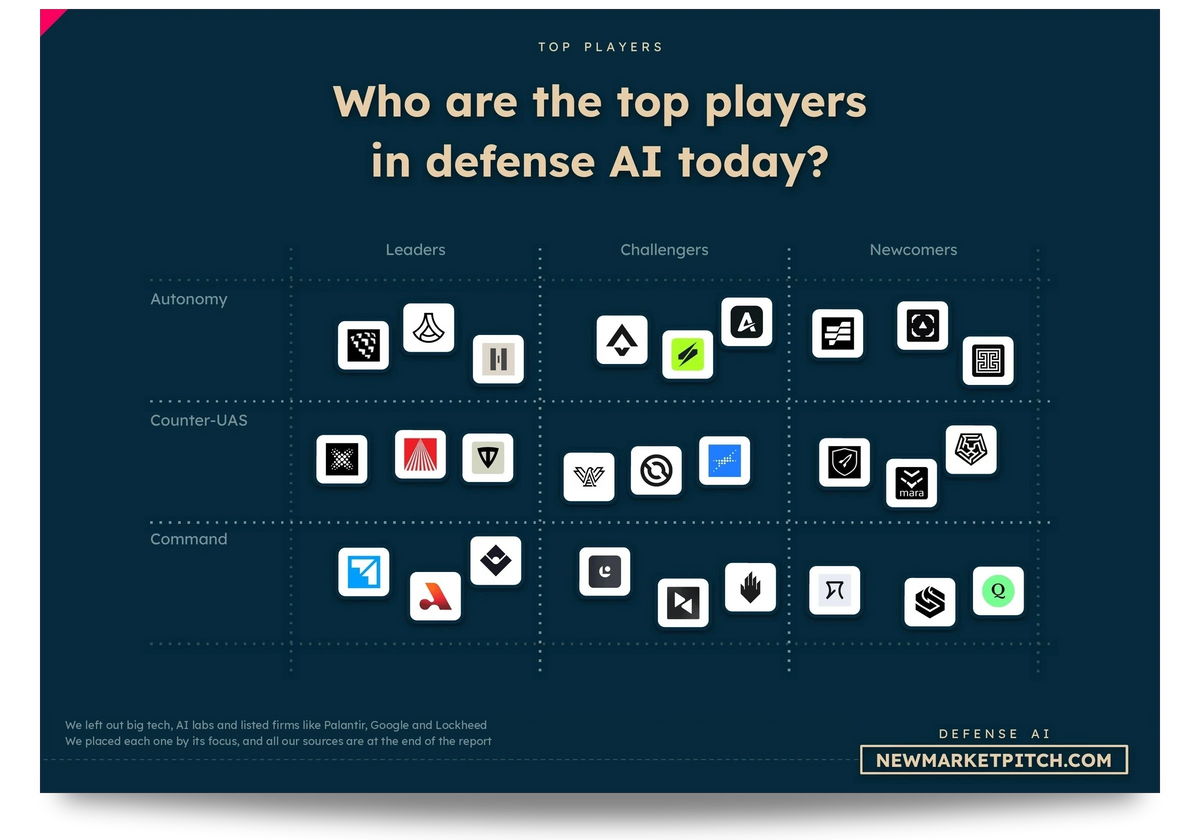
In our research about AI for defense, we turn what is vague and complex into simple, useful visuals. Market maps like this one show you at a glance where every startup stands.
Is Lockheed Martin Ventures still the busiest defense AI investor?
Yes, Lockheed Martin Ventures shares first place in defense AI deal activity with 8VC and Lakestar, because it backs different types of military AI instead of concentrating on one product.
We found investments involving HavocAI, Firestorm Labs, Fortem Technologies, Vatn Systems and Primordial Labs. HavocAI works on autonomous maritime operations, Vatn Systems develops underwater vehicles, and Primordial Labs builds military mission software. Those are separate problems, but all sit close to systems that a large defense contractor might eventually help field.
Lockheed Martin increased its venture fund capacity from $400 million to $1 billion in April 2026. The company said the expansion would help develop technologies needed by the defense industrial base. Lockheed Martin Ventures also offers startups access to engineers, facilities and integration expertise. Such help can be useful when military buyers want proof that new software works with existing equipment.
The firm was named lead in 2 of its 9 qualifying rounds. It keeps showing up across different military AI products, but the round counts cannot tell us who writes the biggest individual checks.
Does Sequoia Capital lead more defense AI rounds than Lockheed Martin Ventures?
Yes, Sequoia Capital is named as lead more often in defense AI fundraising than Lockheed Martin Ventures.
Sequoia Capital was named lead in 8 rounds, compared with 2 for Lockheed Martin Ventures. It appeared in financings for STARK Defence, Neros Technologies, Cathedral and Kela Technologies, so this is a repeated role across different companies.
Neros offers a concrete example. In August 2026, the company named Sequoia as a co-lead of financing intended to expand its autonomous and interceptor drone programs. Neros described its Archer AI autonomy software and its Bandit counter-drone work. Sequoia was backing a company whose software helps decide how the equipment operates in a mission.
There is a reason to care who leads. NODA AI's February financing, for example, named Bessemer Venture Partners as lead while Booz Allen Ventures joined as an investor. A startup may want one firm to lead the next round and another to help it reach military customers. We cannot infer the size of either firm's check from a round announcement. Nor should published lead rates be treated as a complete picture: announcements tend to name leads more reliably than smaller investors.

Your time is limited. In our market report about AI for defense, we put numbers on each part of the market, so you can see where it makes sense to focus.
Is 8VC the main seed investor in military AI?
Yes, 8VC has joined more defense AI seed rounds than any other investor we identified.
It backed 5 seed rounds, with investments spanning Overland AI, Gallatin AI, Terra Industries and CX2. Overland AI builds autonomous ground systems, Gallatin AI helps military teams handle logistics, and CX2 works in electronic warfare. They give 8VC several routes into software that military units might use every day.
Overland AI said in its 2026 financing announcement that its systems were being deployed with U.S. armed forces. Axios reported in October 2026 that Gallatin's Navigator was already being used by military units and that 8VC joined the company's Series A alongside Silent Ventures. Those are useful tests of the seed bets: the products have to help troops move, plan or respond in difficult conditions.
8VC also joins later financings, including CHAOS Industries' $510M Series D+ in 2025, and it is now tied for first place overall. The early rounds, though, give founders a clear record to examine when looking for a seed investor in military AI.
Is Andreessen Horowitz really leading defense AI investing?
Andreessen Horowitz is a leading defense AI investor, although it does not join the most rounds.
It participated in 7 qualifying rounds and was named lead in 6. The companies include Anduril, Saronic, Air Space Intelligence, Cathedral and Rune Technologies. Anduril builds software-led autonomous military systems, Saronic works on autonomous maritime craft, and Air Space Intelligence helps people make complex operational decisions. The products differ, but all put software at the heart of a defense mission.
The firm's public reputation is closely tied to its American Dynamism work. In October 2026, Andreessen Horowitz argued that successful prototypes mean little if companies cannot manufacture and deploy what they have designed. That argument fits Anduril's factory ambitions and helps explain why the firm backs companies that combine software with physical systems.
Anduril gives the firm a public profile few defense investors can match. Still, 8VC, Lakestar, Sequoia Capital and Accel have joined more qualifying rounds among traditional VCs. Andreessen Horowitz remains important without taking first place in participation.
Has Founders Fund stopped investing in defense AI beyond Anduril?
No, Founders Fund is still backing defense AI companies other than Anduril.
We counted 5 rounds joined and 4 named leads involving Anduril, STARK Defence and Watchtower Labs. Anduril remains Founders Fund's best-known defense bet, but its newer investments show interest in other products.
STARK Defence develops autonomous military systems in Europe. Watchtower Labs works on AI-assisted decisions for military operations. In October 2026, Shield Capital announced a seed round for Watchtower Labs led alongside Conviction, with Founders Fund participating. Shield Capital said Watchtower Labs had worked with the Naval Postgraduate School and was selected for a Defense Innovation Unit sustainment program.
Founders Fund now backs businesses tied to military planning and sustainment as well as autonomous equipment. Its deal count is below the leaders, but it has joined rounds this year. Anduril is still the flagship name, not the entire defense AI portfolio.
Are traditional defense contractors taking over defense AI venture investing?
No, defense contractors have become major defense AI investors, but independent VCs still lead many of the financings.
Lockheed Martin Ventures shares the highest participation count with 8VC and Lakestar, and Booz Allen Ventures is in the next tied group. Axon Enterprise backed Skydio, Buntar Aerospace and Farsight Vision and was named lead in all 4 of its rounds. These companies can offer young startups relationships with engineering teams and buyers who already work in defense or public safety.
Independent venture firms remain prominent when a startup needs someone to lead a new round. Sequoia Capital, 8VC and Andreessen Horowitz have all led qualifying financings. The two groups can bring different kinds of support to the same company.
For a startup developing military autonomy, help integrating software with existing systems can be valuable. Another founder may need a VC to take the lead on a risky new round. Both options are available in defense AI today.

In our document detailing everything you need to know about defense AI, we always try to gather several sources and make estimates that make sense, so you can work with solid numbers.
Can Booz Allen Ventures help defense AI startups reach military customers?
Booz Allen Ventures is built around helping defense AI startups reach and serve government missions, although an investment does not guarantee a contract.
Booz Allen Ventures was named lead in 1 qualifying round and joined other financings for Reveal Technology, NODA AI, Firestorm Labs, Scout AI and Hadean. NODA AI builds software to coordinate mixed fleets of autonomous systems. Booz Allen explained in April 2026 that its investment supported a broader effort to bring autonomous systems into defense operations. Scout AI focuses on software for adaptable robotics, while Hadean works on simulation and mission rehearsal.
Booz Allen started its venture effort with a $100 million fund in 2022. Its current website says $300 million is allocated to Ventures. Lockheed Martin, meanwhile, expanded its fund to $1 billion in April 2026. These are fund capacities, not amounts invested in the defense AI rounds we count.
Booz Allen's pitch to founders is especially relevant when they need to work with government programs and existing mission software. Lockheed Martin offers a different route through a large defense manufacturer's engineering and supply chain. Both most often joined rounds without being named as lead.
Is the NATO Innovation Fund a real defense AI investor?
Yes, the NATO Innovation Fund buys equity in defense AI startups and has already backed several military technology businesses.
We counted 5 qualifying rounds joined and 3 named leads involving TEKEVER, Kraken Technology Group, TYTAN Technologies and ARX Robotics. Its wider mandate covers defense, security and resilience, so it would be misleading to treat everything the fund does as a defense AI investment.
According to NATO, the fund is backed by 24 allied countries and has €1 billion in committed capital. Its investment framework covers direct startup investments and investments in specialist funds. In February 2026, it said it co-led TYTAN Technologies' financing with Armira to support AI-powered air defense interceptors. Other portfolio companies, including TEKEVER and ARX Robotics, develop surveillance and autonomous ground capabilities.
Military startups often need introductions to testing programs and procurement teams. A government-backed investment cannot promise a contract, but the NATO Innovation Fund can give founders another route into Europe's defense ecosystem.
Can European investors compete with American VCs in defense AI?
Yes, European investors are winning places in defense AI rounds, even when American firms lead them.
Lakestar joined 9 of the financings we counted, 7 of them this year, and the NATO Innovation Fund joined 5. Lakestar's companies include UFORCE, Cambridge Aerospace, TYTAN Technologies, Agon and SE3. The fund works on European autonomy alongside investors with much larger global portfolios.
SE3 shows how this can work. In its November 2026 Series A announcement, the company named Accel as lead and Lakestar as a participant. SE3 develops spatial intelligence software for autonomous systems that have to operate when normal navigation signals are unreliable. Its initial focus is European defense, and it says it works with military and industrial partners. American and European money met around a specific military software problem.
Helsing has also drawn international investors, including General Catalyst, into European defense AI. European companies clearly have access to serious investors. The harder question is whether regional funds can keep backing those companies all the way through their biggest expansion rounds.
Do the biggest Silicon Valley VCs control defense AI funding?
No, famous Silicon Valley firms are influential in defense AI, but the investors backing startups are far more varied.
We identified 254 named investors across financings for 117 startups. Some names recur frequently, notably Sequoia Capital, 8VC and Andreessen Horowitz. Corporate investors such as Lockheed Martin Ventures and Booz Allen Ventures, European funds such as Lakestar, the NATO Innovation Fund, and specialists such as Shield Capital also appear repeatedly.
Look at recent company announcements. Neros' August 2026 round involved Sequoia and other backers of autonomous defense systems. NODA AI's February financing brought Bessemer Venture Partners together with Booz Allen Ventures and other investors. Other companies have attracted similar mixes of specialist and generalist backers. Startups are drawing funds whose reasons for investing can be quite different.
A founder should not confuse a big name with the whole market. The familiar firms may be more likely to lead high-profile rounds, while an industry investor can help a product reach military users. The companies that get funded have several routes to capital, even though the most active investors are easier to recognize.

Our report covering the defense AI market gets updated several times a month, so you always get the latest view of where things stand.
Which defense AI investors are still investing this year?
Lakestar is the busiest defense AI investor this year, with 7 rounds, ahead of Booz Allen Ventures at 5.
All 20 of the most active investors overall have joined at least one round this year. Lockheed Martin Ventures remains active recently; its latest qualifying investment involves Primordial Labs.
Across defense AI, more equity rounds have closed this year than in all of last year. Lakestar's participation in European autonomy companies and Booz Allen Ventures' work with NODA AI show that recent activity comes from different types of investors. A long investment history helps establish a track record, but founders should also check whether a firm is still participating now.
The table below shows, year by year, how many rounds 12 of the most active defense AI investors joined, so it is easy to see who is still investing and who has slowed down.
If you want to go more into detail and see which investors are still writing checks and which have slowed down, please check our defense AI report.
| Investor | 2024 | 2025 | 2026* | Total |
|---|---|---|---|---|
| Lakestar | 2 | 7 | 9 | |
| Booz Allen Ventures | 3 | 5 | 8 | |
| 8VC | 2 | 3 | 4 | 9 |
| Lockheed Martin Ventures | 2 | 3 | 4 | 9 |
| Advent International | 4 | 4 | ||
| Sequoia Capital | 3 | 2 | 3 | 8 |
| Accel | 1 | 4 | 3 | 8 |
| Andreessen Horowitz | 3 | 1 | 3 | 7 |
| Bessemer Venture Partners | 2 | 1 | 3 | 6 |
| Founders Fund | 1 | 1 | 3 | 5 |
| Silent Ventures | 1 | 1 | 3 | 5 |
| Axon Enterprise | 1 | 3 | 4 |
* 2026: January to 14 November. Darker cells mean more rounds that year. Data from January 2024 through 14 November 2026.
Which top defense AI investors have slowed down this year?
None of the 20 most active defense AI investors has gone quiet, but Accel, Lux Capital, the NATO Innovation Fund and General Catalyst joined fewer qualifying rounds this year than last.
Accel joined 3 rounds this year after 4 last year. Lux Capital went from 3 to 2, the NATO Innovation Fund from 2 to 1 and General Catalyst from 2 to 1. This year's figures run from January to November 14, 2026, so a gap of one round can still close before the year ends.
General Catalyst shows why a lower count is not the same as a retreat. Its one qualifying round this year was Helsing's $1.8B financing in July 2026, one of the largest rounds of the year. The firm had already led Helsing's July 2024 round, as the company raised money to develop European defense AI systems.
For founders seeking new funding, recent attributable rounds provide stronger evidence than an older portfolio logo. The NATO Innovation Fund's latest counted round is TYTAN Technologies in February 2026, while Lakestar, Booz Allen Ventures and 8VC have kept adding rounds through the autumn.
Are defense AI investors funding software or mostly military drones?
Defense AI investors are backing mission software as well as autonomous military aircraft and ground vehicles.
Auterion develops software that controls and coordinates drones. NODA AI works on mission control across different autonomous systems. Gallatin AI helps military teams plan logistics in difficult conditions. These businesses sell tools used to make decisions or coordinate equipment, even when they do not build the platform itself.
Auterion said in its September 2025 funding announcement that Bessemer Venture Partners led a round linked to Nemyx, its software for coordinating machines from different manufacturers. Booz Allen described NODA AI's work on similar mission-level problems in April 2026. Axios reported on Gallatin AI's use by military units later that year. Investors in these companies are backing software that military teams can use with equipment they already own.
Integrated products also qualify when proprietary AI is a central reason to buy them. Overland AI makes autonomous ground systems, and Neros develops autonomous drones and counter-drone tools. We cannot tell from investor participation alone how the money splits between software and integrated hardware. But calling defense AI investing a drone hardware boom misses much of what these funds are actually backing.

In our research about AI for defense, we look at what the winners do differently, so you can learn from the best instead of guessing.
Which defense AI investors back seed rounds, and which back growth rounds?
8VC backs the most defense AI seed rounds, while Advent International leads at Series D and later, and seed is the busiest stage, with 91 of 199 rounds with a known stage.
8VC leads seed participation with 5 rounds. At Series D and later, Advent International leads with 4 rounds. There were 36 rounds at Series C or later, so the later-stage investor group is working across a smaller set of financings.
Lakestar and Lockheed Martin Ventures are tied at Series A with 4 rounds each, while Lockheed Martin Ventures, Accel and Booz Allen Ventures are tied at Series B with 2. Recent financings for Shield AI, Saronic and Quantum Systems help explain why Advent International appears later: large autonomous systems companies need capital for deployment and production, often alongside other financing types. Those announcements do not tell us how much Advent committed to a specific equity round.
The table below shows, for 12 of the most active defense AI investors, how many rounds they joined at each stage, from seed to growth.
If you want to go more into detail and see where each investor places its bets, from seed to growth, please check our defense AI report.
| Investor | Seed | Series A | Series B | Series C | Series D+ | Growth |
|---|---|---|---|---|---|---|
| 8VC | 5 | 2 | 1 | · | 1 | · |
| Lakestar | 4 | 4 | · | 1 | · | · |
| Lockheed Martin Ventures | 2 | 4 | 2 | · | · | · |
| Sequoia Capital | 2 | 1 | 1 | 2 | · | · |
| Accel | 1 | 2 | 2 | 2 | 1 | · |
| Booz Allen Ventures | 1 | 3 | 2 | · | · | 1 |
| Andreessen Horowitz | 3 | · | 1 | 1 | 1 | · |
| Bessemer Venture Partners | 2 | 3 | 1 | · | · | · |
| Founders Fund | 1 | · | · | 1 | 2 | · |
| Lux Capital | 1 | 3 | · | 1 | · | · |
| NATO Innovation Fund | 2 | 1 | 1 | 1 | · | · |
| Silent Ventures | 3 | 2 | · | · | · | · |
Most active at each stage, among all defense AI investors: Seed, 8VC · Series A, Lakestar and Lockheed Martin Ventures · Series B, Lockheed Martin Ventures, Accel and Booz Allen Ventures · Series C, 5 investors tied with 2 rounds · Series D+, Advent International · Growth, no investor joined more than one round. Bigger dots mean more rounds. Data from January 2024 through 14 November 2026.
Can defense AI startups raise seed money before winning big military contracts?
Yes, defense AI startups can raise seed funding before they have large military contracts, provided investors see a credible mission and product.
Early rounds are a substantial part of defense AI financing. 8VC, Shield Capital and Draper Associates are examples of investors prepared to back military AI work before companies are established. The requirement is a convincing use case, not proof that a new company already operates at the scale of Lockheed Martin.
Shield Capital said in October 2026 that Watchtower Labs had emerged with seed funding after working with the Naval Postgraduate School and being chosen for a Defense Innovation Unit initiative. Draper Associates describes Scout AI's work on a vision-language-action model designed to coordinate autonomous machines even when communications are poor. Overland AI and Gallatin AI show how early bets can later reach military users in very different ways.
A pilot, a research partnership or entry into a government program can show whether military users care about the product. That early engagement can help a startup raise money before it signs a large contract.
Does Advent International now dominate late-stage defense AI?
No, Advent International leads Series D and later defense AI participation, but it does not dominate earlier funding.
Advent joined 4 rounds at that stage, in Shield AI, Saronic and Quantum Systems, all of them since the start of this year. The busiest seed investor is 8VC, while Lakestar and Lockheed Martin Ventures share the lead at Series A. Bigger companies tend to draw investors who can help finance manufacturing, international expansion and acquisitions.
In March 2026, Shield AI announced a financing package in which Advent International led the equity portion and Blackstone-managed funds supplied preferred equity capital. Advent also announced a commitment to invest up to $1 billion in next-generation defense technology. In July, Quantum Systems named both firms among the co-leaders of financing intended to expand autonomous systems across air, land and sea.
For companies selling autonomous defense systems, scaling means paying for software, production and people in the field. The packages announced by Shield AI and Quantum Systems involved different forms of capital, so their headline amounts cannot be assigned to Advent or Blackstone as an individual equity check.
Do specialist defense investors matter more than big-name VCs?
Specialist defense investors can be more useful to a particular defense AI startup than a larger VC, even if they join fewer rounds.
Shield Capital joined 4 qualifying rounds, while the NATO Innovation Fund joined 5. Sequoia Capital and 8VC appear more often. A participation count leaves out the value of introductions to military customers, testing programs and procurement teams.
Shield Capital said it helped incubate Watchtower Labs before co-leading the company's October 2026 seed round with Conviction. The fund described work tied to military decision-making and sustainment. The NATO Innovation Fund supports portfolio companies through allied-country networks as well as equity investments; its backing of TYTAN Technologies is one example.
A generalist fund may bring experience hiring managers, financing growth and selling software across markets. A specialist may understand the people who test and buy a particular defense product. Founders need to judge the investor against their immediate problem. A lower deal count is no reason to dismiss a defense-focused fund that can open the right doors.

In our market report about AI for defense, we don't want to repeat what boring consulting reports say. Instead, we show you the real and latest market signals that matter.
Which defense AI investors most often invest together?
Accel and Lakestar are tied with Lockheed Martin Ventures and SAIC Ventures for the most repeated defense AI co-investments, at 3 rounds per pair.
Accel and Lakestar backed Cambridge Aerospace and SE3 together. Lockheed Martin Ventures and SAIC Ventures appeared in financings for HavocAI and Vatn Systems. Those are unrelated kinds of companies, but both pairs returned to familiar businesses instead of appearing in one isolated financing.
8VC and Valor Equity Partners also joined 2 rounds together, involving CHAOS Industries and Overland AI. Other overlaps are narrower: Booz Allen Ventures and Lockheed Martin Ventures appeared together in 2 Firestorm Labs rounds, while 8VC and Silent Ventures overlapped in 2 Gallatin AI rounds. Repeat investments in one company should not be mistaken for a standing alliance across the market. The named pairs show where funds have made overlapping bets; they do not establish that those firms share a single investment strategy.
The table below lists the pairs of defense AI investors named together in at least two equity rounds, with the startups they backed together.
If you want to go more into detail and see which investor networks back the same startups, please check our defense AI report.
| Investor pair | Rounds together | Startups backed together |
|---|---|---|
| Accel + LakestarCambridge Aerospace, SE3 | 3 | Cambridge Aerospace, SE3 |
| Lockheed Martin Ventures + SAIC VenturesHavocAI, Vatn Systems | 3 | HavocAI, Vatn Systems |
| 8VC + Valor Equity PartnersCHAOS Industries, Overland AI | 2 | CHAOS Industries, Overland AI |
| Hanwha + Lockheed Martin VenturesHavocAI, Vatn Systems | 2 | HavocAI, Vatn Systems |
| Conviction + Shield CapitalDistributed Spectrum, Watchtower Labs | 2 | Distributed Spectrum, Watchtower Labs |
| Eclipse + Riot VenturesTrue Anomaly, Blue Water Autonomy | 2 | True Anomaly, Blue Water Autonomy |
| Booz Allen Ventures + Lockheed Martin VenturesFirestorm Labs | 2 | Firestorm Labs |
| 8VC + Silent VenturesGallatin AI | 2 | Gallatin AI |
Pairs of investors named in the same equity round. Data from January 2024 through 14 November 2026.
So, who are the biggest backers of defense AI startups today?
8VC, Lakestar and Lockheed Martin Ventures are tied as the most active backers of defense AI startups by the number of equity rounds joined, at 9 each.
If the question is who leads financings, Sequoia Capital makes the stronger case. For startups raising their first money, 8VC stands out. When mature companies need substantial growth capital, Advent International comes into view. Those are different jobs, and no investor leads all of them.
We identified 254 named investors backing 117 defense AI startups. The companies range from mission software builders to developers of autonomous military systems. A founder looking for the right fund should ask whether it leads rounds, still invests today and knows how to help companies at that stage. A famous portfolio company is useful evidence, but repeated action says more.
The table below shows what we found.
| Question | Answer |
|---|---|
| Who actually joins the most military AI rounds? | 8VC, Lakestar and Lockheed Martin Ventures share first place in defense AI funding. Each joined 9 qualifying equity rounds during the period studied. That measures participation rather than how much money it contributed. |
| Does Sequoia lead more deals than the busiest firm? | Sequoia Capital has the stronger record of leading defense AI financings. It was publicly named lead in 8 of its rounds. That makes it relevant to founders seeking someone to lead. |
| Are corporate investors pushing independent venture firms aside? | Corporate investors and independent firms both back defense AI startups. Booz Allen Ventures joined 8 rounds alongside the established VC names. Neither group has driven the other out of the market. |
| Is the best-known fund also the busiest investor? | Andreessen Horowitz is prominent without leading the overall participation count. It joined 7 rounds involving several well-known defense AI companies. Its reputation rests partly on the businesses it backed. |
| Has Founders Fund moved past its Anduril investment? | Founders Fund is active in defense AI beyond Anduril. It joined 5 rounds, also backing STARK Defence and Watchtower Labs. Its portfolio now spans different products and military problems. |
| Do most leading investors still write new checks? | Most of the busiest defense AI investors are currently active. All of the top 20 joined qualifying rounds this year. A famous earlier deal alone does not prove current activity. |
| Is European defense AI attracting experienced investment funds? | European military AI companies draw both regional and international investors. Lakestar joined 9 rounds, including investments involving European autonomy startups. SE3 shows how European funds can join American-led financings. |
| Are seed rounds dominated by established defense contractors? | Seed investing has an independent VC at its front. 8VC joined 5 defense AI seed rounds in our research. Young military software companies can attract capital before they mature. |
| Can startups attract investors before landing major contracts? | Early funding does not always require a large government contract. Seed accounts for 91 defense AI rounds with known stages. Research partnerships and government trials can still convince investors. |
| Who backs defense AI when companies become much bigger? | Advent International stands out in later defense AI rounds. It joined 4 Series D and later equity financings. Their role differs from backing companies at the seed stage. |
| Do the same defense investors keep meeting again? | Some defense AI investors repeatedly back the same businesses together. Accel and Lakestar joined 3 rounds together, as did Lockheed Martin Ventures and SAIC Ventures. Several repeat partnerships still center on a few companies. |

Learning from others' mistakes is the cheapest lesson there is. In our document detailing everything you need to know about defense AI, we look at what broke startups before you, so you don't repeat it.
Our methodology
Our data runs through November 14, 2026. We then reviewed this article and updated its answers on November 17, 2026, the date shown under the title. We systematically tracked defense AI equity rounds deal by deal from January 2024, a window long enough to distinguish recent activity from older reputations. We define defense AI as AI-native software and AI-led mission systems built principally for military, defense or intelligence operations, with learning, perception, decision-making or autonomous control central to what customers buy. This includes qualifying autonomy, intelligence, command, targeting, electronic warfare, logistics and cyber mission software, as well as integrated systems whose AI mission capability is essential. It excludes ordinary defense hardware and general-purpose civilian AI without a qualifying defense focus. All companies counted meet our startup definition: independent, founded in 2000 or later, built for rapid growth, and privately held or recently listed, with recent acquisitions retained under our rules. We include companies on the border of the market definition rather than automatically leaving them out when their mission AI is material.
We count each qualifying equity round an investor joined and separately record whether the investor was named as lead; we do not claim to know the size of that investor's check. IPOs and offerings after listing are excluded because they are not private fundraising rounds. We identify investors from company announcements and press reporting, merge different names for the same firm, exclude vague descriptions such as "existing investors" and "angel investors," and merge duplicate reports of the same financing. The current-year column starts in March, when there are three months of observations. When investors joined the same number of rounds, the one named lead more often comes first, then alphabetical order. A deal appears once in the funding record but can count for several investors in this article; deals without named investors do not enter investor rankings.
Announcements name lead investors more reliably than smaller participants, so rounds that an investor joined without leading are undercounted and lead rates are an upper bound.
Rounds confirmed by a company announcement, a press article or a regulatory filing are counted in full. Where no article exists, a round is counted only when at least two recognised databases agree on its date (within one month) and amount (within 5%), and it is marked as low confidence; a round found in a single database stays in the company's history but is left out of totals. For companies that have raised more than $100M, every round counted is backed by an article.
We never rely on investor lists from Crunchbase, PitchBook or similar commercial databases alone, because those lists can mix in investors from other rounds, debt or grants. We identified at least one named investor in 208 of the 227 equity rounds, equal to 92%; deals without named investors remain in the market total but cannot be attributed to any firm. This makes the participation figures a floor for every investor, even when the underlying number of financing events is higher than an individual investor count.
We rank by rounds joined because the investor's own check is usually not disclosed and whole-round amounts would misrepresent who actually supplied the money. That choice favors frequent participants over a fund that made a limited number of much larger investments, and it can place generalist VCs above well-known defense specialists. Rather than hiding that difference, we report named leadership, current activity, stage preferences and repeated partners alongside participation. A fund's announced capacity and its number of qualifying defense AI deals answer different questions and should never be treated as equivalent.
Key sources include Lockheed Martin's April 2026 expansion of venture fund capacity, Lockheed Martin Ventures' strategic focus and portfolio support, Booz Allen Ventures' current fund and mission deployment model, Booz Allen Ventures' original fund launch, Booz Allen Ventures' investment rationale for NODA AI, Neros financing leadership and autonomous drone products, Overland AI's military ground-autonomy deployments and investor announcement, Gallatin AI's military logistics product and investor participation, Andreessen Horowitz's defense manufacturing and deployment argument, Anduril's autonomy products and industrial scale-up, NATO Innovation Fund investment approach, NATO Innovation Fund participation in TYTAN Technologies, Accel's rationale for investing in SE3, SE3's funding participants and navigation-denied autonomy software, General Catalyst's leadership in Helsing's earlier financing, Shield Capital, Conviction and Founders Fund backing Watchtower Labs, Bessemer Venture Partners and Auterion's autonomous software, Draper Associates' Scout AI investment and military AI product, Advent International's announced defense investment commitment, Shield AI's equity and preferred equity investor roles, and Quantum Systems' financing participants and deployment plans.

If you build or invest in the defense AI market, you need to know which business models pay off now and which ones are fading. That's why our report covering it has a whole section on it.
Written by the New Market Pitch teamWe track new markets so founders and investors can move faster. About us