What are the top digital health startups by revenue today?
Building a startup or looking for your next investment in digital health? Our report gives you the full picture.
Summary
Judi Health is the number one digital health startup by revenue in our ranking, with $3.5B of annual revenue for 2024. Monogram Health follows with ~$2.2B of annual revenue for 2023, and Grow Therapy reported ~$1B of annual revenue for an unstated period.
Look at what those companies sell. Judi Health administers health plans, Monogram sends care teams into patients' homes, and Grow arranges insurance-covered mental healthcare. None needs to be a pure AI software company to make serious money.
But the age of those figures matters. Monogram's sales disclosure is historical, while Oura's securities filing includes a more recent partial financial period. A big number can be genuine without describing today's exact pace.
Insurance is another route to scale. Alan makes recurring income from health coverage and care access, showing that digital health can be part of how people pay for treatment, rather than just how they find a doctor.
Then there are the businesses that connect digital tools to physical services. PharmEasy delivers medicines and diagnostics, LetsGetChecked runs tests and virtual care, and Scan.com makes medical imaging easier to arrange. Their sales come with very different operating costs from those of software vendors.
Clinical software has a substantial market of its own. Doctolib has moved beyond appointment booking into daily practice tools, while Innovaccer connects hospital data that would otherwise sit in separate systems.
Healthcare AI is starting to earn meaningful money too. OpenEvidence sells advertising around doctors' use of clinical search, and companies such as Heidi Health and Nelly sell tools for paperwork, patient intake, and everyday medical tasks.
Specialist clinics are doing business beyond general telemedicine. Virta Health sells long-term metabolic care, Midi Health treats women's midlife health, and Thyme Care helps patients navigate cancer treatment. Repeat care is the common thread.
Some of the most famous names still cannot be compared cleanly. Abridge has an analyst-estimated ARR figure, while Commure reports huge payment-processing volumes rather than its own revenue. Activity is easy to confuse with sales in digital health.
We find several ways to build a large business here: delivering care, paying for it, arranging it, or selling technology to the people who provide it. Judi Health holds first place on the figures we can support, while the mix of reporting periods and measures remains important when comparing everyone else.

Written by the New Market Pitch teamWe track new markets so founders and investors can move faster. About us

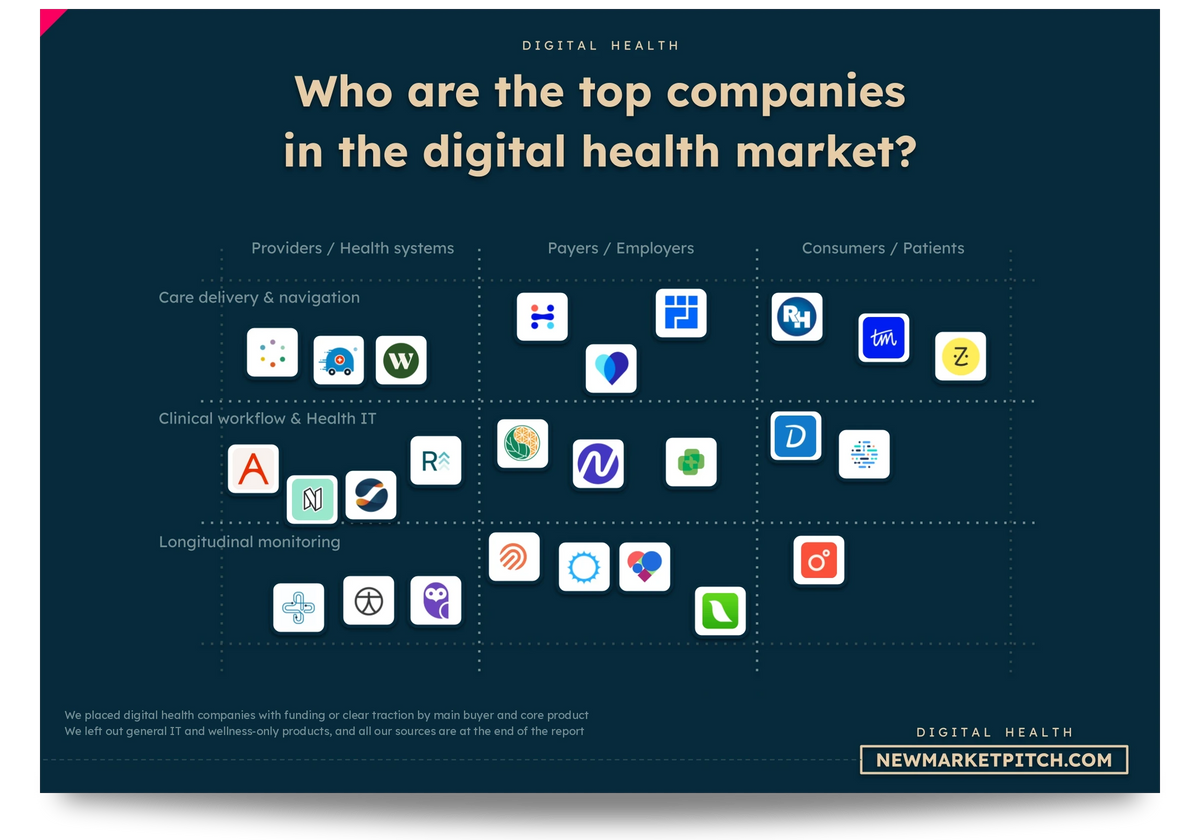
In our report covering the digital health market, we turn what is vague and complex into simple, useful visuals. Market maps like this one show you at a glance where every startup stands.
The ranking of top startups in the digital health market by revenue
Below is a table ranking the startups of this market by their current revenue scale. You can find our methodology at the end of this page.
If you want a deeper understanding of the market and its current dynamics, get our report on the digital health market.
| Ranking | Company | Latest Metric | Metric Type | Freshness | Disclosed When | Source Quality | Confidence | Segment | Why This Ranking | Local Metric | Country |
|---|---|---|---|---|---|---|---|---|---|---|---|
| 1 | Judi Health | $3.5B | Annual Revenue | Aging · 23mo | Feb 10, 2025 | Company Disclosed | Medium | Health Plans, Administration & Financial Access | Annual revenue for the year to Dec 2024 disclosed by the company. | us | |
| 2 | Monogram Health | ~$2.2B | Annual Revenue | Historical · 35mo | Aug 2024 | Company Disclosed | Low | Virtual & Hybrid Care Platforms | Annual revenue for the year to Dec 2023 disclosed by the company. The figure is more than 30 months old. | us | |
| 3 | Grow Therapy | ~$1B | Annual Revenue | Period not stated · collected 8mo ago | Period not stated | Company Disclosed | Low | Virtual & Hybrid Care Platforms | Annual revenue, period not stated (collected Mar 2026) disclosed by the company. Ahead of Alan, whose figure is an annualized run-rate. | us | |
| 4 | Alan | >$924M | ARR | Fresh · 8mo | Apr 2026 | Company Disclosed | Medium | Health Plans, Administration & Financial Access | Annual recurring revenue (ARR) as of Mar 2026 disclosed by the company. ARR and run-rates annualize current sales; they are not recognized revenue. Close to Grow Therapy, at >$924M against ~$1B. | EUR 804M | fr |
| 5 | Oura | $908M | Fiscal-Year Revenue | Fresh · 14mo | Sep 3, 2026 | Filed / Audited | High | Remote Monitoring & Connected Diagnostics | Fiscal-year revenue for the year ended Sep 2025 from a regulatory filing. A more recent partial figure is $1.21B for the nine months to Jun 2026. Close to Alan, at $908M against >$924M. Ahead of PharmEasy, whose figure is older. | us | |
| 6 | PharmEasy | ~$687M | Fiscal-Year Revenue | Aging · 20mo | Sep 8, 2025 | Credible Reported | Medium | Virtual & Hybrid Care Platforms | Fiscal-year revenue for the year ended Mar 2025 reported by the press. | INR 58.72B | in |
| 7 | LetsGetChecked | $500M | Annual Revenue | Aging · 23mo | Apr 1, 2025 | Credible Reported | Medium | Virtual & Hybrid Care Platforms | Annual revenue for the year to Dec 2024 reported by the press. Ahead of Doctolib, whose smaller figure is better documented. | ie | |
| 8 | Doctolib | ~$324M | Fiscal-Year Revenue | Aging · 23mo | Nov 13, 2025 | Filed / Audited | Medium | Clinical Software & AI Workflows | Fiscal-year revenue for the year to Dec 2024 from a regulatory filing. Ranks below LetsGetChecked, whose larger figure is older. | EUR 311M | fr |
| 9 | OpenEvidence | ~$300M | Revenue Run-Rate | Very Fresh · 4mo | Jul 17, 2026 | Credible Reported | Medium | Clinical Software & AI Workflows | Annualized revenue run-rate as of Jul 2026 reported by the press. ARR and run-rates annualize current sales; they are not recognized revenue. Close to Doctolib, at ~$300M against ~$324M. | us | |
| 10 | Innovaccer | $200M | ARR | Very Fresh · 4mo | Jul 23, 2026 | Credible Reported | Medium | Health Data, Analytics & Interoperability | Annual recurring revenue (ARR) as of Jul 2026 reported by the press. ARR and run-rates annualize current sales; they are not recognized revenue. Ahead of Scan.com, whose smaller figure is better documented. | us | |
| 11 | Scan.com | >$165M | Revenue Run-Rate | Very Fresh · 3mo | Aug 31, 2026 | Company Disclosed | Medium | Patient Experience & Navigation | Annualized revenue run-rate as of Aug 2026 disclosed by the company. ARR and run-rates annualize current sales; they are not recognized revenue. Ranks below Innovaccer, whose larger figure is an annualized run-rate. | gb | |
| 12 | Virta Health | >$160M | Revenue Run-Rate | Fresh · 14mo | Sep 22, 2025 | Company Disclosed | Medium | Virtual & Hybrid Care Platforms | Annualized revenue run-rate as of Sep 2025 disclosed by the company. ARR and run-rates annualize current sales; they are not recognized revenue. Close to Scan.com, at >$160M against >$165M. | us | |
| 13 | Midi Health | $150M | Revenue Run-Rate | Fresh · 13mo | Oct 2025 | Credible Reported | Medium | Virtual & Hybrid Care Platforms | Annualized revenue run-rate as of Oct 2025 reported by the press. ARR and run-rates annualize current sales; they are not recognized revenue. Close to Virta Health, at $150M against >$160M. | us | |
| 14 | Thyme Care | >$125M | Annual Revenue | Fresh · 11mo | Jul 15, 2026 | Credible Reported | Medium | Patient Experience & Navigation | Annual revenue for the year to Dec 2025 reported by the press. Ahead of Chapter, whose smaller figure is better documented. | us | |
| 15 | Chapter | >$100M | ARR | Fresh · 11mo | Oct 2026 | Company Disclosed | Medium | Health Plans, Administration & Financial Access | Annual recurring revenue (ARR) as of Dec 2025 disclosed by the company. ARR and run-rates annualize current sales; they are not recognized revenue. | us | |
| 16 | Numan | ~$83.9M | Annual Revenue | Aging · 23mo | Jul 16, 2025 | Credible Reported | Medium | Virtual & Hybrid Care Platforms | Annual revenue for the year to Dec 2024 reported by the press. | GBP 67M | gb |
| 17 | Aidoc | >$60M | Revenue Run-Rate | Fresh · 17mo | Sep 11, 2025 | Credible Reported | Medium | Clinical Software & AI Workflows | Annualized revenue run-rate as of Jun 2025 reported by the press. ARR and run-rates annualize current sales; they are not recognized revenue. Ahead of Natural Cycles, whose smaller figure is better documented. | il | |
| 18 | Natural Cycles | ~$55.6M | Segment Revenue | Fresh · 11mo | 2026 | Filed / Audited | Medium | Digital Therapeutics & Preventive Wellness | Revenue of one segment for the year to Dec 2025 from a regulatory filing. It covers only part of the year or of the business, so it is ranked as a minimum. Close to Aidoc, at ~$55.6M against >$60M. | SEK 512M | se |
| 19 | Heidi Health | $50M | ARR | Fresh · 7mo | Sep 22, 2026 | Company Disclosed | Medium | Clinical Software & AI Workflows | Annual recurring revenue (ARR) as of Apr 2026 disclosed by the company. ARR and run-rates annualize current sales; they are not recognized revenue. | au | |
| 20 | Huma | ~$37.7M | Fiscal-Year Revenue | Aging · 23mo | Oct 23, 2025 | Filed / Audited | Medium | Remote Monitoring & Connected Diagnostics | Fiscal-year revenue for the year to Dec 2024 from a regulatory filing. | GBP 30.1M | gb |
| 21 | Yazen Health | ~$34.5M | Annual Revenue | Fresh · 11mo | Feb 6, 2026 | Company Disclosed | High | Virtual & Hybrid Care Platforms | Annual revenue for the year to Dec 2025 disclosed by the company. Close to Huma, at ~$34.5M against ~$37.7M. Ahead of Practo, whose figure is older. | EUR 29.4M | se |
| 22 | Practo | ~$27.4M | Fiscal-Year Revenue | Aging · 20mo | Aug 4, 2025 | Company Disclosed | Medium | Virtual & Hybrid Care Platforms | Fiscal-year revenue for the year ended Mar 2025 disclosed by the company. | INR 2.34B | in |
| 23 | Nelly | >$22.1M | ARR | Period not stated · collected this month | Period not stated | Company Disclosed | Low | Clinical Software & AI Workflows | Annual recurring revenue (ARR), period not stated (collected Nov 2026) disclosed by the company. ARR and run-rates annualize current sales; they are not recognized revenue. | EUR 20M | de |
| 24 | Qure.ai | ~$20.5M | Fiscal-Year Revenue | Aging · 20mo | Nov 2025 | Filed / Audited | Medium | Clinical Software & AI Workflows | Fiscal-year revenue for the year ended Mar 2025 from a regulatory filing. Close to Nelly, at ~$20.5M against >$22.1M. | INR 1.75B | in |
| 25 | Suki | ~$20M | Annual Revenue | Fresh · 11mo | Oct 12, 2026 | Credible Reported | Medium | Clinical Software & AI Workflows | Annual revenue for the year to Dec 2025 reported by the press. Close to Qure.ai, at ~$20M against ~$20.5M. Ahead of Freed, whose smaller figure is better documented. | us | |
| 26 | Freed | $10M | ARR | Period not stated · collected 25mo ago | Period not stated | Company Disclosed | Low | Clinical Software & AI Workflows | Annual recurring revenue (ARR), period not stated (collected Oct 2024) disclosed by the company. ARR and run-rates annualize current sales; they are not recognized revenue. | us | |
| 27 | Harrison.ai | ~$4.77M | Fiscal-Year Revenue | Fresh · 17mo | May 27, 2026 | Filed / Audited | High | Clinical Software & AI Workflows | Fiscal-year revenue for the year ended Jun 2025 from a regulatory filing. | AUD 7.3M | au |
| NR | Devoted Health | $3.27B | Annual Revenue | Aging · 23mo | Nov 2026 | Third-Party Estimate | Low | Health Plans, Administration & Financial Access | A single analyst estimate puts annual revenue at $3.27B for 2024. Without independent confirmation, it remains unranked. | us | |
| NR | Ro | $598M | Revenue Run-Rate | Aging · 23mo | Dec 19, 2025 | Third-Party Estimate | Low | Virtual & Hybrid Care Platforms | A single analyst estimated $598M in annualized revenue run-rate for 2024. Without independent corroboration, it remains unranked. | us | |
| NR | Lyra Health | $235M | Annual Revenue | Period not stated · collected 24mo ago | Period not stated | Third-Party Estimate | Low | Virtual & Hybrid Care Platforms | Lyra Health has an automated estimate of $235M in annual revenue, but no stated period or second source. It remains unranked. | us | |
| NR | Flo Health | $158M | Annual Revenue | Fresh · 11mo | Sep 15, 2026 | Third-Party Estimate | Low | Digital Therapeutics & Preventive Wellness | A company-data website places Flo Health's annual revenue at $158M for 2025. No second independent source confirms the figure, so it stays unranked. | gb | |
| NR | Collective Health | $143M | Annual Revenue | Fresh · 14mo | Oct 30, 2026 | Third-Party Estimate | Low | Health Plans, Administration & Financial Access | Only an automated estimate supports $143M of annual revenue through September 2025. Collective Health has no rank without another independent source. | us | |
| NR | Pomelo Care | $128M | Annual Revenue | Fresh · 11mo | Aug 20, 2026 | Third-Party Estimate | Low | Virtual & Hybrid Care Platforms | $128M of annual revenue for 2025 comes from one automated estimate, not a company statement. Pomelo Care remains unranked. | us | |
| NR | Hone Health | $114M | ARR | Fresh · 14mo | Oct 19, 2025 | Third-Party Estimate | Low | Virtual & Hybrid Care Platforms | A single analyst, Sacra, estimated $114M of ARR as of September 2025. With no second independent source and no company figure, it is shown without a rank. | us | |
| NR | PathAI | $108M | Annual Revenue | Undated | Third-Party Estimate | Low | Clinical Software & AI Workflows | Automated estimate of annual revenue from a company-data website, not a company figure; the source gives no date, so its age is unknown and it is shown without a rank. | us | ||
| NR | Abridge | $100M | ARR | Fresh · 18mo | May 20, 2025 | Third-Party Estimate | Low | Clinical Software & AI Workflows | A single analyst estimated $100M of ARR as of May 2025. It is annualized recurring sales without a second independent source and remains unranked. | us | |
| NR | Function Health | $100M | Revenue Run-Rate | Aging · 21mo | May 8, 2025 | Third-Party Estimate | Low | Digital Therapeutics & Preventive Wellness | A single analyst estimated $100M in annualized revenue run-rate for 2025. Without independent corroboration, it remains unranked. | us | |
| NR | Cohere Health | $100M | Annual Revenue | Aging · 23mo | 2026 | Third-Party Estimate | Low | Health Plans, Administration & Financial Access | An automated company-data source estimates $100M of annual revenue for 2024. With no independent confirmation, Cohere Health is unranked. | us | |
| NR | Talkiatry | $94.7M | Annual Revenue | Fresh · 11mo | Nov 2026 | Third-Party Estimate | Low | Virtual & Hybrid Care Platforms | Talkiatry has a single automated estimate of $94.7M in annual revenue for 2025. It is not a company disclosure, so no rank is assigned. | us | |
| NR | DentalMonitoring | $91M | Annual Revenue | Aging · 23mo | Oct 30, 2026 | Third-Party Estimate | Low | Remote Monitoring & Connected Diagnostics | A company-data website places DentalMonitoring's annual revenue at $91M for 2024. No second independent source confirms the figure, so it stays unranked. | fr | |
| NR | TytoCare | $82.9M | Annual Revenue | Historical · 35mo | Oct 5, 2026 | Third-Party Estimate | Low | Virtual & Hybrid Care Platforms | Only an automated estimate supports $82.9M of annual revenue for 2023. TytoCare has no rank without another independent source. | us | |
| NR | Zocdoc | $71M | Annual Revenue | Aging · 23mo | Nov 24, 2025 | Third-Party Estimate | Low | Patient Experience & Navigation | $71M of annual revenue for 2024 comes from one automated estimate, not a company statement. Zocdoc remains unranked. | us | |
| NR | Cadence | $58.1M | Annual Revenue | Fresh · 11mo | Oct 7, 2026 | Third-Party Estimate | Low | Remote Monitoring & Connected Diagnostics | An automated company-data source estimates $58.1M of annual revenue for 2025. With no independent confirmation, Cadence is unranked. | us | |
| NR | Candid Health | $57M | Annual Revenue | Period not stated · collected 1mo ago | Period not stated | Third-Party Estimate | Low | Health Plans, Administration & Financial Access | Candid Health has an automated estimate of $57M in annual revenue, but no stated period or second source. It remains unranked. | us | |
| NR | NexHealth | $47.1M | Annual Revenue | Historical · 35mo | Oct 30, 2026 | Third-Party Estimate | Low | Patient Experience & Navigation | A company-data website places NexHealth's annual revenue at $47.1M for 2023. No second independent source confirms the figure, so it stays unranked. | us | |
| NR | ZOE | ~$45.8M | Fiscal-Year Revenue | Fresh · 15mo | Oct 2026 | Third-Party Estimate | Low | Patient Experience & Navigation | Automated estimate of fiscal-year revenue for the year ended Aug 2025 from a company-data website, not a company figure; an automated estimate from a company-data website with no second independent source, so it is shown without a rank. | GBP 34.1M | gb |
| NR | Overjet | $40.7M | Annual Revenue | Fresh · 11mo | Sep 10, 2026 | Third-Party Estimate | Low | Clinical Software & AI Workflows | $40.7M of annual revenue for 2025 comes from one automated estimate, not a company statement. Overjet remains unranked. | us | |
| NR | Viz.ai | $40M | Annual Revenue | Historical · 35mo | 2023 | Third-Party Estimate | Low | Clinical Software & AI Workflows | A single analyst estimate puts annual revenue at $40M for 2023. Without independent confirmation, it remains unranked. | us | |
| NR | ArteraAI | $34.3M | Annual Revenue | Period not stated · collected 14mo ago | Period not stated | Third-Party Estimate | Low | Clinical Software & AI Workflows | Automated estimate of annual revenue, period not stated (collected Sep 2025) from a company-data website, not a company figure; an automated estimate from a company-data website with no second independent source, so it is shown without a rank. | us | |
| NR | AZmed | ~$33.9M | Annual Revenue | Fresh · 14mo | Sep 10, 2026 | Third-Party Estimate | Low | Clinical Software & AI Workflows | AZmed has a single automated estimate of ~$33.9M in annual revenue through September 2025. It is not a company disclosure, so no rank is assigned. | fr | |
| NR | Ambience Healthcare | $30M | ARR | Fresh · 18mo | May 20, 2025 | Third-Party Estimate | Low | Clinical Software & AI Workflows | A single analyst estimated $30M of ARR as of May 2025. It is annualized recurring sales without a second independent source and remains unranked. | us | |
| NR | Caresyntax | $29.3M | Annual Revenue | Fresh · 11mo | Sep 2, 2026 | Third-Party Estimate | Low | Clinical Software & AI Workflows | A company-data website places Caresyntax's annual revenue at $29.3M for 2025. No second independent source confirms the figure, so it stays unranked. | us | |
| NR | Glooko | $28.5M | Annual Revenue | Fresh · 14mo | Oct 30, 2026 | Third-Party Estimate | Low | Remote Monitoring & Connected Diagnostics | Only an automated estimate supports $28.5M of annual revenue through September 2025. Glooko has no rank without another independent source. | us | |
| NR | Nabla | $27.8M | Annual Revenue | Fresh · 11mo | Aug 10, 2026 | Third-Party Estimate | Low | Clinical Software & AI Workflows | $27.8M of annual revenue for 2025 comes from one automated estimate, not a company statement. Nabla remains unranked. | fr | |
| NR | Biofourmis | $20M–$37.7M | Annual Revenue | Fresh · 14mo | Aug 10, 2026 | Third-Party Estimate | Low | Remote Monitoring & Connected Diagnostics | Independent company-data estimates disagree on annual revenue, spanning $20M–$37.7M as of September 2025. The unresolved range stays unranked. | us | |
| NR | Onera Health | $26.6M | Annual Revenue | Period not stated · collected 14mo ago | Period not stated | Third-Party Estimate | Low | Remote Monitoring & Connected Diagnostics | Automated estimate of annual revenue, period not stated (collected Sep 2025) from a company-data website, not a company figure; an automated estimate from a company-data website with no second independent source, so it is shown without a rank. | nl | |
| NR | Evidation | $25M | Annual Revenue | Aging · 23mo | Nov 2026 | Third-Party Estimate | Low | Health Data, Analytics & Interoperability | Evidation has a single automated estimate of $25M in annual revenue for 2024. It is not a company disclosure, so no rank is assigned. | us | |
| NR | Cleerly | $24.6M | Annual Revenue | Historical · 35mo | Oct 30, 2026 | Third-Party Estimate | Low | Clinical Software & AI Workflows | A company-data website places Cleerly's annual revenue at $24.6M for 2023. No second independent source confirms the figure, so it stays unranked. | us | |
| NR | Eleos Health | $15M–$37M | Annual Revenue | Fresh · 14mo | Oct 30, 2026 | Third-Party Estimate | Low | Clinical Software & AI Workflows | Automated estimates disagree on annual revenue, spanning $15M–$37M. The conflicting range remains unranked. | us | |
| NR | Navina | $22.6M | Annual Revenue | Historical · 35mo | Oct 30, 2026 | Third-Party Estimate | Low | Clinical Software & AI Workflows | Only an automated estimate supports $22.6M of annual revenue for 2023. Navina has no rank without another independent source. | us | |
| NR | Neko Health | $21.9M | Annual Revenue | Fresh · 14mo | Oct 8, 2026 | Third-Party Estimate | Low | Digital Therapeutics & Preventive Wellness | A company-data website estimated $21.9M of annual revenue for the year to September 2025. It is not a company figure and no second independent source confirms it, so it is unranked. | se | |
| NR | Qventus | $21.8M | Annual Revenue | Historical · 35mo | Sep 10, 2026 | Third-Party Estimate | Low | Clinical Software & AI Workflows | $21.8M of annual revenue for 2023 comes from one automated estimate, not a company statement. Qventus remains unranked. | us | |
| NR | Allara Health | $21.7M | Annual Revenue | Fresh · 11mo | Sep 10, 2026 | Third-Party Estimate | Low | Virtual & Hybrid Care Platforms | An automated company-data source estimates $21.7M of annual revenue for 2025. With no independent confirmation, Allara Health is unranked. | us | |
| NR | Berry Street | $18.5M | Annual Revenue | Fresh · 11mo | Aug 10, 2026 | Third-Party Estimate | Low | Virtual & Hybrid Care Platforms | A company-data website places Berry Street's annual revenue at $18.5M for 2025. No second independent source confirms the figure, so it stays unranked. | us | |
| NR | Thoughtful AI | ~$17M | Annual Revenue | Fresh · 11mo | 2026 | Third-Party Estimate | Low | Clinical Software & AI Workflows | Only an automated estimate supports ~$17M of annual revenue for 2025. Thoughtful AI has no rank without another independent source. | us | |
| NR | Strolll | $16.4M | Annual Revenue | Fresh · 14mo | Aug 10, 2026 | Third-Party Estimate | Low | Digital Therapeutics & Preventive Wellness | $16.4M of annual revenue through September 2025 comes from one automated estimate, not a company statement. Strolll remains unranked. | gb | |
| NR | Hippocratic AI | $15.8M | Annual Revenue | Fresh · 11mo | Sep 2026 | Third-Party Estimate | Low | Patient Experience & Navigation | An automated company-data source estimates $15.8M of annual revenue for 2025. With no independent confirmation, Hippocratic AI is unranked. | us | |
| NR | CodaMetrix | $14.5M | Annual Revenue | Historical · 35mo | Oct 5, 2026 | Third-Party Estimate | Low | Health Plans, Administration & Financial Access | CodaMetrix has a single automated estimate of $14.5M in annual revenue for 2023. It is not a company disclosure, so no rank is assigned. | us | |
| NR | Rad AI | $13.4M | Annual Revenue | Historical · 35mo | Oct 5, 2026 | Third-Party Estimate | Low | Clinical Software & AI Workflows | A company-data website places Rad AI's annual revenue at $13.4M for 2023. No second independent source confirms the figure, so it stays unranked. | us | |
| NR | XRHealth | $13.1M | Annual Revenue | Fresh · 11mo | Aug 10, 2026 | Third-Party Estimate | Low | Virtual & Hybrid Care Platforms | Only an automated estimate supports $13.1M of annual revenue for 2025. XRHealth has no rank without another independent source. | us | |
| NR | VieCure | $12.3M | Annual Revenue | Fresh · 14mo | Sep 18, 2025 | Third-Party Estimate | Low | Clinical Software & AI Workflows | Automated estimate of annual revenue for the year to Sep 2025 from a company-data website, not a company figure; an automated estimate from a company-data website with no second independent source, so it is shown without a rank. | us | |
| NR | Kontakt.io | ~$12.2M | Annual Revenue | Period not stated · collected 25mo ago | Period not stated | Third-Party Estimate | Low | Clinical Software & AI Workflows | ~$12.2M of annual revenue appears in one automated estimate for Kontakt.io, with no reporting period. It is not ranked. | us | |
| NR | Twentyeight Health | ~$9.7M | Annual Revenue | Historical · 35mo | Oct 5, 2026 | Third-Party Estimate | Low | Virtual & Hybrid Care Platforms | An automated company-data source estimates ~$9.7M of annual revenue for 2023. With no independent confirmation, Twentyeight Health is unranked. | us | |
| NR | Assort Health | $3M–$30M | Revenue Run-Rate | Very Fresh · 5mo | Jun 24, 2026 | Third-Party Estimate | Low | Clinical Software & AI Workflows | Estimates disagree, from $3M to $30M of revenue run-rate as of June 2026 (CB Insights, Forbes). The $30M is Forbes' own estimate, not a company figure, so the range stays unranked. | us | |
| NR | Voize | $9.4M | Annual Revenue | Period not stated · collected 19mo ago | Period not stated | Third-Party Estimate | Low | Clinical Software & AI Workflows | Voize has an automated estimate of $9.4M in annual revenue, but no stated period or second source. It remains unranked. | de | |
| NR | Solera Health | ~$8.4M | Annual Revenue | Period not stated · collected 23mo ago | Period not stated | Third-Party Estimate | Low | Patient Experience & Navigation | A company-data website assigns Solera Health ~$8.4M of annual revenue, with no reported period. The single estimate is unranked. | us | |
| NR | Ultromics | $7.3M | Annual Revenue | Fresh · 11mo | Aug 10, 2026 | Third-Party Estimate | Low | Clinical Software & AI Workflows | Only an automated estimate supports $7.3M of annual revenue for 2025. Ultromics has no rank without another independent source. | gb | |
| NR | Videa | $6.8M | Annual Revenue | Aging · 23mo | Sep 2026 | Third-Party Estimate | Low | Clinical Software & AI Workflows | $6.8M of annual revenue for 2024 comes from one automated estimate, not a company statement. Videa remains unranked. | us | |
| NR | Quibim | ~$2.13M | Segment Revenue | Undated | Third-Party Estimate | Low | Clinical Software & AI Workflows | Automated estimate of revenue of one segment from a company-data website, not a company figure; the source gives no date, so its age is unknown and it is shown without a rank. | EUR 1.94M | es | |
| NR | Hello Patient | $1.8M | Annual Revenue | Fresh · 14mo | Aug 10, 2026 | Third-Party Estimate | Low | Patient Experience & Navigation | An automated company-data source estimates $1.8M of annual revenue through September 2025. With no independent confirmation, Hello Patient is unranked. | us | |
| NR | Flagler Health | $164K | Annual Revenue | Period not stated · collected this month | Period not stated | Third-Party Estimate | Low | Clinical Software & AI Workflows | A company-data website estimated $164K of annual revenue without a stated period. This low-value single-source estimate remains unranked. | us | |
| NR | Strive Health | >121K patients | Other Scale Signal | Aging · 20mo | Mar 2025 | Company Disclosed | Medium | Virtual & Hybrid Care Platforms | >121K patients as of March 2025, disclosed by the company, measures activity or reach rather than company revenue. It is unranked. | us | |
| NR | Precision Neuroscience | >100 clinical procedures | Other Scale Signal | Very Fresh · 2mo | Sep 24, 2026 | Company Disclosed | Medium | Remote Monitoring & Connected Diagnostics | >100 clinical procedures as of September 2026, disclosed by the company, measures activity or reach rather than company revenue. It is unranked. | us | |
| NR | Commure | >$25B (GMV, not revenue) | GMV | Fresh · 10mo | Jan 5, 2026 | Company Disclosed | Medium | Clinical Software & AI Workflows | The company disclosed >$25B (GMV, not revenue) in annualized processing volume as of January 2026. GMV is not company revenue, so it is unranked. | us | |
| NR | Cedar | >$13.6B (GMV, not revenue) | GMV | Period not stated · collected 3mo ago | Period not stated | Company Disclosed | Medium | Health Plans, Administration & Financial Access | The company disclosed >$13.6B (GMV, not revenue) with no stated period. Payment volume is not recognized revenue, so it is unranked. | us | |
| NR | Headway | >30M cumulative appointments | Transactions | Fresh · 11mo | Dec 16, 2025 | Company Disclosed | Medium | Virtual & Hybrid Care Platforms | The company disclosed >30M cumulative appointments through December 2025. Appointments handled are not its own revenue, so it is unranked. | us | |
| NR | Garner Health | >2.5M members | Users | Fresh · 9mo | Feb 10, 2026 | Company Disclosed | Medium | Health Plans, Administration & Financial Access | The company disclosed >2.5M members as of February 2026. Member counts are not revenue, so the company remains unranked. | us | |
| NR | Nourish | $160M (other measure, not revenue) | Other Financial Metric | Period not stated · collected this month | Period not stated | Third-Party Estimate | Low | Virtual & Hybrid Care Platforms | A company-data website estimated $160M (other measure, not revenue), period unstated. The measure is not identified as revenue, so it remains unranked. | us | |
| NR | Spring Health | >10M covered lives | Other Scale Signal | Aging · 28mo | Jul 31, 2024 | Company Disclosed | Medium | Virtual & Hybrid Care Platforms | >10M covered lives as of July 2024, disclosed by the company, measures activity or reach rather than company revenue. It is unranked. | us | |
| NR | Tandem Health | 10K care organizations | Other Scale Signal | Very Fresh · 2mo | Sep 14, 2026 | Company Disclosed | Medium | Clinical Software & AI Workflows | 10K care organizations as of September 2026, disclosed by the company, measures activity or reach rather than company revenue. It is unranked. | se | |
| NR | Tennr | ~$5–10M (bookings, not revenue) | Bookings | Aging · 23mo | 2024 | Credible Reported | Medium | Clinical Software & AI Workflows | The press reported ~$5–10M (bookings, not revenue) for 2024. Bookings are not recognized sales, so the company remains unranked. | us | |
| NR | General Medicine | 2,900 customers | Other Scale Signal | Very Fresh · 1mo | Oct 6, 2026 | Company Disclosed | Medium | Patient Experience & Navigation | 2,900 customers as of October 2026, disclosed by the company, measures activity or reach rather than company revenue. It is unranked. | us | |
| NR | Maven Clinic | $268M (forecast, not revenue) | Revenue Forecast | Forecast | Dec 4, 2024 | Third-Party Estimate | Low | Virtual & Hybrid Care Platforms | An analyst projected $268M (forecast, not revenue) for 2024. This is a forecast rather than achieved revenue, so it is unranked. | us | |
| NR | Pearl Health | >250K patients | Other Scale Signal | Very Fresh · 4mo | Jul 8, 2026 | Credible Reported | Medium | Clinical Software & AI Workflows | >250K patients as of July 2026, reported by the press, measures activity or reach rather than company revenue. It is unranked. | us | |
| NR | Sirona Medical | >12M exams/year under contract | Other Scale Signal | Very Fresh · 2mo | Oct 15, 2026 | Company Disclosed | Medium | Clinical Software & AI Workflows | >12M exams/year under contract as of September 2026, disclosed by the company, measures activity or reach rather than company revenue. It is unranked. | us | |
| NR | Oshi Health | >40M eligible lives | Other Scale Signal | Aging · 25mo | Oct 16, 2024 | Company Disclosed | Medium | Virtual & Hybrid Care Platforms | The company disclosed >40M eligible lives as of October 2024. That reach figure is not company revenue, so it is unranked. | us |

Our research about digital health gets updated several times a month, so you always get the latest view of where things stand.
Is Monogram Health still the biggest digital health startup?
Judi Health ranks first among digital health startups on the available revenue figures, with $3.5B of annual revenue for 2024.
Monogram looks nothing like the health apps that attract the most attention. It sends clinical teams to people with kidney disease and other chronic conditions, working with insurers and health systems that pay for better coordinated care. In its August 2024 announcement about the Inc. 5000, Monogram said it served patients across 35 states, employed more than 1,500 people, and had generated savings for health-plan clients. Those contracts help explain how home-based healthcare can produce sales on this scale.
There is one big catch: the figure describes 2023. Monogram has discussed its growth plans since then, but forecasts cannot tell us what it earned last year. Grow Therapy reports a newer annual figure without a stated period, and Oura has filed more recent accounts. For now, Monogram ranks second because its large annual sales figure is documented, even if it no longer tells us its current pace. That is a much narrower claim than saying it is growing faster than every other digital health business today. Judi Health ranks first, with $3.5B of annual revenue for 2024 disclosed by the company. One unranked company may also be bigger: Devoted Health has an analyst estimate of $3.27B for 2024. It rests on a single estimate with no second independent source, so it takes no rank.
Has Grow Therapy really built a billion-dollar mental health business?
Yes, Grow Therapy reported ~$1B of annual revenue for an unstated period, making insured mental healthcare one of digital health's biggest commercial businesses.
Behavioral Health Business published the amount in March 2026 after speaking with a company spokesperson. Grow also facilitated 7 million therapy and psychiatry visits in 2025, worked with more than 125 health plans, and said it could reach about 220 million covered people in the United States. Those details explain how the money comes in. A patient can find a therapist who accepts their insurance, rather than paying the whole bill personally or abandoning the search.
Grow has been adding ways to reach patients through employers, health systems, and primary care partners such as Circle Medical. It is easier to keep appointments flowing when referrals come from existing healthcare relationships. Still, the revenue disclosure does not identify a completed financial year. Oura's filing does, which makes its numbers easier to check even though Grow's reported annual figure is larger. We can confidently call Grow a large mental health business. We cannot calculate its exact year-on-year sales growth from this disclosure.
Is Oura a real healthcare business or mainly a popular ring company?
Oura is already a major digital health business, with $908M of fiscal-year revenue for the year ended September 2025, and its subscriptions make the ring more than a one-off gadget sale.
The Finnish-founded company's September 2026 US securities filing offers an unusually detailed look at a private health technology business. It also shows $1.21B of revenue for the nine months ended June 2026, a newer partial-period figure. The ranking uses the completed fiscal year, but the later disclosure shows why an older full-year snapshot should not be mistaken for Oura's present scale. The same filing reports 5 million paying members as of June 2026 and roughly 85% twelve-month membership retention.
Customers buy a device and then pay for ongoing sleep, temperature, heart-rate, and other health insights. Device sales still account for a substantial part of the business, so Oura is not simply a software subscription company. Its direct customer relationships also differ from Monogram's health-plan contracts and Grow Therapy's insurance-covered visits. The interesting point is how consistently Oura gets people to use and pay for health monitoring after the initial purchase.
Can Alan's digital health insurance business compete with Oura?
Alan is close enough to Oura in digital health sales scale to invite the comparison, but Alan disclosed >$924M of ARR as of March 2026 rather than completed-year revenue.
Alan sells health coverage alongside digital care access, reimbursement support, prevention tools, and virtual consultations. The French company has described a customer base exceeding 1 million members and around 37,000 business clients across France, Belgium, Spain, and Canada. Insurance gives it recurring relationships with employers and members, without needing a consumer device to keep those customers engaged.
Oura's ranked figure is $908M of fiscal-year revenue for the year ended September 2025. Alan's ARR describes the annualized pace of recurring business at a later point. These two numbers are close, but they answer slightly different questions. With these two numbers alone, nobody can honestly say which one sells more today. The broader contrast is more interesting anyway: one European-founded startup sells biometric devices and memberships, while the other earns recurring income from helping people pay for and access healthcare. Both have found sizable markets outside the classic hospital-software business.

In our market report about digital health, we look at what the winners do differently, so you can learn from the best instead of guessing.
Is PharmEasy still making serious money from online healthcare?
PharmEasy is one of the largest digital health startups outside the United States on disclosed sales, with ~$687M of fiscal-year revenue for the year ended March 2025.
Indian publication Entrackr reported the result in September 2025. PharmEasy combines online pharmacy ordering with diagnostics and related services. The app may be where a customer starts, but medication supply, delivery, and testing are what make the service work. Every order involves physical operations that a typical software company does not have to run.
That explains why its sales are so big, and also why sales alone cannot tell us which digital health model works best. Monogram delivers care at home, Grow Therapy arranges insured mental healthcare, and PharmEasy handles healthcare commerce. The customer pays for a different mix of software and service in each case. PharmEasy's annual sales prove that online pharmacy can become a large healthcare business. They do not tell us its profit margin or establish that it has grown faster than more recent AI software companies. Those questions need costs and comparable reporting periods, not bigger top-line numbers alone.
Can at-home medical testing earn more than doctor-booking software?
Yes, at-home testing startup LetsGetChecked reported $500M of annual revenue for 2024, compared with Doctolib's ~$324M of fiscal-year software revenue for the same year.
Business & Finance reported the LetsGetChecked figure in April 2025. The Irish-founded company combines at-home sample collection, laboratory testing, and virtual care. Customers buy a diagnostic service that needs technicians, laboratories, and delivery, even though they arrange much of it online. That creates a different flow of sales and expenses from licensing scheduling software to a medical practice.
Doctolib gets paid for software that helps doctors run appointments and other clinical tasks. Its financial statements give us a formal record of 2024 sales, while LetsGetChecked's amount comes from press reporting. On the two annual measures we have, LetsGetChecked is larger. But a laboratory-heavy business and a practice-software company can have very different costs, so the sales comparison cannot tell us which keeps more money. What it does show is that digital health companies can build large businesses by making a physical medical service easier to obtain, not just by charging for an app.
Is Doctolib making money beyond booking appointments?
Doctolib now earns revenue from a much broader digital health software business than appointment booking, although its ~$324M fiscal-year revenue figure covers 2024.
Patients know the company for finding doctors, but practices also use Doctolib for documentation, billing, coding, administration, and clinical tasks. In an October 2026 announcement about a planned minority investment from NVIDIA, Doctolib said an AI consultation assistant had documented more than 12 million patient visits. The company also described roughly 570,000 health professionals and 90 million people using its products across Europe. Those are usage figures, not a breakdown of sales by product.
The expansion makes sense. Once doctors use the same platform for calendars and daily work, Doctolib can introduce another tool without starting from scratch with each new customer. That gives it a different advantage from a specialist AI startup selling a single assistant. We can see the product becoming broader, but we cannot say how much of its recorded annual sales came from its newer AI products. That detail has not been separately disclosed in the figures used here.

In our document detailing everything you need to know about digital health, you will always find fresh funding data, taken straight from our own verified funding database.
How does OpenEvidence make so much money if doctors use it for free?
OpenEvidence has built a substantial clinical AI business through advertising, reaching a reported ~$300M revenue run-rate as of July 2026 without primarily charging doctors for search.
The Information described a model in which pharmaceutical advertisers pay to reach clinicians using the evidence-search tool. It reported that changes to advertising auctions increased prices while much of the available ad inventory remained unsold. That helps explain the attraction of a free professional product: repeated medical questions can create valuable advertising opportunities even without a monthly subscription from each physician.
The audience is substantial. An October 2026 JAMA study examined 271 million queries from 952,008 verified US clinicians between January 2024 and June 2026. That study measures use, not advertising revenue or medical accuracy. But it confirms that doctors have repeatedly returned to the tool rather than trying it once. OpenEvidence has proved it can sell access to a professional audience. Its annualized run-rate is still different from a complete fiscal-year sales figure, and the business depends on advertisers continuing to value that audience. For hospitals buying software directly, that is quite a different bargain.
How big is Innovaccer's healthcare AI business today?
Innovaccer has reached $200M of ARR as of July 2026 by selling healthcare data software and AI tools to large health systems.
Fortune reported the amount alongside a useful detail: Innovaccer's software was used by seven of the ten largest US health systems and touched 80 million patient records. Hospitals have information scattered across electronic records, insurance claims, and disconnected administrative systems. Innovaccer connects those systems so clinical staff and care managers can work with a more complete picture of a patient.
That is a harder product to replace than a stand-alone AI chatbot. Once a hospital has connected its data and trained employees on a platform, changing vendors becomes a substantial project. It also helps explain why the company sells recurring software contracts. OpenEvidence earns money from advertising around clinical search, while Innovaccer charges institutions for software infrastructure. Both are serious healthcare AI businesses, but neither ARR nor an advertising run-rate tells us its completed-year profit. Hospitals are clearly paying. How much Innovaccer keeps from those sales is another question.
Can booking medical scans online become a big business?
Scan.com has shown that digital access to medical imaging can generate serious sales, with >$165M of revenue run-rate as of August 2026.
The company connects patients and referring organizations with MRI, CT, and other imaging providers. It helps people find an appointment and get results without having to work through every local clinic themselves. In its August 2026 announcement, Scan.com said revenue had doubled over the preceding year and more than 900,000 patients had used its network globally. It has expanded from the United Kingdom into the United States.
A company coordinating real scans can grow its sales as patients use more medical services, but it also depends on provider capacity and smooth scheduling. Scan.com's figure is an annualized pace rather than revenue booked over a finished financial year. It therefore cannot be compared directly with full-year accounts for companies such as PharmEasy. Still, the business is a useful reminder that plenty of digital health money comes from removing frustrating steps around physical care. People need scans already. Scan.com makes those scans easier to arrange.

Learning from others' mistakes is the cheapest lesson there is. In our report covering the digital health market, we look at what broke startups before you, so you don't repeat it.
Can digital diabetes care make money without selling weight-loss drugs?
Yes, Virta Health built a substantial digital metabolic-care business, reporting >$160M of revenue run-rate as of September 2025 through ongoing clinical and nutrition support.
Virta's September 2025 announcement described more than 550 employer, insurer, and government partners, with access covering over 12 million Americans. Its diabetes and weight-management programs combine clinicians, nutrition coaching, monitoring, and medication guidance. Employers and health plans can pay for the service because preventing diabetes complications affects medical spending, whether patients take GLP-1 medicines or not.
Yazen Health offers a different example. The Swedish company reported ~$34.5M of annual revenue for 2025 from digitally managed weight treatment that includes prescribing and follow-up. Virta's amount is an annualized run-rate from an earlier point, while Yazen's is a finished-year result. Both have paying customers beyond a simple diet-tracking app, but the business models are not identical. We also cannot judge their profitability or future demand from these revenue measures alone. The point is that digital metabolic care already sells ongoing medical support, with drugs only one part of that service.
Can women's digital health apps and clinics make big money?
Midi Health shows that women's digital healthcare can generate substantial recurring sales, with a $150M revenue run-rate as of October 2025.
Business Insider reported that Midi was seeing about 20,000 women a week and expanding beyond menopause treatment into wider midlife care. That change gives patients more reasons to come back for follow-up, medication questions, and prevention. Midi's model involves clinicians and regular visits rather than selling access to a self-guided app alone.
Natural Cycles takes the app route. It recorded ~$55.6M of segment revenue for 2025 in published accounts tied to its fertility and contraception services. That measure covers only the reported segment and should be treated as a minimum, not whole-company sales. Flo Health has a widely circulated $158M annual revenue estimate for 2025, but it comes from a single automated company-data source and remains unranked. The contrast is useful: a virtual clinic can earn money from continuing clinical care, while a digital contraceptive product earns through app use and subscriptions. We should not pretend an estimated figure is as solid as financial accounts simply because the companies target a similar audience.
Can niche digital health startups really make $100M a year?
Yes, Thyme Care reported >$125M of annual revenue for 2025 from cancer-care navigation, while other specialist digital health businesses report or estimate nine-figure annualized sales.
Forbes reported in July 2026 that Thyme Care was profitable and managed more than $6 billion in oncology spending. That much larger amount is the cost of care being coordinated, not the money Thyme Care earned. The company helps patients navigate cancer treatment and works with insurers that want fewer gaps in care. Its finished-year revenue is a stronger record of earned sales than an annualized pace.
Other specialist services use different payment relationships. Hone Health's $114M of ARR as of September 2025 is a single analyst estimate for online hormone care, not a company-reported total, so we show it without a rank. Chapter, which helps older Americans compare and enroll in Medicare plans, disclosed >$100M of ARR as of December 2025, according to Fierce Healthcare. Chapter's figure is better supported, though it measures recurring annualized sales rather than a completed year. These businesses solve quite different problems, but each addresses a difficult healthcare decision people will pay to get help with. Their figures also show why we distinguish an estimate, ARR, and annual revenue instead of treating them as the same proof.
Are healthcare AI startups already earning serious revenue?
Healthcare AI has paying customers today, but the biggest disclosed figures mix annualized recurring sales, run-rates, and completed financial years.
OpenEvidence makes money from clinician search and advertising. Innovaccer sells data software to health systems. Aidoc uses AI to help radiologists evaluate medical images and had >$60M of revenue run-rate as of June 2025 according to an investor fund's annual report. These are three different products, bought and used in different ways. That is why talking about a single healthcare AI business model hides more than it explains.
Smaller vendors are also selling into daily clinical work. Assort Health, which automates appointments, has no ranked figure: estimates of its run-rate as of June 2026 range from $3M to $30M, and the $30M is Forbes' own estimate, not a company number. Qure.ai recorded ~$20.5M of fiscal-year revenue for the year ended March 2025, and Suki reported ~$20M of annual revenue for 2025 from clinical documentation tools. The distinction between current pace and booked sales is important. Hospitals may use a new tool widely before its vendor recognizes a full year of revenue, while other startups already publish annual accounts.
The table below shows different healthcare AI revenue measures, in the order of the digital health ranking.
| Company | Figure | Measure | Period |
|---|---|---|---|
| OpenEvidence | ~$300M | Run-rate | Jul 2026 |
| Innovaccer | $200M | ARR | Jul 2026 |
| Aidoc | >$60M | Run-rate | Jun 2025 |
| Qure.ai | ~$20.5M | Fiscal-year | Mar 2025 |
| Suki | ~$20M | Annual | Dec 2025 |
| Freed | $10M | ARR | Undisclosed |
| Harrison.ai | ~$4.77M | Fiscal-year | Jun 2025 |

Your time is limited. In our research about digital health, we put numbers on each part of the market, so you can see where it makes sense to focus.
Do AI medical scribes actually make money?
AI medical scribes already earn money from clinicians, with Heidi Health reporting $50M of ARR as of April 2026 and Suki posting ~$20M of annual revenue for 2025.
Heidi said in September 2026 that its software was supporting roughly 2.8 million patient visits each week across 190 countries. It has expanded from drafting notes into helping clinicians with other routine tasks, which gives buyers more reasons to keep paying. Those weekly visits demonstrate reach, not the same thing as recurring sales.
The competitive picture is less straightforward than the excitement around AI assistants suggests. Freed disclosed $10M of ARR back in October 2024, without saying which period it covered. Abridge has a $100M ARR estimate for May 2025 from Sacra, but that single analyst number is not ranked. Tandem Health reported 10K care organizations using its tools as of September 2026, again a measure of adoption rather than money earned. Clinicians clearly want help with paperwork. The harder business question is which products will remain worth paying for when writing a basic note becomes an ordinary feature in many health systems.
Are AI receptionists bringing in real money for medical practices?
Yes, AI tools that handle calls and appointments have become a paying digital health business, although the figures are still thin: Nelly disclosed >$22.1M of ARR, while Assort Health's run-rate as of June 2026 is only estimated, between $3M and $30M.
Forbes described Assort's voice agents answering patient calls, finding appointment slots, and dealing with common questions. The company said its systems had handled 190 million patient interactions and reduced waiting times. Those interactions are not revenue, but they show the product running inside the everyday chaos of medical practices rather than staying in a trial demonstration. For a busy clinic, answering another call can mean filling an appointment that might otherwise be missed.
Nelly tackles related intake and billing work and disclosed >$22.1M of ARR without stating the reporting period, so it ranks with low confidence. Assort has published no revenue figure of its own, which is why it stays unranked despite its visibility. Doctolib already serves doctors through a broader practice platform, and Scan.com automates scheduling around imaging. The next challenge for specialist AI receptionists may be convincing practices to pay for a separate tool when their existing software adds similar features. For now, there is enough paid demand for both specialist agents and broader platforms.
Can health wearables beyond Oura become successful businesses?
Some can, although no other connected-health startup in our ranking comes anywhere near Oura's $908M of fiscal-year revenue.
Huma recorded ~$37.7M of fiscal-year revenue for 2024 from remote patient monitoring and clinical technology. It sells monitoring tools to healthcare organizations rather than a device to consumers, so its sales depend on contracts with those organizations. Natural Cycles recorded ~$55.6M of segment revenue for 2025, a minimum for the whole company, by making reproductive decisions part of regular app use.
These companies are not competing for the same buyer as Oura. Natural Cycles serves people using fertility or contraceptive tools, and Huma sells monitoring technology for healthcare settings. A health sensor can support revenue when it solves a problem people return to repeatedly. The sensor alone is not the business.
Are European digital health startups catching up on revenue?
European digital health startups are already making substantial sales, although the published figures do not prove that they have overtaken American competitors overall.
Oura started in Finland and later moved under a US parent. France's Alan sells digital insurance and care access, Irish-founded LetsGetChecked delivers testing and virtual care, and Doctolib supplies practice software. All have disclosed significant business activity, but their reported sales measures are different. That makes a simple Europe-versus-America revenue total misleading.
The next group is varied too. British-founded Scan.com connects patients to diagnostic imaging, Numan reported ~$83.9M of annual revenue for 2024 from its digital clinic, and Sweden's Yazen Health reported ~$34.5M of annual revenue for 2025 from weight management. We have enough evidence to say that Europe produces paid digital health products in several categories, rather than only promising startups. We do not have compatible full-year financial statements for every company, so a continent-wide winner would be guesswork.
The table below shows selected European-founded digital health businesses and their different revenue measures, in the existing ranking order.
| Company | Figure | Measure | Period |
|---|---|---|---|
| Oura | $908M | Fiscal-year | Sep 2025 |
| Alan | >$924M | ARR | Mar 2026 |
| LetsGetChecked | $500M | Annual | Dec 2024 |
| Doctolib | ~$324M | Fiscal-year | Dec 2024 |
| Scan.com | >$165M | Run-rate | Aug 2026 |
| Numan | ~$83.9M | Annual | Dec 2024 |
| Natural Cycles | ~$55.6M | Segment | Dec 2025 |
| Huma | ~$37.7M | Fiscal-year | Dec 2024 |
| Yazen Health | ~$34.5M | Annual | Dec 2025 |

In our market report about digital health, we always try to gather several sources and make estimates that make sense, so you can work with solid numbers.
Are Indian digital health startups more than pharmacy apps?
Yes, India has digital health businesses with documented revenue in pharmacy, patient booking, and medical AI, though PharmEasy is the largest of those three in this ranking.
Practo reported ~$27.4M of fiscal-year revenue for the year ended March 2025 and said it had completed its first profitable year. Its own August 2025 report also distinguished the value of care booked through the platform from money the platform actually earned. A patient may pay a doctor for a visit arranged on Practo, but the full visit price does not necessarily become Practo's sales.
Qure.ai sells a different kind of technology. Financial information from Fractal records ~$20.5M of fiscal-year revenue for the year ended March 2025. Its medical-imaging AI helps evaluate scans for conditions including tuberculosis and stroke. PharmEasy, meanwhile, generates sales through medicine and diagnostic services. India's digital health industry therefore has examples of commerce, patient software, and clinical AI making money. Their costs and margins will be different, and revenue alone cannot settle which business is healthiest. It does settle the narrower question of whether Indian health technology extends beyond prescription delivery.
Why is revenue still unclear for Abridge, Ro, and other famous digital health startups?
Many high-profile digital health startups have large usage figures or estimated sales, but not enough directly supported revenue information to make a fair comparison.
Abridge is a good example. Sacra estimated $100M of ARR for May 2025, but there is no second independent estimate in the evidence we use. Sacra also estimated Ro at a $598M revenue run-rate for 2024 and Devoted Health at $3.27B of annual revenue for 2024. These may help readers understand possible size, yet they should not be confused with a reported company financial year.
Other companies disclose activity rather than income. Commure processed >$25B of annualized claims and payments as of January 2026, while Cedar reported >$13.6B of GMV without a stated period. Neither company keeps all the transaction value as revenue. Headway reported >30M cumulative appointments through December 2025 and Tandem Health said its software served 10K care organizations as of September 2026. Those are useful signs of reach. Maven Clinic's $268M forecast for 2024 is different again: a projection, not money already earned. These businesses may be very successful. Their published figures simply answer different questions.
So, which digital health startups make the most money today?
Monogram Health is the number one digital health startup by the selected revenue figures, although its annual sales disclosure is older than those of several other companies.
Monogram Health and Grow Therapy follow, Grow with company-reported annual mental healthcare sales for an unstated period, while Oura has a more recent filed fiscal year. Those differences are worth keeping visible. Monogram delivers care at home, Grow works with insurance-covered therapists, and Oura sells biometric rings and memberships. All three make money through products people need repeatedly, but a home-care provider and a wearable maker do not record sales in the same way.
The picture gets more varied below them. Alan sells insurance and healthcare access, PharmEasy delivers pharmacy and diagnostic services, and Doctolib sells software used by medical practices. OpenEvidence and Innovaccer show how clinical AI can become a paying business too. But those AI figures are run-rates or ARR, and they do not replace annual accounts. Abridge, Ro, and Commure illustrate the opposite problem: there is not yet the same directly comparable sales evidence for every famous startup.
So Judi Health takes the first position, while Oura provides unusually clear recent filed results and clinical AI companies are starting to report meaningful recurring business. Those are separate findings. A large revenue figure shows what customers paid for; it cannot, on its own, establish profit or better health outcomes.
The table below shows what we found.
| Question | Answer |
|---|---|
| Can home-based care still bring in enormous revenue? | No, Monogram Health ranks second, behind Judi Health at $3.5B. It disclosed ~$2.2B of annual revenue for 2023. Its current pace is less clear because that year is old. |
| Has online therapy become a billion-dollar business? | Grow Therapy has reached serious scale through insured mental healthcare. It reported ~$1B of annual revenue for an unspecified period. That missing period limits any claim about current growth. |
| Can a digital insurer rival health hardware? | Alan is commercially substantial, but comparisons need care. It disclosed >$924M of ARR as of Mar 2026. Recurring annualized sales differ from a completed revenue year. |
| Can healthcare commerce outgrow software-only startups? | PharmEasy shows just how big online pharmacy can become. It reported ~$687M of fiscal-year revenue ending Mar 2025. Physical fulfillment also brings costs that software vendors avoid. |
| Is free clinical AI search commercially viable? | OpenEvidence has built an advertising business around physician use. Its reported run-rate reached ~$300M as of Jul 2026. That annualized pace is different from completed-year sales. |
| Are hospitals paying for healthcare AI infrastructure? | Innovaccer has sold recurring software to major health systems. It reported $200M of ARR as of Jul 2026. Deep hospital integrations help explain why contracts can last. |
| Can online imaging bookings make serious revenue? | Scan.com is making money by connecting patients with scans. It reported >$165M run-rate as of Aug 2026. The figure annualizes sales rather than measuring a complete year. |
| Are women's virtual clinics already sizable businesses? | Midi Health has turned midlife medical care into continuing demand. It reported $150M run-rate as of Oct 2025. Repeat visits support a more durable service relationship. |
| Does cancer-care navigation generate real startup revenue? | Thyme Care has built a substantial oncology support business. Forbes reported >$125M of annual revenue for 2025. That completed-year figure is separate from managed medical spending. |
| Do medical AI assistants have paying customers? | Heidi Health is selling documentation tools to clinical teams. It disclosed $50M ARR as of Apr 2026. Heavy usage alone would not establish recurring sales. |
| Does fame always mean proven healthcare revenue? | No, Abridge remains represented by a single analyst estimate. Sacra estimated $100M of ARR for May 2025. That is weaker evidence than an actual company disclosure. |

If you build or invest in the digital health market, you need to know which business models pay off now and which ones are fading. That's why our report covering it has a whole section on it.
Our methodology
Our data runs through November 13, 2026. We cover independent technology-driven companies that deliver, coordinate, finance access to, monitor, analyze, or improve human healthcare, including virtual care, insurance, clinical software, AI, diagnostics, remote monitoring, and health-oriented sensors. We include companies near the category's edges when their healthcare product is credible. Every ranked business meets our startup rule: founded in 2000 or later, independently financed and built for rapid growth, and private or publicly listed within the previous five years. Established groups are excluded, even when they earn more.
We reviewed company announcements, annual reports, financial and regulatory filings, investor materials, and reputable media published over the preceding decade. Companies describe scale as annual revenue, fiscal-year sales, recurring revenue, run-rates, and sometimes transaction volume or users. We preserve those measures rather than converting one into another. Bookings, gross merchandise value, contracts, forecasts, users, and patients are not counted as revenue, and we do not estimate sales by multiplying a user count by a published price.
For each company we select one indicator of revenue scale, preferring a figure no more than 18 months old, then stronger source evidence, then a more complete period. Filed or company figures take precedence over press reports, then analyst estimates and automated company-site estimates; full-year sales take precedence over ARR or run-rate, and those precede partial-period or segment amounts when freshness and sourcing are otherwise comparable. We order companies by the selected figure, use the proportional midpoint of a published range to avoid overvaluing its high end, and place minimums at their stated lower bounds. Partial and segment figures remain clearly identified as minimum scope, not invented company-wide annual sales. Figures older than three years, and all non-revenue measures, remain unranked.
We label freshness Very Fresh, Fresh, Aging, or Historical based on elapsed months since the reported period ended. High confidence denotes recent exact full-year revenue from filings or companies; Medium covers recurring revenue, run-rates, partial periods, press-reported figures, minimums, and somewhat older results; Low covers estimates, wide ranges, older figures, and company numbers without a stated period. We convert non-US currencies at fixed reference rates while retaining each original-currency amount. A single analyst or automated revenue estimate normally remains unranked; two independent agreeing estimates may qualify at Low confidence, while conflicting estimates remain an unranked range. Company revenue with no stated period can still rank, at Low confidence, whereas an undated estimate cannot. Where a company's revenue includes unrelated markets and its digital health share is unpublished, we do not give the group total a rank.
The obvious objection is that ARR, a run-rate, and recognized annual sales do not measure the same thing. We agree, which is why every selected number carries its label and period and why we do not add the figures together. The order identifies the strongest available reported indicators of company scale rather than pretending to be a uniform audited league table. A widely funded startup may be absent from the numbered list because its best public evidence is a forecast, payment volume, or an unsupported estimate. We prefer a visible limit to a confidently stated but false comparison.
This is a historical revenue ranking, not a funding-period study. It considers each startup's available reporting history, rather than only transactions since January 2024 or a recent twelve-month fundraising window. Company disclosures made at different times can therefore coexist, and a later partial-year update does not automatically erase a selected completed-year figure.
Key sources include Monogram Health's company statement on 2023 revenue, client savings, and in-home kidney care, Grow Therapy's company-reported revenue and insurance-covered mental health visits, Oura's filed fiscal-year and nine-month financial results and memberships, Alan's company-reported recurring revenue, countries, members, and services, PharmEasy fiscal-year sales from reported financial results, LetsGetChecked reported annual revenue and laboratory business, Doctolib's clinical AI tools and physician workflow expansion, OpenEvidence run-rate, advertising model, and reported growth, Peer-reviewed research on verified clinician use of OpenEvidence, Innovaccer ARR, health system relationships, and data integration, Scan.com company disclosure of run-rate, patient network, and business expansion, Virta Health company report on revenue pace and employer coverage, Midi Health run-rate, patient visits, and women's care expansion, Thyme Care annual revenue, profitability, and managed oncology spending, Chapter's disclosed recurring revenue and Medicare navigation business, Heidi Health company ARR disclosure and clinical deployments, Assort Health run-rate, patient calls, and scheduling agents, Yazen Health 2025 revenue and patient care footprint, Practo audited-period revenue discussion and distinction between GMV and sales, and Doctolib's current patient and health professional reach.

Theory only gets you so far. In our report covering the digital health market, we dig up the real signals from the field and show you the ones worth watching.
Written by the New Market Pitch teamWe track new markets so founders and investors can move faster. About us