Digital Twins: what are the biggest unsolved problems?
Whether you're building or investing in the digital twin market, our report covers everything you need to know: the players, the money, and what's coming next.
Summary
The biggest unsolved problems in digital twins are poor data quality, incompatible industrial systems, unreliable predictions, and high deployment costs. These four obstacles explain why digital twins can deliver impressive results in individual factories while remaining difficult to deploy across the wider economy.
The adoption gap is unusually large. PwC found that only 21% of surveyed companies used digital twins in 2025, even though 97% of existing users considered them effective. Successful early deployments haven't yet translated into widespread adoption.
Data problems are the most immediate barrier. Hexagon found that 43% of surveyed leaders struggled with data quality, 42% with integration and interoperability, and 38% with cybersecurity. These challenges often reinforce one another: a sophisticated simulation becomes much less useful when the information feeding it is incomplete or inconsistent.
Interoperability remains stubbornly difficult despite the growing number of industry standards. OpenUSD, OPC UA, ISO 23247, and other frameworks address different pieces of the puzzle, but exchanging data doesn't automatically mean that two systems understand the same physical reality.
Prediction reliability is arguably the most dangerous technical weakness. A digital twin can perform well during normal operations and still fail precisely when an unusual breakdown, extreme weather event, or unexpected equipment change makes an accurate prediction most valuable.
Real-time synchronization creates another constraint. Industrial sensors, maintenance records, and engineering models operate on different timescales, and continuously running detailed simulations can become computationally expensive. More frequent updates don't necessarily produce better decisions.
BMW demonstrates how far the technology has progressed, with virtual factory environments covering more than 30 production locations and projected reductions of up to 30% in production-planning costs. But that achievement also highlights the resources needed to make complex digital twins work across multiple sites.
The economics remain uncertain for smaller manufacturers. Customized integrations, legacy equipment, recurring model updates, and specialist engineering teams can consume much of the financial benefit. Industry-wide ROI surveys are encouraging, but they don't establish what a typical new customer will earn.
AI is improving simulation speed and helping engineers identify patterns, yet it hasn't eliminated the need for trustworthy measurements and validated models. Faster calculations are useful; confidently producing the wrong prediction is not. The same reliability concerns limit autonomous factory control.
Healthcare, electricity grids, and entire cities present even harder modeling problems because their physical systems are complex, constantly changing, and sometimes safety-critical. Our conclusion is that digital twins need to become easier to connect, validate, maintain, and reuse. That would do more for adoption than another leap in the visual realism of virtual factories.

Written by the New Market Pitch teamWe track new markets so founders and investors can move faster. About us
Why are digital twins still so difficult to deploy?
Digital twins are still hard to deploy at scale, even though companies already using them often report good results. The biggest obstacle is getting these systems to work reliably without spending a fortune on integration, engineering, and maintenance.
PwC's 2025 Digital Trends in Operations survey, based on 610 US operations and supply chain leaders, found that only 21% of companies used digital twins. Yet 97% of those users said the technology was somewhat or very effective at creating value. AI and cloud technologies had reached adoption rates of 59% and 56%, respectively.
That's a striking gap. Digital twin adoption was roughly one-third that of AI or cloud, despite similarly positive feedback from existing users. The results don't prove that digital twins would work equally well for everyone, since early adopters may have better infrastructure and larger budgets.
More recent evidence suggests the underlying problems have barely changed. PwC's 2026 operations survey, covering 767 US executives, found that 87% said poor data quality had affected the value of their digital initiatives, while 89% said their technology investments hadn't fully delivered the expected results. Those figures cover digital technologies broadly, rather than digital twins specifically.
NIST's July 2026 Digital Twins Workshops Summary Report identified interoperability, model validation, uncertainty, cybersecurity, and workforce readiness as persistent barriers. These are largely the same problems that industrial digital twin researchers were discussing several years earlier.
If you want more recent data on this point, please see our latest digital twin market report.
What actually counts as a digital twin today?
The definition of a digital twin is still surprisingly loose, and that makes the industry's progress difficult to measure. Companies use the same term for 3D factory models, real-time monitoring systems, predictive simulations, and software that can influence physical equipment.
BMW's FactoryExplorer allows engineers to explore production facilities, evaluate layouts, and simulate logistics before making physical changes. A predictive maintenance twin might instead use machine vibration and temperature readings to estimate when equipment could fail. An electricity-grid twin can combine network models with operating data to examine future conditions.
NIST's manufacturing research and ISO 23247 framework recognize these different functions. What connects them is a digital representation linked to a physical asset or process, with information flowing between the physical and virtual environments.
The difficult cases involve systems that need regular updates from real equipment and must produce reliable decisions. A static 3D representation may be useful for planning, but it doesn't face the same synchronization and prediction problems as a continuously operating industrial twin.
A company saying it has deployed hundreds of digital twins tells us relatively little until we know what those systems actually do.

A good product starts with a real problem. In our report covering the digital twin market, we show you the ones customers still live with.
Is bad data the biggest problem with digital twins?
Poor data quality is currently the most commonly reported digital twin implementation problem, and it can undermine everything else the software does.
Hexagon's Digital Twin Industry Report, based on 660 executives and senior leaders across 11 industries, found that 43% identified data quality as a challenge. Integration and interoperability followed at 42%, while 38% reported cybersecurity concerns.
Data quality and integration are usually connected problems. A manufacturing twin may need information from vibration sensors, machine controllers, maintenance records, and engineering software. If those sources disagree, contain gaps, or use different definitions, the resulting model becomes unreliable.
The consequences depend on the application. In predictive maintenance, a drifting sensor could make healthy equipment appear damaged. In factory planning, incorrect machine-cycle times can distort expected production capacity. In electricity networks, missing or delayed measurements can produce an inaccurate picture of operating conditions.
NIST's 2026 workshop findings show that these problems remain central despite better cloud platforms and simulation software. PwC's latest operations survey reinforces the wider pattern: poor data is still affecting returns from digital investments across industries.
| Implementation challenge | Share of respondents |
|---|---|
| Data quality | 43% |
| Data integration and interoperability | 42% |
| Cybersecurity | 38% |
Source: Hexagon, Digital Twin Industry Report, survey of 660 executives and senior leaders across 11 industries. Respondents could report multiple challenges.
Why can't digital twins from different companies work together?
Digital twins still struggle to work together because industrial software uses different formats, data structures, and ways of describing physical equipment. Even when systems can exchange information, they don't necessarily interpret it the same way.
Imagine a manufacturer using Siemens software for automation, Dassault Systèmes CATIA for product engineering, Autodesk tools for facility design, and another platform for maintenance. Each application describes a different part of the factory, and connecting those descriptions usually takes custom engineering.
BMW has made progress with NVIDIA Omniverse and OpenUSD. Its FactoryExplorer platform brings factory representations into shared environments where planners can examine layouts, logistics, and equipment placement. But OpenUSD primarily helps with complex 3D information. It doesn't automatically reconcile machine behavior, maintenance histories, or simulation assumptions.
Several standards now address different parts of the problem. ISO 23247 provides a framework for manufacturing twins, Asset Administration Shell supports standardized descriptions of industrial assets, and OPC UA enables industrial data exchange. FMI helps connect simulation models, while IFC is widely used for building information.
Their limitations explain why standardization has taken so long. Sharing a model's geometry doesn't guarantee that its physical behavior is accurate. Connecting two machines doesn't establish that their measurements describe the same operating conditions.
NIST's 2026 workshop report still identifies interoperability as a research priority, even after years of standardization efforts. The remaining problem goes well beyond choosing a common file format.
| Standard or technology | Main purpose | What remains difficult |
|---|---|---|
| ISO 23247 | Manufacturing digital twin framework | Integrating independent implementations |
| Asset Administration Shell | Industrial asset descriptions | Keeping behavior and data consistent |
| OpenUSD | Sharing complex 3D environments | Connecting operational meaning |
| OPC UA | Industrial data exchange | Complete model interoperability |
| FMI | Simulation model exchange | Maintaining compatible assumptions |
| IFC | Building information models | Continuous operational updates |
| DTDL | Describing digital entities and relationships | Validating physical behavior |
| MQTT | Transmitting telemetry and events | Interpreting transmitted information |

If you build or invest in the digital twin market, you need to know which business models pay off now and which ones are fading. That's why our report covering it has a whole section on it.
Can digital twins actually predict real-world failures?
Digital twins can predict certain equipment failures and operating outcomes, but their reliability can fall sharply when conditions move beyond what the models were designed or tested to handle.
Engineering simulations have been used successfully for decades. Structural models predict mechanical behavior, computational fluid dynamics estimates airflow, and industrial simulations help engineers examine production constraints.
A continuously updated digital twin faces additional complications. Machines deteriorate, sensors drift, equipment gets repaired, and operators change how systems are used. A model calibrated under normal conditions may become inaccurate without anyone immediately noticing.
Consider three different situations. A factory twin can predict throughput accurately during routine production but miss the effects of an unusual machine breakdown. A wind-turbine twin may estimate performance under normal wind conditions but struggle with unexpected component damage. An electricity-grid twin trained on historical demand may produce weaker forecasts during extreme weather combined with unusual renewable generation.
NIST's research emphasizes verification, validation, and uncertainty quantification. Verification checks whether the computational model works as intended. Validation examines whether its outputs match the physical system for a specific application. Uncertainty quantification helps establish how much confidence to place in those outputs.
The biggest gap is proving that digital twins remain accurate when real systems change, particularly during rare failures. That's also when a bad prediction can do the most damage.
If you want more recent data on this point, please see our latest digital twin market report.
Why is real-time synchronization still so difficult for digital twins?
Keeping a digital twin synchronized with physical equipment is difficult because industrial data arrives at different speeds, while simulations can take longer to run than the decisions they are supposed to support.
A factory may generate vibration measurements thousands of times per second, machine-controller updates every few milliseconds, maintenance records once per shift, and engineering revisions only when equipment changes. Those information streams cannot simply be combined as though they describe the same moment.
Electricity networks have an even more demanding version of this problem. A 2026 review in Energies examining real-time digital simulation for distributed energy resources identified communication delays, computing constraints, synchronization difficulties, and proprietary equipment as continuing obstacles.
Not every digital twin needs millisecond updates. Predicting maintenance requirements for the following month can tolerate much slower calculations than controlling an industrial process. Running a detailed physics simulation continuously may add substantial computing costs without producing better decisions.
This is why many practical architectures separate immediate control from slower prediction and planning. Edge systems handle time-sensitive measurements, while more computationally demanding models run at lower frequencies.
The unresolved question is how reliably these layers stay aligned. If a digital twin uses a factory configuration from yesterday alongside sensor readings from this morning, its results may already be misleading.

Learning from others' mistakes is the cheapest lesson there is. In our market report about digital twins, we look at what broke startups before you, so you don't repeat it.
Are digital twins too expensive for smaller manufacturers to maintain?
Digital twins can become expensive to maintain because their physical counterparts keep changing, and smaller manufacturers are particularly exposed to these ongoing costs.
Every equipment replacement, factory rearrangement, control-system update, or change in operating conditions can require additional engineering work. A company also needs dependable data pipelines, computing resources, software licenses, and people capable of maintaining the models.
NIST's Digital Twins for Advanced Manufacturing program identifies small and medium-sized manufacturers as an important target for improved standards, technical guidance, and reusable digital twin methods. Its research has repeatedly identified customized implementations and limited model reuse as barriers to broader adoption.
The economic difference between a global automotive company and a smaller industrial supplier is substantial. BMW can distribute its software investment across more than 30 production sites. A supplier operating a few production lines has fewer opportunities to recover comparable development costs.
Older equipment adds another obstacle. Many machines lack modern sensors, accessible control interfaces, or documentation that makes digital modeling straightforward. Installing sensors and extracting usable information can become a significant project before the actual twin is built.
A 2026 study in the Journal of Intelligent Manufacturing examining digital twins for legacy manufacturing systems found that business justification remained a concern. Respondents recognized potential operational benefits, but reported ROI was often moderate or still developing, and some organizations had not measured it formally.
Digital twins can also create an awkward economic situation: the more physical detail a model includes, the more work may be needed to keep that detail accurate.
For smaller manufacturers, products that monitor a specific class of equipment or predict a recurring production issue with minimal customization may be easier to justify than comprehensive factory simulations.
Do digital twins really deliver a good return on investment?
Digital twins can deliver attractive financial returns, but today's industry-wide ROI claims are less convincing than specific, measurable project results.
Hexagon's industry research reported average revenue growth of 19%, average cost reductions of 19%, and average ROI of 22% among the organizations surveyed. Those are impressive figures, although survey responses cannot establish that digital twins independently caused every reported improvement.
BMW offers a more concrete example. According to its June 2025 announcement, the company was scaling virtual factory planning across more than 30 production sites and projected reductions of up to 30% in production-planning costs. Its virtual environments covered more than one million square meters.
The scale is significant, but the 30% figure was a projection rather than a verified, company-wide saving. It also applied specifically to production planning, so we shouldn't use it as evidence that digital twins typically reduce all factory operating costs by that amount.
PwC's 2025 survey provides another perspective. Although 97% of digital twin users reported that the technology was somewhat or very effective, the survey didn't establish how much profit those implementations generated.
A digital twin should also be judged against what the company could have achieved using conventional simulation, predictive analytics, or existing maintenance software. Otherwise, improvements can be attributed to the digital twin even when a simpler tool might have delivered similar savings.
If you want more recent data on this point, please see our latest digital twin market report.

When you build or invest in the digital twin market, you need clarity, not confusion. In our document detailing everything you need to know about digital twin, we always try to put numbers on and quantify whatever is usually vague and confusing.
Can digital twins scale across hundreds of factories?
Digital twins can already operate across large industrial networks, but repeating a successful implementation without extensive customization remains difficult.
BMW provides one of the strongest examples of multi-site deployment. In June 2025, the company said its Virtual Factory covered digital twins of more than 30 production locations. NVIDIA's FactoryExplorer case study describes virtual environments spanning over one million square meters, roughly the area of 140 football fields.
That is far beyond a laboratory demonstration. BMW uses the technology to evaluate factory layouts, logistics, and production changes across an extensive manufacturing network.
Yet BMW's experience also shows what successful scaling requires. The company has dedicated engineering teams, substantial software infrastructure, and enough facilities to spread development costs across many applications.
Smaller manufacturers often operate equipment from different generations and suppliers, with inconsistent documentation and limited sensor coverage. A digital twin developed for one factory may therefore need considerable reworking before it can represent another.
The question is particularly important for software vendors. Building an impressive custom implementation proves technical capability, but a scalable software business needs to reproduce that capability at a reasonable cost.
We still have limited public evidence showing that complex industrial twins can routinely be installed across hundreds of unrelated customer sites with little customization. BMW demonstrates what's possible for a major manufacturer; it doesn't establish that deployment has become easy for everyone else.
Can digital twins run factories without human supervision?
Digital twins are not currently a broadly proven replacement for human supervision in safety-critical industrial operations. Most established applications still focus on monitoring, planning, prediction, or recommendations.
There is a major difference between identifying a potential equipment failure and automatically changing how a machine operates.
A predictive maintenance twin might advise a technician to inspect a pump. A more autonomous system could adjust pressure, temperature, or operating speed without waiting for approval. The second application introduces much greater consequences if the model is wrong.
Hexagon's industry research offers a useful look at how companies actually use AI alongside digital twins. Among surveyed leaders, 59% reported using AI to process front-end data, 56% to improve user interfaces, and 43% to provide recommendations. Only 27% reported using AI to make decisions.
Companies appear more comfortable using AI to support digital twin operations than allowing it to make decisions directly. The survey doesn't measure how many of those decisions affect safety-critical equipment, however.
BMW's FactoryExplorer similarly focuses heavily on virtual planning and testing before changes are introduced into physical factories.
Fully autonomous digital twins will need reliable methods for detecting when their predictions are no longer trustworthy, enforcing safety limits, and transferring control when something unexpected occurs. Those requirements are considerably stricter than producing a useful simulation.

In our report covering the digital twin market, we look at what the winners do differently, so you can learn from the best instead of guessing.
Could digital twins become a cybersecurity problem?
Digital twins can create serious cybersecurity risks because they connect detailed models of physical infrastructure with operational data and, sometimes, industrial control systems.
Hexagon's research found cybersecurity among the three most frequently reported implementation challenges, affecting 38% of surveyed leaders.
The risks vary considerably. A digital twin containing detailed factory layouts could expose sensitive engineering information. Manipulated sensor readings might distort maintenance predictions. A compromised system connected to operational controls could potentially influence physical equipment.
NIST published Security and Trust Considerations for Digital Twin Technology in February 2025, examining security and trust problems associated with digital twin architectures. Its July 2026 workshop report continued to identify cybersecurity as an important area for research and standardization.
The challenge becomes more complicated when a company combines data from multiple vendors, external cloud platforms, legacy machines, and internal industrial networks. Every new connection introduces another interface that needs protection.
A factory-planning platform and a digital twin controlling physical equipment clearly shouldn't receive the same permissions. Security requirements need to reflect what a compromised system could actually do.
There is still no widely demonstrated security approach that eliminates the risks created by connecting complex digital twins to industrial operations. Existing cybersecurity controls remain essential, and more autonomy will make their reliability even more important.
Will AI solve the biggest problems with digital twins?
AI is making digital twins faster and more useful, but it hasn't solved their biggest reliability problems. Better prediction software still depends on accurate information about the physical world.
Machine learning can detect equipment anomalies, estimate variables that are difficult to measure, and approximate simulations that would otherwise consume substantial computing resources.
There is measurable progress on the computing side. In June 2025, NVIDIA reported tests in which its Grace Blackwell hardware and CUDA-X-accelerated Siemens Simcenter Star-CCM+ software delivered a 30-fold speedup for transient vehicle-aerodynamics simulations.
That kind of improvement can make detailed simulations more practical for engineers. However, a faster simulation can still produce incorrect results if its assumptions or source data are wrong.
NIST's 2026 workshop findings remain relevant here. Model validation and uncertainty quantification continue to be priorities even as AI becomes more deeply integrated with digital twin systems.
AI-generated models can also become unreliable when equipment operates outside the conditions represented in training data. Rare breakdowns, unusual weather, and unexpected changes in industrial processes are particularly demanding cases.
The most promising approach combines physical modeling with machine learning, using AI to accelerate calculations and identify patterns while engineering constraints help keep the results plausible.
If you want more recent data on this point, please see our latest digital twin market report.

In our research about digital twins, we always try to gather several sources and make estimates that make sense, so you can work with solid numbers.
Are digital twins ready to simulate human patients?
Healthcare digital twins are still far from routinely simulating complete individual patients with enough accuracy to guide complex treatment decisions.
A 2025 meta-review published in the Journal of Medical Internet Research examined 25 literature reviews released between 2021 and 2024. It identified personalized medicine, operational efficiency, and medical research as major application areas, while finding that patient-specific treatment simulations and predictive diagnostic applications were still relatively immature.
The central difficulty is biological complexity. A model of one organ or physiological process may perform well under specific conditions without capturing interactions across the entire body.
Patient information also comes from disconnected sources: medical records, imaging systems, laboratory measurements, wearables, and hospital equipment. Differences in data quality and frequency make it difficult to maintain a coherent model.
A 2026 study published in npj Health Systems on digital-twin approaches for hospital-at-home care identified further problems involving heterogeneous medical devices, sensor deterioration, data integrity, and validation methods.
There is also a fundamental difference between predicting an outcome and proving that changing treatment based on that prediction will help patients. Healthcare systems need clinical evidence of improved outcomes, not just technically impressive simulations.
We see much stronger near-term potential in narrowly defined models that can be tested against clinical results. Complete virtual patients remain a long-term ambition rather than an established healthcare product.
Can digital twins model entire cities or electricity grids?
City-scale and electricity-grid digital twins already support useful planning applications, but continuously simulating every important part of these systems remains beyond what most implementations can reliably achieve.
Singapore's Virtual Singapore initiative illustrates the range of potential urban applications. Its digital modeling efforts have covered building information, solar exposure, environmental conditions, and planning scenarios.
Those applications don't all require the same model. Studying rooftop solar generation needs different information from predicting urban flooding or assessing pedestrian movement.
Electricity networks face an even more demanding problem. Grid operators need to represent transmission infrastructure, substations, generators, electricity demand, and increasingly distributed energy resources.
A 2026 review in Energies examining digital real-time simulation for distributed energy resources identified communication latency, computational scalability, synchronization, and proprietary equipment among the obstacles.
Grid modeling itself has a long history. Utilities have used network simulations for decades. Newer digital twin approaches aim to make those simulations more closely connected to live operating conditions, reducing the manual work needed to keep them current.
The most practical systems therefore use different levels of detail for different decisions. A high-resolution simulation might be essential for examining a particular fault, while a much simpler model could be sufficient for longer-term planning.

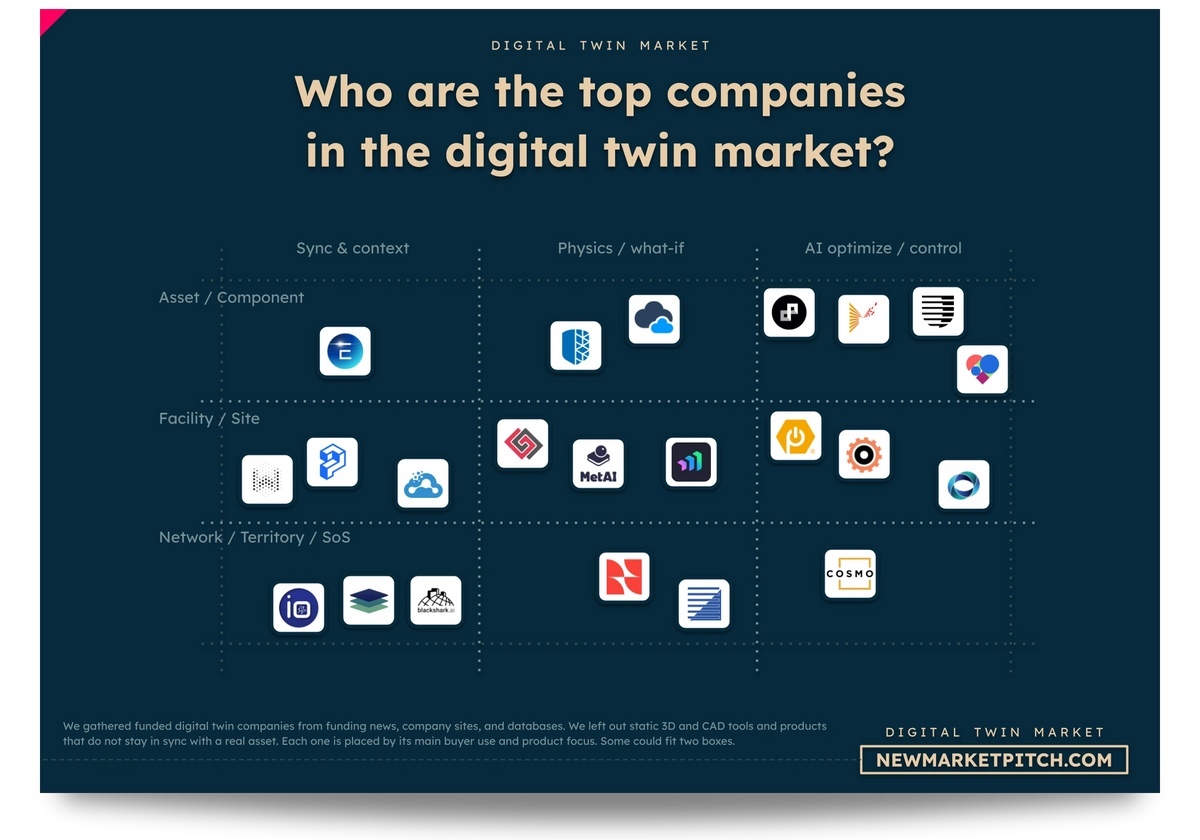
In our market report about digital twins, we turn what is vague and complex into simple, useful visuals. Market maps like this one show you at a glance where every startup stands.
Which digital twin problems need to be solved first?
The most urgent digital twin problems today are data quality, interoperability, model validation, and deployment costs. These four issues affect both the reliability of existing systems and the industry's ability to reach more customers.
Our ranking combines the frequency of reported problems, their consequences for operational decisions, and the dependencies between them.
Hexagon's survey provides a useful picture of what companies experience during implementation. PwC's 2025 and 2026 operations surveys reveal the broader struggle to extract value from digital investments. NIST's latest workshop findings show which technical difficulties remain unresolved.
Data quality comes first because incorrect measurements can undermine virtually every digital twin application. Interoperability follows closely because companies often cannot assemble the necessary information without costly integration work.
Model validation ranks third. A digital twin that produces believable but incorrect predictions can be more problematic than one whose limitations are immediately visible.
Cost and reusability determine whether these capabilities become available beyond large organizations with extensive engineering resources.
| Priority | Unsolved problem | Main consequence |
|---|---|---|
| 1 | Data quality | Incorrect representation of physical systems |
| 2 | Interoperability | Expensive custom integrations |
| 3 | Model validation | Predictions that cannot be trusted |
| 4 | Deployment and maintenance costs | Limited adoption outside large organizations |
| 5 | Real-time synchronization | Decisions based on outdated information |
| 6 | Reusability across facilities | Difficult and expensive scaling |
| 7 | Cybersecurity | Exposure of sensitive industrial systems |
| 8 | Uncertainty quantification | Excessive confidence in unreliable predictions |
| 9 | Demonstrable financial ROI | Difficulty justifying investments |
| 10 | Autonomous control | Limited use in safety-critical operations |
This is our assessment of the industry's priorities rather than a ranking published by one research organization.
If you want more recent data on this point, please see our latest digital twin market report.
So what are the biggest unsolved problems in digital twins?
The biggest unsolved problems in digital twins are data quality, interoperability, prediction reliability, and the cost of deploying and maintaining systems at scale. Together, they explain why the technology can deliver strong results in specific applications while still struggling to reach the wider market.
The evidence is consistent across several sources. PwC's 2025 survey found 21% adoption despite very positive feedback from existing users. Hexagon's industry report identified data quality and interoperability as the most common implementation challenges. NIST's 2026 workshop report continued to highlight interoperability, validation, uncertainty, and cybersecurity as unresolved priorities.
Successful deployments such as BMW's FactoryExplorer demonstrate that digital twins can support major industrial operations. BMW's virtual environments now cover more than 30 production locations, with potential reductions of up to 30% in production-planning costs. That is meaningful progress, although the projected savings should not be confused with independently verified results across the industry.
We think the industry's central challenge is making this level of capability repeatable. Companies need digital twins that can connect to unfamiliar equipment, keep their models accurate as conditions change, produce predictions whose reliability can be measured, and deliver enough financial value to justify ongoing costs.
For now, digital twins work best when the application is clearly defined, the underlying data is dependable, and the potential savings are large enough to justify the engineering effort.
The next major breakthrough will likely come from making these systems easier to deploy and trust, rather than making their virtual environments more visually impressive.

Our document detailing everything you need to know about digital twin gets updated several times a month, so you always get the latest view of where things stand.
Our methodology
This analysis identifies the biggest unsolved problems in digital twins using recent industry surveys, technical research, manufacturing standards, and documented deployments. We examined adoption, data quality, interoperability, predictive reliability, synchronization, deployment economics, scalability, cybersecurity, and operational autonomy, with particular emphasis on evidence published in 2025 and 2026.
We evaluated each challenge separately before examining the connections between them. Our priority ranking considers how frequently a problem appears in industry research, how seriously it affects operational decisions, and whether solving it would help remove other barriers. The ranking is our assessment of the evidence, rather than a ranking reproduced from any single study.
We distinguished between different kinds of evidence. Survey responses help establish which problems organizations commonly encounter, but cannot independently prove financial returns or technical reliability. Technical studies explain why specific limitations persist, while documented deployments show which capabilities have already been demonstrated. We also distinguished projected savings from verified outcomes and industry-wide findings from results specific to digital twins.
The main industry evidence comes from PwC's 2025 Digital Trends in Operations survey, PwC's 2026 operations survey, and Hexagon's Digital Twin Industry Report. These sources provide the adoption, implementation-challenge, reported ROI, and AI-use figures discussed throughout the article. PwC's broader digital operations findings are treated as contextual evidence rather than digital-twin-specific measurements.
For technical challenges, we relied primarily on NIST's July 2026 Digital Twins Workshops Summary Report, its Digital Twins for Advanced Manufacturing program, its research on standardized implementation, and Security and Trust Considerations for Digital Twin Technology. We also examined the Asset Administration Shell specifications, OPC UA documentation, and buildingSMART's IFC framework to understand the scope and limitations of interoperability standards.
For real-world deployment, we used BMW Group's June 2025 Virtual Factory announcement and NVIDIA's FactoryExplorer case study. For deployment economics, we examined research in the Journal of Intelligent Manufacturing. Grid synchronization and computational challenges were assessed using a 2026 Energies review, while healthcare limitations were examined through a 2025 Journal of Medical Internet Research meta-review and 2026 npj Health Systems research.
We gave greater weight to recent, first-hand evidence and to findings that were consistent across independent sources. Where studies covered different populations or applications, we kept those distinctions rather than combining their figures into a single industry-wide estimate. The aim was to establish which problems most directly affect the reliability, economics, and repeatability of digital twin deployments, while separating demonstrated progress from ambitions that remain technically or commercially unproven.

In our report covering the digital twin market, we don't want to repeat what boring consulting reports say. Instead, we show you the real and latest market signals that matter.
Written by the New Market Pitch teamWe track new markets so founders and investors can move faster. About us