Industrial digital twins: which company is ahead?
Whether you're building or investing in the digital twin market, our report covers everything you need to know: the players, the money, and what's coming next.
Summary
Siemens is currently the leading industrial digital twin company overall, ahead of Dassault Systèmes, AVEVA, and NVIDIA when it comes to connecting product engineering, manufacturing simulation, factory planning, and industrial operations.
Siemens' biggest advantage is its existing industrial software and automation business. Its Digital Industries division generated €6.17 billion in software revenue in fiscal 2025, giving the company an established commercial base that would be difficult for a newer competitor to replicate.
The strongest evidence comes from actual factories. PepsiCo reported a 20% throughput improvement at an initial manufacturing deployment using Siemens and NVIDIA technology, alongside estimated capital spending reductions of 10-15% from testing proposed changes virtually.
Siemens is also bringing AI closer to daily manufacturing decisions. At its Erlangen electronics factory, projects announced in October 2026 targeted up to 85% less engineering effort in selected workflows, although these figures should not be mistaken for results achieved across its customer base.
Dassault Systèmes has a credible claim to leadership in product-focused virtual twins. Its 3DEXPERIENCE software revenue grew 10% in constant currencies during 2025 and 14% in the second quarter of 2026, substantially faster than Siemens' broader Digital Industries software revenue.
NVIDIA is becoming increasingly influential without replacing traditional industrial software providers. Omniverse supplies simulation infrastructure for manufacturers, but companies still need engineering models, operational information, and industrial systems from suppliers such as Siemens and Dassault.
AVEVA occupies another valuable position: connecting information from industrial plants that are already operating. Its strengths in real-time equipment data and asset information make it particularly relevant to energy, chemicals, mining, and other asset-intensive industries.
The competitive picture changes outside conventional factories. Bentley has a strong position in infrastructure digital twins, Hexagon specializes in capturing and modeling physical assets, and PTC has narrowed its industrial software strategy after selling ThingWorx and Kepware in March 2026.
Smaller companies such as Cognite and Twinzo are attacking integration and usability problems that established industrial software companies have not completely solved. However, the available commercial disclosures do not support the conclusion that an independent startup has overtaken the major industrial platforms.
The biggest limitation is the absence of comparable standalone digital twin revenue and market-share data. Siemens remains our overall leader based on portfolio breadth, industrial reach, and documented deployments, but the next real test is whether its strongest factory results can be reproduced across many unrelated customers.

Written by the New Market Pitch teamWe track new markets so founders and investors can move faster. About us

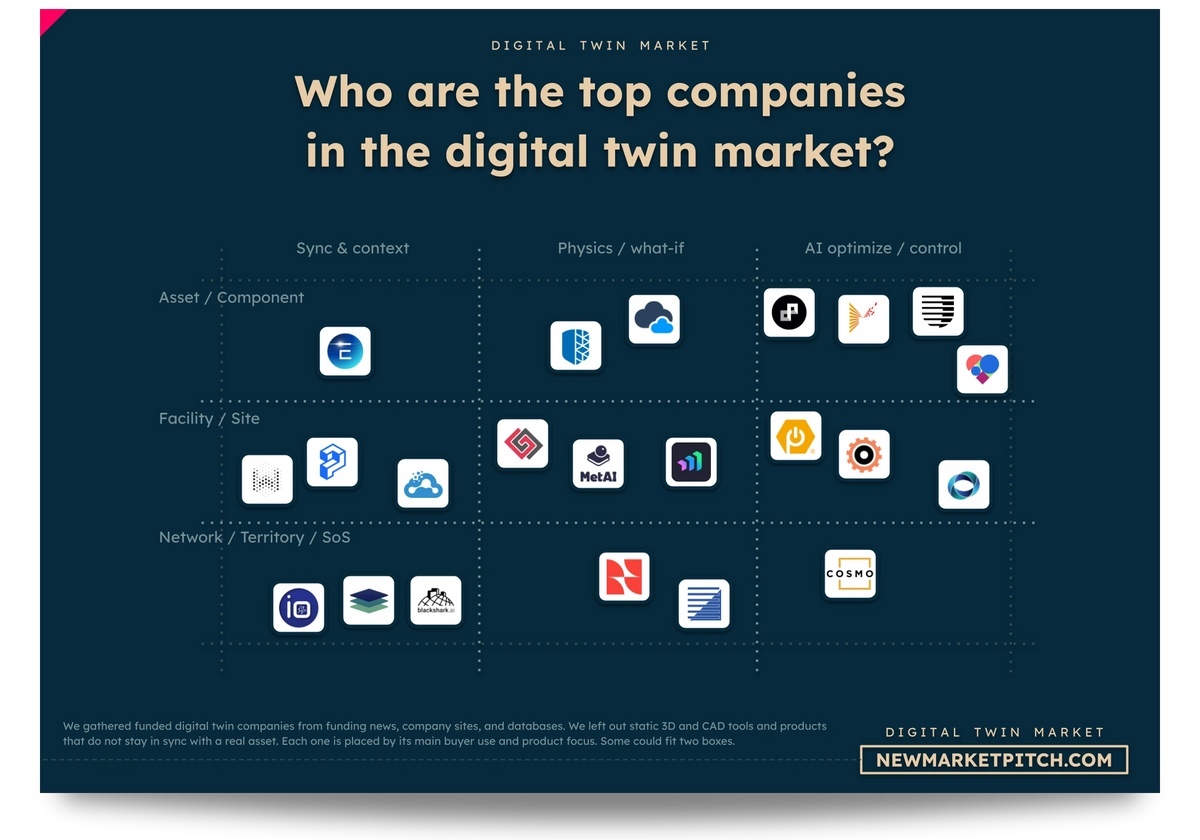
In our report covering the digital twin market, we turn what is vague and complex into simple, useful visuals. Market maps like this one show you at a glance where every startup stands.
Why are industrial digital twins getting so much attention now?
Industrial digital twins are becoming much more useful to manufacturers, and Siemens' recent work with PepsiCo shows why companies are taking the technology seriously.
In January 2026, PepsiCo announced a collaboration with Siemens and NVIDIA to build virtual replicas of selected U.S. factories and warehouses. At one Gatorade manufacturing plant, Siemens reported a 20% increase in throughput within three months. PepsiCo also estimated that validating factory changes virtually could reduce capital spending by 10-15%.
The figures are striking because industrial digital twins have existed for decades. Automotive and aerospace manufacturers were using virtual engineering models long before generative AI became popular. What has changed is the ability to combine detailed 3D environments, live equipment data, AI, and faster simulation in the same workflow.
BMW, for example, has been using NVIDIA Omniverse to plan factories digitally, while AVEVA connects engineering information with real-time industrial operating data. Siemens is taking these capabilities further by testing how AI can prepare manufacturing processes and help operators make production decisions.
Technologies that developed separately for years are starting to converge. Companies that once specialized in engineering design, industrial data, or simulation are now competing to provide a more complete picture of how a factory works.
What makes a company the leader in industrial digital twins?
The strongest industrial digital twin company is the one that can connect engineering models with real factory operations and turn that connection into measurable improvements. By that definition, Siemens currently has the most convincing overall position.
The difficulty is that digital twins cover several different markets. An aircraft manufacturer might use a virtual twin to test a new engine before building it. A chemical company might use one to monitor operating equipment. An automotive manufacturer could simulate an entire assembly line to find production bottlenecks.
Dassault Systèmes is particularly strong in the first category through CATIA, SIMULIA, and 3DEXPERIENCE. AVEVA has a strong position in the second through its PI and CONNECT technologies. Siemens competes across all three through its Xcelerator portfolio, which combines product engineering, simulation, manufacturing planning, and industrial automation.
NVIDIA occupies a different position. Its Omniverse technology helps companies build and simulate complex virtual environments, but customers generally need other industrial software to supply engineering models, equipment information, and operational data.
We give more weight to the ability to connect multiple industrial workflows than to the quality of any single simulation product. Actual deployments, commercial scale, and measurable customer results also matter.
There is one important limitation: no consistently defined, independently audited market-share dataset covers the entire industrial digital twin industry. Company financial reports usually combine digital twins with CAD, simulation, industrial IoT, or automation software. Any precise ranking based on standalone digital twin revenue would be difficult to defend.

Our research about digital twins gets updated several times a month, so you always get the latest view of where things stand.
Is Siemens really ahead of every other industrial digital twin company?
Siemens is currently the strongest overall industrial digital twin provider, largely because it already supplies much of the software and automation technology that manufacturers need to connect.
Its Xcelerator portfolio includes Teamcenter for product lifecycle management, NX for engineering design, Simcenter for simulation, and Tecnomatix for manufacturing planning. Siemens also sells industrial automation equipment and software that operate inside real factories.
That combination gives Siemens a practical advantage. A manufacturer can use Siemens technology to design a product, simulate how it will be manufactured, plan the production line, and connect parts of that digital environment to physical equipment.
The company's existing business is substantial. According to Siemens' fiscal 2025 annual report, Digital Industries generated €17.79 billion in revenue, including €6.17 billion from software. Software represented approximately 35% of the division's revenue.
Those €6.17 billion cannot be treated as digital twin revenue. They include a much wider range of industrial software products. Still, they show how large Siemens' established engineering and automation software business has become.
Siemens also has a stronger case than many competitors when we examine actual factory deployments. PepsiCo has reported improvements in manufacturing throughput, while Siemens' Erlangen electronics factory is testing AI-assisted manufacturing preparation and production planning.
The Erlangen work is particularly interesting. In October 2026, Siemens announced that preparing certain printed circuit board manufacturing processes virtually could reduce engineering effort by up to 85% and time-to-market by up to 40%. The company also described AI-assisted production planning with potential cost savings of up to 20%.
These are specific application results and targets rather than averages across Siemens' customer base. Even with that limitation, the combination of existing industrial reach and new factory applications puts Siemens ahead overall.
If you want more recent data on this point, please see our latest digital twin market report.
Could Dassault Systèmes actually be ahead of Siemens?
Dassault Systèmes could be considered the leader in product-focused virtual twins, especially for complex engineering, but Siemens has the stronger position across manufacturing operations.
Dassault's greatest advantage comes from its established role in designing and simulating complex products. CATIA is widely used in aerospace and automotive engineering, SIMULIA handles advanced simulation, and 3DEXPERIENCE connects different stages of product development.
The scale of this business is impressive. Dassault reported approximately €6.24 billion in total revenue in 2025, including €5.64 billion from software. Its Industrial Innovation business generated around €3.13 billion, representing 56% of software revenue.
More interestingly, 3DEXPERIENCE software revenue grew 10% in constant currencies during 2025, followed by 14% growth in the second quarter of 2026. Dassault's total revenue grew only 4% in each of those periods.
Its main virtual engineering platform is expanding considerably faster than the rest of the company.
However, Dassault's strength remains concentrated on product engineering and virtual product development. Siemens has a broader combination of engineering software, production planning, automation, and factory operations.
For an aerospace company building a digital twin of a new aircraft, Dassault could easily be the better choice. For an industrial group trying to connect product development with dozens of operating factories, Siemens has the more complete portfolio.

In our market report about digital twins, we look at what the winners do differently, so you can learn from the best instead of guessing.
Which companies are leading different parts of the industrial digital twin market?
Industrial digital twins currently have several leaders because no company dominates engineering design, factory operations, infrastructure modeling, and AI simulation simultaneously.
We compared eight major providers by the industrial workflows they support and the roles their technologies play. Siemens offers the broadest integrated manufacturing portfolio, while Dassault, AVEVA, Bentley, and others have stronger positions in particular applications.
| Company | Main strength | Core technology | Where it stands |
|---|---|---|---|
| Siemens | Manufacturing and automation | Xcelerator, Teamcenter, Simcenter | Overall leader |
| Dassault Systèmes | Product virtual twins | 3DEXPERIENCE, CATIA, SIMULIA | Product engineering leader |
| AVEVA / Schneider Electric | Live industrial operations | PI, CONNECT | Strong in industrial asset data |
| NVIDIA | AI and simulation infrastructure | Omniverse, OpenUSD, Isaac Sim | Key technology provider |
| Bentley Systems | Infrastructure digital twins | iTwin, ProjectWise, AssetWise | Infrastructure specialist |
| Hexagon | Reality capture and physical assets | HxDR, Leica technologies | Strong in physical-world modeling |
| PTC | Product lifecycle management | Windchill, Creo, Codebeamer | Product engineering specialist |
| AWS | Cloud-based digital twins | AWS IoT TwinMaker | Cloud infrastructure provider |
Could NVIDIA overtake Siemens in industrial digital twins?
NVIDIA is becoming essential to advanced industrial digital twins, but Siemens still has the stronger position in complete industrial software. Their expanding partnership actually makes the distinction clearer.
NVIDIA Omniverse provides tools for building and simulating detailed virtual environments. Its Isaac Sim platform supports robotics development, while NVIDIA's accelerated computing hardware allows companies to run increasingly complex AI and physics simulations.
BMW offers a good example of how far the technology has progressed. The automaker developed FactoryExplorer using Omniverse and created virtual factory environments spanning more than one million square meters. NVIDIA's published BMW case study describes projected planning savings of 30%.
However, BMW's virtual factory environment brings together data and software from several providers, including engineering technologies associated with Bentley, Autodesk, and Dassault Systèmes.
Siemens has chosen to work closely with NVIDIA rather than compete directly against its simulation infrastructure. The two companies expanded their partnership in January 2026, combining Siemens' engineering and automation software with NVIDIA's accelerated computing and simulation technologies.
That collaboration has since produced applications tested in Siemens' Erlangen electronics factory. NVIDIA Cosmos models help generate synthetic training data for visual inspection, while Omniverse supports virtual testing of production plans.
The partnership gives Siemens access to advanced AI simulation capabilities without requiring it to develop every underlying technology itself. NVIDIA, meanwhile, gains access to manufacturing applications built around an established industrial software provider.
NVIDIA is also collaborating with Dassault Systèmes, Hexagon, and other industrial companies, so Siemens does not have exclusive access to these tools.
NVIDIA could become the dominant simulation infrastructure provider without ever becoming the leading industrial digital twin vendor. Siemens still controls more of the engineering and operational workflows that industrial customers use every day, and those relationships are difficult to displace.
If you want more recent data on this point, please see our latest digital twin market report.

In our document detailing everything you need to know about digital twin, you will always find fresh funding data, taken straight from our own verified funding database.
Is AVEVA better than Siemens for industrial plant digital twins?
AVEVA can be the better choice for digital twins focused on running industrial plants, particularly when a company needs to combine equipment information with live operational data.
Siemens has the broader manufacturing portfolio, but AVEVA has spent years building software for asset-intensive industries such as chemicals, energy, mining, and utilities.
Its PI technology collects and organizes time-series data from industrial equipment. CONNECT and Asset Information Management bring together operational measurements, engineering records, and information about physical assets.
These capabilities are especially useful when a company already operates a large facility and wants to understand equipment performance, maintenance requirements, or changes in production conditions.
In October 2025, AVEVA announced enhancements designed to connect industrial asset information more closely with real-time operating data. This continued a strategy built around making different sources of industrial information accessible within a common environment.
The commercial performance has also been solid. Schneider Electric reported that AVEVA's annualized recurring revenue grew 12% at the end of 2025, with sustained double-digit growth demonstrating demand for its industrial software.
The choice between Siemens and AVEVA depends heavily on what the customer wants to do. Siemens is particularly attractive when designing and changing manufacturing processes. AVEVA is a strong contender when the priority is monitoring and improving equipment that is already operating.
Are industrial digital twins actually improving factory performance?
Industrial digital twins are already delivering measurable improvements in selected factories, although the public evidence is still too limited to establish what an average manufacturer should expect.
PepsiCo provides one of the strongest examples. According to the company's January 2026 announcement, its work with Siemens and NVIDIA helped increase throughput by 20% at an initial manufacturing deployment, identify up to 90% of potential issues before physical modifications, and reduce estimated capital spending by 10-15%.
The three numbers describe different improvements. Higher throughput means greater output from existing production capacity. Earlier detection of potential problems reduces the risk of expensive modifications. Lower capital spending suggests that companies may be able to use existing facilities more efficiently instead of building additional capacity.
At Siemens' Erlangen factory, the focus is on preparing production earlier. AI-generated representations of electronic assemblies allow engineers to train visual inspection systems before physical prototypes are available.
Siemens' October 2026 announcements included targets of up to 85% less manual engineering effort, more than 40% fewer false inspection calls, and over 5% improvement in first-pass yield for the relevant inspection workflow.
BMW's virtual factory program provides another example, but its published 30% planning savings figure is a projection rather than an independently established average across all BMW facilities.
Taken together, these projects show that industrial digital twins can improve planning, equipment preparation, and production performance. We still lack comparable results from hundreds of independent factories, particularly information about implementation costs, payback periods, and ongoing maintenance.
The technology has demonstrated practical value. The harder question is whether a factory with older equipment, inconsistent data, and a limited engineering budget can achieve anything close to the same results.

Learning from others' mistakes is the cheapest lesson there is. In our report covering the digital twin market, we look at what broke startups before you, so you don't repeat it.
Is Dassault's digital twin business growing faster than Siemens'?
Dassault Systèmes currently shows stronger growth in its main virtual engineering platform than Siemens reported across its broader Digital Industries software business.
Siemens generated €6.17 billion in Digital Industries software revenue during fiscal 2025, compared with €6.29 billion in 2024. That represents a reported decline of approximately 1.9%.
Dassault's 3DEXPERIENCE software revenue increased 10% in constant currencies during 2025, then 14% in the second quarter of 2026. Both figures were well above Dassault's overall revenue growth of 4%.
AVEVA offers another comparison. Its annualized recurring revenue was growing 12% year over year at the end of 2025, while Bentley Systems reported approximately $1.46 billion in annualized recurring revenue at the end of 2025, up from $1.28 billion the previous year.
These figures suggest that demand for integrated engineering platforms and industrial software subscriptions remains healthy, even though growth varies considerably between companies.
We should be careful about treating the comparison as a digital twin sales ranking. Siemens' revenue includes products that are not digital twins, and Dassault's 3DEXPERIENCE platform covers a wider range of engineering applications. AVEVA and Bentley also report recurring revenue using different business definitions.
Still, Dassault's growth advantage is hard to ignore. Its named virtual engineering platform has recently been growing much faster than Siemens' overall Digital Industries software operation. Siemens has the broader manufacturing position, but Dassault has the better recent growth story in this particular comparison.
| Company | Reported metric | Period | Growth |
|---|---|---|---|
| Siemens | Digital Industries software revenue | FY2025 | -1.9% reported |
| Dassault Systèmes | Total revenue | FY2025 | +4% constant currency |
| Dassault Systèmes | 3DEXPERIENCE revenue | FY2025 | +10% constant currency |
| Dassault Systèmes | 3DEXPERIENCE revenue | Q2 2026 | +14% constant currency |
| AVEVA | Annualized recurring revenue | December 2025 | +12% year over year |
| Bentley Systems | Annualized recurring revenue | FY2025 | +13.9% reported |
| PTC | Annual recurring revenue | FY2025 | +10% reported |
| Hexagon | Group organic sales | Q4 2025 | +3% |
If you want more recent data on this point, please see our latest digital twin market report.
Has PTC fallen behind Siemens in industrial digital twins?
PTC has fallen behind Siemens in the broader industrial digital twin market, and its decision to sell ThingWorx and Kepware makes that gap more pronounced.
PTC historically combined several technologies relevant to connected industrial products. Creo handled engineering design, Windchill managed product lifecycle information, ThingWorx provided industrial IoT capabilities, and Kepware connected factory equipment.
In March 2026, PTC completed the sale of ThingWorx and Kepware to TPG for approximately $523 million in cash proceeds at closing.
The transaction removed two important components of PTC's industrial connectivity portfolio. PTC explained that the sale would allow it to concentrate on its Intelligent Product Lifecycle strategy, with greater emphasis on engineering design and product information.
PTC remains a significant industrial software company. Its fiscal 2025 annual recurring revenue reached approximately $2.48 billion, growing 10% as reported.
However, its current strategy is more focused than Siemens'. PTC remains competitive in product design and lifecycle management, particularly through Creo and Windchill, but it now relies more heavily on integrations and external technologies for connected industrial operations.
For manufacturers primarily interested in product engineering, PTC is still relevant. For companies seeking a broad industrial digital twin platform spanning design, live equipment data, and factory automation, Siemens has the stronger offering.

In our research about digital twins, we always try to gather several sources and make estimates that make sense, so you can work with solid numbers.
Could Bentley or Hexagon challenge Siemens in industrial digital twins?
Bentley Systems and Hexagon can challenge Siemens in specific applications, particularly infrastructure modeling and reality capture, but neither has established the same breadth in factory engineering and automation.
Bentley's iTwin technology helps organizations connect engineering models, infrastructure information, and asset data. It is especially suited to railways, utilities, transportation networks, and other infrastructure assets that must be maintained over decades.
Its financial performance is substantial. Bentley reported approximately $1.46 billion in annualized recurring revenue at the end of 2025, compared with $1.28 billion one year earlier. Fourth-quarter subscription revenue increased 13% year over year to approximately $357 million.
Hexagon approaches digital twins from a different direction. Its measurement, reality-capture, geospatial, and industrial software technologies allow organizations to create accurate representations of physical assets, including facilities that were built long before modern digital engineering systems existed.
In June 2025, Hexagon announced an integration of NVIDIA Omniverse and OpenUSD with its HxDR digital reality workflows. That combination is designed to make realistic digital environments easier to create using captured physical data.
Bentley is particularly well positioned when engineering information must be maintained throughout the lifetime of infrastructure. Hexagon has an advantage when accurate measurements and physical-world data are central to the application.
Both could continue growing without becoming direct replacements for Siemens. In their respective markets, specialized technology may be far more useful than a large integrated manufacturing suite.
Are digital twin startups catching up with Siemens and Dassault?
Industrial digital twin startups are making progress in specialized applications, but there is currently no convincing public evidence that an independent startup has overtaken Siemens or Dassault Systèmes in overall commercial adoption.
One reason smaller companies can compete is that traditional industrial software is often difficult to deploy across older facilities. Equipment may come from different manufacturers, operational records may be incomplete, and connecting engineering models with live data can require extensive integration work.
Companies such as Cognite and Twinzo have built products addressing parts of this problem.
Cognite focuses on organizing and connecting industrial data from multiple systems. Its technology can support operational digital twins by making equipment records, engineering information, and sensor measurements easier to access together.
Twinzo approaches the market through interactive 3D representations of industrial facilities, connecting visual environments with operational information.
The difference between these companies and Siemens is substantial. A smaller provider may offer a more accessible product for a specific application, but Siemens brings decades of engineering software development, established industrial relationships, and a large portfolio of complementary technologies.
We also have limited financial visibility into private digital twin startups. Revenue, paying customer numbers, production deployments, and retention rates are rarely disclosed in a consistent format.
Without those figures, ranking startups by fundraising or announcements would tell us relatively little about commercial leadership.
The most promising opening for startups may be the messy integration work that large industrial platforms still struggle with. Making an existing factory's data usable, without replacing its systems or rebuilding everything from scratch, could be a valuable business on its own.
For now, though, Siemens and Dassault remain in a different commercial league.
If you want more recent data on this point, please see our latest digital twin market report.

If you build or invest in the digital twin market, you need to know which business models pay off now and which ones are fading. That's why our report covering it has a whole section on it.
Can Siemens keep its industrial digital twin lead as AI improves?
Siemens is well positioned to keep leading industrial digital twins, but AI is making it easier for competing software companies to build sophisticated simulation and optimization tools.
The company's strongest advantage remains its installed industrial technology. Engineering models, automation systems, and manufacturing software are difficult to replace, particularly in factories where reliability and production continuity are critical.
Its recent work with NVIDIA strengthens that position. At Erlangen, AI can generate possible production plans and use digital twins to evaluate them before operators make physical changes. This brings simulation closer to decisions that factories make every day.
Dassault is also expanding AI capabilities within its virtual engineering software. AVEVA is developing AI-assisted industrial data applications, while NVIDIA and AWS provide technologies that other companies can use to create their own digital twin systems.
The growing use of shared infrastructure could reduce some of Siemens' historical advantages. A manufacturer may eventually combine engineering software from one provider, operational data from another, and AI simulation from a third without depending entirely on Siemens.
Yet the difficulty of deploying and maintaining industrial systems still favors established companies. A sophisticated simulation is only useful if it represents the physical process accurately and remains connected to changing equipment and production conditions.
Siemens' next challenge is therefore commercial as much as technical. It needs to show that the improvements reported at PepsiCo and Erlangen can be repeated across many unrelated customers, rather than remaining impressive results from carefully selected projects.
The company has a strong starting position. We have not yet seen enough comparable deployment data to conclude that its next generation of AI-powered digital twins will outperform every competing approach.
Which company is winning the industrial digital twin market today?
Siemens is currently winning the industrial digital twin market overall. Dassault Systèmes is its strongest rival in virtual product engineering, AVEVA stands out in live industrial operations, and NVIDIA is becoming increasingly important to the simulation technology behind both.
Siemens leads because it combines several capabilities that other suppliers tend to offer separately: engineering design, manufacturing simulation, production planning, and industrial automation.
Its €6.17 billion Digital Industries software business demonstrates the scale of its established industrial software operation, while deployments involving PepsiCo and its own Erlangen factory show how newer AI-enabled digital twins can influence actual manufacturing decisions.
Dassault deserves particular attention because its 3DEXPERIENCE software revenue has been growing considerably faster than Siemens' broader Digital Industries software revenue. Its position in complex product engineering is exceptionally strong, and the latest financial results show continued demand.
AVEVA remains a serious competitor for industrial operators whose main priority is monitoring and improving existing assets. NVIDIA could become increasingly influential as more industrial companies depend on its computing and simulation infrastructure.
We cannot establish which company generates the most standalone digital twin revenue because the necessary comparable disclosures are unavailable. That prevents a definitive market-share ranking, but Siemens' broader industrial advantages are still clear.
For now, Siemens is the company to beat. Its greatest advantage is the range of industrial systems it can connect, and the PepsiCo and Erlangen projects provide unusually concrete evidence of what that integration can achieve.
The next challenge is proving those results can be repeated across entire manufacturing networks. If Siemens succeeds, it will have a much stronger claim to leadership than any software revenue comparison or product demonstration could provide.
If you want more recent data on this point, please see our latest digital twin market report.

In our document detailing everything you need to know about digital twin, we don't want to repeat what boring consulting reports say. Instead, we show you the real and latest market signals that matter.
Our methodology
This analysis evaluates which company leads industrial digital twins based on evidence available as of October 2026. We compared major providers across industrial technology coverage, integration between engineering and operations, commercial scale, reported growth, real-world deployments, and measurable improvements in industrial performance.
We distinguished overall industrial digital twin leadership from leadership in individual applications. Siemens was assessed primarily on its integration of engineering software, manufacturing planning, and automation; Dassault Systèmes on virtual product engineering; AVEVA on operational asset data; NVIDIA on simulation infrastructure; and Bentley, Hexagon, PTC, AWS, and emerging providers on their respective industrial capabilities.
Financial metrics were used as indicators of commercial scale and momentum, not as direct measurements of digital twin market share. Siemens' Digital Industries software revenue, Dassault's 3DEXPERIENCE growth, and recurring revenue metrics from AVEVA, Bentley, and PTC cover different product portfolios and accounting definitions. We also separated reported operational improvements from projected benefits and project targets, particularly in the PepsiCo, BMW, and Siemens Erlangen examples.
We prioritized official annual reports, investor disclosures, original product announcements, and documented industrial deployments. The core financial references include Siemens' 2025 Annual Report, Dassault Systèmes' 2025 results, Dassault's second-quarter 2026 results, Schneider Electric's 2025 results presentation, Bentley Systems' 2025 results, PTC's 2025 results, and Hexagon's 2025 financial report.
For deployments and competitive developments, key sources include Siemens' CES 2026 industrial AI announcement, the PepsiCo digital twin case study, Siemens' October 2026 autonomous factory announcement, its PCB inspection announcement, the Siemens-NVIDIA partnership expansion, and NVIDIA's BMW FactoryExplorer case study.
Additional technology and strategy references include AVEVA's industrial digital twin developments, PTC's ThingWorx and Kepware divestiture announcement, Hexagon's Omniverse integration, Cognite Data Fusion documentation, and AWS IoT TwinMaker documentation. Our overall conclusion reflects the combined evidence rather than a standalone digital twin revenue ranking, which the available company disclosures do not support.

In our report covering the digital twin market, we like to show you the big picture. We know your time is precious, so we make every page quick to read and packed with as much learning as possible per minute.
Written by the New Market Pitch teamWe track new markets so founders and investors can move faster. About us