Which digital twin startup is growing the fastest?
Whether you're building or investing in the digital twin market, our report covers everything you need to know: the players, the money, and what's coming next.
Summary
Buildots is currently the fastest-growing major digital twin startup based on disclosed revenue growth, with reported annual increases of 200% over multiple years. Its combination of rapid sales expansion, large enterprise contracts and adoption by major construction companies gives it the strongest case among the leading private companies.
Buildots' revenue has reportedly tripled annually, although its absolute sales remain undisclosed. That makes its growth rate unusually impressive, but prevents a proper comparison of how many additional dollars it generates against larger competitors.
Cognite leads on disclosed commercial scale, reporting more than $170 million in 2025 revenue and 36% growth in annual recurring revenue bookings. Schneider Electric's proposed $3.1 billion acquisition also demonstrates how valuable established industrial software platforms have become.
NavVis has a much broader published customer footprint than Buildots, with more than 1,500 customers and 150,000 users across over 50 countries. Yet customer reach tells us little about revenue acceleration when the companies sell different products under different commercial models.
Neara is arguably Buildots' most interesting challenger. Its infrastructure modeling technology reportedly serves nearly 90% of Australian network utilities, while its AUD 90 million financing in February 2026 gives it resources to expand internationally.
Buildots' growth is closely tied to the increasing complexity of major construction projects. Data centers, advanced manufacturing facilities and energy infrastructure create unusually expensive scheduling problems, making automated progress tracking more valuable to project owners.
The shift toward seven-figure, multiyear, portfolio-wide contracts is especially important. Buildots can expand from individual projects into long-term relationships covering entire construction portfolios, potentially increasing revenue without constantly acquiring new corporate customers.
Digital twin financing is becoming concentrated among fewer, larger companies. Identified equity funding increased 18.2% through September 21, 2026, even as the number of funded companies fell from 29 to 18. Removing rounds above $50 million reveals that funding for smaller transactions actually declined.
Public-market evidence shows why percentage growth needs context. Listed digital twin company 51WORLD increased company-wide revenue by 21% in 2025, while one smaller product line expanded nearly fivefold. Its gross margin nevertheless fell sharply, showing that rapid product adoption does not automatically produce healthy financial performance.
Buildots' main competitive advantage may be its eight years of construction-site data, which support computer vision models trained to recognize hundreds of construction activities. Its next test is whether it can maintain rapid growth as contracts grow larger, implementation becomes more complex and the company expands beyond its strongest markets.
Our conclusion is that Buildots leads on reported revenue growth, Cognite stands out for proven revenue scale, NavVis leads on disclosed customer reach, and Neara is a serious potential challenger. Buildots deserves the top position today, but its undisclosed revenue and unaudited growth figures prevent an absolute global ranking.

Written by the New Market Pitch teamWe track new markets so founders and investors can move faster. About us
Is Buildots the fastest-growing digital twin startup right now?
Buildots is currently the strongest candidate for the fastest-growing digital twin startup, with reported annual revenue growth of 200% and major construction companies increasingly adopting its software.
The Israeli company uses AI, construction-site imagery, project schedules and 3D building models to track construction progress. Contractors can see which activities are behind schedule, spot problems earlier and compare what has actually been built with what was planned.
In September 2026, Buildots announced a $130 million funding round that brought its total capital raised to $297 million. According to Intel Capital, the company had maintained a multiyear streak of tripling annual revenue. Buildots also reported deployments across more than 100 major organizations, including Intel, Digital Realty, JE Dunn, Mortenson, Bouygues and HOCHTIEF.
The important distinction is that Buildots has reported rapid commercial growth over several years. Other prominent digital twin startups, including Neara, NavVis and PassiveLogic, have raised substantial amounts of money, but their public disclosures do not establish comparable revenue-growth rates.
We still lack Buildots' audited revenue figures, so calling it the world's undisputed fastest-growing digital twin company would go too far. Among the major startups with meaningful public growth evidence, however, Buildots has the strongest case.
If you want more recent data on this point, please see our latest digital twin market report.
Why is it so hard to tell which digital twin startup is growing fastest?
Digital twin startups are unusually difficult to rank because companies use the same term for very different products, and most keep their revenue private.
Buildots creates digital representations of construction progress. Neara models electricity networks and other infrastructure. NavVis specializes in spatial mapping, while Cognite connects industrial data to support digital models, analytics and AI applications.
For this comparison, we include companies whose products depend heavily on digital representations of physical assets, environments or processes. We focus on independent startups and scale-ups, while using listed companies and acquisition targets as useful benchmarks.
Revenue growth deserves the most weight. Customer numbers, contract values and deployment growth help us understand whether that revenue trajectory is credible. Funding tells us considerably less: investors may be financing years of anticipated expansion rather than growth already achieved.
There is another complication. A company with $2 million in revenue can grow 300% by adding $6 million, while a company generating $150 million would need another $450 million to achieve the same rate. Percentage growth and the amount of new business created can produce different winners.
Since private digital twin startups rarely disclose both their revenue and year-over-year growth, we cannot calculate a definitive global leaderboard. We can still compare the strongest available evidence and identify which company currently stands out.

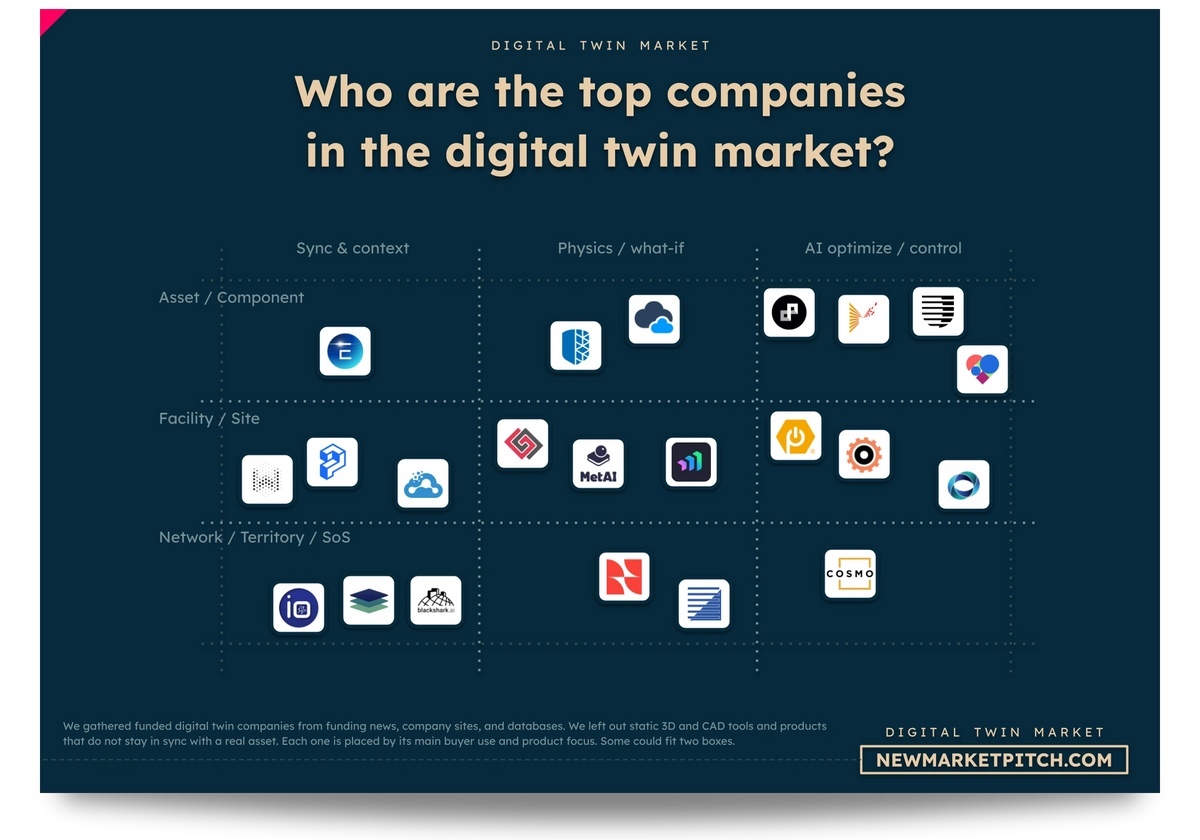
In our report covering the digital twin market, we turn what is vague and complex into simple, useful visuals. Market maps like this one show you at a glance where every startup stands.
How fast is Buildots actually growing?
Buildots has reported a remarkable pace of revenue growth: approximately 200% annually over multiple years, according to its September 2026 announcement.
That means revenue tripled each year. Two consecutive years at that pace would make the business nine times larger, while three would make it 27 times larger. These are mathematical comparisons, rather than estimates of Buildots' undisclosed revenue.
CEO Roy Danon told Calcalist that revenue had tripled in 2025 and was expected to grow at a similar pace in 2026. The second figure was still a forecast when reported, so the completed 2026 growth rate remains unconfirmed.
The company has also changed the size of the contracts it sells. Buildots stated that seven-figure, portfolio-wide, multiyear agreements have become normal rather than exceptional. Such deals cover large construction operations and potentially multiple projects.
The combination is unusual. Buildots is reporting very high percentage growth while moving toward large enterprise contracts, which typically involve longer purchasing decisions and more complex implementation.
The missing number is absolute revenue. A threefold increase from $5 million and a threefold increase from $30 million represent very different amounts of new business. Buildots has not disclosed enough financial information for us to determine which scale is closer to reality.
Is Buildots growing faster than Cognite, Neara and NavVis?
Buildots has the highest reported annual revenue-growth rate among these major digital twin companies, although Cognite has much stronger evidence of its absolute business size.
Cognite reported annual revenue exceeding $170 million for 2025 and 36% growth in annual recurring revenue bookings. That is substantial growth for an established industrial software company, although the bookings figure cannot be directly compared with Buildots' reported recognized revenue growth.
Neara raised AUD 90 million in February 2026, valuing the company above AUD 1 billion. Its infrastructure modelling software has become widely used among Australian electricity network operators, but Neara has not published a comparable annual revenue-growth rate.
NavVis secured an $85 million Series D financing in August 2026. Its spatial digital twin platform operates across industrial facilities, buildings and construction sites. The company's customer footprint is impressive, but publicly available information does not establish that revenue has been growing faster than Buildots'.
PassiveLogic also deserves attention. The building automation startup raised $74 million in September 2025, with investors including Johnson Controls, Brookfield and Nvidia's NVentures. Its software uses digital models to help buildings control their own systems. Again, independently comparable revenue growth remains unavailable.
Some competitors may be adding more revenue in absolute dollars, and others could be growing faster from smaller bases. On the numbers they have actually disclosed, though, Buildots comes out ahead.
| Company | Main market | Latest commercial or financial evidence | What we can conclude |
|---|---|---|---|
| Buildots | Construction | Reported 3x annual revenue growth | Strongest disclosed revenue acceleration |
| Cognite | Industrial AI | Over $170M revenue in 2025 | Strongest disclosed revenue scale among these private-company peers |
| Neara | Electricity infrastructure | AUD 90M Series D in 2026 | Major utility adoption; revenue growth undisclosed |
| NavVis | Spatial digital twins | $85M Series D in 2026 | Established commercial footprint |
| PassiveLogic | Building automation | $74M Series C in 2025 | Well-funded; revenue growth undisclosed |
| Twin Health | Healthcare digital twins | Substantial private financing | Separate healthcare market; comparable revenue growth unavailable |
| 51WORLD | Simulation and digital twins | Revenue +21% in 2025 | Verified growth, but publicly listed |
| Aize | Industrial asset software | NOK 442.1M operating income in 2025 | Meaningful scale, but no evidence of faster recent growth |
If you want more recent data on this point, please see our latest digital twin market report.

Our research about digital twins gets updated several times a month, so you always get the latest view of where things stand.
Why is Buildots growing so fast right now?
Buildots is growing quickly because large construction projects have become more expensive and complicated, especially data centers, advanced manufacturing facilities and energy infrastructure.
Construction companies already use schedules, inspection reports and building models. The problem is keeping that information consistent with what is actually happening on site.
Buildots uses computer vision to analyze construction-site imagery, compare progress with the original plan and show where work is falling behind. That can help contractors make decisions before delays spread to later stages of a project.
Data centers are a particularly attractive market. Delayed completion can postpone the installation and operation of expensive computing equipment, making reliable progress tracking more valuable to project owners.
Buildots' customer list illustrates the opportunity. Intel and Digital Realty are owners of major facilities, while JE Dunn, Mortenson, Bouygues and HOCHTIEF are construction businesses. The platform can therefore reach different organizations involved in the same construction ecosystem.
There is also evidence of broader adoption beyond data centers. Buildots reports deployments in residential, commercial and industrial construction. Its management says demand for better project information existed before the AI infrastructure boom, which has accelerated purchasing decisions for particularly complex projects.
Buildots does not publish sales by industry, so we cannot separate these drivers into precise revenue contributions. But the timing works strongly in its favor: a product addressing a longstanding construction problem is finding buyers just as large projects face even greater scheduling pressure.
Has Buildots become a big business or is it still testing its technology?
Buildots has clearly moved beyond experimental deployments, with more than 100 major organizations using its software and large multiyear agreements now forming part of its commercial business.
That customer count includes some of the world's largest contractors and infrastructure owners. These are organizations with complicated projects, established procurement requirements and substantial budgets.
Buildots also reports operations across more than 12 countries and billions of square feet of construction activity covered annually. The geographic spread suggests its technology can be sold outside its original Israeli market and used across different construction environments.
One particularly interesting development is the move toward portfolio-wide contracts. Instead of selling access for one construction site, Buildots can work with a company managing several projects simultaneously.
This changes the potential size of each customer relationship. A contractor with projects across multiple countries can expand spending on the same platform as more sites adopt it, without Buildots having to win an entirely new enterprise account each time.
We should still be careful with the numbers. More than 100 customer organizations does not tell us how many projects are active or how much each customer pays. The billions of square feet figure describes construction activity covered, not a financial metric.
Even so, repeated enterprise purchases and contracts worth at least seven figures provide much stronger evidence of a working commercial product than a collection of pilot announcements.

In our market report about digital twins, we look at what the winners do differently, so you can learn from the best instead of guessing.
Is NavVis actually bigger than Buildots?
NavVis has a much larger reported customer base than Buildots, making it one of the strongest digital twin companies by market reach. Whether its annual revenue is larger remains harder to establish.
The German company reported more than 1,500 customers across over 50 countries and more than 150,000 users in its August 2026 financing announcement. It also reported adding over one billion square meters of industrial plants, buildings and construction sites to its platform during 2025.
Those numbers show the breadth of NavVis' adoption. Its technology captures physical spaces and turns them into accurate digital representations that customers can inspect and use for planning.
Buildots operates differently. Its customers use construction imagery and project information to understand progress, identify delays and manage active construction work.
The difference helps explain why customer counts alone cannot settle the comparison. NavVis can serve many organizations buying spatial mapping technology, while Buildots increasingly signs large contracts with companies managing construction portfolios.
NavVis has an established distribution footprint that Buildots has not yet matched in published customer numbers. But until we have comparable revenue figures, NavVis' larger user base cannot establish which company generates more money or adds revenue faster.
Could Neara overtake Buildots as the fastest-growing digital twin startup?
Neara could become Buildots' biggest challenger because electricity networks need increasingly sophisticated planning tools, and the Australian startup is already established among major utilities.
Neara creates detailed, physics-based models of electricity networks and other critical infrastructure. Utilities can use these models to understand available capacity, assess engineering constraints and plan upgrades.
In February 2026, Neara raised AUD 90 million in a Series D led by TCV, with existing investors including Partners Group, EQT, Square Peg Capital and Skip Capital. The round valued the business at approximately AUD 1.1 billion.
The Wall Street Journal reported that Neara's technology served nearly 90% of Australian network utilities. It also identified Southern California Edison and CenterPoint Energy among its customers, demonstrating that the business has expanded beyond its home market.
That is an unusually strong domestic position. Neara has reached a large proportion of its core Australian customer market, so a substantial part of future expansion will need to come from deeper contracts, new countries or applications beyond electricity distribution.
The company is targeting demand caused by growing electricity consumption, renewable generation, aging networks and the construction of power-hungry data centers.
Neara's challenge is the speed of utility purchasing decisions. Major network operators often work through lengthy procurement, engineering and regulatory processes. Those relationships can be valuable, but converting market demand into revenue may take considerable time.
Neara has the customer foundations and financing to become a major digital twin company. Its position in electricity infrastructure makes it one of the most interesting businesses to watch, although there is no published revenue-growth figure that puts it ahead of Buildots today.
If you want more recent data on this point, please see our latest digital twin market report.

In our document detailing everything you need to know about digital twin, you will always find fresh funding data, taken straight from our own verified funding database.
Is Cognite still the biggest success story in digital twins?
Cognite has demonstrated much greater revenue scale than most independent digital twin startups, and its proposed $3.1 billion acquisition by Schneider Electric makes it one of the sector's clearest commercial success stories.
In January 2026, Cognite reported more than $170 million of annual revenue for 2025, alongside 36% growth in annual recurring revenue bookings.
The company also disclosed a sharp increase in AI product adoption. Its Atlas AI customer count grew nearly 700% year over year, while customers representing 59% of Cognite's total ARR had operationalized the product. More than 70% of 2025 bookings included Atlas AI.
These figures show how Cognite has been expanding from industrial data management into AI applications. The near-700% customer increase is especially striking, although it describes adoption of one product rather than company-wide revenue growth.
In June 2026, Schneider Electric announced an agreement to acquire Cognite for $3.1 billion in cash. The agreement would combine Cognite's industrial data capabilities with Schneider Electric's energy management and industrial software operations, including AVEVA.
At the announced price, Schneider's offer represented roughly 18 times Cognite's reported 2025 revenue if we use $170 million as the denominator. Because revenue exceeded that amount, the actual multiple would be somewhat lower. It remains a substantial software acquisition valuation.
Cognite shows what a digital twin-related startup can become after years of enterprise adoption. Its revenue scale is impressive, but its recent growth disclosures do not challenge Buildots' reported 200% annual revenue expansion.
Does Buildots' $130 million funding round really prove its growth?
Buildots' $130 million financing is unusually large for the digital twin market, but the strongest evidence of its growth comes from the reported revenue trajectory and expanding enterprise contracts.
The September 2026 financing brought Buildots' cumulative funding to $297 million. The latest round alone represented approximately 43.8% of all the equity capital raised by the company up to that point.
Calcalist reported that Buildots' valuation had increased from approximately $300 million at its previous $45 million financing to nearly $1 billion. That suggests the company became worth more than three times as much between rounds, according to those approximate reported valuations.
The financial market clearly reassessed Buildots' potential. However, valuation increases can reflect optimism about future growth, and the company has not disclosed enough financial information for us to calculate its revenue multiple.
A separate look at the wider digital twin market makes the Buildots round more interesting.
According to New Market Pitch's September 2026 funding tracker, identified digital twin equity financing reached $497.2 million through September 21, up 18.2% from the comparable 2025 period. Yet the number of funded companies dropped from 29 to 18, a decrease of 37.9%.
The median financing increased from $5 million to $25.5 million, or more than five times its previous level. Meanwhile, the three largest rounds, raised by Buildots, NavVis and Neara, represented 55.9% of total funding.
Even more revealing, removing rounds above $50 million left just $219.2 million of financing, compared with $223.6 million in the previous period. On that basis, funding for smaller rounds actually declined by about 2%.
Investors are putting much larger amounts into a narrower group of established digital twin companies. Buildots is the clearest beneficiary, but the broader market is far less buoyant than headline funding growth suggests.
| Digital twin funding measure | 2025 comparable period | 2026 comparable period |
|---|---|---|
| Total equity funding | $420.8M | $497.2M |
| Number of funded companies | 29 | 18 |
| Median financing | $5.0M | $25.5M |
| Average disclosed financing | $15.6M | $27.6M |
| Capital excluding rounds above $50M | $223.6M | $219.2M |
| Largest financing | $74M | $130M |
| Three largest rounds' share | 46.9% | 55.9% |
| Annual change in total funding | - | +18.2% |

Learning from others' mistakes is the cheapest lesson there is. In our report covering the digital twin market, we look at what broke startups before you, so you don't repeat it.
Is 51WORLD growing faster than digital twin startups?
51WORLD's audited financial statements show 21% revenue growth in 2025, considerably slower than Buildots' reported pace, despite very rapid expansion in one smaller product line.
The Chinese digital twin and simulation company reported revenue of RMB347.8 million for 2025, compared with RMB287.4 million in 2024.
We examined the individual product lines to see where the increase came from. The company's largest business, 51Aes, generated RMB274.4 million, up from RMB236.2 million. Its 51Sim simulation business increased from RMB47.6 million to RMB55.6 million.
51Earth grew much faster, from RMB3.6 million to RMB17.7 million. That is almost five times its previous revenue, but the business still accounted for only about 5% of company-wide revenue.
Here's the catch with product-level growth figures. One business line can expand nearly 400% while total company revenue increases only 21%.
51WORLD's financial results also reveal a less attractive side of its expansion. Gross margin fell from 51.1% in 2024 to 30.0% in 2025, while its annual net loss increased from RMB79 million to RMB186 million.
Revenue increased by about RMB60.4 million, but gross profit actually declined by approximately RMB42.7 million. The additional sales therefore came alongside a significant deterioration in overall profitability.
51WORLD listed in Hong Kong in December 2025, so it is no longer a private startup. Its audited figures nevertheless provide a valuable comparison: the company has growing digital twin revenue, but its financial performance is much less impressive than its fastest-growing product would suggest.
If you want more recent data on this point, please see our latest digital twin market report.
What makes Buildots harder to compete with?
Buildots' most interesting advantage is its construction-specific data, which helps the company turn site imagery into information contractors can use in daily decisions.
According to its September 2026 announcement, Buildots' computer vision models draw on eight years of real construction-site data and can classify hundreds of types of construction activity.
That experience could be difficult for a new competitor to reproduce quickly. Construction sites vary enormously in design, layout, equipment and working conditions, so recognizing meaningful progress requires more than a generic image-analysis model.
Buildots also connects its observations with project schedules and 3D building information. This allows customers to identify differences between planned and actual progress and prioritize work that could affect later activities.
The company's competitive position becomes clearer when we compare what customers buy from three different digital twin providers.
NavVis helps organizations capture and understand physical spaces. Neara lets infrastructure operators model how networks behave. Buildots helps construction teams see whether work is progressing as expected and where intervention is needed.
Each product serves a different need, and Buildots' current commercial success suggests that construction progress tracking has become particularly valuable to large customers.
The company is now aiming to expand further into the construction lifecycle, including earlier planning and project handover. That could increase the amount existing customers spend, although there is no published evidence yet showing how much additional revenue these newer applications generate.
Buildots' eight-year data history is a credible advantage, but we have not seen independent benchmarking proving its models outperform every alternative. Its commercial traction provides stronger evidence of competitive strength than any unverified claim of technological superiority.

In our research about digital twins, we always try to gather several sources and make estimates that make sense, so you can work with solid numbers.
Can Buildots keep growing this fast?
Buildots is unlikely to maintain 200% annual revenue growth indefinitely, but its large enterprise contracts and expansion into new construction markets give it room to keep growing quickly.
The biggest challenge is the arithmetic of repeated tripling. Imagine a software company generating $5 million annually. Two years of tripling would take it to $45 million, and four years would take it to $405 million.
Buildots' actual revenue is undisclosed, so those figures illustrate the difficulty of maintaining its growth rate rather than predicting its future sales.
Its current strategy offers several ways to keep expanding. Buildots wants to sell across more construction portfolios in North America and EMEA, cover more stages of construction projects and provide increasingly detailed information to senior management.
Existing large customers may also contribute to growth without requiring the company to win entirely new corporate accounts. A contractor deploying Buildots across five projects could potentially extend the platform to dozens of additional projects.
Data centers present both an opportunity and a risk. Buildots has strong exposure to this market, where project delays can be very expensive. But it has not disclosed what percentage of revenue comes from data centers, making it impossible to measure how dependent its growth has become on AI infrastructure spending.
Competition and implementation costs could also become more important as the company grows. Larger customers may require extensive integrations and support, while established construction software vendors have their own relationships with contractors.
We would be more confident in Buildots' long-term trajectory if the company published annual revenue, net revenue retention, gross margins and customer expansion rates. For now, its commercial evidence supports continued growth, but not another guaranteed year of tripling.
Which digital twin startup is growing the fastest overall?
Buildots is currently the strongest candidate for the fastest-growing digital twin startup, based on its reported threefold annual revenue growth and evidence of expanding commercial adoption.
Its growth rate is unusually high for enterprise software, and the company has demonstrated traction among major contractors and infrastructure owners. The shift toward seven-figure multiyear agreements is particularly encouraging because it shows customers are committing substantial budgets to the platform.
The other major contenders have different strengths. Cognite has demonstrated much greater absolute revenue scale and attracted a $3.1 billion acquisition offer. NavVis has an extensive international customer base. Neara has established a strong position with Australian electricity utilities and is expanding abroad. PassiveLogic is developing a potentially valuable building automation business.
None has published directly comparable evidence of faster overall revenue growth.
Buildots' position comes with an important limitation: its absolute revenue is undisclosed, its growth figures are company-reported, and we cannot rule out a smaller private competitor expanding more quickly.
Still, the available evidence is strong enough to make a choice. Buildots leads on reported revenue acceleration, Cognite stands out for proven financial scale, and Neara looks like one of the most serious potential challengers.
If Buildots can maintain rapid growth while turning its largest construction customers into long-term, portfolio-wide relationships, it has a credible path toward becoming one of the biggest independent businesses in digital twin software. Its next challenge is proving that the remarkable growth rate can hold as the company becomes substantially larger.
If you want more recent data on this point, please see our latest digital twin market report.

If you build or invest in the digital twin market, you need to know which business models pay off now and which ones are fading. That's why our report covering it has a whole section on it.
Sources and methodology
This analysis identifies the fastest-growing digital twin startup using publicly available evidence through October 2026. We compare reported revenue growth, commercial scale, customer adoption, enterprise contracts, financing activity and competitive positioning across major digital twin companies, including Buildots, Cognite, Neara, NavVis, PassiveLogic and selected public-market benchmarks.
We give revenue growth the greatest weight when ranking companies by speed of expansion. Absolute revenue establishes business scale, while customer counts, contract sizes and geographic reach help assess commercial traction. Funding and valuation increases provide additional context, but they do not establish how quickly a company's sales are growing.
Our comparison includes businesses whose products rely heavily on digital representations of physical assets, spaces, infrastructure or industrial processes. We focus on independent startups and scale-ups, using 51WORLD as a listed-company benchmark and Cognite as an established private-company comparison following its announced acquisition agreement. We distinguish company-wide revenue growth from product adoption, bookings growth and changes in individual business lines.
Buildots' reported annual revenue growth is based on company and investor disclosures, supported by independent reporting on its financing, valuation and enterprise contracts. These figures are company-reported rather than independently audited. Cognite's published revenue and bookings figures provide a separate benchmark for commercial scale, while 51WORLD's audited annual report allows us to assess revenue growth, product-level performance, gross margins and losses using reported financial statements.
We also examine digital twin funding concentration using New Market Pitch's September 2026 equity funding tracker, comparing total capital raised, funded-company counts, median financing sizes and capital excluding rounds above $50 million. The comparison uses the tracker’s stated periods and coverage rather than treating the figures as an exhaustive global record of every digital twin investment.
For broader demand, we consider construction-industry reporting and International Energy Agency research on electricity demand, data centers and grid modernization. These sources help explain why construction monitoring and infrastructure modeling are attracting customers, without assuming that industry demand translates directly into any particular startup's revenue.
Key sources for Buildots include Intel Capital's September 2026 financing announcement, Buildots' expansion strategy, Calcalist Tech's valuation and revenue-growth reporting, and Construction Dive's coverage of its commercial momentum.
Competitor comparisons draw on Cognite's 2025 financial and operating results, the Schneider Electric acquisition announcement, NavVis' August 2026 Series D announcement, Neara's February 2026 financing announcement, The Wall Street Journal's reporting on Neara's utility adoption, and PassiveLogic's Series C announcement.
Financial and market benchmarks include 51WORLD's 2025 audited annual report and New Market Pitch's digital twin funding trends analysis. Industry context comes from the International Energy Agency's Electricity 2026, Modernising Grids in the Age of Electricity, and Key Questions on Energy and AI.
Our conclusion reflects the strongest disclosed evidence rather than a complete ranking of private-company finances. Buildots' reported revenue acceleration supports its position as the current leader, while competitors' different reporting practices and undisclosed financial results limit how precisely their growth rates can be compared.

In our document detailing everything you need to know about digital twin, we don't want to repeat what boring consulting reports say. Instead, we show you the real and latest market signals that matter.
Written by the New Market Pitch teamWe track new markets so founders and investors can move faster. About us