Edge AI chips: which startup is ahead?
Building a startup or looking for your next investment in edge AI? Our report gives you the full picture.
Summary
Axelera AI is ahead in edge AI chips today, with SiMa.ai the closest challenger and Hailo still a serious third despite its financial problems.
Axelera has the strongest overall package rather than one unbeatable metric: verified high-throughput hardware, more than 500 disclosed customers, industrial distribution and enough fresh capital to fund its next generation.
SiMa is the company most likely to take the lead. Modalix is shipping, its performance-per-watt evidence is unusually credible, and its integrated architecture fits industrial buyers that want fewer separate processors and software layers.
Hailo has more visible accelerator adoption than either leader, including more than 500,000 reported units sold and a large developer base. The catch is company risk: layoffs, a failed SPAC process and financing pressure now matter almost as much as the chips.
Syntiant wins the shipment race by a huge margin, with at least 20 million processors deployed. Those chips handle smaller always-on tasks, so the number proves manufacturing scale more than leadership in high-performance edge inference.
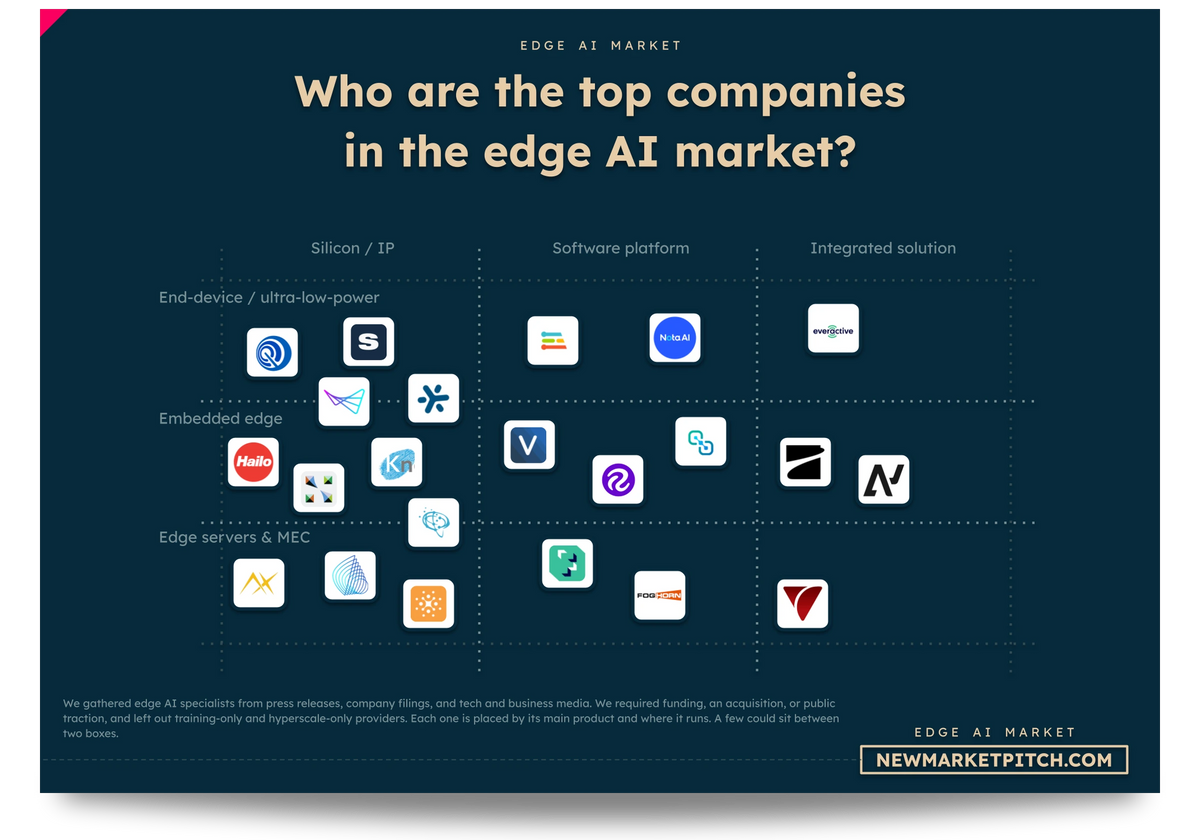
The field splits into two different markets. Axelera, SiMa and Hailo compete for heavier vision and generative-AI workloads, while Syntiant owns the ultra-low-power endpoint where milliwatts matter more than headline TOPS. Who competes in heavier vision workloads and who in ultra-low-power endpoints is shown on the market maps in our report covering the edge AI market.
Independent evidence changes the ranking. Axelera benefits from a third-party buyer reproducing its performance, SiMa has repeated MLPerf submissions, and MemryX has earned unusually positive outside feedback on software usability.
DEEPX is rising fastest from a small base, but pre-orders and partnerships still need to turn into repeat production. Mythic has the most dramatic comeback story, though most of the proof sits in future automotive development rather than current deployments.
Hailo offers the easiest low-cost route into serious edge AI through products such as the Raspberry Pi AI HAT+ 2. Axelera may have better economics for dense multi-camera systems, but it publishes too little consistent pricing for a clean payback comparison.
Funding alone does not explain who is ahead. Axelera is converting capital into products and customers more convincingly than its peers, while Syntiant has the best unit-output ratio and Hailo shows that strong adoption can still coexist with a fragile balance sheet.
The ranking could move quickly. A large recurring SiMa deployment could put it first, a mass-production order could lift DEEPX into the top group, and continued financial pressure could push Hailo down even if its product ecosystem remains strong.

Written by the New Market Pitch teamWe track new markets so founders and investors can move faster. About us

In our report covering the edge AI market, we turn what is vague and complex into simple, useful visuals. Market maps like this one show you at a glance where every startup stands.
Which edge AI chip startups are we comparing?
The serious edge AI chip startup field currently contains ten companies, although only four have enough product, customer and deployment evidence to compete for the overall lead.
We include independent companies developing their own processors, accelerators or full chip-and-software platforms for running AI inside cameras, robots, industrial equipment, vehicles, computers and other devices. The comparison covers startups with working silicon, meaningful funding and a credible path to commercial deployment. What counts as an edge AI chip company, rather than a software or IP vendor, is defined in our report on edge AI.
Axelera AI, SiMa.ai, Hailo and Syntiant form the leading group. DEEPX, Kneron and EdgeCortix have commercial products but disclose less convincing deployment data. MemryX is smaller but already shipping production-quality hardware. EnCharge AI and Mythic have raised substantial capital around analog computing, although both still need to prove that their latest technology can reach repeatable commercial scale.
We exclude Nvidia, Qualcomm, NXP, Ambarella and other established semiconductor companies because this analysis focuses on startups. Blaize and BrainChip are publicly traded. NXP acquired Kinara. Quadric mainly licenses processor intellectual property rather than competing as a merchant chip supplier. Groq, Cerebras and Etched are primarily fighting for data-center inference workloads.
Funding numbers remain imperfect because companies calculate them differently. Axelera includes equity, grants and venture debt in its total. Mythic’s cumulative figure varies across databases because the company went through a financial restructuring before its latest funding round.
| Startup | What it does | Cumulative funding |
|---|---|---|
| Axelera AI | High-performance edge inference accelerators for vision, robotics and industrial systems | More than $450M |
| SiMa.ai | Integrated machine-learning chips and software for industrial and physical AI | $355M |
| Hailo | Embedded accelerators and vision processors for cameras, computers, vehicles and industrial devices | More than $340M |
| Mythic | Analog compute-in-memory processors for automotive, robotics, defense and edge inference | About $266M |
| Kneron | Reconfigurable edge NPUs, embedded systems and private AI servers | More than $200M |
| EnCharge AI | Analog in-memory accelerators for computers, workstations and edge devices | More than $144M |
| Syntiant | Ultra-low-power processors, sensors and models for always-on devices | About $120M |
| EdgeCortix | Low-power accelerators for vision, generative AI, defense and aerospace | More than $110M |
| DEEPX | Low-power NPUs and modules for cameras, robots and industrial equipment | About $100M |
| MemryX | Compute-at-memory accelerators for embedded vision and edge servers | About $63M |
Is there a clear leader among edge AI chip startups today?
Axelera AI leads overall, with SiMa.ai now the closest challenger and a meaningful gap separating both companies from the rest of the field.
Axelera has the most complete collection of evidence. It has production hardware, strong outside performance testing, more than 500 disclosed customers, a major industrial distribution relationship and enough fresh capital to fund another product generation.
SiMa has become the clearest number two. Its Modalix processor is shipping, its performance-per-watt results are among the best documented in the market, and companies such as Emerson are putting the technology into real industrial computers. What SiMa still does not disclose is how many chips or systems customers are buying.
Hailo would rank close to SiMa on product maturity alone. It has reportedly sold more than 500,000 accelerators, supports hundreds of customers and has built the largest visible developer community in the startup field. Its failed SPAC transaction, investor write-down and roughly 50% workforce reduction now create a much larger execution risk.
Syntiant leads a narrower market. It has shipped far more processors than any competitor, but most handle small, always-on audio, sensor or vision tasks. Its recent IPO filing also showed that acquired microphone and sensor operations now produce nearly all company revenue.
So the broad race is Axelera first and SiMa chasing. Hailo combines strong products with serious financial pressure, while Syntiant dominates ultra-low-power endpoints.

Our research about edge AI gets updated several times a month, so you always get the latest view of where things stand.
Which edge AI chip startup has shipped the most processors?
Syntiant has shipped the most edge AI processors by a huge margin, with at least 20 million Neural Decision Processors already in devices.
Hailo recently said it had sold more than 500,000 edge AI accelerators. That is a substantial result for a high-performance chip startup, but Syntiant’s disclosed processor volume is still at least 40 times larger.
The products are not directly equivalent. Syntiant chips generally perform focused tasks such as detecting a wake word, identifying a sound or deciding whether a person appears in front of a camera. An Axelera, SiMa or Hailo accelerator can process several cameras, run a large object-detection model or support a small generative model. Very different jobs.
Syntiant’s recent regulatory filing says its technology now operates in tens of millions of devices. Hailo is the closest company with a credible public unit figure. Axelera reports customers rather than chips, while SiMa, DEEPX and Kneron disclose too little shipment data for a reliable comparison.
Which edge AI chip startup has the strongest high-performance product?
Axelera AI currently has the strongest high-performance edge AI product. SiMa.ai offers the most credible alternative for customers prioritizing a complete low-power system.
Axelera’s Metis platform reaches up to 214 TOPS and is available in PCIe and M.2 formats. An independent engineer bought a Metis module and reproduced Axelera’s ResNet-50 workload at about 2,050 images per second, compared with Axelera’s published M.2 result of 1,756 images per second.
That outside test carries more weight than a company-controlled demonstration. The engineer used his own hardware, measured power separately and found that the host computer sometimes became the bottleneck before the accelerator.
SiMa’s Modalix takes a more integrated approach. The chip combines an AI accelerator, Arm application processors and computer-vision processing in one package. Modalix delivers 50 TOPS below ten watts and can run vision, transformer and generative-AI workloads without relying on a separate host processor for every stage.
Hailo-10H reaches 40 TOPS at INT4 precision with typical power consumption of about 2.5 watts. It can run selected language and vision-language models locally, making it attractive for compact computers, smart displays and automotive systems.
EnCharge has unveiled the EN100, which the company rates at 200 TOPS. We still lack independent tests, widespread developer access and production deployments, so it cannot yet challenge Axelera’s proven position.

In our market report about edge AI, we look at what the winners do differently, so you can learn from the best instead of guessing.
Which edge AI chip startup owns ultra-low-power AI?
Syntiant clearly leads ultra-low-power edge AI, and none of the broader accelerator startups is close within this particular market.
Syntiant built its processors for devices that must remain awake throughout the day without draining a small battery. Its NDP family handles speech, sounds, sensor data and simple vision tasks using tiny amounts of energy. The company has reported vision inference below one milliwatt for the NDP200.
Hailo-10H typically consumes about 2.5 watts, equivalent to 2,500 milliwatts. Syntiant runs much smaller models, but the power gap gives it a protected market in earbuds, smoke detectors, trail cameras, wearables and battery-powered sensors. Buyers who need AI on a tiny battery budget are one of the customer groups we study in our market report about edge AI.
Syntiant has also moved beyond isolated chips. Its acquisition of a major microphone business allows it to package sensors, processors and optimized models together, reducing the integration work required from device manufacturers.
Which edge AI chip startups have real demand and can deliver at scale?
Axelera currently has the broadest high-performance customer demand, while Syntiant has the deepest quantified deployment and Hailo has the strongest visible accelerator volume.
Axelera says it has shipped products to more than 500 customers across manufacturing, retail, agriculture, robotics, public safety, defense and security. It manufactures through established semiconductor partners and has brought Metis modules into Advantech’s international sales and support network.
Syntiant has the clearest manufacturing history. Its collaboration with PRADCO Outdoor Brands has passed one million trail and security cameras, while its processors now operate in tens of millions of devices.
Hailo reports more than 300 customers and over 500,000 accelerators sold. Its chips appear in products from Raspberry Pi, ASUS and industrial hardware manufacturers, and customers can source modules through several regional distributors. Its financial restructuring could still affect future support and product investment.
SiMa has production silicon, available modules and strong industrial names. Emerson is integrating SiMa technology into rugged computers for factory floors and remote sites. SiMa has also announced work with Cisco, TRUMPF and Kontron, although order volumes remain undisclosed.
DEEPX has signed a three-year mass-production cooperation agreement with AAEON, and certified systems have begun receiving initial pre-orders. The path to volume is credible, but the company has not yet demonstrated large repeat shipments.
| Startup | Strongest demand evidence | Delivery position |
|---|---|---|
| Axelera AI | Products shipped to more than 500 customers | Commercial production with global industrial channels |
| Syntiant | More than one million cameras in one collaboration | Proven high-volume manufacturing |
| Hailo | More than 500,000 accelerators sold and over 300 customers | Mature products and broad distribution |
| SiMa.ai | Industrial integrations with Emerson and other major manufacturers | Second-generation silicon and modules shipping |
| DEEPX | Certified systems receiving initial pre-orders | Entering early mass production |

In our document detailing everything you need to know about edge AI, you will always find fresh funding data, taken straight from our own verified funding database.
Which edge AI chip startup is growing fastest right now?
DEEPX is growing fastest from a small base, Axelera is adding the most commercially important momentum, and Mythic is staging the boldest comeback.
DEEPX has expanded its partner network from around 15 companies to more than 30, more than doubling its reach within roughly a year. Certified DEEPX systems have begun receiving pre-orders, and its DX-M1 recently demonstrated small language models running completely on-device. The unanswered question is whether these projects will produce thousands of repeat orders.
Axelera’s recent progress is larger in absolute terms. The company raised more than $250 million in new financing, taking cumulative funding above $450 million, and introduced plans for its Europa platform with up to 629 TOPS and as much as 164GB of memory.
SiMa’s progress has been steadier. Modalix entered production and demonstrated 16 simultaneous video streams with several model classes on one module below ten watts. It now needs faster customer and shipment growth, not another polished demo.
Mythic has returned from a near-collapse with a $125 million funding round, a joint-development agreement with Honda and the acquisition of processor-IP company Videantis. Mythic has regained strategic relevance, although most of its new commercial promise still sits ahead of it.
Hailo is moving in the opposite direction at the company level. Its products continue to improve, but the failed SPAC process and loss of about half its workforce outweigh recent launch announcements.
Which edge AI chip startup wins on performance per watt?
SiMa.ai has the strongest standardized performance-per-watt evidence, while Axelera has the best independently reproduced high-throughput result.
SiMa has entered MLPerf’s controlled edge-power benchmarks over several rounds. Its submissions improved by 7% to 16% between successive tests, and the company reported roughly twice the multi-stream efficiency of the nearest comparable submission in one round.
Axelera also benefits from a strong outside test. An independent buyer reproduced Metis performance and exceeded the company’s published throughput on ResNet-50.
Hailo performs particularly well at the lower end of the power range. Hailo-10H provides 40 INT4 TOPS at about 2.5 watts and can run selected language models, vision-language models and real-time 4K object detection.
Syntiant wins below one watt, especially for always-on sensing. DEEPX also looks competitive, with the DX-M1 rated at 25 TOPS while consuming roughly one to five watts, but most comparisons still come from the company or its partners.
EnCharge’s EN100 is rated at 200 TOPS using analog in-memory computing. Independent tests and real customer deployments remain scarce.

Learning from others' mistakes is the cheapest lesson there is. In our report covering the edge AI market, we look at what broke startups before you, so you don't repeat it.
Which edge AI chip startup offers customers the best value?
Hailo currently offers the easiest and most affordable entry into serious edge AI, while Axelera may produce better economics for dense multi-camera systems.
The Raspberry Pi AI HAT+ 2 combines Hailo-10H, 8GB of memory and up to 40 TOPS for about $130. Developers can run local vision and smaller generative models using a familiar computer rather than buying an industrial server.
Axelera targets a different buyer. One Metis accelerator can process many camera streams, potentially replacing a larger GPU and reducing power, cooling and server requirements. Independent testing confirms the throughput, but Axelera does not publish enough consistent pricing or customer cost data for a reliable payback calculation. How edge chip companies turn a technical edge into revenue that holds its margins is compared in our edge AI market report.
SiMa’s value comes from system consolidation. Modalix can handle application processing, computer vision and AI inference on one chip. In a recent demonstration, one module processed 16 video streams with several model types while remaining below ten watts.
MemryX could become a strong value option for developers who need several vision models without a difficult installation. One MX3 chip typically consumes about 0.6 to two watts, although public pricing and deployment data remain limited.
Which edge AI chip startup has the strongest ecosystem and moat?
Hailo has the strongest edge AI ecosystem today. SiMa has the most integrated industrial stack, and Axelera has the strongest overall competitive position.
Hailo says more than 10,000 developers use its tools each month. Its software supports several chip generations, common AI frameworks, Windows, Linux and Android. Developers can also buy finished hardware from Raspberry Pi, ASUS and industrial computer makers.
Raspberry Pi gives Hailo a low-cost route from experimentation to a finished product. Its hundreds of customer designs, model libraries, automotive qualifications and distribution relationships create switching costs that a better benchmark alone cannot erase.
Hailo’s weakness is financial. Customers may hesitate to commit to a long product cycle while the company is cutting staff and looking for strategic financing.
SiMa’s Palette software controls model conversion, optimization, runtime management and application development. Combined with Modalix and its Arm-based processors, it allows industrial customers to run more of the full workload in one environment. Once a robot or industrial system is built around that stack, changing suppliers becomes expensive.
MemryX has a smaller community but unusually strong outside feedback. Independent evaluators found that its MX3 tools installed and ran with little difficulty across Windows, Linux, PCs and Raspberry Pi systems.
Syntiant has built a different moat by combining microphones, other sensors, low-power processors and optimized models. Axelera’s protection currently comes from verified performance, industrial channels and the capital available for its next product generation.

In our research about edge AI, we always try to gather several sources and make estimates that make sense, so you can work with solid numbers.
Is the best-funded edge AI chip startup using its money well?
Axelera is converting funding into products and customers more effectively than the other heavily funded edge AI chip startups.
Axelera has raised more than $450 million and disclosed over 500 customers. That works out to roughly one customer for every $900,000 raised, although the figure is not a customer-acquisition-cost calculation because the funding includes debt and grants and customers vary greatly in size.
SiMa has raised $355 million and produced two chip generations, a substantial software platform and several high-quality industrial relationships. The technical output looks strong, but the company has not disclosed unit shipments, revenue or order growth.
Hailo raised more than $340 million and used that capital to build a mature product family, sell over 500,000 accelerators and support a large developer community. Its recent liquidity problems show that strong product output did not create a financially stable company.
Syntiant offers the best unit-output ratio. At least 20 million processors against roughly $120 million of funding equals more than 166,000 shipped processors for every $1 million raised. Those processors are cheaper and less powerful than Axelera or Hailo products, but the manufacturing result is still hard to dismiss.
Syntiant’s IPO filing also showed that sensors generated about 97% of 2025 revenue and roughly 96% in the latest reported quarter. Mythic has raised heavily across two lives as a company, but its new platform has not yet reached enough customers to judge the latest capital deployment.
Can we trust edge AI chip startup claims?
We can trust the leading group and the broad ranking, but many precise performance, customer and cost claims remain impossible to verify.
Axelera has unusually good technical evidence because an independent buyer purchased Metis hardware, measured it and reproduced the company’s workload. SiMa’s repeated MLPerf submissions provide a controlled comparison across defined models and power rules. MemryX has also allowed independent evaluators to test its hardware and software.
Syntiant offers the best financial transparency because its proposed IPO required a detailed regulatory filing. The filing confirmed substantial revenue, tens of millions of deployed devices and a growing sensor platform. It also exposed a quarterly net loss of $20.9 million and the small contribution of the original AI business to total revenue.
Hailo’s product and shipment figures come largely from the company, while its financial problems were revealed through investor filings and Israeli business reporting.
Evidence becomes thinner lower in the ranking. DEEPX has certified products and pre-orders but no disclosed order value. Kneron names major adopters without consistently explaining the product, volume or contract stage. Mythic’s Honda project remains under development, while EnCharge has announced impressive specifications without enough outside testing.

If you build or invest in the edge AI market, you need to know which business models pay off now and which ones are fading. That's why our report covering it has a whole section on it.
What could change the edge AI chip ranking?
Axelera can lose the lead if its large customer count fails to produce repeat orders. SiMa can take first place by proving that Modalix is shipping at real industrial scale.
Axelera’s biggest unknown is revenue quality. Five hundred customers could include hundreds of growing production deployments or a long tail of evaluation kits and small initial orders. A large production contract or evidence of expansion inside existing customers would strengthen its lead. Large production contracts and repeat orders from existing customers are among the growth drivers we look at in our market report about edge AI.
SiMa needs volume. Its product, software, benchmarks, funding and industrial partners already support a number-two ranking. A meaningful recurring order from Emerson, Cisco or another industrial buyer could move it into first place.
Hailo’s future depends more on financing than technology. A strong acquirer could preserve its products, customers and developer ecosystem. Continued financial pressure could delay new chips and push customers toward Axelera or SiMa.
DEEPX could enter the top three if initial pre-orders become mass-production commitments. Mythic could make an even larger jump if its Honda project produces a working automotive chip.
Which edge AI chip startups are actually ahead?
Axelera AI is ahead overall today, SiMa.ai is the closest challenger, and Hailo remains third because proven products and shipments still outweigh its severe financial problems.
Axelera combines the strongest high-performance product, more than 500 customers, independent testing, global industrial distribution and the largest fresh funding base. We do not yet know its revenue or repeat-order rate, but no competitor currently matches the full picture.
SiMa holds second place because Modalix is shipping, its efficiency evidence is credible and its industrial positioning is stronger than before. A large disclosed production deployment could close the gap quickly.
Hailo falls to third despite having more commercial history than either company. More than 500,000 reported accelerator sales, over 300 customers and a large developer community prove genuine adoption. The failed SPAC process, investor write-down and 50% workforce reduction now place its future investment capacity in doubt.
Syntiant ranks fourth as the clear low-power specialist. It leads the field in processor shipments, but most company revenue now comes from acquired sensors rather than its AI processors.
DEEPX is the most credible rising challenger. Kneron has a long product history and major named partners but weaker proof of recent commercial growth. Mythic has more momentum than EdgeCortix or MemryX, although its latest platform remains earlier. EnCharge finishes last because its customer and deployment evidence remains limited.
| Rank | Startup | Why it holds this position |
|---|---|---|
| 1 | Axelera AI | Strongest mix of performance, customers, funding, industrial distribution and current momentum |
| 2 | SiMa.ai | Best integrated industrial platform and standardized efficiency evidence, with shipment scale still undisclosed |
| 3 | Hailo | Mature products, over 500,000 reported accelerator sales and the best developer ecosystem, weakened by severe financial pressure |
| 4 | Syntiant | Unmatched low-power shipment volume and a real high-volume business, but a narrower AI processor position |
| 5 | DEEPX | Fastest-rising commercial challenger, with early orders still waiting to become proven mass volume |
| 6 | Kneron | Broad product history and major named adopters, but limited recent and quantified commercial evidence |
| 7 | Mythic | Powerful comeback backed by Honda, new funding and an acquisition, with the latest platform still under development |
| 8 | EdgeCortix | Credible products and a strong defense and aerospace niche, but a smaller broad-market footprint |
| 9 | MemryX | Production hardware and unusually accessible software, with limited distribution and customer scale |
| 10 | EnCharge AI | Promising 200-TOPS analog accelerator, but the weakest current evidence of repeat commercial deployment |
Our methodology
This analysis asks which independent edge AI chip startup is ahead based on the evidence available today. We compare product maturity, measured performance, power efficiency, processor shipments, customer deployments, production readiness, developer adoption, distribution, funding and recent company execution.
We gave the most weight to evidence that shows technology working outside a controlled announcement. Independently purchased hardware, standardized benchmark submissions, regulatory disclosures, quantified shipments and confirmed production deployments therefore carried more weight than headline TOPS, early-access claims or partnerships without disclosed volumes.
We did not treat every edge AI processor as directly comparable. Syntiant’s always-on chips perform smaller audio, sensor and vision tasks than the accelerators sold by Axelera, SiMa or Hailo, so shipment volume, performance and power were interpreted in the context of the workload each product was designed to run.
The final ranking was not calculated from a rigid scorecard. We looked at the strength, recency and consistency of the evidence across all dimensions, then judged whether each company had turned its technology into a defensible commercial position. A startup could lead a specialist category without leading the overall market.
Funding totals are approximate because private companies do not always separate equity, grants, debt, strategic investment and project financing in the same way. We used them as evidence of financial capacity, not as a substitute for product or deployment progress.
Product claims were checked against the strongest available supporting material. Axelera’s position draws on its Metis platform specifications, product-performance documentation, Advantech partnership, financing and 500th-customer disclosure, and Europa announcement.
For SiMa.ai, key sources include the Modalix architecture and product specifications, the company’s production-availability announcement, its Modalix product-family release, the 16-stream demonstration below ten watts, and MLCommons material on standardized edge and low-power benchmarking.
For Hailo, we relied on the Hailo-10H specifications, its commercial-availability and developer disclosure, the company’s funding and customer announcement, the Raspberry Pi AI HAT+ 2 integration, and the Hailo-10H M.2 module page.
Syntiant’s shipment position is based on its disclosure of more than 20 million processors shipped. We also used MLCommons’ TinyML benchmark material to frame ultra-low-power performance and energy measurement.
Additional product evidence includes SiMa’s Modalix system-on-module announcement and multimodal execution notes, along with Axelera’s worldwide shipment of Metis evaluation systems. These sources were used to confirm specific product, performance, deployment and availability claims rather than to accept each company’s broader market positioning at face value.

In our document detailing everything you need to know about edge AI, we don't want to repeat what boring consulting reports say. Instead, we show you the real and latest market signals that matter.
Written by the New Market Pitch teamWe track new markets so founders and investors can move faster. About us