
Which edtech startup is growing the fastest?
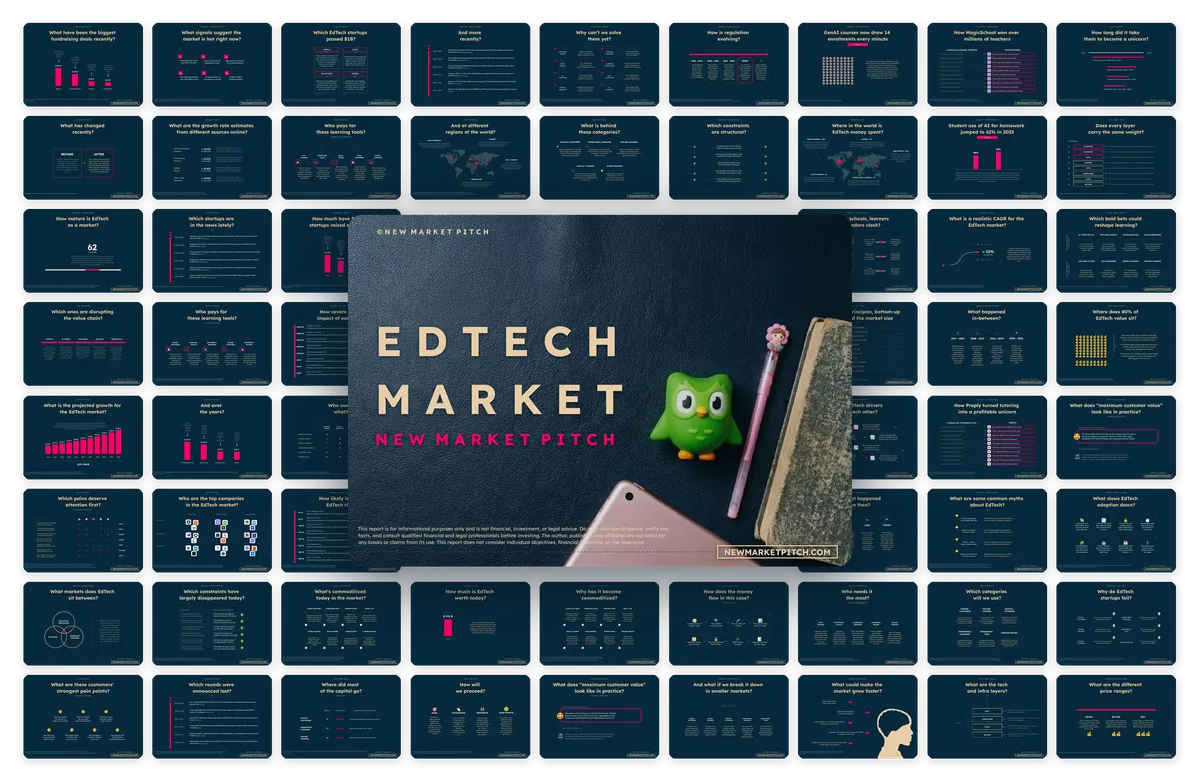
Whether you're building or investing in the edtech market, our report covers everything you need to know: the players, the money, and what's coming next.
Summary
Pingo AI is the fastest-growing early-stage EdTech startup in our comparison, with its reported annualized recurring revenue multiplying roughly 40-fold between March 2025 and August 2026. Speak is the stronger commercial leader at scale, while MagicSchool stands out for its rapid adoption across schools.
Pingo's early growth is particularly well documented. Its monthly recurring revenue increased from approximately $25,000 in March 2025 to $200,000 by July, an eightfold increase in just four months.
The larger growth story is less certain but potentially more important. An August 2026 third-party estimate places Pingo at roughly $12 million in annual recurring revenue, compared with a $300,000 annualized run rate in March 2025. That later figure is an estimate, not audited company revenue.
Pingo's percentage growth has slowed considerably from its earliest months, but its absolute revenue gains have become larger. The implied addition of recurring revenue after July 2025 was about 4.6 times greater than during the preceding four months, over a much longer period.
Speak presents the strongest challenge to Pingo's growth story. With more than $100 million in reported annualized revenue and 3.74 billion spoken interactions in 2025, it has built a business more than eight times larger than Pingo's estimated revenue scale.
MagicSchool illustrates a completely different route to growth. It reportedly reached $10 million ARR within nine months of monetization and expanded to more than seven million educators by June 2026. Its district-level contracts can distribute the product across thousands of classrooms at once.
BoldVoice shows how lean these businesses can become. The AI pronunciation coach passed $10 million ARR with just seven employees, implying more than $1.4 million in recurring revenue per employee, although that says nothing definitive about its profitability.
SchoolAI has reached one million classrooms, with Stanford research finding substantial repeat usage among teachers in an analyzed cohort. Yet classroom adoption, teacher counts and paying subscribers are different measures, making direct comparisons with MagicSchool difficult.
Pingo's biggest unanswered commercial question is conversion and retention. Its reported cumulative audience expanded roughly 27-fold after July 2025 while estimated recurring revenue increased fivefold. That gap does not prove weak retention, but it makes paying-subscriber data increasingly important.
The broader lesson is that AI speaking practice has become a substantial subscription category, even alongside Duolingo's much larger business. Pingo currently leads our early-stage growth ranking, but the next test will be whether its customers keep paying and whether all that practice produces measurable learning improvements.

Written by the New Market Pitch teamWe track new markets so founders and investors can move faster. About us
Why are AI EdTech startups growing so quickly right now?
AI-powered learning startups are growing unusually fast because they have found ways to sell specific educational outcomes, especially speaking practice and classroom assistance, without the costs of traditional tutoring.
Three companies show how quickly this is happening. Pingo AI, which launched its language-learning app in January 2025, reached $200,000 in monthly recurring revenue by July. MagicSchool, which helps teachers prepare lessons and assessments, reached $10 million in annual recurring revenue within nine months of starting to charge customers, according to investor Valor. BoldVoice, an AI pronunciation coach, announced that it had passed $10 million in annual recurring revenue with just seven employees in January 2026.
These businesses took different routes. Pingo sells conversational language practice to consumers. MagicSchool attracts teachers through free tools and sells paid access to schools. BoldVoice focuses on professionals who want to improve their spoken English.
Their growth contrasts with what is happening to older EdTech models. Chegg has struggled as students shift toward AI-powered homework assistance, while established online course platforms such as Udemy have faced slower growth.
The important change is that several young companies have turned narrow learning problems into subscription businesses worth millions of dollars. We're seeing that pattern in consumer apps and classroom software, although some of the strongest revenue acceleration is coming from AI language-learning products.
How can we tell which EdTech startup is actually growing the fastest?
The fastest-growing EdTech startup should be judged primarily by how quickly its revenue increases, with its starting size and the time taken to grow kept in view.
A startup going from $100,000 to $1 million in annual revenue has grown 900%. Another moving from $50 million to $100 million has grown 100%, but added more than 50 times as much revenue. Depending on the question, either could deserve more attention.
We therefore looked for companies with several dated financial milestones rather than relying on one fundraising announcement or a record user count.
Annual recurring revenue, or ARR, is particularly useful for subscription businesses because it gives us an annualized view of their current revenue. But it has limitations. A company reporting $1 million in monthly recurring revenue has a $12 million annualized run rate; that doesn't mean it actually earned $12 million during the previous year.
There is another problem with private EdTech startups: most publish financial figures selectively. We can verify Pingo's early recurring revenue through Y Combinator, for example, but its larger subsequent revenue estimate comes from secondary research. Public companies such as Duolingo provide more reliable financial statements, although they are no longer startups.
For our ranking, we give the most weight to measurable revenue growth over a meaningful period, then look at customer adoption and revenue scale. That gives us a clearer picture than treating downloads, valuation and revenue as equivalent measures of success.

In our report covering the edtech market, we turn what is vague and complex into simple, useful visuals. Market maps like this one show you at a glance where every startup stands.
Is Pingo AI the fastest-growing EdTech startup today?
Pingo AI is currently our strongest candidate for the fastest-growing early-stage EdTech startup, with revenue reportedly increasing around 40-fold from its initial commercial base.
Pingo, founded by Michael Xing and Morrie Schonfeld, launched in January 2025 as an AI tutor designed to help people practice real conversations in foreign languages.
The early numbers are unusually detailed. In March 2025, the company had approximately 50,000 users and $25,000 in monthly recurring revenue. By July, its Y Combinator profile reported more than 300,000 users and $200,000 in monthly recurring revenue.
Revenue multiplied eightfold in approximately four months. During the same period, users increased sixfold.
The company also reported averaging 100% month-over-month growth around its Y Combinator launch, although that early rate should not be assumed to have continued.
A subsequent August 2026 analysis by Systemaic estimated Pingo's annual recurring revenue at approximately $12 million, drawing on public information and company-reported growth. The report also cited more than eight million cumulative users.
That later figure is an estimate rather than audited revenue. Still, it suggests that Pingo moved from a $300,000 annualized run rate in March 2025 to roughly $12 million in less than 18 months.
| Milestone | Users | Monthly recurring revenue | Annualized run rate |
|---|---|---|---|
| January 2025 launch | Not disclosed | Not disclosed | Not disclosed |
| March 2025 | 50,000 | $25,000 | $300,000 |
| July 2025 | 300,000+ | $200,000 | $2.4M |
| August 2026 estimate | 8M+ | Approximately $1M | Approximately $12M |
| March-July 2025 growth | 6× | 8× | 8× |
| July 2025-August 2026 growth | More than 26× | Approximately 5× | Approximately 5× |
| Overall reported growth | More than 160× | Approximately 40× | Approximately 40× |
If you want more recent data on this point, please see our latest EdTech market report.
Is Pingo's revenue growth impressive only because it started small?
Pingo's small starting base helped produce spectacular growth percentages, but its later revenue gains were considerably larger in dollar terms.
Between March and July 2025, Pingo added approximately $175,000 in monthly recurring revenue. That's an increase of $2.1 million when expressed as an annualized run rate.
Between July 2025 and the later $12 million ARR estimate, the implied increase was approximately $800,000 in monthly recurring revenue, or another $9.6 million annualized.
The second period was considerably longer, so it would be misleading to describe Pingo's percentage growth as accelerating. In fact, its implied average monthly percentage growth slowed sharply as the business became larger.
Yet the amount of new recurring revenue added was roughly 4.6 times greater in the second period.
That's the interesting part. Pingo appears to have continued attracting substantial commercial demand after the spectacular multiplication of its first few months.
We should still separate reported recurring revenue from realized revenue and profit. Pingo hasn't publicly provided enough information about subscription churn, marketing costs or gross margins to establish how much money it keeps.
But a reported eight-figure annualized revenue business is a very different proposition from a viral app with a few thousand dollars in subscriptions.

Our research about education technology gets updated several times a month, so you always get the latest view of where things stand.
Could Speak be growing faster than Pingo AI?
Speak is a much larger AI language-learning company than Pingo, and its growth at scale makes it the strongest challenger to Pingo's early-stage revenue story.
Speak was founded in 2016 by Connor Zwick and Andrew Hsu and built its business around helping people become comfortable speaking foreign languages.
Its commercial growth accelerated well before the current wave of AI tutoring startups. In December 2024, Speak raised $78 million at a valuation of approximately $1 billion. By November 2025, the company was reporting more than $100 million in annualized revenue.
The usage figures are particularly revealing. Speak reported that learners spoke approximately 3.74 billion lines in 2025, a 111% increase over the previous year. Practice time increased 85% to approximately 19.6 million hours.
We can calculate that users spoke roughly 10.2 million lines per day during 2025, compared with about 4.9 million per day in 2024.
That gives Speak a substantial advantage when assessing repeat engagement. Its customers are using the product frequently enough to produce billions of spoken interactions.
Speak has also expanded beyond individual subscribers. The number of organizations offering the platform to employees reportedly increased from more than 200 in late 2024 to approximately 500 by November 2025.
Pingo's reported revenue multiplication is faster over its early period. But Speak has already built a business more than eight times larger, and its growth is supported by substantial product-usage figures.
We would rank Pingo first for early revenue speed and Speak first for proven commercial scale among these AI-native language-learning startups.
If you want more recent data on this point, please see our latest EdTech market report.
Is MagicSchool growing faster than consumer EdTech apps?
MagicSchool is one of the fastest-growing AI education companies in schools, but its public revenue figures don't establish that it is growing faster than Pingo or Speak today.
Founded by former educator Adeel Khan, MagicSchool launched in 2023 with AI tools for lesson planning, assessments, communication and classroom administration.
Its initial adoption was exceptional. MagicSchool reached approximately one million users within five months of launching. By June 2026, the company reported more than seven million educators across 160 countries.
Its revenue developed rapidly too. According to its investor Valor, MagicSchool reached $10 million in annual recurring revenue within nine months of first monetizing its product, while expanding to more than 6,000 schools.
That makes MagicSchool a serious commercial contender rather than simply a popular free teaching tool.
There is a useful difference between its growth and Pingo's. Pingo generally needs individuals to subscribe. MagicSchool can reach a teacher for free, become useful in daily work, and eventually sell access to an entire district.
Its June 2026 agreement with Hillsborough County Public Schools illustrates that approach. The partnership brought MagicSchool to a district with more than 218,000 students and more than 14,000 educators and school leaders.
A single institutional agreement can therefore expand MagicSchool's reach across thousands of classrooms.
The challenge is that its latest detailed revenue trajectory remains private. Seven million educators establishes broad distribution, but we cannot use that figure to calculate paying-customer growth.

In our market report about education technology, we look at what the winners do differently, so you can learn from the best instead of guessing.
Is SchoolAI catching up with MagicSchool?
SchoolAI is already competing with MagicSchool for classroom adoption, although MagicSchool has provided clearer evidence of recurring-revenue scale.
SchoolAI was launched in 2023 by Caleb Hicks, a former teacher who wanted to give educators better visibility into students' individual progress.
In September 2025, OpenAI published a case study reporting that SchoolAI had reached one million classrooms across more than 80 countries, with over 500 education partnerships.
The product lets teachers create supervised AI learning environments in which students can practice, ask questions and receive personalized help. Teachers can monitor those interactions rather than leaving students to work with an unrestricted chatbot.
Research published by Stanford's SCALE Initiative provides a more useful perspective on engagement. Researchers examined SchoolAI activity among 59,650 US teachers between September 2023 and November 2024, including a cohort of more than 9,000 teachers who started using the platform near the beginning of the school year.
More than 40% of teachers in the analyzed cohort became regular or power users during the observation period.
That finding gives us something that cumulative adoption figures cannot: evidence that a meaningful share of teachers returned to the product.
MagicSchool and SchoolAI also count reach differently. MagicSchool reports individual educators, while SchoolAI reports classrooms. Comparing seven million teachers with one million classrooms would make little sense.
SchoolAI could eventually become the stronger company if its supervised student interactions produce better retention or higher district spending. For now, MagicSchool has the clearer public commercial milestones.
Which EdTech startups have the strongest growth figures?
Pingo, Speak, MagicSchool and BoldVoice currently stand out among younger AI-native EdTech companies, although their available figures measure different stages of growth.
BoldVoice is particularly interesting. In January 2026, the company announced that it had crossed $10 million in annual recurring revenue with seven employees. It had also accumulated more than five million downloads across more than 150 countries.
That implies over $1.4 million in ARR per employee, an unusually high ratio for an education business. It says little about profitability without knowing marketing and computing costs, but it shows how much revenue a small software team can manage.
Established EdTech businesses provide a different reference point. India's PhysicsWallah reported ₹3,899.5 crore in consolidated operating revenue for FY2026, up 35.1% from ₹2,886.6 crore in FY2025, according to its annual report.
PhysicsWallah also expanded from 198 to 353 learning centers. That means it increased its physical footprint by approximately 78% while growing revenue by 35%.
The company is now publicly listed, so it falls outside our startup ranking. However, it demonstrates how quickly a large education business can grow through a combination of online learning and physical centers.
| Company | Latest useful growth evidence | Revenue scale | Our assessment |
|---|---|---|---|
| Pingo AI | Around 40× reported run-rate growth from March 2025 | Approximately $12M ARR estimated | Fastest visible early-stage multiplication |
| Speak | Spoken interactions increased 111% in 2025 | More than $100M annualized | Strongest AI-native revenue scale |
| MagicSchool | Reached $10M ARR within nine months of monetization | $10M+ ARR milestone | Exceptional school adoption |
| BoldVoice | Five million cumulative downloads; seven employees | More than $10M ARR | Remarkably lean commercial operation |
| SchoolAI | One million classrooms reached by September 2025 | Undisclosed | Strong classroom distribution |
| PhysicsWallah | FY2026 operating revenue increased 35.1% | ₹3,899.5 crore | Large-scale growth; now public |
| Duolingo | Q2 2026 revenue increased 18% year over year | $298.5M quarterly | Dominant established platform |
If you want more recent data on this point, please see our latest EdTech market report.

In our document detailing everything you need to know about edtech, you will always find fresh funding data, taken straight from our own verified funding database.
Why are AI language-learning startups growing faster than many other EdTech companies?
AI language-learning startups are benefiting from a very clear customer problem: people can study a language for years and still struggle to speak it confidently.
Pingo, Speak and BoldVoice approach that problem from different directions.
Pingo lets users practice realistic conversations with an AI tutor that provides corrections. Speak puts spoken interaction at the center of language lessons. BoldVoice concentrates on pronunciation and clarity, particularly for professionals who already speak English but want to communicate more confidently.
These products are easy to understand before someone subscribes. A potential customer can try a conversation, hear the feedback and decide whether further practice is worth paying for.
The business model also differs from traditional tutoring. A live tutor has limited working hours, whereas an AI conversation product can serve users in different time zones without scheduling individual lessons.
Of course, AI processing still costs money, and more sophisticated voice interactions can be expensive. We cannot establish which company has the best margins from public disclosures.
But the commercial pattern is striking. At least three specialized AI speaking businesses have reached or reportedly exceeded $10 million in annualized recurring revenue, with Speak above $100 million.
Their growth suggests that speaking practice has become a substantial subscription market of its own, rather than merely one feature inside general language-learning software.
Is Pingo gaining users faster than it can turn them into subscribers?
Pingo's reported audience has expanded considerably faster than its revenue, raising a real question about how effectively it converts new users into paying language learners.
In July 2025, the company reported more than 300,000 users and $200,000 in monthly recurring revenue.
Systemaic's later research cited more than eight million cumulative users and approximately $12 million estimated ARR.
Using those reference figures, the audience increased roughly 27-fold, while monthly recurring revenue grew fivefold.
If we divide monthly recurring revenue by cumulative reported users, the ratio moves from approximately $0.67 per user to $0.125.
That calculation does not give us average subscription revenue. Cumulative users include people who may no longer use the product, and Pingo has not publicly disclosed a comparable paying-subscriber count.
Still, the gap deserves attention. User growth and recurring-revenue growth are moving at very different speeds.
Pingo's creator-led marketing helps explain why the app can attract a large audience. Systemaic identified unpaid creators posting language-learning content on TikTok and Instagram as an important distribution channel, with different creators targeting specific language communities.
That approach can produce millions of downloads without requiring every viewer to become a subscriber.
The unanswered question is how many users continue paying after the novelty wears off. Pingo's future growth will depend heavily on conversion and retention, two metrics we still cannot verify.

Learning from others' mistakes is the cheapest lesson there is. In our report covering the edtech market, we look at what broke startups before you, so you don't repeat it.
Could another EdTech startup be growing even faster than Pingo?
A smaller EdTech startup could easily exceed Pingo's percentage growth rate, and incomplete private-company disclosures prevent us from naming an unquestionable worldwide winner.
Consider a company increasing monthly recurring revenue from $5,000 to $50,000 in six months. Its revenue has multiplied tenfold, even though it adds only $45,000 per month.
A larger company adding several million dollars of recurring revenue might have a much lower percentage growth rate.
This problem also appears when people use website traffic to rank startups.
In May 2025, Ahrefs published an analysis of more than 1,800 EdTech websites. Its ranking identified exceptionally rapid estimated organic-search growth for companies including LabEx, Gizmo and BoldVoice.
LabEx's estimated organic traffic increased around 3,931%, Gizmo's approximately 3,117%, and BoldVoice's roughly 2,828%.
Those figures show how quickly smaller learning platforms can gain visibility, but organic search traffic cannot tell us how many people subscribe or how much revenue they generate.
A company might dominate such a ranking while earning far less than an established subscription business.
This is why we favor Pingo over an unknown startup with an even higher short-term growth percentage. Pingo combines multiple dated financial milestones with a reported eight-figure annualized revenue run rate.
We can reasonably call it one of the fastest-growing visible early-stage EdTech businesses. Claiming that no company in the world has grown faster would go beyond the available evidence.
If you want more recent data on this point, please see our latest EdTech market report.
Does Pingo need big investors to keep growing?
Pingo has demonstrated substantial early growth without the huge financing rounds raised by some competitors, but we still don't know whether its business is profitable.
Pingo joined Y Combinator's Summer 2025 batch, whose standard investment structure provides $500,000.
Compare that with Speak's $78 million Series C in December 2024, MagicSchool's $45 million Series B, and BoldVoice's $21 million Series A announced in January 2026.
These financing differences partly reflect company maturity and business models.
Speak is expanding a sizable international consumer subscription platform. MagicSchool needs to support school districts, institutional customers and classroom security requirements. BoldVoice is investing in speech technology and expansion among professional users.
Pingo's consumer-focused model can grow through mobile distribution and creator partnerships with a comparatively small team.
Systemaic's August 2026 analysis estimated that Pingo had approximately six employees and identified creator-led promotion rather than large paid advertising campaigns as a major growth channel.
That suggests a relatively lightweight operating structure, although the research does not establish the company's actual spending.
We would need gross margins, paid acquisition costs, infrastructure expenses and retention figures before claiming that Pingo is more capital-efficient than Speak or BoldVoice.
For now, its fundraising history shows that a young EdTech company can reach meaningful revenue without first raising tens of millions of dollars.

In our research about education technology, we always try to gather several sources and make estimates that make sense, so you can work with solid numbers.
Can Pingo compete with Duolingo?
Pingo can become a major AI language-learning company, but Duolingo remains vastly larger in revenue, active users and paying subscribers.
Duolingo's second-quarter 2026 results offer a useful comparison because they come from public financial filings.
The company reported $298.5 million in quarterly revenue, up 18% year over year. Daily active users reached 58.7 million, an increase of 23%, while paid subscribers reached 12.7 million, up 17%.
Duolingo also generated approximately $78.6 million in quarterly free cash flow.
Using its latest quarterly revenue as a simple annualized reference gives roughly $1.19 billion, close to 100 times Pingo's estimated $12 million ARR.
And Duolingo is still expanding. Its daily active audience increased by approximately 11 million year over year, a much larger absolute gain than most young EdTech companies can achieve.
However, these companies serve overlapping customer needs in different ways.
Duolingo provides a broad set of courses, exercises and learning features. Pingo focuses more narrowly on spoken conversation practice.
A learner might use Duolingo to build vocabulary and Pingo to practice speaking. These products can compete for subscription spending while still being used together.
Speak's success suggests there is room for specialized speaking platforms to become large businesses alongside Duolingo.
The real test for Pingo is whether people will continue paying for conversational practice once similar AI features become more common in established learning apps.
Can Pingo AI keep growing this fast?
Pingo is unlikely to repeat its earliest 40-fold revenue expansion at the same pace, but its current reported revenue scale leaves room for a much larger business.
An increase from $300,000 to $12 million in annualized revenue is extraordinary. Repeating that multiplication would take Pingo to $480 million.
At that size, the company would need a far larger base of paying subscribers, stronger retention and much broader international distribution.
Speak offers evidence that this kind of product can reach more than $100 million in annualized revenue. But crossing that threshold would still require Pingo to increase its estimated revenue more than eightfold.
At 100% annual revenue growth, an eightfold increase takes three years. At 50% annual growth, it takes a little over five years.
These are mathematical illustrations rather than financial forecasts.
A useful warning comes from the wider subscription market. Downloads can rise quickly because of influencer campaigns, app-store promotion or temporary interest, while subscription revenue grows more slowly if users do not renew.
Pingo's reported user expansion already outpaces its revenue growth, as we saw above.
That doesn't establish a retention problem, but it means the next meaningful test is recurring revenue from existing customers.
If Pingo can maintain strong retention while continuing to attract new subscribers, its growth has room to continue. Without those disclosures, we would not assume the early multiplication rate can last.

If you build or invest in the edtech market, you need to know which business models pay off now and which ones are fading. That's why our report covering it has a whole section on it.
Are EdTech startups growing because students are actually learning more?
Fast-growing EdTech startups have demonstrated demand for AI learning tools, but there is still much less public evidence that their rapid adoption produces equally large improvements in learning outcomes.
The distinction is important for long-term growth.
Speak's billions of spoken lines show that learners are practicing frequently. That is encouraging for a product designed around conversational fluency, but the volume of practice does not establish how much language proficiency improved.
Pingo similarly provides real-time corrections and simulated conversations, yet it has not published large, independently controlled studies showing measurable improvements across its user base.
The institutional market offers some additional research.
A MagicSchool case study of a 2024 pilot at Aurora Public Schools reported a 28% improvement in grade-level literacy outcomes. That is a promising result, although the public summary does not provide enough experimental detail to determine how much improvement was directly caused by MagicSchool.
Stanford's research on SchoolAI provides stronger visibility into teacher behavior, finding that more than 40% of an analyzed teacher cohort became regular or power users. However, regular usage alone cannot establish student learning gains.
For companies selling to schools, evidence of educational effectiveness may become increasingly important as district budgets tighten and purchasing decisions face closer scrutiny.
Consumer products can grow quickly through convenience and engagement. Schools must also justify why a product deserves a place in teaching and learning.
That may eventually favor companies that can show improvements in proficiency, academic performance or teacher effectiveness rather than relying mainly on usage statistics.
Which EdTech startup is growing the fastest right now?
Pingo AI is our leading candidate for the fastest-growing early-stage EdTech startup by revenue multiplication, while Speak is the stronger commercial leader at scale.
Pingo reportedly expanded its annualized recurring revenue run rate around 40-fold between March 2025 and August 2026. Its early numbers are supported directly by Y Combinator, while the larger $12 million ARR figure comes from a secondary estimate based partly on company-reported information.
That evidence supports a strong early-growth claim, although we cannot independently confirm that Pingo has the highest current growth rate of every EdTech startup worldwide.
Speak has already reached more than $100 million in reported annualized revenue and recorded a 111% annual increase in spoken interactions during 2025. It has built a much larger business, with usage that suggests substantial recurring engagement.
MagicSchool deserves separate recognition for the speed of its school adoption. Reaching seven million educators and passing $10 million ARR within nine months of monetization is an impressive combination, even without a detailed recent revenue-growth series.
BoldVoice adds another useful comparison: more than $10 million ARR with only seven employees, showing that specialized AI coaching can become commercially meaningful with a remarkably small team.
Our final ranking therefore depends on what the reader wants to know. For early-stage revenue growth speed, Pingo comes first. For revenue scale among younger AI-native learning companies, Speak has the stronger position. For teacher adoption and school distribution, MagicSchool stands out.
Pingo remains our answer to the title because its revenue has multiplied at an exceptional rate while reaching a meaningful commercial size. The next question is whether it can keep adding paying subscribers without a sharp slowdown. That will tell us whether its early growth was the beginning of a much larger EdTech business or simply an unusually successful launch.
If you want more recent data on this point, please see our latest EdTech market report.

Theory only gets you so far. In our document detailing everything you need to know about edtech, we dig up the real signals from the field and show you the ones worth watching.
Our methodology
This analysis examines which EdTech startup is growing the fastest using recent, dated evidence of revenue momentum, commercial scale, customer adoption, product engagement and distribution. We focused on younger AI-powered education companies while using established businesses such as Duolingo and PhysicsWallah as benchmarks rather than direct contenders in the startup ranking.
We prioritized recurring-revenue growth over downloads, website traffic, fundraising and valuation. For subscription businesses, we compared monthly recurring revenue and annualized revenue run rates across disclosed periods, accounting for both percentage growth and the absolute revenue added. We also examined whether usage and adoption figures supported the commercial growth story.
Our assessment distinguishes directly disclosed financial milestones from independent estimates. Pingo's March and July 2025 recurring-revenue figures provide the historical baseline for its growth calculation, while its August 2026 estimated annual recurring revenue is treated as an approximate later reference. Annualized recurring revenue is not equivalent to revenue actually collected over the preceding twelve months.
We examined consumer learning products and institutional education software separately where appropriate. Individual app users, cumulative downloads, classrooms reached, educator accounts and district partnerships measure different kinds of adoption. We therefore considered these figures alongside engagement evidence and available revenue disclosures rather than combining them into a single numerical ranking.
We also assessed the limits of the growth evidence, including undisclosed subscription retention, customer-acquisition costs, profitability and measurable learning outcomes. The resulting ranking reflects the strongest available evidence of commercial growth, with particular weight given to companies showing multiple financial milestones over time.
Key sources used for this analysis include Y Combinator's Pingo AI company profile, Systemaic's Pingo AI growth analysis, Speak's 2025 engagement report, Speak's Series C announcement, OpenAI's interview with Speak's founder, MagicSchool's Series B announcement, MagicSchool's 2026 district partnerships report, MagicSchool's Aurora Public Schools case study, OpenAI's SchoolAI case study, Stanford SCALE's research on teacher engagement with AI, Stanford SCALE's analysis of teacher AI interactions, BoldVoice's financing and revenue announcement, Ahrefs' fastest-growing EdTech website analysis, Duolingo's second-quarter 2026 financial results, PhysicsWallah's annual reports, Y Combinator's standard investment terms, and Chegg's second-quarter 2026 financial results.

In our report covering the edtech market, we don't want to repeat what boring consulting reports say. Instead, we show you the real and latest market signals that matter.
Written by the New Market Pitch teamWe track new markets so founders and investors can move faster. About us