
Who are the top investors in edtech?
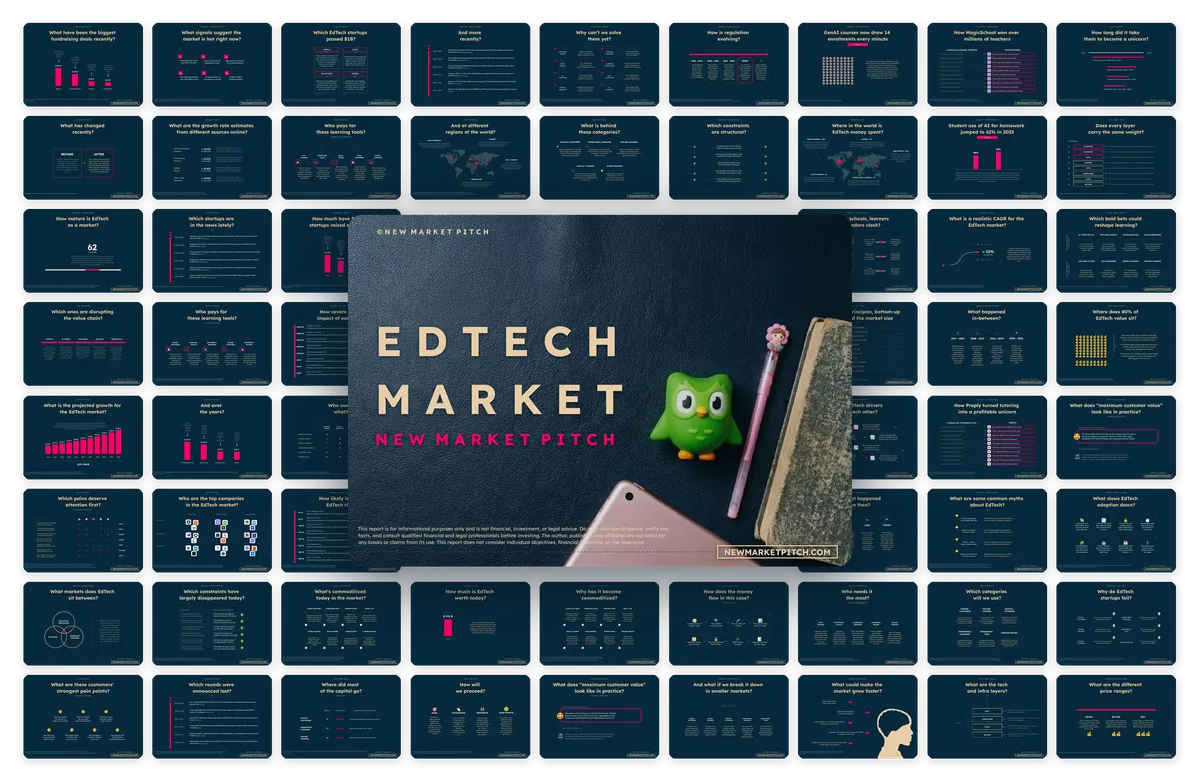
Whether you're building or investing in the edtech market, our report covers everything you need to know: the players, the money, and what's coming next.
Summary
Reach Capital is the top investor in edtech in 2026, combining the highest disclosed investment count among specialist education funds with stronger recent activity than its closest competitors. Owl Ventures ranks second for its financial capacity, followed by GSV Ventures, Rethink Education, and Learn Capital.
The ranking has changed because edtech venture funding has collapsed since 2021. Global investment fell from $20.8 billion at the pandemic peak to $2.6 billion in 2025, making recent deal activity a better test of investor commitment than historical portfolio size.
Reach Capital leads with 145 recorded edtech investments, just ahead of Learn Capital's 143 and Rethink Education's 132. But the real separation is recent activity: Reach recorded 25 investments across sectors over the preceding 12 months, compared with only one for Learn.
Owl Ventures wins on financial capacity. With more than $2.2 billion committed across seven funds, it has a stronger publicly documented capital base than most dedicated edtech investors and can support companies through multiple financing rounds.
GSV Ventures has a different advantage: international reach. Its investments in Coursera, PhysicsWallah, Classplus, and Gizmo show experience across American education platforms, India's exam-preparation market, and newer AI-powered study products.
Rethink Education remains a major specialist with 132 recorded investments, while Learn Capital's large historical portfolio is less persuasive when recent disclosed activity is so limited. Investment experience and current availability of capital are two different things.
Brighteye Ventures is the most interesting European challenger. Its $72 million Fund III first close in September 2026, with eight investments already made, provides unusually concrete evidence of fresh capital being deployed into learning, AI, and work technology.
AI is broadening the investor landscape rather than producing a single new winner. Owl is backing reading tools and institutional AI infrastructure, Reach is financing student applications, and GSV is investing in consumer learning platforms. Generalist AI investors are increasingly joining these rounds.
Traditional edtech specialization still has value where schools are the customers. Selling curriculum software to school districts requires knowledge of procurement and educational outcomes, while consumer AI study applications and workforce platforms may benefit just as much from generalist technology investors.
No leading edtech fund can be declared the most profitable investor using public information. Coursera, Clever, and Nearpod provide examples of important exits, but the underlying ownership stakes, dilution, and realized fund returns are not sufficiently disclosed for a reliable financial ranking.
For founders raising capital today, Reach and Owl are the strongest starting points. GSV is especially relevant for international education businesses, Rethink for education and workforce access, and Brighteye for European startups connecting learning with employment and AI.

Written by the New Market Pitch teamWe track new markets so founders and investors can move faster. About us
Why are the top edtech investors harder to identify today?
The edtech investors leading today are operating in a market that has lost nearly 90% of its venture funding since the pandemic boom, making recent investments much more revealing than old portfolio rankings.
According to HolonIQ's global funding data, edtech startups raised $20.8 billion in 2021, compared with $10.6 billion in 2022, $3 billion in 2023, and $2.4 billion in 2024. Funding recovered slightly to $2.6 billion in 2025, but the first half of 2026 brought only about $1 billion, 26% below the same period a year earlier.
The scale of the correction is extraordinary. For every $100 invested in education technology at the 2021 peak, the market attracted only about $12.50 in 2025.
That changes how we should rank investors. A fund with dozens of investments made between 2018 and 2022 may still have an impressive portfolio, but that tells us relatively little about its willingness to finance a startup now.
Three names consistently emerge from recent investment databases: Reach Capital, Learn Capital, and Rethink Education. Owl Ventures stands out for the amount of dedicated capital it manages, while GSV Ventures has an unusually international education portfolio.
The interesting question is which of these firms combines historical experience with enough current activity and financial capacity to remain a serious investor in the next generation of education companies.
Who has invested in the most edtech startups?
Reach Capital currently leads the specialist edtech investor rankings by disclosed investment count, although Learn Capital and Rethink Education are close competitors.
Fundraisly's September 2026 database records 145 education technology investments for Reach Capital, compared with 143 for Learn Capital, 132 for Rethink Education, 119 for GSV Ventures, and 113 for Owl Ventures.
The gaps are smaller than their reputations might suggest. Reach has recorded only two more sector investments than Learn and 13 more than Rethink. All five firms have built substantial education portfolios.
An independent October 2026 ranking by Shizune also puts Reach first, with 123 relevant investments. Rethink and Learn appear with 96 and 93 respectively, followed by GSV with 92. The different totals reflect differences in database coverage and what qualifies as an edtech investment.
Generalist investors complicate the comparison. Bossa Invest has 141 education-related investments according to Fundraisly, nearly matching Reach. Antler and Right Side Capital Management also appear prominently in rankings, but education represents only part of their much broader investment activity.
For that reason, we give specialist funds more weight when identifying the investors most closely associated with edtech.
| Investor | Edtech investments recorded by Fundraisly | Investment focus |
|---|---|---|
| Reach Capital | 145 | Education technology |
| Learn Capital | 143 | Education and learning |
| Bossa Invest | 141 | Generalist early-stage investing |
| Rethink Education | 132 | Education and workforce |
| GSV Ventures | 119 | Global education technology |
| Owl Ventures | 113 | Education technology |
| Right Side Capital Management | 107 | Generalist early-stage investing |
| Kapor Capital | 107 | Technology and impact investing |
| Antler | 98 | Global early-stage investing |
| Goodwater Capital | 95 | Consumer technology |

In our report covering the edtech market, you will always find fresh funding data, taken straight from our own verified funding database.
Is Reach Capital the strongest early-stage edtech investor?
Reach Capital is our strongest overall choice among early-stage edtech investors, thanks to its large portfolio and evidence that it is still making new education investments.
Founded in 2015, Reach backed companies including ClassDojo, Nearpod, Newsela, and Tynker. Together, these investments cover classroom communication, teaching content, curriculum software, and children's technology education.
Its recent transactions show how the portfolio is evolving.
According to CB Insights, Reach participated in Kollegio's $5.3 million seed financing in October 2026. Kollegio develops AI-assisted tools for college applications. Reach also invested in Lium AI's $5.5 million seed round and CommonTime Pathways' $1.5 million financing in June 2026.
Those three recorded rounds total $12.3 million. This is the aggregate amount raised by the companies, rather than Reach's disclosed contributions.
The timing is especially useful. These investments occurred after several years of depressed edtech funding, so they provide stronger evidence of current interest than portfolio holdings accumulated during the boom.
Reach has also expanded into career development and employment-related technology, including investments in Stepful and WorkWhile.
There's a consistent interest in businesses helping people move through education and into employment. That gives Reach a broader opportunity set than investors focused exclusively on classroom software.
The firm's realized returns are not publicly available in enough detail to prove that it is the most profitable edtech investor. But for an early-stage founder looking for an active, experienced education specialist, Reach has the most convincing combination of activity and sector knowledge.
If you want more recent data on this point, please see our latest EdTech market report.
Is Owl Ventures the biggest edtech venture capital fund?
Owl Ventures is the largest dedicated edtech investor among the leading specialists by publicly disclosed committed capital, with more than $2.2 billion across seven funds.
Owl's own figures also show more than 100 investments. Its portfolio spans early childhood education, K-12 schools, higher education, professional learning, and educational AI.
That financial scale separates Owl from most smaller specialist firms. Education startups often need several funding rounds before reaching profitability, especially when selling to schools or building businesses that involve instructors, curriculum, or other delivery costs.
Owl has demonstrated its ability to participate in larger transactions. In January 2026, it led Cloudforce's $10 million Series A, alongside Microsoft's venture fund M12. Cloudforce develops AI infrastructure used by universities and other institutions.
The company reported that its nebulaONE platform already served more than 3 million users across 90 institutions at the time of the announcement.
Owl also participated in AnswersNow's $40 million Series B that month, although AnswersNow primarily provides virtual autism therapy and should be viewed as an adjacent investment rather than conventional classroom edtech.
By July 2026, CB Insights also recorded Owl's participation in a $5 million Series A for DeweyLearn.
Reach leads on recorded education deal count, but Owl has the stronger publicly documented capital base and the ability to finance businesses at several stages.
For a startup expecting to raise several substantial rounds, Owl may therefore be the more attractive investor.

In our research about education technology, we turn what is vague and complex into simple, useful visuals. Market maps like this one show you at a glance where every startup stands.
Is Learn Capital still one of the most active edtech investors?
Learn Capital remains one of the most experienced edtech venture firms, but its recent disclosed investment activity is far below that of Reach Capital.
Fundraisly records 143 education investments for Learn, just two fewer than Reach's 145. That makes their accumulated sector portfolios remarkably similar in size.
The difference becomes much clearer when we examine recent activity.
In the same September 2026 database, Fundraisly records 25 investments across all sectors for Reach during the preceding 12 months, against only one for Learn. These recent counts cover each firm's total recorded investments, so they should not be mistaken for edtech-only activity.
Still, a 25-to-one difference is too large to ignore when assessing visible deal flow.
Learn has historically invested in educational software, learning platforms, and technology-enabled education businesses, building relationships across several parts of the industry.
Its portfolio history earns it a place among the sector's leading firms. The question for founders is whether that experience translates into accessible capital today.
We cannot conclude that Learn has stopped investing, because private transactions and unannounced deals may be missing from public databases. But Reach currently has much stronger evidence of active deployment.
That's enough to rank Reach above Learn when looking at the most relevant investors for startups raising money now.
Does GSV Ventures deserve a place among the top five edtech investors?
GSV Ventures deserves a top-five position because few education-focused investors have backed such a geographically diverse group of recognizable learning businesses.
Its portfolio includes Coursera, ClassDojo, Clever, and India's PhysicsWallah. These investments span online courses, school communication, educational infrastructure, and exam preparation.
PhysicsWallah offers a particularly useful example of GSV's international strategy. The Indian company raised $210 million in September 2024 at a valuation of approximately $2.8 billion, according to TechCrunch. GSV participated alongside other investors, continuing its involvement after earlier financing rounds.
The firm has also invested in Classplus and LEAD, two Indian companies with business models quite different from PhysicsWallah. Classplus helps educators manage and distribute their services, while LEAD provides curriculum and technology to schools.
More recently, GSV participated in Gizmo's $22 million Series A in April 2026. The AI-powered study platform said it had reached more than 13 million learners across over 120 countries. Shine Capital led the round, with GSV participating alongside Ada Ventures, NFX, and other investors.
GSV's portfolio therefore reaches from established online education platforms to newer AI learning products.
Its recent disclosed activity is less extensive than Reach's, so we would not rank it first for deal frequency. But for founders building international education businesses, GSV remains one of the most relevant specialist names.
If you want more recent data on this point, please see our latest EdTech market report.

In our market report about education technology, we always try to gather several sources and make estimates that make sense, so you can work with solid numbers.
Is Rethink Education more active than people realize?
Rethink Education is one of the most active edtech specialists historically, and its 2026 investments show that it remains involved in financing new companies.
Fundraisly records 132 education investments for Rethink, placing it third among the major dedicated specialists, ahead of GSV and Owl by deal count.
The portfolio covers a wide range of education needs. NoRedInk develops writing instruction software, Campus works in higher education, and Hiveclass provides educational video content and physical education resources.
Rethink has also backed companies addressing career access, employment, and the affordability of education.
CB Insights records two March 2026 investments worth $5 million each: Rasa and Understood Care. Rasa operates in the education and workforce development market, while Understood Care provides healthcare navigation services and demonstrates the firm's interest in adjacent sectors.
The $10 million combined financing total represents the amounts raised by both startups, not the amount Rethink itself invested.
Rethink's recent activity is more modest than Reach's, but its portfolio is sufficiently large and varied to make it a serious competitor to Learn and GSV.
The firm is particularly relevant for founders whose products sit between education, employment, and improved access to essential services.
Which edtech investors are actually investing now?
Reach Capital has the strongest recent disclosed deal activity among the established specialists, while Owl Ventures, Rethink Education, GSV Ventures, and Brighteye Ventures also have credible evidence of continued investment.
The distinction becomes clearer when we compare the investment databases with actual financing announcements.
Fundraisly records 25 transactions across all sectors for Reach over the preceding 12 months, versus six each for Rethink and Owl, two for GSV, and one for Learn.
Those numbers measure recorded total deal activity rather than education-only investments. They are useful as a comparative indicator, especially because all five firms are included in the same database, but should not be interpreted as a complete census of investments.
Individual announcements help establish where the capital has gone. Reach continued backing student-focused AI applications, Owl led an institutional AI infrastructure round, and GSV participated in the financing of a consumer study platform.
Brighteye offers another perspective: the ability to raise a new fund. In September 2026, it completed a $72 million first close for its third fund and reported eight investments already made from that vehicle.
That combination of a fresh fund and actual deployment is particularly meaningful in a difficult fundraising market.
| Investor | Recent verified activity | Financing announced | Role or significance |
|---|---|---|---|
| Reach Capital | Kollegio seed, October 2026 | $5.3M | Participating investor |
| Reach Capital | Lium AI seed, June 2026 | $5.5M | Participating investor |
| Owl Ventures | DeweyLearn Series A, July 2026 | $5M | Participating investor |
| GSV Ventures | Gizmo Series A, April 2026 | $22M | Participating investor |
| Rethink Education | Rasa seed, March 2026 | $5M | Participating investor |
| Owl Ventures | Cloudforce Series A, January 2026 | $10M | Lead investor |
| Brighteye Ventures | Fund III first close, September 2026 | $72M | New investment capital |

Our document detailing everything you need to know about edtech gets updated several times a month, so you always get the latest view of where things stand.
Is Brighteye Ventures Europe's leading edtech investor?
Brighteye Ventures has one of the strongest claims to leadership in European early-stage learning technology, especially after raising fresh capital and expanding into AI-powered work tools.
In September 2026, Brighteye announced a $72 million first close for its third fund, bringing total assets under management to approximately $245 million.
The firm reported investments in more than 50 companies since its founding. Those companies had collectively raised over $1 billion, and several were generating more than $100 million in annual revenue, according to Brighteye's announcement.
The $1 billion figure includes financing from other investors, so it cannot be attributed to Brighteye alone.
The new fund is also revealing because Brighteye has widened its focus. It now invests in technologies helping people learn, work, and adapt, including AI, productivity software, and labor infrastructure.
Its September announcement identified eight investments already made from Fund III, including imagi, Gyver, sherpa, and NEX Health Intelligence. The firm also said it expected to back approximately 30 additional companies in the coming years.
Brighteye's own research estimated that European venture funding for learning and work businesses doubled between 2024 and 2025 to roughly $1.85 billion. That category is broader than traditional edtech, but it explains why the firm sees an opportunity beyond school software.
For European founders building education and workforce technology, Brighteye is among the most attractive specialist investors today. Its newest fund gives it a particularly concrete advantage over firms relying mainly on older commitments.
If you want more recent data on this point, please see our latest EdTech market report.
Are American investors dominating edtech worldwide?
US-based venture firms dominate the specialist edtech investor rankings, although much of their investment activity reaches companies outside America.
Reach Capital, Learn Capital, Rethink Education, GSV Ventures, and Owl Ventures all have US headquarters. These five firms occupy five of the six highest positions in Fundraisly's edtech deal-count ranking, with Brazilian generalist Bossa Invest being the exception.
This concentration reflects the historical depth of the American venture capital market, but education startups are being built and funded internationally.
GSV has backed PhysicsWallah, Classplus, and LEAD in India, along with companies operating in other emerging education markets. Owl has invested internationally, while Brighteye specializes in European startups.
The Indian market illustrates why investors cannot rely on the same strategy everywhere.
PhysicsWallah combines digital learning with physical education centers and exam preparation. Its $210 million financing in September 2024 was one of the country's largest education technology rounds after the sector's correction.
GSV participated alongside investors including WestBridge, Lightspeed, and Hornbill Capital. The transaction shows how specialist education funds and larger international investors can finance the same company for different strategic reasons.
American specialists still lead the overall global rankings, but regional investors can have stronger relationships, greater regulatory knowledge, and better access to specific local education markets.

In our report covering the edtech market, we look at what the winners do differently, so you can learn from the best instead of guessing.
Can generalist venture funds beat specialist edtech investors?
Generalist funds can compete with edtech specialists on deal volume and access to capital, but the advantages depend heavily on what an education startup sells.
Fundraisly identifies 2,997 investors with at least two edtech company investments, including 2,171 funds and 826 individual investors.
That makes the education investment market considerably broader than the handful of firms usually described as edtech specialists.
Bossa Invest has 141 education-related investments in the database. Right Side Capital Management has 107, Kapor Capital also has 107, and Antler has 98.
However, these firms invest across many industries. Antler's published investment activity covers software, financial technology, artificial intelligence, and numerous other sectors.
For an AI startup whose technology happens to be used by universities, a generalist investor with strong enterprise software expertise may be more useful than an education specialist.
The calculation changes for a company selling curriculum software to public school districts. Those businesses face unusual procurement cycles, constrained budgets, curriculum requirements, and implementation challenges. Experienced education investors can help founders avoid mistakes that generalist funds may have encountered less frequently.
The best investors therefore depend on the company's actual customers and revenue model. We would favor specialist funds for school-facing software, while keeping generalist AI and software investors in the financing mix for products with broader markets.
Who is investing in AI education startups?
Owl Ventures, Reach Capital, and GSV Ventures are among the most established edtech specialists currently backing AI-powered education products, with each approaching the opportunity from a different angle.
Owl's investments include Amira Learning, which uses AI to listen to children read and provide personalized feedback. The firm has also backed StudyFetch, which helps students turn educational materials into study resources.
Reach's investment in Kollegio addresses college applications, while GSV's participation in Gizmo focuses on consumer study habits and AI-assisted learning.
These businesses tackle separate problems. Amira works on foundational reading skills, Kollegio helps students navigate college admissions, and Gizmo encourages learning through interactive study experiences.
The differences have real commercial consequences. A school reading platform may need to prove educational effectiveness and fit institutional purchasing processes. A consumer study application needs enough recurring engagement to convert users into paying customers.
Gizmo's April 2026 announcement reported 13 million learners across more than 120 countries. That's a substantial distribution figure, but it doesn't reveal paid subscribers, revenue per user, or retention.
Cloudforce offers yet another model. Its institutional AI infrastructure, backed by Owl, was serving millions of users through universities and other organizations when it raised its Series A.
Owl currently has the broadest visible AI education exposure among these specialists, covering student applications, reading technology, and institutional infrastructure. Reach and GSV remain serious competitors, particularly in early-stage student-facing software.
If you want more recent data on this point, please see our latest EdTech market report.

Theory only gets you so far. In our research about education technology, we dig up the real signals from the field and show you the ones worth watching.
Are workforce-learning startups attracting the top edtech investors?
Workforce learning has become a major priority for edtech investors, with firms such as Reach Capital, GSV Ventures, and Brighteye Ventures expanding beyond traditional school software.
According to HolonIQ's 2024 funding analysis, workforce training and development represented approximately one-third of global edtech venture investment.
The attraction is straightforward: businesses that connect education to jobs, qualifications, or professional skills can sell to employers as well as individuals.
Reach-backed Stepful provides training for healthcare careers, a different proposition from selling teaching software to schools. GSV's portfolio includes learning platforms serving students and working professionals, while Brighteye's latest fund explicitly targets technologies connecting learning and work.
The shift also changes how investors assess success.
A classroom application may be judged by student progress, teacher adoption, and school renewals. A workforce training platform can also be evaluated through job placement rates, professional qualifications, employer demand, and graduates' earnings.
These indicators can make the value of education easier to demonstrate, although training companies may still face high delivery costs and expensive customer acquisition.
Workforce-related education should remain an important investment category because it gives investors more ways to build businesses around learning. But the returns will depend on whether customers continue paying after initial adoption, not simply on the growing demand for new skills.
Which edtech investors have produced the best exits?
No major edtech venture fund can currently be ranked confidently as the best performer by realized returns, because comparable fund-level financial results are largely private.
Several leading investors have backed businesses that eventually reached important exits.
GSV invested in Coursera, which completed its IPO in March 2021. It also backed Clever, acquired by Kahoot in 2021.
Reach was an investor in Nearpod, which Renaissance Learning acquired in 2021 in a transaction valued at approximately $650 million.
These examples establish that specialist education investors have helped finance companies with substantial exit value.
The difficulty is reconstructing the investor's actual profit. A venture firm that first invested at a $20 million valuation could achieve an excellent return from an acquisition that disappoints investors who entered at a $500 million valuation.
Dilution, ownership, follow-on participation, liquidation preferences, and the timing of share sales can all change the outcome.
For Owl, Reach, GSV, Learn, and Rethink, we lack a consistent public dataset of realized investment multiples, distributions to investors, and net fund returns.
That prevents us from declaring one financial winner.
Reach leads on disclosed education investment count, Owl on dedicated committed capital, and GSV has recognizable exits. None of those facts, by themselves, proves that one fund has generated the highest returns.

In our market report about education technology, we don't want to repeat what boring consulting reports say. Instead, we show you the real and latest market signals that matter.
Should NewSchools Venture Fund rank alongside edtech venture capital firms?
NewSchools Venture Fund is one of the most important funders of education innovation in the United States, but its philanthropic model makes a direct comparison with venture capital firms misleading.
NewSchools supports education ventures through grants, funding, expertise, and partnerships. Its objectives place a strong emphasis on learning outcomes and educational access.
The organization reports having invested more than $511 million in early-stage ventures over its history.
Its 2025 annual report provides a particularly useful view of its recent scale: $28 million invested across 86 funded ventures, from 1,651 applicants.
That works out to approximately $326,000 invested per funded venture on average, although individual awards vary and the total includes different types of support.
NewSchools funds work involving mathematics, literacy, school design, AI-supported learning, and educational access.
The organization has also studied AI applications for teaching and learning, including an analysis of 260 ideas involving generative AI for mathematics tutoring.
For founders developing education products whose social value may exceed their immediate commercial potential, NewSchools can be highly relevant.
We would include it among the most influential education innovation funders, but keep it outside a strict ranking of equity venture capital investors. Its financial model and expected outcomes are different.
Could AI startups change the ranking of top edtech investors?
AI is already changing where the leading edtech funds invest, but there is not yet enough evidence to say that a new investor has overtaken Reach Capital or Owl Ventures.
The established funds are responding in different ways.
Owl has expanded its activity in AI reading, study assistance, and institutional infrastructure. Reach has backed AI applications for students and adjacent career services. GSV participated in Gizmo's $22 million financing, and Brighteye raised fresh capital for AI, learning, and work technology.
Generalist technology investors are also appearing in these rounds. Microsoft's M12 participated in Cloudforce, Shine Capital led Gizmo's Series A, and other AI-focused investors are increasingly able to finance learning companies.
The competitive risk for specialist funds is that education software could become just another application of widely available AI models.
Generating flashcards, quizzes, written explanations, and learning materials is becoming easier. Startups built around these functions may struggle to charge enough if similar features are included in general-purpose AI products.
Education companies with strong institutional distribution, measurable learning results, trusted brands, or specialized content have better opportunities to defend their position.
The current generation of AI-native learning startups is still too young to show which investors will achieve the strongest exits. We can identify who is participating and where the capital is going, but long-term financial winners remain unproven.

Learning from others' mistakes is the cheapest lesson there is. In our document detailing everything you need to know about edtech, we look at what broke startups before you, so you don't repeat it.
Who are the top investors in edtech overall?
Reach Capital is the top edtech investor overall in our assessment, followed by Owl Ventures, GSV Ventures, Rethink Education, and Learn Capital. Brighteye Ventures is the most compelling additional specialist for European learning and work startups.
Reach takes first place because it combines the highest disclosed specialist edtech deal count with stronger recent activity than its closest historical competitors.
Owl earns second place through its exceptional dedicated capital base, investment across several education stages, and continued involvement in AI learning and infrastructure.
GSV remains particularly strong internationally, especially in India, while Rethink's substantial investment history and recent activity place it ahead of Learn in our current ranking.
Learn retains a top-five position because of its accumulated sector experience, although its visible deal flow has slowed considerably.
| Rank | Investor | Best evidence of leadership |
|---|---|---|
| 1 | Reach Capital | 145 disclosed edtech investments and strong recent activity |
| 2 | Owl Ventures | More than $2.2B committed across seven funds |
| 3 | GSV Ventures | International portfolio including Coursera, PhysicsWallah, and Gizmo |
| 4 | Rethink Education | 132 disclosed edtech investments and continued early-stage funding |
| 5 | Learn Capital | 143 disclosed edtech investments, but limited recent recorded activity |
| 6 | Brighteye Ventures | $72M Fund III first close and active European investment strategy |
| 7 | Bossa Invest | 141 edtech investments within a broader early-stage portfolio |
| 8 | Kapor Capital | 107 education-related investments across a broader impact portfolio |
| 9 | Antler | 98 education-related investments and a large global startup network |
| 10 | NewSchools Venture Fund | More than $511M invested in education innovation through venture philanthropy |
Reach Capital has the strongest claim to being the leading edtech investor when we combine historical commitment with recent financing activity. Owl Ventures would win a ranking based primarily on dedicated capital, while GSV is especially relevant for education companies expanding internationally.
The biggest unresolved question is investment performance. None of these firms publishes sufficiently comparable realized-return data to establish which has made the most money from edtech.
For founders, though, the practical ranking is already becoming clearer. Reach and Owl are the two names we would investigate first, followed by GSV, Rethink, and Brighteye depending on the company's stage, geography, and customer market.
If you want more recent data on this point, please see our latest EdTech market report.
Our methodology
This analysis identifies the top edtech investors in 2026 by comparing disclosed investment activity, sector specialization, financial capacity, geographic reach, portfolio development, and investment outcomes. We place particular weight on activity in 2025 and 2026, rather than relying exclusively on historical portfolio rankings.
We use two separate measures of investment activity: accumulated edtech investments and recent recorded transactions. These are not interchangeable. Historical investment counts establish the depth of each firm's education portfolio, while recent financing rounds provide a more direct indication of continued participation. We also distinguish total startup financing from the amount contributed by an individual investor, which is often undisclosed.
For investment rankings, we primarily use Fundraisly's September 2026 edtech investor database and Shizune's October 2026 rankings, supplemented by CB Insights investor transaction records. Differences between their counts reflect database coverage and sector classifications, so we use the figures as comparative indicators rather than an exhaustive record of every investment.
We assess financial capacity using publicly disclosed fund commitments and fundraising announcements, especially Owl Ventures' reported capital commitments and Brighteye Ventures' September 2026 Fund III first close. Committed capital and assets under management are not treated as equivalent to cash available for new investments.
We verify recent activity against individual company financing announcements where possible, including Cloudforce's January 2026 Series A, Gizmo's April 2026 financing, and Brighteye's official fundraising disclosure. We also examine investment focus and geographic coverage through investor portfolios, giving additional weight to repeated sector participation rather than isolated transactions.
We treat publicly announced exits separately from realized financial performance. IPOs and acquisitions can establish that a portfolio company reached a liquidity event, but cannot independently reveal the investor's actual financial return. Ownership, dilution, timing, and proceeds would be required for a consistent ranking by investment profitability. NewSchools Venture Fund is included for its influence on education innovation, while its philanthropic funding model is distinguished from conventional equity venture capital.
For the broader market context, we use HolonIQ's global edtech venture funding research, including historical funding trends and the share attributable to workforce training. The analysis combines these market conditions with identifiable investment records, fund disclosures, financing announcements, and portfolio evidence to determine which firms have the strongest claims to leadership today.
Key sources used for this analysis include: QS and HolonIQ on global edtech funding in H1 2026, HolonIQ on 2024 venture funding and workforce education, Fundraisly's edtech investor rankings, Shizune's edtech venture capital rankings, CB Insights on Reach Capital, Reach Capital's official portfolio, Owl Ventures' official website and capital disclosures, Cloudforce's Series A announcement, CB Insights on Owl Ventures, Gizmo's April 2026 funding announcement, TechCrunch on PhysicsWallah's financing, CB Insights on Rethink Education, Brighteye Ventures' Fund III announcement, Coursera's IPO announcement, Kahoot's Clever acquisition announcement, NewSchools' 2025 impact reporting, and NewSchools Venture Fund's official website.

If you build or invest in the edtech market, you need to know which business models pay off now and which ones are fading. That's why our report covering it has a whole section on it.
Written by the New Market Pitch teamWe track new markets so founders and investors can move faster. About us
