What’s the latest funding news in the energy storage market? (October 2026)
Whether you're building or investing in the energy storage market, our report covers everything you need to know: the players, the money, and what's coming next.
Energy storage fundraising in 2026 spans factory-scale batteries, commercial building systems and software that makes existing storage more valuable.
The 12 deals in this selection were announced between July and October 2026 and represent approximately $1.47B in reported financing.
Form Energy and Antora Energy attracted most of that capital, while smaller rounds backed industrial heat, battery reuse and storage operations.
And if you want to better understand this new industry, you can download our pitch covering the energy storage market.
Insights
- Form Energy and Antora Energy contributed about $1.30B of the roughly $1.47B reported across these 12 energy storage deals, or 88.3%. Large factory-scale financings dominate the dollar total.
- Nine of the 12 announcements came in September or October, yet the two largest rounds were announced in July and August. Funding frequency and capital concentration tell very different stories.
- European companies account for six of the 12 deals, compared with five in the United States and one in India. The two biggest checks, however, went to US storage manufacturers.
- Without Form Energy and Antora Energy, the remaining ten rounds total about $172M, an average of roughly $17.2M. That is a more useful comparison for emerging energy storage startups.
- Industrial thermal storage appears at two very different funding stages: Epyr raised about $17.8M to roll out early factory projects, while Antora Energy secured $550M to scale manufacturing.
- Second-life batteries attracted funding in two formats: VoltR is expanding remanufacturing for several battery markets, while Rebaba focuses on stationary storage built from retired electric-vehicle batteries.
- Not every financing figure represents venture equity. VoltR's package includes about $7M in grants, and Octave.energy combines equity with debt, making simple equity-only comparisons misleading.
- Nine companies are direct storage specialists, while Mana Battery, VoltR and Yuma Energy serve broader battery or mobility markets. That distinction matters when estimating the size of the stationary storage segment.
- Energy storage value is moving beyond battery chemistry: Novele bundles building batteries with controls, Branch operates storage for customers, and Furo optimizes batteries without making cells.

Written by the New Market Pitch teamWe track new markets so founders and investors can move faster. About us

In our report covering the energy storage market, you will always find fresh funding data, taken straight from our own verified funding database.
Summary table of the latest funding deals in the energy storage market as of October 2026
We define the energy storage market as technologies and systems that store energy for later use.
We include electrical, thermal, mechanical and chemical storage systems and dedicated storage-management products.
We exclude energy generation without storage and fuels sold solely for immediate consumption.
| Name | When | Amount in $ | Round Type | Category |
|---|---|---|---|---|
| Mana Battery | Oct 15, 2026 | $10.15M | Seed | Sodium-ion battery cells |
| Epyr | Oct 13, 2026 | ~$17.8M | Series A | Industrial thermal storage |
| VoltR | Oct 4, 2026 | ~$25.6M total (~$18.6M equity) | Strategic growth financing | Second-life battery manufacturing |
| Novele | Sep 30, 2026 | $17M | Series A | Building batteries & energy software |
| Branch Energy | Sep 15, 2026 | $33M | Series B | Commercial battery storage |
| Furo | Sep 10, 2026 | $4M | Early-stage funding | Battery optimization software |
| Rebaba | Sep 9, 2026 | $4.6M | Seed | Second-life stationary batteries |
| Octave.energy | Sep 4, 2026 | ~$11.6M (equity & debt) | Series A | Commercial battery storage & EMS |
| Yuma Energy | Sep 1, 2026 | $35M | Series A | Battery swapping & Battery-as-a-Service |
| Certain Energy | Aug 26, 2026 | ~$13.6M | Series A | Long-duration flow batteries |
| Form Energy | Aug 12, 2026 | $750M | Series G | Iron-air long-duration batteries |
| Antora Energy | Jul 30, 2026 | $550M | Series C | Industrial thermal batteries |
All the latest funding deals in the energy storage market as of October 2026
Mana Battery raised $10.15M in October 2026 for its sodium-ion battery technology.
When was it?
Mana Battery announced its seed financing on October 15, 2026.
Who are they?
Mana Battery develops anode-free sodium-ion cells and tailored electrolytes that can store power without lithium or cobalt.
Geographical focus?
Mana Battery develops its technology in the United States and targets grid storage, backup power, transport, defense and aerospace customers.
Why do we include them in the energy storage market?
Sodium-ion cells are a form of electrochemical energy storage, although Mana Battery serves several markets beyond stationary batteries.
What is the company stage?
Mana Battery is developing its products and preparing manufacturing scale-up with established cell-production partners.
How much did they raise?
Mana Battery secured $10.15M in this financing.
What round is it?
Mana Battery raised a seed round led by Voyager Ventures.
Why did they raise?
Mana Battery will refine its battery chemistry and prepare cost-competitive cells for larger-scale production.
Epyr raised about $17.8M in October 2026 to expand industrial thermal batteries.
When was it?
Epyr announced the financing on October 13, 2026.
Who are they?
Epyr stores low-cost electricity as heat in refractory bricks and delivers that heat as hot air or steam to factories.
Geographical focus?
Epyr operates in France and is expanding its industrial heat-storage offering across Europe.
Why do we include them in the energy storage market?
Industrial thermal batteries are Epyr's main product, serving paper mills and other factories that need reliable process heat.
What is the company stage?
Epyr is in early commercialization, with an operating system at WEPA and a larger project planned for Papeco.
How much did they raise?
Epyr raised approximately $17.8M, equivalent to a EUR 15M financing.
What round is it?
Epyr raised a Series A led by SlateVC.
Why did they raise?
Epyr will deliver more factory installations, including a planned 35 MWh system, and expand its Heat-as-a-Service offering.

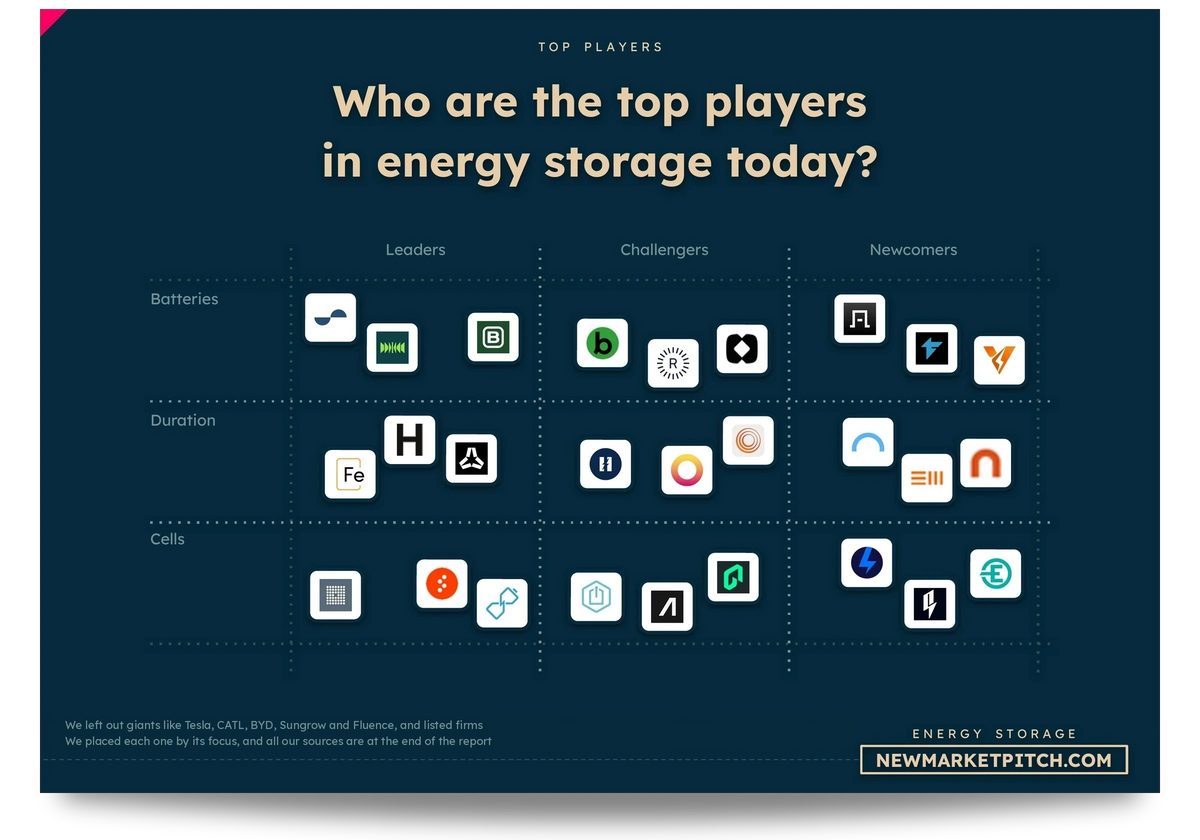
In our research about energy storage, we turn what is vague and complex into simple, useful visuals. Market maps like this one show you at a glance where every startup stands.
VoltR secured a roughly $25.6M financing package in October 2026 for second-life batteries.
When was it?
VoltR dated its company announcement October 4, 2026, and industry coverage followed on October 6.
Who are they?
VoltR tests used lithium battery cells and remanufactures suitable ones into battery packs for storage, mobility and electronics.
Geographical focus?
VoltR manufactures in France and plans to expand its capacity for customers across the European battery market.
Why do we include them in the energy storage market?
Battery remanufacturing extends the useful life of stored-energy products, but stationary storage is only one of VoltR's end markets.
What is the company stage?
VoltR is commercially manufacturing batteries and entering a larger industrial expansion phase.
How much did they raise?
VoltR secured approximately $25.6M in total, including $18.6M in equity and $7.0M in grants.
What round is it?
VoltR described the package as strategic growth financing rather than a named Series round.
Why did they raise?
VoltR will increase manufacturing capacity, automate cell testing and expand facilities for battery remanufacturing and storage.
Novele raised $17M in September 2026 for commercial building batteries and energy software.
When was it?
Novele announced its Series A on September 30, 2026.
Who are they?
Novele pairs thin wall-mounted battery systems with software that predicts peak electricity demand in commercial buildings.
Geographical focus?
Novele focuses on commercial properties in the United States, including retail sites, offices and data-intensive buildings.
Why do we include them in the energy storage market?
Novele combines distributed battery hardware with storage-control software to shift when buildings draw electricity from the grid.
What is the company stage?
Novele is in early commercial growth, with installations already operating and further deployments planned.
How much did they raise?
Novele raised $17M in new financing.
What round is it?
Novele closed an oversubscribed Series A led by Boisei Labs.
Why did they raise?
Novele will hire, install more batteries and improve the software used to coordinate storage across buildings.

Your time is limited. In our market report about energy storage, we put numbers on each part of the market, so you can see where it makes sense to focus.
Branch Energy raised $33M in September 2026 to deploy commercial battery systems.
When was it?
Branch Energy published its funding announcement on September 15, 2026, with trade coverage on September 16.
Who are they?
Branch Energy installs and operates on-site battery systems that lower electricity costs and provide backup power for businesses.
Geographical focus?
Branch Energy serves commercial customers in the United States, starting in Texas and expanding toward Illinois.
Why do we include them in the energy storage market?
Its Arc systems are behind-the-meter battery storage assets managed for commercial buildings and high-demand electricity users.
What is the company stage?
Branch Energy is in commercial growth, with installed customer systems and plans to expand its operating battery fleet.
How much did they raise?
Branch Energy raised $33M.
What round is it?
Branch Energy raised a Series B co-led by Piva Capital and Clean Energy Ventures.
Why did they raise?
Branch Energy will install more Arc systems and help business customers obtain power without waiting for major grid upgrades.
Furo raised $4M in September 2026 for industrial battery optimization software.
When was it?
Furo announced the financing on September 10, 2026, and additional coverage appeared September 11.
Who are they?
Furo builds software that tells industrial battery operators when to charge, discharge and trade electricity.
Geographical focus?
Furo is based in Germany and targets commercial and industrial battery operators across European energy markets.
Why do we include them in the energy storage market?
Furo specializes in storage-management software rather than manufacturing batteries or selling general electricity services.
What is the company stage?
Furo is in early commercial growth, with industrial users and enterprise customers already adopting its software.
How much did they raise?
Furo secured $4M.
What round is it?
Furo received early-stage financing led by TQ Ventures, without a consistently reported Series label.
Why did they raise?
Furo will improve its optimization platform, expand its team and serve more industrial storage operators in Europe.

In our document detailing everything you need to know about energy storage, we always try to gather several sources and make estimates that make sense, so you can work with solid numbers.
Rebaba raised $4.6M in September 2026 to grow second-life battery storage.
When was it?
Rebaba announced its seed financing on September 9, 2026.
Who are they?
Rebaba turns retired electric-vehicle batteries into stationary energy storage systems for businesses and buildings.
Geographical focus?
Rebaba operates in Sweden and is expanding manufacturing and sales across the European market.
Why do we include them in the energy storage market?
Rebaba uses second-life batteries specifically in stationary storage systems, making energy storage its direct commercial focus.
What is the company stage?
Rebaba is in early commercial growth with deployed systems and plans for additional manufacturing.
How much did they raise?
Rebaba raised $4.6M, equivalent to about SEK 44.1M.
What round is it?
Rebaba closed a seed round led by Sistafund and EIT Urban Mobility.
Why did they raise?
Rebaba will increase annual production capacity, hire staff and open manufacturing capacity beyond Sweden.
Octave.energy raised about $11.6M in September 2026 to scale commercial battery storage.
When was it?
Octave.energy announced the Series A on September 4, 2026.
Who are they?
Octave.energy supplies battery storage systems and software that helps businesses shift consumption, cut peak demand and use energy markets.
Geographical focus?
Octave.energy is based in Belgium and is expanding into the Netherlands, France, Germany and other European markets.
Why do we include them in the energy storage market?
Battery energy storage systems and the software that manages them form Octave.energy's principal commercial offering.
What is the company stage?
Octave.energy is in profitable commercial growth, with a track record of installing systems for business customers.
How much did they raise?
Octave.energy secured approximately $11.6M, combining equity and flexible debt with no disclosed split.
What round is it?
Octave.energy described the package as a Series A led by SPDG Growth.
Why did they raise?
Octave.energy will expand sales and operations in Europe while improving its battery control and asset-management products.

Our report covering the energy storage market gets updated several times a month, so you always get the latest view of where things stand.
Yuma Energy raised $35M in September 2026 to expand its battery-swapping network.
When was it?
Yuma Energy reported the investment on September 1, 2026, following coverage in the United States on August 31.
Who are they?
Yuma Energy runs a network of swappable batteries for electric two-wheelers and three-wheelers so vehicles can exchange batteries quickly.
Geographical focus?
Yuma Energy operates in India and plans to expand into additional Indian cities and fleet markets.
Why do we include them in the energy storage market?
Yuma Energy owns and manages rechargeable battery assets, although its storage model serves electric mobility rather than the grid.
What is the company stage?
Yuma Energy is in commercial growth, with more than 60 million swaps reported across a large operating battery fleet.
How much did they raise?
Yuma Energy raised $35M from Magna International.
What round is it?
Yuma Energy described the investment as Series A financing.
Why did they raise?
Yuma Energy will install more swap stations, expand city coverage and strengthen partnerships with fleets and vehicle manufacturers.
Certain Energy raised about $13.6M in August 2026 for grid-scale flow batteries.
When was it?
Certain Energy announced its financing and new company name on August 26, 2026.
Who are they?
Certain Energy develops manganese-based flow batteries that store electricity for later use when renewable power output is low.
Geographical focus?
Certain Energy is based in the United Kingdom and plans an MWh-scale demonstration in India before wider commercialization.
Why do we include them in the energy storage market?
The company develops long-duration battery storage specifically for electricity grids, rather than general battery equipment.
What is the company stage?
Certain Energy is commercializing its technology and preparing a grid-connected demonstration and larger supply chain.
How much did they raise?
Certain Energy raised approximately $13.6M, equal to GBP 10M.
What round is it?
Certain Energy raised a Series A led by the British Business Bank.
Why did they raise?
Certain Energy will build a demonstration system in India, expand UK research facilities and prepare its flow batteries for volume production.

In our research about energy storage, we look at what the winners do differently, so you can learn from the best instead of guessing.
Form Energy raised $750M in August 2026 to expand long-duration iron-air battery manufacturing.
When was it?
Form Energy announced its Series G on August 12, 2026.
Who are they?
Form Energy makes iron-air batteries that store grid electricity through reversible rusting and can discharge for as long as 100 hours.
Geographical focus?
Form Energy manufactures in the United States and supplies grid storage projects for domestic and international customers.
Why do we include them in the energy storage market?
Multi-day grid battery storage is Form Energy's central product and commercial purpose.
What is the company stage?
Form Energy is scaling commercial manufacturing and deliveries, backed by a substantial contracted project pipeline.
How much did they raise?
Form Energy raised $750M.
What round is it?
Form Energy raised a Series G led by T. Rowe Price.
Why did they raise?
Form Energy will expand output at its West Virginia factory to deliver more long-duration storage projects.
Antora Energy raised $550M in July 2026 to scale industrial thermal battery production.
When was it?
Antora Energy announced the financing on July 30, 2026, with follow-up coverage in early August.
Who are they?
Antora Energy stores electricity as heat in insulated carbon blocks and supplies stored energy to industrial sites as heat or electricity.
Geographical focus?
Antora Energy focuses on the United States, including energy-intensive manufacturing and industrial customers.
Why do we include them in the energy storage market?
Thermal batteries for stored industrial heat and power are Antora Energy's core technology and product.
What is the company stage?
Antora Energy is at the commercial scale-up stage, with deployed technology and plans for more manufacturing capacity.
How much did they raise?
Antora Energy raised $550M.
What round is it?
Antora Energy raised a Series C co-led by G2 Venture Partners and Eclipse.
Why did they raise?
Antora Energy will accelerate customer deployments and develop a second US manufacturing facility.
Written by the New Market Pitch teamWe track new markets so founders and investors can move faster. About us