What are the top energy storage startups by total funding raised?
Whether you're building or investing in the energy storage market, our report covers everything you need to know: the players, the money, and what's coming next.
Summary
The top energy storage startups by total funding raised are SVOLT Energy Technology ($3.2 billion), Base Power ($2.3 billion), Form Energy (more than $2.0 billion), Sila Nanotechnologies ($1.6 billion) and Zenobē Energy (more than $1.3 billion). Together, they represent the biggest investment bets across battery manufacturing, residential storage, long-duration energy systems, advanced materials and grid infrastructure.
Energy storage has become a major industrial investment category. The 20 highest-ranked startups have raised at least $21.01 billion combined, with the ten largest accounting for $15.22 billion. The concentration reflects the enormous capital requirements of manufacturing batteries and developing infrastructure at commercial scale.
Battery manufacturing and materials production attract much of the money, but residential energy storage has emerged as an equally interesting investment opportunity. Base Power has raised $2.3 billion by combining household batteries with virtual power plant technology, showing that distributed energy systems can attract financing on the scale of major industrial manufacturers.
Long-duration energy storage is finally receiving serious financial backing. Form Energy, Highview Power and Hydrostor are developing technologies that can store electricity for longer periods than conventional lithium-ion batteries. Form Energy's reported 80 GWh commercial backlog makes it one of the most closely watched companies in this segment.
Lithium-ion remains firmly in control of the commercial market. Lithium iron phosphate batteries accounted for approximately 90% of battery storage deployments in 2025, giving established manufacturers a substantial advantage over alternative chemistries. Most competing technologies will need to demonstrate a clear cost or performance benefit to displace them.
Silicon battery materials offer a more immediate route to improving existing battery technology. Sila Nanotechnologies and Group14 Technologies have raised $1.6 billion and $1.3 billion respectively, with both companies investing heavily in manufacturing capacity. Their commercial opportunity is particularly interesting because silicon materials can be integrated into the wider lithium-ion supply chain.
Sodium-ion, flow batteries and other alternative chemistries are attracting investment for more specialized applications. Peak Energy, Alsym Energy, Dalian Rongke Power and Weijing Energy Storage are pursuing different approaches, particularly for stationary storage where energy density is often less important than cost, safety and operating life.
Thermal storage is another promising category. Antora Energy has raised $750 million, while Rondo Energy has accumulated $270 million. Their systems target industrial customers that consume large amounts of heat, opening a market that conventional electricity batteries cannot address particularly efficiently.
AI data centers are creating an additional source of demand. Form Energy, Peak Energy and Antora Energy are developing systems that could support data center electricity and heat requirements, while companies such as Base Power can help utilities manage growing demand through distributed batteries.
The strongest commercial stories are increasingly connected to manufacturing facilities, customer orders and actual deployment plans. Peak Energy has announced more than $1 billion in customer orders, Group14 is expanding production in Spain, and Antora is financing additional manufacturing capacity. These developments offer a more useful indication of progress than fundraising announcements alone.
The next generation of energy storage leaders will probably emerge from several different technologies rather than one universal winner. Conventional lithium-ion will remain important, but long-duration storage, silicon materials, thermal batteries and sodium-ion systems could each build substantial businesses in markets with different technical and economic requirements.
Our conclusion is that energy storage has moved beyond an early-stage technology investment theme. It is becoming a major industrial market, backed by substantial infrastructure spending and growing electricity demand. The companies that can manufacture reliably, deliver projects on time and secure repeat customers will have the best chance of turning today's enormous funding commitments into lasting businesses.

Written by the New Market Pitch teamWe track new markets so founders and investors can move faster. About us

In our report covering the energy storage market, you will always find fresh funding data, taken straight from our own verified funding database.
Top startups in the energy storage market ranked by total funding raised
Here is an updated table that ranks the top startups in the energy storage market based on the total amount of funding they have raised to date.
The table also includes the total number of funding rounds, the date and size of the latest round, the financing type (e.g. Series A, equity financing), key investors, the startup's current status (active, IPO, acquired, or shut down), and a confidence score based on the data collected (we excluded startups with very low data confidence, to make sure everything is reliable).
If you need to dig deeper and get more detailed data, please check our report covering the energy storage market.
| # | Startup | What They Do | Total Raised ($) | Total Rounds | Last Round Date | Last Round Amount ($) | Last Round Type | Key Investors | Current Stage | Confidence | Country |
|---|---|---|---|---|---|---|---|---|---|---|---|
| 1 | SVOLT Energy Technology | Manufactures electric vehicle batteries | $3.2B | 4 | December 2021 | $942M | Series B+ | Sichuan Energy Investment, CDH Investments, Han's Laser | Active | Partial | China |
| 2 | Base Power | Residential batteries and virtual power plants | $2.3B | 5 | August 2026 | $1.0B | Series D | Ribbit Capital, Addition, Valor Equity Partners | Active | Strong | United States |
| 3 | Form Energy | Iron-air long-duration grid batteries | $2.0B+ | 7 | August 2026 | $750M | Series G | T. Rowe Price, Sequoia Capital, Janus Henderson | Active | Strong | United States |
| 4 | Sila Nanotechnologies | Manufactures advanced silicon battery anodes | $1.6B | 7 | July 2026 | $300M | Series H / Growth Equity | Atreides Management, Sutter Hill Ventures, 8VC | Active | Strong | United States |
| 5 | Zenobē Energy | Grid batteries and electric fleet infrastructure | $1.3B+ | 5 | September 2023 | $1.1B | Strategic Equity | Clean Energy Finance Corporation | Active | Partial | United Kingdom |
| 6 | Group14 Technologies | Silicon battery anode materials | $1.3B | 7 | October 2026 | $169M | Series D Extension | Undisclosed | Active | Partial | United States |
| 7 | Verkor | Manufactures low-carbon lithium-ion battery cells | $1.0B+ | 5 | October 2024 | Undisclosed | Strategic Equity | EnerSys, ING Sustainable Investments | Active | Partial | France |
| 8 | Hithium | Grid-scale lithium battery manufacturing | $899M | 6 | July 2023 | $621M | Series C | China Life Private Equity, Beijing Financial Street Capital, Goldstone Investment | Active | Partial | China |
| 9 | Solid Power | Develops solid-state battery technology | $871M1 | 5 | January 2026 | $130M | Registered Direct Offering | Undisclosed | IPO | Strong | United States |
| 10 | Antora Energy | Industrial thermal battery storage | $750M | 3 | July 2026 | $550M | Series C | G2 Venture Partners, Eclipse | Active | Full | United States |
| 11 | EnerVenue | Industrial nickel-hydrogen batteries | $745M | 4 | March 2026 | $300M | Series B Extension | Full Vision Capital, Hong Kong Investment Corporation, Aramco Ventures | Active | Strong | United States |
| 12 | Amprius Technologies | Silicon-anode lithium-ion battery cells | $660M | 11 | January 2026 | $98M | ATM Equity Offering | Public investors, B. Riley Securities, Cantor Fitzgerald | IPO | Partial | United States |
| 13 | Lyten | Lithium-sulfur batteries and advanced materials | $625M+ | 3 | July 2025 | $200M+ | Growth Equity | Prime Movers Lab | Active | Partial | United States |
| 14 | Highview Power | Liquid air energy storage | $621M | 3 | November 2025 | $171M | Growth Equity | Scottish National Investment Bank, Centrica, KIRKBI | Active | Strong | United Kingdom |
| 15 | Fidra Energy | Utility-scale battery storage development | $595M2 | 1 | September 2025 | $595M | Infrastructure Growth Equity | EIG, National Wealth Fund | Active | Partial | United Kingdom |
| 16 | ProLogium | Solid-state EV battery manufacturing | $540M | 6 | July 2026 | $50M | Committed Equity | Primavera Capital, dGav Capital, Mercedes-Benz | Active | Partial | Taiwan |
| 17 | Lunar Energy | Residential batteries and energy management | $532M | 4 | February 2026 | $102M | Series D | B Capital, Prelude Ventures, DCVC | Active | Partial | United States |
| 18 | Hydrostor | Advanced compressed air energy storage | $517M3 | 3 | August 2026 | $230M | Growth Equity | Baker Hughes, Hatch, Realize Capital Partners | Active | Partial | Canada |
| 19 | 24M Technologies | Semi-solid lithium-ion battery technology | $488M | 8 | September 2024 | $87M | Series H | Asahi Kasei, Dai Nippon Printing, Kyocera | Active | Partial | United States |
| 20 | Our Next Energy | EV and grid battery systems | $462M | 6 | May 2026 | $20M | Series 2 | Fifth Wall, Franklin Templeton, Breakthrough Energy Ventures | Active | Partial | United States |
| 21 | Return | Develops utility-scale battery storage | $440M | 2 | October 2025 | $330M | Growth Equity | APG | Active | Strong | Netherlands |
| 22 | Torus | Flywheel and battery energy storage systems | $393M | 3 | June 2026 | $290M | Series C | Undisclosed | Active | Strong | United States |
| 23 | Nexeon | Silicon-based battery anode materials | $365M | 6 | August 2026 | $133M | Growth Equity | National Wealth Fund, Korea Development Bank, Honda Xcelerator Ventures | Active | Partial | United Kingdom |
| 24 | Skeleton Technologies | Manufactures high-power graphene energy storage | $350M | 11 | October 2026 | $100M | Strategic Growth Equity | Siemens | Active | Partial | Estonia |
| 25 | Dalian Rongke Power | Vanadium redox flow batteries | $314M | 4 | June 2026 | $140M | Series B+ | Legend Capital, Dalian Financial Investment, Rongtuo Capital | Active | Partial | China |
| 26 | Factorial Energy | Solid-state electric vehicle batteries | $312M4 | 2 | June 2026 | $112M | de-SPAC / PIPE | Cartesian Growth Corporation III, PIPE investors | IPO | Partial | United States |
| 27 | Energy Vault | Gravity-based grid energy storage | $280M | 4 | January 2022 | $50M | Strategic Equity | Korea Zinc | IPO | Partial | United States |
| 28 | Rondo Energy | Develops industrial thermal energy batteries | $270M | 4 | December 2024 | $158M | Series B | Undisclosed | Active | Partial | United States |
| 29 | ZincFive | Nickel-zinc batteries for critical infrastructure | $254M | 9 | December 2025 | $30M | Series F | Helios Climate Ventures, Climate Investment, Japan Energy Fund | Active | Partial | United States |
| 30 | FlexGen | Battery integration and control software | $250M | 2 | July 2022 | $100M | Series C | Vitol, existing investors | Active | Partial | United States |
| 31 | China Storage Guoneng | Compressed-air energy storage | $242M | 4 | May 2023 | $143M | Series A | Cinda Kunpeng, China Development Bank Capital, Legend Star | Active | Strong | China |
| 32 | NineDot Energy | Urban battery storage project development | $225M+ | 2 | January 2024 | $225M | Growth Equity | Manulife Investment Management, Carlyle | Active | Partial | United States |
| 33 | StoreDot | Develops extreme fast-charging EV batteries | $216M | 6 | January 2022 | $70M | Series D | VinFast, BP Ventures, Golden Energy Global Investment | Active | Strong | Israel |
| 34 | terralayr | Grid batteries and virtual flexibility platform | $211M | 3 | January 2026 | $130M | Growth Equity | Eurazeo, RIVE Private Investment | Active | Partial | Switzerland |
| 35 | Enevate | Fast-charging silicon battery technology | $192M | 6 | February 2021 | $81M | Series E | Fidelity Investments, Mission Ventures, Infinite Potential Technologies | Shutdown | Strong | United States |
| 36 | Nyobolt | Ultra-fast charging battery technology | $180M | 6 | May 2026 | $60M | Series C | Symbotic, IQ Capital, Latitude | Active | Strong | United Kingdom |
| 37 | Peak Energy | Grid-scale sodium-ion battery storage | $173M | 3 | October 2026 | $108M | Series B | General Motors Ventures, Maverick Silicon, Eclipse | Active | Full | United States |
| 38 | Element Energy | Battery management and storage systems | $170M | 4 | November 2025 | $97M | Series AA | Undisclosed | Active | Partial | United States |
| 39 | CMBlu Energy | Organic flow battery systems | $165M | 3 | April 2026 | $58M | Series C | Samsung Ventures, STRABAG | Active | Strong | Germany |
| 40 | Polarium | Smart lithium-ion energy storage systems | $160M | 3 | October 2024 | $49M | Convertible Preference Equity | Vargas, AMF, Alecta | Active | Strong | Sweden |
| 41 | Blue Current | Solid-state silicon battery cells | $150M+ | 3 | September 2025 | $81M | Series D | Amazon, Koch Disruptive Technologies, Allen & Company | Active | Strong | United States |
| 42 | Sion Power | Develops high-density lithium-metal batteries | $145M | 3 | January 2024 | $75M | Series A | LG Energy Solution, Euclidean Capital, Hillspire | Active | Strong | United States |
| 43 | Weijing Energy Storage | Manufactures zinc-iron flow battery systems | $145M | 4 | November 2025 | Undisclosed | Series B | Zimi Investment, Hanyuan Assets, Songhe Capital | Active | Partial | China |
| 44 | Exowatt | Dispatchable solar and thermal storage | $140M | 3 | November 2025 | $50M | Series A Extension | 8090 Industries, Felicis, MVP Ventures | Active | Full | United States |
| 45 | Instagrid | Portable industrial battery power systems | $138M | 4 | January 2024 | $95M | Series C | Teachers' Venture Growth, Morgan Stanley Investment Management, Energy Impact Partners | Active | Strong | Germany |
| 46 | EnergyNest | Industrial thermal energy storage | $132M | 1 | April 2021 | $132M | Infrastructure Growth Equity | Infracapital | Active | Partial | Norway |
| 47 | Caban Energy | Telecom battery storage systems | $128M | 5 | April 2025 | $50M | Undisclosed | Ember Infrastructure | Active | Strong | United States |
| 48 | Iontra | Advanced battery charging technology | $119M | 4 | November 2024 | $45M | Series C | Volta Energy Technologies | Active | Partial | United States |
| 49 | Alsym Energy | Non-flammable sodium-ion batteries | $114M | 4 | February 2024 | $78M | Series C | General Catalyst, Tata Limited, Thrive Capital | Active | Strong | United States |
| 50 | EcoFlow | Portable and home battery systems | $105M | 3 | June 2021 | $100M | Series B | Sequoia Capital China, CICC, GL Ventures | Active | Strong | China |
| 51 | Mitra Chem | AI-enabled battery cathode materials | $105M | 5 | June 2025 | $16M | Series B-1 | Social Capital, Alpha Wave Ventures, L&F | Active | Partial | United States |
| 52 | Energy Dome | Carbon dioxide long-duration batteries | $102M | 5 | September 2025 | Undisclosed | Growth Equity | 360 Capital Partners | Active | Partial | Italy |
| 53 | Hydrogenious LOHC Technologies | Liquid organic hydrogen storage carriers | $101M | 5 | February 2025 | $19M | Strategic Equity | AP Ventures, Temasek, Winkelmann Group | Active | Partial | Germany |
| 54 | Moment Energy | Repurposed EV battery storage systems | $100M+ | 5 | May 2026 | $40M | Series B | Evok Innovations, Liberty Mutual Investments, W23 Global Fund | Active | Strong | Canada |
| 55 | Nanotech Energy | Graphene-based advanced battery technology | $95M | 3 | August 2021 | $64M | Series D | Fubon Financial | Active | Partial | United States |
| 56 | Malta | Long-duration thermal energy storage | $86M | 6 | September 2026 | Undisclosed | Strategic Equity | Kobelco, Chevron Technology Ventures, Breakthrough Energy Ventures | Active | Partial | United States |
| 57 | TWAICE | Battery analytics and predictive lifecycle software | $75M | 5 | April 2022 | $30M | Series B Extension | Coatue Management, Lip-Bu Tan | Active | Strong | Germany |
| 58 | NanoGraf | High-density silicon battery anodes | $65M | 2 | February 2023 | $65M | Series B | Volta Energy Technologies, CC Industries, GIC | Acquired | Partial | United States |
| 59 | Corvus Energy | Marine battery energy storage | $60M | 4 | October 2025 | $60M | Series E / Growth Capital | Morgan Stanley, Just Climate, J. Lauritzen | Active | Partial | Norway |
| 60 | e-Zinc | Zinc-air long-duration storage | $56M | 2 | June 2024 | $31M | Series A2 | Evok Innovations, Mitsubishi Heavy Industries, Export Development Canada | Active | Strong | Canada |
| 61 | Fourth Power | High-temperature thermal grid batteries | $45M | 2 | September 2025 | $20M | Series A Plus | Munich Re Ventures, Breakthrough Energy Ventures, DCVC | Active | Full | United States |
| 62 | Tempo Energy | Thermochemical storage for industrial heat | $41M | 2 | October 2024 | $30M | Series A Extension | Prelude Ventures, Imperative Ventures, New System Ventures | Active | Strong | United States |
| 63 | ION Storage Systems | Solid-state lithium metal batteries | $40M | 5 | June 2026 | $2M | Venture Equity | TEDCO | Active | Partial | United States |
| 64 | Field | Grid-scale battery storage development | $38M | 1 | August 2026 | Undisclosed | Infrastructure Equity | CVC DIF | Active | Partial | United Kingdom |
| 65 | Liminal Energy | Ultrasonic battery manufacturing quality inspection | $38M | 4 | October 2024 | $10M | Strategic Equity | LG Technology Ventures, Chailease Holdings, ArcTern Ventures | Active | Strong | United States |
| 66 | Ampd Energy | Construction-site battery energy systems | $35M | 3 | November 2024 | $27.3M | Series B | Kibo Invest, Openspace Ventures, MTR Lab | Active | Strong | Singapore |
| 67 | Elestor | Hydrogen-bromine flow batteries | $30M | 1 | August 2022 | $30M | Series A | Equinor Ventures, Invest-NL, Vopak Ventures | Active | Partial | Netherlands |
| 68 | On.Energy | Distributed battery storage development | $30M | 2 | June 2023 | $20M | Series B | Ultra Capital, Phalanx Investment Partners | Active | Partial | United States |
| 69 | Quidnet Energy | Underground pumped hydro energy storage | $28M | 5 | May 2024 | $10M | Strategic Equity | Hunt Energy Network, Breakthrough Energy Ventures, Evok Innovations | Active | Partial | United States |
| 70 | FranklinWH | Residential batteries and energy management | $25M | 1 | August 2023 | $25M | Series B | Particle Future | Active | Partial | United States |
| 71 | Kraftblock | Industrial high-temperature thermal energy storage | $24M+ | 5 | August 2023 | $22M | Series B | Shell Ventures, Finindus, Moore Strategic Ventures | Active | Partial | Germany |
| 72 | Electrified Thermal Solutions | Industrial thermal batteries | $24M | 2 | December 2024 | $19M | Series A | Holcim MAQER Ventures, Vale Ventures, GVP Climate | Active | Strong | United States |
| 73 | LiNa Energy | Solid-state sodium battery storage | $20M | 7 | January 2025 | $4M | Venture Equity | Undisclosed | Active | Partial | United Kingdom |
| 74 | Relectrify | Advanced battery control and inverters | $18M | 8 | May 2024 | $11M | Series C / Growth Equity | At One Ventures, Toyota Ventures, CEFC | Active | Partial | Australia |
| 75 | Sunamp | Develops phase-change thermal batteries | $17M | 5 | August 2020 | $6M | Series A | Aurus Capital, Scottish Investment Bank | Active | Partial | United Kingdom |
| 76 | Advanced Battery Concepts | Bipolar lead-acid batteries | $14M | 4 | October 2020 | $10M | Series B | Nuveen Global Impact Fund | Active | Partial | United States |
| 77 | Inlyte Energy | Iron-sodium batteries for grid storage | $10M | 2 | January 2025 | $2M | Venture Equity | Undisclosed | Active | Strong | United States |
| 78 | Terra One | AI-optimized utility-scale battery storage | $8M | 1 | April 2024 | $8M | Seed | PT1 Ventures, neosfer, 468 Capital | Active | Strong | Germany |
- Includes share issues after listing, plus earlier private funding.
- An equity commitment ceiling, not confirmed paid-in capital.
- The 2026 package includes previously committed convertible financing.
- Includes de-SPAC and PIPE proceeds, not only venture rounds.

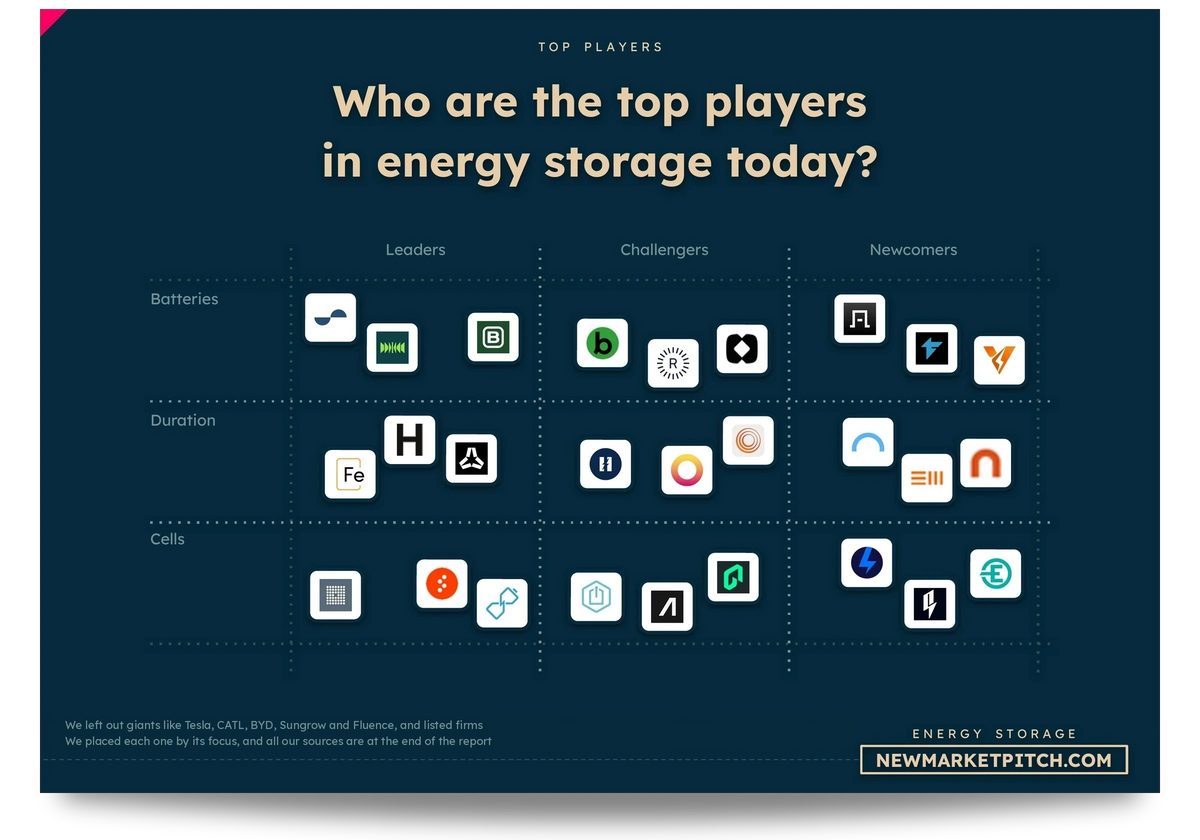
In our research about energy storage, we turn what is vague and complex into simple, useful visuals. Market maps like this one show you at a glance where every startup stands.
Why are energy storage startups attracting so much funding right now?
Energy storage startups are attracting billions of dollars because electricity demand is growing, power grids are struggling to keep up, and renewable energy requires increasingly large storage systems. The sector has become a major destination for industrial and infrastructure investment, with companies raising money to build factories, develop grid-scale projects and supply electricity to data centers.
According to the International Energy Agency's Global Energy Review 2026, worldwide battery storage additions reached 108 GW in 2025, up 40% from the previous year. Installed capacity is now eleven times higher than in 2021. Around 80% of new installations were utility-scale systems, showing how quickly the market is shifting towards large grid-connected batteries.
The investment opportunity spans several distinct technologies. Base Power is developing residential batteries that can also support electricity networks. Form Energy is working on iron-air batteries designed for multi-day storage, while Antora Energy is targeting industrial customers that need large amounts of heat and reliable electricity.
These businesses are attracting capital for different reasons, but they are benefiting from the same underlying problem: electricity systems need more flexibility, and building new generation and transmission infrastructure takes time. Storage companies can help bridge that gap.
How much funding have energy storage startups raised altogether?
The 20 highest-ranked energy storage startups have raised at least $21.01 billion combined. The top ten account for $15.22 billion, while the five largest have accumulated $10.4 billion.
The concentration reflects where investors are placing their biggest bets. SVOLT Energy Technology, Base Power, Form Energy, Sila Nanotechnologies and Zenobē Energy have each attracted more than $1 billion. Their businesses cover battery manufacturing, residential energy systems, long-duration storage, advanced battery materials and grid infrastructure.
The gap becomes more noticeable further down the ranking. The ten largest companies have raised substantially more than the next ten combined, even though the latter group includes established names such as Hydrostor, Lunar Energy, 24M Technologies and Our Next Energy.
We are seeing a market where a relatively small group of companies has secured the capital needed to pursue industrial-scale ambitions. Smaller specialists can still attract meaningful investment, but the largest financing commitments increasingly go to businesses with substantial manufacturing or infrastructure requirements.
| Funding group | Combined funding |
|---|---|
| Top 5 | $10.40B |
| Top 10 | $15.22B |
| Companies ranked 11–20 | $5.79B |
| Top 20 | $21.01B |

Your time is limited. In our market report about energy storage, we put numbers on each part of the market, so you can see where it makes sense to focus.
Which energy storage startups have raised the most funding?
SVOLT Energy Technology, Base Power and Form Energy occupy the first three positions in our ranking, with $3.2 billion, $2.3 billion and more than $2.0 billion raised respectively. The top ten companies have each attracted at least $750 million, demonstrating the enormous capital requirements of the energy storage industry.
SVOLT's $3.2 billion reflects its position in electric vehicle battery manufacturing. Base Power has attracted $2.3 billion for residential batteries and virtual power plants, while Form Energy has raised more than $2.0 billion to develop multi-day iron-air storage.
Sila Nanotechnologies follows with $1.6 billion, reflecting investor interest in advanced silicon battery materials. Zenobē Energy has raised at least $1.3 billion in equity through its energy infrastructure and electric fleet activities, while Group14 Technologies has accumulated $1.3 billion for silicon battery materials.
Verkor, Hithium, Solid Power and Antora Energy complete the top ten. Their technologies cover low-carbon lithium-ion manufacturing, grid-scale batteries, solid-state technology and industrial thermal storage.
| Rank | Startup | Total raised |
|---|---|---|
| 1 | SVOLT Energy Technology | $3.2B |
| 2 | Base Power | $2.3B |
| 3 | Form Energy | $2.0B+ |
| 4 | Sila Nanotechnologies | $1.6B |
| 5 | Zenobē Energy | $1.3B+ |
| 6 | Group14 Technologies | $1.3B |
| 7 | Verkor | $1.0B+ |
| 8 | Hithium | $899M |
| 9 | Solid Power | $871M |
| 10 | Antora Energy | $750M |
Which energy storage startups have raised the biggest funding rounds?
Base Power's $1.0 billion Series D, Form Energy's $750 million Series G and Antora Energy's $550 million Series C are among the largest recent rounds in our ranking. These transactions show how much capital investors are prepared to commit to companies developing energy infrastructure and manufacturing capacity.
Base Power's August 2026 financing was led by Ribbit Capital, Addition, Valor Equity Partners and JPMorganChase's Strategic Investment Group, with participation from other existing investors. Form Energy's Series G was led by T. Rowe Price, with Sequoia Capital and Janus Henderson among the new investors.
Antora's July 2026 Series C was co-led by G2 Venture Partners and Eclipse. The company said the funding would support the expansion of its thermal battery manufacturing and deployments for industrial customers, data centers and electricity networks.
Other substantial transactions include Sila Nanotechnologies' $300 million July 2026 financing, EnerVenue's $300 million Series B extension and Hydrostor's $230 million growth financing.
| Overall rank | Startup | Latest round | Amount |
|---|---|---|---|
| 2 | Base Power | Series D | $1.0B |
| 3 | Form Energy | Series G | $750M |
| 4 | Sila Nanotechnologies | Series H / Growth Equity | $300M |
| 6 | Group14 Technologies | Series D Extension | $169M |
| 10 | Antora Energy | Series C | $550M |
| 11 | EnerVenue | Series B Extension | $300M |
| 14 | Highview Power | Growth Equity | $171M |
| 18 | Hydrostor | Growth Equity | $230M |
| 22 | Torus | Series C | $290M |
| 23 | Nexeon | Growth Equity | $133M |
| 37 | Peak Energy | Series B | $108M |

In our document detailing everything you need to know about energy storage, we always try to gather several sources and make estimates that make sense, so you can work with solid numbers.
Who are the biggest investors in energy storage startups?
Ribbit Capital, Addition, T. Rowe Price, Sequoia Capital, Eclipse and G2 Venture Partners are among the most prominent investors in major energy storage financing rounds. Industrial companies and specialist infrastructure investors also play an important role, particularly in battery manufacturing and grid-scale projects.
T. Rowe Price and Sequoia Capital are important backers of Form Energy, while Ribbit Capital, Addition and Valor Equity Partners are among Base Power's key investors. Sila Nanotechnologies attracted Atreides Management and Sutter Hill Ventures for its $300 million financing, while G2 Venture Partners and Eclipse co-led Antora Energy's $550 million Series C.
Corporate participation is particularly interesting. General Motors Ventures is a key investor in Peak Energy, Siemens is associated with Skeleton Technologies, and LG Energy Solution has invested in Sion Power. Amazon has also backed Blue Current, while Aramco Ventures is among EnerVenue's investors.
This combination of financial and industrial capital gives startups access to more than money. Industrial investors can bring manufacturing expertise, potential customers and supply-chain relationships, all of which are particularly valuable when a company needs to move from a working technology to large-scale production.
| Startup | Key investors |
|---|---|
| Base Power | Ribbit Capital, Addition, Valor Equity Partners |
| Form Energy | T. Rowe Price, Sequoia Capital, Janus Henderson |
| Sila Nanotechnologies | Atreides Management, Sutter Hill Ventures, 8VC |
| Zenobē Energy | Clean Energy Finance Corporation |
| Antora Energy | G2 Venture Partners, Eclipse |
| EnerVenue | Full Vision Capital, Hong Kong Investment Corporation, Aramco Ventures |
| Hydrostor | Baker Hughes, Hatch, Realize Capital Partners |
| Peak Energy | General Motors Ventures, Maverick Silicon, Eclipse |
Which countries have the strongest energy storage startup ecosystems?
The United States has the largest representation among the leading companies in our ranking, while China remains particularly important in battery manufacturing and stationary storage. The United Kingdom and other European countries also have a strong group of companies developing grid infrastructure, alternative battery technologies and industrial storage systems.
The American ecosystem includes Base Power, Form Energy, Sila Nanotechnologies, Group14 Technologies, Antora Energy, EnerVenue, Lunar Energy and Solid Power. These companies cover a particularly wide range of activities, from residential batteries to silicon materials and long-duration storage.
China's presence includes SVOLT Energy Technology, Hithium, Dalian Rongke Power, China Storage Guoneng and Weijing Energy Storage. Their activities span electric vehicle batteries, grid-scale lithium-ion systems, compressed-air storage and flow batteries.
Europe has developed important specialists such as Zenobē Energy, Verkor, Highview Power, Fidra Energy, Nexeon, Skeleton Technologies, CMBlu Energy and Energy Dome. Several of these companies are particularly interesting because their activities extend beyond conventional battery manufacturing.
The International Energy Agency's 2026 battery storage analysis shows that China accounted for around 60% of worldwide battery storage additions in 2025. The United States and Europe followed. The geographical picture reflects two complementary strengths: China's manufacturing and deployment scale, and the substantial technology and infrastructure investment taking place in the United States and Europe.

Our report covering the energy storage market gets updated several times a month, so you always get the latest view of where things stand.
Are grid-scale energy storage startups attracting more funding than residential battery companies?
Grid-scale energy storage companies account for many of the largest funding positions, but Base Power shows that residential battery businesses can also attract billion-dollar investment. The difference comes down to how these companies build their businesses and generate revenue.
Form Energy, Hithium, Hydrostor and Highview Power are developing technologies or systems for large electricity networks. Their projects can involve substantial storage capacity, grid connections, engineering and long-term infrastructure investment.
Base Power and Lunar Energy take a different approach by installing batteries in residential properties and managing them through energy software. FranklinWH and EcoFlow also target household energy storage, although their products and commercial models differ.
Zenobē Energy combines large battery installations with electric fleet infrastructure, giving it exposure to both grid flexibility and transportation electrification.
Residential storage can clearly compete for major investment. Lunar Energy has raised $532 million, while the grid-scale specialists include Form Energy with more than $2.0 billion and Highview Power with $621 million. Both markets have considerable room to grow. Residential systems need strong customer acquisition and installation networks, while utility-scale projects require large amounts of capital and access to electricity markets.
Is long-duration energy storage finally attracting serious investment?
Yes. Long-duration energy storage has attracted billions of dollars, particularly through Form Energy, Highview Power and Hydrostor. Investors are increasingly willing to finance technologies designed to store electricity for longer periods, although these companies still have to prove that their systems can compete economically with conventional batteries.
Form Energy is the clearest example, with more than $2.0 billion raised across seven rounds. Its iron-air batteries are designed for multi-day storage, allowing electricity to be stored for much longer than the typical duration of conventional lithium-ion installations.
Highview Power has raised $621 million developing liquid-air energy storage, while Hydrostor has accumulated $517 million developing advanced compressed-air systems. Both technologies are designed to support longer storage periods and provide flexibility to electricity networks.
Other companies are pursuing different approaches. Malta develops thermal energy storage, Energy Dome uses carbon dioxide, and Quidnet Energy is working on underground pumped hydro storage.
The commercial challenge remains substantial. Long-duration systems need to demonstrate competitive costs over their operating lives, secure project financing and find electricity markets that adequately reward their ability to store energy for extended periods.
Form Energy's reported backlog reached approximately 80 GWh in 2026, up from around 20 GWh earlier in the year. It includes projects involving Xcel Energy, Google, Crusoe and FuturEnergy Ireland. That level of commercial interest makes the company one of the most important businesses to watch in the sector.

In our research about energy storage, we look at what the winners do differently, so you can learn from the best instead of guessing.
Is lithium-ion still dominating the energy storage market?
Yes. Lithium-ion remains the dominant commercial battery technology, and the latest deployment figures show that its position is still strengthening. The International Energy Agency reports that lithium iron phosphate batteries accounted for around 90% of battery storage deployments in 2025.
LFP batteries have become particularly attractive for stationary applications because they offer a relatively inexpensive solution with good cycle life and safety characteristics. Grid installations can also accommodate larger physical systems than electric vehicles, reducing the importance of maximum energy density.
Several companies in our ranking are directly involved in this market. SVOLT Energy Technology, Hithium, Verkor, 24M Technologies, Polarium, EcoFlow and Our Next Energy develop battery cells or systems for different applications.
Other startups are trying to improve existing lithium-ion technology. Sila Nanotechnologies, Group14 Technologies, Nexeon, Amprius Technologies and NanoGraf focus on silicon-based materials that can improve battery energy density and charging performance.
Alternative chemistries are attracting attention, but lithium-ion's manufacturing scale and established supply chain give it a considerable advantage. For the foreseeable future, most competing technologies will need to demonstrate a clear economic or performance benefit in specific applications to displace it.
Which silicon battery startups have raised the most funding?
Sila Nanotechnologies and Group14 Technologies lead the silicon battery materials category in our ranking, with $1.6 billion and $1.3 billion raised respectively. Nexeon follows with $365 million, while Amprius Technologies has accumulated $660 million developing silicon-anode lithium-ion cells.
Sila's $300 million July 2026 financing was led by Atreides Management and Sutter Hill Ventures. The company is expanding production of its silicon-carbon anode material at its Moses Lake facility.
Group14 Technologies secured a €150 million, approximately $169 million, Series D extension in October 2026. The investment supports a new manufacturing facility in Spain, adding to its existing production footprint in the United States and South Korea.
Nexeon raised $133 million in August 2026, with participation from the National Wealth Fund, Korea Development Bank and Honda Xcelerator Ventures. Its funding supports the development of silicon-anode manufacturing and wider commercial adoption.
Other companies in the category include Enevate, which raised $192 million before shutting down, NanoGraf, which raised $65 million before its acquisition, and Mitra Chem, with $105 million raised.
The important development is that silicon materials companies are moving towards industrial manufacturing. Their commercial opportunity depends on supplying battery producers at competitive costs and demonstrating that their materials can be integrated reliably into existing production lines.

In our market report about energy storage, we don't want to repeat what boring consulting reports say. Instead, we show you the real and latest market signals that matter.
Are solid-state battery startups still attracting investors?
Solid-state battery startups continue to attract substantial investment, although commercial manufacturing remains the biggest hurdle. Solid Power, ProLogium and Factorial Energy are the most heavily funded examples in our ranking.
Solid Power has raised $871 million and is publicly listed. Its January 2026 registered direct offering brought in $130 million. ProLogium has raised $540 million, with Mercedes-Benz among its strategic investors, while Factorial Energy has raised $312 million and reached the public markets through a de-SPAC transaction and PIPE financing.
Blue Current has raised more than $150 million developing solid-state silicon battery cells. ION Storage Systems has raised $40 million developing solid-state lithium-metal batteries, while Sion Power has accumulated $145 million developing high-density lithium-metal technology.
The attraction is understandable. Solid-state technologies could potentially improve energy density, safety and charging performance. However, companies still need to solve manufacturing consistency, material costs and long-term durability before they can compete with established lithium-ion products.
Solid-state battery development remains an important investment opportunity, but investors are still financing a technology transition rather than an established mass-market replacement.
Is sodium-ion becoming a serious alternative to lithium-ion energy storage?
Sodium-ion is becoming a serious alternative for stationary energy storage, particularly where battery cost, material availability and safety are more important than maximum energy density. Peak Energy is the most visible specialist in our ranking, with $173 million raised across three rounds.
Its October 2026 $108 million Series B was led by General Motors Ventures, with participation from Maverick Silicon, Eclipse and LG Technology Ventures. The company said the financing would support manufacturing expansion and the development of its sodium-ion platform for grid and data center applications.
Other companies are pursuing different approaches. Alsym Energy has raised $114 million developing non-flammable sodium-ion batteries, while LiNa Energy has raised $20 million developing solid-state sodium battery storage.
We also find companies developing related alternative chemistries. Dalian Rongke Power has raised $314 million in vanadium redox flow batteries, Weijing Energy Storage has raised $145 million in zinc-iron flow battery systems, and Inlyte Energy has raised $10 million developing iron-sodium batteries.
These technologies should not be confused with one another, but they share an ambition to reduce dependence on conventional lithium-ion systems. Sodium-ion is particularly interesting for stationary storage because lower energy density can be acceptable when the system is installed on land and optimized around lifetime cost.

Learning from others' mistakes is the cheapest lesson there is. In our document detailing everything you need to know about energy storage, we look at what broke startups before you, so you don't repeat it.
Which thermal energy storage startups are attracting the most funding?
Antora Energy leads the thermal storage specialists in our ranking with $750 million raised, followed by Rondo Energy with $270 million and EnergyNest with $132 million. Their technologies target industrial customers that need large quantities of reliable heat.
Antora's thermal batteries store electricity as heat in insulated blocks of solid carbon. The company can then deliver that energy as industrial heat or convert it back into electricity.
Rondo Energy also develops thermal batteries for industrial applications, while EnergyNest focuses on solid-material thermal storage. Malta has raised $86 million developing long-duration thermal storage, and Fourth Power has raised $45 million developing high-temperature thermal grid batteries.
Other companies in this category include Electrified Thermal Solutions, with $24 million raised; Kraftblock, with at least $24 million; Sunamp, with $17 million; and Tempo Energy, with $41 million.
Exowatt, with $140 million raised, combines dispatchable solar power and thermal storage. Energy Dome, with $102 million, uses a carbon dioxide-based storage system.
Antora's $550 million July 2026 Series C is particularly significant. Its investors are backing a company that has moved into industrial production and is targeting customers in manufacturing, data centers and electricity infrastructure.
Can energy storage startups benefit from the growing demand for AI data centers?
Yes. AI data centers are creating a major opportunity for energy storage startups because computing facilities need increasingly large amounts of reliable electricity, often in locations where grid connections are difficult to secure.
Form Energy has a particularly interesting position. Its multi-day iron-air technology is designed to support electricity systems over extended periods, and the company announced an agreement with Crusoe for 12 GWh of storage systems for AI data centers in 2026.
Peak Energy is also targeting data center infrastructure with its sodium-ion storage platform. Its October 2026 financing announcement included plans to expand manufacturing and serve growing demand from data center operators.
Antora Energy is targeting industrial and data center electricity and heat demand through its thermal batteries. Base Power offers another approach through residential batteries that can be aggregated to support the wider electricity grid.
Other relevant companies include EnerVenue, which develops industrial nickel-hydrogen batteries, Exowatt, which combines solar generation and thermal storage, and FlexGen, which provides battery integration and control software.
These companies will not all become direct data center suppliers. Some are developing infrastructure for utilities, while others are building systems that could be installed closer to the computing facilities themselves. The growth of AI infrastructure is creating a new group of potential customers for energy storage businesses.

If you build or invest in the energy storage market, you need to know which business models pay off now and which ones are fading. That's why our report covering it has a whole section on it.
Are battery manufacturing startups attracting more funding than energy storage software companies?
Yes. Battery manufacturing and hardware businesses dominate the largest funding positions because factories, materials production and industrial equipment require enormous upfront investment. Software companies generally operate with very different capital requirements.
SVOLT Energy Technology, Sila Nanotechnologies, Group14 Technologies, Verkor and Hithium have each attracted substantial capital to develop battery manufacturing or materials production.
Software and battery management specialists have also secured meaningful funding. FlexGen has raised $250 million developing battery integration and control software. Element Energy has raised $170 million in battery management systems, while TWAICE has raised $75 million in battery analytics and predictive lifecycle software.
Liminal Energy has raised $38 million developing ultrasonic battery manufacturing inspection, and Iontra has raised $119 million in advanced battery charging technology. Relectrify has raised $18 million developing battery control and inverter systems.
The distinction is clear in the funding figures. Manufacturing businesses need to finance equipment, facilities, materials and production qualification. Software businesses can often expand with considerably less physical infrastructure.
Software remains strategically important, though. Battery operators need systems that can monitor performance, manage charging cycles and optimize electricity market participation. The strongest software companies could eventually benefit from the expansion of the entire installed battery base.
Which energy storage startups are building virtual power plants?
Base Power and Lunar Energy are two of the most important companies in the virtual power plant market, with $2.3 billion and $532 million raised respectively. Both are developing businesses around household batteries and software that can coordinate distributed energy assets.
A virtual power plant connects many smaller energy systems and manages them as a coordinated network. Residential batteries can provide backup power to households while also supporting electricity networks when demand is high.
Base Power raised $1.0 billion in its August 2026 Series D, while Lunar Energy secured a $102 million Series D in February 2026, following a previously unannounced $130 million Series C.
FranklinWH has raised $25 million developing residential batteries and energy management systems. EcoFlow has raised $105 million developing portable and home battery systems, while Zenobē Energy operates a different distributed infrastructure model through batteries and electric fleet services.
The opportunity is attractive, but the business model requires more than selling batteries. Companies must finance equipment, install it in homes, maintain customer relationships and build relationships with electricity providers. Their ability to aggregate those assets into reliable grid services will determine how profitable the model becomes.

In our research about energy storage, we like to show you the big picture. We know your time is precious, so we make every page quick to read and packed with as much learning as possible per minute.
Which energy storage startups are developing alternatives to conventional batteries?
A significant group of startups is developing storage technologies that use compressed air, liquid air, gravity, flywheels, flow batteries and underground pumped hydro systems.
Hydrostor has raised $517 million developing advanced compressed-air energy storage, while Highview Power has raised $621 million developing liquid-air systems. Both technologies target longer storage periods than conventional short-duration lithium-ion installations.
Energy Vault, with $280 million raised, develops gravity-based storage systems. Quidnet Energy has raised $28 million developing underground pumped hydro storage, while Torus has accumulated $393 million developing flywheel and battery systems.
Flow battery specialists include Dalian Rongke Power, with $314 million raised; CMBlu Energy, with $165 million; and Elestor, with $30 million. Weijing Energy Storage is developing zinc-iron flow batteries, while e-Zinc has raised $56 million developing zinc-air storage.
Hydrogenious LOHC Technologies has raised $101 million developing liquid organic hydrogen carriers, offering another approach to storing and transporting energy.
These technologies address different requirements. Flywheels can provide rapid power response, while compressed-air, liquid-air and pumped hydro systems target longer storage periods. Flow batteries are designed for repeated cycling and stationary applications.
The commercial winner will depend on the cost of storing and delivering electricity over the full operating life of each installation.
Which energy storage startups are targeting industrial, commercial and transport applications?
Several startups have developed specialized storage products for industrial facilities, construction sites, telecommunications and transportation. These markets can be attractive because customers often have specific energy requirements and may value reliability more than the lowest possible battery price.
Instagrid has raised $138 million developing portable industrial battery power systems. Ampd Energy has raised $35 million targeting construction-site battery systems, while Caban Energy has raised $128 million developing telecommunications battery storage.
Corvus Energy has raised $60 million developing marine battery systems, where reliability, space and operating conditions are particularly important.
Moment Energy has raised more than $100 million developing storage systems using repurposed electric vehicle batteries. ZincFive has raised $254 million developing nickel-zinc batteries for critical infrastructure, while Advanced Battery Concepts has raised $14 million developing bipolar lead-acid batteries.
Other specialists include StoreDot, with $216 million raised in extreme fast-charging EV batteries, and Nyobolt, with $180 million raised developing ultra-fast-charging battery technology.
Lyten has raised more than $625 million developing lithium-sulfur batteries and advanced materials, while 24M Technologies has raised $488 million developing semi-solid lithium-ion technology.
The variety of applications shows why energy storage has become such a broad industrial market. Battery performance requirements differ considerably between a construction site, a ship, a telecommunications installation and a passenger vehicle.

When you build or invest in the energy storage market, you need clarity, not confusion. In our market report about energy storage, we always try to put numbers on and quantify whatever is usually vague and confusing.
What happens to energy storage startups after an IPO, acquisition or shutdown?
Public listings, acquisitions and shutdowns are part of the energy storage startup landscape, and the companies involved remain important when assessing the industry's financing history.
Solid Power has raised $871 million and is publicly listed, continuing to develop solid-state battery technology. Amprius Technologies has raised $660 million and is also publicly listed, focusing on silicon-anode lithium-ion cells.
Factorial Energy has raised $312 million and reached the public markets through a de-SPAC transaction and PIPE financing. Energy Vault has raised $280 million and is publicly listed, developing gravity-based energy storage.
NanoGraf raised $65 million before being acquired, illustrating how battery materials companies can become valuable acquisition targets for larger industrial businesses.
Enevate raised $192 million across six rounds before shutting down. Its history is a reminder that significant financing and promising battery technology do not guarantee commercial success.
These different outcomes also affect how we interpret funding figures. Public companies can continue raising capital through share offerings, acquisitions can transfer technology and intellectual property to new owners, and shutdowns show that investors can lose their entire investment even after years of development.
Which energy storage startups have the strongest commercial momentum?
Form Energy, Base Power, Antora Energy, Group14 Technologies and Peak Energy stand out because their funding is connected to identifiable manufacturing, customer or deployment activity.
Form Energy has reported a backlog of approximately 80 GWh of iron-air battery systems, up from around 20 GWh earlier in 2026. Its agreements include projects involving Xcel Energy, Google, Crusoe and FuturEnergy Ireland.
Peak Energy announced more than $1 billion in existing customer orders alongside its October 2026 $108 million Series B. The company also unveiled a 4 GWh manufacturing facility in California, with production planned to begin in 2027.
Antora Energy's $550 million Series C is financing its expansion into industrial and data center applications. Group14 Technologies' $169 million financing extension supports its next manufacturing site in Spain, while Sila Nanotechnologies' $300 million round supports additional silicon-anode production in Washington.
Base Power is another important example because its $1.0 billion Series D is financing the expansion of a residential battery and virtual power plant business.
There are differences in the quality of commercial evidence. Announced orders, manufacturing capacity, project backlogs and recognized revenue are separate measures. Still, these companies have some of the clearest links between major financing rounds and concrete industrial or commercial expansion.

A good product starts with a real problem. In our document detailing everything you need to know about energy storage, we show you the ones customers still live with.
Which energy storage startups are worth watching over the next few years?
Form Energy, Base Power, Antora Energy, Sila Nanotechnologies, Group14 Technologies and Peak Energy are particularly interesting because they represent six different opportunities within the energy storage market.
Form Energy is developing multi-day grid storage, with more than $2.0 billion raised and a growing commercial backlog. Base Power is building a distributed residential battery business, backed by $2.3 billion in funding.
Antora Energy is targeting industrial heat and electricity demand, while Sila Nanotechnologies and Group14 Technologies are trying to improve conventional lithium-ion batteries through silicon materials.
Peak Energy is developing sodium-ion systems for stationary storage, with a recent financing round and manufacturing expansion supporting its commercial ambitions.
Other companies deserve attention in their respective segments. Hydrostor and Highview Power are developing alternatives for long-duration storage, Verkor is expanding low-carbon battery manufacturing in Europe, and Lunar Energy is building residential battery and virtual power plant capabilities.
The companies that eventually become major industrial businesses will need to demonstrate reliable manufacturing, repeat customer demand and competitive lifetime costs. Fundraising provides the resources to pursue those goals, but commercial execution will determine which businesses survive the transition to large-scale deployment.
Which energy storage technologies are most likely to attract the next wave of investment?
Grid-scale lithium-ion batteries, advanced silicon materials, sodium-ion systems and industrial thermal storage are particularly well positioned to attract further investment. Long-duration storage also has considerable potential, although financing will depend heavily on commercial contracts and project economics.
Conventional battery manufacturing continues to benefit from the rapid expansion of stationary storage. SVOLT Energy Technology, Hithium and Verkor represent this opportunity.
Advanced battery materials offer another route to investment. Sila Nanotechnologies, Group14 Technologies and Nexeon are developing materials that could improve the performance of existing lithium-ion manufacturing systems.
Alternative battery chemistry is also attracting attention. Peak Energy, Alsym Energy, Weijing Energy Storage and Inlyte Energy are pursuing different approaches to reduce dependence on conventional lithium-ion systems.
Industrial heat storage offers a separate opportunity. Antora Energy, Rondo Energy, Malta, Fourth Power and Electrified Thermal Solutions are developing systems for industrial customers that need large amounts of heat.
Long-duration storage companies will have to work harder to prove their economics. Their technologies can solve problems that conventional batteries struggle with, but the ability to secure financing and profitable long-term contracts remains decisive.

In our report covering the energy storage market, we try to remove everything that could confuse you, especially if you're investing or building in this market.
Can energy storage startups become the next major industrial technology companies?
Yes. Several energy storage startups have the funding, technology and commercial opportunities to become major industrial businesses, although the market will produce winners and failures across different technologies.
SVOLT Energy Technology, Base Power, Form Energy, Sila Nanotechnologies and Zenobē Energy illustrate the scale of ambition already present in the sector. They are pursuing very different businesses, ranging from battery manufacturing and residential electricity services to advanced materials and energy infrastructure.
Antora Energy, Hydrostor and Highview Power are also interesting because they are developing technologies that could serve industrial customers and electricity networks where conventional lithium-ion systems are not always the best solution.
The next phase of the industry will be shaped by manufacturing costs, project delivery, customer demand and the ability to operate profitably over long periods. Companies that can establish reliable production and secure repeat customers will have a substantial advantage.
Our overall assessment is that energy storage has moved well beyond an early-stage technology investment theme. It is becoming a major industrial market with several competing technologies, increasingly large financing rounds and a growing number of commercial applications. The challenge now is to turn that investment into infrastructure that works economically at scale.
Our methodology
This analysis examines cumulative funding raised by startups operating in the energy storage market. We focus on companies whose core businesses involve battery manufacturing, energy storage technologies, advanced materials, grid infrastructure or energy management systems.
Our ranking covers equity financing, including companies that subsequently went public or were acquired. Debt and grants are excluded from cumulative funding totals so that the figures remain focused on equity investment.
We considered the different technologies and commercial applications across the industry, including lithium-ion, silicon-anode batteries, solid-state batteries, sodium-ion, flow batteries, thermal storage, compressed-air systems, gravity storage and residential virtual power plants.
Key sources include the International Energy Agency's Global Energy Review 2026, company and investor financing announcements, regulatory filings, official press releases, reputable financial and industry media, and venture capital databases. Company announcements were particularly important for financing amounts, investors, manufacturing expansion, commercial agreements and deployment plans.
We also considered subsequent company developments, including public listings, acquisitions, shutdowns and commercial deployments, to provide a broader picture of the businesses behind the funding figures.
In our research about energy storage, you will always find fresh funding data, taken straight from our own verified funding database.
Written by the New Market Pitch teamWe track new markets so founders and investors can move faster. About us