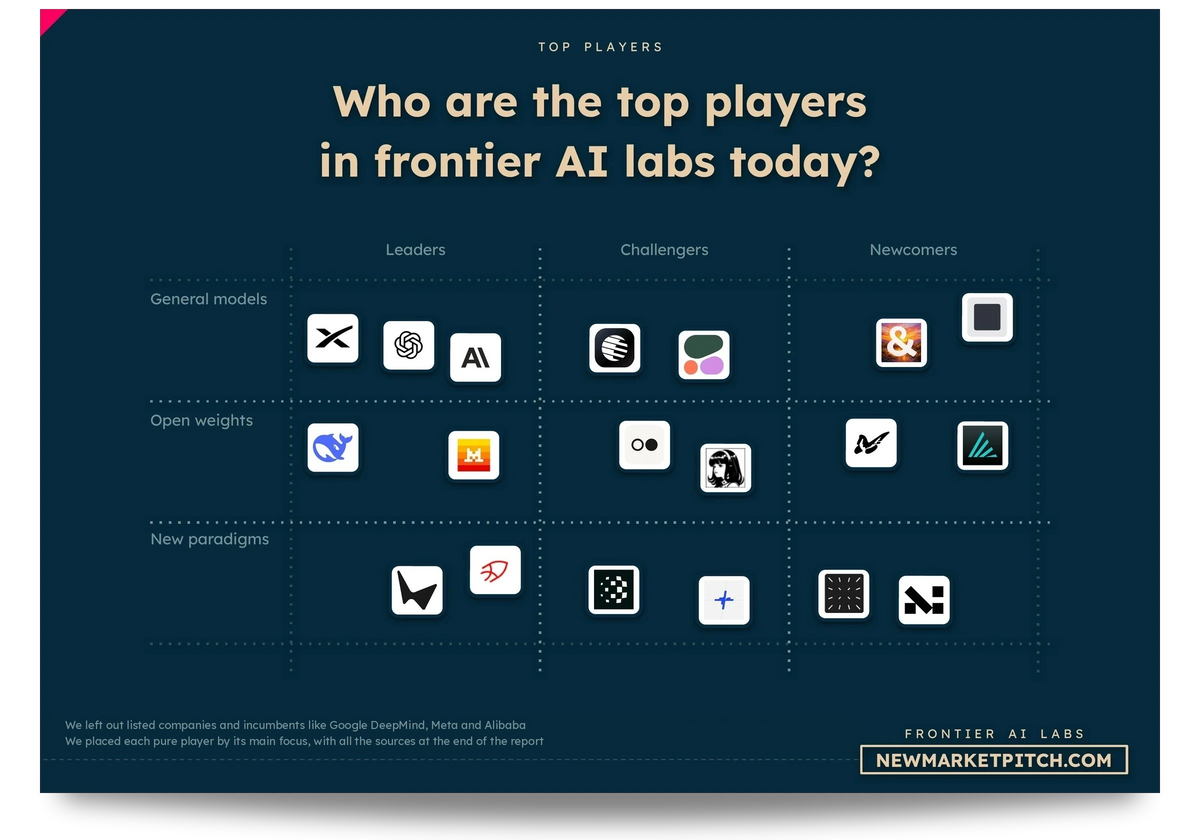
What are the top frontier AI lab startups by revenue today?


Every funding round, every investor, and what the labs promised in return, in one document. Have a look ↓
Summary
Anthropic is the number one frontier AI lab startup by the revenue figures available today, with ~$81B of annualized revenue as of October 2026, according to its regulatory filing. OpenAI follows: Reuters reports ~$50B of annualized revenue for OpenAI (September 2026), and the last figure confirmed by the company was $20B at the end of 2025. The periods and measures differ, so this is a ranking of reported commercial scale rather than identical annual accounts.
That first-place result may surprise anyone who assumes ChatGPT's vast audience must produce the largest revenue figure. OpenAI's enormous free user base tells us little about how much each customer pays.
Chinese labs are making real money too. Moonshot AI reports $1B ARR, DeepSeek has a reported ~$1B run-rate, and MiniMax has a reported $800M run-rate. Paid demand now extends well beyond the best-known American chatbots.
Video and image models are becoming a business too, although the sales evidence is thinner. MiniMax sells video models to companies, while developers such as Luma AI and Black Forest Labs increasingly sell through other creative software. Distribution and paying customers matter more than viral clips.
Voice and music provide another route to sales. ElevenLabs reports $600M ARR from speech technology, and Suno reports >$300M ARR for AI music. Both have customers with reasons to come back, although the risks are different.
Europe has credible companies in several parts of the market. Mistral AI serves customers who want more control over their models, while ElevenLabs sells voice tools worldwide. There is still a wide gap between these businesses and the largest American disclosures.
A mass-market chatbot is no longer a requirement for a meaningful business. Labs selling robot intelligence, training tools and voice APIs have reached substantial annualized sales figures of their own.
The smaller names are harder to judge. Some disclose recurring revenue, while others appear only through analyst or automated estimates. Those estimates are shown without a rank, as clues about scale rather than reported sales.
Huge user counts make the picture even messier. PixVerse, ShengShu Technology and Zhipu AI report adoption, but those figures cannot tell us how much money customers spend. Hume AI's revenue forecast also belongs outside a ranking of realized or currently annualized sales.
Anthropic holds first place in our revenue ranking. The bigger change is the spread of paying demand across language, coding, video, audio and robotics models. To understand who earns the most, we have to keep run-rates, ARR and completed-year revenue separate.

Written by the New Market Pitch teamWe track new markets so founders and investors can move faster. About us


This is just a preview page. Don’t worry if a number looks old: the report gets refreshed, and you’ll always get the latest version.
The ranking of top startups in the frontier AI labs market by revenue
Below is a table ranking the startups of this market by their current revenue scale. You can find our methodology at the end of this page.
If you want a deeper understanding of the market and its current dynamics, get our report on the frontier AI labs market.
| Ranking | Company | Latest Metric | Metric Type | Freshness | Disclosed When | Source Quality | Confidence | Segment | Why This Ranking | Local Metric | Country |
|---|---|---|---|---|---|---|---|---|---|---|---|
| 1 | Anthropic | ~$81B | Revenue Run-Rate | Very Fresh · 1mo | Nov 2026 | Filed / Audited | Medium | Language & Reasoning Models | Anthropic's regulatory filing gives ~$81B of annualized revenue as of October 2026. It is a current sales pace, not a completed year of recognized revenue. | us | |
| 2 | OpenAI | ~$50B | Revenue Run-Rate | Very Fresh · 2mo | Oct 8, 2026 | Credible Reported | Medium | Language & Reasoning Models | Reuters reports ~$50B (September 2026), and the last figure confirmed by the company was $20B in December 2025. It is a press-reported sales pace, not recognized fiscal-year sales. | us | |
| 3 | Moonshot AI | $1B | ARR | Very Fresh · 3mo | Sep 11, 2026 | Credible Reported | Medium | Language & Reasoning Models | Annual recurring revenue (ARR) as of August 2026 reported by the press. ARR and run-rates annualize current sales. They are not recognized revenue. | cn | |
| 4 | DeepSeek | ~$1B | Revenue Run-Rate | Very Fresh · 2mo | Sep 23, 2026 | Credible Reported | Medium | Language & Reasoning Models | Annualized revenue run-rate as of Sep 2026 reported by the press. ARR and run-rates annualize current sales; they are not recognized revenue. Close to Moonshot AI, at ~$1B against $1B. | cn | |
| 5 | MiniMax | $800M | Revenue Run-Rate | Very Fresh · 3mo | Aug 26, 2026 | Credible Reported | Medium | Multimodal & World Models | Annualized revenue run-rate as of Aug 2026 reported by the press. ARR and run-rates annualize current sales; they are not recognized revenue. Ahead of ElevenLabs, whose smaller figure is better documented. | cn | |
| 6 | ElevenLabs | $600M | ARR | Very Fresh · 2mo | Sep 24, 2026 | Company Disclosed | Medium | Audio & Speech Models | Annual recurring revenue (ARR) as of Sep 2026 disclosed by the company. ARR and run-rates annualize current sales; they are not recognized revenue. Ranks below MiniMax, whose larger figure is an annualized run-rate. | gb | |
| 7 | Mistral AI | >$400M | Revenue Run-Rate | Fresh · 9mo | Feb 11, 2026 | Company Disclosed | Medium | Language & Reasoning Models | Annualized revenue run-rate as of February 2026 disclosed by the company. ARR and run-rates annualize current sales. They are not recognized revenue. | fr | |
| 8 | Suno | >$300M | ARR | Very Fresh · 1mo | Oct 2, 2026 | Company Disclosed | Medium | Audio & Speech Models | Annual recurring revenue (ARR) as of October 2026 disclosed by the company. ARR and run-rates annualize current sales. They are not recognized revenue. | us | |
| 9 | Cohere | $240M | ARR | Fresh · 11mo | Sep 16, 2026 | Credible Reported | Medium | Language & Reasoning Models | Annual recurring revenue (ARR) as of December 2025 reported by the press. ARR and run-rates annualize current sales. They are not recognized revenue. | ca | |
| 10 | Prime Intellect | >$100M | Revenue Run-Rate | Very Fresh · 4mo | Jul 8, 2026 | Company Disclosed | Medium | Language & Reasoning Models | Annualized revenue run-rate as of Jul 2026 disclosed by the company. ARR and run-rates annualize current sales; they are not recognized revenue. Ranks below Cohere, whose larger figure is an annualized run-rate. | us | |
| 11 | Thinking Machines Lab | >$100M | Revenue Run-Rate | Very Fresh · 2mo | Sep 3, 2026 | Credible Reported | Medium | Language & Reasoning Models | Annualized revenue run-rate as of Sep 2026 reported by the press. ARR and run-rates annualize current sales; they are not recognized revenue. Close to Prime Intellect, at >$100M against >$100M. Ahead of Skild AI, whose smaller figure is better documented. | us | |
| 12 | Skild AI | $100M | ARR | Very Fresh · 2mo | Sep 10, 2026 | Company Disclosed | Medium | Multimodal & World Models | Annual recurring revenue (ARR) as of Sep 2026 disclosed by the company. ARR and run-rates annualize current sales; they are not recognized revenue. Close to Thinking Machines Lab, at $100M against >$100M. | us | |
| 13 | General Intuition | ~$40M | Annual Revenue | Fresh · 11mo | Sep 30, 2026 | Company Disclosed | High | Multimodal & World Models | Annual revenue for the year to Dec 2025 disclosed by the company. | us | |
| 14 | 01.AI | ~$35.7M | Annual Revenue | Fresh · 11mo | May 28, 2026 | Credible Reported | Medium | Language & Reasoning Models | Annual revenue for the year to Dec 2025 reported by the press. Ahead of Fish Audio, whose smaller figure is better documented. | CNY 250M | cn |
| 15 | Fish Audio | $21M | ARR | Very Fresh · 4mo | Jul 28, 2026 | Company Disclosed | Medium | Audio & Speech Models | Annual recurring revenue (ARR) as of Jul 2026 disclosed by the company. ARR and run-rates annualize current sales; they are not recognized revenue. | us | |
| 16 | Upstage | ~$17.2M | Fiscal-Year Revenue | Fresh · 11mo | Jun 16, 2026 | Filed / Audited | High | Language & Reasoning Models | Fiscal-year revenue for the year to Dec 2025 from a regulatory filing. | KRW 24.8B | kr |
| 17 | Recraft | >$5M | ARR | Fresh · 18mo | May 5, 2025 | Company Disclosed | Medium | Image Generation Models | Annual recurring revenue (ARR) as of May 2025 disclosed by the company. ARR and run-rates annualize current sales; they are not recognized revenue. | gb | |
| 18 | Sarvam AI | ~$4.81M | Fiscal-Year Revenue | Fresh · 8mo | Jun 2026 | Credible Reported | Medium | Language & Reasoning Models | Fiscal-year revenue for the year ended Mar 2026 reported by the press. Close to Recraft, at ~$4.81M against >$5M. | INR 451M | in |
| 19 | Aleph Alpha | <$1.1M | Annual Revenue | Historical · 35mo | Sep 16, 2026 | Credible Reported | Low | Language & Reasoning Models | Annual revenue for the year to Dec 2023 reported by the press. The figure is more than two years old, and the company has grown strongly since, so its revenue today is very likely much higher. | < EUR 1M | de |
| NR | xAI | $500M | Revenue Run-Rate | Fresh · 11mo | Feb 3, 2026 | Third-Party Estimate | Low | Language & Reasoning Models | xAI, now owned by SpaceX, has a single $500M run-rate estimate from Sacra as of December 2025 with no second independent source, so it is shown without a rank. | us | |
| NR | Domyn | ~$230M | ARR | Very Fresh · 4mo | Aug 20, 2026 | Third-Party Estimate | Low | Language & Reasoning Models | Automated estimate of annual recurring revenue (ARR) as of Jul 2026 from a company-data website, not a company figure; an automated estimate from a company-data website with no second independent source, so it is shown without a rank. | EUR 200M | it |
| NR | Deepgram | $100M | Revenue Run-Rate | Very Fresh · 3mo | Oct 2026 | Third-Party Estimate | Low | Audio & Speech Models | Analyst estimate of annualized revenue run-rate as of August 2026, not a company figure. A single analyst estimate with no second independent source, so it is shown without a rank. | us | |
| NR | Black Forest Labs | ~$96.3M | Revenue Run-Rate | Fresh · 15mo | 2026 | Third-Party Estimate | Low | Image Generation Models | Analyst estimate of annualized revenue run-rate as of August 2025, not a company figure. A single analyst estimate with no second independent source, so it is shown without a rank. | de | |
| NR | World Labs | $50M | ARR | Fresh · 12mo | Nov 28, 2025 | Third-Party Estimate | Low | Multimodal & World Models | Automated estimate of annual recurring revenue (ARR) as of Nov 2025 from a company-data website, not a company figure; an automated estimate from a company-data website with no second independent source, so it is shown without a rank. | us | |
| NR | AI21 Labs | $50M | Annual Revenue | Fresh · 11mo | Oct 2026 | Third-Party Estimate | Low | Language & Reasoning Models | Automated estimate of annual revenue for the year to December 2025 from a company-data website, not a company figure. An automated estimate from a company-data website with no second independent source, so it is shown without a rank. | il | |
| NR | Stability AI | $50M | Annual Revenue | Aging · 23mo | Oct 2026 | Third-Party Estimate | Low | Image Generation Models | Analyst estimate of annual revenue for the year to December 2024, not a company figure. A single analyst estimate with no second independent source, so it is shown without a rank. | gb | |
| NR | Mind Robotics | $41M | Annual Revenue | Period not stated · collected 8mo ago | Period not stated | Third-Party Estimate | Low | Multimodal & World Models | Automated estimate of annual revenue, period not stated (collected Mar 2026) from a company-data website, not a company figure; an automated estimate from a company-data website with no second independent source, so it is shown without a rank. | us | |
| NR | Reflection AI | ~$20M | Annual Revenue | Fresh · 11mo | 2026 | Third-Party Estimate | Low | Language & Reasoning Models | Automated estimate of annual revenue for the year to December 2025 from a company-data website, not a company figure. An automated estimate from a company-data website with no second independent source, so it is shown without a rank. | us | |
| NR | Luma AI | $8M–$21.2M | Revenue Run-Rate | Aging · 23mo | 2026 | Third-Party Estimate | Low | Video Generation Models | Estimates disagree (Sacra, GetLatka): from $8M to $21.2M, a vague signal that gives the order of size, so it is shown without a rank. | us | |
| NR | Imbue | $11.5M | Annual Revenue | Fresh · 17mo | Aug 20, 2026 | Third-Party Estimate | Low | Agentic & Self-Improving Models | The $11.5M figure for the year to June 2025 is a single automated estimate with no second independent source, so it is shown without a rank. | us | |
| NR | Reka AI | ~$10.9M | Annual Revenue | Fresh · 11mo | 2026 | Third-Party Estimate | Low | Multimodal & World Models | Automated estimate of annual revenue for the year to December 2025 from a company-data website, not a company figure. An automated estimate from a company-data website with no second independent source, so it is shown without a rank. | us | |
| NR | Ideogram | $7M | Annual Revenue | Fresh · 11mo | 2026 | Third-Party Estimate | Low | Image Generation Models | Automated estimate of annual revenue for the year to December 2025 from a company-data website, not a company figure. An automated estimate from a company-data website with no second independent source, so it is shown without a rank. | ca | |
| NR | Sereact | $6.4M | Annual Revenue | Fresh · 14mo | Sep 18, 2025 | Third-Party Estimate | Low | Multimodal & World Models | Automated estimate of annual revenue for the year to Sep 2025 from a company-data website, not a company figure; an automated estimate from a company-data website with no second independent source, so it is shown without a rank. | de | |
| NR | PlayAI | $3.8M | Annual Revenue | Fresh · 11mo | Aug 2026 | Third-Party Estimate | Low | Audio & Speech Models | PlayAI, which Meta bought in July 2025, has an automated estimate of $3.8M of annual revenue for 2025 from a company-data website, with no second independent source, so it is shown without a rank. | us | |
| NR | Magic | $2M | Annual Revenue | Historical · 35mo | Oct 5, 2026 | Third-Party Estimate | Low | Language & Reasoning Models | Automated estimate of annual revenue for the year to Dec 2023 from a company-data website, not a company figure; an automated estimate from a company-data website with no second independent source, so it is shown without a rank. | us | |
| NR | Rime | $1.1M | Annual Revenue | Fresh · 11mo | Aug 10, 2026 | Third-Party Estimate | Low | Audio & Speech Models | Automated estimate of annual revenue for the year to December 2025 from a company-data website, not a company figure. An automated estimate from a company-data website with no second independent source, so it is shown without a rank. | us | |
| NR | Zhipu AI | >1M users | Users | Very Fresh · 3mo | Aug 11, 2026 | Credible Reported | Medium | Language & Reasoning Models | Users as of August 2026 reported by the press. Not revenue, so it is not ranked against revenue figures. | cn | |
| NR | Poolside | $6B (contract value, not revenue) | Contract Value | Very Fresh · 3mo | Aug 20, 2026 | Credible Reported | Medium | Language & Reasoning Models | Contract value for the year to Aug 2026 reported by the press; not revenue, so it is not ranked against revenue figures. | us | |
| NR | ShengShu Technology | >40M users | Users | Fresh · 10mo | Jan 2026 | Company Disclosed | Medium | Video Generation Models | Users as of January 2026 disclosed by the company. Not revenue, so it is not ranked against revenue figures. | cn | |
| NR | PixVerse | >150M users | Users | Very Fresh · 4mo | Jul 13, 2026 | Company Disclosed | Medium | Video Generation Models | Users as of July 2026 disclosed by the company. Not revenue, so it is not ranked against revenue figures. | cn | |
| NR | Sakana AI | 3 financial-institution partnerships | Other Scale Signal | Very Fresh · 3mo | Aug 2026 | Company Disclosed | Medium | Language & Reasoning Models | Other scale signal as of August 2026 disclosed by the company. Not revenue, so it is not ranked against revenue figures. | jp | |
| NR | Writer | >$50M (bookings, not revenue) | Bookings | Aging · 19mo | Apr 10, 2025 | Company Disclosed | Medium | Language & Reasoning Models | Bookings as of Apr 2025 disclosed by the company; not revenue, so it is not ranked against revenue figures. | us | |
| NR | Cartesia | >50K customers | Customers | Fresh · 8mo | 2026 | Credible Reported | Medium | Audio & Speech Models | Customers as of March 2026 reported by the press. Not revenue, so it is not ranked against revenue figures. | us | |
| NR | Hume AI | $100M (forecast, not revenue) | Revenue Forecast | Forecast | Jan 22, 2026 | Credible Reported | Medium | Audio & Speech Models | Revenue forecast for the year to Jan 2026 reported by the press; not revenue, so it is not ranked against revenue figures. | us |

Is Anthropic really making more money than OpenAI?
Anthropic currently ranks ahead of OpenAI among frontier AI labs, although the two companies have not published sales for the same period using the same accounting measure.
Anthropic's own regulatory filing puts its annualized revenue at ~$81B as of October 2026, above every figure available for OpenAI. Reuters reported a lower annualized pace for OpenAI in September 2026, and the last figure confirmed by OpenAI was $20B at the end of 2025. Both figures annualize a recent sales pace. Neither should be called audited full-year revenue.
There is a reason Anthropic's business has accelerated. Claude is increasingly used for programming and work inside companies, not just for occasional questions. Businesses pay for that kind of repeated work because it saves time on something they already spend money doing.
OpenAI is growing too, but the Reuters figure stays below Anthropic's pace even though it describes a later month. On the evidence used here, Anthropic comes first, while a like-for-like comparison of recognized annual sales remains unavailable.
How much money does OpenAI actually make now?
OpenAI makes more money than any other frontier AI lab except Anthropic: Reuters reports ~$50B of annualized revenue for September 2026.
That is a press-reported pace, not a company filing. The last figure confirmed by the company was $20B of annual recurring revenue at the end of 2025, so the reported pace points to very fast growth during 2026. Neither number is a completed year of recognized revenue.
OpenAI's own description of its business helps explain the jump. Its January 2026 essay linked revenue growth to more compute capacity and more customers putting its models to work, and its September update described a growing base of business customers. Companies, developers calling the API and paying subscribers all feed an annualized figure, while free ChatGPT users mostly add cost.
A reported run-rate can move quickly in either direction. The next figure confirmed by OpenAI itself will tell us more than any single press report.
Does ChatGPT's huge audience mean OpenAI earns more?
No. ChatGPT's enormous reach does not, by itself, make OpenAI the highest-earning frontier AI lab.
OpenAI said in September 2026 that its products served more than one billion weekly active users and 2.5 million businesses. That includes people using ChatGPT for free, paying subscribers, companies buying work tools, and developers calling its APIs. A free user and a company running an AI-powered product can look identical in an audience headline while generating different sales.
Even the September 2026 pace that Reuters reports for OpenAI stays below Anthropic's run-rate. We should be careful about comparing two press-reported paces, but there is no good reason to turn a count of ChatGPT users into revenue dollars.
OpenAI itself explained in a January 2026 essay on its business that compute capacity and customer adoption have grown together. Extra usage can bring in more money, but serving those requests also costs money. The questions investors and customers should ask are who pays, how often they pay, and what they keep using. Download charts and message counts cannot answer those questions.
Are US frontier AI labs still far ahead of China and Europe?
The biggest frontier AI revenue figures still come from the United States, but Chinese labs and European specialists are already selling models at meaningful scale.
Anthropic and OpenAI occupy the first two places in our ranking. China has a different story: Moonshot AI sells Kimi subscriptions and model access, DeepSeek monetizes API use, and MiniMax now relies heavily on companies buying its language and video models. The UK-based ElevenLabs sells speech technology to large enterprises. All of them have published or reported sales measures rather than user counts alone.
The products are too different to combine into a precise national market share. A developer buying low-cost model tokens, a bank paying for private deployment, and a creator subscribing to a video tool may all be purchasing frontier AI, yet their bills and costs look nothing alike. Even the disclosed figures mix ARR and annualized run-rates.
The gap at the very top is real in the retained figures. Still, geography matters less to a customer than price, language, reliability, deployment controls and what a model can actually do. The commercial race already extends across several regions and several kinds of AI products.
The table below shows where seven of the highest-ranked frontier AI labs are based and what measure each reports.
| Lab | Country | Figure | Measure |
|---|---|---|---|
| Anthropic | US | ~$81B | Revenue Run-Rate |
| OpenAI | US | ~$50B | Revenue Run-Rate |
| Moonshot AI | CN | $1B | ARR |
| DeepSeek | CN | ~$1B | Revenue Run-Rate |
| MiniMax | CN | $800M | Revenue Run-Rate |
| ElevenLabs | GB | $600M | ARR |
| Mistral AI | FR | >$400M | Revenue Run-Rate |

This is a preview page. Spotted an outdated number? That’s normal here. The report you get is always the freshest version.
Are Chinese frontier AI labs getting paying customers now?
Yes. Chinese frontier AI labs are making substantial sales from their own models, with stronger evidence of paid use than their early popularity suggested.
Bloomberg reported that Moonshot AI's Kimi business reached its recurring-revenue milestone after the release of Kimi K3 in July 2026. Demand came from subscribers and businesses using the model, not just downloads of open weights. The Information reported that DeepSeek's annualized revenue pace rose as API customers continued paying after a price increase. MiniMax shows a third route: it has moved from relying mainly on its Talkie consumer app toward selling language and video models through APIs.
These changes say more than another benchmark win. DeepSeek is testing whether customers will stay when an inexpensive service becomes less cheap. Moonshot is trying to turn interest in a strong model into ongoing subscriptions. MiniMax has found enterprises willing to pay for a model inside their own products. Those are three different forms of customer commitment.
The disclosed numbers remain annualized measures, and none tells us the net profit of the underlying model business. But it is already outdated to describe China's frontier labs as free-model experiments with no paying market.
Is DeepSeek making more money than Kimi's maker Moonshot AI?
We cannot say DeepSeek earns more than Moonshot AI from the sales evidence currently available for China's frontier AI labs.
Bloomberg placed Moonshot AI at $1B ARR for August 2026. The Information reported a ~$1B revenue run-rate for DeepSeek in September 2026. The displayed figures are close, but ARR and run-rate are different measures and neither is a full-year income statement. Claiming a winner on recognized annual sales would go beyond the evidence.
Their routes to paying customers also differ. Moonshot grew quickly after releasing Kimi K3, attracting demand for reasoning and coding as well as subscriptions to Kimi services. DeepSeek initially stood out for strong models at low prices. Its reported API price increase is therefore revealing: higher prices only help if developers still find the models worth using.
For now, both companies have shown that Chinese model builders can charge customers without copying the American chatbot business exactly. What we would want to see next is how much money each recognizes over a full year and how much it costs to serve that demand. The published pace figures cannot settle either question.
Did MiniMax make more money by selling models to businesses?
MiniMax's latest growth comes largely from enterprise customers, a sharp change from its earlier consumer-chatbot business.
The Information reported $800M in annualized revenue run-rate for August 2026 and described the move away from Talkie, MiniMax's role-play chatbot. Companies now pay for its video and language models through APIs. MiniMax's own half-year financial results add a useful check: enterprise and open-platform services grew faster than its consumer AI products, according to the company's August filing.
There is a straightforward reason that change could last. A business using a model to make advertisements or handle work inside its software may need it every day. A consumer role-play app depends much more on individual habits and willingness to keep paying. Neither guarantees high margins, but the kinds of customers are plainly different.
MiniMax also has an advantage in selling more than one kind of model. Video creation and language tasks are different products, so the same lab can serve companies with different needs. Its reported run-rate shows a much bigger commercial operation than its early chatbot identity suggested. We still cannot infer completed-year revenue or profitability from an annualized pace alone.

Preview only. Some numbers may have changed since we made this page, but your report will be up to date.
Do millions of AI video users turn into real revenue?
Only sometimes. A huge audience for AI video shows that people want the product, but it does not tell us how much anyone pays.
MiniMax says businesses now pay for its video models through APIs, alongside its language models. Luma AI only has estimates ranging from $8M to $21.2M of run-rate for 2024, too vague to earn a rank. PixVerse disclosed >150M users in July 2026 and ShengShu Technology reported >40M Vidu users in January 2026. Neither user count establishes a comparable sales figure, so neither company gets a revenue rank.
A free clip shared online, an agency buying credits every month, and a company integrating an AI video model through an API can each count as usage. Only the latter two necessarily imply a paying customer. Adobe's integration of partner models, including offerings from Luma AI and Black Forest Labs, adds another possibility: a model builder can earn money through professional software that users already know.
The lesson from today's video market is simple. Popularity can help distribution, but the serious sales evidence comes from paid work that customers want to repeat. It is still missing for several of the most widely used video apps.
Are big companies really paying ElevenLabs for voice AI?
Yes. ElevenLabs has turned voice generation into an enterprise product, with $600M ARR reported as of September 2026.
In a TechCrunch interview, the company said traditional enterprise customers now account for more than half its recurring business. It named Klarna, Deutsche Telekom, Cisco and Adobe among customers. Those companies use speech technology for tasks such as service conversations, dubbing and voice interfaces. That puts ElevenLabs in everyday operations, far beyond the original novelty of copying a person's voice.
The reason customers pay is fairly clear. A voice agent needs to respond quickly, sound natural and work reliably through thousands of conversations. Once that system is part of customer service, replacing it takes time and testing. Even then, the business is not immune to competition. ElevenLabs's founder acknowledged that speech models could become easier to copy and that some customers might build their own.
The reported figure is annual recurring revenue, not completed-year sales. It still shows that an audio-focused frontier lab can build a substantial paid business without trying to make the world's best general-purpose chatbot.
Can Suno keep making money from AI-generated music?
Suno has proved that people pay for AI-generated music, but keeping that business growing depends partly on music rights and repeat subscriptions.
Suno reported >$300M ARR in October 2026. Earlier in the year it had announced 2 million paying subscribers, showing that music generation had moved well beyond a free viral experiment. People pay to make songs, edit them and try different versions. Unlike a workplace AI tool, the reason to return may be creative enjoyment rather than a task an employer has to finish.
The harder issue is licensing. Music Business Worldwide has reported agreements involving Warner Music Group, BMG and Believe, alongside continued disputes with other rights holders. A song-generation company has to keep customers happy while paying for computing and operating under copyright rules that are still being contested. A popular product could face different costs once those arrangements change.
We cannot treat Suno's recurring-sales figure as profit or as a guarantee about the next full year. But consumers have already shown a willingness to pay for AI music. The open question is how much of those subscription dollars Suno can keep as the business matures.

This is just a preview page. Don’t worry if a number looks old: the report gets refreshed, and you’ll always get the latest version.
Is Mistral AI becoming Europe's answer to OpenAI?
Mistral AI is one of Europe's biggest commercial frontier labs, but its sales are still much smaller than those reported for OpenAI and Anthropic.
Mistral disclosed >$400M in annualized revenue run-rate as of February 2026. Its pitch is easy to understand: companies can use powerful models while keeping more control over where they run and where their data goes. That is valuable to organizations in regulated sectors and to buyers wary of depending entirely on an American provider.
Chief executive Arthur Mensch discussed the sales pace with the Financial Times in February. Mistral has also kept releasing open-weight models and investing in infrastructure so customers can deploy models in more than one way. Those choices give buyers an alternative to an API that can only be reached through someone else's cloud. They do not automatically mean Mistral wins every model benchmark or offers a cheaper service for every task.
Its run-rate reflects a recent selling pace, rather than recognized sales for a completed year. Mistral is already a credible European AI business with paying customers. Catching the American leaders would require a much larger and more sustained customer base than Mistral has disclosed so far.
Is Grok earning enough to compete with ChatGPT and Claude?
Grok's commercial reach is hard to pin down, and xAI, which SpaceX bought in February 2026, has a much smaller estimated revenue pace than OpenAI and Anthropic.
Since that purchase, the Grok developer is part of SpaceX rather than an independent company. Sacra estimates xAI's annualized revenue run-rate at $500M as of December 2025. That is a single analyst estimate, not a number xAI published itself, and no second independent source confirms it, so xAI is shown without a rank.
Grok has a big promotional advantage: X can put the assistant in front of people who already use the social network. But visibility is not the same as paid model use. We do not know from audience numbers how much comes from subscribers, API customers, internal arrangements or other channels. Those distinctions matter when the product belongs to a larger group.
Grok can be a prominent AI assistant without matching the commercial sales of the largest independent labs. Until xAI or SpaceX reports clearer figures for the model business, the present estimate is a starting point, not proof that Grok is catching up in annual revenue.
Is Cohere making money without a consumer chatbot?
Cohere makes money selling frontier AI to businesses without chasing a giant consumer audience; Reuters reported $240M ARR for December 2025.
Cohere's Command models and North platform aim at companies that want AI to work with their own documents, data and business tasks. Cohere has named RBC, Dell, Bell and LG CNS among organizations using or working with its products. A bank choosing a model for sensitive information may care more about deployment controls, uptime and support than about which chatbot won the latest public benchmark.
There is a trade-off. Enterprise customers can pay for years when software becomes part of their operations, but buying decisions are slow and often involve security reviews, trials and integration work. A few major contracts may have a large effect on a smaller provider's business, for better or worse.
The Reuters figure describes a recurring-revenue base, not a complete year of recognized sales. Even with that distinction, Cohere shows that a model lab can bring in substantial money while staying mostly out of the consumer chatbot race. Its next test is whether customers keep expanding their use after the first deployment.
Can an AI lab reach $100M without a famous chatbot?
Frontier AI labs can reach a $100M annualized sales pace without a famous chatbot by selling training tools, robot intelligence or speech models.
Thinking Machines Lab has a reported >$100M revenue run-rate for September 2026. TechCrunch linked its early business to Inkling and the Tinker platform, where customers pay for compute while adapting models to their data. Prime Intellect disclosed a run-rate of more than $100M for July 2026 from its training and evaluation stack. Skild AI disclosed $100M ARR for September 2026 by selling general-purpose intelligence for robots, while Deepgram's $100M run-rate for August 2026 is an analyst estimate shown without a rank.
Those businesses have almost nothing in common with a consumer chat subscription. A research team pays to customize models; a factory pays to make robots perform useful work; a developer pays for speech recognition. Each can create repeat demand even without millions of app users.
The numbers are not identical kinds of evidence. Company statements, press reports and estimates sit next to one another here, and annualizing a current pace is different from filing full-year revenue. The point is that customers now buy frontier-model capabilities for specific jobs, sometimes from companies they have never heard of.
The table below shows specialist frontier AI labs and the sales measures available for them.
| Lab | Figure | Measure | Revenue rank |
|---|---|---|---|
| Thinking Machines Lab | >$100M | Revenue Run-Rate | 10 |
| Prime Intellect | >$100M | Revenue Run-Rate | 11 |
| Skild AI | $100M | ARR | 12 |
| Deepgram | $100M | Revenue Run-Rate | NR |
| Black Forest Labs | ~$96.3M | Revenue Run-Rate | NR |
| AI21 Labs | $50M | Annual Revenue | NR |
| Stability AI | $50M | Annual Revenue | NR |
| Writer | >$50M | Bookings | NR |

Are companies already paying for AI models that control robots?
Skild AI is already getting paid to put general-purpose models into physical machines, with $100M ARR reported in September 2026.
Skild says it reached that recurring-revenue pace ten months after its first commercial deployment and now serves more than 60 paying customers. Its examples include warehouses, factories, inspections, deliveries and food preparation. It also describes work with NVIDIA and Foxconn on assembly tasks, plus work with Sumitomo Wiring Systems. Those are specific jobs that customers can test on a real site.
A robot model has to work under messy conditions that a chatbot never encounters. Boxes change shape, tools shift, and a mistake can stop a production line. Skild's bet is that a single adaptable model can learn from many tasks instead of being programmed again for every machine. If that works reliably, customers have a reason to keep paying.
ARR still tells us the annualized recurring business, not how much sales revenue has already been recognized. But the deals show a practical use for frontier AI beyond screens: businesses are buying model intelligence to help machines complete physical work now.
Can independent image AI labs compete with Adobe and OpenAI?
Independent image-model labs can compete with Adobe and OpenAI by selling specialist tools, although the strength of their sales evidence varies.
Black Forest Labs has an analyst-estimated ~$96.3M annualized revenue run-rate as of August 2025. Stability AI has an analyst-estimated $50M in annual revenue for 2024. Recraft disclosed >$5M ARR in May 2025, while Ideogram's $7M annual revenue for 2025 comes from an automated estimate. A company statement and an automated guess should not be read with the same confidence, which is why only Recraft gets a rank here.
The ways these companies sell are worth watching. Recraft focuses on design tasks where the user cares about text, layout and consistent visual identity. Adobe offers partner models, including Black Forest Labs' FLUX family, within tools that creative professionals already use. That can put a smaller developer's model in front of paying customers without requiring everyone to visit its own website. It can also leave the larger platform controlling the customer relationship.
As image generation becomes easier to access, the harder challenge is getting paid again and again. Independent labs can compete where their models do something designers need, but they have to keep proving that advantage as the big platforms improve their own offerings.
Are AI coding startups making serious money beyond Claude?
Some independent AI coding-model labs have paying customers, but their disclosed revenue remains far below the top general-purpose labs.
Poolside has a press-reported $6B contract value for the year to August 2026, which is not revenue. Magic has an automated estimate of $2M annual revenue for 2023. Neither gets a revenue rank. Writer, which sells enterprise-oriented models rather than focusing solely on code, disclosed >$50M of bookings in April 2025, also not revenue. Prime Intellect's company-disclosed run-rate covers training and evaluation tools as well as model work.
Coding remains a strong reason to pay for AI. Teams can check whether a change passes tests, measure how long tasks take and keep using an assistant inside their development tools. Anthropic's study of Claude Code sessions found customers moving from simple bug fixes toward broader work on software. That helps explain demand across the category, although it does not tell us how much every specialist model developer earns.
The business opportunity is clear; the sales evidence for smaller coding labs is less so. We would need fresher company disclosures to claim that Poolside or Magic has reached anything like Claude's current commercial scale.
Do Indian and Korean frontier AI labs have paying customers yet?
Indian and Korean frontier AI labs already have paying customers and report completed-year sales, though they remain smaller than the global model giants.
Upstage in South Korea recorded ~$17.2M of fiscal-year revenue for 2025, from a regulatory filing. India's Sarvam AI recorded ~$4.81M of fiscal-year revenue for the year ending March 2026, as reported by the press. China's 01.AI has a press-reported ~$35.7M in annual revenue for 2025. These numbers describe finished financial periods, which makes their meaning clearer than a projection based on one strong month.
Local buyers have reasons to choose local models. Upstage focuses on Korean-language work and documents. Sarvam builds tools for Indian languages and has links to the country's effort to develop domestic AI capabilities. An organization handling local documents, regulated information or public services may want support and deployment options tailored to its market.
Not every national champion has a recent sales disclosure. Aleph Alpha's <$1.1M annual revenue figure refers to 2023 and is too old to describe the German lab today. Still, the financial results from Upstage and Sarvam show that local-language AI is already a business rather than just a government ambition.

This is a preview page. Spotted an outdated number? That’s normal here. The report you get is always the freshest version.
Is there money in voice AI beyond ElevenLabs?
Voice-model startups beyond ElevenLabs are making money, though their reported figures are often less reliable.
Deepgram has an analyst-estimated $100M annualized revenue run-rate as of August 2026, shown without a rank. Fish Audio disclosed $21M ARR in July 2026 and described developers and businesses paying for multilingual voice generation. Rime's $1.1M annual revenue for 2025 comes from an automated estimate. PlayAI, which Meta acquired in July 2025, has an automated estimate of $3.8M in 2025 annual revenue. Neither estimate gets a rank.
Voice is not one product. Some buyers need speech turned into text, others need realistic speech generated from text, and others want conversational agents able to reply instantly. Customers can buy those capabilities through APIs or as part of business software. That gives several companies room to sell, even if the biggest platforms offer their own voices.
Hume AI is a useful reminder to separate plans from sales. Its $100M figure is a forecast for fiscal 2026, not revenue already earned, so Hume AI has no revenue rank. Demand exists across voice AI, but public numbers still vary widely in quality.
Does a million AI users mean a startup has big revenue?
No. Large user counts make frontier AI products popular, but they do not show whether those labs are making much money.
PixVerse reported >150M users in July 2026, ShengShu Technology reported >40M users of Vidu in January 2026, and Zhipu AI's ZCode was reported to have >1M users in August 2026. Those numbers describe adoption. They cannot tell us how much was paid for subscriptions, API use or commercial licenses. Sakana AI's 3 financial-institution partnerships show business interest, but partnerships are not annual sales either.
Cartesia's reported >50K customers in March 2026 is another adoption measure, not a sales figure. Hume AI has a forward-looking revenue figure rather than completed sales. None of these signals can be inserted into a revenue ranking as though users, customers, contracts and dollars were interchangeable.
The difference is especially important in AI because free usage can be expensive to serve. A product with millions of curious users may have a smaller business than a less famous model sold to a few large enterprises. Until the companies publish revenue, popularity alone leaves that question open.
So, which frontier AI lab startups make the most money today?
Anthropic is the number one frontier AI lab startup by the available revenue figures today, with ~$81B of annualized revenue as of October 2026, according to its regulatory filing.
OpenAI follows on a press-reported annualized pace for September 2026, while Moonshot AI, DeepSeek and MiniMax put Chinese models near the top of the ranking. ElevenLabs and Suno show that voice and music have also found customers willing to pay. We would not describe those different measures as identical completed-year revenue.
The main story is how many different kinds of models people now buy. Developers pay for coding and model access, companies pay for advertising and customer-service tools, and factories are starting to pay for robot intelligence. Anthropic holds first place in the ranking, but no single product or pricing model explains the whole market. The strongest comparisons are still between businesses that disclose the same metric for the same period.
The table below shows what we found.
| Question | Answer |
|---|---|
| Can coding work explain Anthropic's lead over chat? | Claude Code is part of Anthropic's large enterprise business. Companies use it for longer software tasks, not just quick fixes. Repeated workplace use gives customers a reason to keep paying. |
| Does a massive ChatGPT audience guarantee more sales? | OpenAI serves more than one billion weekly active users. Its audience includes free consumers alongside paying business customers and developers. User reach cannot settle a comparison of annualized sales figures. |
| Are video models finding paying customers? | Luma AI and Black Forest Labs reach customers through Adobe's creative software. Luma AI's estimates range from $8M to $21.2M of run-rate. Sales evidence for video models is still thinner than for language models. |
| Are Chinese AI labs finding willing paying customers? | Moonshot AI reported $1B ARR after demand for Kimi rose. DeepSeek also found paying users for its model API. Both show that Chinese AI models have genuine commercial buyers. |
| Has MiniMax moved beyond consumer chatbot subscriptions? | MiniMax reported an $800M annualized run-rate for August 2026. Business customers now buy its language and video models through APIs. Those payments broaden the business beyond its Talkie consumer app. |
| Can speech models become a serious enterprise product? | ElevenLabs reported $600M ARR from voice technology in September 2026. Companies use its voice models in support and communication systems. Ongoing use creates a different business from occasional voice cloning. |
| Will paid AI music survive rights disputes? | Suno reported >$300M ARR from music creation for October 2026. Users pay to create and edit songs repeatedly. Licensing costs and lawsuits remain important to its long-term economics. |
| Is Europe building a credible alternative to US labs? | Mistral AI disclosed >$400M in annualized revenue run-rate. Its deployment options appeal to companies concerned about model control. European demand exists, although the largest US labs still lead. |
| Can enterprise models sell without a consumer chatbot? | Cohere reported $240M ARR from enterprise models for December 2025. Its products help companies work with internal information securely. Winning long-term deployments matters more than becoming a household app. |
| Are robot models already useful to paying customers? | Skild AI disclosed $100M ARR in September 2026. It works with paying customers across factories and warehouses. Reliable physical work could make model spending a recurring expense. |
| Do huge adoption figures mean a lab earns more? | PixVerse reported >150M users for its AI video service in July 2026. That figure counts users rather than recognized revenue or ARR. A popular free app may still have limited sales disclosure. |

Preview only. Some numbers may have changed since we made this page, but your report will be up to date.
Our methodology
Our data runs through November 13, 2026. We define frontier AI labs as venture-scale developers primarily advancing their own reusable language, multimodal, media, world or general embodied model families toward the capability frontier; borderline firms are included when the original-model thesis is credible. All 18 ranked companies qualify under our consistent startup definition: founded in 2000 or later, growth-oriented and founder-, grant- or venture-financed, including firms listed within five years and those acquired within three years. Older established groups are excluded even where their AI sales are larger.
We examined company announcements, accounts, regulatory filings, investor materials and reputable press over the past ten years. AI companies express commercial scale as full-year recognized revenue, recurring revenue, short-period annualized run-rates and sometimes segment sales. We keep each measure in its original form: ARR remains ARR, while bookings, contracts, GMV, user counts and forecasts never become revenue by calculation.
We select one figure for each company, favoring a figure no older than eighteen months, then an authoritative source such as a filing or company statement before press, analyst work and automated commercial estimates. Where evidence is otherwise comparable, complete fiscal-year revenue is preferable to ARR or run-rate, which is preferable to a partial period or a single published segment treated as a minimum. We order companies by the retained figure, using the midpoint of a disclosed range and the lower bound of a minimum. Figures older than 36 months, nonrevenue signals and companies whose relevant segment sales cannot be separated remain without a rank.
Freshness is measured from the end of the period described and labeled Very Fresh, Fresh, Aging or Historical. High confidence is reserved for recent exact full-year sales from company accounts or a filing; Medium covers ARR, run-rates, press disclosures, partial figures, minimums and periods eighteen to thirty months old; Low covers estimates, wide ranges and older figures. Where needed, local-currency figures are converted at fixed rates while the original amount remains visible. A single analyst or automated estimate with no second independent source, or estimates that disagree widely, are shown without a rank. When a first-tier outlet reports a figure at least six months newer than the company's last figure and at least 50% higher or lower, we rank the press figure.
The obvious objection is that an annualized figure can appear above an audited annual total, while an equally famous startup receives no revenue rank. That is a deliberate disclosure-aware ordering, not a claim that a run-rate equals money already recognized under accounting rules. We show the measure, period and confidence beside each figure so readers can identify what is comparable and what is not. A company with only users, projected sales or bookings belongs outside a revenue order, however impressive its other achievements.
Each company's available history is eligible for this revenue article, subject to freshness rules, unlike our separate funding-flow studies that cover specified deal windows. Recently acquired companies remain represented for a limited period so their final independent business scale is not erased. We use the same fixed market boundary across articles while keeping revenue, valuation and capital raised as distinct questions.
Key sources include Anthropic annualized revenue in its 2026 registration filing, OpenAI recurring-revenue disclosures and compute growth, OpenAI consumer and enterprise product reach, Reuters report of OpenAI's September 2026 annualized revenue, Moonshot AI Kimi sales pace and business traction, DeepSeek annualized model-access sales and pricing, MiniMax revenue pace and enterprise shift, ElevenLabs ARR and enterprise customer mix, Suno subscriptions and music licensing context, Mistral AI disclosed revenue run-rate, Official statement confirming SpaceX acquisition of xAI, Reuters account of Cohere ARR and Aleph Alpha accounts, Meta acquisition of PlayAI in July 2025, Thinking Machines Lab sales pace and Tinker platform, Prime Intellect annualized sales and customer workflows, Skild AI ARR, deployments and paying customers, Adobe integrations of independent image and video models, Recraft ARR and professional design positioning, Fish Audio ARR and voice platform use, Upstage audit-based fiscal sales and enterprise adoption, Sarvam AI fiscal sales and Indian enterprise customers, PixVerse reported user reach without disclosed revenue, and Hume AI fiscal-year revenue forecast, not realized sales.
Written by the New Market Pitch teamWe track new markets so founders and investors can move faster. About us