What are the top foundation model startups by revenue today?
Whether you're building or investing in the foundation model market, our report covers everything you need to know: the players, the money, and what's coming next.
Summary
Anthropic is the number one foundation model startup by revenue today, with ~$81B of annualized revenue run-rate as of October 2026, from a regulatory filing. OpenAI ranks second: Reuters reports about $50B of annualized revenue (September 2026), and the last figure confirmed by the company was $20B at the end of 2025. Moonshot AI is third with $1B of ARR as of August 2026. These are annualized sales measures, not three comparable full-year income statements.
That result surprises anyone who assumes OpenAI must still sell the most AI. Claude's use in coding and company workflows has pushed Anthropic to the top of the available revenue figures, even though OpenAI still sells to consumers, developers and businesses on a huge scale.
The next names come from China rather than from the usual American chatbot list. Moonshot AI and DeepSeek make money from language models and access to them.
MiniMax gives China another serious model business. Its move toward paying API and enterprise customers matters as much as consumer interest in its products.
Audio has grown into its own paid category. ElevenLabs sells voice generation to creators and companies, while Suno has persuaded people to subscribe to AI music creation.
A famous name can also have a less certain figure. xAI, acquired by SpaceX in February 2026, only has a single analyst estimate of a $500M revenue run-rate, so it is shown without a rank. Mistral AI has a company-disclosed >$400M revenue run-rate as of February 2026. Those claims deserve different levels of confidence.
Companies also pay for models they can run under tighter controls. Cohere's $240M ARR as of December 2025 shows there is money in private deployment and enterprise-focused language models.
Robotics is starting to produce sales, too. AgiBot reported ~$157M of 2025 annual revenue, while Skild AI disclosed $100M ARR as of September 2026. Selling robots and selling annualized robot intelligence are two different businesses.
Farther down, image, speech and coding developers are harder to compare. Many have only one analyst or automated estimate, which we show without a rank. A precise-looking dollar amount does not make a single estimate reliable.
The strongest conclusion is that foundation model developers can now earn from several products beyond general-purpose chat. Coding, video, voice, music, business APIs and robots all have paying customers. But the company at the top, and the confidence we place in every other figure, still depend on what was actually measured.

Written by the New Market Pitch teamWe track new markets so founders and investors can move faster. About us

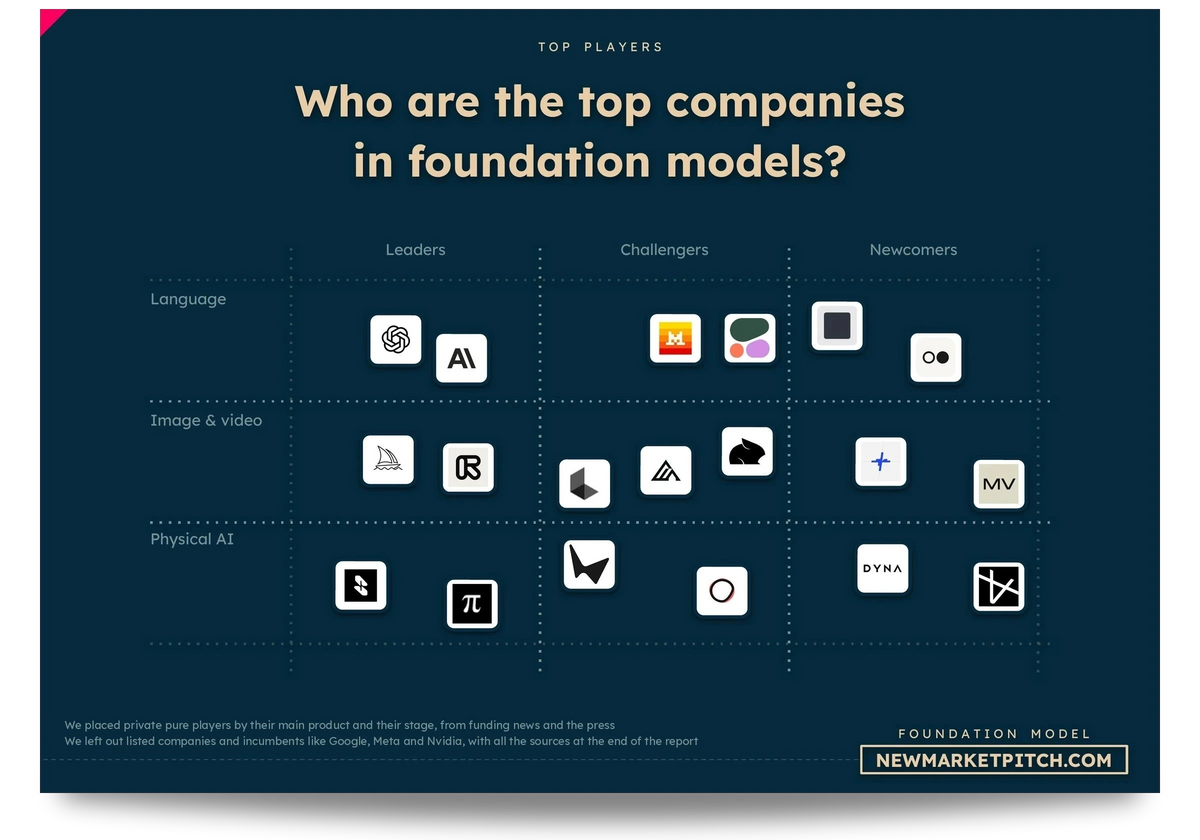
In our report covering the foundation model market, we turn what is vague and complex into simple, useful visuals. Market maps like this one show you at a glance where every startup stands.
The ranking of top startups in the foundation model market by revenue
Below is a table ranking the startups of this market by their current revenue scale. You can find our methodology at the end of this page.
If you want a deeper understanding of the market and its current dynamics, get our report on the foundation model market.
| Ranking | Company | Latest Metric | Metric Type | Freshness | Disclosed When | Source Quality | Confidence | Segment | Why This Ranking | Local Metric | Country |
|---|---|---|---|---|---|---|---|---|---|---|---|
| 1 | Anthropic | ~$81B | Revenue Run-Rate | Very Fresh · 1mo | Nov 2026 | Filed / Audited | Medium | Language Models | Anthropic's amended public-offering filing put its annualized revenue run-rate at ~$81B for October 2026. It is a recent sales pace, not full-year recognized revenue. | us | |
| 2 | OpenAI | ~$50B | Revenue Run-Rate | Very Fresh · 2mo | Oct 8, 2026 | Credible Reported | Medium | Multimodal Models | Reuters reported about $50B of annualized revenue for September 2026. The last figure confirmed by the company was $20B at the end of 2025. | us | |
| 3 | Moonshot AI | $1B | ARR | Very Fresh · 3mo | Sep 11, 2026 | Credible Reported | Medium | Language Models | Annual recurring revenue (ARR) as of Aug 2026 reported by the press. ARR and run-rates annualize current sales; they are not recognized revenue. | cn | |
| 4 | DeepSeek | ~$1B | Revenue Run-Rate | Very Fresh · 2mo | Sep 23, 2026 | Credible Reported | Medium | Language Models | The press reported a ~$1B revenue run-rate for September 2026. This approximate annualized pace is not the same as recognized annual revenue. | cn | |
| 5 | MiniMax | $800M | Revenue Run-Rate | Very Fresh · 3mo | Aug 26, 2026 | Credible Reported | Medium | Multimodal Models | Annualized revenue run-rate as of Aug 2026 reported by the press. ARR and run-rates annualize current sales; they are not recognized revenue. Ahead of ElevenLabs, whose smaller figure is better documented. | cn | |
| 6 | ElevenLabs | $600M | ARR | Very Fresh · 2mo | Sep 24, 2026 | Company Disclosed | Medium | Audio & Speech Models | ElevenLabs disclosed $600M of ARR as of September 2026. The company-backed recurring figure measures a current annualized rate, not booked sales over a year. | gb | |
| 7 | Mistral AI | >$400M | Revenue Run-Rate | Fresh · 9mo | Feb 11, 2026 | Company Disclosed | Medium | Language Models | Mistral AI disclosed >$400M of revenue run-rate in February 2026. This company-backed annualized pace is a minimum, not fiscal-year revenue. | fr | |
| 8 | Suno | >$300M | ARR | Very Fresh · 1mo | Oct 2, 2026 | Company Disclosed | Medium | Audio & Speech Models | Suno disclosed >$300M of ARR in October 2026. The company-reported minimum is recurring annualized sales rather than a fiscal-year revenue total. | us | |
| 9 | Cohere | $240M | ARR | Fresh · 11mo | Sep 16, 2026 | Credible Reported | Medium | Language Models | Reuters reported $240M of ARR for December 2025. The measure reflects recurring business at that date rather than revenue recognized through the year. | ca | |
| 10 | AgiBot | ~$157M | Annual Revenue | Fresh · 11mo | Apr 20, 2026 | Company Disclosed | High | World & Robotics Models | Annual revenue for the year to Dec 2025 disclosed by the company. Ranks below Cohere, whose larger figure is an annualized run-rate. Ahead of Thinking Machines Lab, whose figure is an annualized run-rate. | CNY 1.1B (~$147M per Yicai) | cn |
| 11 | Thinking Machines Lab | >$100M | Revenue Run-Rate | Very Fresh · 2mo | Sep 3, 2026 | Credible Reported | Medium | Multimodal Models | Annualized revenue run-rate as of Sep 2026 reported by the press. ARR and run-rates annualize current sales; they are not recognized revenue. Ahead of Skild AI, whose smaller figure is better documented. | us | |
| 12 | Skild AI | $100M | ARR | Very Fresh · 2mo | Sep 10, 2026 | Company Disclosed | Medium | World & Robotics Models | Annual recurring revenue (ARR) as of Sep 2026 disclosed by the company. ARR and run-rates annualize current sales; they are not recognized revenue. Close to Thinking Machines Lab, at $100M against >$100M. | us | |
| 13 | General Intuition | ~$40M | Annual Revenue | Fresh · 11mo | Sep 30, 2026 | Company Disclosed | High | World & Robotics Models | Annual revenue for the year to Dec 2025 disclosed by the company. | us | |
| 14 | 01.AI | ~$35.7M | Annual Revenue | Fresh · 11mo | May 28, 2026 | Credible Reported | Medium | Language Models | Annual revenue for the year to Dec 2025 reported by the press. Ahead of Fish Audio, whose smaller figure is better documented. | CNY 250M | cn |
| 15 | Fish Audio | $21M | ARR | Very Fresh · 4mo | Jul 28, 2026 | Company Disclosed | Medium | Audio & Speech Models | Annual recurring revenue (ARR) as of Jul 2026 disclosed by the company. ARR and run-rates annualize current sales; they are not recognized revenue. | us | |
| 16 | Upstage | ~$17.2M | Fiscal-Year Revenue | Fresh · 11mo | Jun 16, 2026 | Filed / Audited | High | Language Models | Fiscal-year revenue for the year to Dec 2025 from a regulatory filing. | KRW 24.8B | kr |
| 17 | Recraft | >$5M | ARR | Fresh · 18mo | May 5, 2025 | Company Disclosed | Medium | Image Generation Models | Annual recurring revenue (ARR) as of May 2025 disclosed by the company. ARR and run-rates annualize current sales; they are not recognized revenue. | gb | |
| 18 | Sarvam AI | ~$4.81M | Fiscal-Year Revenue | Fresh · 8mo | Jun 2026 | Credible Reported | Medium | Language Models | Fiscal-year revenue for the year ended Mar 2026 reported by the press. Close to Recraft, at ~$4.81M against >$5M. | INR 451M | in |
| 19 | Aleph Alpha | <$1.1M | Annual Revenue | Historical · 35mo | Sep 16, 2026 | Credible Reported | Low | Language Models | Annual revenue for the year to Dec 2023 reported by the press. The figure is more than two years old, and the company has grown strongly since, so its revenue today is very likely much higher. | < EUR 1M | de |
| NR | xAI | $500M | Revenue Run-Rate | Fresh · 11mo | Feb 3, 2026 | Third-Party Estimate | Low | Language Models | $500M of revenue run-rate as of December 2025 is a single analyst estimate with no second independent source, so it is shown without a rank. | us | |
| NR | Deepgram | $100M | Revenue Run-Rate | Very Fresh · 3mo | Oct 2026 | Third-Party Estimate | Low | Audio & Speech Models | $100M of revenue run-rate is a single analyst estimate with no second independent source, so it is shown without a rank. | us | |
| NR | Black Forest Labs | ~$96.3M | Revenue Run-Rate | Fresh · 15mo | 2026 | Third-Party Estimate | Low | Image Generation Models | ~$96.3M of revenue run-rate is a single analyst estimate with no second independent source, so it is shown without a rank. | de | |
| NR | AssemblyAI | $76M | Revenue Run-Rate | Very Fresh · 1mo | Nov 2026 | Third-Party Estimate | Low | Audio & Speech Models | $76M of revenue run-rate as of October 2026 is a single analyst estimate with no second independent source, so it is shown without a rank. | us | |
| NR | Lila Sciences | $75.1M | Annual Revenue | Undated | Third-Party Estimate | Low | Scientific & Biology Models | Automated estimate of annual revenue from a company-data website, not a company figure; the source gives no date, so its age is unknown and it is shown without a rank. | us | ||
| NR | World Labs | $50M | ARR | Fresh · 12mo | Nov 28, 2025 | Third-Party Estimate | Low | World & Robotics Models | Automated estimate of annual recurring revenue (ARR) as of Nov 2025 from a company-data website, not a company figure; an automated estimate from a company-data website with no second independent source, so it is shown without a rank. | us | |
| NR | AI21 Labs | $50M | Annual Revenue | Fresh · 11mo | Oct 2026 | Third-Party Estimate | Low | Language Models | $50M of annual revenue is an automated estimate from a company-data website with no second independent source, so it is shown without a rank. | il | |
| NR | Stability AI | $50M | Annual Revenue | Aging · 23mo | Oct 2026 | Third-Party Estimate | Low | Image Generation Models | $50M of annual revenue is a single analyst estimate with no second independent source, so it is shown without a rank. | gb | |
| NR | Reflection AI | ~$20M | Annual Revenue | Fresh · 11mo | 2026 | Third-Party Estimate | Low | Language Models | ~$20M of annual revenue is an automated estimate from a company-data website with no second independent source, so it is shown without a rank. | us | |
| NR | Speechmatics | $18.7M | Annual Revenue | Fresh · 11mo | Nov 2026 | Third-Party Estimate | Low | Audio & Speech Models | $18.7M of annual revenue is a single analyst estimate with no second independent source, so it is shown without a rank. | gb | |
| NR | Hippocratic AI | $15.8M | Annual Revenue | Fresh · 11mo | Sep 2026 | Third-Party Estimate | Low | Language Models | $15.8M of annual revenue is an automated estimate from a company-data website with no second independent source, so it is shown without a rank. | us | |
| NR | Luma AI | $8M–$21.2M | Revenue Run-Rate | Aging · 23mo | 2026 | Third-Party Estimate | Low | Video Generation Models | Estimates disagree, from $8M to $21.2M of revenue run-rate, so the figure gives an order of size and is shown without a rank. | us | |
| NR | Imbue | $11.5M | Annual Revenue | Fresh · 17mo | Aug 20, 2026 | Third-Party Estimate | Low | Language Models | $11.5M of annual revenue for the year to June 2025 is a single automated estimate with no second independent source, so it is shown without a rank. | us | |
| NR | Reka | ~$10.9M | Annual Revenue | Fresh · 11mo | 2026 | Third-Party Estimate | Low | Multimodal Models | ~$10.9M of annual revenue is an automated estimate from a company-data website with no second independent source, so it is shown without a rank. | us | |
| NR | Krea AI | $8M | Annual Revenue | Period not stated · collected 1mo ago | Period not stated | Third-Party Estimate | Low | Image Generation Models | $8M of annual revenue is a single automated estimate with no stated period and no second independent source, so it is shown without a rank. | us | |
| NR | Ideogram | $7M | Annual Revenue | Fresh · 11mo | 2026 | Third-Party Estimate | Low | Image Generation Models | $7M of annual revenue is an automated estimate from a company-data website with no second independent source, so it is shown without a rank. | ca | |
| NR | Sereact | $6.4M | Annual Revenue | Fresh · 14mo | Sep 18, 2025 | Third-Party Estimate | Low | World & Robotics Models | Automated estimate of annual revenue for the year to Sep 2025 from a company-data website, not a company figure; an automated estimate from a company-data website with no second independent source, so it is shown without a rank. | de | |
| NR | PlayAI | $3.8M | Annual Revenue | Fresh · 11mo | Aug 2026 | Third-Party Estimate | Low | Audio & Speech Models | $3.8M of annual revenue is an automated estimate from a company-data website with no second independent source, so it is shown without a rank. | us | |
| NR | Hedra | $3.5M | Annual Revenue | Period not stated · collected 2mo ago | Period not stated | Third-Party Estimate | Low | Video Generation Models | $3.5M of annual revenue is an automated estimate from a company-data website with no second independent source, so it is shown without a rank. | us | |
| NR | Magic | $2M | Annual Revenue | Historical · 35mo | Oct 5, 2026 | Third-Party Estimate | Low | Language Models | Automated estimate of annual revenue for the year to Dec 2023 from a company-data website, not a company figure; an automated estimate from a company-data website with no second independent source, so it is shown without a rank. | us | |
| NR | Rime | $1.1M | Annual Revenue | Fresh · 11mo | Aug 10, 2026 | Third-Party Estimate | Low | Audio & Speech Models | $1.1M of annual revenue is an automated estimate from a company-data website with no second independent source, so it is shown without a rank. | us | |
| NR | Figure AI | >30K BMW vehicles supported | Other Scale Signal | Fresh · 12mo | Nov 19, 2025 | Company Disclosed | Medium | World & Robotics Models | Figure AI disclosed >30K BMW vehicles supported during 2025. Vehicle involvement is an operating signal, not company revenue, so no revenue rank applies. | us | |
| NR | Zhipu AI | >1M users | Users | Very Fresh · 3mo | Aug 11, 2026 | Credible Reported | Medium | Language Models | The press reported >1M users for Zhipu AI in August 2026. Product users do not establish paying customers or revenue, so the company is unranked. | cn | |
| NR | Poolside | $6B (contract value, not revenue) | Contract Value | Very Fresh · 3mo | Aug 20, 2026 | Credible Reported | Medium | Language Models | Contract value for the year to Aug 2026 reported by the press; not revenue, so it is not ranked against revenue figures. | us | |
| NR | ShengShu Technology | >40M users | Users | Fresh · 10mo | Jan 2026 | Company Disclosed | Medium | Video Generation Models | ShengShu Technology disclosed >40M users in January 2026. That adoption figure is not annualized or recognized revenue, so it cannot receive a revenue rank. | cn | |
| NR | PixVerse | >150M users | Users | Very Fresh · 4mo | Jul 13, 2026 | Company Disclosed | Medium | Video Generation Models | PixVerse disclosed >150M users in July 2026. Registrations measure audience size rather than sales, so the company has no revenue rank. | cn | |
| NR | FieldAI | >$100M (other measure, not revenue) | Other Financial Metric | Period not stated · collected 5mo ago | Period not stated | Company Disclosed | Medium | World & Robotics Models | Other financial metric, period not stated (collected Jun 2026) disclosed by the company; not revenue, so it is not ranked against revenue figures. | us | |
| NR | Sakana AI | 3 financial-institution partnerships | Other Scale Signal | Very Fresh · 3mo | Aug 2026 | Company Disclosed | Medium | Multimodal Models | Sakana AI disclosed 3 financial-institution partnerships in August 2026. Partnerships indicate distribution, not attributable revenue, so no sales rank applies. | jp | |
| NR | Writer | >$50M (bookings, not revenue) | Bookings | Aging · 19mo | Apr 10, 2025 | Company Disclosed | Medium | Language Models | Bookings as of Apr 2025 disclosed by the company; not revenue, so it is not ranked against revenue figures. | us | |
| NR | Covariant | $380M (contract value, not revenue) | Contract Value | Aging · 27mo | Jan 18, 2025 | Credible Reported | Medium | World & Robotics Models | Contract value for the year to Aug 2024 reported by the press; not revenue, so it is not ranked against revenue figures. | us | |
| NR | Cartesia | >50K customers | Customers | Fresh · 8mo | 2026 | Credible Reported | Medium | Audio & Speech Models | The press reported >50K customers for March 2026. A customer count is not revenue, so Cartesia has no revenue rank. | us | |
| NR | Profluent | $2.25B (contract value, not revenue) | Contract Value | Fresh · 7mo | Apr 28, 2026 | Company Disclosed | Medium | Scientific & Biology Models | Contract value for the year to Apr 2026 disclosed by the company; not revenue, so it is not ranked against revenue figures. | us | |
| NR | Hume AI | $100M (forecast, not revenue) | Revenue Forecast | Forecast | Jan 22, 2026 | Credible Reported | Medium | Audio & Speech Models | Revenue forecast for the year to Jan 2026 reported by the press; not revenue, so it is not ranked against revenue figures. | us |

Our research about foundation models gets updated several times a month, so you always get the latest view of where things stand.
Is Anthropic really making more money than OpenAI?
Anthropic currently leads foundation model startup revenue, though its ~$81B October 2026 run-rate, taken from a regulatory filing, and OpenAI's ~$50B September 2026 run-rate, reported by Reuters, cover different months.
Anthropic's amended public-offering filing put its annualized revenue at ~$81B as of October 2026. TechCrunch had already described in August how Claude's popularity among developers and large companies was driving that growth. OpenAI's own January account shows how much its business has grown: ARR increased from $2B in 2023 to $6B in 2024, before climbing further. Reuters reports about $50B of annualized revenue (September 2026). The last figure confirmed by the company was $20B at the end of 2025. OpenAI sells ChatGPT subscriptions, developer access and business products. Both companies have customers paying for models in their daily work, not just trying a chatbot once.
We put Anthropic first and OpenAI second among the 18 startups we rank on revenue. That tells us who leads on today's figures. It cannot settle which will report more recognized revenue over the same full year. The dates, the customers and the sales measures differ. OpenAI remains a huge commercial competitor; Anthropic has the higher recorded pace for now.
Have any other foundation model startups reached $1B in sales?
Yes, foundation model startups beyond Anthropic and OpenAI have reached billion-dollar annualized sales levels, with Chinese language models providing the clearest examples.
Bloomberg reported Moonshot AI's $1B ARR for August, while The Information described DeepSeek's ~$1B September run-rate. The two businesses collect money in different ways. Moonshot sells access to Kimi, while DeepSeek charges customers to run its models through an API.
The milestone is impressive, but the measure matters. An ARR number describes recurring sales at a point in time, while a run-rate projects a short spell of trading over a year. Neither is a completed annual revenue statement. Moonshot AI's $1B of ARR and DeepSeek's ~$1B run-rate sit side by side, too close to call a real gap. More importantly, the names show how far model sales have spread beyond the original race between two American chatbots.

In our market report about foundation models, we look at what the winners do differently, so you can learn from the best instead of guessing.
Are AI video foundation model startups making real money yet?
Not much yet: AI video foundation model startups have products on the market, but their published revenue figures remain small and mostly estimated.
Luma AI's estimates disagree, from $8M to $21.2M of revenue run-rate, so it is shown without a rank. Hedra has a single $3.5M automated estimate with no stated period, collected in September 2026, and is unranked too. Neither figure comes from the company. The best-known Chinese video developers, PixVerse and ShengShu Technology, publish user counts instead of sales, and they stay unranked.
Video is expensive to generate, and customers can move to a rival tool when quality or prices change. A large audience therefore says little about how much of it pays. We see real commercial activity in video models, but none of the dedicated video developers in our data has published a revenue figure close to the leading language model labs. For now, the biggest sales in this market come from chat, coding and business use.
Are Chinese foundation model companies catching the US in revenue?
Chinese foundation model startups are now making substantial sales, but Anthropic and OpenAI still hold the first two places on the revenue measures we use.
Moonshot AI, DeepSeek and MiniMax have each found paying demand for their models. Bloomberg linked Moonshot's rise to Kimi, while The Information described how DeepSeek monetizes hosted models and how MiniMax has been selling more to businesses. China's commercial story now has several companies, not a single breakout product.
The American side is varied, too. Anthropic sells heavily into coding and company work, while OpenAI reaches consumers and developers. So country comparisons need to keep the product and the sales measure in view. We cannot turn an ARR figure, a run-rate and an estimate into an exact country-level revenue total. What we can say is that the Chinese labs have become credible commercial competitors, even though the highest recorded figures remain American.
The table below shows five leading American and Chinese foundation model startups, in ranking order.
| Startup | Country | Sales signal | Metric | Period |
|---|---|---|---|---|
| Anthropic | US | ~$81B | Revenue Run-Rate | Oct 2026 |
| OpenAI | US | ~$50B | Revenue Run-Rate | Sep 2026 |
| Moonshot AI | CN | $1B | ARR | Aug 2026 |
| DeepSeek | CN | ~$1B | Revenue Run-Rate | Sep 2026 |
| MiniMax | CN | $800M | Revenue Run-Rate | Aug 2026 |

In our document detailing everything you need to know about foundation model, you will always find fresh funding data, taken straight from our own verified funding database.
Can DeepSeek really earn money from open models?
DeepSeek can sell foundation model access even when developers can download its model weights, and its reported revenue run-rate shows that some customers prefer to pay for hosting.
The Information reported DeepSeek's commercial progress in September 2026 and described API pricing as part of that story. Open weights let a company run the model itself, but doing so requires servers, engineers and continuing maintenance. Paying DeepSeek to handle the hosting can be easier, especially for a team that wants to launch a product quickly.
That business has limits. Customers can switch to another hosted model or bring a model in-house if the economics change. And the annualized figure tells us how much the company was selling at that point, not what it booked over the preceding full year. Still, open distribution and paid service clearly can work together. For DeepSeek, the important revenue question now is how long customers keep sending their workloads to its API once the next set of competing models arrives.
Will Moonshot AI keep making money after Kimi's big launch?
Moonshot AI has built a substantial paid foundation model business around Kimi, but the recent rise in ARR does not yet prove its customers will stay.
Bloomberg linked Moonshot's August 2026 sales pace to the July release of Kimi K3. It also reported the company's ambition to grow its annualized sales again. That target is a plan, not a completed revenue result. The interesting part is how quickly customers started paying once they thought Kimi was worth using: a better model can change a lab's business in a matter of weeks.
The opposite can happen just as quickly. Developers can test a rival model without changing their whole company, and casual users may stop subscribing when another service looks better. Moonshot AI holds third place on the selected ARR figure, but we would not call one successful launch permanent dominance. The company has proved it can get customers to pay. Repeat payments after the initial enthusiasm will tell us more about the strength of that business.

Learning from others' mistakes is the cheapest lesson there is. In our report covering the foundation model market, we look at what broke startups before you, so you don't repeat it.
Why is MiniMax selling more AI models to businesses?
MiniMax is earning more from foundation model customers using its products at work, rather than relying only on consumer entertainment apps.
The Information reported an $800M annualized revenue run-rate for August 2026 and described the Chinese company's shift toward API and enterprise sales. MiniMax develops models across text, audio and video, which gives a business several ways to use its technology. A developer might pay for model access every day, while a consumer may use a creative app only occasionally.
DeepSeek is another example of the same hosting opportunity, and Moonshot AI benefits when developers choose Kimi for paid tasks. MiniMax sells across several model types, which makes its changing mix of customers different from a language-model-only business. We put it fifth on its recent run-rate. The next test is whether those production customers keep spending after they try cheaper or better models elsewhere. The annualized pace is compelling; customer retention is still a separate question.
Is ElevenLabs the biggest startup in AI voice models?
ElevenLabs has the strongest company-backed ARR figure among specialist voice foundation model startups in our revenue comparison.
Its chief executive told TechCrunch in September 2026 that businesses produced more than half of its sales. That explains why voice AI has moved beyond novelty narration. Companies pay for dubbing, voice agents and speech generation inside tools that people use repeatedly. Independent creators also subscribe, but enterprise contracts can make the product useful every day.
The broader audio category is not one business. Suno sells AI music creation, while Deepgram, AssemblyAI and Speechmatics focus on recognizing speech. Fish Audio sells voice generation and cloning. PlayAI, acquired by Meta in July 2025, still counts here as a recently acquired startup. Deepgram, AssemblyAI and Speechmatics only have analyst estimates, so they are shown without a rank, below companies with disclosed figures. ElevenLabs has established an especially clear specialist business, while the smaller providers show several other ways audio models earn money.
The table below shows the audio-focused model developers, their rank (NR when only an estimate exists) and the sales measure attached to each.
| Startup | Revenue rank | Sales signal | Metric | Period |
|---|---|---|---|---|
| ElevenLabs | 6 | $600M | ARR | Sep 2026 |
| Suno | 8 | >$300M | ARR | Oct 2026 |
| Deepgram | NR | $100M | Revenue Run-Rate | Aug 2026 |
| AssemblyAI | NR | $76M | Revenue Run-Rate | Oct 2026 |
| Fish Audio | 14 | $21M | ARR | Jul 2026 |
| Speechmatics | NR | $18.7M | Annual Revenue | 2025 |
| PlayAI | NR | $3.8M | Annual Revenue | 2025 |
| Rime | NR | $1.1M | Annual Revenue | 2025 |

In our research about foundation models, we always try to gather several sources and make estimates that make sense, so you can work with solid numbers.
Will people keep paying Suno to make AI music?
Suno has already turned AI music generation into a sizable subscription business, but keeping casual musicians subscribed is the harder part.
In October 2026, chief executive Mikey Shulman told Music Business Worldwide how far the service had grown beyond its early paid audience. The appeal is easy to understand: a person can describe a song and hear a finished result without buying recording equipment or learning production software. People pay for that speed and creative freedom, not for the kind of model API a developer buys from DeepSeek.
But many people make music only when inspiration strikes. That raises a real question about how often they need a paid plan. Copyright and licensing disputes create another practical limit on what customers can do with the results. Suno's disclosed ARR shows a real business, rather than just a big audience generating free tracks. Whether the same users renew over several years is still unknown, so its sales strength should not be confused with proven long-term retention.
Is xAI's revenue as big as the hype around Grok?
xAI's revenue is far less documented than the hype: a single analyst estimate puts the foundation model company's revenue run-rate at $500M for December 2025.
SpaceX acquired xAI in February 2026. The figure comes from analyst work by Sacra, not an audited statement from xAI. Grok's public profile, distribution through X and investments in computing facilities all say something about reach and ambition, but none separately tells us how much revenue the models brought in.
Because no second independent source confirms that figure, we show xAI without a rank. Mistral AI's >$400M run-rate came from the company, so the two figures do not deserve the same confidence. The acquisition makes future comparisons harder as well: SpaceX may report businesses together, and group sales would not automatically mean model revenue. xAI clearly has a product people know. Its actual revenue remains much less transparent than the headlines about its technology.

If you build or invest in the foundation model market, you need to know which business models pay off now and which ones are fading. That's why our report covering it has a whole section on it.
Can Mistral AI really compete with OpenAI for paying customers?
Mistral AI has become a serious European foundation model seller, especially for companies that want more control over where their models run.
Mistral AI disclosed a >$400M annualized revenue run-rate for February 2026. Its chief executive also spoke to the Financial Times about demand from European enterprises. Banks, governments and other regulated buyers sometimes need private deployment or tighter control of sensitive data. Mistral offers that alongside access to its multilingual models, giving customers a concrete reason to consider it even when they also use American systems.
OpenAI's annualized revenue is still far larger. Mistral's case therefore rests on winning a useful share of the market, rather than replacing the biggest lab outright. Customers who insist on regional hosting or private model operation create a real opening. We see a credible paid alternative with a different selling point, but the current numbers do not support saying it has caught OpenAI on revenue.
Is enterprise AI earning more money than consumer AI models?
Enterprise foundation models can earn substantial recurring sales, but the public evidence does not prove business buyers always spend more than consumers.
Cohere had $240M of ARR as of December 2025, according to reporting around its planned combination with Aleph Alpha. Its models are aimed at companies that need secure deployment and control. Mistral AI sells a similar promise, while ElevenLabs told TechCrunch that corporate customers already supplied more than half its sales. Enterprise buyers will pay for reliability and the ability to use a model inside existing systems.
Consumers pay for other reasons. Suno turns a creative idea into a finished song, and OpenAI sells subscriptions directly to individuals. ElevenLabs sits somewhere in between, serving solo creators as well as companies. These products are too different to declare one kind of customer the permanent winner. The clearer test is whether people need the service often enough to keep paying for it. A long corporate contract can help, but winning one takes time; an individual can subscribe in seconds, and cancel almost as quickly.

In our document detailing everything you need to know about foundation model, we don't want to repeat what boring consulting reports say. Instead, we show you the real and latest market signals that matter.
Are robot foundation model startups making actual sales yet?
Robot foundation model startups are already selling products, but their reported sales mix physical robots with model services.
AgiBot reported ~$157M in annual revenue for 2025, according to Yicai's coverage of the company's disclosure. The Chinese business sells robots as well as developing embodied intelligence, so its revenue includes the physical machines. Skild AI develops transferable robot intelligence and reported ARR from commercial deployments in September 2026. Those subscriptions describe a different model of customer spending.
A smaller German company, Sereact, has a single $6.4M automated estimate of annual revenue for the year to September 2025 for its warehouse robotics work, so it is shown without a rank. Models trained for many physical tasks are now reaching paying customers. Hardware deliveries, model contracts and deployments still need separate treatment. A robot that works reliably on a production floor is a better test of a business than another polished demo video.
Can a lesser-known foundation model lab really make $100M?
Less-famous foundation model labs can already reach $100M in annualized sales without becoming household chatbot brands.
TechCrunch reported >$100M of revenue run-rate for Thinking Machines Lab as of September 2026. The company, founded by former OpenAI executive Mira Murati, sells model adaptation through its Tinker platform. Skild AI disclosed a $100M ARR for September 2026 from robot intelligence deployments. Neither company depends on millions of consumers chatting with a general-purpose assistant.
Deepgram has a single $100M August 2026 run-rate estimate from Sacra, so it stays unranked. These differences matter more than the shared round number. In one case customers pay to customize models, in another they use intelligence for physical tasks, and in the third they pay for speech recognition. We see real demand for narrower products around foundation models. A reported annualized pace is still no guarantee of a matching full year's sales or a profitable business.

In our report covering the foundation model market, we like to show you the big picture. We know your time is precious, so we make every page quick to read and packed with as much learning as possible per minute.
Are AI image model startups actually making money?
AI image foundation model companies are selling their products, but much of the published revenue evidence still comes from estimates.
Black Forest Labs has an analyst-estimated ~$96.3M revenue run-rate as of August 2025. Stability AI's $50M annual revenue estimate describes 2024 instead. Each comes from a single analyst, so neither company is ranked. Recraft, ranked 17th, is much smaller but has a direct company source for >$5M ARR as of May 2025. All three develop reusable image models, yet they sell them through different combinations of tools, subscriptions and developer access.
Other recognizable names are even harder to measure. Ideogram has a single $7M automated estimate for 2025 annual revenue, while Krea AI has a single $8M automated estimate without a stated period. Those estimates suggest activity but offer little proof of current sales. Image customers can switch tools when output quality or prices change, and generating images costs computing money. That makes repeat paying usage more important than a viral image or a benchmark win. The category has commercial products today; we cannot say its lesser-known developers have all built durable revenue businesses.
Is AI speech recognition selling as well as synthetic voices?
Speech recognition foundation models have paying customers, but synthetic-voice specialist ElevenLabs has the clearest large company-disclosed ARR in this group.
Fish Audio disclosed $21M ARR in July 2026 from voice generation. On the transcription side, AssemblyAI has a single analyst estimate of a $76M run-rate for October 2026, while Speechmatics has a single estimate of $18.7M in 2025 annual revenue. Neither is ranked. Deepgram is another recognized transcription provider, though its public revenue measure is an analyst estimate rather than a company statement. Comparing these businesses as though they all published full-year revenue would distort the result.
The buying decisions differ. A call-center product may use speech recognition throughout the workday, while a creator may generate narration for an occasional video. AssemblyAI's September 2026 launch of Universal-3.6 Pro Realtime shows what recognition companies are trying to sell: fast, accurate transcription in live conversations. That is a valuable job even if the company does not disclose an ARR figure as strong as ElevenLabs'. Synthetic voices have the more visible company-backed sales evidence here; transcription remains a genuine infrastructure business.

When you build or invest in the foundation model market, you need clarity, not confusion. In our research about foundation models, we always try to put numbers on and quantify whatever is usually vague and confusing.
Can Indian and Korean foundation models find paying customers?
Indian and South Korean foundation model startups are earning revenue, even though they remain much smaller on the available figures than the biggest US and Chinese labs.
South Korea's Upstage reported ~$17.2M of fiscal-year revenue for 2025 in a regulatory filing covered by ChosunBiz. Its Solar models and document tools serve companies looking for language and document processing. India's Sarvam AI recorded ~$4.81M of fiscal-year revenue for the year ended March 2026, an unaudited figure reported by the Financial Express. It is building models around Indian languages and local buyers.
Germany adds a cautionary example: Aleph Alpha's figure is <$1.1M of annual revenue for 2023, below EUR 1M, reported in coverage of its planned combination with Cohere. That old amount is not a fair description of the company's sales today. Local languages, control of data and government requirements can all produce paying demand, but national ambition does not automatically become a big revenue business. The reported figures show genuine sales and also how much work remains before these labs approach the commercial scale of the largest providers.
Do AI coding model startups make meaningful revenue yet?
AI coding foundation model startups have begun selling, but none of them has a revenue figure we can rank yet.
The Information reported a $6B contract value for Poolside, tied to a licensing and hiring deal with NVIDIA, which is not revenue. Imbue has a single automated estimate of $11.5M for the year to June 2025, and Magic has a single automated $2M estimate for the year to December 2023. Writer, another enterprise-oriented developer, disclosed more than $50M of bookings in April 2025, which is signed contract value rather than revenue. None of the four has a ranked revenue figure.
People pay for coding models when they help with actual software work, such as reading repositories, writing changes and checking results. The value is easier to understand after a team uses the model every day, but public benchmarks alone do not prove purchases. Anthropic has shown how powerful repeated developer use can become commercially. For the younger coding labs, sales estimates point to activity without settling how much customers spend now or how profitable their products are.

A good product starts with a real problem. In our market report about foundation models, we show you the ones customers still live with.
Does PixVerse's huge AI video audience mean huge revenue?
PixVerse has a large audience for its own video foundation models, but >150M users as of July 2026 is not a revenue figure.
ShengShu Technology reported >40M users in January 2026, while Zhipu AI's >1M user figure likewise describes adoption of a product, not money earned. The same caution applies outside consumer AI. FieldAI reported more than $100M on a measure other than revenue, and Sakana AI disclosed 3 financial-institution partnerships. Those are signs of customers or commercial activity, without telling us the dollar value recognized as revenue.
Profluent's $2.25B contract value announced in April 2026 is the most it could earn in milestone payments, not current revenue. Hume AI's $100M forecast for the year to January 2026 is a prediction that WIRED attributes to an investor, and Cartesia's >50K customers, reported for March 2026, are not a sales amount. We leave these businesses unranked instead of pretending their users, deals and forecasts are equivalent to money earned. Some may be growing quickly. Their available public numbers simply answer a different question.
So, which foundation model startups make the most money today?
Anthropic is the number one foundation model startup by the revenue figures available today, with OpenAI second and Moonshot AI third on their separately dated annualized measures.
Moonshot AI and DeepSeek show that Chinese language model developers now sell at serious scale. MiniMax is also converting business use into paid model access. ElevenLabs and Suno have done the same in audio, while Mistral AI and Cohere serve customers who want more control over how AI is deployed. The same market now includes video production and reusable robot intelligence, not just chat interfaces.
There is a catch. A huge ARR figure is still different from recognized annual revenue, and an analyst's estimate is less dependable than a company filing. On the evidence we use, Anthropic clearly holds first place. The remaining names tell us that original foundation models have become products companies and individuals are willing to pay for across several industries.
The table below shows what we found.
| Question | Answer |
|---|---|
| Can voice startups sell without consumer chatbots? | Yes, Fish Audio sells reusable speech models to paying customers. Its $21M ARR was disclosed for July 2026. Creator and developer demand can support a specialist business. |
| Has OpenAI stopped growing its AI business? | No, OpenAI remains a major commercial model developer. Reuters reports about $50B of annualized revenue for September 2026. Its second place reflects Anthropic's higher pace, not a slowdown. |
| Can robot intelligence sell at scale? | Yes, Skild AI is already earning from commercial robot deployments. Its $100M ARR was disclosed for September 2026. Repeated customer tasks create demand for flexible software intelligence. |
| Have Chinese models become serious sellers? | Yes, Moonshot AI now makes real money from Kimi. Its $1B ARR describes an August 2026 recurring pace. Model launches can translate quickly into customers paying for access. |
| Does open weight mean no revenue? | No, DeepSeek earns money by hosting models for customers. Its ~$1B September 2026 run-rate is an approximate measure. Free model access and paid infrastructure can coexist commercially. |
| Is enterprise demand reshaping Chinese labs? | It is, with MiniMax increasingly serving production customers. Its $800M August 2026 run-rate reflects current annualized sales. Paying API customers matter more than downloads alone. |
| Is speech a serious independent market? | Yes, ElevenLabs has established a substantial audio-model business. Its $600M ARR was disclosed for September 2026. Businesses as well as creators pay for expressive voice capabilities. |
| Can music subscriptions make model companies large? | Yes, Suno has converted music creation into recurring spending. Its >$300M ARR was disclosed for October 2026. Rights and retention remain important tests of durability. |
| Can European labs sell without matching OpenAI? | Yes, Mistral AI has won meaningful controlled-deployment demand. Its >$400M February 2026 run-rate is annualized, not recognized sales. European data-control needs give the business a specific opening. |
| Are robotics models still just demonstrations? | No, AgiBot has reported meaningful actual robot-business sales. Its ~$157M figure is annual revenue for 2025. Hardware sales require different interpretation from software subscription ARR. |
| Do famous user counts prove monetization? | No, product reach cannot substitute for paid sales. PixVerse publicly disclosed >150M users in July 2026. Without a revenue figure, it remains outside the ranking. |

It's easy to get lost in the details. In our document detailing everything you need to know about foundation model, we give you some perspective first, so you see the whole market before you make a move.
Our methodology
Our data runs through November 13, 2026. We define foundation models as large, broadly reusable AI systems trained on diverse data and adaptable to many tasks, including language, visual, audio, multimodal and robotics models and the services that provide access to them. We include genuine original-model developers at the boundaries of adjacent markets rather than silently exclude them. Every ranked company meets our consistent startup definition: founded in 2000 or later, innovation-led and growth-oriented, independently financed or backed by founders, and either private, recently listed or recently acquired. Established groups are excluded even when their sales are greater.
We reviewed company releases, annual reports, regulatory filings, investor communications and reputable business reporting across the companies' histories, including the last ten years. Different companies disclose completed fiscal-year revenue, recurring annualized revenue, run-rates and narrower business measures. We preserve those labels rather than converting one into another. Bookings, merchandise volume, lifetime receipts, contract values, forecasts, user counts and prices never become revenue through assumption.
We select one figure per company: first favoring a measure from the past 18 months, then stronger evidence from filings or the company itself before reputable press, analyst estimates and automated company-data estimates, then more complete measures such as full-year revenue before ARR, run-rate, partial-period or segment revenue. The figures are ordered by their reported values. A range is ranked on its middle taken in proportion, the geometric mean of its two ends, and a minimum on its lower bound. A partial period or single product is marked as a minimum when appropriate. Figures more than 36 months old and non-revenue signals appear without a revenue rank.
The freshness label distinguishes Very Fresh, Fresh, Aging and Historical using the months since the underlying measurement period ended, rather than the date somebody repeated it. Confidence is High for a current exact full-year figure grounded in a filing or company disclosure, Medium for ARR, run-rates, partial periods, credible press figures, minimums and observations aged 18 to 30 months, and Low for all estimates, wide ranges and older observations. Non-dollar original currencies are preserved next to US-dollar conversions using fixed conversion rates. A single analyst or automated estimate is shown without a rank, as are estimates that disagree, and a forecast is never ranked. An estimate ranks only when two independent sources agree.
The natural objection is that placing an estimated revenue run-rate beside a filed fiscal-year result may create a false impression of precision. We address that by showing the exact type, period, freshness, source and confidence for every entry, not by inventing a common accounting basis. A well-funded company with only user figures or multiyear contract value remains unranked, and a diversified group's total sales are not treated as foundation model revenue when its relevant share is undisclosed. Recent acquisitions stay visible under the same startup rule; they are not mistaken for independent companies.
Key sources include Anthropic's amended public-offering filing and October annualized revenue, Anthropic's enterprise and developer demand, Poolside's $6B licensing and hiring deal with NVIDIA, OpenAI's CFO explains historical ARR growth and compute capacity, Reuters on OpenAI's September annualized revenue, Moonshot AI's August ARR and Kimi launch effects, DeepSeek's annualized model API sales and pricing, MiniMax revenue run-rate and enterprise shift, ElevenLabs CEO on ARR and enterprise customers, Official SpaceX acquisition disclosure for xAI, Suno's CEO discusses current subscriber and recurring revenue milestones, Reuters reporting on Cohere, Aleph Alpha and enterprise AI demand, Mistral AI enterprise demand and February annualized sales, AgiBot management's annual robot-business revenue disclosure, Thinking Machines Lab annualized revenue and customization platform, Skild AI's robot intelligence ARR and paying customers, Fish Audio's recurring revenue and customers, Meta's acquisition of PlayAI, AssemblyAI's September speech recognition release, Upstage's regulatory revenue and customer activity, Sarvam AI's fiscal-year turnover and Indian enterprise relationships, PixVerse's user figures, not revenue, Hume AI investor forecast and Google DeepMind licensing agreement, FieldAI deployment and contract context, and Profluent commercial partnership and contract potential.

In our report covering the foundation model market, we try to remove everything that could confuse you, especially if you're investing or building in this market.
Written by the New Market Pitch teamWe track new markets so founders and investors can move faster. About us