What’s funding like in inspection robotics right now?
Whether you're building or investing in the inspection robotics market, our report covers everything you need to know: the players, the money, and what's coming next.
Summary
Inspection robotics funding is down, even though deals are still getting done. We tracked 22 financings worth at least $687M in the last 12 months. Skydio raised the most, $365M across 2 rounds, including the period's largest deal, a $255M Series D+ in November 2026.
The 12 months before brought 20 deals worth at least $830M. Deal count rose 10%, but disclosed capital fell 17%. Investors kept backing inspection robots, but the typical check became much smaller.
Even a typical disclosed round looks different now. The median fell 47%, from $14M to $7.7M. That drop tells us more about the funding climate than the small change in announcements.
Removing the largest deals does not rescue the picture. Excluding rounds above $50M leaves at least $104M recently, compared with at least $124M before. Smaller financings also took a hit.
Marine inspection is holding up. Subsea and marine inspection recorded 6 deals and at least $165M in the last 12 months, against 6 deals and at least $155M in the earlier period.
The United States draws the most disclosed capital among individual countries, $427M across 5 deals, mostly through Skydio. Chinese startups raised at least $218M across 3 deals, all for Seahi Robotics and DEEP Robotics. Europe, meanwhile, has lost much of its previous fundraising strength.
The stage breakdown points in the same direction. Early-stage deals made up 67% of financings with a named stage recently, compared with 44% before. Much of that jump came as later-stage rounds grew scarce.
Newcomers have not clearly benefited. Only 1 recent round was clearly a company's first, and for most recent deals it is not clear whether the round was a first one. It is too early to call this a revival of first checks.
There is still an investment case for robots that inspect ships, pipelines, warehouses and industrial plants. Companies including BeeX, Gather AI and ANYbotics can point to specific work customers need done. Funding, however, remains patchy across those applications.
Our verdict is clear: inspection robotics is still getting funded, but ordinary checks are smaller and the headline total leans heavily on Skydio. A real recovery would bring back ordinary checks, later-stage rounds and more distinct companies, rather than depend on the next giant deal.

Written by the New Market Pitch teamWe track new markets so founders and investors can move faster. About us

In our report covering the inspection robotics market, you will always find fresh funding data, taken straight from our own verified funding database.
All funding deals in the inspection robotics market over the last 24 months
Below is the table listing all the deals. You can find our methodology at the end of this page.
If you want a deeper understanding of the market and its current dynamics, get our inspection robotics market report.
| Company | Category | Date | Stage | Deal size | What they do | Region | Lead investors | Country | Rank |
|---|---|---|---|---|---|---|---|---|---|
| Skydio | Autonomous aerial asset inspection | November 2026 | Series D+ | $255M | Autonomous drones and aerial intelligence | North America | Axon Enterprise | United States | |
| Armatrix | Climbing and contact NDT | November 2026 | Seed | $7.1M | Builds snake-arm robotic systems for hazardous confined-space infrastructure inspection and maintenance. | Asia-Pacific | Crane Venture Partners | India | |
| Corvus Robotics | Warehouse and inventory inspection | August 2026 | Series A | $20M | Autonomous warehouse inventory drones | North America | Catalyst Investors | United States | |
| Solinas Integrity | Pipe sewer and tunnel inspection | August 2026 | Series A | $5.5M | EndoBot crawlers inspect municipal water pipelines | Asia-Pacific | Hero Enterprise Partner Ventures, Mela Ventures | India | |
| Seahi Robotics | Subsea and marine inspection | July 2026 | Series A | $148M+ | Makes professional underwater hull cleaning robots | Asia-Pacific | Shanghe Momentum Fund, Vertex Growth | China | |
| Perceptual Robotics | Wind and renewable asset inspection | July 2026 | Unknown | Undisclosed | Automated drones assess wind turbine blade defects | Europe | Not disclosed | United Kingdom | |
| BeeX | Subsea and marine inspection | June 2026 | Series A | $7.7M | Autonomous underwater drones inspect offshore infrastructure | Asia-Pacific | Monk's Hill Ventures | Singapore | |
| Solaris | Pipe sewer and tunnel inspection | May 2026 | Unknown | Undisclosed | Soft robots for pipe inspection | Asia-Pacific | Not disclosed | Japan | |
| Fleet Robotics | Subsea and marine inspection | May 2026 | Unknown | $2.4M | On-hull robots inspect and clean ship surfaces | North America | Not disclosed | United States | |
| Percepto | Autonomous aerial asset inspection | May 2026 | Unknown | Undisclosed | Autonomous industrial inspection drones | Middle East | Benhamou Global Ventures | Israel | |
| Skydio | Autonomous aerial asset inspection | April 2026 | Series D+ | $110M | Autonomous drones and aerial intelligence | North America | Not disclosed | United States | |
| Bubble Robotics | Subsea and marine inspection | April 2026 | Seed | $5M | Resident underwater robots inspect subsea assets | Europe | Episode 1 Ventures, Asterion Ventures, Norrsken Evolve | Switzerland | |
| Donecle | Autonomous aerial asset inspection | April 2026 | Unknown | $12M | Autonomous drones for aircraft inspections | Europe | IRDI Capital Investissement, SWEN Capital Partners | France | |
| XiniX AI | Pipe sewer and tunnel inspection | March 2026 | Seed | Undisclosed | Soft robots for confined-space inspections | Europe | Actia Capital Partners | Belgium | |
| Armatrix | Climbing and contact NDT | February 2026 | Seed | $2.1M | Builds snake-arm robotic systems for hazardous confined-space infrastructure inspection and maintenance. | Asia-Pacific | Pi Ventures | India | |
| Gather AI | Warehouse and inventory inspection | February 2026 | Series B | $40M | AI drone-based warehouse inventory monitoring | North America | Smith Point Capital Management | United States | |
| EyeROV | Subsea and marine inspection | February 2026 | Unknown | ~$1.4M | Underwater inspection robots and marine drones | Asia-Pacific | AWE Funds, Unicorn India Ventures | India | |
| Pipein | Pipe sewer and tunnel inspection | January 2026 | Seed | $1.2M | Robots inspect pressurized pipelines and tunnels | Europe | Not disclosed | Italy | |
| HiBot | Climbing and contact NDT | December 2025 | Unknown | Undisclosed | Snake robots inspect confined industrial infrastructure | Asia-Pacific | Terna Forward | Japan | |
| DEEP Robotics | Autonomous plant patrol | December 2025 | Series C | $70M+ | Autonomous quadruped and humanoid industrial robots | Asia-Pacific | CMB International, China Asset Management | China | |
| ExRobotics | Autonomous plant patrol | November 2025 | Growth Equity | Undisclosed | Explosion-proof ground robots inspect hazardous facilities | Europe | FORWARD.one | Netherlands | |
| Seahi Robotics | Subsea and marine inspection | November 2025 | Seed | Undisclosed | Makes professional underwater hull cleaning robots | Asia-Pacific | Jinglue Venture Capital | China | |
| Tethys Robotics | Subsea and marine inspection | October 2025 | Seed | $4.1M | Autonomous underwater robots inspect submerged assets | Europe | Redstone | Switzerland | |
| Dexory | Warehouse and inventory inspection | October 2025 | Series C | $100M | Live warehouse digital twins from scanning robots | Europe | Eurazeo | United Kingdom | |
| Energy Robotics | Autonomous plant patrol | October 2025 | Series A | $14M | Software automates industrial mobile robot inspections | Europe | Blue Bear Capital, Climate Investment | Germany | |
| Flybotix | Confined-space aerial inspection | September 2025 | Series A | ~$10M | Drones for indoor industrial inspections | Europe | Not disclosed | Switzerland | |
| Nearthlab | Wind and renewable asset inspection | August 2025 | Series D+ | $12M | Autonomous drones inspect wind turbine blades | Asia-Pacific | Not disclosed | South Korea | |
| Remora Robotics | Subsea and marine inspection | July 2025 | Growth Equity | $15M | Robotic systems inspect and clean fish pens | Europe | Hatch Blue (Blue Revolution Fund) | Norway | |
| Kongsberg Ferrotech | Subsea and marine inspection | July 2025 | Seed | $14M | Subsea robots inspect and repair offshore structures | Europe | NATO Innovation Fund, Investinor | Norway | |
| DEEP Robotics | Autonomous plant patrol | July 2025 | Series B | ~$70M | Autonomous quadruped and humanoid industrial robots | Asia-Pacific | Fortune Venture Capital, CRHC Fund | China | |
| YOUIBOT | Autonomous plant patrol | July 2025 | Unknown | $9.8M | Autonomous mobile robots for manufacturing | Asia-Pacific | Not disclosed | China | |
| Cosma | Subsea and marine inspection | June 2025 | Seed | ~$2.9M | Underwater drones map and inspect seabeds | Europe | Wind, Ternel | France | |
| Voliro | Climbing and contact NDT | June 2025 | Series A | ~$11M | Aerial robots perform contact-based asset inspection | Europe | Not disclosed | Switzerland | |
| Gecko Robotics | Climbing and contact NDT | June 2025 | Series D+ | $125M | AI inspection robots for infrastructure | North America | Cox Enterprises | United States | |
| Aerones | Wind and renewable asset inspection | June 2025 | Series B | $62M | Robots maintaining and inspecting wind turbines | Europe | Activate Capital, S2G Investments | Latvia | |
| Sensyn Robotics | Autonomous aerial asset inspection | June 2025 | Unknown | Undisclosed | Autonomous drone inspections for infrastructure | Asia-Pacific | Not disclosed | Japan | |
| Seahi Robotics | Subsea and marine inspection | May 2025 | Seed | Undisclosed | Makes professional underwater hull cleaning robots | Asia-Pacific | GSR Ventures | China | |
| SkySpecs | Wind and renewable asset inspection | March 2025 | Series D+ | $20M | Automated drones inspect wind turbine blades | North America | Goldman Sachs Alternatives | United States | |
| Capra Robotics | Autonomous plant patrol | January 2025 | Seed | ~$12M | Mobile inspection robots patrol utility installations | Europe | Supernova Invest, Promus Ventures | Denmark | |
| XOCEAN | Subsea and marine inspection | January 2025 | Growth Equity | $119M | Autonomous marine survey vessels and data services | Europe | S2G Investments | Ireland | |
| ANYbotics | Autonomous plant patrol | December 2024 | Series B | $60M | Autonomous industrial inspection robots | Europe | Qualcomm Ventures, Supernova Invest | Switzerland | |
| Skydio | Autonomous aerial asset inspection | November 2024 | Series D+ | $170M | Autonomous drones and aerial intelligence | North America | KDDI, Axon Enterprise | United States |

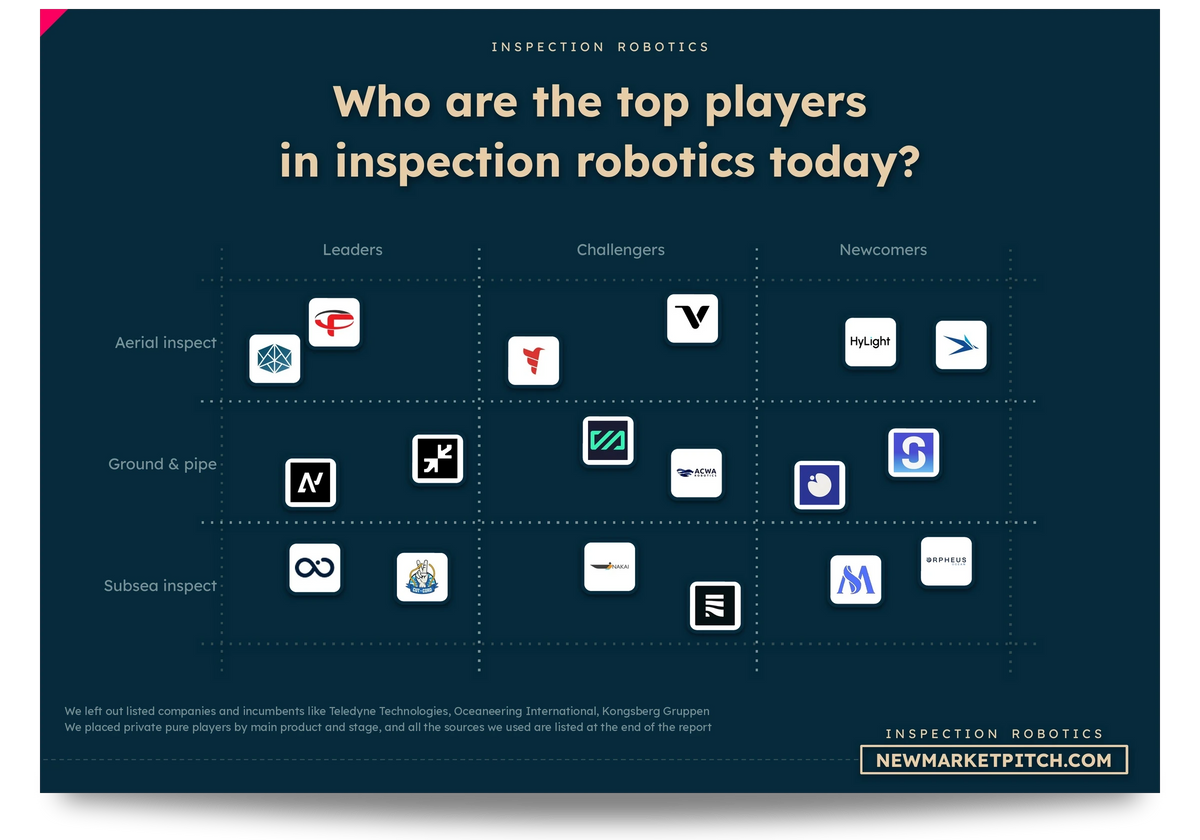
In our research about inspection robotics startups, we turn what is vague and complex into simple, useful visuals. Market maps like this one show you at a glance where every startup stands.
Is inspection robotics funding actually drying up?
Inspection robotics funding has dropped 17%, but investors are still paying to put inspection robots into the field.
We found 22 financings worth at least $687M in the last 12 months, compared with 20 deals and at least $830M in the 12 months before. The money fell 17%, while the number of deals rose 10%. That tells us investors have pulled back on check size rather than on the idea of inspection robotics.
The customers have not gone away. ANYbotics described industrial deployments at energy, mining and chemical sites when it announced its December 2024 financing. Gecko Robotics has worked on inspection projects across power and defense infrastructure. Those companies tackle recurring problems that factories and utilities still have. What has changed is how much money is being raised to solve them.
Are inspection robotics deals disappearing, or are the checks getting smaller?
The inspection robotics slowdown is mostly about smaller checks, rather than deals disappearing.
The median disclosed round fell 47%, to $7.7M in the last 12 months from $14M in the 12 months before. And 19 companies raised money recently, compared with 20 previously. Distinct fundraisers fell 5%, even as deal count rose.
Consider the recent rounds. BeeX raised a $7.7M Series A in June 2026, Solinas Integrity raised a $5.5M Series A in August 2026, and Armatrix closed a $2.1M Seed round in February 2026. Each backs a specific physical inspection job. The preceding period also had Gecko Robotics' $125M Series D+ in June 2025 and Dexory's $100M Series C in October 2025. Those missing growth checks help explain why today's typical round looks so much smaller.
Does the inspection robotics slowdown disappear if you remove giant rounds?
No, the inspection robotics decline does not disappear without giant rounds: smaller financings have weakened too.
Excluding rounds above $50M leaves at least $104M in the last 12 months, against at least $124M in the 12 months before, down 16%. Remove only rounds above $100M and the recent total is at least $174M, compared with at least $415M previously, down 58%. Both tests point the same way.
The earlier period had major financings for Gecko Robotics, XOCEAN and Dexory, each serving a different inspection market. That spread of large checks has not repeated: the recent big money went to Skydio and Seahi Robotics. Nor has the smaller-round pool filled the gap. We can therefore call the funding decline broad without claiming that customers have stopped buying inspection technology.
Are $100M rounds still realistic for inspection robotics startups?
Only for a few: inspection robotics startups can still raise $100M or more, but only two companies did it recently.
We recorded 3 rounds above $100M in the last 12 months, the same number as in the 12 months before. Skydio's $255M Series D+ in November 2026 was the recent period's largest deal, Seahi Robotics raised at least $148M in a Series A in July 2026, and Skydio also raised $110M in a Series D+ round in April 2026. Together, those transactions show that major backers still write very large checks for selected robotic platforms.
They also show why a $100M round tells us little about a young startup's prospects. Skydio said in April 2026 that its existing business was funding more of its own growth. Seahi is building systems for marine operations. Both have a different path from a small developer starting with a first industrial pilot. The unusual deals remain possible, but they no longer describe the wider funding market.

In our market report about inspection robotics startups, we always try to gather several sources and make estimates that make sense, so you can work with solid numbers.
Is Skydio still raising the biggest inspection robotics rounds?
Yes, Skydio raised the biggest inspection robotics round in both periods, and it took the largest share of recent money.
Skydio raised $110M in a Series D+ round in April 2026 and $255M in a Series D+ round led by Axon Enterprise in November 2026, $365M in the last 12 months. In the 12 months before, its $170M Series D+ in November 2024 was also the largest deal in our inspection robotics count. The company said in April 2026 that its established operations now cover more of its growth spending.
There is another reason to read its funding carefully. Skydio serves defense and public safety customers alongside utilities and infrastructure operators. Its April 2026 manufacturing announcement covered those wider markets. We include its qualifying financing in inspection robotics, but should not pretend every dollar of its business comes from inspection work.
Why are investors putting money into underwater inspection robots?
Underwater inspection robots have the busiest deal flow in inspection robotics right now, and their disclosed funding has held up.
Subsea and marine inspection recorded 6 deals and at least $165M in the last 12 months. The 12 months before had 6 deals and at least $155M. The number of financings stayed flat and the total edged up, mostly thanks to Seahi Robotics' Series A. Offshore customers have plenty of inspection work, but most marine checks remain small.
Seahi Robotics develops robotic hull systems, BeeX raised a $7.7M Series A in June 2026 to expand underwater operations, and Bubble Robotics raised a $5M Seed round in April 2026 for robots designed to remain at sea. XOCEAN, which raised a $119M Growth Equity round in January 2025, uses uncrewed vessels to gather offshore survey data. These companies serve different parts of a marine asset's life, from inspection to mapping. That variety is why the category deserves attention beyond its largest financing.
Has Europe lost its lead in inspection robotics funding?
Europe has lost a lot of its inspection robotics funding weight, despite having established companies with paying customers.
European startups raised at least $18M across 6 deals in the last 12 months, against $423M across 12 deals in the 12 months before. Europe went from 60% to 27% of the deals and from 51% to 3% of disclosed capital. That is a severe pullback in new financing.
Part of the contrast comes from a strong earlier run. ANYbotics raised a $60M Series B in December 2024, Aerones raised a $62M Series B in June 2025, and Dexory raised a $100M Series C in October 2025. Donecle's $12M round of undisclosed stage in April 2026 shows European companies are still raising, but the older expansion checks have not been replaced. The problem right now is fresh funding volume, rather than a lack of useful European robots.

Our document detailing everything you need to know about inspection robotics gets updated several times a month, so you always get the latest view of where things stand.
Is China taking over inspection robotics investment?
No, the United States leads individual countries in disclosed inspection robotics funding, while China's recent money comes from two companies.
Chinese startups brought in at least $218M from 3 deals in the last 12 months, representing 32% of the period's disclosed capital. The previous 12 months had 3 Chinese deals worth at least $80M. Across Asia-Pacific, the more recent count was 10 deals and at least $242M, versus 5 deals and at least $91M before.
DEEP Robotics raised at least $70M in a Series C round in December 2025, and its announcement highlighted quadruped robots for industrial and power-system work. DEEP Robotics also sells outside inspection robotics, with quadruped and humanoid robots for other jobs. The 3 Chinese deals come from just 2 companies, Seahi Robotics and DEEP Robotics. U.S. startups raised $427M in the same period, so China ranks second. Chinese money grew, though a handful of financings cannot prove that it will keep growing.
Can American inspection robotics startups still raise big money?
Yes, American inspection robotics startups attract the largest checks, and U.S. fundraising rose from its earlier level.
U.S. companies raised $427M across 5 deals in the last 12 months, compared with $315M across 3 deals in the 12 months before. Skydio's April and November financings took most of the recent capital. Gather AI raised a $40M Series B in February 2026, while Corvus Robotics raised a $20M Series A in August 2026.
The warehouse businesses have customers that make their pitches easy to understand. Gather AI has named GEODIS, NFI Industries and Kwik Trip, and Corvus Robotics has described work with logistics and retail operators. Their drones check inventory without waiting for manual stock counts. U.S. investors are still backing products that solve expensive operating problems. Outside Skydio, though, every recent U.S. round stayed below $50M.
Are early-stage inspection robotics startups getting more investor attention?
Early-stage rounds now make up most named-stage inspection robotics deals, mainly because later-stage fundraising has thinned.
Among deals with a named stage, early-stage financings accounted for 67% in the last 12 months, up from 44% in the 12 months before. The later-stage share fell from 56% to 33%. Still, 32% of the recent deals had no disclosed stage, compared with 10% previously. We can only compare stages for the deals that disclosed them.
Seed financings have kept coming, including Bubble Robotics' $5M Seed round in April 2026 and Armatrix's seed investment. Yet the disappearance of major late-stage deals explains much of the higher early-stage share. It says little on its own about whether young companies are getting bigger checks.
The table below shows the recent inspection robotics rounds by reported stage.
| Stage | Deals | Disclosed capital | Deal share |
|---|---|---|---|
| Series D+ | 2 | $365M | 9% |
| Series A | 4 | $181M+ | 18% |
| Series C | 1 | $70M+ | 5% |
| Series B | 1 | $40M | 5% |
| Seed | 6 | $15M+ | 27% |
| Unknown | 7 | $15M+ | 32% |
| Growth Equity | 1 | Undisclosed | 5% |

In our report covering the inspection robotics market, we look at what the winners do differently, so you can learn from the best instead of guessing.
Are seed investors writing bigger checks for inspection robots?
No, inspection robotics seed rounds are getting smaller even while more seed financings are being announced.
We recorded 6 Seed rounds worth at least $15M in the last 12 months, versus 5 Seed rounds and at least $32M in the 12 months before. The Seed median slipped from $7.8M to $3.6M. A slightly higher deal count has come with less money overall and smaller typical checks.
The problems are still worth funding. Armatrix raised a $2.1M Seed in February 2026 to develop robots for difficult industrial spaces, and Bubble Robotics raised a $5M Seed round in April 2026 for long-running underwater systems. Other companies, including Kongsberg Ferrotech, are developing robots for subsea inspection and repair. Investors still find new technical ideas, but the numbers do not support calling this a stronger seed market.
Are fewer inspection robotics startups raising their first round?
Probably, though the evidence is thin: new inspection robotics startups still raise first checks, but there is little sign of a broad wave of new fundraisers.
Only 1 deal in the last 12 months was identifiable as a company's first financing, versus 3 deals in the 12 months before. The recent one was Bubble Robotics' $5M Seed round in April 2026. We also recorded 14 recent deals whose first-round or follow-on status could not be confirmed, so the low identified count cannot be treated as a complete picture of entry into the market.
Bubble wants to leave autonomous equipment underwater for long periods, reducing the need to send a vessel and crew out each time. Armatrix targets confined industrial spaces with snake-like robotic arms. Both are aiming at clear, difficult jobs. Investors are still willing to back those problems; what remains unclear is how many first-time founders are getting access to capital outside the cases whose histories we can verify.
Is inspection robotics funding reaching fewer companies?
Inspection robotics funding now reaches slightly fewer distinct startups, while some companies return for multiple rounds.
We tracked 19 funded companies in the last 12 months, down 5% from 20 in the 12 months before. Among those funded recently, 3 companies raised more than once, compared with none in the earlier period. Armatrix, for example, raised a $2.1M Seed in February 2026 and a $7.1M Seed in November 2026. Skydio and Seahi Robotics also raised twice.
That does not mean everyone is raising more quickly. Across the gaps between rounds we could verify, the median was 22 months recently, versus 15.5 months previously. Yet 38% of those recent observed gaps were under 12 months, against 36% earlier. We could measure these gaps for 59% of the recent deals and 70% of the earlier ones, not for every startup. Some companies came back fast, while the typical observed interval lengthened. Counting distinct fundraisers gives a better picture of how widely money is spreading.
Are investors abandoning robots that inspect pipes and industrial equipment?
Robots that inspect industrial equipment and buried pipes still get funded, even though the biggest checks have faded.
The climbing and contact NDT category recorded 3 deals and at least $9.2M in the last 12 months, after 2 deals and $136M in the previous period. That earlier amount included Gecko Robotics' $125M Series D+ in June 2025. Voliro's robots attach measuring tools to aerial platforms for work on tanks and industrial structures, and Armatrix develops machines for spaces that workers cannot easily enter.
Pipeline inspection is another smaller market with clear customers. Pipe, sewer and tunnel inspection brought 2 deals totaling $6.7M recently. Solinas Integrity raised a $5.5M Series A in August 2026 for robotic water-pipe inspections, while Pipein raised a $1.2M Seed in January 2026. These rounds are smaller than Gecko's, but they show investment in inspection methods that spare workers dangerous or disruptive access jobs.

In our research about inspection robotics startups, we don't want to repeat what boring consulting reports say. Instead, we show you the real and latest market signals that matter.
Are investors losing interest in industrial patrol robots?
Industrial patrol robots are raising less money now, even though operators are still using them to inspect hazardous sites.
The autonomous plant patrol category had 2 deals worth at least $70M in the last 12 months, down from 5 deals worth $165M in the 12 months before. Its share of deals dropped from 25% to 9%. DEEP Robotics' at least $70M Series C in December 2025 was the standout recent round. Earlier financings included ANYbotics' $60M Series B in December 2024 and Energy Robotics' $14M Series A in October 2025.
ANYbotics' four-legged machines move through industrial sites; Energy Robotics supplies autonomy software for recurring inspections; ExRobotics builds robots certified for hazardous industrial environments. Energy Robotics has named Shell, BP and BASF in reporting on its customer base. Those deployments show there is still work for plant-patrol systems. What has changed is the flow of equity rounds, not the underlying need to inspect industrial assets.
Are warehouse inspection robots holding up better than other robotics startups?
Warehouse inspection robots are still finding investors, particularly when they can point to logistics customers already using them.
Warehouse and inventory inspection attracted 2 deals and $60M in the last 12 months, after 1 deal and $100M in the 12 months before. Gather AI's $40M Series B in February 2026 backed drone-based stock checks, while Corvus Robotics' $20M Series A in August 2026 supported a different autonomous inventory system.
Gather AI has worked with GEODIS and NFI Industries; Corvus Robotics has described deployments with Southern Glazer's Wine & Spirits and Dermalogica. Dexory's earlier $100M Series C in October 2025 showed how large an inventory-scanning business can become. These companies help warehouse teams find missing stock and keep records current. Investors are still writing checks for that practical result, although the category raised less money than it did before.
Has funding for wind turbine inspection robots dried up?
Wind turbine inspection robot funding is thin right now, despite continuing commercial work on turbine blades.
Wind and renewable asset inspection recorded 1 deal in the last 12 months, with its amount undisclosed. In the 12 months before, the category recorded 3 deals worth $94M, including Aerones' $62M Series B in June 2025 and SkySpecs' $20M Series D+ in March 2025.
Aerones used its earlier financing to expand turbine-maintenance services and manufacturing. Perceptual Robotics has continued developing drone-based blade inspection tools. Wind-farm operators still need to find damage before repairs become more expensive. We can say the recent financing activity is sparse; the transaction history does not show that operators have abandoned the service.
Do inspection robotics rounds still find lead investors?
Yes, inspection robotics rounds still find lead investors, and almost every one of them is a different name.
We identified 56 unique participating investors in the last 12 months, against 32 in the preceding 12 months. Yet the number of unique disclosed lead investors was 24 recently, compared with 21 before. No named investor led multiple recent rounds. More investors joined these rounds, but none of them came back to lead a second one.
The names cover different jobs. Shanghe Momentum Fund and Vertex Growth backed Seahi Robotics' marine operations. Smith Point Capital Management led Gather AI's warehouse financing, and Catalyst Investors backed Corvus Robotics in logistics. That is continued investment from varied backers, although it offers little proof that raising money has become easier for the average developer.

Learning from others' mistakes is the cheapest lesson there is. In our market report about inspection robotics startups, we look at what broke startups before you, so you don't repeat it.
What do inspection robotics startups need to show investors?
Real customer deployments give inspection robotics startups a stronger funding story than a demonstration alone.
Look at the companies that have raised. Gather AI and Corvus Robotics have named warehouse customers. Donecle said in April 2026 that its aircraft inspection systems were already operating internationally. ExRobotics has described certified robots working in hazardous plants, while ANYbotics has shown industrial use in energy and chemical facilities. These are machines doing work customers already pay people to do.
A robot that works near aircraft, power stations or offshore equipment must deliver measurements buyers trust. A flashy video cannot establish that. Funding announcements rarely say what investors asked to see, so nobody can prove that a new customer bar now applies. The funded companies nevertheless give plenty of examples of why contracts and repeat deployment are useful evidence.
Could inspection robotics recover without bigger growth rounds?
Inspection robotics will struggle to show a broad funding recovery without more expansion rounds and a healthier flow of ordinary checks.
The last 12 months brought fewer funded companies, a lower typical disclosed round and less capital even after removing huge deals. Another major raise could push the headline upward while leaving those weaknesses intact. We would look for more distinct recipients, stronger ordinary checks and a return of later-stage fundraising.
There is a solid business case to build on. Gecko Robotics helps power operators make maintenance decisions; Dexory scans warehouse stock; BeeX and XOCEAN gather data offshore. Those are different sources of customer demand, so the next question is whether more of these businesses can secure new capital in the same period. Until then, we see a live market working through a funding downturn.
So, what does inspection robotics funding look like right now?
Inspection robotics is still attracting investors, but the funding market is weaker and the checks are much smaller than before.
In the last 12 months, 22 financings brought in at least $687M, with fewer later-stage checks than before and a total that leans on Skydio. The deal count has held up better than capital, marine robots have been more active than many other specialties, and Europe has seen a steep retreat in fresh rounds. For now, a few big companies can raise serious money while ordinary startups face a tougher market.
The table below shows what we found.
| Question | Answer |
|---|---|
| Can stable deal counts hide much smaller checks? | Yes, inspection robotics still has a steady flow of deals. The median disclosed round fell to $7.7M in the last 12 months. That drop explains why the market feels so much tighter. |
| Did removing the biggest financings restore the picture? | No, smaller inspection robotics rounds weakened along with the giants. Deals excluding rounds above $50M raised $104M+ recently. The slowdown reaches well beyond the largest announcements in the market. |
| Can inspection startups still close giant funding rounds? | Yes, inspection robotics still attracts some very large financings. There were 3 rounds above $100M recently. Most startups have to plan for much smaller checks. |
| Is marine robotics holding up across every measure? | Mostly, as underwater inspection kept its deal count and raised a little more. Subsea and marine inspection recorded 6 deals in the latest period. Seahi Robotics' Series A supplied most of that money. |
| Has Europe's inspection robotics fundraising held up recently? | No, European inspection robotics startups raised much less recently. The region recorded $18M+ across 6 deals in the last 12 months. Earlier growth rounds make the new gap especially visible. |
| Is Chinese funding spread across many companies? | No, China's recent money comes from very few companies. Chinese startups raised $218M+ across 3 recent inspection robotics deals. Just 2 companies, Seahi Robotics and DEEP Robotics, raised that money. |
| Are seed rounds now paying founders bigger checks? | No, early inspection robotics checks have become smaller recently. Seed rounds brought in $15M+ in the last 12 months. A larger share of early deals does not mean more cash. |
| Is the money reaching more individual robotics startups? | No, slightly fewer distinct inspection robotics companies raised recent capital. We counted 19 funded companies in the last 12 months. A rising announcement count can therefore overstate how widely money spreads. |
| Are inspection robotics companies all raising again sooner? | No, the observed fundraising intervals still vary considerably today. The median observed gap reached 22 months in the latest period. Some quick repeat rounds coexist with longer typical waits. |
| Have plant patrol robots stopped drawing fresh investors? | No, but recent financing activity has become much thinner. Autonomous plant patrol recorded 2 deals in the last 12 months. Commercial plant deployments continue despite the reduced flow of funding. |
| Are more investors now repeatedly leading robotics rounds? | No, repeat lead investment remains scarce across inspection robotics. We identified 24 distinct disclosed leads in the last 12 months. More participant names have not created more recurring lead investors. |

If you build or invest in the inspection robotics market, you need to know which business models pay off now and which ones are fading. That's why our report covering it has a whole section on it.
Our methodology
Our data runs through November 14, 2026. We then reviewed this article and updated its answers on November 17, 2026, the date shown under the title. We compare November 15, 2025 to November 14, 2026 with November 15, 2024 to November 14, 2025, the last 12 months against the 12 months before. Both windows fall within our complete coverage, which begins in January 2024. The 12-month comparison qualifies because each period contains at least 20 deals.
We count equity financings of private companies of at least $300K, including priced rounds and qualifying equity transactions. Debt, grants, loans, unconverted convertible instruments, SAFEs and public offerings are excluded. A round appears once even when several investors or news outlets announce it; duplicate reports and extensions of the same transaction are merged where appropriate.
Inspection robotics means mobile, aerial, climbing, underwater or remotely controlled robots whose central job is assessing physical assets. The scope covers plants, power equipment, pipelines, aircraft, warehouses, turbines, ships and subsea infrastructure, including inspection software integral to the robot. We exclude generic drones with incidental inspection work, surveillance-only machines, production-line automation, standalone software, fixed sensors and non-robotic testing devices. Borderline businesses with a substantive robot-centered inspection offering are included rather than silently removed.
Every company counted meets our startup definition: an independent, high-growth technology company founded in 2007 or later and funded through entrepreneurial or private risk capital. Companies listed in the past 5 years can remain eligible, and an acquisition within the past 3 years does not automatically remove an otherwise eligible company. A famous manufacturer that fails this definition may still be discussed for context, but is not added to startup financing totals.
We count undisclosed-amount rounds in deal totals but exclude them from disclosed capital sums; reported totals therefore represent minimums. Stage labels distinguish Seed, Series A, Series B, Series C, Series D+, Growth Equity and Unknown. Early-versus-later-stage shares use only deals with named stages. Categories follow the robot's main inspection job; geographic groups use headquarters country. First-financing status and gaps between rounds are assessed only where the required histories can be established.
Our first evidence is the company's own announcement, a regulatory filing or reliable reporting. Rounds confirmed by a company announcement, a press article or a regulatory filing are counted in full. Where no article exists, a round is counted only when at least two recognised databases agree on its date (within one month) and amount (within 5%), and it is marked as low confidence; a round found in a single database stays in the company's history but is left out of totals. For companies that have raised more than $100M, every round counted is backed by an article.
A reader comparing our capital figure with a press release should check whether that announcement combines fresh equity with debt, grants, commitments or secondary transactions. We include only qualifying equity and count a company's financing once. Conversely, a quiet recent month or a missing large-name company does not by itself indicate falling demand: the relevant tests are the same market definition and equivalent observation windows, applied consistently to every company.
Key sources include Seahi Robotics on its large ocean robotics Series A and investors, Skydio on its April 2026 financing and commercial business, Skydio manufacturing strategy and customer applications, Gecko Robotics on its June 2025 financing and customers, Gecko and NAES industrial inspection partnership, ANYbotics financing and industrial deployments, Aerones wind inspection expansion and financing, Dexory disclosed Series C equity and separate debt facility, Gather AI fundraising and warehouse customers, Corvus Robotics financing and warehouse deployments, BeeX Series A and commercial underwater operations, Bubble Robotics financing and persistent underwater robots, DEEP Robotics Series C and industrial applications, Donecle aircraft inspection deployment and expansion, ExRobotics growth funding and hazardous-plant deployments, Energy Robotics industrial inspections and customers, Solinas pipeline robotics financing and expansion, Voliro contact inspection technology and commercial adoption, Kongsberg Ferrotech underwater repair and inspection, XOCEAN offshore survey operations and customers, SkySpecs wind turbine inspection and investment, and Perceptual Robotics commercial expansion and funding context.

In our report covering the inspection robotics market, we like to show you the big picture. We know your time is precious, so we make every page quick to read and packed with as much learning as possible per minute.
Written by the New Market Pitch teamWe track new markets so founders and investors can move faster. About us