Inspection Robotics funding tracker (50+ deals)
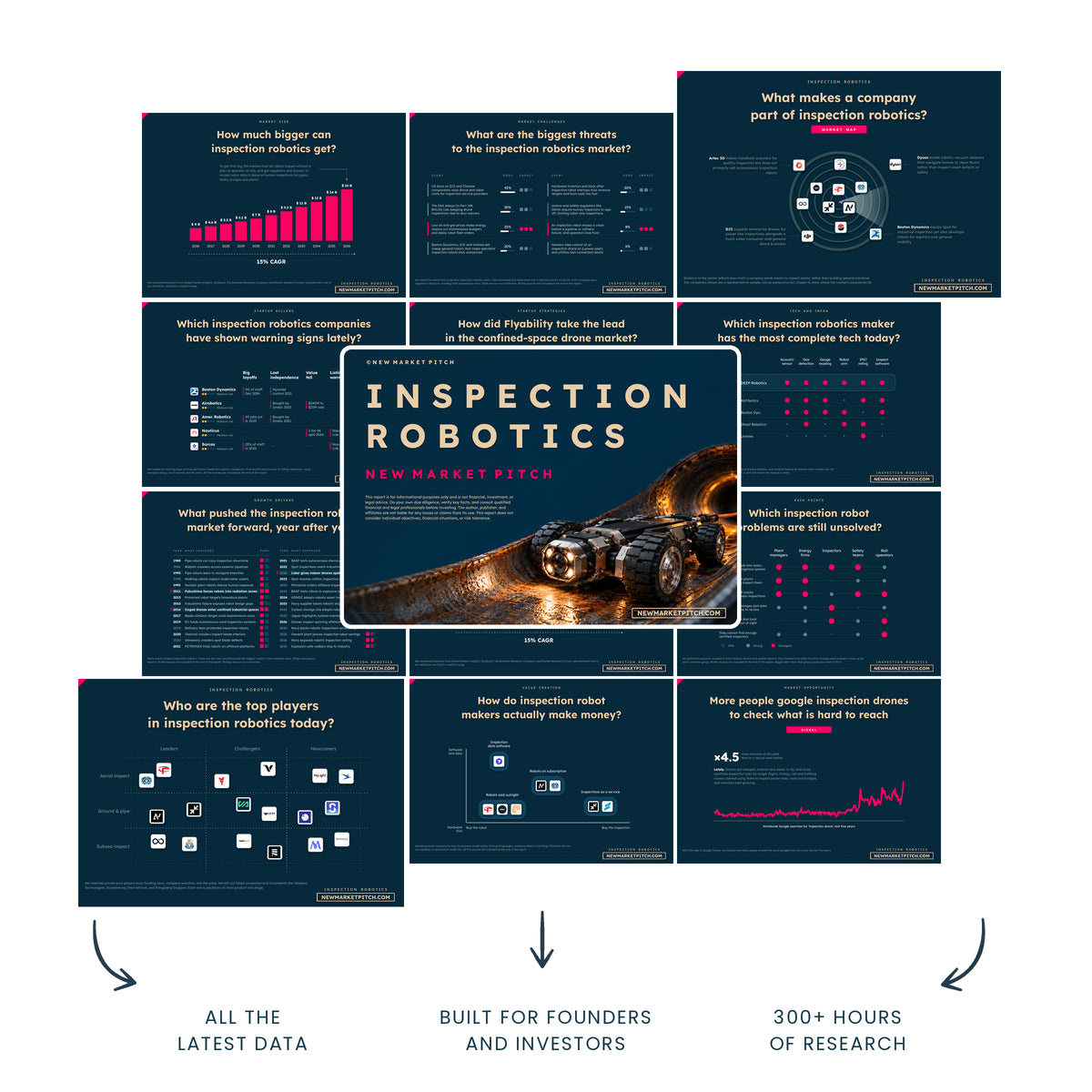
Whether you're building or investing in the inspection robotics market, our report covers everything you need to know: the players, the money, and what's coming next.
Summary
We tracked 55 inspection robotics deals across 40 startups, with at least $1.7B raised. Skydio received the most funding in the period, $535M across 3 rounds, and it also closed the largest individual deal: a $255M Series D+ in November 2026.
A few big checks dominate that total. The 12 rounds above $50M brought in at least $1.4B. Without them, the remaining rounds raised at least $295M.
For most companies, the checks are much smaller. The median disclosed round is $12M, and seed-stage founders face other requirements than teams already deploying robots at industrial sites.
Autonomous aerial asset inspection attracts the most disclosed capital, at least $552M, mostly through Skydio. Underwater and marine inspection has the most deals, which shows how differently these robot businesses get funded.
Warehouse inventory is another established use. Dexory, Gather AI and Corvus Robotics sell machines that check stock, helping operators solve a problem they already pay people to manage.
The money also reaches beyond one region. Europe leads by deals, while North America attracts the most disclosed capital through a few large checks.
Inspection robots take time to prove themselves. The median company age at financing is 8 years, and companies raising above $50M have a median age of 8.5 years.
The calendar is uneven: the median completed month has 1 deal, and 5 completed months have no deals. A busy month can give a misleading impression of permanent growth.
Repeat investors can help a startup scale, but verified first financings remain scarce. We identified 4 first financings; many other companies' earlier funding histories are unknown.
Currently, inspection robotics has paying industrial use cases, substantial funding and a wide range of specialist products. The main divide is between companies that can repeatedly deploy robots and the many still trying to prove they can.

Written by the New Market Pitch teamWe track new markets so founders and investors can move faster. About us

In our report covering the inspection robotics market, you will always find fresh funding data, taken straight from our own verified funding database.
Our funding tracker covering the inspection robotics market
Below is the table listing all the deals. You can find our methodology at the end of this page.
If you want a deeper understanding of the market and its current dynamics, get our inspection robotics market report.
| Company | Category | Date | Stage | Deal size | What they do | Region | Lead investors | Country | Rank |
|---|---|---|---|---|---|---|---|---|---|
| Skydio | Autonomous aerial asset inspection | November 2026 | Series D+ | $255M | Autonomous drones and aerial intelligence | North America | Axon Enterprise | United States | |
| Armatrix | Climbing and contact NDT | November 2026 | Seed | $7.1M | Builds snake-arm robotic systems for hazardous confined-space infrastructure inspection and maintenance. | Asia-Pacific | Crane Venture Partners | India | |
| Corvus Robotics | Warehouse and inventory inspection | August 2026 | Series A | $20M | Autonomous warehouse inventory drones | North America | Catalyst Investors | United States | |
| Solinas Integrity | Pipe sewer and tunnel inspection | August 2026 | Series A | $5.5M | EndoBot crawlers inspect municipal water pipelines | Asia-Pacific | Hero Enterprise Partner Ventures, Mela Ventures | India | |
| Seahi Robotics | Subsea and marine inspection | July 2026 | Series A | $148M+ | Makes professional underwater hull cleaning robots | Asia-Pacific | Shanghe Momentum Fund, Vertex Growth | China | |
| Perceptual Robotics | Wind and renewable asset inspection | July 2026 | Unknown | Undisclosed | Automated drones assess wind turbine blade defects | Europe | Not disclosed | United Kingdom | |
| BeeX | Subsea and marine inspection | June 2026 | Series A | $7.7M | Autonomous underwater drones inspect offshore infrastructure | Asia-Pacific | Monk's Hill Ventures | Singapore | |
| Solaris | Pipe sewer and tunnel inspection | May 2026 | Unknown | Undisclosed | Soft robots for pipe inspection | Asia-Pacific | Not disclosed | Japan | |
| Fleet Robotics | Subsea and marine inspection | May 2026 | Unknown | $2.4M | On-hull robots inspect and clean ship surfaces | North America | Not disclosed | United States | |
| Percepto | Autonomous aerial asset inspection | May 2026 | Unknown | Undisclosed | Autonomous industrial inspection drones | Middle East | Benhamou Global Ventures | Israel | |
| Skydio | Autonomous aerial asset inspection | April 2026 | Series D+ | $110M | Autonomous drones and aerial intelligence | North America | Not disclosed | United States | |
| Bubble Robotics | Subsea and marine inspection | April 2026 | Seed | $5M | Resident underwater robots inspect subsea assets | Europe | Episode 1 Ventures, Asterion Ventures, Norrsken Evolve | Switzerland | |
| Donecle | Autonomous aerial asset inspection | April 2026 | Unknown | $12M | Autonomous drones for aircraft inspections | Europe | IRDI Capital Investissement, SWEN Capital Partners | France | |
| XiniX AI | Pipe sewer and tunnel inspection | March 2026 | Seed | Undisclosed | Soft robots for confined-space inspections | Europe | Actia Capital Partners | Belgium | |
| Armatrix | Climbing and contact NDT | February 2026 | Seed | $2.1M | Builds snake-arm robotic systems for hazardous confined-space infrastructure inspection and maintenance. | Asia-Pacific | Pi Ventures | India | |
| Gather AI | Warehouse and inventory inspection | February 2026 | Series B | $40M | AI drone-based warehouse inventory monitoring | North America | Smith Point Capital Management | United States | |
| EyeROV | Subsea and marine inspection | February 2026 | Unknown | ~$1.4M | Underwater inspection robots and marine drones | Asia-Pacific | AWE Funds, Unicorn India Ventures | India | |
| Pipein | Pipe sewer and tunnel inspection | January 2026 | Seed | $1.2M | Robots inspect pressurized pipelines and tunnels | Europe | Not disclosed | Italy | |
| HiBot | Climbing and contact NDT | December 2025 | Unknown | Undisclosed | Snake robots inspect confined industrial infrastructure | Asia-Pacific | Terna Forward | Japan | |
| DEEP Robotics | Autonomous plant patrol | December 2025 | Series C | $70M+ | Autonomous quadruped and humanoid industrial robots | Asia-Pacific | CMB International, China Asset Management | China | |
| ExRobotics | Autonomous plant patrol | November 2025 | Growth Equity | Undisclosed | Explosion-proof ground robots inspect hazardous facilities | Europe | FORWARD.one | Netherlands | |
| Seahi Robotics | Subsea and marine inspection | November 2025 | Seed | Undisclosed | Makes professional underwater hull cleaning robots | Asia-Pacific | Jinglue Venture Capital | China | |
| Tethys Robotics | Subsea and marine inspection | October 2025 | Seed | $4.1M | Autonomous underwater robots inspect submerged assets | Europe | Redstone | Switzerland | |
| Dexory | Warehouse and inventory inspection | October 2025 | Series C | $100M | Live warehouse digital twins from scanning robots | Europe | Eurazeo | United Kingdom | |
| Energy Robotics | Autonomous plant patrol | October 2025 | Series A | $14M | Software automates industrial mobile robot inspections | Europe | Blue Bear Capital, Climate Investment | Germany | |
| Flybotix | Confined-space aerial inspection | September 2025 | Series A | ~$10M | Drones for indoor industrial inspections | Europe | Not disclosed | Switzerland | |
| Nearthlab | Wind and renewable asset inspection | August 2025 | Series D+ | $12M | Autonomous drones inspect wind turbine blades | Asia-Pacific | Not disclosed | South Korea | |
| Remora Robotics | Subsea and marine inspection | July 2025 | Growth Equity | $15M | Robotic systems inspect and clean fish pens | Europe | Hatch Blue (Blue Revolution Fund) | Norway | |
| Kongsberg Ferrotech | Subsea and marine inspection | July 2025 | Seed | $14M | Subsea robots inspect and repair offshore structures | Europe | NATO Innovation Fund, Investinor | Norway | |
| DEEP Robotics | Autonomous plant patrol | July 2025 | Series B | ~$70M | Autonomous quadruped and humanoid industrial robots | Asia-Pacific | Fortune Venture Capital, CRHC Fund | China | |
| YOUIBOT | Autonomous plant patrol | July 2025 | Unknown | $9.8M | Autonomous mobile robots for manufacturing | Asia-Pacific | Not disclosed | China | |
| Cosma | Subsea and marine inspection | June 2025 | Seed | ~$2.9M | Underwater drones map and inspect seabeds | Europe | Wind, Ternel | France | |
| Voliro | Climbing and contact NDT | June 2025 | Series A | ~$11M | Aerial robots perform contact-based asset inspection | Europe | Not disclosed | Switzerland | |
| Gecko Robotics | Climbing and contact NDT | June 2025 | Series D+ | $125M | AI inspection robots for infrastructure | North America | Cox Enterprises | United States | |
| Aerones | Wind and renewable asset inspection | June 2025 | Series B | $62M | Robots maintaining and inspecting wind turbines | Europe | Activate Capital, S2G Investments | Latvia | |
| Sensyn Robotics | Autonomous aerial asset inspection | June 2025 | Unknown | Undisclosed | Autonomous drone inspections for infrastructure | Asia-Pacific | Not disclosed | Japan | |
| Seahi Robotics | Subsea and marine inspection | May 2025 | Seed | Undisclosed | Makes professional underwater hull cleaning robots | Asia-Pacific | GSR Ventures | China | |
| SkySpecs | Wind and renewable asset inspection | March 2025 | Series D+ | $20M | Automated drones inspect wind turbine blades | North America | Goldman Sachs Alternatives | United States | |
| Capra Robotics | Autonomous plant patrol | January 2025 | Seed | ~$12M | Mobile inspection robots patrol utility installations | Europe | Supernova Invest, Promus Ventures | Denmark | |
| XOCEAN | Subsea and marine inspection | January 2025 | Growth Equity | $119M | Autonomous marine survey vessels and data services | Europe | S2G Investments | Ireland | |
| ANYbotics | Autonomous plant patrol | December 2024 | Series B | $60M | Autonomous industrial inspection robots | Europe | Qualcomm Ventures, Supernova Invest | Switzerland | |
| Skydio | Autonomous aerial asset inspection | November 2024 | Series D+ | $170M | Autonomous drones and aerial intelligence | North America | KDDI, Axon Enterprise | United States | |
| Corvus Robotics | Warehouse and inventory inspection | October 2024 | Series A | $7.5M | Autonomous warehouse inventory drones | North America | S2G Investments, Spero Ventures | United States | |
| Voliro | Climbing and contact NDT | October 2024 | Series A | $12M | Aerial robots perform contact-based asset inspection | Europe | Cherry Ventures | Switzerland | |
| Dexory | Warehouse and inventory inspection | October 2024 | Series B | $80M | Live warehouse digital twins from scanning robots | Europe | DTCP | United Kingdom | |
| DEEP Robotics | Autonomous plant patrol | August 2024 | Series B | Undisclosed | Autonomous quadruped and humanoid industrial robots | Asia-Pacific | Not disclosed | China | |
| Exyn Technologies | Confined-space aerial inspection | July 2024 | Series B | $5M | Autonomous drones map inaccessible industrial environments | North America | Not disclosed | United States | |
| XOCEAN | Subsea and marine inspection | June 2024 | Series B | Undisclosed | Autonomous marine survey vessels and data services | Europe | Venturewave Capital | Ireland | |
| YOUIBOT | Autonomous plant patrol | June 2024 | Series C | Undisclosed | Autonomous mobile robots for manufacturing | Asia-Pacific | Zengcheng | China | |
| Solinas Integrity | Pipe sewer and tunnel inspection | May 2024 | Unknown | Undisclosed | EndoBot crawlers inspect municipal water pipelines | Asia-Pacific | Not disclosed | India | |
| HyLight | Autonomous aerial asset inspection | April 2024 | Seed | $4.1M | Autonomous airships for infrastructure inspections | Europe | Not disclosed | France | |
| Gather AI | Warehouse and inventory inspection | March 2024 | Series A | $17M | AI drone-based warehouse inventory monitoring | North America | Bain Capital Ventures | United States | |
| Airpelago | Autonomous aerial asset inspection | February 2024 | Seed | $1.9M | Autonomous drone power-line inspections | Europe | Not disclosed | Sweden | |
| ACWA Robotics | Pipe sewer and tunnel inspection | January 2024 | Series A | ~$5.2M | Autonomous robots inspect drinking-water networks | Europe | Not disclosed | France | |
| Nearthlab | Wind and renewable asset inspection | 2024 | Series D+ | $15M | Autonomous drones inspect wind turbine blades | Asia-Pacific | Not disclosed | South Korea |

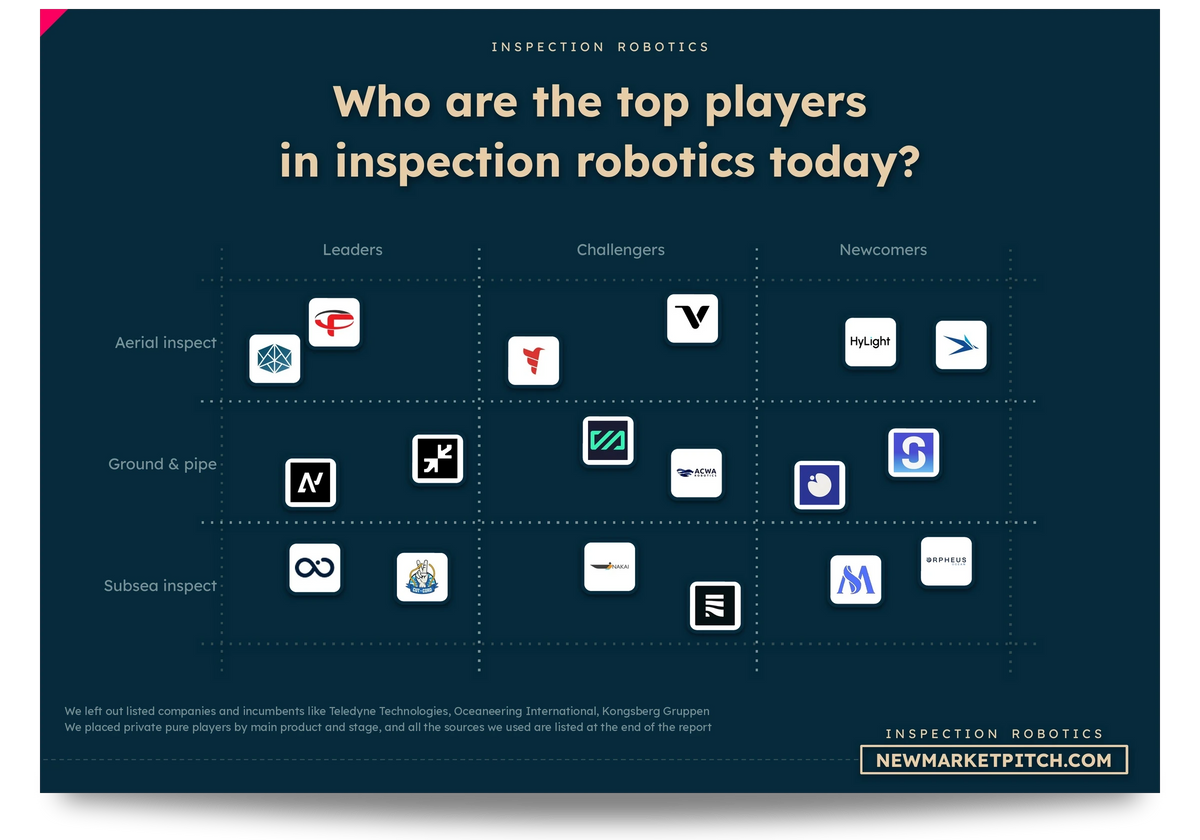
In our research about inspection robotics startups, we turn what is vague and complex into simple, useful visuals. Market maps like this one show you at a glance where every startup stands.
Is inspection robotics funding really a billion-dollar market?
Yes, inspection robotics startups have raised at least $1.7B across our coverage, although a few companies received much of that money.
Across the continuous period we cover, our research identifies 55 deals involving 40 startups and at least $1.7B of disclosed capital. The median disclosed round is $12M. Those figures describe a market with a substantial funding base and a very long distance between its typical company and its biggest recipients. In particular, Skydio raised $535M across 3 financings and Dexory raised $180M across 2. Gecko Robotics also secured substantial later-stage funding.
The businesses behind these rounds sell to different buyers. Dexory sells scanning robots and warehouse intelligence; Gecko Robotics gathers condition data on critical industrial assets; Skydio offers autonomous aerial systems used across several sectors, including inspections. Each has a different buyer, deployment cycle and route to recurring sales. According to Gecko Robotics' June 2025 announcement, its inspection platform serves manufacturing, energy and defense customers, while Dexory's October 2025 announcement highlighted demand for its warehouse intelligence platform.
Are a few giant rounds driving inspection robotics funding?
Yes, a handful of very large inspection robotics rounds accounts for most of the money raised.
We counted 12 rounds above $50M, representing 22% of deals but at least $1.4B of disclosed funding. Remove those rounds and the remaining disclosed capital falls to at least $295M. A stricter threshold identifies 6 rounds above $100M, together worth at least $927M. The "$100M or more" group includes 7 deals and at least $1.0B of disclosed funding, because it also includes Dexory's round of exactly $100M. The funding story depends heavily on where that line is drawn.
Skydio's $255M Series D+ in November 2026, led by Axon Enterprise, is the largest individual deal in the period. Skydio's earlier $170M Series D+ in November 2024 and XOCEAN's $119M Growth Equity round in January 2025 show why robotics funding totals can change sharply with a few announcements. Autonomous drones and uncrewed marine surveying are separate businesses. A large round can finance production, deployment and customer expansion, but it does not establish that hundreds of smaller hardware businesses can raise on comparable terms.
A new inspection robotics founder should expect another kind of fundraising process than an established company raising a large expansion round.
How much money does a typical inspection robotics startup raise?
The median disclosed inspection robotics round is $12M, but the check changes considerably from Seed to later stages.
Our deal-size distribution is concentrated in the $5M to under $20M range, which contains 19 deals, or 45% of rounds with an announced amount. Seed rounds have a $4.1M median, compared with $11M for Series A and $61M for Series B. Later rounds can be far larger. A single average would hide these differences.
The companies raising at each stage are solving different problems. Bubble Robotics' $5M Seed round in April 2026 supports resident underwater robots; Energy Robotics' $14M Series A in October 2025 backs industrial robot inspection software; Gather AI's $40M Series B in February 2026 finances warehouse inventory monitoring. The difference is not simply how fashionable each application is. The robotics company at Series B is usually solving a different problem: deploying, supporting and improving a system across real customer sites.
The table below shows funding by stage across the entire inspection robotics coverage period.
| Stage | Deals | Capital | Median |
|---|---|---|---|
| Series D+ | 7 | $707M | $110M |
| Series B | 8 | $317M+ | $61M |
| Series A | 11 | $257M+ | $11M |
| Series C | 3 | $170M+ | $85M |
| Growth Equity | 3 | $134M+ | $67M |
| Seed | 13 | $54M+ | $4.1M |
| Unknown | 10 | $25M+ | $6.1M |
“+” indicates a minimum because some round amounts were not disclosed.
Are inspection robotics investors backing new startups or the same ones again?
Inspection robotics funds a broad set of companies, but repeat rounds bring much of the money.
We identify 40 funded startups, including 12 companies that raised more than once, a repeat rate of 30%. By company, 28 recorded startups have 1 round, 9 have 2 rounds, and 3 have 3 or more rounds. Most funded startups have only 1 recorded round, while repeat recipients account for many of the large checks.
The repeated rounds have distinct explanations. Skydio returns three times with autonomous drones, Seahi Robotics across marine robot financings, and DEEP Robotics across industrial quadruped fundraising. Dexory moved from an $80M Series B in October 2024 to a $100M Series C in October 2025, and Gather AI progressed from a $17M Series A in March 2024 to a $40M Series B in February 2026. Investors have returned to these businesses as their products developed, which is harder to achieve than securing a first round.
Investors still finance new inspection robots. The biggest repeat checks go to teams that have moved beyond the first deployment.

In our market report about inspection robotics startups, we always try to gather several sources and make estimates that make sense, so you can work with solid numbers.
Can a new inspection robotics startup still get seed funding?
Yes, inspection robotics investors are still writing seed checks for machines that solve a specific difficult inspection job.
Seed accounts for 13 deals involving 11 startups, with at least $54M of disclosed funding and a $4.1M median. That is a different funding environment from the headline large rounds. Tethys Robotics raised a $4.1M Seed round in October 2025 for underwater inspections, Bubble Robotics raised $5M in April 2026 for resident marine systems, and Armatrix raised $7.1M in a Seed round in November 2026 for snake-arm robotics in hazardous spaces.
All these robots tackle work that is costly or dangerous for people. They try to send a machine into places where workers face risk, where shutdowns are costly, or where repeated measurement is difficult. Bubble Robotics described its ambition in an April 2026 company announcement as continuous robotic operation at sea. Solinas Integrity's EndoBot materials similarly show how pipe crawlers can inspect inaccessible municipal water networks, though Solinas is a different stage and product type.
Getting the first check is possible. Winning recurring customers across many sites is the harder test.
How hard is it to raise a Series A for inspection robots?
Inspection robotics Series A funding is common enough to be a real next step, but round sizes vary enormously.
We tracked 11 Series A deals involving 9 startups and at least $257M in disclosed capital. The median Series A is $11M. At one end, BeeX's $7.7M Series A in June 2026 funds autonomous underwater drones, and Energy Robotics' $14M Series A in October 2025 focuses on automating industrial inspection missions. At the other, Seahi Robotics' $148M+ Series A in July 2026, which combined its A, A+ and A++ tranches in one announcement, is a far larger commitment within the same nominal stage.
The Series A label alone tells founders little about the check they can expect. BeeX already works on underwater autonomy for hard-to-access offshore sites, according to its June 2026 company release. Energy Robotics works with mobile robots that patrol industrial facilities. Seahi develops hull-cleaning and marine robotics with a much bigger manufacturing and expansion ambition, described in its company financing release.
Investors use Series A to fund anything from proving deployments to building a much larger business. The largest deals are unusual.
Do inspection robotics startups still raise money after Series B?
Yes, inspection robotics startups do receive funding beyond Series B, although relatively few reach those rounds.
Among deals with a named stage, early-stage rounds account for 53% of deals but only 19% of disclosed capital, while later-stage rounds account for 47% of deals and 81% of disclosed capital. Looking at the named stages individually, we recorded 3 Series C deals and 7 Series D+ deals. The Series D+ group alone accounts for $707M of disclosed funding, and those rounds have a $110M median.
The companies illustrate what later-stage money buys. Gecko Robotics moved into later-stage financing as it expanded industrial and defense infrastructure work. Skydio raised $170M in a Series D+ round in November 2024, $110M in April 2026 and $255M in November 2026. Dexory likewise progressed into a substantial later-stage warehouse financing after an earlier Series B.
These businesses have to build machines, install them, support customers and manage long purchasing cycles. Investors still finance them after Series B. Only a limited group of robot makers has raised at that level.
How much money goes into industrial plant inspection robots?
Industrial plant patrol robots raised at least $235M, fourth among inspection robotics categories by disclosed capital, behind aerial, marine and warehouse inspection.
Our autonomous plant patrol category records 9 deals across 6 companies and at least $235M in disclosed capital, accounting for 14% of the money with a public amount. Its median disclosed financing is $37M. Autonomous aerial asset inspection, at least $552M, and subsea and marine inspection, at least $320M, both raised more. The plant patrol money goes to a small set of machines meant to work inside operating facilities.
ANYbotics' $60M Series B in December 2024 supports industrial inspection robots deployed around energy, chemicals, metals and mining assets. DEEP Robotics raised about $70M in a Series B in July 2025 and at least $70M in a Series C in December 2025 for a broader industrial quadruped and humanoid platform, and it also sells outside inspection robotics. YOUIBOT, which also makes manufacturing robots, raised $9.8M in July 2025. Energy Robotics raised $14M at Series A in October 2025 to automate inspections across mobile robots. These companies serve adjacent tasks but do not share identical hardware, customers or business models.
To keep a plant customer, a robot must collect useful measurements every shift and fit into existing maintenance routines. That takes far more than a convincing demonstration.

Our document detailing everything you need to know about inspection robotics gets updated several times a month, so you always get the latest view of where things stand.
Are underwater inspection robots attracting the most deals?
Yes, subsea and marine inspection leads inspection robotics by deal count, even though aerial asset inspection takes in more money.
The subsea and marine inspection category has 13 deals involving 10 companies, with at least $320M in disclosed funding and a $6.4M median round. That is more financing events than autonomous plant patrol, which has 9 deals, while autonomous aerial asset inspection attracts more money with only 8 deals.
XOCEAN raised $119M in a Growth Equity financing in January 2025 for uncrewed marine survey vessels and data services. BeeX raised $7.7M at Series A in June 2026 for underwater drones. Bubble Robotics' $5M Seed round in April 2026 targets a resident robotic fleet for ocean infrastructure. Their machines differ considerably: autonomous surface vessels, free-swimming underwater robots, and persistent systems that reduce the need for costly human intervention.
A July 2025 NATO Innovation Fund announcement about Kongsberg Ferrotech highlighted another use: checking submerged cables and pipelines, which also matters for security. The projects range from short surveys to robots that remain underwater for extended inspections.
The table below shows how inspection robotics activity and disclosed funding differ across product categories.
| Category | Deals | Companies | Capital |
|---|---|---|---|
| Autonomous aerial asset inspection | 6 | 4 | $546M+ |
| Subsea and marine inspection | 13 | 10 | $320M+ |
| Warehouse and inventory inspection | 6 | 3 | $265M |
| Autonomous plant patrol | 9 | 6 | $235M+ |
| Climbing and contact NDT | 6 | 4 | $157M+ |
| Wind and renewable asset inspection | 5 | 4 | $109M+ |
| Pipe sewer and tunnel inspection | 4 | 3 | $12M+ |
| Confined-space aerial inspection | 1 | 1 | $5M |
“+” means at least the stated amount; some funding amounts are undisclosed.
Can warehouse inspection robot startups really raise $100M?
Yes, warehouse inspection robotics companies can raise $100M when their machines help customers find inventory errors and cut manual work.
Warehouse and inventory inspection accounts for 6 deals across 3 startups and $265M of disclosed capital, representing 16% of disclosed funding in our coverage. Dexory raised an $80M Series B in October 2024 and a $100M Series C in October 2025. Gather AI raised a $40M Series B in February 2026. Corvus Robotics raised a $20M Series A in August 2026. Each automates a different part of discovering what physically sits on warehouse shelves or racks.
Dexory's October 2025 announcement described a product combining robot scans with a live warehouse intelligence platform and expansion into North America. Gather AI's March 2024 announcement named distribution and logistics customers and reported fewer misplaced inventory errors at deployed facilities. Corvus Robotics' August 2026 release detailed an autonomous physical AI system backed by enterprise customers and new funding.
Warehouse operators already pay for stock counts, error correction and inventory visibility. The robot is valuable if it reduces those costs reliably. Investors have committed heavily to a few warehouse platforms with working products.
Are inspection drones attracting funding for infrastructure or defense?
Infrastructure inspection still attracts drone funding, while large aerial robotics companies increasingly sell to public-safety buyers too.
Autonomous aerial asset inspection records 8 deals across 6 companies, at least $552M of disclosed funding and a $61M median, the highest of any category because Skydio's rounds dominate it. Skydio raised a $170M Series D+ in November 2024, a $110M Series D+ in April 2026 and a $255M Series D+ in November 2026. Donecle's $12M round of undisclosed stage in April 2026 and Percepto's undisclosed round in May 2026 show how aircraft maintenance and industrial site drones sit beside the larger autonomous-drone company.
Skydio also sells outside inspection robotics, with drones for public safety and defense. Donecle is much more specialized: its drones inspect aircraft, and its April 2026 funding announcement focused on making those checks faster.
The biggest drone companies can sell into several markets at once. Their rounds cannot all be treated as money spent on inspection alone.
How did Gecko Robotics convince investors to fund industrial inspection?
Gecko Robotics has attracted major inspection robotics funding by turning condition measurements into services industrial and government customers use.
Gecko Robotics raised a $125M Series D+ in June 2025, placing it among the better-funded companies in our coverage. Its climbing and contact NDT category contains 6 deals involving 4 companies and at least $157M in disclosed funding. NDT means non-destructive testing: robots collect structural measurements without cutting a machine or industrial asset apart. For an asset owner, the immediate benefit is knowing where equipment needs repair.
The customer contracts are specific. Gecko announced work with BPMI on Navy vessel components in July 2025. Later, the U.S. Navy and GSA awarded a contract for inspecting ships in the Pacific Fleet. According to Gecko Robotics' October 2026 announcement, the ceiling on that contract reached $300M, up from $71M when it was awarded. That is a ceiling on potential customer work, not a venture financing, but it shows the scale of the inspection job.
Voliro solves a related problem with aerial robots that touch surfaces, while Armatrix builds snake-arm systems for confined spaces. Investors are backing multiple ways to get sensors where people cannot work safely. Gecko's larger round reflects the potential value of making condition data central to an industrial customer's maintenance decisions.

In our report covering the inspection robotics market, we look at what the winners do differently, so you can learn from the best instead of guessing.
Are investors still funding wind turbine inspection robots?
Yes, investors continue backing wind turbine inspection robots, particularly businesses that also help operators maintain blades.
Wind and renewable asset inspection generated 5 deals involving 4 startups and at least $109M of disclosed capital, with a $17M median. Aerones raised a $62M Series B in June 2025, while SkySpecs secured a $20M Series D+ in March 2025 and Nearthlab raised a $12M Series D+ in August 2025. Those financings support related activities but not identical businesses, from robotic blade care to autonomous aerial blade inspection.
Aerones made the commercial argument explicit in its June 2025 announcement: its investors backed global expansion, manufacturing scale and additional AI-driven services after a period of rapid operational growth. Turbine operators already budget for maintenance and blade checks. A customer wants to know whether a blade has a defect and, preferably, how it will be repaired without prolonged downtime.
The category remains much smaller than autonomous plant patrol by disclosed capital, but its specialist companies serve an established installed base of industrial equipment. Investors can assess how often a turbine operator needs inspections and whether a robot can perform them cheaper and more safely.
Why do pipeline inspection robot startups raise smaller rounds?
Pipeline inspection robotics companies are raising smaller checks than the leading plant and warehouse robotics businesses.
Pipe sewer and tunnel inspection has 6 deals across 5 startups, with at least $12M of disclosed funding and a $5.2M median. Solinas Integrity raised a $5.5M Series A in August 2026; Pipein raised a $1.2M Seed round in January 2026. ACWA Robotics also develops autonomous machines for inspecting drinking-water networks. These are focused products aimed at an infrastructure problem rather than broad robotics platforms.
The inspection job is straightforward. Solinas Integrity describes EndoBot crawlers that record internal pipe footage, measure defects and inspect networks otherwise difficult to access. Its published case studies describe practical work for water operators and industrial sites. Yet buyers of municipal inspection systems may have long procurement cycles and limited budgets compared with a large warehouse or industrial plant group. That may help explain why these rounds are smaller.
Investors are still backing pipeline robots, but the category has yet to produce the large financing rounds seen in warehouse or plant inspection.
Has China or the United States raised more for inspection robots?
The United States has raised far more for inspection robots over the whole period we track, while China's money is concentrated in a few exceptionally large rounds.
We record 11 U.S. deals across 7 startups and $772M in disclosed funding, or 46% of disclosed capital. China accounts for 8 deals across 3 startups and at least $298M, representing 18% of disclosed capital. China's funding is visibly more concentrated, around DEEP Robotics, Seahi Robotics and YOUIBOT.
DEEP Robotics raised about $70M in its July 2025 Series B and at least $70M in its December 2025 Series C, while Seahi Robotics attracted a $148M+ Series A in July 2026. YOUIBOT's only disclosed amount in the period is $9.8M in July 2025. These are industrial patrol and marine robotics businesses, not evidence that every Chinese robotics category is attracting equally large checks.
The U.S. side includes Skydio's autonomous drones, Gecko Robotics' industrial inspection hardware and Dexory's American warehouse competitors Gather AI and Corvus Robotics. Skydio alone raised $535M, more than all Chinese startups combined. China is a source of large funding rounds, not the overall leader.

In our research about inspection robotics startups, we don't want to repeat what boring consulting reports say. Instead, we show you the real and latest market signals that matter.
Does Europe actually lead inspection robotics funding?
Europe leads inspection robotics in deals and funded companies, while North America records more disclosed capital.
Europe accounts for 24 deals across 21 startups, with at least $544M in disclosed capital. North America records 11 deals across 7 companies and $772M, while Asia-Pacific records 19 deals across 11 companies and at least $348M. Even though the European and Asia-Pacific figures are minimums, North America leads on money by a clear margin.
Europe's company base includes Swiss industrial inspection robots, British warehouse intelligence platforms, Irish marine survey systems, Latvian wind turbine robots and continental pipe inspection specialists. ANYbotics' December 2024 company announcement described U.S. expansion for a Swiss industrial robotics company. Dexory's October 2025 release described expansion of a British-founded warehouse platform in North America. European headquarters therefore do not imply local-only customers.
Deal counts and disclosed dollars lead to different answers. Europe appears to support more independent attempts at applying robotics to industrial assets. North America attracts some of the largest individual checks. We cannot tell from fundraising alone which region will build the best businesses.
Where are inspection robotics startups getting funded today?
Inspection robotics startups attract funding across 19 headquarters countries, although the biggest disclosed checks cluster in a few markets.
Our coverage includes 19 headquarters countries across 4 regions. The United States and China attract the largest company financings, while the United Kingdom has an outsized capital total for its deal count. Switzerland has 6 deals across 5 startups, showing that a smaller national market can support a substantial industrial robotics cluster. India records 5 deals across 3 companies, typically in more focused utility or confined-space applications.
Countries specialize differently. The United Kingdom's Dexory builds tall warehouse scanning systems, Switzerland's ANYbotics and Voliro work on industrial asset inspections, and India's Solinas Integrity and Armatrix address hard-to-access infrastructure. France also contributes aircraft, pipeline and underwater inspection businesses. Each country has built strengths in a different inspection job.
Japanese startups have recorded rounds too, but their amounts were undisclosed. Published funding totals cannot capture the full picture there.
The table below shows countries with at least 3 inspection robotics funding deals.
| Country | Deals | Companies | Capital |
|---|---|---|---|
| United States | 11 | 7 | $772M |
| China | 8 | 3 | $298M+ |
| United Kingdom | 3 | 2 | $180M+ |
| Switzerland | 6 | 5 | $102M |
| France | 4 | 4 | $24M |
| India | 5 | 3 | $16M+ |
| Japan | 3 | 3 | Undisclosed |
Country is based on startup headquarters, not investor location; “+” denotes a minimum.
Why do inspection robotics startups take so long to raise big rounds?
Inspection robotics startups usually need years of field testing and customer work before they can raise large checks.
The median company age at financing is 8 years, and 8.5 years for companies receiving rounds above $50M. Among companies raising under $5M, the median age is 3 years. In addition, 83% of the tracked companies were founded since 2015, while 25% were founded since 2020 and 20% since 2022. The biggest checks are going to teams with years of product development behind them.
The product histories help explain the timing. Dexory describes a development path from retail robots to warehouse scanning and a live data platform. ANYbotics has spent years refining industrial quadrupeds for operational sites. Gecko Robotics began with inspection crawlers and expanded into industrial asset intelligence. Each had to prove mobility, sensing, reliability and useful information for its customers before its largest recorded financing.
Age does not guarantee success. Still, the companies raising big rounds have generally spent years getting their machines to work at customer sites.
Does inspection robotics funding keep flowing every month?
No, inspection robotics funding comes in short bursts, with long gaps between the busiest months.
Across 34 completed months, the median month records 1 deal and $6.4M in disclosed capital. We identify 5 completed months with no deals and 13 months with deal counts above the median. June 2025 is the busiest month, with 5 deals. It also records the largest monthly disclosed amount, at least $201M, with Gecko Robotics the principal named contributor.
Busy months bring together unrelated capital needs. June 2025 includes Gecko Robotics' $125M Series D+, Aerones' $62M Series B and Voliro's Series A of about $11M. July 2025 includes marine inspection and industrial patrol robots. There was no single announcement that explained the whole period. Several decisions happened close together.
Inspection robots sell into sectors with procurement schedules, engineering validations and project-based deployments. Those long customer projects may help explain the irregular calendar. One quiet month says little about demand, just as a crowded month cannot predict a full year.

Learning from others' mistakes is the cheapest lesson there is. In our market report about inspection robotics startups, we look at what broke startups before you, so you don't repeat it.
Is inspection robotics still getting funded right now?
They are: inspection robotics companies are still closing rounds, and this partial year is already close to the previous full year in disclosed money.
Our complete coverage includes 15 deals and at least $377M in 2024, followed by 22 deals and at least $670M in 2025. This year to date contains 18 deals involving 16 companies and at least $617M. These are period totals, not a like-for-like comparison between complete years and an unfinished one. The latest figures should not be described as a closed-year result.
Funding is still reaching companies with concrete customers. Skydio raised a $110M Series D+ in April 2026 and a $255M Series D+ in November 2026, Seahi Robotics raised a $148M+ Series A in July 2026, and Corvus Robotics raised a $20M Series A in August 2026. Meanwhile, smaller rounds continued in marine robotics, warehouse inspection, pipelines and dangerous confined spaces.
Funding announcements tell only part of the business story. Gecko Robotics' March 2026 U.S. Navy contract announcement and Corvus Robotics' August 2026 corporate update show continuing customer and product activity that cannot be read directly from quarterly financing totals. Inspection robots are still winning customers even as headline funding swings with a few large deals.
Can first-time inspection robotics founders still get funded?
Yes, some inspection robotics startups secure a first financing, but confirmed first rounds account for little disclosed capital.
We classify 4 deals as first financings, involving 4 startups and $26M, or 2% of disclosed capital. Follow-ons account for 23 deals across 15 companies and at least $1.4B, or 82% of disclosed capital. Crucially, the financing history cannot be established for 28 deals, representing 51% of the transactions. We cannot assume that every unclassified transaction was a first round or a repeat investment.
The named first financings include Tethys Robotics' $4.1M Seed in October 2025 and Bubble Robotics' $5M Seed in April 2026. The NATO Innovation Fund also backed Kongsberg Ferrotech in subsea infrastructure repair, showing why investors see value in difficult-to-access marine assets. These are far smaller starting points than the major follow-on checks for Skydio, Gecko Robotics and Dexory.
First checks still exist. But much of the funding with a verified history goes back to companies that already raised, and many older funding histories remain uncertain.
Is there one VC firm leading inspection robotics funding?
No single VC dominates inspection robotics funding: named round leads are spread across many investors, and the most active lead has led only 3 rounds.
We identify 107 different named investors and 50 unique named lead investors. A lead is named in 69% of the rounds, and only 3 investors led more than once. S2G Investments is the first name in our lead-investor ranking, with 3 led rounds and a combined round size of $189M. Axon Enterprise led 2 Skydio rounds with combined round sizes of $425M, and Supernova Invest also led 2 rounds, with combined round sizes of $72M. Those combined sizes describe full financing rounds, not the investors' own checks.
The backers reflect different customer markets. S2G Investments has led rounds for XOCEAN's uncrewed marine surveying, Corvus Robotics' warehouse inventory systems and Aerones' wind turbine robots. Axon Enterprise, a public-safety technology group, backs Skydio's drones. Supernova Invest has backed ANYbotics and Capra Robotics, which both build mobile robots for industrial users. Other disclosed leads include Cox Enterprises for Gecko Robotics and Monk's Hill Ventures for BeeX's $7.7M Series A in June 2026.
The investment base is broad, but repeated leadership is scarce. Founders have many possible backers, although only a small number lead more than one round in our coverage.
So, is inspection robotics funding broad or mostly for a few winners?
Inspection robotics is a substantial venture market, but a small group of big rounds and repeat recipients drives its funding totals.
The biggest checks generally follow companies with customers and a reason to deploy robots repeatedly. Industrial patrol, warehouse inventory, critical asset inspection and autonomous marine surveys have attracted different investors for different reasons. Skydio is the biggest capital recipient in our period and also has the biggest individual round, while the marine category records the most financing events. None of these positions makes one business model the default for the whole sector.
Several inspection robotics companies already do real customer work. Gecko Robotics works on ship and industrial asset condition data, Dexory sells warehouse intelligence, and Aerones connects robotic inspection with turbine maintenance. That success does not make raising money easy for a startup still proving its first product.
The table below shows what we found.
| Question | Answer |
|---|---|
| Is the funding boom broadly shared across companies? | Not entirely; unusually large rounds still shape the funding story. We recorded 12 rounds above $50M in the coverage period. That concentration makes ordinary company fundraising conditions look considerably stronger. |
| Can marine startups lead deals without leading capital? | Yes, underwater inspection attracts transactions across several distinct robot designs. The category recorded 13 deals across the observed period. Larger aerial inspection rounds nevertheless account for more disclosed capital. |
| Can warehouse robots raise big growth rounds? | They do, especially when inventory automation has measurable customer value. Dexory completed a $100M Series C in October 2025. The company sells repeatable warehouse data rather than general robotics. |
| Are dangerous industrial tasks getting startup funding? | Yes; investors fund robots that reach places workers cannot. Gecko Robotics raised a $125M Series D+ in June 2025. Its customer programs demonstrate demand for reliable inspection information. |
| Is Europe merely following America's inspection robot market? | No, European startups generate a broader range of funding events. Europe recorded 24 deals across the entire coverage period. North America nevertheless records a larger disclosed capital total. |
| Are Chinese startups winning every capital comparison? | No, China's big rounds do not imply overall dominance. China recorded 8 deals across 3 funded companies. The American startup base is broader over our observed period. |
| Are investors routinely financing brand-new robot companies? | Not yet; confirmed first financings are relatively uncommon here. We identified 4 such deals in our coverage. Many other financings lack enough history for definitive classification. |
| Does a seed check mean rapid scaling follows? | No, seed capital and industrial rollout remain separate challenges. The Seed stage records 13 inspection robotics financing events. Later checks require stronger proof of commercial and technical reliability. |
| Has inspection robotics become a monthly funding machine? | No; its financing calendar is exceptionally uneven across months. The median completed month contains 1 deal in our coverage. Short bursts should not be projected into continuous fundraising growth. |
| Are older robot companies losing access to capital? | Quite the opposite; established teams regularly secure the biggest checks. The median age at financing was 8 years. Hardware validation and customer integration often require long development cycles. |
| Has a single VC captured inspection robotics financing? | No, identified lead investors are diverse across several customer markets. We counted 50 unique named lead investors in total. Repeat leadership remains limited despite extensive institutional participation. |

If you build or invest in the inspection robotics market, you need to know which business models pay off now and which ones are fading. That's why our report covering it has a whole section on it.
Our methodology
Our data runs through November 14, 2026. We then reviewed this article and updated its answers on November 17, 2026, the date shown under the title. We track financings from January 1, 2024 to November 14, 2026, the complete period for which we systematically cover this market deal by deal.
We count equity financings by eligible private startups of at least $300K. We exclude debt, grants, loans, unconverted convertibles, SAFEs, IPOs and financing after a public listing. We include companies founded in 2007 or later that pursue rapid growth around a new product or technology; recent listings and recent acquisitions remain eligible under our startup definition.
Inspection robotics includes mobile, climbing, underwater, aerial and remotely operated robots that inspect the condition of industrial plants, structures, networks, warehouses and marine assets. Robot-centered inspection services and the software integral to those machines qualify. General-purpose robots, security-only patrol machines, fixed sensors and standalone inspection software do not. We include borderline companies when robotic inspection is a material offering rather than excluding them without review.
We count each financing once and merge duplicated announcements. When a company reports multiple amounts on the same day, we keep one financing event. Undisclosed funding amounts still contribute to deal counts, but not monetary totals; sums marked with a plus sign are minimums. Stages are grouped as Seed, Series A, Series B, Series C, Series D+, Growth Equity or Unknown. We assign categories by the company's principal inspection use and regions by headquarters country.
Our financing figures prioritize company announcements, regulatory filings and reliable original reporting, with database records used only under the independent-confirmation rule.
Rounds confirmed by a company announcement, a press article or a regulatory filing are counted in full. Where no article exists, a round is counted only when at least two recognised databases agree on its date (within one month) and amount (within 5%), and it is marked as low confidence; a round found in a single database stays in the company's history but is left out of totals. For companies that have raised more than $100M, every round counted is backed by an article.
We separately identify the amount of capital, the number of financings and the number of funded companies because they answer different questions. We also distinguish a first known financing from a verified first financing and do not silently assume a company has no earlier history. Categories and stage totals exclude records for which that classification is not established.
A headline that differs from a corporate press release is not automatically contradictory. Announcements sometimes include debt, secondary shares, total company funding or transactions that are not yet completed, while we count qualifying equity rounds in the coverage window. Likewise, a partial latest month is not evidence that deal activity stopped; comparisons need to respect the actual coverage period.
Key sources include ANYbotics industrial inspection deployments and financing, Aerones financing, wind services and expansion, Dexory Series C equity component, warehouse customers and growth debt distinction, Gecko Robotics financing and industry customers, Gecko Robotics inspection work for U.S. Navy suppliers, Gecko Robotics U.S. Navy asset maintenance contract, Gecko Robotics official October 2026 contract ceiling expansion, Gather AI physical AI warehouse Series B financing, Gather AI warehouse customers and Series A context, Corvus Robotics funding, leadership and warehouse systems, Bubble Robotics persistent ocean robotics and seed financing, BeeX autonomous underwater inspection and financing, Kongsberg Ferrotech subsea resilience applications, Solinas Integrity pipe crawler products and capabilities, Solinas Integrity inspection case studies, Donecle autonomous aircraft inspection and funding, Seahi Robotics marine robotics financing and commercial plans, XOCEAN uncrewed marine surveying business, Flybotix confined-space inspection product history, Skydio public-safety distribution and drone operations, Gecko Robotics founding and product evolution, and Dexory company product history and expansion.

In our report covering the inspection robotics market, we like to show you the big picture. We know your time is precious, so we make every page quick to read and packed with as much learning as possible per minute.
Written by the New Market Pitch teamWe track new markets so founders and investors can move faster. About us