What are the most valuable inspection robotics startups?
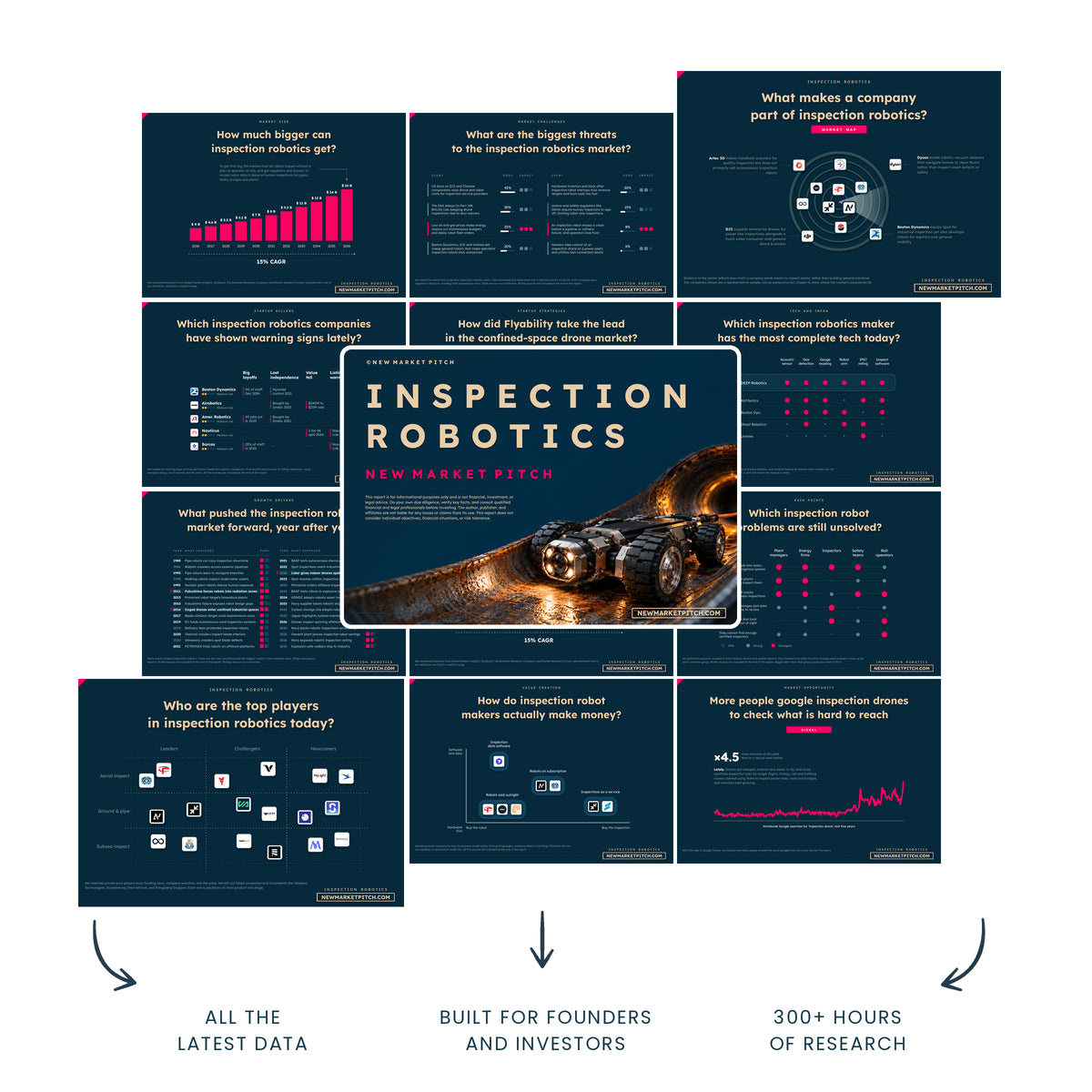
Whether you're building or investing in the inspection robotics market, our report covers everything you need to know: the players, the money, and what's coming next.
Summary
Skydio is the most valuable inspection robotics startup, valued at $5.2B+. It is one of only 3 inspection robotics unicorns we can identify confidently. Its valuation also reflects a much wider business in public safety and defense drones.
That customer base helps explain Skydio's lead. Our comparison puts it 3.5x ahead of DEEP Robotics, the Chinese maker of legged industrial robots.
Gecko Robotics has taken a narrower route. Its robots find damage inside industrial assets, and its software helps operators decide when and where to repair them.
XOCEAN, Seahi Robotics and Dexory could join that group. One sells ocean survey data, one builds underwater robots for ship hulls, and the third scans warehouse inventory. Their businesses are real, but their estimated valuations do not yet prove unicorn status.
Seahi Robotics also shows how far the field stretches beyond drones and walking robots. The young Chinese company, founded in 2023, builds underwater systems for ship hulls and other marine work.
Wind energy supports its own specialists. Aerones maintains and inspects turbine blades with robots and field crews. SkySpecs uses drones and software to inspect blades at scale.
Real customer work separates the stronger inspection robotics startups from demonstrations. ANYbotics sends robots through industrial plants, Percepto flies repeated site inspections, and Flyability reaches tight spaces that ordinary drones cannot enter.
Warehouses offer another kind of repeat work. Dexory, Gather AI, Verity, and Corvus Robotics all check stock against warehouse records, using different machines and software. Investors value them very differently.
The United States dominates the very top of the valuation list. China has serious contenders, while European startups have found customers in marine surveys, wind turbines, factories, and warehouses.
There is one big catch when comparing these values: only 4 of the 35 startups have a valuation stated by a source. The rest are estimates. Skydio is the clear leader, while several other possible unicorns still need a confirmed price.

Written by the New Market Pitch teamWe track new markets so founders and investors can move faster. About us

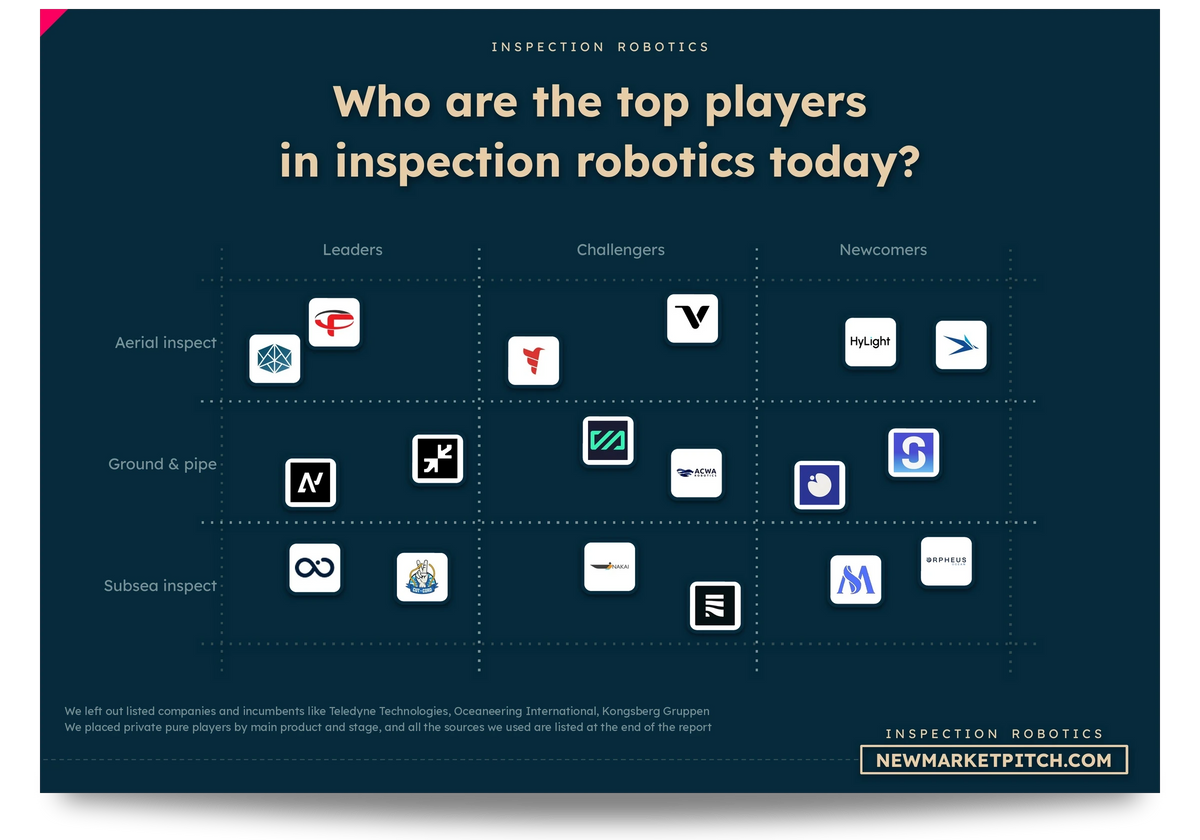
In our report covering the inspection robotics market, we turn what is vague and complex into simple, useful visuals. Market maps like this one show you at a glance where every startup stands.
Top startups in the inspection robotics market ranked by valuation
Here is the current ranking of the most valuable inspection robotics startups. For each one you will also find our confidence level and the valuation basis we used.
If you want to go deeper into the inspection robotics startup landscape, check our report covering the inspection robotics market.
| # | Startup | Valuation | Confidence | Valuation basis | Last round | Total funding |
|---|---|---|---|---|---|---|
| Private startups | ||||||
| 1 | SkydioAutonomous drones and aerial intelligence | $5.2B+as of Nov 2026 | Full | Announced private round valuation | $255MSeries G · Nov 2026 | $1.1B+valued at 4.7× this |
| 2 | DEEP RoboticsAutonomous quadruped and humanoid industrial robots | >$1.5Bas of May 2026 | Strong | Reported private round valuation | $70M+Series C · Dec 2025 | $140M+valued at 10.7× this |
| 3 | Gecko RoboticsAI inspection robots for infrastructure | $1.25Bas of Jun 2025 | Strong | Reported private round valuation | $125MSeries D+ · Jun 2025 | $345Mvalued at 3.6× this |
| 4 | XOCEANAutonomous marine survey vessels and data services | $795M–$1.5Bas of Jan 2025 | Low | Estimated from last round | $119MGrowth equity · Jan 2025 | $119M+valued at 9.1× this |
| 5 | Seahi RoboticsMakes professional underwater hull cleaning robots | $741M–$1.2Bas of Jul 2026 | Low | Estimated from last round | $148M+Series A, A+ and A++ (cumulative) · Jul 2026 | $148M+valued at 6.5× this |
| 6 | DexoryLive warehouse digital twins from scanning robots | $667M–$1.3Bas of Oct 2025 | Low | Estimated from last round | $100MSeries C equity · Oct 2025 | $215M+valued at 4.3× this |
| 7 | AeronesRobots maintaining and inspecting wind turbines | $413M–$775Mas of Jun 2025 | Low | Estimated from last round | $62MSeries B · Jun 2025 | $112Mvalued at 5.1× this |
| 8 | PerceptoAutonomous industrial inspection drones | $333M–$625Mas of Jun 2023 | Low | Estimated from last round | UndisclosedOther · May 2026 | $110M+valued at 4.1× this |
| 9 | YOUIBOTAutonomous mobile robots for manufacturing | ~$371Mas of Dec 2025 | Strong | Reported private round valuation | $9.8MOther · Jul 2025 | $22M+valued at 16.7× this |
| 10 | Gather AIAI drone-based warehouse inventory monitoring | $267M–$500Mas of Feb 2026 | Low | Estimated from last round | $40MSeries B · Feb 2026 | $67Mvalued at 5.4× this |
| 11 | ANYboticsAutonomous industrial inspection robots | $230M–$420Mas of Nov 2026 | Partial | Comparables-based estimate | $60MSeries B · Dec 2024 | $132Mvalued at 2.4× this |
| 12 | SkySpecsAutomated drones inspect wind turbine blades | $133M–$250Mas of Mar 2025 | Low | Estimated from last round | $20MSeries D+ · Mar 2025 | $135Mvalued at 1.4× this |
| 13 | VerityAutonomous warehouse inventory scanning drones | $135M–$220Mas of Nov 2026 | Partial | Comparables-based estimate | $11MSeries B extension · Jul 2023 | $64Mvalued at 2.7× this |
| 14 | FlyabilityCollision-tolerant drones inspect confined industrial spaces | $115M–$216Mas of Sep 2022 | Low | Estimated from last round | UndisclosedSeries C · Mar 2023 | $40M+valued at 3.9× this |
| 15 | Remora RoboticsRobotic systems inspect and clean fish pens | $102M–$191Mas of Jul 2025 | Low | Estimated from last round | $15MGrowth equity · Jul 2025 | $15Mvalued at 9.1× this |
| 16 | Corvus RoboticsAutonomous warehouse inventory drones | $100M–$167Mas of Aug 2026 | Low | Estimated from last round | $20MSeries A · Aug 2026 | ~$28Mvalued at 4.7× this |
| 17 | Energy RoboticsSoftware automates industrial mobile robot inspections | $68M–$113Mas of Oct 2025 | Low | Estimated from last round | $14MSeries A · Oct 2025 | $16Mvalued at 5.6× this |
| 18 | DonecleAutonomous drones for aircraft inspections | $46M–$115Mas of Apr 2026 | Low | Estimated from last round | $12MApr 2026 | $12Mvalued at 6.3× this |
| 19 | Kongsberg FerrotechSubsea robots inspect and repair offshore structures | $55M–$91Mas of Jul 2025 | Low | Estimated from last round | $14MSeed · Jul 2025 | $14Mvalued at 5.2× this |
| 20 | Capra RoboticsMobile inspection robots patrol utility installations | $46M–$77Mas of Jan 2025 | Low | Estimated from last round | ~$12MSeed · Jan 2025 | $12Mvalued at 5.2× this |
| 21 | BeeXAutonomous underwater drones inspect offshore infrastructure | $39M–$64Mas of Jun 2026 | Low | Estimated from last round | $7.7MSeries A · Jun 2026 | $7.7Mvalued at 6.5× this |
| 22 | Exyn TechnologiesAutonomous drones map inaccessible industrial environments | $33M–$63Mas of Jul 2024 | Low | Estimated from last round | $5MSeries B · Jul 2024 | $5Mvalued at 9.1× this |
| 23 | ArmatrixBuilds snake-arm robotic systems for hazardous confined-space infrastructure inspection and maintenance. | $29M–$48Mas of Nov 2026 | Low | Estimated from last round | $7.1MSeed · Nov 2026 | $9.2Mvalued at 4.0× this |
| 24 | Solinas IntegrityEndoBot crawlers inspect municipal water pipelines | $28M–$46Mas of Aug 2026 | Low | Estimated from last round | $5.5MSeries A · Aug 2026 | $6.1M+valued at 5.9× this |
| 25 | ACWA RoboticsAutonomous robots inspect drinking-water networks | $26M–$43Mas of Jan 2024 | Low | Estimated from last round | ~$5.2MSeries A · Jan 2024 | $7.2Mvalued at 4.7× this |
| 26 | Bubble RoboticsResident underwater robots inspect subsea assets | $20M–$33Mas of Apr 2026 | Low | Estimated from last round | $5MPre-Seed · Apr 2026 | $5Mvalued at 5.2× this |
| 27 | HyLightAutonomous airships for infrastructure inspections | $16M–$27Mas of Apr 2024 | Low | Estimated from last round | $4.1MSeed · Apr 2024 | $4.1Mvalued at 5.2× this |
| 28 | Tethys RoboticsAutonomous underwater robots inspect submerged assets | $16M–$27Mas of Oct 2025 | Low | Estimated from last round | $4.1MSeed · Oct 2025 | $4.1Mvalued at 5.2× this |
| 29 | Invert RoboticsClimbing robots inspect tanks and vessels | $11M–$28Mas of Dec 2023 | Low | Estimated from last round | $2.8MOther · Dec 2023 | $26M+valued at 0.7× this |
| 30 | Fleet RoboticsOn-hull robots inspect and clean ship surfaces | $9.8M–$24Mas of May 2026 | Low | Estimated from last round | $2.4MOther · May 2026 | $2.9M+valued at 5.3× this |
| 31 | CosmaUnderwater drones map and inspect seabeds | $12M–$20Mas of Jun 2025 | Low | Estimated from last round | ~$2.9MSeed · Jun 2025 | $2.9Mvalued at 5.2× this |
| 32 | Forssea RoboticsAutonomous ROVs inspect subsea energy structures | $8.8M–$22Mas of Jan 2022 | Low | Estimated from last round | $2.2MOther · Jan 2022 | $5.4M+valued at 2.6× this |
| 33 | AirpelagoAutonomous drone power-line inspections | $7.6M–$13Mas of Feb 2024 | Low | Estimated from last round | $1.9MSeed · Feb 2024 | $1.9Mvalued at 5.2× this |
| 34 | EyeROVUnderwater inspection robots and marine drones | $5.8M–$14Mas of Feb 2026 | Low | Estimated from last round | ~$1.4MFeb 2026 | $1.4Mvalued at 6.3× this |
| 35 | PipeinRobots inspect pressurized pipelines and tunnels | $4.8M–$8.1Mas of Jan 2026 | Low | Estimated from last round | $1.2MSeed · Jan 2026 | $2Mvalued at 3.1× this |
| Listed in the last 5 years or acquired in the last 3 years · not ranked | ||||||
| Terra Drone1Drone mapping and industrial inspection services | ~$1.08Bas of Nov 2026 | Full | Public market cap | UndisclosedIPO · Nov 2024 | Undisclosed | |
| Nearthlab1Autonomous drones inspect wind turbine blades | ~$49Mas of Nov 2026 | Full | Public market cap | $12MSeries D · Aug 2025 | $49Mvalued at 1.0× this | |
No startups match this search.
- Total funding includes the primary proceeds of its IPO.

Our research about inspection robotics startups gets updated several times a month, so you always get the latest view of where things stand.
Why is Skydio worth so much more than other inspection robotics startups?
Skydio leads inspection robotics partly because it can sell the same autonomous drones to utilities, police departments, and defense customers.
Skydio carries a valuation of at least $5.2B, a 3.5x lead over DEEP Robotics in our comparison. Customers can buy its aircraft, docks, remote-control tools, and software for scheduled inspections. A utility can compare equipment condition over time or send a docked drone out after a storm without first dispatching an inspection crew.
The customer mix is equally important. Skydio's business also serves police departments, emergency responders, and defense agencies. Axon's November 2026 announcement of an expanded distribution partnership makes that point particularly clear: public safety can create demand independently of spending on industrial inspections. At the same time, utilities such as National Grid and Southern Company appear among Skydio's infrastructure customers.
Skydio therefore has a bigger set of potential buyers than a company focused on one kind of inspection. Its valuation covers that entire drone business. The inspection work alone has no separately published price.
Is Skydio actually an inspection robotics company or mostly a security drone maker?
It is an inspection robotics company too: Skydio sells real infrastructure inspection systems, although policing and defense also shape its drone business.
The very same autonomous aircraft can inspect power lines, support police, or check a secured site. Skydio markets specific workflows for distribution networks, substations, power generation, bridges, and industrial assets, not just a general flying camera. Its Asset Command software connects inspection plans to existing asset records, while docked aircraft can launch repeatedly without a team standing next to the site.
That is different from Gecko Robotics, whose customer proposition begins with measuring the condition of physical infrastructure, or SkySpecs, whose inspection work centers on wind turbine blades. Skydio's platform is used for asset inspection, but those applications compete for engineering and sales attention with public safety and national security.
Skydio qualifies because inspection is a product customers can actually buy, not a feature someone might use one day. Its company valuation tells us investors prize the wider business; it says nothing precise about the value of its inspection sales alone.

In our market report about inspection robotics startups, we look at what the winners do differently, so you can learn from the best instead of guessing.
Could DEEP Robotics catch Skydio in valuation?
DEEP Robotics is the closest challenger to Skydio in inspection robotics valuation today, but it remains well behind.
DEEP Robotics is reportedly valued at more than $1.5B, with at least $140M of equity raised in our company history. Its December 2025 financing supported work on embodied intelligence, manufacturing capacity, and industrial deployments. Its four-legged robots move through factories, utility sites, and uneven terrain that can stop wheeled machines.
That opens jobs a docked drone cannot handle, such as crossing stairs and examining equipment under a roof. The opportunity also extends beyond inspection into other industrial and humanoid applications, just as Skydio has multiple markets outside asset inspection.
The valuation is a press-reported floor, not a price announced by DEEP Robotics. Its humanoid ambitions could broaden the business further, but Skydio remains ahead on current valuations. Repeated deployments and inspection contracts would make the challenge more convincing than new robot models alone.
Is Gecko Robotics the biggest pure-play infrastructure inspection startup?
Gecko Robotics is the highest-valued clear specialist in infrastructure inspection, while Skydio leads the wider category.
Gecko Robotics is reportedly valued at $1.25B and has raised $345M in equity. Its wall-climbing and crawling robots inspect metal, coatings, and structures; Cantilever software converts those measurements into maintenance information. This is a more tightly defined infrastructure inspection proposition than Skydio's mix of utilities, public safety, and defense drone missions.
Gecko has a serious commercial record. Gecko announced a U.S. Navy inspection and maintenance agreement in March 2026 and reported in October that the contract ceiling had expanded to $300 million. That ceiling is not booked revenue, but it indicates how much work the customer may be able to order through the contract. The company also works with shipbuilding and industrial partners, where inspection results can determine which repairs to prioritize before equipment is taken out of service.
Investors are paying for the inspection data and the decisions customers can make with it, as well as the robots. The test now is whether enough asset owners keep paying for that information between major maintenance projects.
How many inspection robotics startups are actually unicorns?
Only 3 inspection robotics startups clearly pass the $1B unicorn mark today.
Those inspection robotics unicorns are Skydio, DEEP Robotics, and Gecko Robotics. The difference between a proven threshold and an optimistic upper end is especially important in this market. XOCEAN has an estimated valuation range that extends beyond the threshold, but its lower end does not. Dexory and Seahi Robotics have the same underlying uncertainty: their ranges reach the unicorn territory without establishing that they have crossed it.
The category contains 35 ranked companies. Most inspection robotics startups are much smaller: 31 fall in the below-$1B bracket, whereas 3 are in the $1B–$5B bracket and 1 is in the $5B–$10B bracket. The figures describe the distribution of companies, not the total value of the sector, because combining private prices and wide estimates would create a misleading aggregate.
A large contract or a funding round can make a startup famous without establishing its price. For the unicorn count, we need the whole valuation range to clear $1B, not just its most optimistic end.

In our document detailing everything you need to know about inspection robotics, you will always find fresh funding data, taken straight from our own verified funding database.
Has XOCEAN already become a billion-dollar marine robotics startup?
XOCEAN may already be a billion-dollar marine robotics company, but its valuation has not been confirmed.
We estimate XOCEAN's value at $795M to $1.5B from the size of its January 2025 Growth Equity round, dated to that round. This is our estimate, not a valuation announced by XOCEAN or its investors. Its uncrewed surface vessels gather seabed, geological, and offshore infrastructure data for customers who previously depended heavily on crewed survey ships.
In January 2025, Morgan Stanley Investment Management described participating in a €115 million financing alongside S2G and other investors. The investors emphasized data services for offshore energy and civil hydrography, which reveals the business model: XOCEAN is selling useful survey output, not simply transferring ownership of vessels to customers. Ocean surveys can involve substantial mobilization, operating, and personnel costs, so delivering repeated measurements with unmanned boats creates a concrete economic proposition.
China's Seahi Robotics is a close marine contender, with an estimated $741M to $1.2B value from the size of its July 2026 Series A, dated to that round. We derived that range from the financing, and Seahi did not announce the valuation. The company has reported work tied to Singapore's underwater hull initiative. XOCEAN surveys the seabed from the surface, while Seahi focuses on underwater hull work. Their ranges overlap, so neither has a confirmed valuation lead over the other.
Is Dexory's warehouse robot business worth $1B today?
Dexory could be worth $1B today, but no announced price confirms that the warehouse robot startup is a unicorn.
We estimate Dexory at $667M to $1.3B from the size of its October 2025 Series C round, dated to that round. The figure is our estimate, not a company-announced price. Dexory ranks just behind Seahi Robotics, whose range looks almost the same, because we rank ranges by their middle in proportion and Seahi's higher lower end puts its middle slightly above Dexory's. Dexory's tall autonomous scanning robots collect inventory data while moving through warehouse aisles, then feed its DexoryView software to show what is physically on a shelf instead of what the warehouse management system expects to be there.
The business has evidence beyond fundraising. DHL's chief executive described Dexory robots working in the United States, the United Kingdom, and the Netherlands during the group's May 2026 annual meeting. The operator explained that the machines scan thousands of storage positions per hour and help staff identify differences between recorded and physical inventory. Warehouse teams can use those scans to find missing or misplaced stock during normal shifts.
The hard part now is selling that result across entire warehouse networks while keeping installation and service costs under control. If Dexory can keep scans accurate across more buildings, a unicorn price becomes easier to defend.

Learning from others' mistakes is the cheapest lesson there is. In our report covering the inspection robotics market, we look at what broke startups before you, so you don't repeat it.
Are investors paying for inspection robots or the information they collect?
Investors are paying for useful inspection results as much as for the robots themselves, although companies charge customers in different ways.
Skydio combines drones with docks, software, and managed workflows; Gecko Robotics combines measurements from specialized robots with asset-health analysis; XOCEAN operates uncrewed vessels to deliver marine data. Dexory and Percepto make persistent automated measurement part of a customer's daily operation, while Aerones sells a service-heavy approach to turbine inspection and care.
A one-time equipment sale ends when the hardware arrives. A customer who needs fresh inspection readings every week may keep paying for years. That is appealing, but someone still has to maintain the robots, handle failed missions, and support the software. XOCEAN also runs vessels and crews to produce its data, so recurring work brings recurring costs.
The most convincing valuations belong to companies whose inspection output changes everyday decisions. A plant manager who depends on those readings to plan repairs has a stronger reason to renew than someone buying an occasional survey.
The table below shows the business focus of selected highly valued inspection robotics startups.
| Company | Valuation | Main product |
|---|---|---|
| DEEP Robotics | >$1.5B | Legged robots |
| Gecko Robotics | $1.25B | Infrastructure analysis |
| XOCEAN | $795M–$1.5B | Marine survey data |
| Seahi Robotics | $741M–$1.2B | Marine robots |
| Dexory | $667M–$1.3B | Warehouse visibility |
| Aerones | $413M–$775M | Turbine services |
| Percepto | $333M–$625M | Remote inspections |
Ranges are estimates; > marks a reported floor.
Are American inspection robotics startups more valuable than Chinese rivals?
American inspection robotics startups lead on the highest company valuations, while Chinese rivals are strongest in different kinds of machines.
The United States accounts for 7 companies in our ranking, compared with 3 in China. Skydio leads the American group, while DEEP Robotics is the highest-valued Chinese company. Gecko Robotics shows how American investors value infrastructure-specific analysis, Seahi Robotics illustrates China's push into marine systems, and YOUIBOT combines industrial mobility with inspection applications in factories and utilities.
Look at what the robots actually do. Skydio's public-safety and defense demand differs from DEEP Robotics' factory and field environments. YOUIBOT also serves semiconductor and industrial logistics customers, according to Japan's trade promotion agency, so its value is not based solely on inspection rounds. A single national champion therefore cannot stand in for every application in that country.
Chinese firms are building useful industrial and marine robots, but their prices have not displaced the American leaders. European challengers make the picture even less clear-cut.
The table below shows the Chinese startups and the American names that come after Skydio and Gecko Robotics, in valuation order.
| Company | Country | Valuation |
|---|---|---|
| DEEP Robotics | China | >$1.5B |
| Seahi Robotics | China | $741M–$1.2B |
| YOUIBOT | China | ~$371M |
| Gather AI | United States | $267M–$500M |
| SkySpecs | United States | $133M–$250M |
| Corvus Robotics | United States | $100M–$167M |
| Exyn Technologies | United States | $33M–$63M |
Ranges are estimates; > denotes a reported valuation floor.

In our research about inspection robotics startups, we always try to gather several sources and make estimates that make sense, so you can work with solid numbers.
Is any European inspection robotics startup worth $1B?
Not for sure: Europe has credible inspection robotics specialists, but none has a confirmed $1B valuation and none comes close to Skydio at the top of the private valuation list.
Ireland's XOCEAN, the United Kingdom's Dexory, and Latvia's Aerones represent three unrelated opportunities: ocean data, warehouse visibility, and wind turbine care. Switzerland adds ANYbotics, Verity, and Flyability, whose systems work in industrial plants, warehouse racks, and confined spaces. The breadth matters because industrial customers buy robots for narrow problems where an established workflow can be more valuable than a general machine.
Switzerland accounts for 5 ranked startups, France for 5, and Ireland for 2. Those country counts do not mean Europe leads by valuation. The private estimates vary widely, and Skydio remains far ahead. European founders have built robots for places where getting workers to the asset is expensive or dangerous.
The commercial challenge is distribution and repeatability. XOCEAN must run a marine service network, Dexory must deploy across warehouse groups, and ANYbotics must integrate into plant maintenance systems. These are difficult businesses to scale, but they also create reasons for customers to stay once the robotic inspection process becomes part of routine operations.
Why aren't wind turbine inspection startups valued like the biggest drone makers?
Wind turbine inspection startups are worth less than Skydio mainly because they sell into a narrower market.
Aerones is estimated at $413M to $775M from its June 2025 Series B, dated to that round; it is our estimate from the size of the financing, not an announced valuation. SkySpecs is estimated at $133M to $250M from its March 2025 Series D+ on the same basis. These are different businesses: Aerones combines robotic blade maintenance, inspection, and repair services, while SkySpecs pairs drone inspections with software for monitoring asset health.
Both are well beyond early demonstrations. Aerones said its revenue had grown strongly as it expanded its industrial operations, while SkySpecs reported a large installed base of inspected turbines and developed tools to inspect the inside of blades as well as the outside. Those products address real costs: checking large turbines often requires access teams, stopped equipment, and work at height or offshore.
Wind farm owners need recurring blade checks, but their budgets follow the number of turbines they run. Skydio sells aircraft into several other markets as well. That helps explain the valuation gap without assuming the wind specialists have worse technology.
Is Percepto still a serious competitor to Skydio in industrial inspection?
Yes, Percepto still competes seriously with Skydio for regular industrial drone inspections, despite the valuation gap.
Percepto is estimated at $333M to $625M from the size of its June 2023 round, dated to that round. This is our estimate, not a price announced by its investors. Its May 2026 round has no public amount, so it cannot be used for the estimate. That range still puts Percepto just ahead of YOUIBOT's reported ~$371M, because we rank ranges by their middle. Percepto's product is an industrial drone that lives at a facility, launches inspections remotely, and feeds images and alerts into its AIM software. Skydio also offers docked aircraft and remote workflows, but it spreads its platform across utilities, public safety, defense, and other applications.
Percepto has documented work with industrial users including Siemens Energy, where regular drone flights helped teams detect blocked piping and monitor plant shutdown activities. The aircraft already fly repeat missions and flag problems that workers might otherwise miss until the next manual check.
Plant owners will care about which drone can run with their permissions, software, and maintenance teams. Percepto can win that kind of customer even while Skydio remains much more valuable as a company.

If you build or invest in the inspection robotics market, you need to know which business models pay off now and which ones are fading. That's why our report covering it has a whole section on it.
Why isn't industrial inspection robot maker ANYbotics worth $1B yet?
ANYbotics has serious industrial customers, but its inspection robot business has not reached a confirmed $1B valuation.
We estimate ANYbotics at $230M to $420M using comparable companies and its commercial position. Its ANYmal robots patrol industrial sites, gathering thermal, acoustic, visual, and other readings while remaining connected to maintenance workflows. Customers pay for readings that help them spot trouble before equipment shuts down.
The company reported that energy and chemical groups including BP, Shell, Petrobras, and BASF had tested its explosion-protected ANYmal X through an early-access program. It also described more than 50 customers across power, materials, and related industries using its inspection systems, with more than 120,000 autonomous inspections every month. Those numbers show frequent real-world use, although the company does not disclose corresponding revenue or profits.
Explosion-risk facilities require certified hardware and dependable maintenance software. That slows sales, but a robot that wins approval can be hard to replace. ANYbotics has shown customers and repeat use; investors still need to see how much those inspections earn.
Are autonomous warehouse inspection robots becoming billion-dollar businesses?
Warehouse scanning robots have real paying users, but Dexory remains a possible unicorn rather than proof that the whole niche is worth billions.
Dexory is the highest-valued warehouse scanning startup in our list; Gather AI, Verity, and Corvus Robotics are further behind. Gather AI is valued at an estimated $267M to $500M from the size of its February 2026 Series B, dated to that round. Its camera and drone-based approach helps warehouses reconcile physical inventory with digital records. Verity uses autonomous indoor drones, while Corvus Robotics emphasizes inventory flights that do not depend on infrastructure installed around a building.
Customers are already using these machines. Gather AI announced a new financing with a plan to extend its platform across warehouse operations; Verity's system has been used by the Ingka Group, the largest IKEA retailer; and Corvus reported production use in different warehouse environments, including cold storage. These deployments matter because warehouses constantly change. A one-time map quickly goes stale, while recurring inventory scans can prevent stock errors and wasted labor.
Still, warehouse layouts differ, and no buyer wants to rebuild the building around a robot. The best companies will have to make setup quick, scans reliable, and repeat contracts cheap to serve.

In our document detailing everything you need to know about inspection robotics, we don't want to repeat what boring consulting reports say. Instead, we show you the real and latest market signals that matter.
Why are subsea inspection robot startups worth less than the biggest drone makers?
Subsea inspection startups still carry lower valuations than the biggest drone makers, even though offshore inspection is expensive and difficult.
XOCEAN operates uncrewed surface vessels that collect offshore survey data. Seahi Robotics builds systems for hull work and other underwater operations. Remora Robotics inspects and cleans fish pens, while BeeX, Bubble Robotics, and Tethys Robotics work on different forms of submerged inspection. These companies do not solve the same customer's problem, even when all are described as marine robotics.
Our values demonstrate the spread of commercial expectations. Remora Robotics is estimated at $102M to $191M from its July 2025 Growth Equity round, dated to that round, and BeeX is estimated at $39M to $64M from June 2026's Series A. Both are our estimates from the sizes of their respective last rounds, not prices announced by their companies. The customer needs range from finding damage near offshore structures to keeping aquaculture nets clean.
A marine robot can save a costly vessel trip but still fail because of weather, corrosion, or poor communications. Customers need dependable service across different sites. Those costs help explain why a strong offshore product does not automatically turn into a Skydio-sized company.
Why is YOUIBOT valued far above what it has raised in inspection robotics?
YOUIBOT is reportedly valued at ~$371M, while its confirmed equity total is only $22M+, because most of its rounds have no public amount.
The Chinese company ranks 9th, just behind Percepto and ahead of Gather AI, on a reported valuation of ~$371M. Our total counts only the rounds we can confirm with an amount: a $193M round reported for June 2024 does not appear in the financing history of its Hong Kong listing filing, so we do not count it, and its latest recorded round, $9.8M in July 2025, has no disclosed stage. That is why we show no valuation-to-funding multiple for YOUIBOT.
YOUIBOT is also broader than inspection. Its mobile robots move materials in factories as well as patrol sites, and inspection made up 40.6% of its 2025 revenue, according to that filing. Japan's trade promotion agency reported in April 2025 that it had opened a Tokyo subsidiary to serve semiconductor and electronics manufacturers.
YOUIBOT belongs in this market because inspection is a large, separately reported part of its sales. Its valuation, though, prices the whole company, so it says little about what an inspection-only business of the same size would be worth.

In our report covering the inspection robotics market, we like to show you the big picture. We know your time is precious, so we make every page quick to read and packed with as much learning as possible per minute.
Why hasn't Flyability become one of the most valuable inspection robotics startups?
Flyability solves a genuinely hard inspection problem, but its confined-space drones have not earned one of the biggest robotics valuations.
We estimate Flyability's value at $115M to $216M from the size of its September 2022 round, dated to that round. Its March 2023 Series C has no public amount, so it cannot be used for the estimate. That is our estimate, not a current price announced by Flyability or its investors. Its caged Elios drones fly inside tanks, industrial vessels, tunnels, and other spaces where collisions or the lack of GPS would defeat a conventional aircraft. They let inspectors gather images and spatial data while staying out of hazardous areas.
Flyability's product materials describe collision tolerance, LiDAR mapping, and operation in confined locations. A U.S. Department of Energy technical paper on Savannah River waste-tank inspections also documents selection of the Elios 3 after work at another nuclear site. That shows the product is useful in demanding conditions, but it tells us nothing about company revenue.
Flyability can charge for access to places where sending people is risky. Still, the number of tanks and tunnels needing this equipment is different from the number of customers Skydio can reach. Its smaller valuation does not mean its inspection missions are less important.
Why aren't water-pipe inspection robot startups worth more?
Water-pipe inspection robots solve an expensive utility problem, but their startups remain much less valuable than the biggest inspection drone companies.
Solinas Integrity is estimated at $28M to $46M from its August 2026 Series A, ACWA Robotics at $26M to $43M from its January 2024 Series A, and Pipein at $4.8M to $8.1M from its January 2026 Seed round. Each range is our estimate from the size of the company's last round, dated to that round, rather than a disclosed company valuation. The companies address an awkward and expensive problem: pipes are often buried, full, difficult to enter, and expensive to excavate.
Solinas markets robotic crawlers that inspect water pipelines for leakage, obstructions, and structural defects. ACWA Robotics has reported a Pathfinder deployment on the Dunkirk water network with SUEZ and regional partners. These are practical demonstrations of why utilities might pay for robots that find faults before a major leak forces disruptive repairs.
Public utilities buy slowly, and pipe sizes and conditions differ between networks. Startups also have to prove that robotic surveys save money compared with excavation or traditional checks. Bubble Robotics, founded in 2025, illustrates how early other inspection niches remain: its underwater inspection valuation is estimated at $20M to $33M from the size of its April 2026 round, dated to that round, not an announced price.
Do inspection robotics valuations rise in line with the money companies raise?
No, inspection robotics startups do not automatically become more valuable when they raise more equity.
Gecko Robotics has raised $345M and carries a reported $1.25B valuation, a valuation-to-capital-raised multiple of 3.6x. It is the only company with both a source-stated valuation and a complete equity funding total, because the totals of Skydio, DEEP Robotics and YOUIBOT are minimums. The estimates point the same way: SkySpecs has raised $135M and is estimated at $133M to $250M, while Seahi Robotics has raised $148M+ and is estimated at $741M to $1.2B. Those figures compare company value with equity raised, not profits or returns.
The businesses behind those numbers have little in common. Gecko uses inspection data and AI to support decisions about expensive infrastructure repairs. YOUIBOT sells industrial mobile robotics across inspection and factory logistics, so customers and investors evaluate a different mixture of hardware and software. Dexory and XOCEAN have meaningful funding histories too, but their valuation ranges are estimates rather than a similarly observed price.
Customers tell us more about the value created. A robotics maker can spend heavily on factories and service teams while a smaller inspection specialist wins repeat contracts. And the price set in a funding round reflects investor expectations at that moment, not a permanent appraisal.

When you build or invest in the inspection robotics market, you need clarity, not confusion. In our research about inspection robotics startups, we always try to put numbers on and quantify whatever is usually vague and confusing.
Does Terra Drone's stock-market listing make it an inspection robotics leader?
No, Terra Drone's stock-market listing makes it a public drone company, not the highest-valued private inspection robotics startup.
Terra Drone listed on the Tokyo Stock Exchange Growth Market in November 2024. Its business spans drone surveying, industrial inspection, agriculture, and air-traffic management, so its public shares reflect more than one inspection product. We show Terra Drone separately with a public market capitalization of ~$1.08B, rather than placing that daily traded market value alongside private funding prices and estimated ranges.
Nearthlab, the South Korean drone inspection company, is also shown separately after listing, with a public market capitalization of ~$49M. These public figures can move as shares trade, whereas private valuation headlines often refer to a particular financing event. A traded share price and an old private financing price answer different questions.
Terra Drone does give investors a public-market comparison for a drone business with genuine inspection work. But its share price moves daily and covers all its activities, so it cannot price Skydio's private shares or any one inspection division.
So, which inspection robotics startups are worth the most today?
Skydio is the most valuable inspection robotics startup today; DEEP Robotics and Gecko Robotics follow it.
Skydio's valuation is at least $5.2B, and the evidence behind its price includes a broad autonomous-drone business extending into public safety, defense, and utility inspection. DEEP Robotics has a substantial reported valuation but a different focus on industrial legged robots. Gecko Robotics is the most convincing example of a specialist building value specifically from structural inspection data, asset intelligence, and large institutional customers.
XOCEAN, Dexory, and Seahi Robotics are important contenders whose estimated values could reach unicorn territory. We derived those ranges from the sizes of their last rounds, dated to those rounds; the companies did not announce those valuations. Aerones, Percepto, ANYbotics, and Gather AI show how many different inspection jobs can support a startup.
Skydio leads at company level, but specialist inspection robotics has several credible businesses rather than one winner. Recurring customers and useful inspection data will decide which ones can defend higher prices.
The table below shows what we found.
| Question | Answer |
|---|---|
| Is one drone maker far ahead? | Yes, Skydio leads the most valuable inspection robotics startups. Its valuation lead over DEEP Robotics is 3.5x. That includes its public safety and defense business. |
| Have many inspection startups reached unicorn status? | No, confirmed inspection robotics unicorns remain a small group. Only 3 companies securely clear the $1B threshold. Estimated upper ranges cannot establish a funding price. |
| Can infrastructure inspection support a giant startup? | Yes, Gecko Robotics has built a valuable specialist business. Its Navy contract ceiling reached $300 million in October 2026. That ceiling shows potential work, not recognized revenue. |
| Is ocean surveying already a billion-dollar business? | Possibly, XOCEAN operates uncrewed vessels for repeated marine surveys. We estimate its valuation at $795M to $1.5B. Its financing has not confirmed a billion-dollar price. |
| Are warehouse scanning robots close to unicorn status? | Yes, Dexory has moved beyond warehouse trials into operations. Its estimated company value is $667M to $1.3B. Installation costs and repeat contracts still determine durability. |
| Can Chinese underwater startups beat European rivals? | Possibly, Seahi Robotics is now a serious marine competitor. Its estimate runs from $741M to $1.2B. XOCEAN's overlapping range prevents a clear winner. |
| Do wind turbine robots justify major valuations? | Yes, Aerones and SkySpecs handle real turbine maintenance work. Aerones carries an estimated $413M to $775M valuation. Their narrower customer base limits comparisons with Skydio. |
| Are industrial walking robots used beyond demonstrations? | Yes, ANYbotics robots inspect major industrial plants regularly. We estimate the company at $230M to $420M. Customer activity alone does not disclose its profits. |
| Does raising more money always mean higher value? | No, company valuations depend on far more than equity raised. Gecko Robotics has a 3.6x valuation-to-funding multiple. That number measures neither profitability nor investor returns. |
| Are warehouse inventory drones already being deployed? | Yes, Gather AI, Verity, and Corvus serve real warehouses. Gather AI's value is estimated at $267M to $500M. Customers still need accurate scans without disruptive installation. |
| Does going public make Terra Drone number one? | No, Terra Drone trades publicly and sits outside our private comparison. Its market capitalization is ~$1.08B. Skydio remains the highest-valued startup in the private ranking. |

A good product starts with a real problem. In our market report about inspection robotics startups, we show you the ones customers still live with.
Our methodology
Our data runs through November 14, 2026. We then reviewed this article and updated its answers on November 17, 2026, the date shown under the title. We define inspection robotics as robot-centered systems and services that examine and measure the condition of physical infrastructure, including aerial, climbing, mobile, underwater, and remotely controlled platforms. We include companies at the boundaries when inspection is a genuine integrated robotic offering, rather than excluding them for serving adjacent uses. Every company in the main ranking is an independent startup under our definition, founded in 2007 or later and built to scale around a new product or technology; acquired or listed companies are shown apart. The ranking uses each company's funding and valuation history, not only recent deals.
Every startup in this ranking has raised equity funding, and each valuation comes with a confidence level that shows how it was obtained. A Full rating means the company announced the valuation itself, or several independent sources report the same figure. A Strong rating means a credible press report gives the valuation, or it follows directly from the terms of a funding round, such as the amount raised and the stake sold.
When no valuation has been disclosed, it is estimated. A Partial rating means the startup was compared with similar companies at the same stage, using indicators such as revenue, deal terms or recent transactions in the sector. A Low rating means the only reliable data point is the last equity round: the valuation is then derived from the amount raised and the share of the company that startups usually give up at that stage, which is why it is shown as a range and dated to that round.
Several safeguards keep these figures honest. Valuations that appear only in commercial databases, with no article or company statement behind them, are not used, and neither are share sales between existing shareholders, which often take place at a discount or a premium. Rounds older than five years are not used to estimate a valuation, debt and grants never count as equity, and companies whose claims are disputed are left out of the ranking. Startups that have since been acquired or have gone public are listed separately, valued at their acquisition price or market capitalization rather than at a past private round.
We order companies with a valuation range by the geometric mean of its low and high ends, so an optimistic high end cannot pull a company too far up. Funding totals count equity only, excluding debt, grants, and post-IPO offerings; a plus sign means a minimum because some confirmed amounts are undisclosed. We include a round only when a company statement, filing, or press article confirms it, or when two recognized databases agree on its date and amount and there is no article; the latter remains low confidence and is not used for a company with more than $100M raised. A round found in just one database is excluded. Valuations come from company statements, filings, and reliable press, never a commercial database figure alone.
An estimated range can therefore appear ahead of a smaller reported valuation without pretending that investors paid the estimated amount. We use the geometric mean to order the range, date a Low estimate to the funding round from which it was derived, and show the confidence level so readers can weigh it against a stated price. Different publications may report larger funding totals because they include debt, grants, unconfirmed database entries, or later announcements; we apply the equity-only standard consistently rather than silently combining incompatible figures.
Key sources include Axon's November 2026 announcement of its Skydio investment and public-safety distribution relationship., Skydio's autonomous utility-inspection workflows and customer examples., DEEP Robotics' December 2025 financing and industrial deployment strategy., Gecko Robotics' company-stated June 2025 valuation and expansion plans., Gecko Robotics' October 2026 U.S. Navy contract-ceiling expansion., Morgan Stanley's January 2025 account of XOCEAN's marine data investment., Dexory's October 2025 fundraising and warehouse-product expansion., DHL's May 2026 description of Dexory robots in operating warehouses., Seahi Robotics' 2026 marine robotics financing and deployment details., Seahi Robotics' reported selection for Singapore's underwater hull initiative., Aerones' June 2025 financing and expansion in wind turbine services., SkySpecs' turbine inspection systems and service offerings., ANYbotics' hazardous-area robot launch and industrial deployment metrics., Gather AI's February 2026 warehouse robotics financing and product plans., Verity's autonomous inventory system in use with IKEA's Ingka Group., Corvus Robotics' October 2026 account of commercial warehouse drone operations., Siemens Energy's use of Percepto for autonomous plant inspections., Flyability's confined-space inspection drone capabilities., U.S. Department of Energy technical account of robot-assisted tank inspection., Solinas Integrity's robotic water-pipeline inspection offering., ACWA Robotics' reported first Pathfinder water-network mission., and Terra Drone's November 2024 stock exchange listing..
In our document detailing everything you need to know about inspection robotics, we turn what is vague and complex into simple, useful visuals. Market maps like this one show you at a glance where every startup stands.
Written by the New Market Pitch teamWe track new markets so founders and investors can move faster. About us