
Legal Tech: what are the biggest unsolved problems?
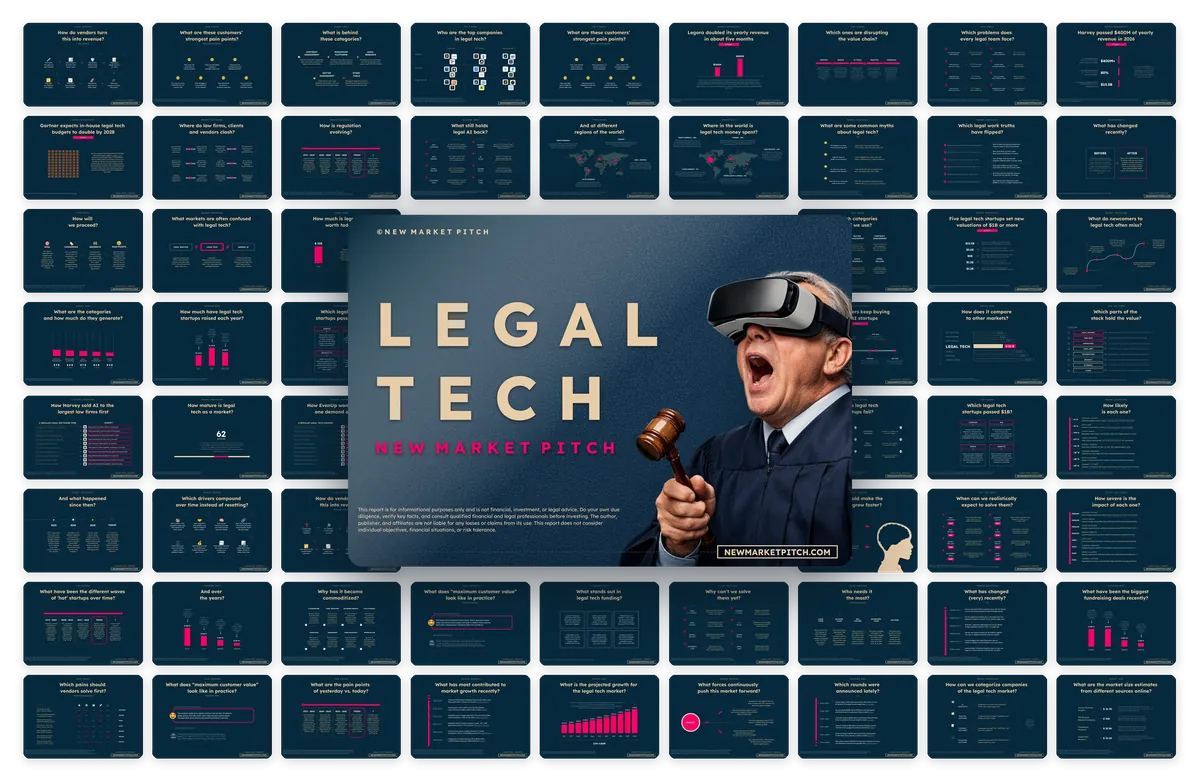
Whether you're building or investing in the legaltech market, our report covers everything you need to know: the players, the money, and what's coming next.
Summary
Legal tech's biggest unsolved problems are unreliable AI answers, unaffordable legal services, fragmented workflows, confidentiality risks and the difficulty of turning faster legal work into better legal outcomes. The central problem is that technology is improving much faster than the systems responsible for delivering legal services.
AI adoption is already widespread. Clio's 2026 research found that 85% of surveyed legal professionals reported some AI adoption at their firms, yet only 28% of law firms surveyed by Thomson Reuters had changed their pricing structures in response to AI. The productivity revolution is arriving before the pricing revolution.
Accuracy remains a serious weakness. Stanford researchers found that specialized legal research systems hallucinated between 17% and 33% of the time under their testing conditions. Connecting AI to legal databases helps, but even a genuine court citation can support an incorrect legal conclusion.
Legal AI has a particularly unforgiving error problem. A fabricated citation can lead to sanctions, a missed deadline can damage a case, and an incorrect privilege decision can expose confidential information. Small mistakes can have enormous consequences.
Access to justice is the industry's largest unresolved problem by human impact. The Legal Services Corporation found that 92% of substantial civil legal problems experienced by low-income Americans received inadequate or no legal assistance. Consumer AI makes legal information easier to find, but there is little evidence that it has meaningfully closed this gap.
Law firms face an economic contradiction. AI can reduce the hours required for an assignment, while traditional hourly billing rewards the hours worked. Until more firms rethink pricing, efficiency gains will not automatically translate into cheaper services.
Corporate legal departments have a different headache: their technology rarely works as one connected system. Contracts, approvals, billing, compliance and matter management often sit in separate applications. Extracting information with AI is becoming easier than making sure someone acts on it.
Confidentiality and oversight are becoming harder as employees adopt AI independently. Thomson Reuters found that 34% of surveyed law firm professionals used unauthorized AI tools, creating a visibility problem for firms handling privileged and sensitive information.
Measuring whether legal AI actually works financially is another weakness. Only 18% of professionals surveyed by Thomson Reuters said their organizations tracked AI ROI. Time savings are easy to advertise, but the cost of verification, error correction and risk management can change the economics considerably.
Autonomous legal agents remain a long way from handling complicated cases without lawyers. They can assist with research, document classification and administrative tasks, but legal representation requires accountable decisions across workflows where one error can affect everything that follows.
The most immediate startup opportunities are legal AI verification, connected workflows, contract obligation management and regulatory compliance. The bigger, more difficult prize is affordable legal assistance that people can rely on when the stakes are high. That remains legal tech's defining challenge.

Written by the New Market Pitch teamWe track new markets so founders and investors can move faster. About us
Why does legal tech still have so many problems despite the AI boom?
Legal tech is growing quickly, but the industry still struggles to deliver legal services that are consistently reliable, affordable and easy to access. AI has made legal research, document review and contract drafting faster. The harder problems, especially accuracy, legal costs and access to justice, remain largely unsolved.
The pace of adoption is impressive. Thomson Reuters' 2026 AI in Professional Services Report found that organization-wide AI adoption across the professions surveyed almost doubled, from 22% in 2025 to 40% in 2026. Clio's 2026 Legal Trends Report found that 85% of surveyed legal professionals reported some AI adoption at their firms, compared with 79% the previous year. Among professionals working at firms that use AI, 64% said it had positively affected revenue, up from 36% in 2025.
Yet these improvements contrast sharply with the state of legal access. The Legal Services Corporation's latest comprehensive Justice Gap Report found that low-income Americans received inadequate or no legal assistance for 92% of their substantial civil legal problems. That study was published in 2022, before the current generative AI boom, and we still lack a comparable nationwide study showing how much AI has improved access.
Legal software is getting better at helping professionals do their work, while the much bigger challenge of delivering affordable legal outcomes remains unresolved. Meanwhile, AI is introducing new questions about reliability, confidentiality and professional responsibility.
Can legal AI actually be trusted to give correct legal answers?
Legal AI is still too unreliable to handle important legal work without human verification. Even specialized tools built for lawyers have been shown to produce incorrect or unsupported answers, sometimes while citing genuine legal sources.
In June 2025, researchers from Stanford Law School published a study in the Journal of Empirical Legal Studies evaluating AI-powered legal research products. They found that systems from LexisNexis and Thomson Reuters hallucinated between 17% and 33% of the time, depending on the product and testing conditions.
The results were particularly interesting because these products use retrieval-augmented generation, which connects AI answers to external legal databases. That approach generally performed better than relying on general-purpose models alone, but it did not eliminate hallucinations.
A legal AI system can retrieve an actual court decision and still misunderstand what the decision establishes. It might overlook an exception, confuse binding precedent with persuasive authority or apply a ruling from the wrong jurisdiction. These mistakes are harder to detect than invented cases because the cited documents genuinely exist.
The benchmark also has limits. It measured particular products and tasks at a specific point in time, so the reported failure rates should not be treated as permanent scores for every newer product. Still, the study established that the presence of legal citations is insufficient evidence of accuracy.
If you want more recent data on this point, please see our latest Legal Tech market report.

A good product starts with a real problem. In our report covering the legaltech market, we show you the ones customers still live with.
Why do AI-generated legal citations keep getting lawyers in trouble?
AI-generated legal citations remain a serious problem because a convincing legal argument can hide fabricated cases, misleading quotations or incorrect interpretations of real judgments. Courts increasingly expect lawyers to understand this risk, yet AI-related citation failures continue to appear in litigation.
The best-known early case was Mata v. Avianca in 2023. Lawyers submitted fictional judicial opinions generated by ChatGPT, and a federal judge imposed sanctions. The incident demonstrated how easily fabricated legal authorities could make their way into formal filings when attorneys failed to verify them.
The problem persisted after that warning. In 2025, the High Court of England and Wales addressed AI-generated false authorities in cases including Ayinde v. London Borough of Haringey and Al-Haroun v. Qatar National Bank. The court's concerns showed that fabricated references were becoming a broader professional issue rather than an isolated American incident.
The American Bar Association had already clarified lawyers' obligations in Formal Opinion 512, published in July 2024. Lawyers using generative AI remain responsible for competence, confidentiality, supervision and candor toward courts. Commercial AI software does not transfer those duties to the technology provider.
As the Stanford research discussed above demonstrated, even specialized research tools can produce unsupported claims. That leaves lawyers with a particularly awkward workflow: AI may accelerate the initial drafting, but every important legal proposition still needs checking.
Why is legal research still so fragmented?
Legal research remains fragmented because courts, governments and private publishers maintain different collections of legal information. AI has made these collections easier to search, but lawyers still need to establish whether the sources are complete, current and legally relevant.
The United States illustrates the scale of the problem. Federal law operates alongside 50 state legal systems, the District of Columbia and thousands of local jurisdictions. Federal courts publish opinions and filings through their own infrastructure, while state and local courts maintain separate systems with different access rules.
PACER provides electronic access to federal court records, although usage fees can apply. CourtListener, developed by the Free Law Project, makes large collections of judicial information publicly accessible. Commercial services such as Westlaw and Lexis offer extensive legal databases with editorial enhancements and specialized research tools.
These products overlap, but none gives lawyers unrestricted access to every relevant legal document across the country. Unpublished decisions, sealed filings, local administrative materials and older records can create further gaps.

If you build or invest in the legaltech market, you need to know which business models pay off now and which ones are fading. That's why our report covering it has a whole section on it.
Can legal AI handle the laws of different countries?
Legal AI still struggles to work reliably across different countries because every jurisdiction has its own laws, sources and procedures. Multilingual capabilities have improved quickly, but translating an answer does not establish that the answer is legally correct in another country.
The problem begins with the structure of legal systems. American and English common-law traditions rely heavily on judicial precedent, while France and Germany operate within civil-law systems where legislation and legal codes play different roles.
Even closely connected jurisdictions can disagree. Within the European Union, EU regulations coexist with national laws, administrative practices and court procedures. A question about employment contracts, for example, may require a different answer in France, Germany and Spain despite all three countries operating under some common European rules.
Legal AI developers also need to track whether a source is currently effective. Regulations can be amended, judicial decisions overturned and administrative interpretations revised. A model may produce a fluent answer based on material that is no longer applicable.
The European Union's AI Act makes the challenge more complicated because certain AI uses associated with the administration of justice fall within its high-risk framework. Developers must consider obligations governing the technology alongside the underlying legal information.
Products expanding internationally therefore need authoritative local databases, accurate legal terminology and evaluations designed around the relevant jurisdiction.
Can legal tech make lawyers affordable for ordinary people?
Legal tech has not yet made legal help affordable for the people who need it most. Consumer AI is starting to change how people search for legal answers, but there is still little evidence that it has substantially reduced the number of people facing serious legal problems without adequate assistance.
The scale is enormous. The Legal Services Corporation's 2022 Justice Gap Report, based partly on a nationwide survey conducted with NORC at the University of Chicago, found that 74% of low-income American households had experienced at least one civil legal problem during the preceding year.
Among people who did not seek assistance for at least one problem, 46% mentioned concerns about cost. More importantly, the study found that 92% of substantial civil legal problems experienced by low-income Americans received inadequate or no legal help.
Legal AI is beginning to change consumer behavior. Clio's 2026 Legal Trends Report found that 24% of American adults had already used AI to answer a legal question, while 46% said they would consult AI before contacting a lawyer.
However, the same report found that only 26% of consumers were comfortable with AI making decisions, and just 6% were comfortable with AI being used in high-stakes personal matters. People appear much more willing to use AI for initial guidance than to trust it with decisions that could affect their housing, finances or family.
Someone using ChatGPT to understand an eviction notice has gained easier access to information. That doesn't mean they can now defend an eviction case, negotiate effectively with a landlord or meet a filing deadline.
If you want more recent data on this point, please see our latest Legal Tech market report.

Learning from others' mistakes is the cheapest lesson there is. In our market report about legal technology, we look at what broke startups before you, so you don't repeat it.
Why hasn't legal tech made lawyers much cheaper?
Legal tech has made many legal tasks faster, but law firms have been slow to pass those efficiency gains into their pricing. The traditional hourly billing model remains a major obstacle, particularly when AI reduces the time needed to complete work that was previously billed by the hour.
Thomson Reuters' 2026 Future of Professionals legal report found that 71% of surveyed in-house legal professionals expected outside law firms to change their commercial models as AI adoption increased. However, only 28% of law firms said they had changed their pricing structures in response to AI.
That represents a 43-percentage-point gap between client expectations and reported firm action. The same research found that 32% of in-house legal professionals were already reconsidering, or expected to reconsider within a year, relationships with firms that failed to demonstrate clear AI-enabled value.
The conflict is straightforward. If AI reduces a ten-hour assignment to four hours, an hourly-billing firm may earn less revenue for the same deliverable. The client benefits from the shorter bill, but the firm must find additional work, raise rates or introduce a different pricing model to maintain revenue.
Fixed-fee agreements can solve part of this problem. They allow firms to keep some of the savings from faster work while giving clients predictable costs. Yet they also leave firms exposed when cases become more complicated than expected.
Subscription services and outcome-based pricing offer other possibilities, especially for recurring commercial work. However, complex litigation and uncertain transactions remain difficult to price in advance.
Why do corporate legal teams still use so many disconnected tools?
Corporate legal teams still depend on disconnected software because legal work crosses several departments and business systems. Most organizations already have tools for contracts, billing, documents and matter management, but keeping information synchronized across them remains difficult.
A normal commercial contract may begin with a request in Salesforce, move through negotiations in Microsoft Word and Outlook, require approvals in Microsoft Teams, receive signatures through DocuSign and eventually end up in a contract management platform.
Each application may perform its job well. Problems emerge when the legal team needs to understand the entire process. Who approved the latest version? Which obligations were accepted? Does the final agreement match the commercial terms in Salesforce? Who is responsible for monitoring renewal dates?
The growth of legal operations shows that companies are increasingly focused on these questions. CLOC's 2026 State of the Industry Report found that 80% of surveyed legal operations professionals prioritized technology strategy, while 72% prioritized financial management and 62% outside counsel and vendor management.
Legal departments have moved well beyond purchasing individual applications. They're now trying to make existing technology work together while managing growing workloads.
Smaller law firms face a related problem. Products such as Clio, MyCase and Smokeball combine case management, billing and document workflows, but small practices often lack dedicated technology teams to handle migration, integration and configuration.
For both groups, the opportunity is reliable coordination across tools that organizations already use, reducing repeated data entry, missed handoffs and manual reconciliation.

When you build or invest in the legaltech market, you need clarity, not confusion. In our document detailing everything you need to know about legaltech, we always try to put numbers on and quantify whatever is usually vague and confusing.
Is contract management software actually solving the contract problem?
Contract management software has made agreements easier to organize, search and approve, but companies still struggle to track what happens after a contract is signed. The harder challenge is making sure contractual commitments are understood and followed throughout the relationship.
Companies such as Icertis, Ironclad and Sirion offer contract lifecycle management platforms covering agreement creation, negotiation, storage and analysis. AI has made it easier to extract clauses, compare versions and identify unusual terms.
However, contracts often contain obligations that depend on events occurring months or years later. A software agreement may require advance termination notice, specific cybersecurity protections, annual price increases and service-level commitments.
Extracting these terms is useful, but the business still needs to act on them. A 60-day termination notice has little value if the responsible team never receives an alert. A pricing clause can create financial exposure when the billing system applies a different calculation. An indemnity obligation may require coordination between legal, insurance and procurement teams.
These issues become particularly difficult for large companies managing thousands of active agreements across subsidiaries and jurisdictions.
AI is improving the extraction of contract information, but the real challenge now is turning that information into actions inside procurement, finance, sales and compliance systems.
If you want more recent data on this point, please see our latest Legal Tech market report.
Can law firms keep client information safe when employees use AI?
Law firms are struggling to control how employees use AI, creating confidentiality risks even when approved legal technology is secure. The biggest immediate concern is unauthorized AI usage involving sensitive information that firms cannot properly monitor.
Thomson Reuters' 2026 Future of Professionals legal report found that 34% of law firm professionals were using AI tools their firms had not authorized. That means approximately one in three respondents reported some shadow AI usage.
The figure does not establish that one-third of lawyers have leaked confidential information. However, it shows that firms have a substantial visibility problem around the tools employees choose for their work.
Legal confidentiality is especially demanding. A law firm may handle privileged communications, sensitive medical records, confidential transactions and information concerning clients with conflicting interests. Depending on the circumstances, uploading such material into an external AI service can create professional and contractual risks.
The ABA's July 2024 guidance on generative AI requires lawyers to assess confidentiality and security when using these systems. Relevant questions include how information is stored, whether it can be used to train models and who can access it.
Enterprise controls such as restricted data retention, encryption, audit logs and access permissions can reduce exposure. But security depends on consistent usage, and lawyers may choose convenient unauthorized tools when approved alternatives are too limited.

In our report covering the legaltech market, we look at what the winners do differently, so you can learn from the best instead of guessing.
Why is proving the return on legal AI so difficult?
Legal AI is beginning to show measurable financial benefits, but most organizations still cannot reliably say how much value their investment creates. The evidence is stronger for time savings and revenue differences than for improvements in legal outcomes or reductions in risk.
Thomson Reuters' 2026 AI in Professional Services Report found that only 18% of surveyed professionals said their organizations tracked the return on investment of AI tools. Another 40% did not know whether ROI was being measured.
There are encouraging results at the company level. Clio's 2026 Legal Trends Report found that firms using its AI products generated approximately 8.1% more revenue per responsible lawyer than comparable firms without those tools. That represented roughly $1,800 in additional monthly revenue per lawyer, or $21,600 annually if the difference persisted.
The more intensive combination of Clio Work and Clio Manage produced an even larger reported difference: 10% higher revenue per responsible lawyer, 6.5% more billable hours and collection rates 2.5 percentage points higher than comparable nonusers.
These findings are commercially interesting, but they are observational comparisons. We cannot attribute the entire revenue difference to AI because firms adopting these products may also differ in management practices, client demand or technology investment.
A legal AI platform that saves three hours on document review may look valuable until a senior lawyer spends two hours correcting its output. Conversely, a system that prevents one expensive contractual mistake might be worth much more than its measurable time savings.
Can AI agents actually handle a legal case without a lawyer?
AI agents cannot currently be trusted to manage an entire high-stakes legal case independently. They are becoming useful for connected administrative and research tasks, but litigation and legal representation still involve decisions that require professional judgment and accountability.
Interest in agentic AI is growing. Thomson Reuters' 2026 professional services research found that 15% of surveyed organizations were already using agentic AI, while another 53% were planning or considering adoption. These figures cover several professional sectors rather than law alone.
There is a substantial difference between preparing a legal document and managing a case from beginning to end. An autonomous litigation agent would need to evaluate evidence, monitor deadlines, choose procedural steps, communicate with clients and adjust its strategy as new information emerged.
Errors can accumulate across such a workflow. A missed deadline may invalidate an otherwise strong argument. An incorrect privilege decision can expose sensitive communications. A poorly framed factual admission may affect the rest of the proceedings.
That risk helps explain why early agentic applications are more convincing in narrower processes. Contract review, document classification, matter intake and deadline monitoring have clearer boundaries and more opportunities for structured verification.
Consumer attitudes also suggest that broad autonomy faces a trust problem. Clio's 2026 research found that only 6% of surveyed consumers were comfortable with AI being used in high-stakes personal matters.
If you want more recent data on this point, please see our latest Legal Tech market report.

In our research about legal technology, we always try to gather several sources and make estimates that make sense, so you can work with solid numbers.
Can legal tech keep up with all the new regulations?
Legal tech can increasingly monitor regulatory changes, but companies still struggle to work out exactly which rules apply to them and what they need to change. Compliance automation remains especially difficult when regulations affect multiple departments, countries and business activities.
CLOC's 2026 State of the Industry Report found that 63% of surveyed legal departments reported increasing workloads related to regulatory compliance, while 58% reported increases related to cybersecurity.
Resources are not keeping pace. Only 32% of departments expected attorney headcount to increase, and 47% expected higher internal legal spending. The share expecting increased outside counsel spending also fell from 58% in the previous year's survey to 37%.
Legal teams face more work in technically demanding areas while becoming less confident that they can solve the problem by hiring additional lawyers or buying more outside advice.
Regulatory intelligence products from Thomson Reuters, CUBE and other providers can help organizations monitor legal changes. But identifying a new regulation is only the beginning.
A new privacy requirement, for example, may affect customer databases, supplier contracts, employee policies and international data transfers. Whether it applies can depend on the company's location, activities, data and organizational structure.
The difficult part is converting a legal requirement into a series of specific actions, assigning responsibility and proving that the changes were completed.
Can legal tech make court cases move faster?
Legal tech can speed up filing, document exchange and routine administration, but courts still face delays that software alone cannot remove. Judge availability, procedural requirements and contested evidence continue to influence how long cases take.
The United States has already invested heavily in electronic court infrastructure. Federal courts use CM/ECF for electronic case filing and PACER for access to court records. State courts operate their own digital systems, with different levels of functionality and accessibility.
These tools can reduce paper handling and improve access to filings. But a court's ability to resolve disputes also depends on staffing, hearing capacity, case complexity and the conduct of the parties.
AI could help courts classify filings, identify missing information, organize records and support administrative scheduling. More ambitious uses, especially those affecting judicial decisions, raise much harder questions about procedural fairness, explainability and oversight.
There is also a risk of leaving some users behind. Digital processes can be inconvenient or inaccessible for people with limited internet access, language barriers or disabilities.

In our market report about legal technology, we turn what is vague and complex into simple, useful visuals. Market maps like this one show you at a glance where every startup stands.
Is legal AI making junior lawyers less prepared?
Legal AI could weaken the training of junior lawyers by automating the research, drafting and review tasks that traditionally helped them develop judgment. The concern is credible, although we do not yet have enough long-term evidence to know how much professional competence will be affected.
Thomson Reuters' 2026 Future of Professionals legal report found that 78% of surveyed law firm professionals believed early-career lawyers depended on experienced colleagues to develop skills that AI was beginning to displace.
The broader Future of Professionals research also found that legal professionals expected the time needed to develop trusted independent judgment to increase by approximately 1.7 years. That is a survey-based expectation, rather than an observed increase in training time.
The concern makes sense when we examine how junior lawyers learn. Preparing research memoranda, reviewing documents and drafting agreements exposes them to legal reasoning, exceptions, procedural details and mistakes that senior lawyers subsequently correct.
If AI handles much of that initial work, younger lawyers may have fewer opportunities to build those skills through repetition.
However, the current evidence does not show a widespread collapse in junior hiring. Clio's 2026 Legal Trends Report found limited evidence of broad AI-related workforce reductions among surveyed firms, including for junior associates and paralegals.
Firms may therefore continue hiring junior lawyers while changing the work those lawyers perform. Whether structured supervision and AI-assisted assignments can replace traditional learning opportunities remains an open question.
What are the biggest unsolved problems in legal tech today?
The biggest unsolved problem in legal tech is making dependable legal assistance available at a much lower cost. AI accuracy, fragmented software, confidentiality and automation remain serious challenges, but the industry's biggest opportunity is to turn improvements in technology into better legal services for more people.
Our research points to three areas that deserve the most attention.
First, legal AI still needs stronger reliability. Stanford's findings showed that specialized legal research tools could make substantial errors even when connected to authoritative databases. Products have continued developing since that study, but dependable verification remains an essential requirement for high-stakes work.
Second, law firms need to change how they deliver and charge for services. The 43-percentage-point gap between client expectations and reported pricing changes illustrates how slowly commercial practices are adjusting. Meanwhile, organizations are adopting AI faster than they are measuring its financial value or integrating it into everyday workflows.
Third, access to justice remains the largest problem in terms of unmet human need. The Legal Services Corporation's research found that millions of Americans faced serious legal issues without adequate assistance. Clio's latest consumer research shows that AI is becoming part of how people look for legal help, but we still cannot demonstrate that this change has substantially improved their outcomes.
For startups selling to law firms and corporate legal departments, the most immediate commercial opportunities are reliable AI verification, connected workflows, contract obligations management and compliance automation. Companies already spend money on these problems and can measure many of the resulting improvements.
For consumers, the opportunity is potentially bigger but harder to deliver. Affordable legal guidance needs to be accurate, understandable and connected to practical assistance when a situation requires a qualified professional.
Legal tech has made impressive progress in helping lawyers work faster, but the biggest problems remain unresolved where technology meets legal responsibility, business economics and access to justice. The next major advances will come from products that can deliver correct and useful legal outcomes at a cost people and organizations can actually afford.
If you want more recent data on this point, please see our latest Legal Tech market report.

Our document detailing everything you need to know about legaltech gets updated several times a month, so you always get the latest view of where things stand.
Sources and methodology
This analysis examines the biggest unresolved problems in legal technology using evidence available as of October 2026. We assessed AI reliability, professional responsibility, legal costs, access to justice, fragmented workflows, contract management, confidentiality, regulatory compliance and the practical limits of legal automation.
We reviewed empirical research, legal industry surveys, original judicial decisions and official legal resources. Rather than ranking problems by industry attention or startup funding, we compared their persistence, the scale of the people and organizations affected, the severity of potential failures and the extent to which existing technology has solved them.
For AI reliability, we used Stanford Law School's peer-reviewed research on hallucinations in specialized legal research systems. We treated its reported failure rates as measurements of specific products and tests, not as permanent accuracy scores for the entire market. We also examined the consequences of AI-generated legal errors through judicial decisions in the United States and England and Wales, alongside the American Bar Association's professional guidance.
For adoption, financial performance and legal operations, we compared Thomson Reuters' 2026 professional services reports, Clio's 2026 Legal Trends Report and CLOC's 2026 State of the Industry Report. We distinguished reported adoption and professional expectations from independently established outcomes. In particular, observational differences in law firm revenue were not treated as proof that AI alone caused those differences.
For access to justice, we retained the Legal Services Corporation's 2022 Justice Gap Report as the main nationwide benchmark for unmet civil legal needs among low-income Americans. We compared those findings with newer evidence on consumer AI adoption, while keeping the difference between access to legal information and successful legal outcomes explicit.
We also examined legal information infrastructure and regulatory frameworks using official documentation from the U.S. Courts, PACER, the Free Law Project and the European Union. These sources helped assess the difficulties of incomplete legal databases, court modernization, cross-jurisdictional research and regulatory obligations.
We synthesized the findings across these areas, placing particular weight on problems where the evidence showed a persistent gap between technological capability and practical results. The conclusion distinguishes commercial opportunities for legal software providers from broader unmet legal needs affecting consumers and access to justice.
Key sources used for this analysis include: Thomson Reuters' 2026 AI in Professional Services Report, Thomson Reuters' 2026 Future of Professionals Legal Report, Thomson Reuters' broader Future of Professionals Report, Clio's 2026 Legal Trends Report, the Legal Services Corporation's Justice Gap Report, Stanford Law School's research on legal AI hallucinations, the corresponding Journal of Empirical Legal Studies publication, CLOC's State of the Industry Report, and CLOC's 2026 findings announcement.
Additional legal and institutional sources include: the American Bar Association's Formal Opinion 512, the Mata v. Avianca sanctions order, the Ayinde and Al-Haroun judgment, the European Union's Artificial Intelligence Act, the U.S. Courts' electronic filing documentation, PACER's pricing and access information, and the Free Law Project's CourtListener documentation.

In our report covering the legaltech market, we don't want to repeat what boring consulting reports say. Instead, we show you the real and latest market signals that matter.
Written by the New Market Pitch teamWe track new markets so founders and investors can move faster. About us