Who are the top investors in medical imaging AI?
Whether you're building or investing in the medical imaging AI market, our report covers everything you need to know: the players, the money, and what's coming next.
Summary
Insight Partners is the most active medical imaging AI investor in our research, having joined 4 rounds. It was named as lead in every round we found. Across the market, we identified 248 named investors backing startups through qualifying equity financings.
The overall leader is not the most active investor right now. Insight Partners has joined no new round this year, while Twin Path Ventures and Mayo Clinic have each joined 2.
That split tells us more than a famous-name ranking. Twin Path Ventures is active with young image-analysis startups, while Mayo Clinic also brings experience as a clinical research institution.
Insight Partners has invested in Cleerly, Proscia, Optain and Pictor Labs. Those businesses work with coronary CT, pathology and retinal imaging, rather than selling variations of a single radiology algorithm.
Elaia Partners has also backed clinically focused imaging software in Europe. Specialist investors are involved too, from surgical imaging to pathology models and radiology workflow.
At the earliest stage, we counted 52 Seed rounds among 141 rounds with a known stage. Twin Path Ventures joined the most Seed financings in the period we examined.
Later checks bring different names. Parkwalk Advisors was the most active participant at Series C, with 2 joined rounds, while NVIDIA was most active at Series D+ with 2.
Hospitals and diagnostics companies play a role alongside venture funds. Mayo Clinic has backed imaging AI startups, and Labcorp and Quest Diagnostics have joined funding for pathology software.
Repeated co-investment remains narrow. The busiest investor pairs joined 2 rounds together, usually by returning to a single company rather than funding a whole series of competitors.
The answer depends on what a founder needs. Insight Partners leads by cumulative participation, but the firms active this year, the investors who lead Seed rounds and the institutions that help with clinical access are not always the same people.

Written by the New Market Pitch teamWe track new markets so founders and investors can move faster. About us

In our report covering the medical imaging AI market, you will always find fresh funding data, taken straight from our own verified funding database.
Which VCs invest the most in medical imaging AI right now?
Insight Partners leads medical imaging AI investing with 4 rounds joined, although it has not joined a new qualifying round this year.
Twin Path Ventures, Elaia Partners and Mayo Clinic are tied behind it with 3 rounds each. Insight Partners was named lead in every round we found, backing Cleerly, Proscia, Optain and Pictor Labs. Those companies work on cardiovascular CT, pathology, retinal screening and tissue imaging. A firm can back several clinical products without specializing in a single kind of scan.
We identified 248 named investors across the medical imaging AI market, but repeat participation is limited. Another 16 investors in the leading group are tied at 2 rounds. Our ranking counts a firm's participation, not the dollars from its own account. Mayo Clinic is a clinical institution rather than a traditional VC, so the investor list includes more than venture funds.
The table below ranks the 20 most active medical imaging AI investors by the number of equity rounds they joined, with the rounds they led, their main stages, the startups they backed and the biggest round they joined.
If you want to go more into detail and get more data to understand what investors are betting on now, please check our medical imaging AI report.
| # | Investor | Rounds | Led | Main stages | Medical imaging AI startups backed | Biggest round joined | Latest round |
|---|---|---|---|---|---|---|---|
| 1 | Insight Partners | 4 | 4Named as lead in every round found | Series A 1Series B 1 | Cleerly, Proscia, Optain, Pictor Labs | $106MCleerly · 2024 | Sep 2025 |
| 2 | Twin Path Ventures | 3 | 3Named as lead in every round found | Seed 3 | TileBio, EnAcuity, Octopath AI | $2.1MTileBio · 2026 | Nov 2026 |
| 3 | Elaia Partners | 3 | 2Named as lead in every round found (lead known for 2 of 3 rounds) |
Series A 2Seed 1 | inHEART, Primaa, Pixacare | $11MinHEART · 2024 | Oct 2025 |
| 4 | Mayo Clinic | 3 | 0Never led | Seed 1Series B 1 | AIgnostics, Techcyte, ViewsML Technologies | $34MAIgnostics · 2024 | Apr 2026 |
| 5 | Avidity Partners | 2 | 2Named as lead in every round found | Series C 1Series D+ 1 | Sirona Medical | $42MSirona Medical · 2024 | Oct 2026 |
| 6 | Heal Capital | 2 | 2Named as lead in every round found | Seed 1Series A 1 | Hypervision Surgical, Spotlight Medical | $23MHypervision Surgical · 2026 | Apr 2026 |
| 7 | Parkwalk Advisors | 2 | 2Named as lead in every round found | Series C 2 | Brainomix | $18MBrainomix · 2025 | Feb 2026 |
| 8 | GO Capital | 2 | 2Named as lead in every round found | Seed 1Series A 1 | BrightHeart, Avatar Medical | $12MBrightHeart · 2026 | Jan 2026 |
| 9 | Khosla Ventures | 2 | 2Named as lead in every round found | Seed 1Series B 1 | Rad AI, a2z Radiology AI | $50MRad AI · 2024 | Dec 2025 |
| 10 | North Ventures | 2 | 2Named as lead in every round found | Series A 2 | Cerebriu | $19MCerebriu · 2024 | Aug 2025 |
| 11 | id4 ventures | 2 | 2Named as lead in every round found | Seed 2 | ThinkSono | $5.8MThinkSono · 2025 | Jun 2025 |
| 12 | Eventide Asset Management | 2 | 2Named as lead in every round found | Series B 2 | PreciseDx | $21MPreciseDx · 2024 | Jun 2025 |
| 13 | LUMO Labs | 2 | 2Named as lead in every round found | Seed 2 | Nuclivision, Sycai Medical | $5.7MNuclivision · 2025 | Apr 2025 |
| 14 | Newfund | 2 | 2Named as lead in every round found | Seed 2 | Raidium, Diagnoly | $17MRaidium · 2024 | Apr 2025 |
| 15 | Kurma Partners | 2 | 2Named as lead in every round found | Seed 2 | Raidium, Spotlight Medical | $17MRaidium · 2024 | Nov 2024 |
| 16 | BSK Investment | 2 | 1Named as lead in every round found (lead known for 1 of 2 rounds) |
Series C 1Series D+ 1 | AIRS Medical | $22MAIRS Medical · 2026 | Sep 2026 |
| 17 | Starset Investment | 2 | 1Named as lead in every round found (lead known for 1 of 2 rounds) |
Series A 1Series B 1 | Promedius | $16MPromedius · 2026 | Jun 2026 |
| 18 | ZEISS Ventures | 2 | 1Leads half its rounds | Series A 2 | Hypervision Surgical, MindPeak | $23MHypervision Surgical · 2026 | Apr 2026 |
| 19 | ACE Global Equity | 2 | 1Named as lead in every round found (lead known for 1 of 2 rounds) |
Series A 1Series B 1 | Clairity | $43MClairity · 2025 | Nov 2025 |
| 20 | Santé Ventures | 2 | 1Named as lead in every round found (lead known for 1 of 2 rounds) |
Series A 1Series B 1 | Clairity | $43MClairity · 2025 | Nov 2025 |
No investors match this search.
Data from January 2024 through 13 November 2026, which is enough to show who is active today and who has been for years. Rounds: equity rounds in which the investor is named. Led: rounds it led or co-led. ▲ more rounds in 2026 so far than its 2025 pace, ▼ fewer.

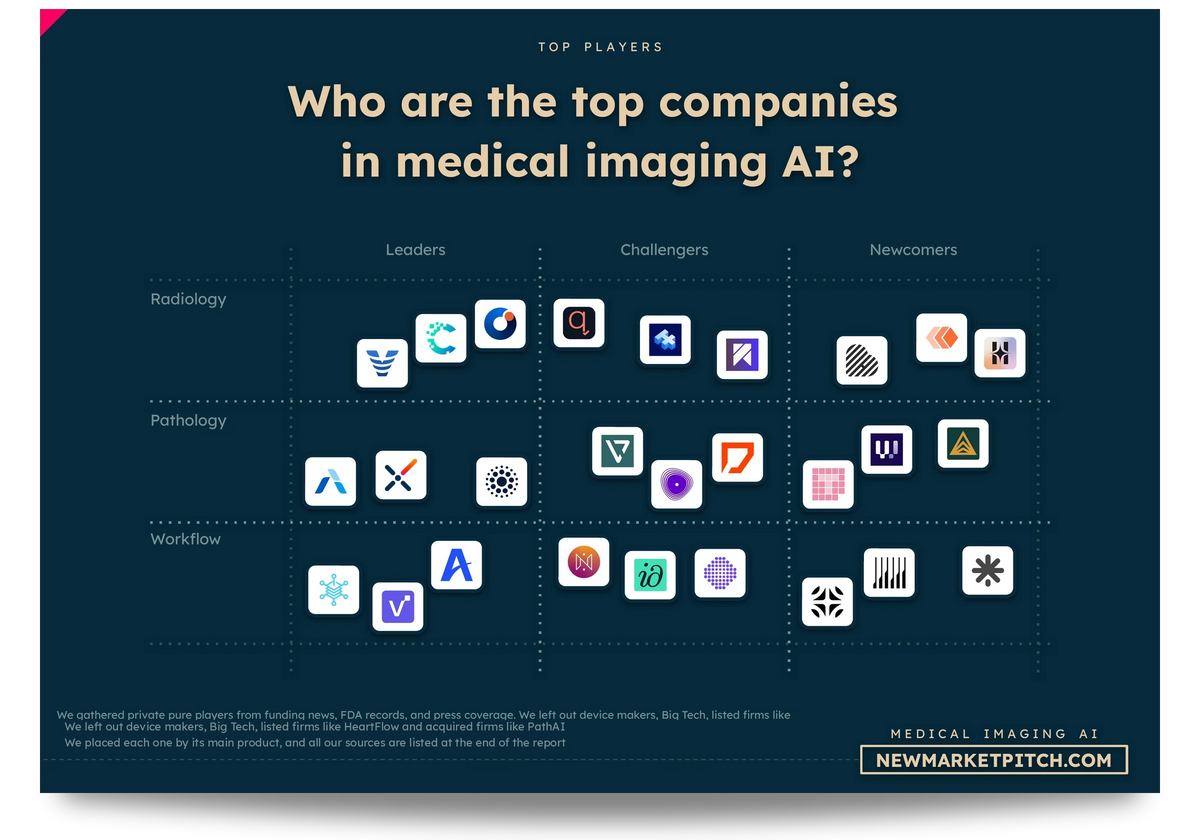
In our research about AI for medical imaging, we turn what is vague and complex into simple, useful visuals. Market maps like this one show you at a glance where every startup stands.
Is Insight Partners still writing medical imaging AI checks?
Insight Partners is still the overall activity leader in medical imaging AI, but it has joined no qualifying new round this year.
Its latest recorded participation was Optain's Series A in September 2025. Earlier investments included Cleerly's Series C in December 2024, Pictor Labs' Series B in September 2024 and Proscia's Growth Equity round in March 2025. They cover coronary CT analysis, tissue imaging and pathology software. The common feature is a product that clinicians or laboratories can use repeatedly.
Insight Partners also invests in broader healthcare software. Those investments cannot count toward our medical imaging AI round total. Its existing portfolio remains relevant, but founders looking for firms that have written new checks this year should look beyond the cumulative leader.
Why has Insight Partners backed imaging AI in so many fields?
Insight Partners has backed medical imaging AI startups that sell recurring clinical software, even when their products handle very different images.
We track 4 startups it supported: Cleerly, Proscia, Optain and Pictor Labs. Cleerly uses coronary CT for plaque analysis, Proscia sells pathology workflow tools, Optain uses retinal images for screening, and Pictor Labs develops virtual staining. Their clinical buyers differ, but all need products doctors or laboratories can fit into everyday work.
Cleerly announced Medicare contractor coverage for coronary plaque analysis in October 2024. Proscia described both pathology diagnostic workflows and pharmaceutical customers during its March 2025 financing. An Insight Partners profile of Pictor Labs discussed the launch of its ClearStain software. These are useful examples of commercial progress, although they do not tell us the private returns on Insight Partners' investments.

Your time is limited. In our market report about AI for medical imaging, we put numbers on each part of the market, so you can see where it makes sense to focus.
Which medical imaging AI investors are still investing this year?
Twin Path Ventures and Mayo Clinic are tied as the busiest medical imaging AI investors this year, each joining 2 rounds.
Insight Partners has not joined a new qualifying financing this year despite leading the whole-window ranking. Of the 20 investors in our leading group, 9 have joined a round this year and 11 have not. That difference matters to a startup looking for investors who are currently active, rather than those with the longest historical track record.
Twin Path Ventures has backed young pathology and image-analysis teams including TileBio and Octopath AI. Mayo Clinic has joined rounds involving Techcyte and ViewsML Technologies, while also helping develop and deploy pathology technology. They appear together at the top of this year's activity count, but the kind of support they offer can be quite different.
The table below shows, year by year, how many rounds 12 of the most active medical imaging AI investors joined, so it is easy to see who is still investing and who has slowed down.
If you want to go more into detail and see which investors are still writing checks and which have slowed down, please check our medical imaging AI report.
| Investor | 2024 | 2025 | 2026* | Total |
|---|---|---|---|---|
| Twin Path Ventures | 1 | 2 | 3 | |
| Mayo Clinic | 1 | 2 | 3 | |
| Avidity Partners | 1 | 1 | 2 | |
| Heal Capital | 1 | 1 | 2 | |
| Parkwalk Advisors | 1 | 1 | 2 | |
| GO Capital | 1 | 1 | 2 | |
| BSK Investment | 1 | 1 | 2 | |
| Starset Investment | 1 | 1 | 2 | |
| ZEISS Ventures | 1 | 1 | 2 | |
| Insight Partners | 2 | 2 | 4 | |
| Elaia Partners | 2 | 1 | 3 | |
| Khosla Ventures | 1 | 1 | 2 |
* 2026: January to 13 November. Darker cells mean more rounds that year. Data from January 2024 through 13 November 2026.
Are specialist investors more active than famous VCs in imaging AI?
No, Insight Partners leads medical imaging AI by participation count, although specialists and clinical institutions stand out in certain products and stages.
Among the most active firms are Twin Path Ventures, Elaia Partners and Mayo Clinic. Avidity Partners has returned to Sirona Medical's radiology platform, Heal Capital has backed surgical image analysis, and Parkwalk Advisors has financed Brainomix through later rounds. GO Capital has backed BrightHeart and Avatar Medical, while Khosla Ventures has backed Rad AI and a2z Radiology AI.
A startup building diagnostic models may need access to clinicians and data before a national sales team. A company already serving hospitals may need an investor used to larger software contracts. Avidity Partners' support of Sirona Medical and Mayo Clinic's digital pathology collaborations show why the biggest brand name alone is a poor way to choose a backer.
Is Khosla Ventures a leading investor in radiology AI?
Khosla Ventures is a recognizable backer of medical imaging AI, but it has not joined as many qualifying rounds as the market's most active investors.
We identified 2 rounds involving Rad AI and a2z Radiology AI, both with Khosla Ventures named as lead. Its largest joined round was Rad AI's $50M Series B in May 2024. Rad AI helps radiologists prepare reports and manage work, giving a general AI investor a concrete healthcare software business to back.
When Rad AI raised a $60M Series C in January 2025, its announcement named Transformation Capital as lead and Khosla Ventures as an existing participant. Joining a later round does not mean leading it. The important point is that Khosla Ventures has backed radiology workflow software, while its frequency of participation remains below the leaders in this market-specific count.
Is Elaia Partners a major investor in European imaging AI?
Yes, Elaia Partners is among the more active European medical imaging AI investors, having joined 3 qualifying rounds.
Its investments covered inHEART, Primaa and Pixacare. inHEART makes image-derived models for cardiac procedures, Primaa analyzes digital pathology slides, and Pixacare uses clinical images in wound monitoring. Elaia Partners was named as lead in 2 of the rounds where the lead was known. Its latest recorded participation was Primaa in October 2025.
These are not identical healthcare software businesses. Each needs clinicians to adopt image-based tools in a particular part of care. For founders selling specialized imaging software in Europe, that history is more useful than knowing a much larger investor has backed a healthcare AI company somewhere else.

In our document detailing everything you need to know about medical imaging AI, we always try to gather several sources and make estimates that make sense, so you can work with solid numbers.
Is Mayo Clinic actually investing in medical imaging AI startups?
Yes, Mayo Clinic has joined 3 qualifying medical imaging AI financing rounds, alongside its clinical research and deployment work.
The startups are AIgnostics, Techcyte and ViewsML Technologies. Mayo Clinic joined 2 rounds this year and was not named as lead in any of the rounds we counted. Its potential contribution is different from that of a fund that focuses mainly on financial returns: clinical expertise, pathology data and real hospital workflows can help a product develop.
Mayo Clinic announced a digital pathology effort with AIgnostics and NVIDIA in January 2025. It later described rolling out a co-developed AI-enabled pathology platform with Techcyte. ViewsML's financing announcement also identified Mayo Clinic as a participant. An investment, a research agreement and an actual software deployment are different things, but Mayo Clinic has been involved in all of those kinds of activity.
Are medical imaging equipment companies funding AI startups?
Yes, medical equipment and diagnostics companies are directly backing imaging AI startups whose software could complement clinical hardware.
ZEISS Ventures joined 2 qualifying rounds, involving Hypervision Surgical and MindPeak, and was named lead in 1. GE HealthCare led Laza Medical's Series B in November 2026, announced as up to $160M of structured financing for intelligent imaging during cardiac catheterization procedures. These companies bring knowledge of clinical equipment, which can be valuable when software has to work inside an operating room or imaging suite.
ZEISS has disclosed its MindPeak investment, and Hypervision Surgical uses hyperspectral images to guide surgery. Laza Medical's funding announcement described future robotic interventions alongside its imaging technology. None of those investments guarantees a distribution agreement, but they show why imaging vendors may want to help develop software close to their equipment businesses.
Which medical imaging AI investors back seed rounds, and which back growth rounds?
Seed is the busiest known medical imaging AI stage, with 52 of 141 rounds, and Twin Path Ventures is its most active investor with 3 joined rounds.
At the other end, 32 rounds were Series C or later. Parkwalk Advisors was most active at Series C with 2 joined rounds, while NVIDIA led the Series D+ activity count with 2. Early model developers and established hospital software vendors tend to bring different evidence to their investors.
Twin Path Ventures backed TileBio, EnAcuity and Octopath AI at Seed. Parkwalk Advisors supported Brainomix, whose products analyze stroke and lung imaging. NVIDIA's AI infrastructure collaborations extend beyond its equity participation, so a computing partnership should not automatically be counted as a funding round. These stage totals describe rounds, never the investors' individual check sizes.
The table below shows, for 12 of the most active medical imaging AI investors, how many rounds they joined at each stage, from seed to growth.
If you want to go more into detail and see where each investor places its bets, from seed to growth, please check our medical imaging AI report.
| Investor | Seed | Series A | Series B | Series C | Series D+ | Growth |
|---|---|---|---|---|---|---|
| Insight Partners | · | 1 | 1 | 1 | · | 1 |
| Twin Path Ventures | 3 | · | · | · | · | · |
| Elaia Partners | 1 | 2 | · | · | · | · |
| Mayo Clinic | 1 | · | 1 | · | · | · |
| Avidity Partners | · | · | · | 1 | 1 | · |
| Heal Capital | 1 | 1 | · | · | · | · |
| Parkwalk Advisors | · | · | · | 2 | · | · |
| GO Capital | 1 | 1 | · | · | · | · |
| Khosla Ventures | 1 | · | 1 | · | · | · |
| North Ventures | · | 2 | · | · | · | · |
| id4 ventures | 2 | · | · | · | · | · |
| Eventide Asset Management | · | · | 2 | · | · | · |
Most active at each stage, among all medical imaging AI investors: Seed, Twin Path Ventures · Series A, 6 investors tied with 2 rounds · Series B, 5 investors tied with 2 rounds · Series C, Parkwalk Advisors · Series D+, NVIDIA · Growth, no investor joined more than one round. Bigger dots mean more rounds. Data from January 2024 through 13 November 2026.

Our report covering the medical imaging AI market gets updated several times a month, so you always get the latest view of where things stand.
Are medical imaging AI Seed investors betting only on pathology?
No, medical imaging AI Seed investors also back radiology models, breast imaging and surgical guidance, alongside pathology.
Twin Path Ventures backed TileBio, EnAcuity and Octopath AI across 3 Seed rounds. TileBio builds tissue-image models and Octopath AI develops pathology analysis, while EnAcuity works on hyperspectral surgical imaging. Newfund participated in 2 Seed financings involving Raidium and Diagnoly; Kurma Partners backed Raidium and Spotlight Medical; LUMO Labs backed Nuclivision and Sycai Medical.
TileBio's financing announcement discussed early model work and recruitment. Octopath AI has developed its Kraken pathology model and participated in the UK's AI Airlock program. Raidium is pursuing a more general medical-image foundation-model approach. None of those milestones proves a company can sell at scale, but they explain why Seed investors can back more than one kind of imaging problem.
Can imaging AI startups still find backers after Series C?
Yes, medical imaging AI investors continue writing later-stage checks, although repeat investors at those stages are less common.
Parkwalk Advisors joined 2 Series C rounds for Brainomix. NVIDIA had the highest Series D+ participation with 2 rounds. Avidity Partners also returned to Sirona Medical as the company moved between later stages. These investors are not all competing to lead the earliest model experiments.
Parkwalk Advisors participated in Brainomix's Series C and its later extension, while Sirona Medical reported more than 12 million primary imaging exams per year under contract when it announced expansion financing. The contracted volume is company-reported, but it gives investors something to examine beyond model accuracy. Later-stage checks can depend on clinical adoption and the ability to support real customers.
Who keeps backing Sirona Medical as it grows?
Avidity Partners has repeatedly backed Sirona Medical, the radiology software developer, through its later medical imaging AI financings.
We recorded 2 joined rounds, with Avidity Partners named lead in both. That includes Sirona Medical's $40M Series D+ in October 2026, following its Series C in November 2024. Avidity Partners' participation is concentrated in one company rather than spread across rival radiology platforms.
Sirona Medical said its RadOS platform served dozens of contracted customers across hundreds of connected sites. The contracts represent commercial progress, though we cannot infer profit or investor returns from customer figures alone. For founders building software that hospitals use every day, an investor willing to return after the first major round may be especially relevant.

In our research about AI for medical imaging, we look at what the winners do differently, so you can learn from the best instead of guessing.
Is NVIDIA now a major medical imaging AI investor?
NVIDIA is the most active Series D+ medical imaging AI investor in our stage figures, but its technology partnerships reach much further than its counted equity rounds.
The company participated in 2 Series D+ rounds. NVentures, NVIDIA's investment arm, joined Aidoc's April 2026 financing, which was led by Growth Equity at Goldman Sachs Alternatives. It would be wrong to treat NVIDIA as lead on that financing just because it supplies important AI technology to hospitals and imaging developers.
Mayo Clinic has worked with NVIDIA on digital pathology models and computing infrastructure. Such collaborations can influence what medical imaging AI startups build, even where there is no new equity transaction. Investors and founders should distinguish NVIDIA's hardware and software role from the narrower question of which financing rounds it joined.
Are Labcorp and Quest Diagnostics backing pathology AI?
Yes, Labcorp and Quest Diagnostics have invested alongside financial backers in PreciseDx, a pathology-image AI startup focused on cancer testing.
Labcorp and Quest Diagnostics each joined 2 PreciseDx rounds alongside Eventide Asset Management. PreciseDx analyzes breast cancer pathology images, so laboratory operators have a direct reason to watch the technology's clinical development. Their involvement does not prove the labs bought or deployed its product.
PreciseDx's June 2025 announcement identified Eventide Asset Management, Merck Global Health Innovation Fund and Philips Ventures as leaders of an $11M round, with Labcorp and Quest Diagnostics participating. The company discussed additional clinical data and work toward commercial use. For this kind of imaging software, laboratory knowledge may be useful well before a product becomes standard practice.
Which medical imaging AI investors most often invest together?
No single pair leads medical imaging AI co-investment: 4 pairs are tied at 2 joined rounds together each.
ACE Global Equity and Santé Ventures appeared together in financing for Clairity. The other repeated pairs involved Eventide Asset Management, Labcorp and Quest Diagnostics, all connected through PreciseDx. Each leading pair returned to 1 startup rather than jointly funding many different imaging companies.
That pattern is easy to overinterpret. A group of investors can support the next round for a company they already know without operating as an exclusive alliance. The Clairity and PreciseDx examples show repeat backing of individual clinical products, not a standing network that invests in every medical imaging AI segment.
The table below lists the pairs of medical imaging AI investors named together in at least two equity rounds, with the startups they backed together.
If you want to go more into detail and see which investor networks back the same startups, please check our medical imaging AI report.
| Investor pair | Rounds together | Startups backed together |
|---|---|---|
| ACE Global Equity + Santé VenturesClairity | 2 | Clairity |
| Eventide Asset Management + LabcorpPreciseDx | 2 | PreciseDx |
| Eventide Asset Management + Quest DiagnosticsPreciseDx | 2 | PreciseDx |
| Labcorp + Quest DiagnosticsPreciseDx | 2 | PreciseDx |
Pairs of investors named in the same equity round. Data from January 2024 through 13 November 2026.
Does an imaging AI investor have to lead rounds to matter?
No, medical imaging AI companies can benefit from investors that offer clinical access or technical expertise without leading a financing.
Mayo Clinic joined 3 qualifying rounds without being identified as lead. ZEISS Ventures joined 2 rounds and was named lead in 1. The amount each participant personally invested is not publicly established by those counts, and the size of a company round cannot be assigned to its most recognizable participant.
Mayo Clinic's work with Techcyte links pathology image software with hospital processes; ZEISS is involved in image-based technologies connected to optical equipment. Those relationships may help a startup test or explain its product to clinical buyers. They are different from the job of negotiating and leading a venture round, and neither automatically guarantees a sale.

In our market report about AI for medical imaging, we don't want to repeat what boring consulting reports say. Instead, we show you the real and latest market signals that matter.
Is GE HealthCare the biggest medical imaging AI investor?
No, GE HealthCare led a closely watched medical imaging AI round, but Insight Partners joined the most financing rounds in the market.
GE HealthCare led Laza Medical's Series B in November 2026, announced as structured financing of up to $160M. Laza has not published the committed amount, so we do not treat it as the market's largest round: that place goes to Aidoc's $150M in April 2026, led by Growth Equity at Goldman Sachs Alternatives. Insight Partners has the highest repeat participation count across our full coverage window. A round's size is not the amount its lead investor personally contributed, and it cannot be compared with private check sizes from other investors.
GE HealthCare's involvement reflects its expertise in imaging equipment used during cardiac interventions. Insight Partners has backed separate businesses in coronary CT analysis, pathology software and retinal screening. For a startup, those are different potential partners. A headline deal shows who led that financing; it does not tell us which firm most often backs medical imaging AI founders.
So, who are the biggest investors in medical imaging AI today?
Insight Partners is the most active medical imaging AI investor by cumulative rounds joined, while Twin Path Ventures and Mayo Clinic are the most active this year.
Insight Partners has backed multiple clinical software businesses, but its latest recorded participation was last year. Twin Path Ventures focuses on early medical-image products, and Mayo Clinic brings clinical research and hospital experience alongside investment. Elaia Partners has backed European companies with distinct clinical image-analysis tools. No one investor leads every stage or clinical product category.
For founders, the useful distinction is between an investor who makes Seed bets, one who returns for later rounds, and a company or institution that can help a product reach clinicians. The largest financing announcement alone will not identify the most active backer. In medical imaging AI, the right investor depends on the product and how far it has progressed.
The table below shows what we found.
| Question | Answer |
|---|---|
| Does one investor repeatedly dominate every imaging stage? | No, market leadership changes when we distinguish stages and current activity. Insight Partners joined 4 rounds across the complete observation window. Seed and later-stage leaders differ, so founders need stage-specific targets. |
| Has the most active backer kept investing recently? | No, the cumulative leader has gone quiet in new deals. Insight Partners joined no qualifying new round this year. Its earlier portfolio still matters, but current activity belongs elsewhere. |
| Are recent imaging AI checks led by one firm? | No, the busiest current investors share the top activity position. Twin Path Ventures and Mayo Clinic have joined 2 rounds each. Their approaches differ between early products and clinician-linked investment activity. |
| Is early imaging AI funding concentrated in Seed? | Yes, Seed is the busiest stage in named medical imaging rounds. We identified 52 Seed financings among rounds with known stages. Early model developers need different partners from mature hospital software vendors. |
| Have technical Seed specialists become more visible? | Yes, small funds are backing novel image-analysis products at inception. Twin Path Ventures joined 3 qualifying Seed rounds in our research. Pathology models are important, but its activity also reaches surgical imaging. |
| Can European firms lead meaningful imaging investments? | Yes, European investors back several kinds of clinically focused imaging software. Elaia Partners joined 3 qualifying rounds during our covered window. Its companies span cardiac planning, pathology analysis and wound imaging. |
| Are hospitals participating in imaging AI financing? | Yes, clinical institutions now appear alongside conventional venture capital firms. Mayo Clinic participated in 3 qualifying imaging AI rounds. Its clinical collaborations can matter even without leading a financing. |
| Can a venture fund keep supporting one vendor? | Yes, repeat financing of the same software company is visible. Avidity Partners joined 2 rounds for Sirona Medical in our research. That reflects continuing support, not necessarily diversification across many startups. |
| Do imaging equipment makers fund software innovation? | Yes, industry companies have joined funding rounds for complementary technologies. ZEISS Ventures participated in 2 qualifying medical imaging AI rounds. Commercial links may help, though financing does not guarantee distribution contracts. |
| Do laboratory investors frequently back multiple pathology startups together? | Not among the leading repeated pairs observed in this market. Eventide Asset Management and Labcorp joined 2 shared PreciseDx rounds. Their repeated collaboration centers on one company, not an established network. |
| Does the biggest check identify the most active investor? | No, one large financing cannot measure repeat investor participation accurately. Growth Equity at Goldman Sachs Alternatives led Aidoc's $150M round in April 2026. Insight Partners still leads the cumulative deal count by participation. |

Learning from others' mistakes is the cheapest lesson there is. In our document detailing everything you need to know about medical imaging AI, we look at what broke startups before you, so you don't repeat it.
Our methodology
Our data runs through November 13, 2026. We track equity financings systematically from January 2024 through that date, deal by deal, to identify who is active in medical imaging AI today. The market includes AI software that interprets, measures, reconstructs, enhances or manages clinical images across radiology, ultrasound, dental imaging and digital pathology. We include substantial image-AI businesses on category boundaries rather than excluding them; every company counted meets our definition of a startup founded in 2000 or later, independent and technology-led, with only recently listed or recently acquired exceptions under our stated rules.
We count the equity rounds each investor joined and the rounds in which it was identified as a lead, not the dollars that investor committed. IPOs and post-listing offerings are excluded. We reconcile investor names across announcements and reliable reporting, merge duplicate descriptions of the same round, and exclude vague references such as "existing investors" when individual firms are not named. The column for the current year begins in March, once there are three months of data.
Announcements name lead investors more reliably than smaller participants, so rounds that an investor joined without leading are undercounted and lead rates are an upper bound.
Rounds confirmed by a company announcement, a press article or a regulatory filing are counted in full. Where no article exists, a round is counted only when at least two recognised databases agree on its date (within one month) and amount (within 5%), and it is marked as low confidence; a round found in a single database stays in the company's history but is left out of totals. For companies that have raised more than $100M, every round counted is backed by an article.
Commercial investor directories are not used on their own to establish who joined a financing, because they can add unnamed participants, confuse loans with equity or repeat the same firm under different labels. Our research has 151 rounds with at least 1 named investor out of 173 rounds examined, representing 87%. Round activity is therefore a documented minimum for every investor rather than a claim to list every undisclosed participant.
The deal counts in an investor study need not match a funding-tracker company's display: the investor ranking only uses rounds in which an investor is identified, and a single round can appear once under every named participating firm. We use rounds joined because it measures repeat commitment without inventing private check sizes. A famous specialist fund with few qualifying appearances may be highly influential in healthcare overall, but that is not evidence it financed more independent medical imaging AI rounds inside this carefully defined window.
Key sources include Insight Partners' discussion of its imaging and healthcare software portfolio, Cleerly Series C led by Insight Partners, Cleerly's Medicare contractor coverage context, Proscia financing led by Insight Partners and pathology deployment, Pictor Labs financing and ClearStain product development, Insight Partners' Optain investment profile, Khosla Ventures-led Rad AI Series B and radiology reporting product, Rad AI later Series C led by Transformation Capital, inHEART's imaging-based cardiac software financing and Elaia participation, Elaia news on Primaa and other portfolio financing, Pixacare identification of Elaia as an investor, Mayo Clinic digital pathology, NVIDIA and AIgnostics collaboration, Mayo Clinic and Techcyte clinical deployment announcement, ViewsML financing with Mayo Clinic participation, TileBio Seed financing led by Twin Path Ventures, Octopath AI clinical AI development and seed investor, Brainomix Series C extension led by Parkwalk Advisors, Sirona Medical Series D led by Avidity Partners and product use, ZEISS Ventures investment in MindPeak, Hypervision Surgical Series A with ZEISS Ventures participation, PreciseDx financing participants including laboratories and Eventide, GE HealthCare-led Laza Medical November 2026 financing, and Aidoc financing including NVentures participation.

If you build or invest in the medical imaging AI market, you need to know which business models pay off now and which ones are fading. That's why our report covering it has a whole section on it.
Written by the New Market Pitch teamWe track new markets so founders and investors can move faster. About us