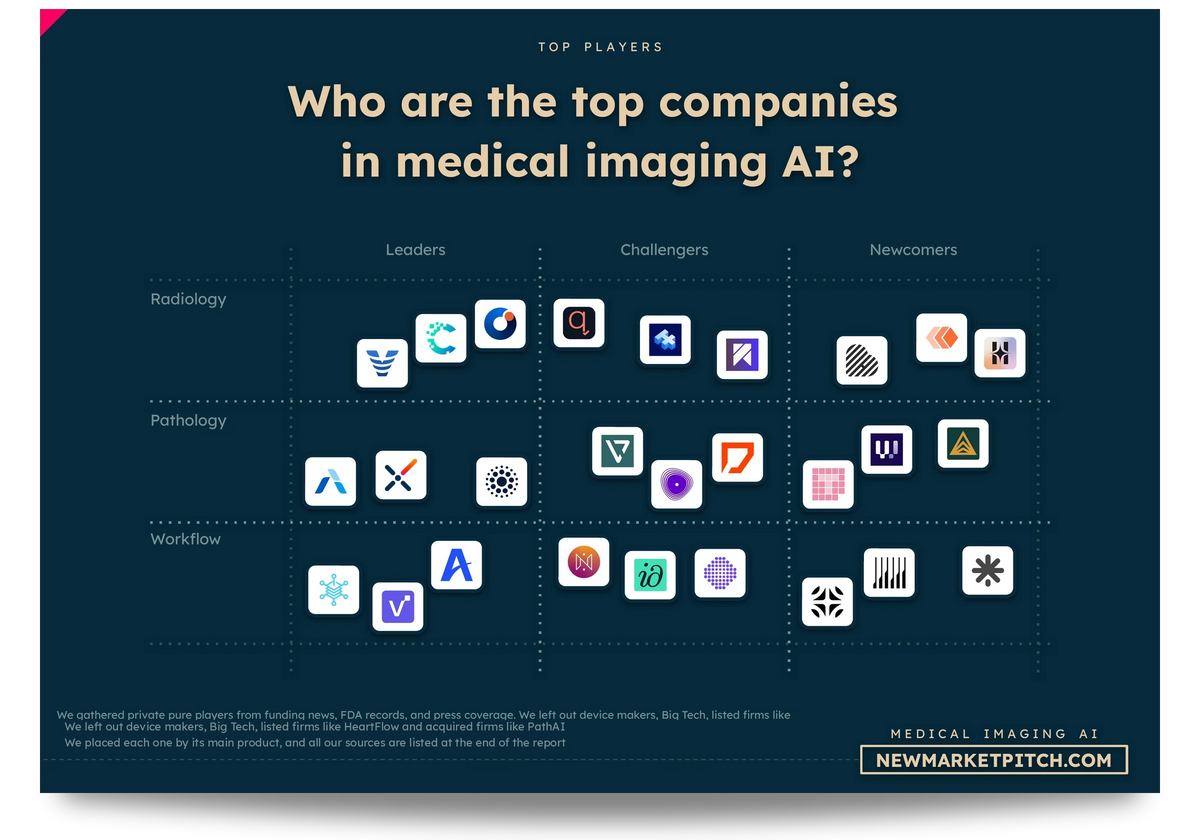
What are the top medical imaging AI startups by total funding raised?
Whether you're building or investing in the medical imaging AI market, our report covers everything you need to know: the players, the money, and what's coming next.
Summary
HeartFlow leads medical imaging AI startups by lifetime equity raised, with $806M. Aidoc follows at $436M and Cleerly at $372M. The leader is already public, while its closest challengers remain private.
HeartFlow's IPO played a big part in that lead. It brought in $364M in primary proceeds, and HeartFlow's cumulative funding is now 1.8x Aidoc's.
The two closest challengers have very different businesses. Aidoc helps hospitals detect urgent findings and act on them, while Cleerly analyzes coronary CT scans. Similar funding totals do not mean the two sell the same thing.
The next surprise comes from outside radiology departments. DentalMonitoring raised $300M for orthodontic image analysis, while Chinese retinal-screening company Airdoc raised at least $252M.
Tissue images also attract serious investment. PathAI raised at least $236M, and Paige raised $190M before Tempus acquired it. Agilent's acquisition of Proscia shows another way that pathology AI companies can grow.
The rest of the top 10 tells a similar story. Shukun Technology ($181M) works on CT analysis, Viz.ai (at least $171M) on stroke alerts and Lunit ($162M) on cancer imaging. Investors are backing different parts of the same clinical journey.
Those big numbers are unusual. Among the 171 medical imaging AI startups we track, 150, or 88%, are below nine figures. The best-known companies tell only part of the story.
The United States is home to 49 of these companies, representing 29%. France, the United Kingdom, China, Israel and South Korea also have substantial players, often focused on different types of medical images.
Some leaders still raise new equity, while others are already public or have been acquired. A company's lifetime total can remain high for years after its last private round.
So HeartFlow is the clear fundraising leader, but there is no single way to build a well-funded medical imaging AI company. The real differences appear in the images each startup analyzes, the customers it serves and whether its software has become part of everyday care.

Written by the New Market Pitch teamWe track new markets so founders and investors can move faster. About us

In our report covering the medical imaging AI market, you will always find fresh funding data, taken straight from our own verified funding database.
Top startups in the medical imaging AI market ranked by total funding raised
Here is the current ranking of the medical imaging AI startups that raised the most, with the total each one has raised and our confidence level.
If you want to go deeper into the medical imaging AI startup landscape, check our report covering the medical imaging AI market.
| # | Startup | Total raised | Last round | Status | Confidence |
|---|---|---|---|---|---|
| $500M to $1B | |||||
| 1 | HeartFlowAI coronary artery disease diagnostics | $806M1 | Aug 2025$364M · IPO | IPO | Full |
| $100M to $500M | |||||
| 2 | AidocAI radiology diagnostic decision support | $436M | Apr 2026$150M · Series E | Active | Strong |
| 3 | CleerlyAI-powered coronary artery disease analysis | $372M | Dec 2024$106M · Series C | Active | Strong |
| 4 | DentalMonitoringAI orthodontic treatment monitoring | $300M | Feb 2026$100M · Growth equity | Active | Full |
| 5 | AirdocAI-powered medical screening and diagnostics | $252M+1 | Nov 2021$214M · IPO | IPO | Full |
| 6 | PathAIAI-powered digital pathology diagnostics | $236M+ | May 2021$165M · Series C | Active | Partial |
| 7 | Paigewhole-slide cancer image analysis and diagnostic ai | $190M | Jan 2021$100M · Series C | Acquired | Full |
| 8 | Shukun TechnologyAI-powered medical imaging diagnostics | $181M | Feb 2022Undisclosed · Strategic equity | Active | Full |
| 9 | Viz.aiAI-powered disease detection and care coordination | $171M+ | Apr 2022$100M · Series D | Active | Full |
| 10 | LunitAI cancer imaging and diagnosis | $162M1 | Jul 2022~$28M · IPO | IPO | Low |
| 11 | OverjetAI-powered dental radiograph analysis | $156M | Dec 2025$25M · Series C-1 | Active | Full |
| 12 | Rad AIAI radiology reporting and workflows | $147M+ | May 2025$8M · Series C extension | Active | Strong |
| 13 | Harrison.aiAI radiology and pathology diagnostics | $131M+ | Feb 2025$112M · Series C | Active | Full |
| 14 | ProsciaAI-powered digital pathology platform | $129M | Mar 2025$50M · Growth equity | Acquired | Strong |
| 15 | Scopio LabsAI blood smear microscopy and analysis | $125M | Jul 2025$10M · Series D+ | Active | Strong |
| 16 | Sirona MedicalCloud-native AI radiology software | $122M+ | Oct 2026$40M · Series D | Active | Full |
| 17 | Qure.aiAI radiology disease detection | $121M | Sep 2024$65M · Series D | Active | Partial |
| 18 | ArteraAIAI cancer treatment decision tests | $110M | Feb 2024$20M · Other | Active | Full |
| 19 | AI Medical ServiceAI-assisted endoscopic cancer detection | $108M | Apr 2022$54M · Series C | Active | Full |
| 20 | Ibex Medical AnalyticsAI-powered digital pathology diagnostics | $104M | Sep 2023$55M · Series C | Active | Full |
| 21 | UltromicsAI-powered cardiac ultrasound diagnostics | $101M+ | Jul 2025$55M · Series C | Active | Full |
| Below $100M | |||||
| 22 | Keya MedicalAI coronary CT analysis | $96M+ | Jan 2021$46M · Series D | Active | Full |
| 23 | Aiforia TechnologiesAI-powered digital pathology image analysis | $76M1 | Dec 2021$32M · IPO | IPO | Strong |
| 24 | AIgnosticsAI-powered computational pathology diagnostics | $76M | Oct 2024$34M · Series B | Active | Full |
| 25 | Digital DiagnosticsAutonomous AI diagnostic screening | $75M | Aug 2022$75M · Series B | Active | Full |
| 26 | DeepwiseAI medical imaging diagnosis | $70M+ | Jan 2025$70M · Series D | Active | Full |
| 27 | PearlAI-powered dental X-ray diagnostics | $69M | Dec 2024Undisclosed · Other | Active | Partial |
| 28 | ElucidAI cardiovascular CT image analysis | $65M | Sep 2026$55M · Series D | Active | Partial |
| 29 | QuibimAI quantitative medical imaging biomarkers | $65M | Jan 2025$50M · Series A | Active | Partial |
| 30 | VideaAI dental X-ray diagnostics | $65M+ | Jan 2025$40M · Series B | Active | Partial |
| 31 | AIRS MedicalAI-powered MRI reconstruction and optimization | $61M | Sep 2026$22M · Series D | Active | Strong |
| 32 | BrainomixAI-powered stroke and lung imaging | $59M+ | Feb 2026~$6.5M · Series C | Active | Strong |
| 33 | Nucleaiai tissue image profiling for oncology precision medicine | $58M | Apr 2024$14M · Series B | Active | Partial |
| 34 | DeciphexAI digital pathology workflows | $57M | Jan 2025$32M · Series C | Active | Strong |
| 35 | Techcyteai digital microscopy and clinical pathology diagnostics | $53M | Apr 2026$15M · Other | Active | Full |
| 36 | Incepto MedicalMedical imaging AI platform | $52M | Sep 2026$16M · Growth equity | Active | Full |
| 37 | SigTupleAI-powered digital pathology microscopy | $50M+ | Aug 2024~$3.9M · Series C extension | Active | Partial |
| 38 | Pictor LabsAI virtual histology staining | $49M | Sep 2024$30M · Series B | Active | Strong |
| 39 | EdenRadiology workflow and AI platform | $47M | Oct 2025$22M · Series A | Active | Strong |
| 40 | ScreenPoint MedicalAI breast cancer screening | $47M | Apr 2026$14M · Series C extension | Active | Strong |
| 41 | CathWorksAI-guided coronary physiology assessment | $46M+ | Feb 2019$30M · Series C | Acquired | Full |
| 42 | Huiyi HuiyingAI medical imaging diagnosis platform | $45M+ | Jul 2021Undisclosed · Equity financing | IPO | Low |
| 43 | Smart ReportingAI medical reporting automation | $45M+ | Apr 2024~$24M · Series C | Active | Partial |
| 44 | OptainAI retinal disease detection | $45M | Sep 2026$7.5M · Series A extension | Active | Partial |
| 45 | Imagene AIAI pathology biomarker analysis | $44M | Jul 2025$23M · Series B | Active | Strong |
| 46 | Subtle MedicalAI-enhanced MRI and PET imaging | $43M | Jun 2026$33M · Series C | Active | Strong |
| 47 | ClairityAI-powered breast cancer risk prediction | $43M+ | Nov 2025$43M · Series B | Active | Full |
| 48 | PreciseDxAI pathology diagnostics for cancer care | $42M | Jun 2025$11M · Series B | Active | Full |
| 49 | GleamerAI radiology interpretation and detection | $40M | Jun 2023$30M · Series B | Acquired | Strong |
| 50 | Vista AIAutomated MRI scanning software | $38M+ | Jan 2026$30M · Series B | Active | Strong |
| 51 | UltraSightAI-guided cardiac ultrasound imaging | $37M | Sep 2026$24M · Series B2 | Active | Strong |
| 52 | aetherAIdigital pathology ai slides and whole-slide analysis | $37M+ | 2024$24M · Series B | IPO | Full |
| 53 | ArtryaAI-powered coronary artery disease diagnosis | $36M1 | Nov 2021$26M · IPO | IPO | Full |
| 54 | CerebriuAI-powered MRI workflow automation | $36M+ | Aug 2025$11M · Series A | Active | Partial |
| 55 | Laza MedicalAI-powered robotic cardiac imaging systems optimize catheterization-lab image acquisition and support image-guided intervention. | $36M+ | Nov 2026Undisclosed · Series B | Active | Full |
| 56 | MediwhaleAI retinal cardiovascular risk prediction | ~$35M | Mar 2026~$13M · Series C | Active | Partial |
| 57 | WaivAI-powered precision oncology pathology testing | $35M | Apr 2026$2M · Series A | Active | Full |
| 58 | HutomAI surgical planning and navigation | $34M | Mar 2024$15M · Series C | Active | Full |
| 59 | EyenukAI eye disease screening | $33M | Jun 2026$5.6M · Series A extension | Active | Partial |
| 60 | See All AIAI intraoperative 3D imaging navigation | $33M | May 2025$33M · Series A | Active | Partial |
| 61 | HOPPRmedical image foundation models and developer platform | $32M | Jun 2025$32M · Series A | Active | Full |
| 62 | Hypervision SurgicalHyperspectral imaging for surgery | $31M+ | Apr 2026~$23M · Series A | Active | Low |
| 63 | VIDA DiagnosticsAI-powered lung imaging analysis | $29M | Sep 2023$11M · Equity financing | Active | Partial |
| 64 | inHEARTAI cardiac imaging digital twins | $28M+ | Oct 2024$825K · Series A | Active | Strong |
| 65 | Medical Image InsightsAI infrastructure for medical imaging | $28M+ | Oct 2025$14M | Active | Full |
| 66 | Omniscient NeurotechnologyBrain mapping software from MRI scans | $27M+ | May 2026$27M · Series D+ | Active | Full |
| 67 | deepcAI integration platform for radiology | $26M+ | Jul 2024$13M · Series A extension | Active | Full |
| 68 | Skin AnalyticsAI skin cancer screening | $26M+ | Apr 2025$19M · Series B | Active | Partial |
| 69 | PromediusAI imaging analysis for age-related disease | $26M+ | Jun 2026$16M · Series B | Active | Full |
| 70 | Valar LabsAI cancer treatment response diagnostics | $26M | May 2024$22M · Series A | Active | Full |
| 71 | RapidAIAI stroke imaging and triage | $25M | Sep 2020$25M · Series B | Active | Full |
| 72 | Ataraxis AIAI pathology tools for cancer prognosis | $24M+ | Mar 2025$20M · Series A | Active | Full |
| 73 | TherapixelAI mammography breast cancer detection | $23M | May 2022$16M · Series B | Active | Strong |
| 74 | Riverain Technologiesai chest ct and x-ray analysis | $23M | Dec 2025$8.2M · Other | Active | Full |
| 75 | Koios MedicalAI breast and thyroid ultrasound | $22M+ | Nov 2024$9.3M · Preferred-equity crowdfunding | Active | Low |
| 76 | Tribun HealthAI-powered digital pathology software | $22M | Sep 2023$16M · Series B | Active | Full |
| 77 | Kheiron Medical Technologiesai breast-screening mammography detection software | $22M | Sep 2019$22M · Series A | Acquired | Full |
| 78 | NeurophetAI neuroimaging and brain diagnostics | $21M+1 | Jul 2025$21M · IPO | IPO | Full |
| 79 | Cydar MedicalAI image-guided surgical planning | $21M | Feb 2023$12M · Series A | Active | Full |
| 80 | AZmedAI-powered radiology imaging analysis | $21M | Feb 2024~$16M · Series A | Active | Low |
| 81 | Medimaps GroupAI bone imaging analysis | $20M+ | Dec 2021$20M · Series A | Acquired | Full |
| 82 | Us2.aiAutomated AI echocardiography interpretation | $20M | Apr 2022$15M · Series A | Active | Strong |
| 83 | Method AIAI-assisted medical imaging interpretation | $20M | Aug 2025$20M · Series A | Active | Full |
| 84 | OptellumAI lung nodule cancer assessment | $19M+ | Jan 2026Undisclosed · Series B | Active | Partial |
| 85 | PrimaaAI breast cancer digital pathology | $19M+ | Oct 2025$8.1M · Venture equity | Active | Low |
| 86 | MedmainAI pathology image diagnosis platform | $19M | May 2025$3.2M · Series A | Acquired | Full |
| 87 | New LanternAI-native radiology workflow platform | $19M | Nov 2024$19M · Series A | Active | Full |
| 88 | MindPeakAI digital pathology cancer detection | $18M | Sep 2024$15M · Series A | Active | Full |
| 89 | Axial3DPatient-specific 3D medical models | $18M | Dec 2024$18M | Active | Full |
| 90 | Caristo DiagnosticsAI-powered cardiovascular imaging diagnostics | $17M | Apr 2023$17M · Series A | Active | Full |
| 91 | RaidiumFoundation models for radiology imaging | $17M+ | Nov 2024$17M · Seed | Active | Partial |
| 92 | VaraAI breast cancer screening platform | $16M | Oct 2024$8.9M · Series B | Active | Full |
| 93 | CARPL.aiRadiology AI marketplace and infrastructure | $16M | Jul 2026$10M · Series A | Active | Full |
| 94 | mediaireAI brain MRI analysis | $16M | Nov 2024$13M · Series A | Active | Strong |
| 95 | StratifAIAI cancer diagnostics from pathology images | $15M | Sep 2025$14M · Other | Active | Full |
| 96 | BrightHeartAI-powered prenatal ultrasound screening | $14M | Jan 2026$12M · Series A | Active | Full |
| 97 | IkerianAI retinal imaging and disease detection | $14M | Oct 2024$8M · Series B | Acquired | Full |
| 98 | Thorough FutureAI digital pathology diagnostics | $14M | Jun 2024$14M · Series A | Active | Full |
| 99 | AISAPAI ultrasound interpretation for clinical diagnosis | $13M | May 2024$13M · Seed | Active | Full |
| 100 | BarreleyePortable ultrasound imaging systems | $13M | Nov 2025$10M · Series A | Active | Full |
| 101 | Piur Imaging3D ultrasound imaging from standard probes | $12M | Jul 2025$6.2M · Growth equity | Active | Full |
| 102 | AllisoneAI-powered dental X-ray analysis | $11M+ | Sep 2022$11M · Seed | Active | Strong |
| 103 | Lucida MedicalAI prostate MRI cancer detection | $11M+ | Mar 2026$11M · Growth equity | Active | Partial |
| 104 | SkinVisionSmartphone AI skin cancer screening | $11M+ | Jul 2018$7.6M · Series A/B | Active | Partial |
| 105 | Avicenna.AIAI-powered emergency medical imaging | $11M+ | Feb 2023$7.7M · Series A | Active | Full |
| 106 | FloyAI assistance for medical imaging | $11M | Feb 2025$4M · Seed | Active | Full |
| 107 | XRlabsSurgical AI analyzes live clinical imaging and preoperative scans to guide procedures with real-time anatomical visualization. | $11M | Oct 2026$8.4M · Seed | Active | Full |
| 108 | DeepTekAI radiology workflow and diagnostics | $10M+ | Mar 2022$10M · Series A | Active | Partial |
| 109 | RetiSpecRetinal imaging tests for neurological disease | $10M | Jul 2024$10M · Series A | Active | Full |
| 110 | QritiveAI-powered cancer pathology diagnostics | $9M+ | Jan 2023$7.5M · Seed / Series A | Active | Partial |
| 111 | BrainreaderMRI brain volumetry for clinical decision support | $8.9M | May 2025$7.3M · Series A | Active | Full |
| 112 | VoioAI analysis for medical imaging | $8.6M | Nov 2025$8.6M · Seed | Active | Full |
| 113 | ThinkSonoAI-guided vascular ultrasound imaging | $8.5M+ | Jun 2025$5.8M · Series A extension | Active | Full |
| 114 | Springbok AnalyticsMRI-based muscle analytics software | $8M | Jan 2025$5M · Series A | Active | Full |
| 115 | Swift MedicalAI wound imaging and care management | $8M | Jan 2024$8M | Active | Full |
| 116 | Cercare MedicalBrain perfusion imaging and decision software | $7.8M | Mar 2025$7.8M | Active | Full |
| 117 | Mirada MedicalAI radiotherapy imaging software | $7.7M | Apr 2019~$7.7M · Growth equity | Active | Full |
| 118 | RevealDxAI lung nodule cancer assessment | $7.7M | Aug 2026$3.4M · Other | Active | Full |
| 119 | Gestalt DiagnosticsDigital pathology workflow and AI platform | $7.5M | Apr 2025$7.5M · Series A | Active | Full |
| 120 | UncovrSurgical video documentation and coding automation | $7M | Jun 2026$7M · Seed | Active | Full |
| 121 | Spotlight MedicalCancer prognostic assays for treatment decisions | $6.8M | Jul 2024$6.8M · Seed | Active | Full |
| 122 | DESKiAI-guided cardiac ultrasound imaging platform | $6M | Jun 2025~$6M · Seed | Active | Low |
| 123 | DiagnolyAI breast imaging decision support | $6M | Apr 2025$6M · Seed | Active | Full |
| 124 | NuclivisionAI analysis for nuclear medicine imaging | $5.7M | Apr 2025$5.7M · Seed | Active | Full |
| 125 | ThironaAI thoracic CT image analysis | $5.5M+ | Sep 2023$5.5M · Series B | Active | Low |
| 126 | Avatar MedicalVR medical imaging visualization software | $5.4M | Feb 2024~$5.4M · Seed | Active | Low |
| 127 | BrainSightAIBrain imaging analytics for clinical decisions | $5M | Jan 2025$5M · Seed | Active | Full |
| 128 | ViewsML TechnologiesAI pathology image analysis software | $4.9M | Apr 2026$4.9M · Seed | Active | Full |
| 129 | a2z Radiology AIAI software for radiology workflows | $4.5M | Dec 2025$4.5M · Seed | Active | Full |
| 130 | AcurionAI cancer imaging and clinical decision support | $4.3M | Apr 2026$4.3M · Seed | Active | Full |
| 131 | Mecha HealthRadiology foundation models generating medical reports | $4.1M | Nov 2025$4.1M · Seed | Active | Full |
| 132 | Alpha Intelligence ManifoldsAI software for medical image analysis | $3.9M | Aug 2025$3.9M · Seed | Active | Full |
| 133 | Soombit.aiAI interpretation of chest X-rays | $3.6M | Nov 2024$3.6M · Seed | Active | Full |
| 134 | Moonlight AIImaging-based genomic diagnostic software | $3.3M | May 2026$3.3M · Seed | Active | Full |
| 135 | Sycai MedicalAI imaging analysis for pancreatic lesions | $3.3M | Jan 2025$3.3M · Seed | Active | Full |
| 136 | ImagenomixAI analysis of medical imaging scans | $3.2M | May 2026$3.2M · Seed | Active | Full |
| 137 | PixacareMedical photography and wound monitoring software | $3.2M | Apr 2024~$3.2M · Seed | Active | Low |
| 138 | Imbioai ct lung imaging quantitative analysis | $3M | Mar 2017$1.5M · Series A | Acquired | Low |
| 139 | AiosynAI pathology software for cancer diagnostics | $2.8M | Sep 2025~$2.8M · Seed | Active | Full |
| 140 | CancilicoAI bone marrow cell analysis software | $2.8M | Jan 2026$2.8M · Seed | Active | Full |
| 141 | RainPathPathology laboratory workflow software | $2.8M | Jul 2025$2.8M · Pre-Seed | Active | Full |
| 142 | Spotlight PathologyAI tools for digital pathology | $2.6M | May 2026$160K · Seed | Active | Full |
| 143 | Computer VisionAI medical imaging analysis for radiology | $2.3M | Jun 2026$1.4M | Active | Full |
| 144 | Augere Medical2AI colonoscopy polyp detection guidance | $2.1M | Nov 2024$2.1M · Seed | Active | Full |
| 145 | TileBioPathology foundation models for tissue imaging | $2.1M | Mar 2026~$2.1M · Seed | Active | Full |
| 146 | DiagnocatAI dental X-ray analysis | $2M | Apr 2021$2M · Seed | Active | Low |
| 147 | Scopia SurgicalAI guidance for surgical imaging | $1.9M | Sep 2026$1.9M · Pre-Seed | Active | Full |
| 148 | DeepLook MedicalImage enhancement software for radiology | $1.7M+ | Sep 2024Undisclosed · Series A | Active | Full |
| 149 | PurpleAIAI analysis of medical imaging | $1.7M | Feb 2025~$1.7M · Seed | Active | Low |
| 150 | RADiCAITAI radiology analysis for medical scans | $1.7M | Oct 2025$1.7M · Seed | Active | Full |
| 151 | EnAcuityHyperspectral imaging software for surgery | $1.6M | Dec 2024$1.6M · Pre-Seed | Active | Full |
| 152 | Rayscapeai chest x-ray and lung ct analysis | $1.6M | Mar 2024$500K · Seed | Active | Full |
| 153 | vopemedAI ultrasound guidance for medical procedures | $1.6M | Apr 2025$1.6M · Seed | Active | Full |
| 154 | EyedentityRetinal image screening for eye disease | $1.5M | Aug 2026~$1.5M · Seed | Active | Low |
| 155 | Octopath AIDevelops pathology AI software that analyses microscopic cancer tissue slides at single-cell resolution. | $1.3M | Nov 2026~$1.3M · Seed | Active | Full |
| 156 | Better MedicineAI cancer imaging analysis software | $1.2M | Aug 2025~$1.2M · Seed | Active | Low |
| 157 | MultivisionDxAI imaging analysis for radiology diagnostics | $1.1M | Dec 2025$1.1M · Pre-Seed | Active | Full |
| 158 | AI Medical Technology AIMAI skin cancer image analysis software | $1M | Apr 2024$1M | Active | Full |
| 159 | neuropacsBrain imaging analysis for neurological diagnosis | $1M+ | Jan 2026$1M+ · Seed | Active | Full |
| 160 | AinovisAI radiology reporting software | $748K | May 2026$748K · Other | Active | Full |
| 161 | Flonics4D flow MRI analysis software | $740K | Aug 2025$740K · Seed | Active | Full |
| 162 | Endimension TechnologyAI chest imaging for clinical diagnosis | $720K | Apr 2024~$720K · Seed | Active | Low |
| 163 | Dectrocel Healthcare and ResearchAI analysis for medical imaging diagnostics | $480K | Sep 2025$480K · Seed | Active | Full |
| 164 | Viseur AIAI radiology analysis for medical imaging | $350K+ | May 2026$350K · Seed | Active | Full |
| 165 | Envisionit Deep AIAI medical imaging diagnostics | $338K+ | Sep 2025$338K · Seed | Active | Full |
| 166 | Behold.aiai chest x-ray diagnostic interpretation | $260K | May 2016$240K · Seed | Active | Low |
| Undisclosed | |||||
| 167 | AEYE HealthAI-powered retinal disease screening | Undisclosed | Nov 2018Undisclosed · Seed | Active | Low |
| 168 | Yizhun IntelligentAI-assisted medical imaging diagnostics | Undisclosed | Feb 2021Undisclosed · Series B+ | Active | Low |
| 169 | VisiopharmAI-driven digital pathology analysis | Undisclosed | Sep 2020Undisclosed · Venture equity | Acquired | Low |
| 170 | NicolabAI stroke imaging and triage | Undisclosed | Jun 2024Undisclosed · Late-stage equity | Active | Low |
| 171 | Radioboticsai musculoskeletal radiography interpretation | Undisclosed | Dec 2020Undisclosed · Seed | Active | Low |
No startups match this search.
- Includes the primary proceeds of its IPO.
- In insolvency proceedings since March 2026; no liquidation so far.

In our research about AI for medical imaging, we turn what is vague and complex into simple, useful visuals. Market maps like this one show you at a glance where every startup stands.
Did HeartFlow's IPO put it ahead of every medical imaging AI startup?
HeartFlow's IPO helped make it the best-funded medical imaging AI startup by lifetime equity.
The company raised $364M when it went public in August 2025. Its cumulative total stands at 1.8x that of Aidoc, the second-best-funded company, so this is a clear lead rather than a close finish. The listing counts because HeartFlow issued new shares and received the proceeds. Shares traded between investors afterward do not put new money into the company.
HeartFlow had already spent years building software that turns coronary CT scans into information doctors can use to assess artery disease. Its November 2026 results described growing use of coronary analysis and plaque assessment products. That gives the funding a commercial context: hospitals and cardiologists are using a diagnostic service, not simply waiting for the technology to arrive.
A public listing also changes the comparison with privately funded rivals. HeartFlow can raise money as a public company, but our lifetime total stops at the IPO. The figure therefore tells us how much primary equity the business collected up to that point. It does not tell us whether HeartFlow is worth more than every competitor or earns more from its products.
Has Cleerly caught HeartFlow in the medical imaging AI funding race?
Cleerly has not caught HeartFlow in lifetime medical imaging AI fundraising.
Cleerly has raised $372M, which puts it third, just behind Aidoc. Its $106M Series C in December 2024 remains its last recorded equity round. The gap with HeartFlow's lifetime total is still substantial.
These are serious competitors in coronary CT analysis, but their products ask different questions of a scan. Cleerly looks closely at plaque buildup and narrowing in coronary arteries. In October 2026 it announced FDA clearance for updated Cleerly LABS software and a new plaque algorithm linked to the CONFIRM2 study cohort. Earlier, MemorialCare announced plans to use Cleerly in its heart-care workflow.
HeartFlow helps clinicians assess the effect of coronary disease on blood flow, alongside its plaque analysis services. Hospitals could see value in either approach, or in different tools for different patients. A close private fundraising total does not settle which software doctors prefer. It tells us Cleerly has won substantial financial backing for a focused clinical product, while HeartFlow remains ahead on accumulated primary equity.

Your time is limited. In our market report about AI for medical imaging, we put numbers on each part of the market, so you can see where it makes sense to focus.
Has Aidoc overtaken Cleerly in medical imaging AI funding?
Aidoc has overtaken Cleerly in lifetime medical imaging AI funding, but HeartFlow still leads both.
Aidoc has raised $436M across 4 equity rounds we could source, including $150M in April 2026. The company itself says its total funding is above $500M, while we count only the rounds documented by an announcement or press article. That recent round matters because Aidoc is still building its company with private equity, rather than relying only on money raised years ago.
Aidoc's imaging software flags findings that may need urgent attention and helps hospitals route those cases to the right clinicians. In August 2026, the company announced a diagnostic AI consortium with U.S. health systems including Cedars-Sinai, Houston Methodist, Mercy and Mount Sinai. The hospitals are working with Aidoc on how to evaluate and use diagnostic AI across care teams.
Cleerly focuses on coronary images, while Aidoc aims to fit into a much wider range of hospital decisions. That gives Aidoc more departments to sell to, but also more systems and clinical processes to integrate. We would need customer and revenue evidence to know which business is growing faster. The funding comparison is much clearer: Aidoc's April 2026 round moved it ahead of Cleerly in accumulated equity, even though the two solve different problems.
How did DentalMonitoring raise more than so many radiology AI startups?
DentalMonitoring raised more equity than most hospital radiology AI startups by turning orthodontic photos into clinical follow-up.
The French company has collected $300M. Its $100M Growth Equity round in February 2026 was led by Lazard Elaia Capital, which also said DentalMonitoring had reached operational profitability in 2025. That makes the financing more interesting than a company simply raising to keep developing its software.
DentalMonitoring analyzes images patients capture between orthodontic appointments. Clinicians can check treatment progress without asking every patient to return to the practice for every review. The product creates an ongoing relationship around images, which is quite different from reading a one-time chest scan in a hospital.
This also explains why dental imaging belongs in the medical imaging AI market. The software extracts clinical information from patient images, even though the camera and customer setting differ from radiology. Its financing shows that investors will back image analysis wherever doctors can use it repeatedly and patients see a practical benefit. That does not establish orthodontics as the biggest imaging AI market; it explains why one of its companies sits so high in the funding comparison.

In our document detailing everything you need to know about medical imaging AI, we always try to gather several sources and make estimates that make sense, so you can work with solid numbers.
Are Chinese medical imaging AI startups still among the best funded?
Chinese medical imaging AI companies remain among the best funded, even though some of their biggest rounds are older.
Airdoc has raised at least $252M, and Shukun Technology has raised $181M. Airdoc analyzes retinal photographs for health screening and diagnostics; its $214M IPO in November 2021 was a major part of its equity history. The company's products have been used in hospitals and health-check settings, where retinal images can help screen people without a specialist examining every photograph.
Shukun Technology has focused on clinical CT and other imaging, including coronary and brain applications. Its regulatory announcements describe approvals for different algorithms rather than one general-purpose imaging tool. Keya Medical, with at least $96M, also works on coronary CT, while Deepwise has raised at least $70M for imaging diagnostics.
Several of these companies last raised equity years ago. That is important when someone asks who is drawing fresh investor interest, but it does not remove their accumulated funding from the comparison. The Chinese leaders developed sizable businesses around retinal screening, cardiovascular scans and other clinical images. Their older financing dates tell us little by themselves about current hospital use.
Can AI pathology startups raise as much as radiology AI companies?
Digital pathology startups have raised amounts that put them alongside major medical imaging AI companies in radiology.
PathAI has raised at least $236M, Paige raised $190M, and Proscia raised $129M. These businesses work with digital images of tissue samples rather than CT or MRI scans, but the clinical task is similar: help a specialist read an image accurately and fit that work into a busy service.
PathAI is a useful example. In February 2026, Labcorp announced plans to expand PathAI's FDA-cleared AISight Dx platform across its pathology laboratory network. That is a route into routine laboratory work, where the software has to fit existing slide review and reporting processes. Paige focused on cancer-image analysis, while Proscia built software for managing digital pathology operations and connecting AI tools.
Ibex Medical Analytics, with $104M, adds another well-funded tissue-image specialist. The companies use different technologies and sell into different parts of diagnosis, laboratory operations and cancer care. Their funding shows that medical imaging AI extends well beyond radiologists reading hospital scans.

Our report covering the medical imaging AI market gets updated several times a month, so you always get the latest view of where things stand.
Did Paige stop being a major imaging AI startup after Tempus bought it?
Paige remains a major medical imaging AI name by funding raised, even after Tempus acquired it.
Paige collected $190M across five equity rounds before Tempus announced the acquisition in August 2025, pointing to Paige's cancer-pathology software, digital slide collection and FDA-cleared AI application.
The purchase gave Tempus more pathology technology and data to use alongside its precision-medicine products. It also ended Paige's life as a separately funded startup. But the money Paige raised while independent still tells us how much investors backed that business before it was bought.
Proscia offers another example. Agilent completed its acquisition of Proscia in November 2026, adding digital pathology software to its laboratory and diagnostic tools. That deal did not turn Proscia's earlier equity rounds into revenue or new fundraising. Acquisitions change who owns a medical imaging AI product and may help it reach more customers. They do not erase what investors previously put into the company. This is why both businesses remain in a lifetime funding comparison, clearly marked as acquired.
Is $100M a normal fundraising total for medical imaging AI startups?
Reaching nine figures in lifetime funding is still exceptional for a medical imaging AI startup.
Of the 171 companies we track, 150, or 88%, have raised less than that threshold. Only 21 have reached nine figures. The median recorded lifetime total is at least $19M, and 62 companies have just one recorded equity round.
A startup can build a useful clinical product long before it reaches that level. Quibim analyzes imaging biomarkers, Pearl works with dental X-rays, and AIRS Medical helps improve MRI images. They face different clinical, regulatory and sales challenges, so the amount each needs to raise will also differ.
Smaller totals do not automatically mean a company lacks hospital customers. Digital Diagnostics has raised $75M and developed autonomous eye-screening software, while Vara has raised $16M for breast cancer screening. Both address clinical decisions where performance and deployment matter more than how impressive a funding headline sounds.
There is a large gap between the handful of familiar names and the rest of the field. Any claim that imaging AI startups normally need enormous fundraising rounds misses most companies working in the market today.

In our research about AI for medical imaging, we look at what the winners do differently, so you can learn from the best instead of guessing.
Did Laza Medical's Series B make it a top-funded cardiac imaging AI startup?
Not yet. Laza Medical's November 2026 Series B was announced as up to $160M, but the amount actually committed is not published, so we count $36M+ in lifetime equity.
GE HealthCare led the Series B for Laza's catheterization-laboratory imaging technology. The company described it as structured financing of up to $160M. A ceiling like that can be paid in stages or tied to milestones, so it is not money the company has already received. Our total therefore keeps only the $36M Series A of December 2023 as a known amount, and the Series B counts as a round of undisclosed size. That places Laza Medical 55th in our ranking, far below where the headline figure would have put it.
Laza wants to improve what doctors can see and do while they perform cardiac procedures. HeartFlow usually starts earlier, using coronary CT scans to help cardiologists assess disease before deciding on treatment. Elucid also analyzes cardiovascular CT images, while Ultromics uses heart ultrasound to support diagnosis. These companies share a medical specialty but do not solve the same problem.
Laza's approach puts imaging software much closer to instruments and live procedures. That could create a large business if hospitals adopt it, but the work also demands reliable integration with equipment and clinical routines. HeartFlow has already spent years establishing its diagnostic products and reimbursement pathway. Laza has strong strategic backing from GE HealthCare; calling it the next HeartFlow would require evidence from actual procedures and customers, and a published amount for its Series B.
Has Viz.ai fallen behind newer medical imaging AI startups?
Viz.ai still belongs among the heavily funded medical imaging AI companies, although its last recorded equity round is old.
Viz.ai has raised at least $171M. Its last recorded financing was a $100M Series D+ in April 2022. A newer round at another company does not make that lifetime total disappear, but it does tell us that the two companies are at different points in their financing histories.
Viz.ai uses scan analysis to help hospitals respond to urgent diseases, especially stroke. Spotting a potential blockage matters most when the right people see the alert quickly. In March 2026, Viz.ai discussed a study presented at the International Stroke Conference that found shorter transfer times for eligible stroke patients at a regional center. That is a more useful sign of clinical relevance than the date on its last funding announcement.
Newer radiology software companies have been raising money too. Rad AI has raised at least $147M, mainly for radiology reporting and workflows. Sirona Medical has raised at least $122M, including a $40M Series D+ in October 2026. We should compare their products and deployments before assuming that the newest financing always belongs to the stronger business.

In our market report about AI for medical imaging, we don't want to repeat what boring consulting reports say. Instead, we show you the real and latest market signals that matter.
Are the biggest medical imaging AI startups still raising money today?
Some leading medical imaging AI startups are still raising private equity, while others have already listed or been acquired.
Among the 171 companies we track, 41 had their last recorded round in 2026, compared with 54 in 2025. Another 29 last raised before 2023. A lifetime funding total therefore mixes recent investors' decisions with money collected much earlier.
Aidoc has completed a large recent financing, and Laza Medical announced a Series B of up to $160M without saying how much was committed. DentalMonitoring has also brought in new growth capital, while Sirona Medical announced a financing in October 2026 after expanding its radiology software business. These announcements show that investors still support both diagnostic software and platforms used in everyday imaging work.
But there is no reason to expect HeartFlow or Airdoc to behave like private companies now that they are listed. Paige and Proscia have also moved into larger businesses after their acquisitions. Their funding histories stay relevant even when another private round is no longer the likely next step.
The table below shows selected recent medical imaging AI equity rounds, ordered from largest to smallest announced amount.
| Company | Round amount | Stage | Date |
|---|---|---|---|
| Aidoc | $150M | Series D+ | April 2026 |
| DentalMonitoring | $100M | Growth Equity | February 2026 |
| Elucid | $55M | Series D+ | September 2026 |
| Sirona Medical | $40M | Series D+ | October 2026 |
| Subtle Medical | $33M | Series C | June 2026 |
| UltraSight | $24M | Series B | September 2026 |
| AIRS Medical | $22M | Series D+ | September 2026 |
| ScreenPoint Medical | $14M | Series C | April 2026 |
Can European and Asian medical imaging AI startups compete with U.S. leaders?
European and Asian medical imaging AI startups can attract major funding, even though the United States leads the company count.
We track 49 U.S. startups, representing 29% of the field. France has 20, and the United Kingdom has 19. Companies from Israel, China, South Korea and India also appear among the larger fundraising names, so the market is not confined to one country's hospitals or investors.
The businesses are not all direct rivals. Australian Harrison.ai develops radiology and pathology tools, French Incepto Medical helps hospitals deploy imaging algorithms, and Israeli Ibex Medical Analytics analyzes pathology slides. Each works with different clinical buyers, sometimes across borders. Their country of incorporation tells us where the company is based, rather than where all its customers are located.
The U.S. remains hard to ignore because of its large healthcare market and established paths for bringing medical software into clinical use. But a startup can build its product elsewhere and sell to American hospitals, laboratories or dental networks. That is already happening across different imaging specialties.
The table below shows the countries with the most medical imaging AI startups in our research.
| Country | Companies | Share |
|---|---|---|
| United States | 49 | 29% |
| France | 20 | 12% |
| United Kingdom | 19 | 11% |
| South Korea | 10 | 6% |
| Germany | 9 | 5% |
| China | 8 | 5% |
| India | 6 | 4% |
| Israel | 6 | 4% |

Learning from others' mistakes is the cheapest lesson there is. In our document detailing everything you need to know about medical imaging AI, we look at what broke startups before you, so you don't repeat it.
Is DentalMonitoring France's only major medical imaging AI success?
DentalMonitoring leads French medical imaging AI fundraising, but it is far from France's only serious company.
Incepto Medical has raised $52M, Therapixel $23M, AZmed $21M and Gleamer $40M. They work on different problems: making algorithms available to hospitals, reading breast images, helping radiologists interpret scans and detecting findings across several imaging types.
Incepto's model stands out. A hospital may want to use more than one AI tool but lack the time or staff to test and maintain every application separately. Incepto supplies a platform that helps hospitals gain access to imaging AI. Its September 2026 funding announcement described an effort to expand that access in Europe.
Gleamer took the route of developing clinical radiology AI itself. RadNet acquired it in March 2026 for the DeepHealth business, pointing to its existing customer base and coverage of several imaging types. Therapixel concentrates on mammography, while AZmed serves radiology teams with image-reading software.
These examples show why one French funding leader cannot stand in for the whole country's imaging AI market. Some companies sell their own algorithms, while others help clinicians get those algorithms into practice.
Can Israeli imaging AI companies compete with American startups?
Israeli medical imaging AI companies compete directly for U.S. hospitals and laboratories, despite having fewer home-market startups.
Aidoc is the best-funded Israeli company in this comparison. Scopio Labs has raised $125M for digital blood-cell microscopy, Ibex Medical Analytics $104M for pathology analysis, and Imagene AI $44M for image-based oncology biomarkers. These companies cover separate parts of medicine.
Ibex announced a partnership in March 2026 with HNL Lab Medicine to use its pathology AI in U.S. laboratory work. Scopio Labs received European IVDR certification in February 2026 for its AI-powered digital morphology products. Both developments are about making image analysis acceptable in real clinical settings, where software has to meet strict requirements and fit an existing workflow.
Israel has 6 medical imaging AI companies in our research, compared with a much larger U.S. group. That makes its well-funded specialists notable, but it would be misleading to treat those companies as a single team or to claim they lead every medical imaging field. A hospital looking for stroke alerts, a lab examining blood smears and a pathologist reviewing cancer slides are buying different tools. Israeli firms have credible offerings in all three settings.

If you build or invest in the medical imaging AI market, you need to know which business models pay off now and which ones are fading. That's why our report covering it has a whole section on it.
Is India's Qure.ai still a serious rival in medical imaging AI?
Qure.ai remains a serious medical imaging AI company, with a global screening business built around interpreting scans.
The Indian company has raised $121M. Its $65M Series D+ in September 2024 backed a business that uses AI to read chest X-rays and other clinical images, including screening for tuberculosis and lung disease.
Qure.ai has focused heavily on settings where radiologists may be scarce. Its January 2026 impact report described deployments across different countries and healthcare facilities. The product therefore has to work not only in large private hospitals but also in public-health programs that screen many people and may have limited clinical infrastructure.
Other Indian companies have taken different approaches. SigTuple has raised at least $50M for pathology microscopy, while DeepTek has raised at least $10M for radiology analysis and workflow software. Their existence makes clear that India's imaging AI industry goes beyond one chest-screening company.
Qure.ai has not accumulated the equity total of the biggest American leaders. A smaller funding figure cannot tell us how many patients use a screening product across countries with uneven healthcare budgets.
Is Lunit still one of the best-funded medical imaging AI companies?
Lunit remains a prominent medical imaging AI fundraiser from South Korea, although it now operates as a public company.
Lunit has raised $162M across 8 equity rounds, the highest round count among the startups we track. Its products focus on cancer imaging, including breast screening and analysis for oncology care.
In April 2026, Lunit described wider use of its breast imaging AI products in the United States, including a deployment at Lexington Clinic. It has also added Volpara's breast imaging capabilities to its offering. Those developments say more about commercial reach than a historic round count can tell us.
South Korea has other companies working on different image types. AIRS Medical has raised $61M for MRI reconstruction and image processing. Mediwhale has raised ~$35M for retinal-image analysis tied to cardiovascular risk, and Neurophet raised at least $21M for brain imaging before its July 2025 IPO.
The mix matters. A company reading mammograms does not sell to the same clinical team as a company speeding up MRI scans or analyzing retinal photographs. Lunit stands out in lifetime financing, but the country's medical imaging AI businesses cover several distinct clinical markets.

In our research about AI for medical imaging, we like to show you the big picture. We know your time is precious, so we make every page quick to read and packed with as much learning as possible per minute.
Are dental X-ray AI startups catching up with DentalMonitoring?
Dental X-ray AI companies have attracted serious money, but none has matched DentalMonitoring's lifetime fundraising.
Overjet has raised $156M, Pearl $69M and Videa at least $65M. They analyze dental radiographs to help dentists spot findings, explain treatment to patients and document their decisions. DentalMonitoring focuses more on images collected between orthodontic appointments.
Overjet has made progress with large dental practice groups. Dental Care Alliance announced in June 2026 that it was rolling out Overjet's imaging and other AI software across affiliated practices. This is a practical way to grow: a tool approved by a practice network can reach many dentists without the startup having to sell to every office separately.
Pearl and Videa also want AI to become part of a dentist's ordinary X-ray review. Allisone has raised at least $11M, while Diagnocat has $2M for specialist dental image analysis. The smaller totals show how differently funded these companies can be even when they work with similar images.
Their long-term success depends on whether dentists keep using the software and whether it improves clinical work. The funding totals alone cannot settle that contest, but DentalMonitoring currently stands well ahead.
Can MRI AI startups raise as much as the biggest imaging AI companies?
MRI software startups remain smaller fundraisers than the leading coronary medical imaging AI companies.
AIRS Medical has raised $61M, Subtle Medical $43M, Vista AI at least $38M and Cerebriu at least $36M. The products tackle several problems that MRI departments face, from image reconstruction and quality to automating parts of the scan.
AIRS Medical's September 2026 product update described new capabilities for SwiftMR and SwiftSight, aimed at improving images and helping teams work across different MRI machines. Subtle Medical also works on image enhancement, Vista AI on scanning automation, and Cerebriu on MRI workflow. These businesses can benefit patients even when they do not diagnose a specific disease themselves.
That changes how we should compare them with a coronary diagnosis startup. A hospital might buy MRI AI to get useful images more efficiently from machines it already owns. A cardiac analysis tool may instead be sold around a particular diagnostic decision or care pathway. Both need clinical proof, but their sales conversations look different.
None of these MRI companies has yet accumulated the primary equity of HeartFlow. That leaves room for future growth without implying their software is less useful today.

When you build or invest in the medical imaging AI market, you need clarity, not confusion. In our market report about AI for medical imaging, we always try to put numbers on and quantify whatever is usually vague and confusing.
Do the best-funded medical imaging AI startups actually have hospital customers?
Several of the best-funded medical imaging AI startups have real clinical customers, but fundraising alone cannot prove how widely doctors use their products.
HeartFlow has built a coronary CT analysis service with an established reimbursement pathway. Aidoc works with hospital systems on diagnostic alerts and clinical workflow. PathAI's Labcorp partnership is intended to put its digital pathology platform into routine laboratory practice. These are stronger signs of adoption than the amounts written on a funding announcement.
The evidence also needs to match what the product promises. Viz.ai should help care teams respond to stroke findings quickly. An MRI image-enhancement system should produce usable scans without disrupting radiology work. A pathology tool should help specialists examine tissue reliably. These are different jobs, so one customer count or capital total would not capture every kind of success.
Overjet's rollout through Dental Care Alliance is another way for imaging AI to reach clinicians. Smaller companies can also win customers without becoming funding giants. Our lifetime fundraising comparison shows who secured primary equity. Whether a particular startup has won over clinicians depends on deployments, outcomes and continued use, not its place among the biggest fundraising names.
So, which medical imaging AI startups have raised the most money?
HeartFlow is the most heavily funded medical imaging AI startup by lifetime primary equity, with $806M raised.
Aidoc and Cleerly are the closest challengers. Both remain behind the coronary-imaging company that leads the cumulative equity comparison.
The rest of the upper group covers much more than hospital radiology. DentalMonitoring uses patient photos in orthodontics, Airdoc analyzes retinal images, and PathAI works with pathology slides. Shukun Technology and Viz.ai built their totals around CT analysis and stroke alerts. Different clinical jobs have produced different kinds of highly funded companies.
The most striking gap is between these names and the much larger group of smaller specialists. We should read lifetime fundraising as a record of equity collected over time. It is useful for comparing how much backing a company has secured, but customers, revenue, clinical results and the date of the last round still need separate evidence.
The table below shows what we found.
| Question | Answer |
|---|---|
| Did a public offering create the leader? | HeartFlow leads medical imaging AI funding with $806M in primary equity. Its IPO alone brought in $364M from investors buying new shares. That explains much of its lead over the private competitors. |
| Have HeartFlow's private rivals caught up? | Aidoc and Cleerly remain the closest privately funded challengers today. Their respective totals are $436M and $372M, by our count. Both still trail the company that went public first. |
| Can orthodontic monitoring compete with hospital radiology? | DentalMonitoring has attracted substantial equity outside the hospital radiology market. It raised $300M for AI-assisted orthodontic image monitoring and follow-up. Its recent growth round followed a report of operational profitability. |
| Are Chinese imaging AI companies still relevant? | Airdoc remains one of the largest funded retinal-screening AI developers. It raised at least $252M, including proceeds from its IPO. Shukun Technology also has major clinical imaging products in China. |
| Does tissue-image analysis attract major investor funding? | PathAI is a leading example of well-financed digital pathology software. It raised at least $236M to help analyze clinical tissue images. A Labcorp deployment shows how that software can reach laboratories. |
| Do acquisitions wipe out previous startup fundraising? | Acquisitions leave earlier primary equity contributions in the historical record. Proscia raised $129M before becoming part of Agilent's pathology business. The buyer changed, but the earlier investor backing still counts. |
| Can a headline Series B make a top fundraiser? | Laza Medical announced a Series B of up to $160M in November 2026. The committed amount is not published, so we count $36M+ in lifetime equity. A financing ceiling is not money already received. |
| Is raising nine figures typical in imaging AI? | Most medical imaging AI startups remain far below nine figures. We count 150 companies still below nine figures in funding. A handful of prominent financings can make the market look richer. |
| Can an Indian screening startup compete internationally? | Qure.ai has built a medical imaging business across multiple countries. It raised $121M for AI-based clinical screening and image interpretation. Distribution across many kinds of health systems is its major distinction. |
| Have MRI software specialists topped coronary AI leaders? | MRI AI startups have raised much less than coronary imaging leaders. AIRS Medical has accumulated $61M through its equity funding rounds. Its software instead targets image quality and scanning workflows. |
| Do the biggest funding totals prove clinical success? | Large financing records cannot measure daily use by doctors alone. Sirona Medical has raised at least $122M for radiology workflows. Hospitals' deployments and results provide the evidence that funding cannot. |

A good product starts with a real problem. In our document detailing everything you need to know about medical imaging AI, we show you the ones customers still live with.
Our methodology
Our data runs through November 13, 2026. We define medical imaging AI as software that analyzes or improves clinical images, including interpretation, triage, measurement, reconstruction and imaging-specific workflows in radiology, pathology, dentistry, ophthalmology and other clinical specialties. We include companies at the edge of this definition where image analysis remains central. Every company in this ranking meets our startup definition: founded in 2000 or later, independent when built, and created to grow around a new product or technology. Recently listed, acquired and shut-down businesses retain their positions with their status disclosed; funding stops at the IPO, including primary proceeds, or at acquisition.
A total includes qualifying primary equity received since founding, including every private equity round, however old, and primary IPO proceeds where applicable. We exclude debt, venture debt, grants, unconverted convertibles and SAFEs, post-IPO offerings and secondary share sales. A converted SAFE is counted only through the equity round that absorbed it, and duplicate descriptions of one transaction are merged. A plus sign means the total is a minimum because some qualifying financing has no public amount.
Rounds confirmed by a company announcement, a press article or a regulatory filing are counted in full. Where no article exists, a round is counted only when at least two recognised databases agree on its date (within one month) and amount (within 5%), and it is marked as low confidence; a round found in a single database stays in the company's history but is left out of totals. For companies that have raised more than $100M, every round counted is backed by an article.
We do not substitute lifetime totals or valuations published by Crunchbase, PitchBook or similar databases for our own researched figures. Such sources can mix equity with loans, grants, commitments, secondary transactions or inferred values. Databases alone never justify a fully confirmed round; when two independent databases agree without an article, we retain the low-confidence classification. Where company publicity gives a different lifetime amount, we keep the equity rounds we can document and explain significant gaps beside the full ranking. Our funding-confidence categories, Full, Strong, Partial and Low, indicate how much of a company's included total rests on confirmed evidence.
The first objection is why a listed or acquired company appears in a startup ranking at all. Our question concerns primary equity raised since founding, not which businesses remain private today. The same principle explains why a headline financing amount does not automatically become a company's lifetime total and why the sum we count can differ from an announced aggregate. We preserve a consistent definition across companies rather than mixing private equity, debt and public-market trading.
This company ranking covers each startup's lifetime eligible financing history. Our other medical imaging AI articles look at shorter windows: every deal since January 2024, this year against the same months of earlier years, the last 12 months against the 12 months before, and the investors active since January 2024. Those articles answer different questions, so their numbers need not match this ranking.
Key sources include HeartFlow primary IPO share issuance and closing, HeartFlow clinical platform and operating progress, Cleerly FDA clearance and coronary plaque algorithm update, Cleerly deployment at MemorialCare hospitals, Aidoc diagnostic AI hospital consortium, DentalMonitoring financing and profitability announcement, Airdoc retinal imaging products and listing background, Shukun Technology regulatory approvals in medical imaging, PathAI deployment partnership with Labcorp, Tempus acquisition of Paige and pathology capabilities, Agilent completion of Proscia acquisition, Laza Medical cardiac imaging financing and product strategy, Viz.ai stroke transfer clinical study, Sirona Medical radiology platform expansion and financing, Incepto Medical distribution platform and financing, RadNet acquisition of Gleamer and clinical imaging distribution, Ibex Medical Analytics U.S. pathology laboratory partnership, Qure.ai disease screening and international reach, Lunit breast imaging AI deployments and product updates, Ultromics echocardiography clinical use and reimbursement, Overjet deployment across Dental Care Alliance practices, AIRS Medical MRI reconstruction and workflow products, and Scopio Labs EU certification in AI microscopy.

In our report covering the medical imaging AI market, we try to remove everything that could confuse you, especially if you're investing or building in this market.
Written by the New Market Pitch teamWe track new markets so founders and investors can move faster. About us