
MedTech: what are the biggest unsolved problems?
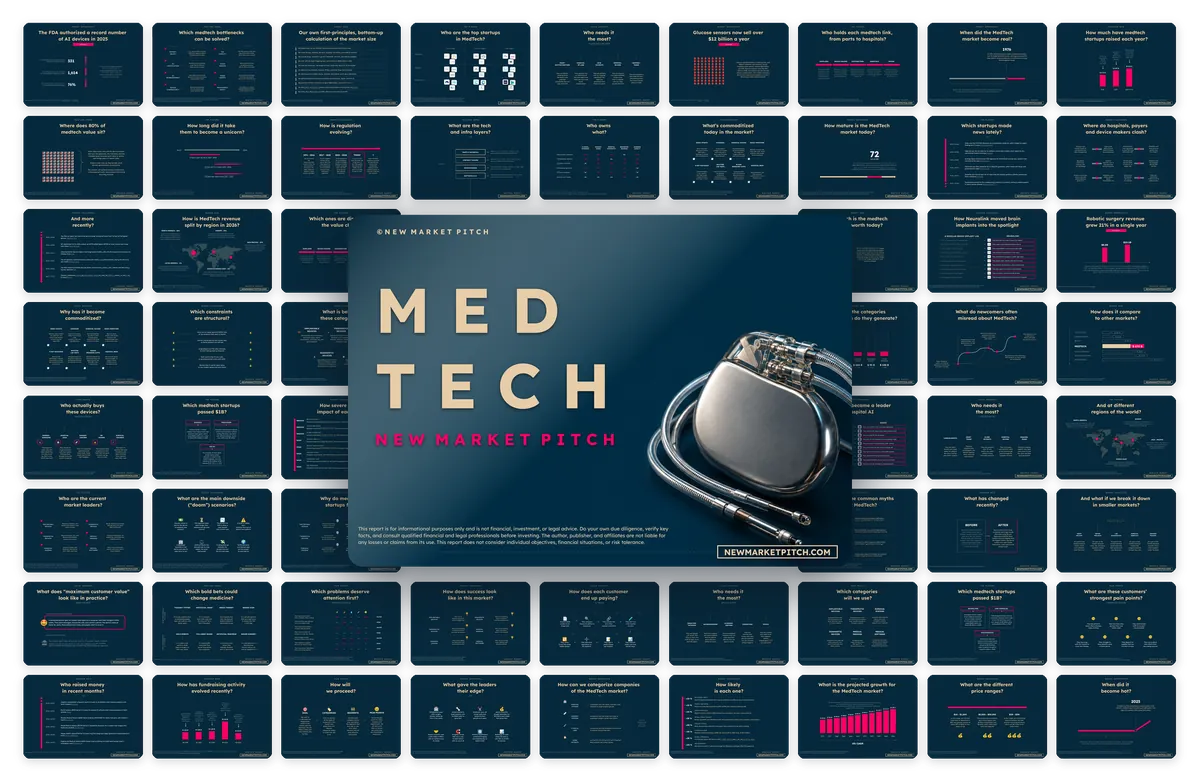
Whether you're building or investing in the medtech market, our report covers everything you need to know: the players, the money, and what's coming next.
Summary
MedTech's biggest unsolved problems are unequal access to diagnostics, the difficulty of proving that new devices genuinely improve patient outcomes, high costs, reimbursement barriers, and the long-term safety and reliability of increasingly complex medical equipment.
The industry's biggest contradiction is that sophisticated medical technologies are advancing while basic healthcare remains unavailable to billions. The WHO estimates that 47% of the world's population has little or no access to reliable diagnostic services, even as wealthy hospitals invest millions in surgical robots and AI systems.
Medical AI illustrates how quickly innovation can outpace clinical evidence. The FDA has authorized more than 1,600 AI-enabled devices, and authorization decisions reached 335 in 2025 alone. But a device that detects abnormalities more accurately or processes images faster has not necessarily demonstrated that patients live longer or experience fewer complications.
Regulatory authorization is also a surprisingly weak predictor of commercial success. The FDA evaluates safety and effectiveness for an intended use, while insurers and hospitals need evidence that a device delivers enough clinical or economic value to justify paying for it. That gap can leave technically successful startups struggling to generate revenue.
The economics of surgical robotics expose another uncomfortable reality. A 2026 systematic review found robot-assisted surgery more expensive in 33 of 36 randomized trials reporting total costs. Only 15 of the 38 trials examined included important acquisition and maintenance expenses, making the full economic burden even harder to assess.
Accuracy problems are not limited to experimental technologies. Pulse oximeters have been shown to overestimate oxygen saturation in some patients with darker skin pigmentation, while medical device trials have historically underrepresented women and certain racial and ethnic populations. Some of the industry's most established technologies still need better validation.
Device safety is becoming more complicated as medical hardware increasingly depends on software and connectivity. Serious recall events remain a concern, and cybersecurity vulnerabilities can potentially compromise patient monitors and other essential equipment. Hospitals must manage these risks for devices that may remain in service for many years.
Earlier disease detection is not automatically better care. A hypothetical screening test with 95% sensitivity and specificity would produce only about 16% genuinely positive results when testing a population with 1% disease prevalence. False positives, unnecessary procedures, and overdiagnosis can erode the benefits of otherwise impressive diagnostic technology.
Wearables and implants show both the promise and limits of continuous medical technology. Glucose sensors and cardiac monitors already provide valuable information outside hospitals, but broader monitoring still faces accuracy and usability problems. Implanted devices add difficult questions about infection, mechanical wear, tissue response, and repeated replacement procedures.
Some of the least glamorous problems may be among the most consequential. Hospitals still face shortages of established devices extending into 2027, while incompatible software and proprietary interfaces make equipment integration expensive. A medical device can work perfectly on its own and still create operational headaches for the healthcare system using it.
Our assessment is that access, clinical evidence, and reimbursement are the hardest problems to solve because they extend beyond device engineering. Better sensors, algorithms, and surgical instruments will help, but MedTech's greatest opportunity lies in getting proven technology into routine care, at an affordable cost, with measurable improvements for patients.

Written by the New Market Pitch teamWe track new markets so founders and investors can move faster. About us

A good product starts with a real problem. In our report covering the medtech market, we show you the ones customers still live with.
Why does MedTech still have so many unsolved problems?
MedTech has made enormous technical progress, but the industry still struggles to turn that progress into better, cheaper, and more widely available healthcare.
The FDA has now authorized more than 1,600 AI-enabled medical devices in the United States, according to its September 2026 update. These include systems for cancer screening, cardiac diagnostics, medical imaging, and automated insulin delivery. Yet the World Health Organization estimates that 47% of the world's population has little or no access to reliable diagnostic services.
Those two figures capture much of the problem. Healthcare is developing increasingly sophisticated tools while billions of people still lack access to basic medical technology.
The gap also exists in wealthy countries. Hospitals can purchase robotic surgical systems costing millions of dollars while struggling to demonstrate that some robotic procedures improve patient outcomes enough to justify the additional expense. AI algorithms can receive regulatory authorization without having established that their use reduces mortality or complications in routine care.
We found three recurring weaknesses behind these problems. Medical technology often advances faster than the evidence supporting its clinical value. Its costs and operational requirements make adoption difficult. And even established devices can remain unreliable, inaccessible, or poorly integrated into healthcare systems.
Is medical AI growing faster than hospitals can use it, and is it actually helping patients?
Medical AI is developing much faster than hospitals can evaluate it, and the evidence of better patient outcomes remains far weaker than the growth in authorized products.
An October 2026 analysis by AI Device Index, based on FDA authorization records, identified 335 AI-enabled device decisions in 2025, compared with 235 in 2024 and 114 in 2020.
Annual authorizations in that dataset have therefore almost tripled in five years. The increase has also been heavily concentrated in a few specialties: approximately 76% of listed devices belonged to radiology, while cardiovascular applications represented around 10%.
There's a practical reason for this concentration. Radiology already produces enormous quantities of digital images, and software can often be added to existing imaging equipment without requiring a completely new medical procedure.
Some applications already have clear clinical uses. Automated retinal screening can help identify patients who need specialist assessment. Algorithms that analyze electrocardiograms can flag cardiac conditions that might otherwise be missed. AI-assisted imaging can improve image quality or reduce the time needed for certain examinations.
But detecting something more accurately or quickly does not guarantee that patients will live longer, avoid complications, or receive better treatment.
The distinction is particularly important for algorithms tested primarily on retrospective datasets. A system may perform extremely well on selected medical images but deliver weaker results when deployed in hospitals with different scanners, patient populations, or disease prevalence.
There is also the problem of additional findings. An AI system that detects more suspicious abnormalities may increase follow-up examinations and biopsies without necessarily identifying more clinically important disease.
Hospitals must now compare competing algorithms, assess their compatibility with existing equipment, train clinicians, and decide whether the benefits justify ongoing costs. That's a lot of work for a product whose real-world benefit may still be uncertain.
The figures below come from AI Device Index's analysis of FDA authorization records. They count authorization decisions rather than distinct technologies currently used in hospitals.
| Year | FDA AI-enabled device decisions | Change from previous year |
|---|---|---|
| 2019 | 80 | - |
| 2020 | 114 | +42.5% |
| 2021 | 129 | +13.2% |
| 2022 | 162 | +25.6% |
| 2023 | 226 | +39.5% |
| 2024 | 235 | +4.0% |
| 2025 | 335 | +42.6% |
| 2026, through June 29 | 181 | Partial year |
If you want more recent data on this point, please see our latest MedTech market report.

If you build or invest in the medtech market, you need to know which business models pay off now and which ones are fading. That's why our report covering it has a whole section on it.
Why do FDA-authorized medical devices still struggle to reach patients?
FDA authorization leaves MedTech companies facing another major obstacle: getting insurers to pay for their products and hospitals to adopt them.
The problem comes from the different evidence required for regulatory authorization and reimbursement.
The FDA evaluates whether a medical device meets the applicable safety and effectiveness requirements for its intended use. Insurers and healthcare systems also need to know whether the device improves care enough to justify paying for it.
A new diagnostic system might be accurate and safe but still struggle commercially if existing tests already identify most of the same patients at a lower cost.
The US Centers for Medicare & Medicaid Services tried to address this gap through its Transitional Coverage for Emerging Technologies pathway, finalized in August 2024.
The program targets selected FDA-designated Breakthrough Devices and aims to make Medicare coverage decisions more predictable. CMS initially expected to accept up to five candidates annually, with a target of completing national coverage determinations within six months of FDA authorization for devices remaining in the pathway.
That is a small number compared with the flow of new medical devices entering the US market.
Manufacturers can spend years developing a device and securing authorization before discovering that the available reimbursement does not support widespread commercial adoption.
For startups, this can be particularly damaging. Clinical trials, manufacturing, regulatory work, and commercialization all consume capital, sometimes long before meaningful revenue arrives.
Why are medical devices still less accurate for some patients?
Medical device accuracy remains uneven across patient populations, and the problem has been documented even in technologies that hospitals have used for decades.
Pulse oximeters are a particularly troubling example.
These devices estimate blood oxygen saturation using light passing through or reflected by tissue. They are routinely used in hospitals, emergency departments, and home monitoring.
Research has shown that some pulse oximeters are more likely to overestimate oxygen saturation in patients with darker skin pigmentation.
This can have serious consequences. A device showing an apparently acceptable oxygen level may delay recognition of a patient whose blood oxygen is dangerously low.
In January 2025, the FDA proposed updated recommendations covering clinical testing, performance evaluation, and labeling to improve pulse oximeter accuracy across skin tones.
Clinical trial representation raises similar concerns.
A systematic review discussed in JAMA in July 2024 examined 195 medical device trials and found that women represented approximately one-third of participants. In cardiovascular device trials, the figure was only 29%.
Research published in JACC in 2026 examined 8,859 participants across 196 US sites involved in coronary stent approval studies. It found that racial and ethnic minority populations were underrepresented, alongside a smaller representation gap for women.
These findings concern different devices, but the underlying weakness is familiar. Testing a technology on a population that does not adequately represent its future users can leave important differences in performance undiscovered.

Learning from others' mistakes is the cheapest lesson there is. In our market report about medical devices, we look at what broke startups before you, so you don't repeat it.
Are medical device recalls and cybersecurity threats getting worse?
Medical device safety remains a serious problem, with increasingly complex equipment introducing cybersecurity risks alongside conventional hardware and manufacturing failures.
An analysis published by Device Safety Index in October 2026 identified 2,834 FDA recall records posted during 2025, compared with approximately 3,520 in 2024.
That is a decline of roughly 19%. However, the number of records does not necessarily equal the number of distinct recall events, because one event can involve multiple models and database entries.
The severity of recalls tells a different story. At the April 2026 MedCon conference, an FDA official highlighted an increase in new Class I recall events during 2025. These represent the most serious category, where continued use could reasonably cause serious injury or death.
Insulin delivery systems show how dangerous failures can become.
In September 2025, the FDA reported a correction involving certain Tandem Diabetes Care t:slim X2 insulin pumps. A wiring problem could interrupt insulin delivery. The notice identified 59 reported injuries and no reported deaths at that time.
In May 2026, Insulet announced a correction affecting specific lots of its Omnipod insulin delivery systems because a manufacturing problem could result in insufficient insulin delivery.
Cybersecurity creates an additional vulnerability.
In January 2025, the FDA issued a safety communication about Contec CMS8000 and rebranded Epsimed patient monitors. The agency identified vulnerabilities that could potentially allow unauthorized remote control, improper operation, and the transfer of patient information outside the healthcare environment.
At the time, the FDA said it was unaware of related cybersecurity incidents, injuries, or deaths. Nevertheless, a compromised patient monitor could affect information clinicians rely on when treating critically ill patients.
The regulatory response has become stricter. In February 2026, the FDA issued updated final guidance addressing cybersecurity across medical device quality management and premarket submissions.
Medical equipment often remains operational for many years, making cybersecurity particularly difficult. Hospitals cannot replace every infusion pump, diagnostic scanner, or monitoring system whenever a vulnerability is discovered. Software updates may require validation, compatibility testing, and coordination across multiple hospital systems.
Manufacturers must therefore manage mechanical reliability, software behavior, component quality, manufacturing consistency, and cybersecurity throughout a device's operational life. And one weak component can undermine years of otherwise successful engineering.
Are surgical robots really worth their enormous cost?
Surgical robots are still difficult to justify economically across many procedures, even though they offer clear technical advantages in selected operations.
A systematic review published in BJS Open in 2026 examined 38 randomized clinical trials involving 5,832 patients.
Among the 36 trials reporting total costs, 33 found robot-assisted surgery more expensive than the comparison procedure.
That is 92% of the trials with available cost data.
The review also exposed serious gaps in how hospitals and researchers measure those expenses. Only 15 of the 38 trials included important structural costs such as robot acquisition and maintenance.
So a majority of the studies did not fully account for some of the costs that make robotic surgery expensive.
Companies such as Intuitive Surgical have demonstrated the technical appeal of robotic systems. Their instruments can improve dexterity, provide three-dimensional visualization, and help surgeons operate in confined anatomical spaces.
But the value varies considerably between procedures.
A robot might offer meaningful advantages in a complex operation requiring precise instrument control. The same system could provide only modest benefits in a procedure already performed efficiently using conventional minimally invasive techniques.
Hospital utilization also changes the calculation. A system performing many procedures can spread its purchase and maintenance costs across more patients.
The review found that only three trials used quality-adjusted life years in cost-effectiveness analyses, leaving limited randomized evidence for comparing additional spending against long-term health benefits.
The technology is impressive. The economic case still needs to be made procedure by procedure.

When you build or invest in the medtech market, you need clarity, not confusion. In our document detailing everything you need to know about medtech, we always try to put numbers on and quantify whatever is usually vague and confusing.
Why can't half the world access basic medical diagnostics?
Access to medical diagnostics remains one of MedTech's largest unsolved problems, affecting billions of people despite the existence of effective testing and imaging technologies.
The World Health Organization's Global Diagnostics Coalition estimates that 47% of the global population has little or no access to safe, affordable, quality-assured diagnostic services.
The scale becomes even clearer when we examine basic healthcare facilities.
Across 14 low- and middle-income countries studied, as many as 81% of basic primary healthcare services lacked access to essential diagnostic tests when HIV and malaria testing were excluded.
These gaps affect conditions that healthcare systems already know how to diagnose and treat.
Diabetes, hypertension, tuberculosis, and common infections can cause avoidable complications when patients cannot obtain timely testing.
The Lancet Commission on Diagnostics estimated in 2021 that closing diagnostic gaps for six priority conditions could prevent approximately 1.1 million premature deaths annually in low- and middle-income countries.
Those conditions included diabetes, hypertension, HIV, tuberculosis, and two infections affecting pregnant women.
Portable ultrasound systems, laboratory analyzers, molecular diagnostic tools, and point-of-care tests can provide valuable information without requiring the infrastructure of a major hospital.
But deployment is difficult when clinics lack reliable electricity, trained personnel, maintenance services, quality controls, or consistent access to consumables.
For many patients, the missing innovation is simply a diagnostic test that is available when they need it.
If you want more recent data on this point, please see our latest MedTech market report.
Why is detecting cancer and other diseases early still so difficult?
Early disease detection remains difficult because identifying an abnormality earlier does not always mean identifying a disease that needs treatment.
The issue affects cancer screening, cardiovascular diagnostics, neurological assessment, and emerging blood-based tests.
A screening technology must work particularly well when the disease is uncommon in the population being tested.
Even a test with impressive accuracy can generate large numbers of false positives.
Consider a hypothetical screening tool with 95% sensitivity and 95% specificity, used on 10,000 people when only 1% have the disease.
Out of 100 people who actually have the disease, approximately 95 would test positive.
But among the 9,900 people without the disease, around 495 would also receive positive results.
That gives us approximately 590 positive tests, of which only 95 would be correct. Around 16% of positive results would therefore represent genuine disease.
This is a mathematical illustration, rather than a performance estimate for any specific product.
Cancer screening also introduces overdiagnosis: detecting abnormalities that would never have caused symptoms or threatened the patient's life.
In such cases, earlier detection can lead to biopsies, treatment, anxiety, and additional expenses without producing a corresponding health benefit.

In our report covering the medtech market, we look at what the winners do differently, so you can learn from the best instead of guessing.
Can medical wearables really replace hospital monitoring?
Medical wearables can already replace some routine measurements and enable valuable monitoring at home, but they remain far from replacing comprehensive hospital assessment.
Continuous glucose monitoring is among the strongest examples of what the technology can accomplish.
Dexcom and Abbott have developed sensors that provide glucose readings throughout the day, allowing patients and clinicians to identify patterns that intermittent measurements might miss.
These systems have also enabled automated insulin delivery, where glucose information helps determine treatment.
Cardiac monitoring has followed a similar but more specialized path.
iRhythm develops wearable systems for recording and analyzing cardiac rhythm data over extended periods. AliveCor offers ECG technology designed to help identify selected rhythm abnormalities outside conventional hospital settings.
The common advantage is that these devices collect information while patients live their ordinary lives.
However, not every physiological measurement can be captured with the same reliability.
Glucose monitoring measures a defined biological variable. ECG devices record electrical signals. Wearables estimating blood pressure, sleep stages, or broader health conditions may rely on indirect measurements that need their own clinical validation.
A device producing frequent alerts can generate unnecessary clinical work if those alerts have poor predictive value. Patients may stop wearing sensors, use them incorrectly, or struggle to interpret the information.
Why do medical implants still fail after years of use?
Long-term implant reliability remains a major MedTech challenge because devices must continue working inside the human body despite constant movement, tissue reactions, and biological changes.
The problem affects orthopedic implants, pacemakers, neurostimulation systems, vascular devices, and emerging brain-computer interfaces.
The failure mechanisms vary widely.
Artificial joints must withstand repeated mechanical loads over many years. Cardiac implants depend on reliable electrical and mechanical performance. Neural interfaces must preserve useful signals while interacting with delicate biological tissue.
Infection creates another serious risk.
An external medical device can often be repaired or replaced relatively easily. An infected implant may require surgery, prolonged treatment, or complete removal.
Device lifetime becomes especially important for younger patients who may need treatment for decades.
An implant that lasts several years can still create a substantial lifetime burden if it requires repeated replacement procedures.
Brain-computer interfaces illustrate the technical challenge particularly well.
Researchers are improving electrode designs, wireless communication, miniaturization, and surgical methods. But maintaining stable signals over long periods remains difficult because electrodes and surrounding tissue can change after implantation.

In our research about medical devices, we always try to gather several sources and make estimates that make sense, so you can work with solid numbers.
Why are hospitals still running short of essential medical devices?
Hospitals continue facing shortages of established medical devices because specialized components, limited suppliers, and manufacturing interruptions can disrupt essential equipment.
The FDA's medical device shortage list includes products used in cardiovascular surgery, breast biopsies, neurosurgery, and implantable gastrointestinal treatment.
Several shortages are expected to continue into 2027.
The problem is particularly striking because these are existing medical technologies rather than experimental products waiting to enter the market.
The FDA identified shortages of oxygenators used in extracorporeal circulation, with estimated durations extending into the first quarter of 2027.
It also listed shortages of stereotactic breast biopsy needles and endoscopic vessel harvesting devices.
Some oxygenator shortages were first recorded in September 2023, meaning the supply problems have persisted for more than three years.
Medical device supply chains often involve specialized parts that cannot be substituted freely. Changing a component may require engineering work, testing, supplier qualification, and regulatory assessment.
The FDA notes that inclusion on its shortage list does not necessarily mean patient care has already been affected. However, shortages can force hospitals to conserve supplies, find alternative products, or adjust procedures.
The information below reflects the FDA's published medical device shortage list as reviewed for this article. Estimated durations may change as manufacturers restore supply or discontinue products.
| Medical device | FDA-listed shortage | Estimated duration |
|---|---|---|
| Neurosurgical patties, sponges and strips | Component or accessory shortage | Through Q4 2026 |
| Stereotactic breast biopsy needles | Component or accessory shortage | Through Q1 2027 |
| Endoscopic vessel harvesting devices | Component or accessory shortage | Through Q1 2027 |
| Long-term extracorporeal oxygenators | Component or accessory shortage | Through Q1 2027 |
| Cardiopulmonary bypass oxygenators | Component or accessory shortage | Through Q1 2027 |
| Implantable gastric electrical stimulation systems | Component or accessory shortage | Through Q4 2027 |
Why can't medical devices from different companies work together easily?
Medical device interoperability remains a major hospital problem because equipment from different manufacturers often exchanges information poorly or requires expensive integration work.
Hospitals routinely combine imaging systems, patient monitors, infusion pumps, laboratory equipment, electronic health records, and specialist clinical software.
Each product may work well independently while creating additional work when clinicians need information from several systems.
For example, a bedside monitor can continuously measure a patient's physiological condition without automatically delivering all the relevant information into the hospital's electronic health record in a useful format.
Similarly, a radiology AI algorithm may analyze medical images accurately but still require integration with imaging archives, reporting software, and clinical workflows.
Standards such as DICOM and HL7 FHIR are helping manufacturers exchange imaging and health information more consistently.
Yet compatibility problems persist because different vendors implement standards differently, use proprietary interfaces, or support different types of data.
Hospitals must also verify that connected systems exchange information securely, that updates do not disrupt existing equipment, and that clinicians receive the information they actually need.
Integration involves software, testing, implementation services, training, and ongoing technical support.
If you want more recent data on this point, please see our latest MedTech market report.

In our market report about medical devices, we turn what is vague and complex into simple, useful visuals. Market maps like this one show you at a glance where every startup stands.
Is medical technology actually making healthcare cheaper, or just adding more costs?
Medical technology can reduce costs in specific areas, but the evidence does not support a broad claim that adding more devices automatically makes healthcare less expensive.
Continuous glucose monitoring can reduce reliance on repeated manual testing and help improve diabetes management. Automated diagnostic software can accelerate selected tasks. Some minimally invasive procedures can shorten recovery and reduce complications.
Those benefits are real, but their economic value depends on what happens across the entire treatment process.
A device might save clinicians time while increasing spending on software subscriptions and maintenance.
Another might reduce complications and benefit insurers through fewer hospital admissions, while leaving hospitals responsible for higher equipment costs.
A cheaper diagnostic test may lead to more testing. Better disease detection may increase treatment volumes. Continuous monitoring may generate additional consultations and investigations.
These outcomes are not necessarily undesirable, especially when patients receive clinically useful care. But they make cost savings harder to predict.
The WHO's patient safety research estimates that roughly one in ten patients experiences harm while receiving healthcare and that more than half of this harm may be preventable.
Regulation adds another cost that manufacturers cannot ignore. On February 2, 2026, the FDA's Quality Management System Regulation became effective, incorporating ISO 13485:2016 into US medical device quality-system requirements.
For startups, meeting quality requirements, documenting design decisions, managing suppliers, and collecting clinical evidence can consume substantial capital before a product generates revenue.
These requirements protect patients, but the financial burden becomes especially difficult when companies must also fund reimbursement studies and hospital integration.
Which MedTech problems are hardest to solve, and who can actually fix them?
The hardest MedTech problems are likely to be unequal access to care, reimbursement uncertainty, and the difficulty of proving that new technology improves outcomes enough to justify its cost.
Technical problems can be extremely demanding, especially in implantable electronics, biological sensing, and long-term device reliability. But at least the engineering objective is often relatively clear.
A sensor should produce more accurate measurements. An implant should last longer. A medical device should fail less frequently.
Healthcare access and payment work differently.
A manufacturer might develop an affordable portable ultrasound system, but patients still need trained operators, reliable healthcare facilities, maintenance, and a pathway to treatment.
Similarly, a startup may produce a clinically effective diagnostic tool without being able to convince insurers to pay for its use.
Hospital procurement creates another difficulty. The healthcare organization purchasing a device may not be the organization receiving the largest financial benefit from its use.
These problems help explain why medical innovation and healthcare productivity often move at different speeds.
Solving them requires changes involving manufacturers, clinicians, regulators, insurers, and healthcare providers. No single company can fix all of that through better engineering alone.

Our document detailing everything you need to know about medtech gets updated several times a month, so you always get the latest view of where things stand.
What are the biggest unsolved problems in MedTech today?
The biggest unsolved MedTech problems today are unequal access to diagnostics, the lack of convincing clinical and economic evidence for many innovations, reimbursement barriers, high device costs, and the long-term safety of increasingly complex equipment.
Their importance depends on which part of healthcare we examine.
For global patient impact, diagnostic access stands out. The WHO's estimate that 47% of the world's population lacks reliable diagnostic services describes a problem affecting billions of people. Addressing even part of that gap could improve healthcare on an enormous scale.
For MedTech startups and manufacturers, reimbursement and clinical evidence are among the strongest commercial constraints. A product can be technologically impressive and authorized for sale while still struggling to prove that hospitals should purchase it.
For patients already receiving treatment through advanced devices, reliability, accuracy, and cybersecurity carry immediate consequences.
Our ranking below combines the scale of the affected population, the seriousness of potential harm, the strength of the available evidence, and the difficulty of solving each problem. It is a qualitative assessment rather than a statistical ranking based on one common dataset.
| Unsolved MedTech problem | Main evidence | Our assessment |
|---|---|---|
| Unequal access to diagnostics | 47% of people lack reliable diagnostic access, according to WHO | Largest global access problem |
| Proving better clinical outcomes | Over 1,600 FDA-authorized AI devices, but fragmented evidence of real-world clinical benefit | Major evidence gap |
| High device and procedure costs | Robotic surgery cost more in 33 of 36 randomized trials reporting total costs | Major economic barrier |
| Reimbursement uncertainty | FDA authorization and insurance coverage require different evidence | Major commercial barrier |
| Device safety and reliability | Serious recalls continue across established treatment devices | Persistent patient safety risk |
| Unequal performance across populations | Women represented roughly one-third of participants in a 195-trial review | Major validation problem |
| Cybersecurity | FDA identified potentially dangerous patient-monitor vulnerabilities in 2025 | Growing connected-device risk |
| Medical device shortages | Several FDA-listed shortages are expected to extend into 2027 | Persistent supply-chain problem |
| Hospital interoperability | Different vendors, software systems, and workflows complicate integration | Major productivity constraint |
| Long-term implant performance | Wear, infection, tissue response, and replacement remain difficult | Major engineering challenge |
| Early disease detection | More sensitive tests can create false positives and overdiagnosis | Major diagnostic challenge |
Our conclusion is that MedTech's greatest opportunity now lies in delivering stronger clinical results at a cost healthcare systems can actually afford.
That may involve advanced medical AI, better surgical robotics, more reliable implants, or entirely new diagnostic technologies. But some of the most meaningful improvements could come from cheaper testing, better integration, dependable manufacturing, and wider access to devices that already exist.
If you want more recent data on this point, please see our latest MedTech market report.
Our methodology
Determining which MedTech problems remain the hardest to solve requires looking beyond individual breakthroughs, product failures, or the technologies attracting the most attention. We divided the question into distinct areas: clinical effectiveness, diagnostic access, device accuracy and safety, reimbursement, economic value, long-term reliability, supply chains, and hospital integration. This allowed us to evaluate problems with very different causes and consequences without treating them as directly interchangeable.
For each area, we examined recent regulatory records, clinical studies, systematic reviews, public-health research, and documented industry developments. We compared findings across sources, distinguished technical performance from demonstrated patient benefit, and looked at both the magnitude of each problem and the evidence that it persists. Particular weight went to findings supported by clinical research, official records, and observations across multiple devices or healthcare settings, rather than isolated incidents or manufacturer claims.
We then assessed the problems across four considerations: the number of people potentially affected, the seriousness of the clinical or economic consequences, the strength of the available evidence, and the difficulty of achieving a durable solution. The resulting ranking is an editorial assessment informed by this structured comparison, rather than a numerical score. It also recognizes that some obstacles can be addressed through better engineering, while others depend on changes in healthcare financing, clinical practice, infrastructure, or regulation.
Key regulatory and public-health sources include the FDA's AI-enabled medical device overview, the FDA's AI-enabled medical device database, CMS's Transitional Coverage for Emerging Technologies framework, the FDA's pulse oximeter testing guidance, the FDA's medical device shortages list, the WHO's Global Diagnostics Coalition, the WHO's October 2026 diagnostic-access assessment, and the WHO's patient safety research.
Clinical and technical evidence includes the systematic review of women's representation in medical device trials, the JACC study of representation in coronary stent trials, the BJS Open systematic review of robotic surgery costs, and The Lancet Commission on Diagnostics. Device safety and regulatory developments were examined using the FDA recall database, the Tandem insulin pump correction, the Insulet Omnipod correction, the FDA's Contec and Epsimed cybersecurity communication, the FDA's medical device cybersecurity guidance, and the Quality Management System Regulation.

Theory only gets you so far. In our report covering the medtech market, we dig up the real signals from the field and show you the ones worth watching.
Written by the New Market Pitch teamWe track new markets so founders and investors can move faster. About us